


 Скачать презентацию Internationalisation learning and adapting Edufair 2012 Conference David
5a1b5d7bcb0478687b5762d1faa5ae99.ppt
- Количество слайдов: 18
 Internationalisation: learning and adapting Edufair 2012 Conference David Bowker, Anne Lawrie, Edward Moran CELT School of Education
 Overview • Setting the scene • Cross-Culture: Experiences and expectations • Learning and Adapting • The dissertation: what do we say?
 Cross-Culture: Experience and Expectations • Group work – Cross-cultural mix • European, home, international – Previous cross-cultural experience • None • Previous study – Positive /negative • Travel
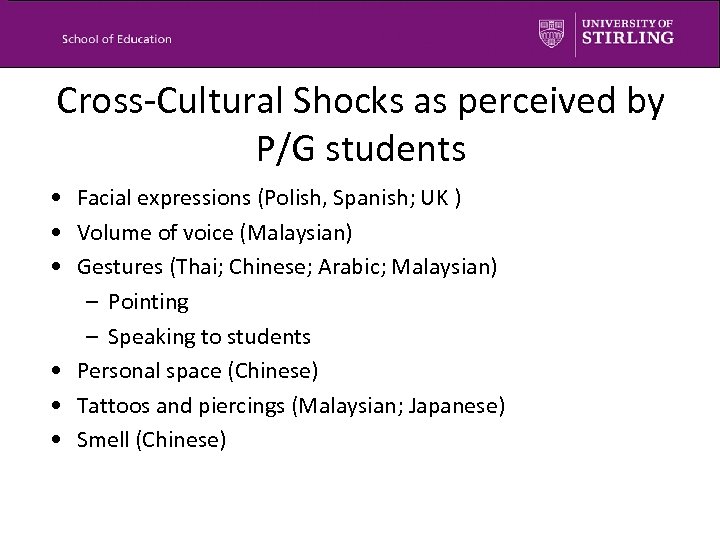 Cross-Cultural Shocks as perceived by P/G students • Facial expressions (Polish, Spanish; UK ) • Volume of voice (Malaysian) • Gestures (Thai; Chinese; Arabic; Malaysian) – Pointing – Speaking to students • Personal space (Chinese) • Tattoos and piercings (Malaysian; Japanese) • Smell (Chinese)
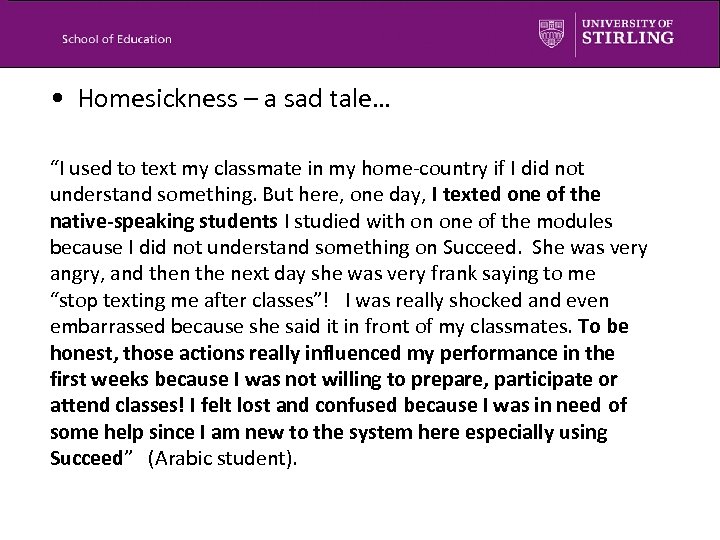 • Homesickness – a sad tale… “I used to text my classmate in my home-country if I did not understand something. But here, one day, I texted one of the native-speaking students I studied with on one of the modules because I did not understand something on Succeed. She was very angry, and then the next day she was very frank saying to me “stop texting me after classes”! I was really shocked and even embarrassed because she said it in front of my classmates. To be honest, those actions really influenced my performance in the first weeks because I was not willing to prepare, participate or attend classes! I felt lost and confused because I was in need of some help since I am new to the system here especially using Succeed” (Arabic student).
 How do we learn and adapt ?
 Learning and adapting How to: • Maintain or increase quality/quantity of delivery • Maintain or increase learner engagement with input • Integrate students from a wide range of cultural backgrounds
 Delivery • Previous format: Three-hour workshops • Replaced by – 30 – 50 minutes video tutorials using Camtasia Studio • Posted in Succeed with the Powerpoint file and seminar notes. • Semester 1: Videos posted in a blog with discussion questions and ss given collaborative writing tasks in wikis as preparation for assessment. – 90 minute seminars • Increased quality of input resulted from: – Extra care necessary in giving clear explanations – No red herrings – Giving very clear indications where input was related to other modules increased course coherence – Opportunity to update and reflect on content
 Student Engagement Increased engagement resulted from: – Opportunity to replay video: • Increased comprehension of language for non-native speakers • Increased comprehension/recall of ideas for all students • Consequent increase in confidence particularly for NNS – Participation in seminar enhanced by: • Better comprehension of input • Opportunity to go through seminar notes beforehand • Ability to bring in ideas from other modules – Access: Students with disabilities, students living at a distance, students with families found it much easier to get the input and prepare.
 Evaluation • Questionnaire findings were very positive overall but: – Some NNSs still report difficulty with seminar participation – Native speakers and Europeans still frustrated when grouped with E. Asians • Staff-student committee – Strong perceptions of course coherence – High level of satisfaction with delivery mode, but they also like variety of delivery mode • Succeed statistics: High level of use (e. g. Lecture 3 viewed 277 times, mean = 4. 4 per student) • Anecdotal – Some frustration with online collaboration – Higher levels of NNS confidence to discuss new ideas/ask questions – Less frustration with understanding of input than in previous years
 Problems • Students – Low level of participation in online collaboration • Poor timing of introduction – start of semester 1 • Need for student training in how to use blogs and wikis • Wiki function and interface – Occasional access problems – Developing strategies – Might not watch the tutorial if it’s not directly related to assessment (e. g. Lecture 8 on writing questionnaires – viewed 48 times, but full attendance at seminar) • Teaching – Developing necessary skills – Preparation and coordination
 Communication in Masters supervision meetings • Conversation Analysis of audio-recorded meetings between 3 supervisors and 7 international students from non-English speaking backgrounds • Business-related topics • Different stages of dissertation planning and execution • Group and individual supervision meetings
 Admitting non-understanding ‘Could you rephrase that, I don't understand. ’ ‘Hybrid? What's that? ’ But students are rarely so explicit.
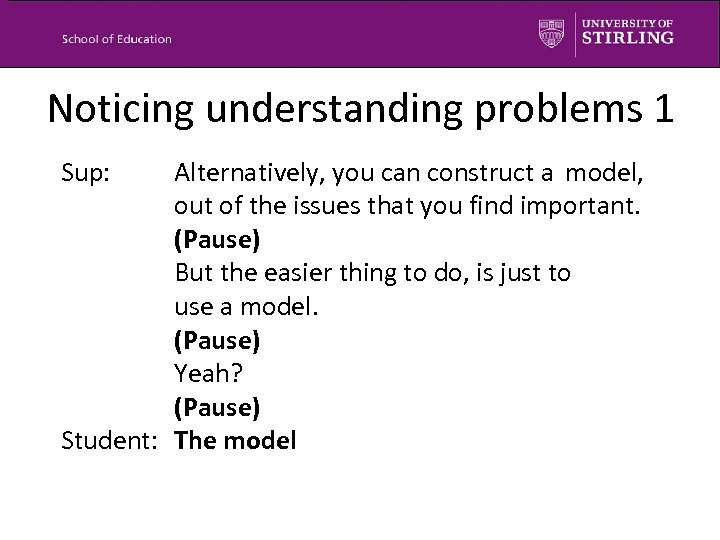 Noticing understanding problems 1 Sup: Alternatively, you can construct a model, out of the issues that you find important. (Pause) But the easier thing to do, is just to use a model. (Pause) Yeah? (Pause) Student: The model
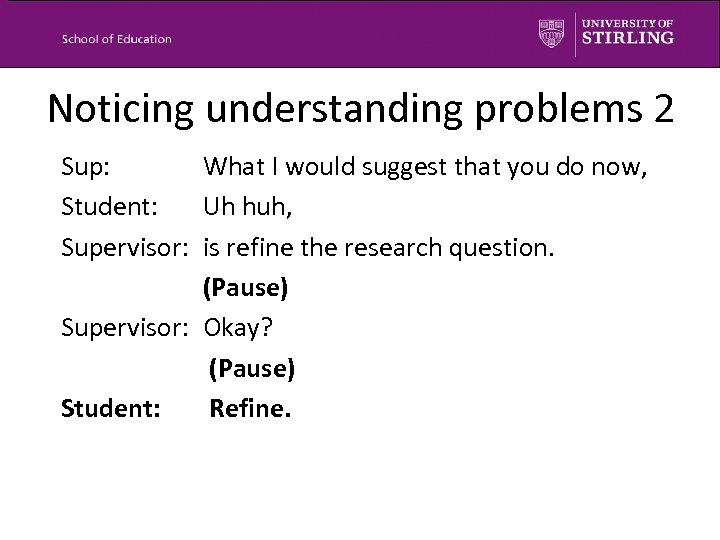 Noticing understanding problems 2 Sup: What I would suggest that you do now, Student: Uh huh, Supervisor: is refine the research question. (Pause) Supervisor: Okay? (Pause) Student: Refine.
![Noticing understanding problems 3 Sup: Student: it must be tighter. (Pause) [Tighter. ] [Yeah?](https://present5.com/presentation/5a1b5d7bcb0478687b5762d1faa5ae99/image-16.jpg "Noticing understanding problems 3 Sup: Student: it must be tighter. (Pause) [Tighter. ] [Yeah?") Noticing understanding problems 3 Sup: Student: it must be tighter. (Pause) [Tighter. ] [Yeah? ] You understand? Yeah. So. . . You mean, I must be more narrow?
Noticing understanding problems 3 Sup: Student: it must be tighter. (Pause) [Tighter. ] [Yeah? ] You understand? Yeah. So. . . You mean, I must be more narrow?
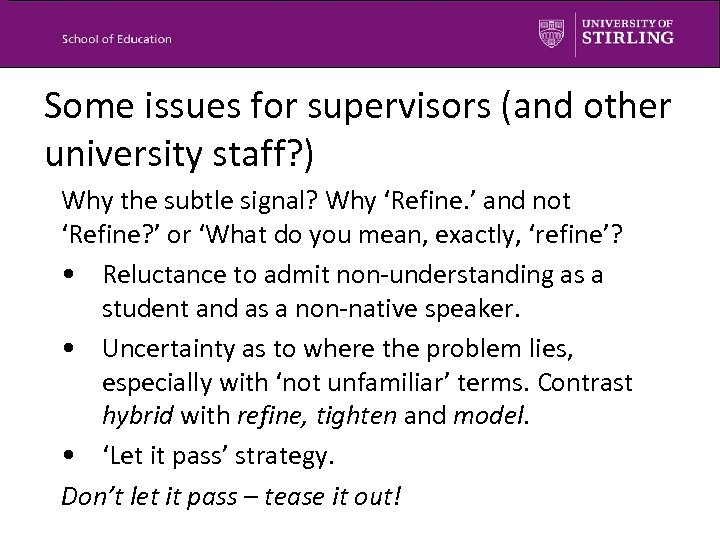 Some issues for supervisors (and other university staff? ) Why the subtle signal? Why ‘Refine. ’ and not ‘Refine? ’ or ‘What do you mean, exactly, ‘refine’? • Reluctance to admit non-understanding as a student and as a non-native speaker. • Uncertainty as to where the problem lies, especially with ‘not unfamiliar’ terms. Contrast hybrid with refine, tighten and model. • ‘Let it pass’ strategy. Don’t let it pass – tease it out!
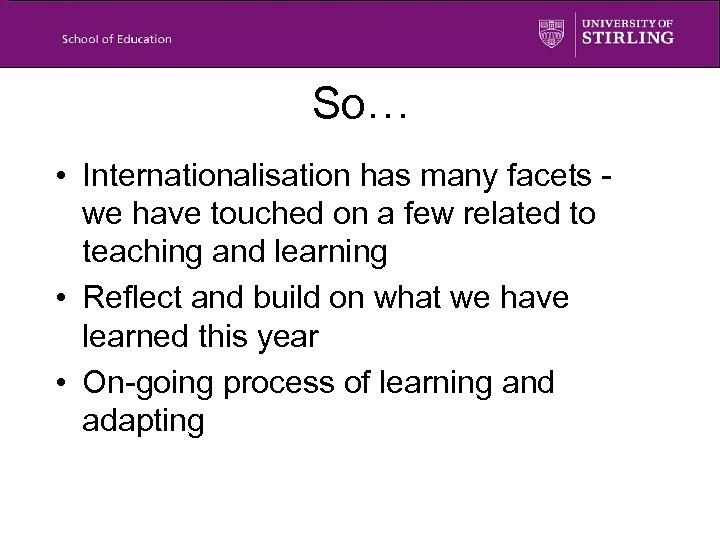 So… • Internationalisation has many facets we have touched on a few related to teaching and learning • Reflect and build on what we have learned this year • On-going process of learning and adapting