


 Скачать презентацию INTERNATIONAL TRUST FUND FOR DEMINING AND MINE VICTIMS
aa07a7b63c21138b2d795e7662a23ad8.ppt
- Количество слайдов: 26
 INTERNATIONAL TRUST FUND FOR DEMINING AND MINE VICTIMS ASSISTANCE
 Technology exchange as a measure of integration and confidence building in Humanitarian Mine Action in the Mediterranean region Dorijan Maršič ITF Director
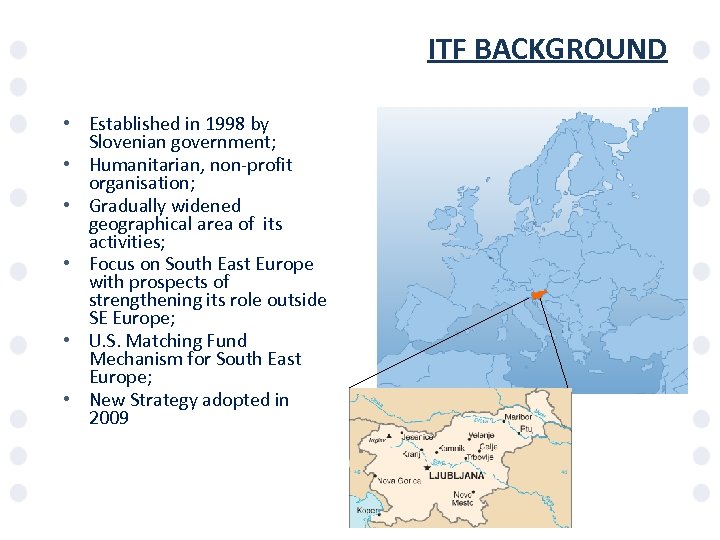 ITF BACKGROUND • Established in 1998 by Slovenian government; • Humanitarian, non-profit organisation; • Gradually widened geographical area of its activities; • Focus on South East Europe with prospects of strengthening its role outside SE Europe; • U. S. Matching Fund Mechanism for South East Europe; • New Strategy adopted in 2009
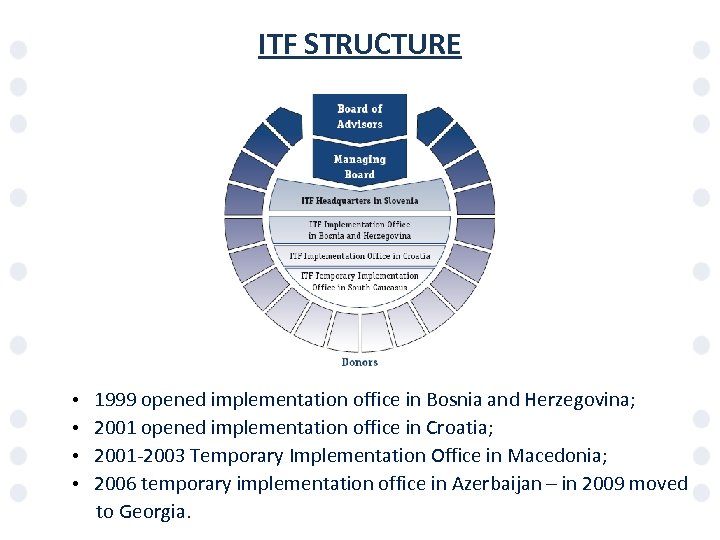 ITF STRUCTURE • 1999 opened implementation office in Bosnia and Herzegovina; • 2001 opened implementation office in Croatia; • 2001 -2003 Temporary Implementation Office in Macedonia; • 2006 temporary implementation office in Azerbaijan – in 2009 moved to Georgia.
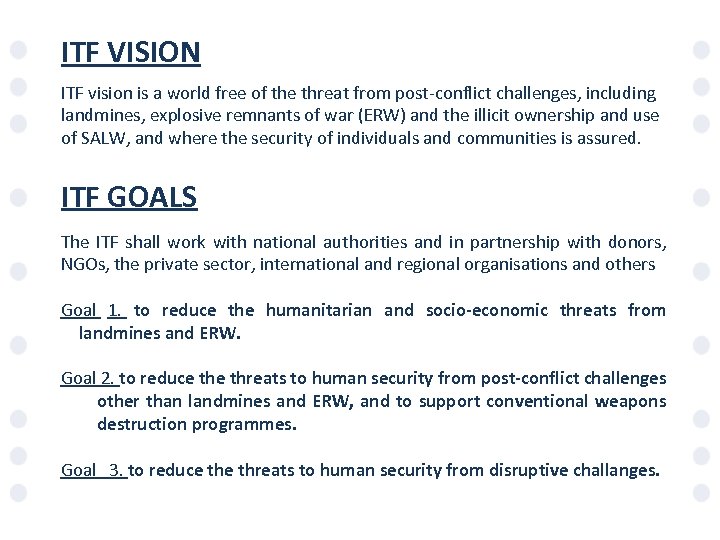 ITF VISION ITF vision is a world free of the threat from post-conflict challenges, including landmines, explosive remnants of war (ERW) and the illicit ownership and use of SALW, and where the security of individuals and communities is assured. ITF GOALS The ITF shall work with national authorities and in partnership with donors, NGOs, the private sector, international and regional organisations and others Goal 1. to reduce the humanitarian and socio-economic threats from landmines and ERW. Goal 2. to reduce threats to human security from post-conflict challenges other than landmines and ERW, and to support conventional weapons destruction programmes. Goal 3. to reduce threats to human security from disruptive challanges.
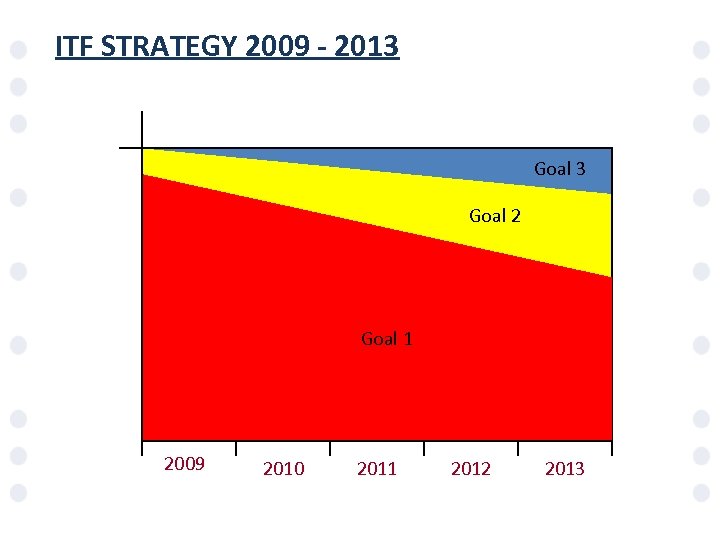 ITF STRATEGY 2009 - 2013 Goal 2 Goal 1 2009 2010 2011 2012 2013
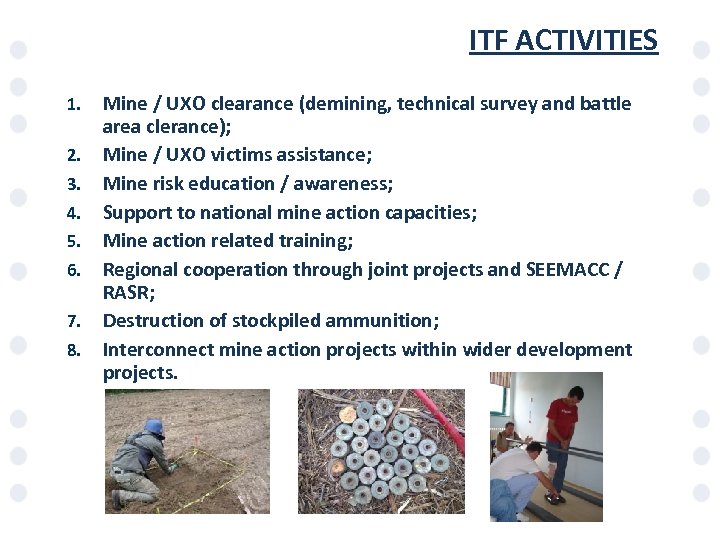 ITF ACTIVITIES 1. 2. 3. 4. 5. 6. 7. 8. Mine / UXO clearance (demining, technical survey and battle area clerance); Mine / UXO victims assistance; Mine risk education / awareness; Support to national mine action capacities; Mine action related training; Regional cooperation through joint projects and SEEMACC / RASR; Destruction of stockpiled ammunition; Interconnect mine action projects within wider development projects.
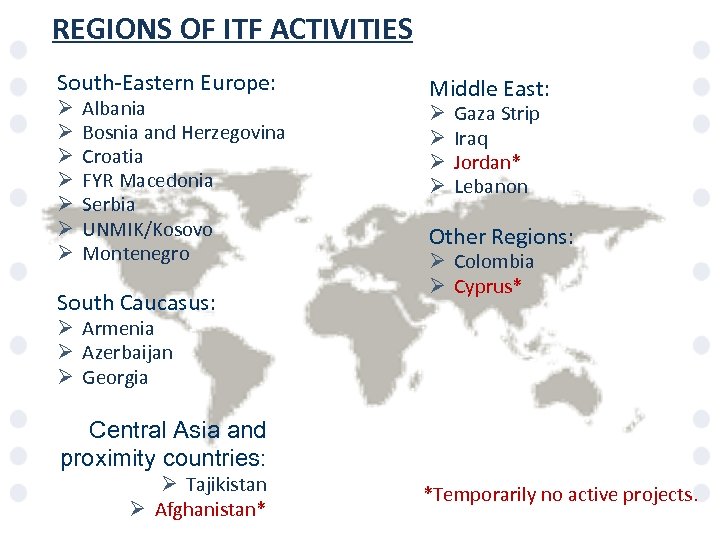 REGIONS OF ITF ACTIVITIES South-Eastern Europe: Ø Ø Ø Ø Albania Bosnia and Herzegovina Croatia FYR Macedonia Serbia UNMIK/Kosovo Montenegro South Caucasus: Middle East: Ø Ø Gaza Strip Iraq Jordan* Lebanon Other Regions: Ø Colombia Ø Cyprus* Ø Armenia Ø Azerbaijan Ø Georgia Central Asia and proximity countries: Ø Tajikistan Ø Afghanistan* *Temporarily no active projects.
 ITF DONOR COMMUNITY PUBLIC DONORS . . . PRIVATE DONORS. . .
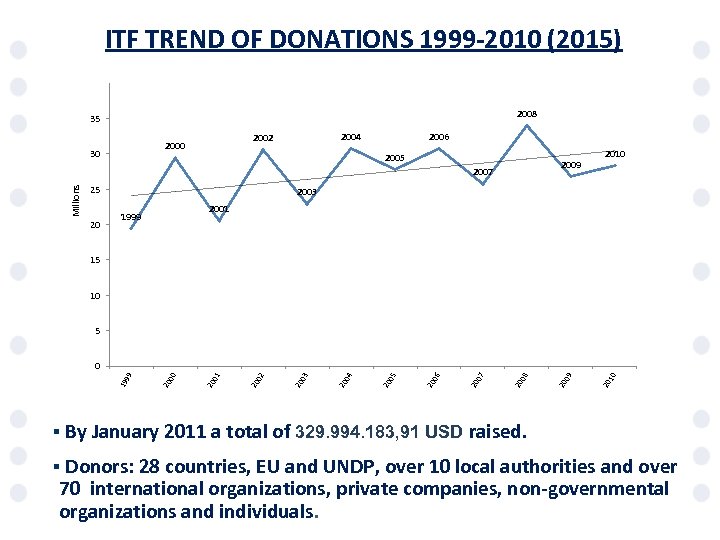 ITF TREND OF DONATIONS 1999 -2010 (2015) 2008 35 30 2004 2002 2000 2006 2005 2009 Millions 2007 25 20 2010 2003 2001 1999 15 10 5 10 20 09 20 08 20 07 20 06 20 05 20 04 20 03 20 02 20 01 20 00 20 19 99 0 § By January 2011 a total of 329. 994. 183, 91 USD raised. § Donors: 28 countries, EU and UNDP, over 10 local authorities and over 70 international organizations, private companies, non-governmental organizations and individuals.
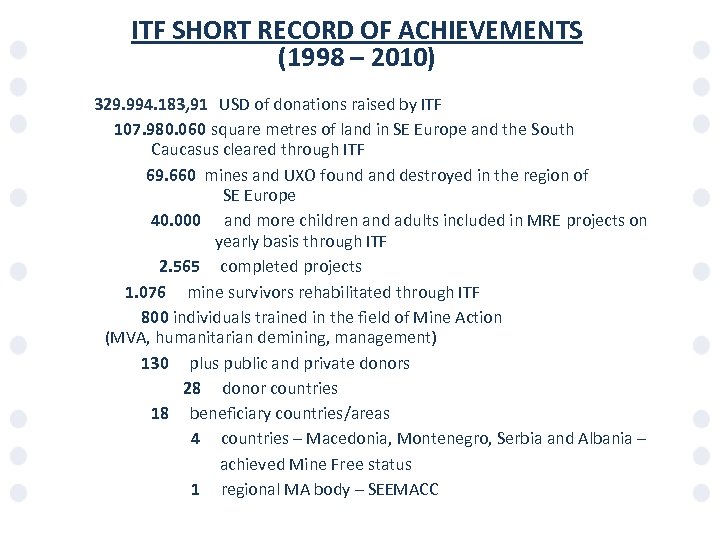 ITF SHORT RECORD OF ACHIEVEMENTS (1998 – 2010) 329. 994. 183, 91 USD of donations raised by ITF 107. 980. 060 square metres of land in SE Europe and the South Caucasus cleared through ITF 69. 660 mines and UXO found and destroyed in the region of SE Europe 40. 000 and more children and adults included in MRE projects on yearly basis through ITF 2. 565 completed projects 1. 076 mine survivors rehabilitated through ITF 800 individuals trained in the field of Mine Action (MVA, humanitarian demining, management) 130 plus public and private donors 28 donor countries 18 beneficiary countries/areas 4 countries – Macedonia, Montenegro, Serbia and Albania – achieved Mine Free status 1 regional MA body – SEEMACC
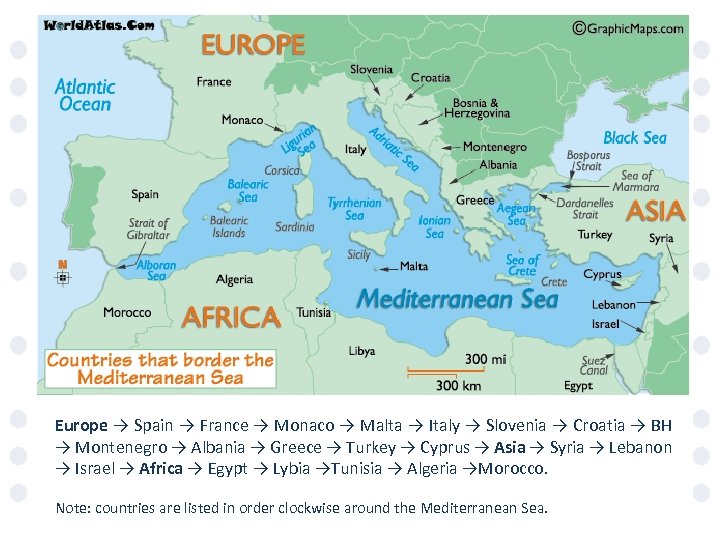 Europe → Spain → France → Monaco → Malta → Italy → Slovenia → Croatia → BH → Montenegro → Albania → Greece → Turkey → Cyprus → Asia → Syria → Lebanon → Israel → Africa → Egypt → Lybia →Tunisia → Algeria →Morocco. Note: countries are listed in order clockwise around the Mediterranean Sea.
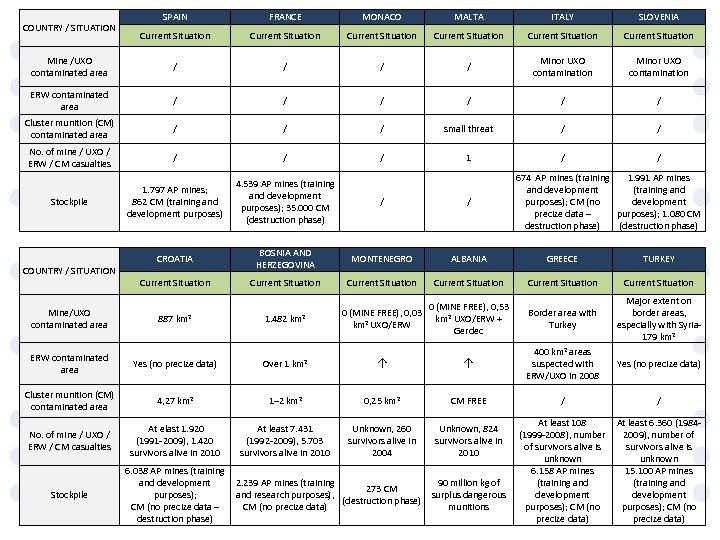 SPAIN FRANCE MONACO MALTA ITALY SLOVENIA Current Situation Current Situation Mine /UXO contaminated area / / Minor UXO contamination ERW contaminated area / / / Cluster munition (CM) contaminated area / / / small threat / / No. of mine / UXO / ERW / CM casualties / / / 1 / / Stockpile 1. 797 AP mines; 862 CM (training and development purposes) 4. 539 AP mines (training and development purposes); 35. 000 CM (destruction phase) / / CROATIA BOSNIA AND HERZEGOVINA MONTENEGRO ALBANIA GREECE TURKEY Current Situation Current Situation 887 km 2 1. 482 km 2 0 (MINE FREE), 0, 03 km 2 UXO/ERW 0 (MINE FREE), 0, 53 km 2 UXO/ERW + Gerdec Border area with Turkey Major extent on border areas, especially with Syria 179 km 2 ERW contaminated area Yes (no precize data) Over 1 km 2 ↑ ↑ 400 km 2 areas suspected with ERW/UXO in 2008 Yes (no precize data) Cluster munition (CM) contaminated area 4, 27 km 2 1– 2 km 2 0, 25 km 2 CM FREE / / No. of mine / UXO / ERW / CM casualties At elast 1. 920 (1991 -2009), 1. 420 survivors alive in 2010 At least 7. 431 (1992 -2009), 5. 703 survivors alive in 2010 Unknown, 260 survivors alive in 2004 Unknown, 824 survivors alive in 2010 COUNTRY / SITUATION Mine/UXO contaminated area Stockpile 6. 038 AP mines (training and development 2. 239 AP mines (training 273 CM purposes); and research purposes), (destruction phase) CM (no precize data – CM (no precize data) destruction phase) 90 million kg of surplus dangerous munitions 674 AP mines (training 1. 991 AP mines and development (training and purposes); CM (no development precize data – purposes); 1. 080 CM destruction phase) (destruction phase) At least 108 At least 6. 360 (1984(1999 -2008), number 2009), number of of survivors alive is unknown 6. 158 AP mines 15. 100 AP mines (training and development purposes); CM (no precize data)
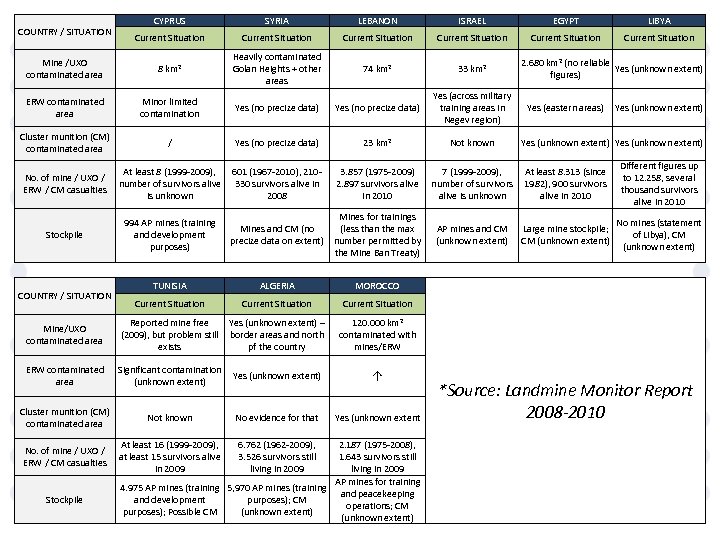 CYPRUS SYRIA LEBANON ISRAEL EGYPT LIBYA Current Situation Current Situation Mine /UXO contaminated area 8 km 2 Heavily contaminated Golan Heights + other areas 74 km 2 33 km 2 ERW contaminated area Minor limited contamination Yes (no precize data) Yes (across military training areas in Negev region) Cluster munition (CM) contaminated area / Yes (no precize data) 23 km 2 Not known COUNTRY / SITUATION No. of mine / UXO / ERW / CM casualties Stockpile COUNTRY / SITUATION At least 8 (1999 -2009), 601 (1967 -2010), 210 number of survivors alive 330 survivors alive in is unknown 2008 994 AP mines (training and development purposes) Mines for trainings Mines and CM (no (less than the max precize data on extent) number permitted by the Mine Ban Treaty) TUNISIA ALGERIA Current Situation Yes (eastern areas) Yes (unknown extent) 7 (1999 -2009), At least 8. 313 (since number of survivors 1982), 900 survivors alive is unknown alive in 2010 AP mines and CM (unknown extent) Yes (unknown extent) Large mine stockpile; CM (unknown extent) Different figures up to 12. 258, several thousand survivors alive in 2010 No mines (statement of Libya), CM (unknown extent) MOROCCO Current Situation Mine/UXO contaminated area Reported mine free Yes (unknown extent) – (2009), but problem still border areas and north exists pf the country ERW contaminated area Significant contamination Yes (unknown extent) Cluster munition (CM) contaminated area Not known No evidence for that No. of mine / UXO / ERW / CM casualties At least 16 (1999 -2009), at least 15 survivors alive in 2009 6. 762 (1962 -2009), 3. 526 survivors still living in 2009 Stockpile 3. 857 (1975 -2009) 2. 897 survivors alive in 2010 2. 680 km 2 (no reliable Yes (unknown extent) figures) 120. 000 km 2 contaminated with mines/ERW ↑ Yes (unknown extent 2. 187 (1975 -2008), 1. 643 survivors still living in 2009 AP mines for training 4. 975 AP mines (training 5, 970 AP mines (training and peacekeeping and development purposes); CM operations; CM purposes); Possible CM (unknown extent) *Source: Landmine Monitor Report 2008 -2010
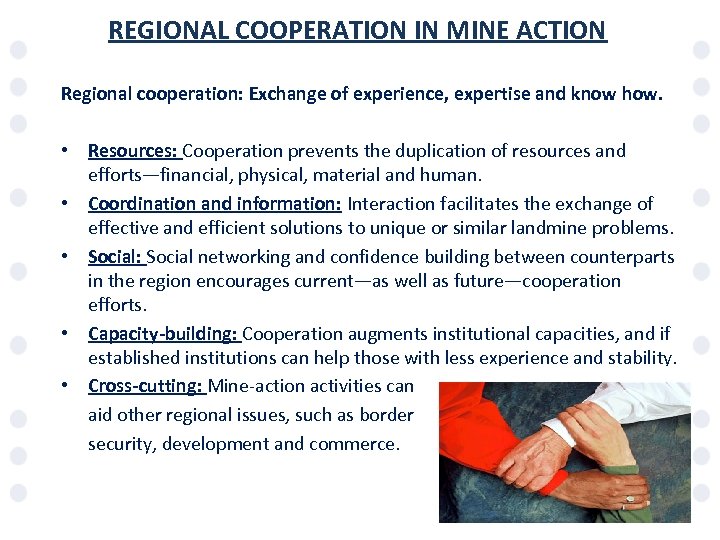 REGIONAL COOPERATION IN MINE ACTION Regional cooperation: Exchange of experience, expertise and know how. • Resources: Cooperation prevents the duplication of resources and efforts—financial, physical, material and human. • Coordination and information: Interaction facilitates the exchange of effective and efficient solutions to unique or similar landmine problems. • Social: Social networking and confidence building between counterparts in the region encourages current—as well as future—cooperation efforts. • Capacity-building: Cooperation augments institutional capacities, and if established institutions can help those with less experience and stability. • Cross-cutting: Mine-action activities can aid other regional issues, such as border security, development and commerce.
 OVERVIEW OF ITF REGIONAL PROJECTS • Regional humanitarian demining projects - cross-border clearance (Albania& Bosnia and Herzegovina & Croatia & Montenegro & Serbia) Donors: European Union, United States • Regional institutional capacities – structure support (MDDC, RCUD, CROMAC CTDT, GIS. . . ) Donors: European Union, the Czech Republic, Slovenia, United States • Regional trainings (humanitarian demining & EOD, underwater EOD, Management Trainings, GIS, rehabilitation & victim assistance, IPDET. . . ) Donors: ER, the Czech Republic, France, Hungary, Slovenia and U. S. • Regional workshops, conferences and other (various fields: MDD, VA, mech. clearance, RASR, SEEMACC, “CAMACC”, confidence building, Telemedicine, AI DSS) Donors: EU, Canada, the Czech Republic, Hungary, the Netherlands, Norway, OSCE Oi. T, Slovenia and US.
 SEEMACC, CAMACC, RASR • in November 2000 on the initiative of countries of South-Eastern Europe (Croatia, Bosnia and Herzegovina, and Albania) and ITF – establishment of South East Europe Mine Action Coordination Council – SEEMACC. • Plays an important role in coordination of joint projects in the region of SEE and is becoming a role model of regional cooperation throughout the world. • In 2009, OSCE endorsed the idea of establishing the Central Asian Mine Action Coordination Council and a multi-phase project of establishment is now undergoing. • Actively involved in US Department of State initiative – Regional Approach to Stockpile Reduction in the region of SEE (RASR)
 SEEMAC GOALS • Exchange of experience, expertise and know-how in the field of mine action in the region of South East Europe; • Promote the regional approach in the planning of demining programs; • Promote the regional approach in the fund raising for mine action; • Exchange experience, expertise and knowledge in the field of training of the deminers and managing personnel in the field of mine action; • Exchange information on testing of the new technologies in demining; • Promote the achievement of common standards and accreditation procedures in the field of demining in the region of South East Europe.
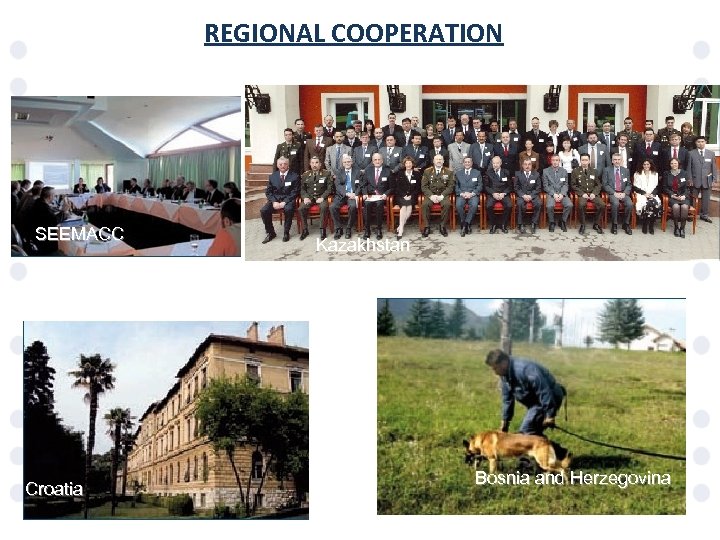 REGIONAL COOPERATION SEEMACC Croatia Kazakhstan Bosnia and Herzegovina
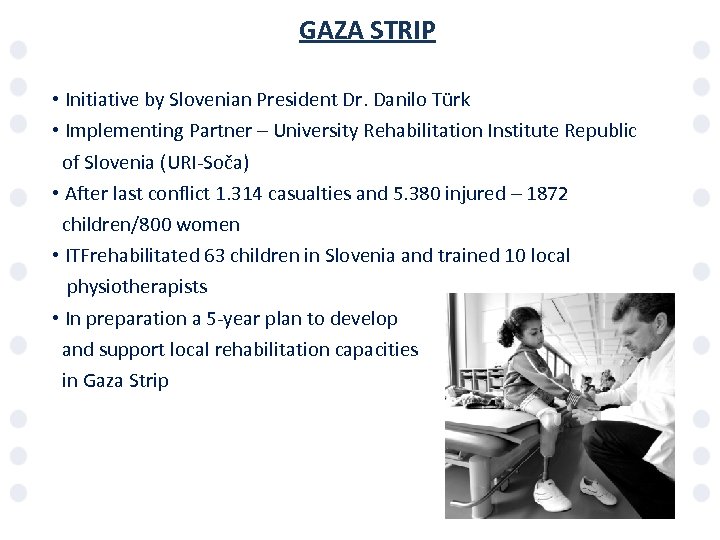 GAZA STRIP • Initiative by Slovenian President Dr. Danilo Türk • Implementing Partner – University Rehabilitation Institute Republic of Slovenia (URI-Soča) • After last conflict 1. 314 casualties and 5. 380 injured – 1872 children/800 women • ITFrehabilitated 63 children in Slovenia and trained 10 local physiotherapists • In preparation a 5 -year plan to develop and support local rehabilitation capacities in Gaza Strip
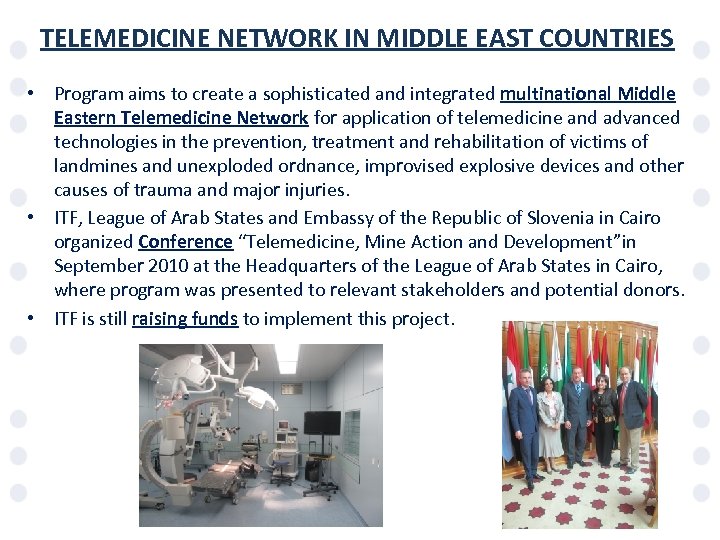 TELEMEDICINE NETWORK IN MIDDLE EAST COUNTRIES • Program aims to create a sophisticated and integrated multinational Middle Eastern Telemedicine Network for application of telemedicine and advanced technologies in the prevention, treatment and rehabilitation of victims of landmines and unexploded ordnance, improvised explosive devices and other causes of trauma and major injuries. • ITF, League of Arab States and Embassy of the Republic of Slovenia in Cairo organized Conference “Telemedicine, Mine Action and Development”in September 2010 at the Headquarters of the League of Arab States in Cairo, where program was presented to relevant stakeholders and potential donors. • ITF is still raising funds to implement this project.
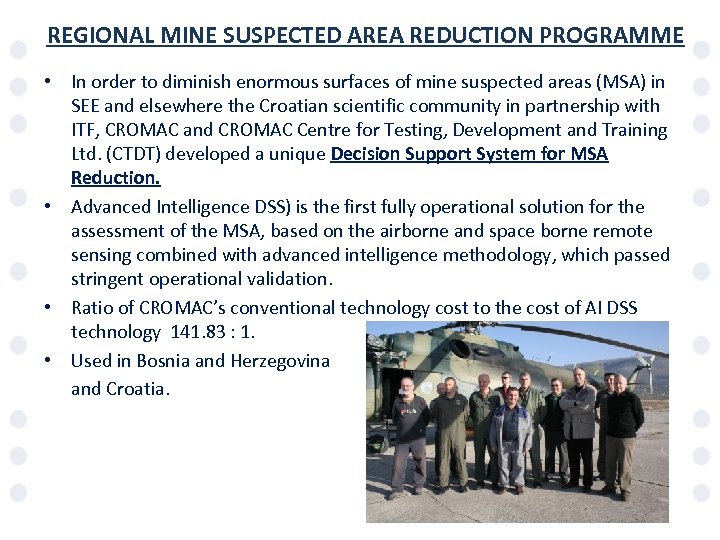 REGIONAL MINE SUSPECTED AREA REDUCTION PROGRAMME • In order to diminish enormous surfaces of mine suspected areas (MSA) in SEE and elsewhere the Croatian scientific community in partnership with ITF, CROMAC and CROMAC Centre for Testing, Development and Training Ltd. (CTDT) developed a unique Decision Support System for MSA Reduction. • Advanced Intelligence DSS) is the first fully operational solution for the assessment of the MSA, based on the airborne and space borne remote sensing combined with advanced intelligence methodology, which passed stringent operational validation. • Ratio of CROMAC’s conventional technology cost to the cost of AI DSS technology 141. 83 : 1. • Used in Bosnia and Herzegovina and Croatia.
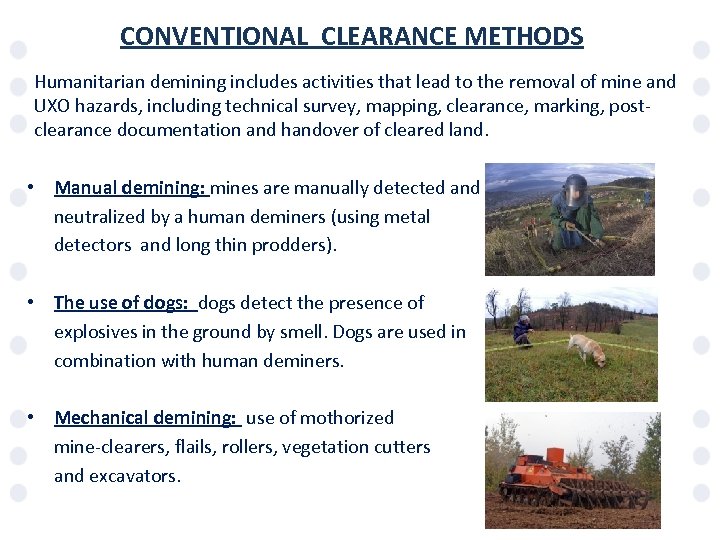 CONVENTIONAL CLEARANCE METHODS Humanitarian demining includes activities that lead to the removal of mine and UXO hazards, including technical survey, mapping, clearance, marking, postclearance documentation and handover of cleared land. • Manual demining: mines are manually detected and neutralized by a human deminers (using metal detectors and long thin prodders). • The use of dogs: dogs detect the presence of explosives in the ground by smell. Dogs are used in combination with human deminers. • Mechanical demining: use of mothorized mine-clearers, flails, rollers, vegetation cutters and excavators.
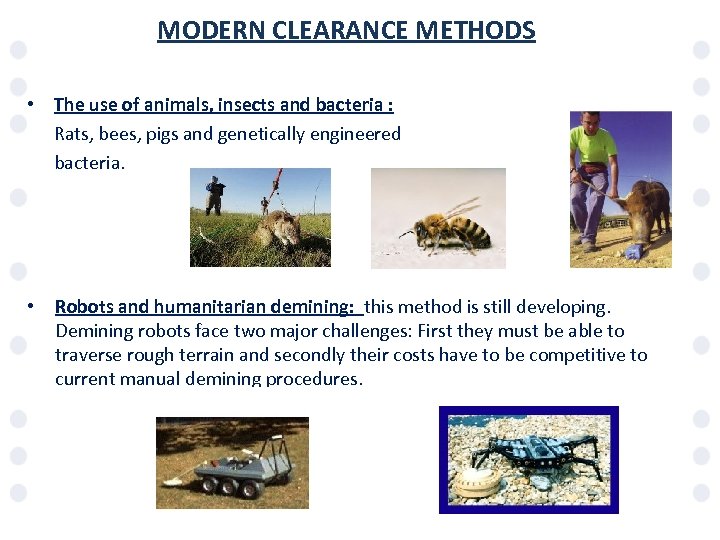 MODERN CLEARANCE METHODS • The use of animals, insects and bacteria : Rats, bees, pigs and genetically engineered bacteria. • Robots and humanitarian demining: this method is still developing. Demining robots face two major challenges: First they must be able to traverse rough terrain and secondly their costs have to be competitive to current manual demining procedures.
 POSSIBLE REGIONAL PROJECTS IN MEDITERRANEAN REGION Cross border demining / UWO / ERW clearance; Victims assistance; Risk education; Structure support; Mine action related trainings and workshops; Advance Intelligence Decision Support System for MSA Reduction. • Technology exchange is applicable to all above mentioned projects • • • Encouraging regional cooperation is an important confidence-building measure, particularly in countries emerging from conflict.
 THANK YOU! www. itf-fund. si