


 Скачать презентацию INTERNATIONAL TRENDS IN MATHEMATICS EDUCATION RESEARCH Markku S
fb3643fa355bf9a1befdab04fb1d645b.ppt
- Количество слайдов: 17
 INTERNATIONAL TRENDS IN MATHEMATICS EDUCATION RESEARCH Markku S. Hannula University of Turku, Finland
 Some ME research organisations • ICMI = International Congress for Mathematis Instruction • IGPME / PME = The International Group for Psychology of Mathematics Education • ERME = European Researchers of Mathematics Education • No. RME=Umbrella organization for Nordic and Baltic ME research associations • SME = Sociology of Mathematics Education • Etc.
 Conferences to go to • • PME (yearly in July) ICME (every 4 years, 2008 in Mexico) CERME (biannually in Europe; Jan - Feb) Norma (2008) Baltic conference [German mathematics conference] Adults Learning Mathematic International Research Forum on Statistical Reasoning, Thinking, and Literacy • International Conference on Technology in Mathematics Teaching. • EARLI • Etc.
 Journals • • • • Scholarly journals: print Educational Studies in Mathematics For the Learning of Mathematics Journal for Research in Mathematics Education Journal of Mathematics Teacher Education Journal of Mathematical Behaviour Mathematical Thinking and Learning Nomad Etc. Scholarly journals: on-line The Philosophy of Mathematics Education Journal The Mathematics Educator The Montana Mathematics Enthusiast International Journal for Mathematics Teaching and Learning Etc.
 Closer Focus • A book on 30 years of PME (Psychology of Mathematics Education) activities 19762006. – Gutiérrez, A. & Boero, P. (2006). Eds. Handbook of Research on the Psychology of Mathematics Education: Past, Present and Future. Rotterdam: Sense. • Research reports in nine of PME conference proceedings from years 19972007
 Theoretical frameworks • The early years of PME research were characterized by a strong emphasis on cognitive psychology. Constructivism ascended in 19851995 and it became the dominating overall framework. – “bridging theories” • APOS and didactical engineering. • A ‘social turn’ in mathematics education research since 1990’s. – 0 13 % of yearly research reports. • New trend: enactivism
 Embodied cognition • Conceptual knowledge is mapped within our sensory-motor system. • Rejects the notion that behind perceptuomotor activity there is a “mind” • what we usually recognize as mental are inhibited and condensed perceptuo-motor activities that do not reach the periphery of our nervous system. • Lakoff and Núñez, 2000.
 Trends in research topics • • Based on PME proceedings Author-selected categories of research Some changes in categories over years Some small categories were united with more popular ones
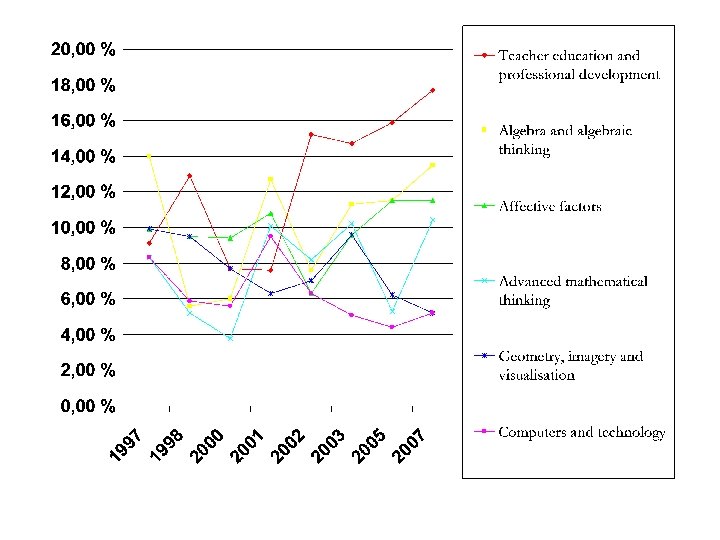
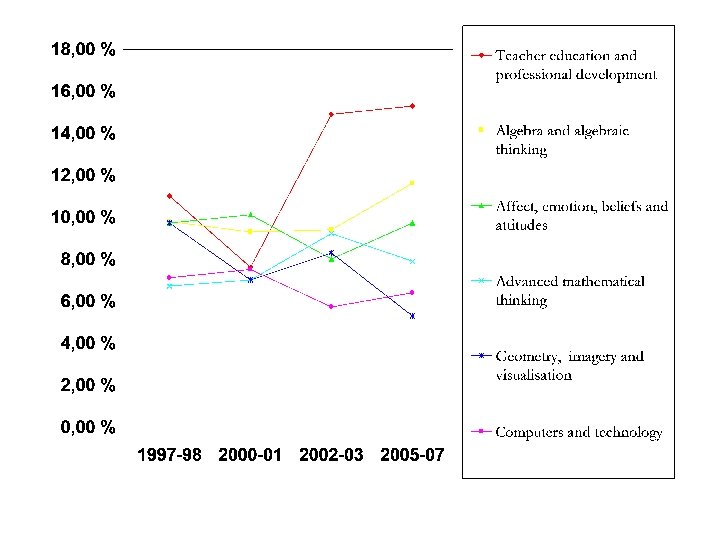


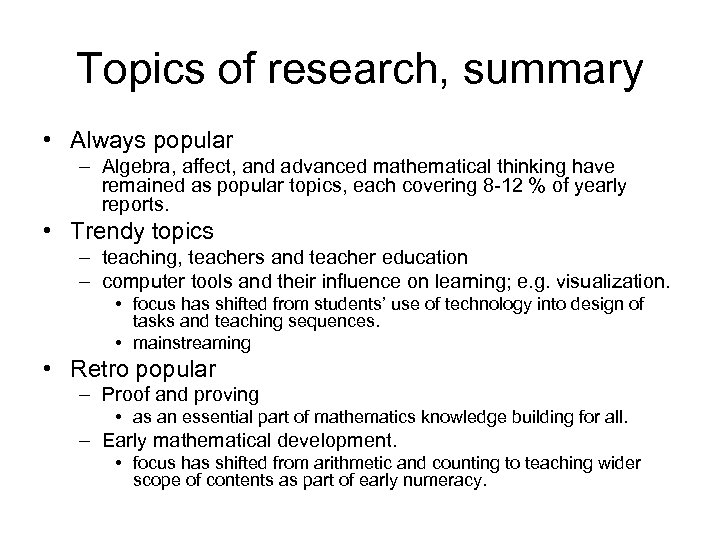 Topics of research, summary • Always popular – Algebra, affect, and advanced mathematical thinking have remained as popular topics, each covering 8 -12 % of yearly reports. • Trendy topics – teaching, teachers and teacher education – computer tools and their influence on learning; e. g. visualization. • focus has shifted from students’ use of technology into design of tasks and teaching sequences. • mainstreaming • Retro popular – Proof and proving • as an essential part of mathematics knowledge building for all. – Early mathematical development. • focus has shifted from arithmetic and counting to teaching wider scope of contents as part of early numeracy.
 Methods of research • Emphasis in PME is in qualitative methods. • For example, 66 % of submitted proposals in 2009 were qualitative, 23 % quantitative and 11 % theoretical. • A notable recent change in methods is the emergence of design studies.
 Design studies • To design teaching sequence, tasks, software, … • Research-based design • Research of design process
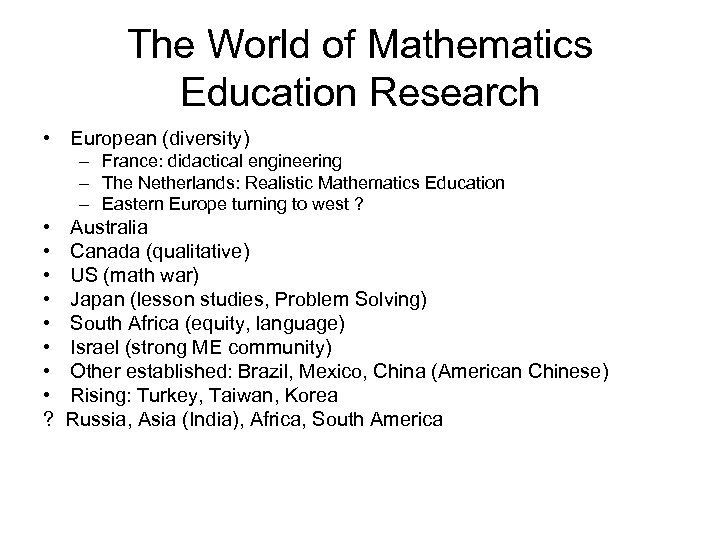 The World of Mathematics Education Research • European (diversity) – France: didactical engineering – The Netherlands: Realistic Mathematics Education – Eastern Europe turning to west ? • • ? Australia Canada (qualitative) US (math war) Japan (lesson studies, Problem Solving) South Africa (equity, language) Israel (strong ME community) Other established: Brazil, Mexico, China (American Chinese) Rising: Turkey, Taiwan, Korea Russia, Asia (India), Africa, South America
 Summary • • • Expansion Diversification Increased complexity Increased connectivity Theories of – theories for