


 Скачать презентацию International Trademark Protection Using the Madrid Protocol Worth
d521d41cd96af47171791bf4e5ab0229.ppt
- Количество слайдов: 28
 International Trademark Protection Using the Madrid Protocol: Worth the Convenience? T. J. Romano tromano@khpatent. com Kolisch Hartwell, P. C. Portland, OR
 Agenda • Options for Foreign Trademark (and Service Mark) Registration • Focus on Madrid System – How does the Madrid Protocol work? – What are the Pros and Cons? • Examples • Strategy Considerations • Useful Resources & Glossary
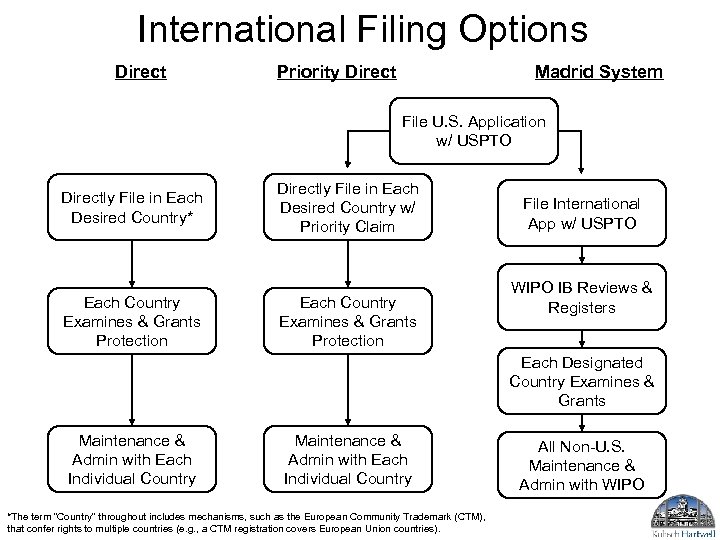 International Filing Options Direct Priority Direct Madrid System File U. S. Application w/ USPTO Directly File in Each Desired Country* Directly File in Each Desired Country w/ Priority Claim Each Country Examines & Grants Protection File International App w/ USPTO WIPO IB Reviews & Registers Each Designated Country Examines & Grants Maintenance & Admin with Each Individual Country *The term ”Country” throughout includes mechanisms, such as the European Community Trademark (CTM), that confer rights to multiple countries (e. g. , a CTM registration covers European Union countries). All Non-U. S. Maintenance & Admin with WIPO
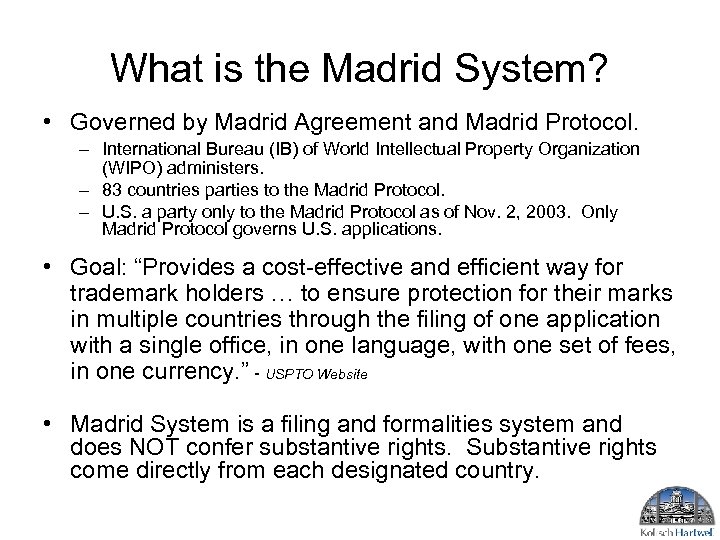 What is the Madrid System? • Governed by Madrid Agreement and Madrid Protocol. – International Bureau (IB) of World Intellectual Property Organization (WIPO) administers. – 83 countries parties to the Madrid Protocol. – U. S. a party only to the Madrid Protocol as of Nov. 2, 2003. Only Madrid Protocol governs U. S. applications. • Goal: “Provides a cost-effective and efficient way for trademark holders … to ensure protection for their marks in multiple countries through the filing of one application with a single office, in one language, with one set of fees, in one currency. ” - USPTO Website • Madrid System is a filing and formalities system and does NOT confer substantive rights. Substantive rights come directly from each designated country.
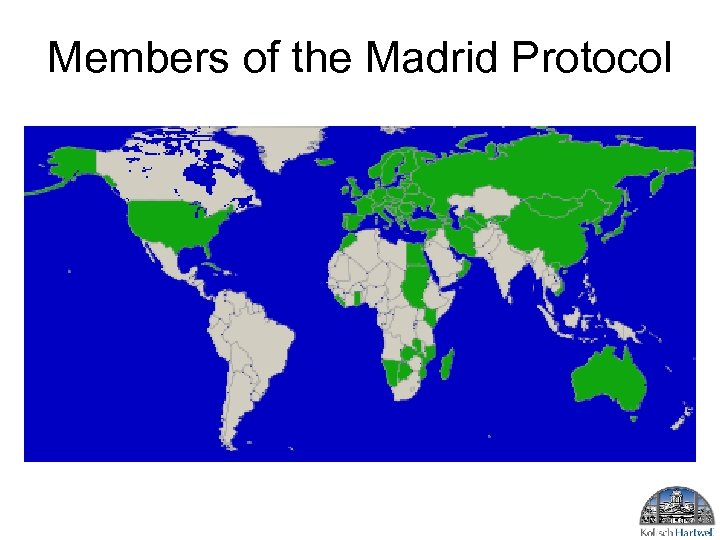 Members of the Madrid Protocol
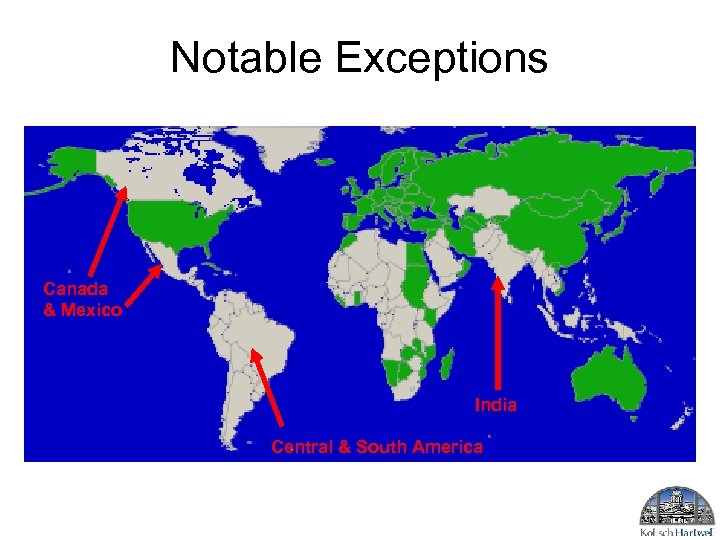 Notable Exceptions Canada & Mexico India Central & South America
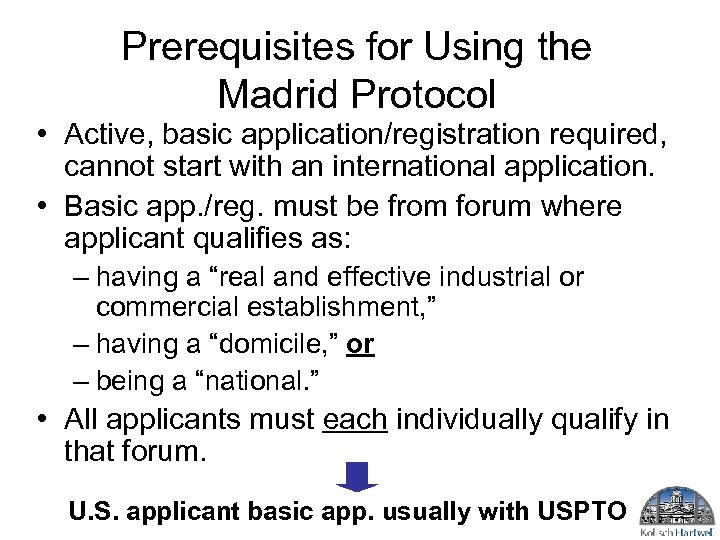 Prerequisites for Using the Madrid Protocol • Active, basic application/registration required, cannot start with an international application. • Basic app. /reg. must be from forum where applicant qualifies as: – having a “real and effective industrial or commercial establishment, ” – having a “domicile, ” or – being a “national. ” • All applicants must each individually qualify in that forum. U. S. applicant basic app. usually with USPTO
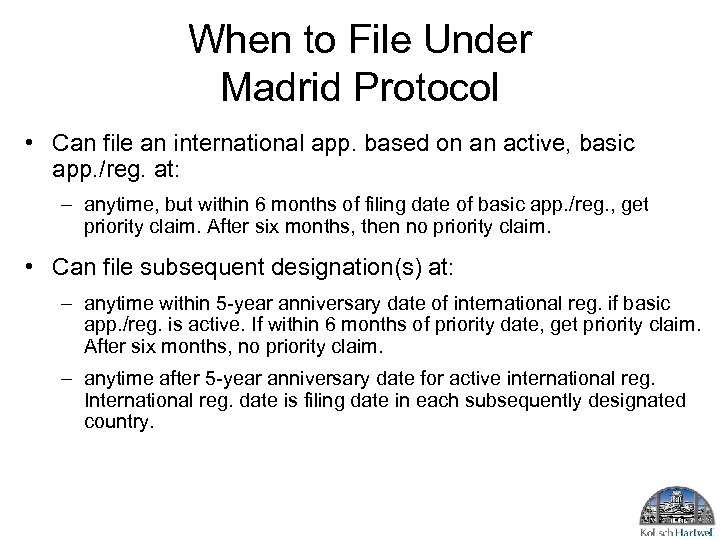 When to File Under Madrid Protocol • Can file an international app. based on an active, basic app. /reg. at: – anytime, but within 6 months of filing date of basic app. /reg. , get priority claim. After six months, then no priority claim. • Can file subsequent designation(s) at: – anytime within 5 -year anniversary date of international reg. if basic app. /reg. is active. If within 6 months of priority date, get priority claim. After six months, no priority claim. – anytime after 5 -year anniversary date for active international reg. International reg. date is filing date in each subsequently designated country.
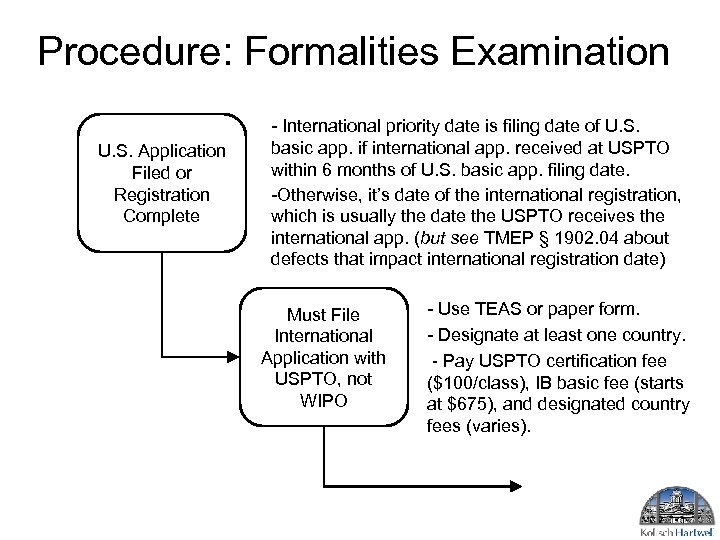 Procedure: Formalities Examination U. S. Application Filed or Registration Complete - International priority date is filing date of U. S. basic app. if international app. received at USPTO within 6 months of U. S. basic app. filing date. -Otherwise, it’s date of the international registration, which is usually the date the USPTO receives the international app. (but see TMEP § 1902. 04 about defects that impact international registration date) Must File International Application with USPTO, not WIPO - Use TEAS or paper form. - Designate at least one country. - Pay USPTO certification fee ($100/class), IB basic fee (starts at $675), and designated country fees (varies).
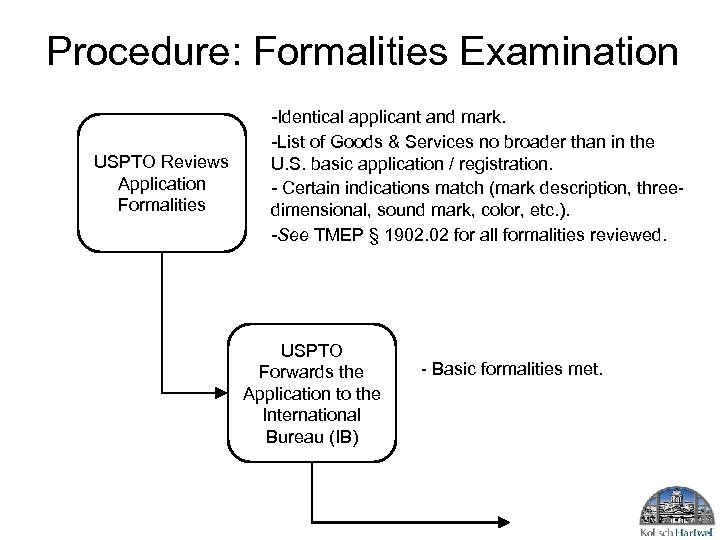 Procedure: Formalities Examination USPTO Reviews Application Formalities -Identical applicant and mark. -List of Goods & Services no broader than in the U. S. basic application / registration. - Certain indications match (mark description, threedimensional, sound mark, color, etc. ). -See TMEP § 1902. 02 for all formalities reviewed. USPTO Forwards the Application to the International Bureau (IB) - Basic formalities met.
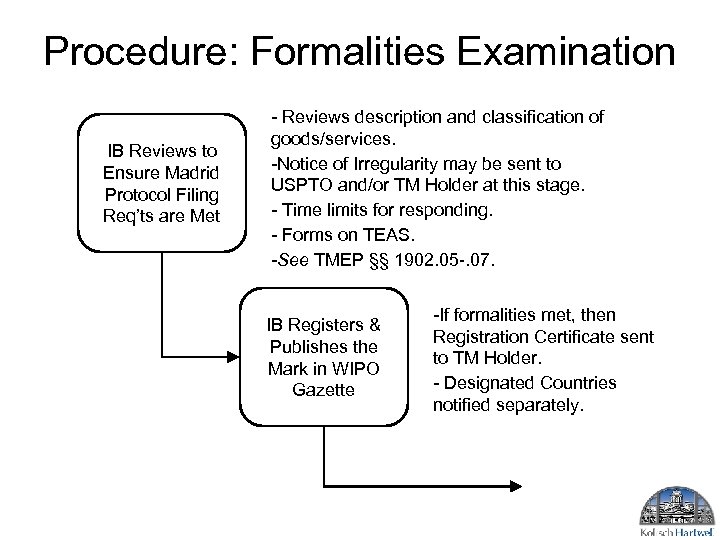 Procedure: Formalities Examination IB Reviews to Ensure Madrid Protocol Filing Req’ts are Met - Reviews description and classification of goods/services. -Notice of Irregularity may be sent to USPTO and/or TM Holder at this stage. - Time limits for responding. - Forms on TEAS. -See TMEP §§ 1902. 05 -. 07. IB Registers & Publishes the Mark in WIPO Gazette -If formalities met, then Registration Certificate sent to TM Holder. - Designated Countries notified separately.
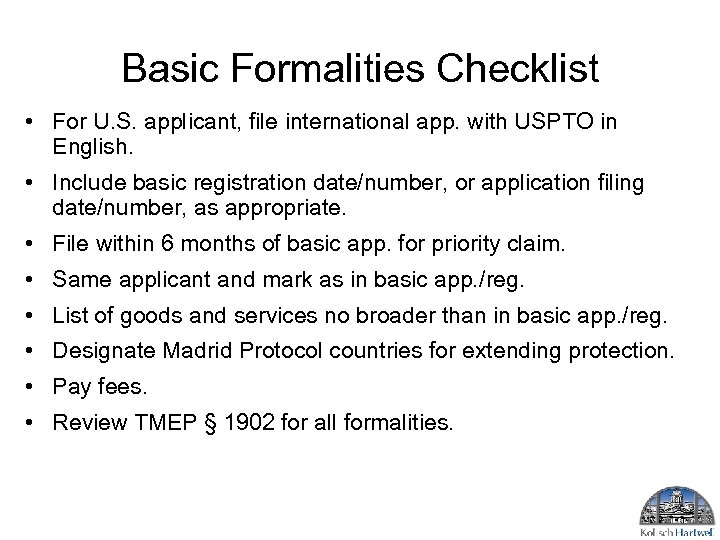 Basic Formalities Checklist • For U. S. applicant, file international app. with USPTO in English. • Include basic registration date/number, or application filing date/number, as appropriate. • File within 6 months of basic app. for priority claim. • Same applicant and mark as in basic app. /reg. • List of goods and services no broader than in basic app. /reg. • Designate Madrid Protocol countries for extending protection. • Pay fees. • Review TMEP § 1902 for all formalities.
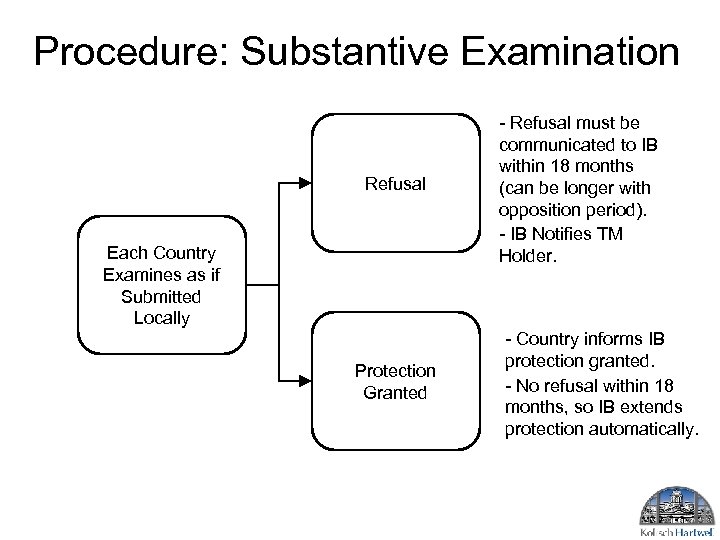 Procedure: Substantive Examination Refusal Each Country Examines as if Submitted Locally Protection Granted - Refusal must be communicated to IB within 18 months (can be longer with opposition period). - IB Notifies TM Holder. - Country informs IB protection granted. - No refusal within 18 months, so IB extends protection automatically.
 Maintenance • 10 year duration based on date of international registration, renewable for additional 10 year periods (6 -mo reminder sent). • Fee paid to International Bureau. • Can renew electronically on WIPO website. • Name, ownership, address changes, license agreements, encumbrances, also done centrally for all designated countries.
 Central Attack & Transformation • Within the first 5 years, any failure of the basic application or registration will result in corresponding cancellation of the international registration. • If this happens, have 3 months to apply directly with each designated country and still get the original application date, and priority date, if any. – But pay more fees and retain foreign agent(s) to file.
 Benefits of Madrid Protocol • File international app. anytime if basic app. /reg. is active. • File one application, in English, and pay one fee for all designated countries. • Foreign agent(s) not needed for filing, reducing costs. • Increasingly cost effective as more countries designated. • Basic registration can be Supplemental Registration. • 18 -month refusal deadline, then automatic protection. • International registration becomes independent of basic registration after 5 years.
 Benefits of Madrid Protocol (cont. ) Simplified subsequent management: • One international registration, with one number and one renewal date. • One place to file renewals, changes of address, assignments, etc. for all designated countries • Can designate countries anytime during life of active, international registration. • Rights under international registration can be assigned separately (e. g. , holder maintain rights in good A, but assign rights in good B, etc. )
 Drawbacks of Madrid Protocol • International “registration” does not confer substantive rights. • Not all countries parties to Madrid Protocol. • Applicant cannot modify international application after filing: – No modification to recorded mark, even if mark modified in basic application. – Can’t expand or extend list of goods/services after submitted, even to include ones omitted that are in basic app. /reg. • Goods/services may be narrow in scope: – U. S. registrations contain high level of specificity and based on use, each limit scope. – Goods/services in international registration, and thus in designated counties, restricted to same scope as in basic registration.
 Drawbacks of Madrid Protocol (cont. ) • USPTO must transmit international application to IB within 2 months of receipt. Otherwise, date of international registration is when IB receives, not when USPTO received. • “Central Attack” 5 -yr dependency (but 3 -month transformation). • Substantive Examination in Each Designated Country: – May need local agent anyway if protection refused. – Designated country can send refusal in English, Spanish, or French. • Subsequent Designation: no prorated fees and scope of goods/services always limited to international registration. • Assignee must qualify as a person, domicile, or effective business in a Madrid Protocol country to maintain international registration.
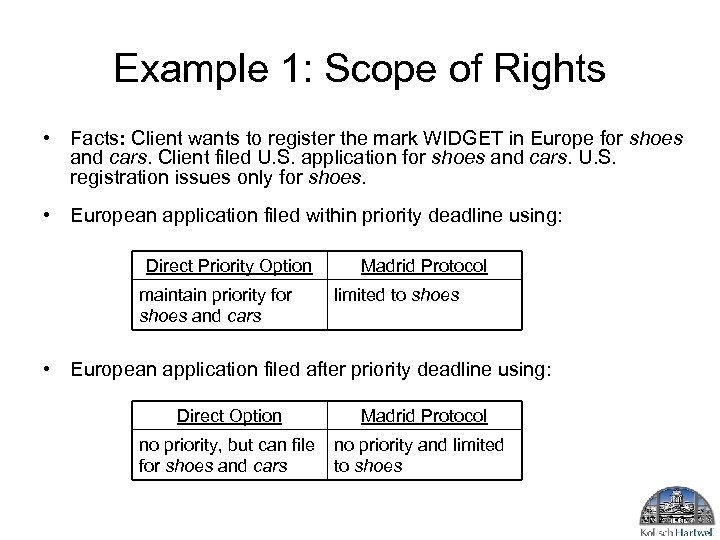 Example 1: Scope of Rights • Facts: Client wants to register the mark WIDGET in Europe for shoes and cars. Client filed U. S. application for shoes and cars. U. S. registration issues only for shoes. • European application filed within priority deadline using: Direct Priority Option maintain priority for shoes and cars Madrid Protocol limited to shoes • European application filed after priority deadline using: Direct Option Madrid Protocol no priority, but can file for shoes and cars no priority and limited to shoes
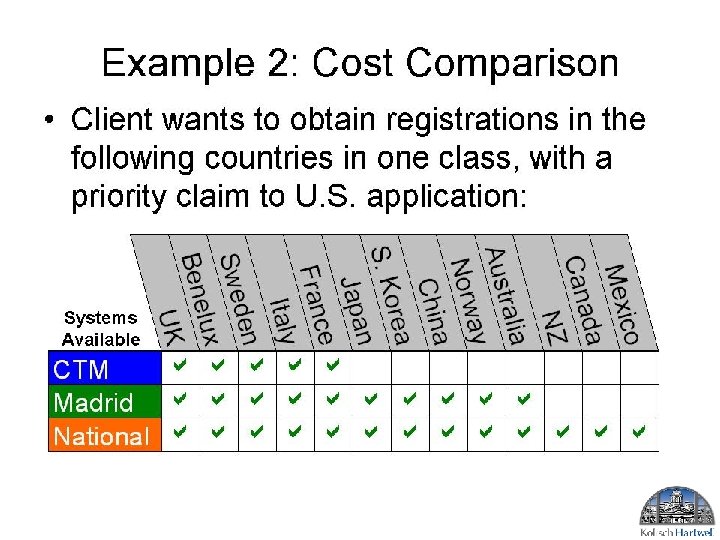 Example 2: Cost Comparison • Client wants to obtain registrations in the following countries in one class, with a priority claim to U. S. application: Systems Available
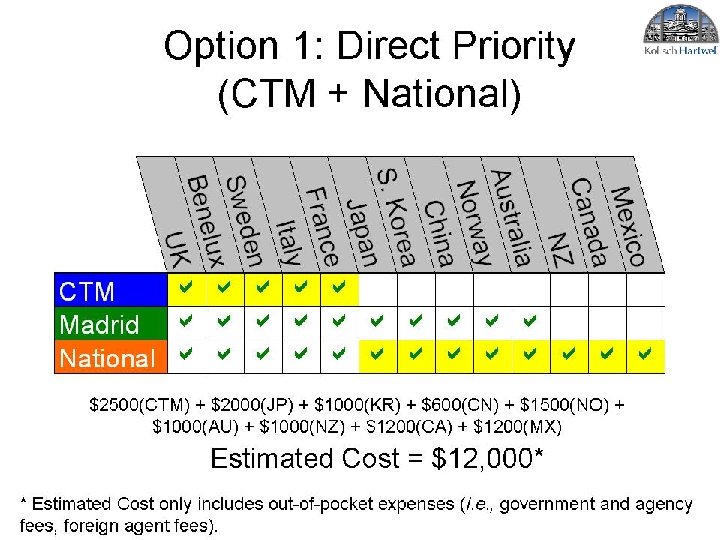 Option 1: Direct Priority (CTM + National) $2500(CTM) + $2000(JP) + $1000(KR) + $600(CN) + $1500(NO) + $1000(AU) + $1000(NZ) + $1200(CA) + $1200(MX) Estimated Cost = $12, 000* * Estimated Cost only includes out-of-pocket expenses (i. e. , government and agency fees, foreign agent fees).
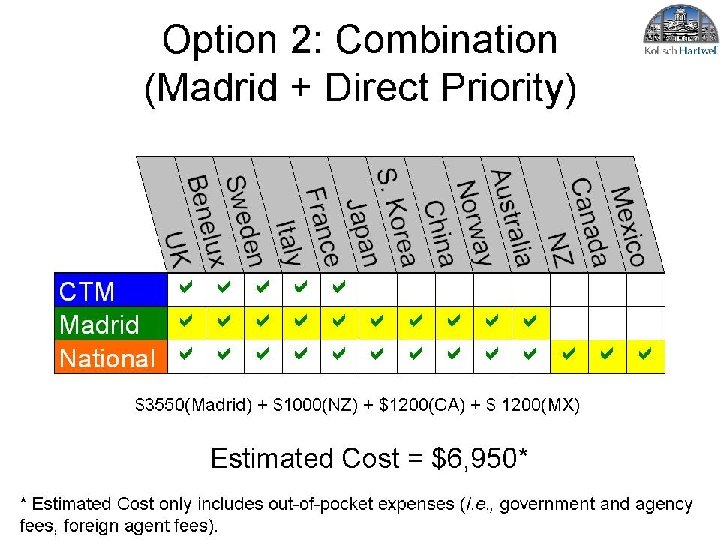 Option 2: Combination (Madrid + Direct Priority) $3550(Madrid) + $1000(NZ) + $1200(CA) + $ 1200(MX) Estimated Cost = $6, 950* * Estimated Cost only includes out-of-pocket expenses (i. e. , government and agency fees, foreign agent fees).
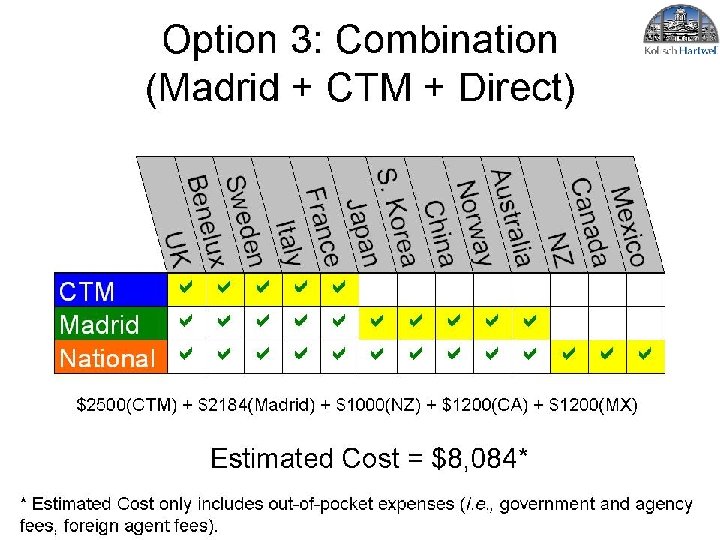 Option 3: Combination (Madrid + CTM + Direct) $2500(CTM) + $2184(Madrid) + $1000(NZ) + $1200(CA) + $1200(MX) Estimated Cost = $8, 084* * Estimated Cost only includes out-of-pocket expenses (i. e. , government and agency fees, foreign agent fees).
 Strategy Considerations • No one-size strategy: each filing option has pros and cons. • Weigh cost & efficiency against importance of broad protection in each individual country. • Consider ways to avoid restricted goods/services worldwide. – Multi-nationals file outside United States with broad description and U. S. application through Madrid Protocol. – But consider risks (e. g. , tax implications, etc. ). • Consider using a combination of available filing options depending on where the client wants protection and which foreign markets are most critical.
 Useful Resources • WIPO at www. wipo. int/madrid/en – Madrid fee calculator (in Swiss francs, no USPTO fees). – Review “Guide to the International Registration of Marks under the Madrid Agreement and the Madrid Protocol. ” – Searchable online databases: • ROMARIN at www. wipo. int/romarin • Madrid Express at www. wipo. int/ipdl/en/madrid • USPTO at www. uspto. gov/trademarks/law/madrid/index. jsp – Online filing system for international applications. – Review Trademark Manual of Examining Procedure (TMEP), Chapter 1900 “Madrid Protocol. ”
 Basic Glossary of Madrid Protocol Terminology • basic application: original application filed in a qualified home forum office of applicant (e. g. , USPTO for U. S. applicant) • basic registration: home forum registration that issues from basic registration (e. g. , USPTO registration). • international application: filed through Madrid Protocol, and is based on an active, basic application or registration. • international registration: issues from the international application. • designated country: any country that is a party to Madrid Protocol for which an applicant requests an extension of protection under the Madrid Protocol. • subsequent designation: request by holder of an international registration for an extension of protection to additional Madrid Protocol countries after international registration issues.
 Contact Information T. J. Romano tromano@khpatent. com Kolisch Hartwell P. C. 520 S. W. Yamhill Street, Suite 200 Portland, Oregon 97204 (503) 224 -6655