

International Tourism Organizations Henryk Handszuh Katowice School of


 Скачать презентацию International Tourism Organizations Henryk Handszuh Katowice School of
34516-ito1.ppt
- Количество слайдов: 31
International Tourism Organizations Henryk Handszuh Katowice School of Economics (GWSH) Plenipotentiary, International Documentation and Research Centre on Industrial Heritage for Tourism Madrid – Zabrze Fmr. Director, Market Department World Tourism Organization – UNWTO, Madrid
Part I. Theory of organizations Organizations as a vehicle of cooperation Roles of organizations Effectiveness of organizations Strategies of organizations Quality and capacity assesment
Organizations as a vehicle of cooperation Cooperation, also called collaboration, is working and doing things together, by independent subjects, whereas it implies on their part: An aptitude of creating links with others An ability (capacity) of working within a group with a view to reaching common objectives An ability (capacity) of team work with a view to executing tasks An ability (capacities) to jointly solve problems On individual level these capacities to cooperate are considered to be among emotional competences of people This capacity is also considered to belong to social competencies which determine the quality of relations with other people
What makes up social competences Social competences make up social capital It implies a social structure: consists of networks of common understanding and trust, shared knowledge and norms of behaviour, language, practice Without trust and comprehension, cooperation and exchanges in the market cannot take place In companies and organizations, without social knowledge and norms, the staff and the employees wouldn´t be able to cooperate and produce together In the economy and the state the social capital makes possible the functioning of the industrial capital
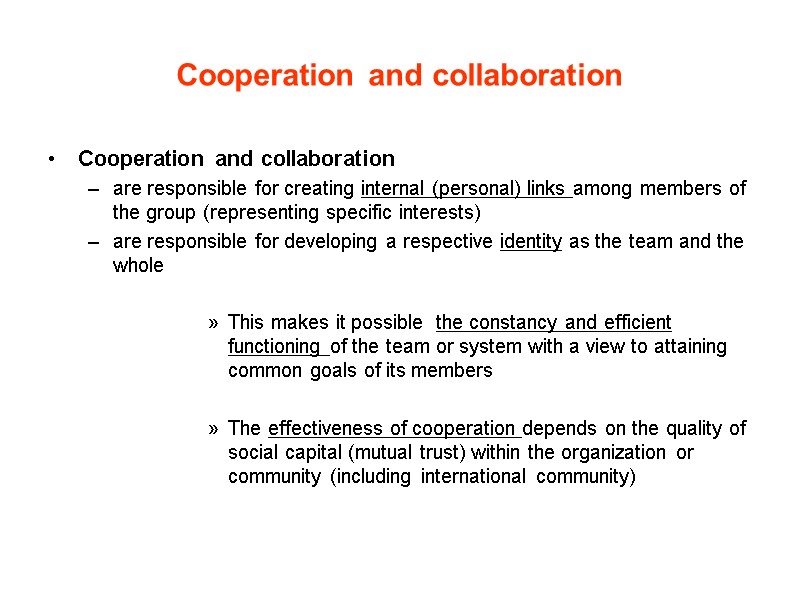
Cooperation and collaboration Cooperation and collaboration are responsible for creating internal (personal) links among members of the group (representing specific interests) are responsible for developing a respective identity as the team and the whole This makes it possible the constancy and efficient functioning of the team or system with a view to attaining common goals of its members The effectiveness of cooperation depends on the quality of social capital (mutual trust) within the organization or community (including international community)
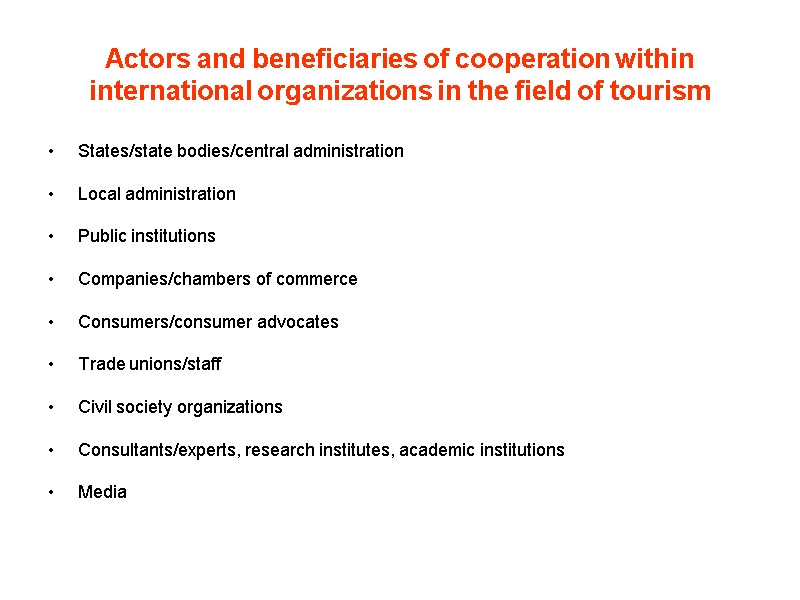
Actors and beneficiaries of cooperation within international organizations in the field of tourism States/state bodies/central administration Local administration Public institutions Companies/chambers of commerce Consumers/consumer advocates Trade unions/staff Civil society organizations Consultants/experts, research institutes, academic institutions Media
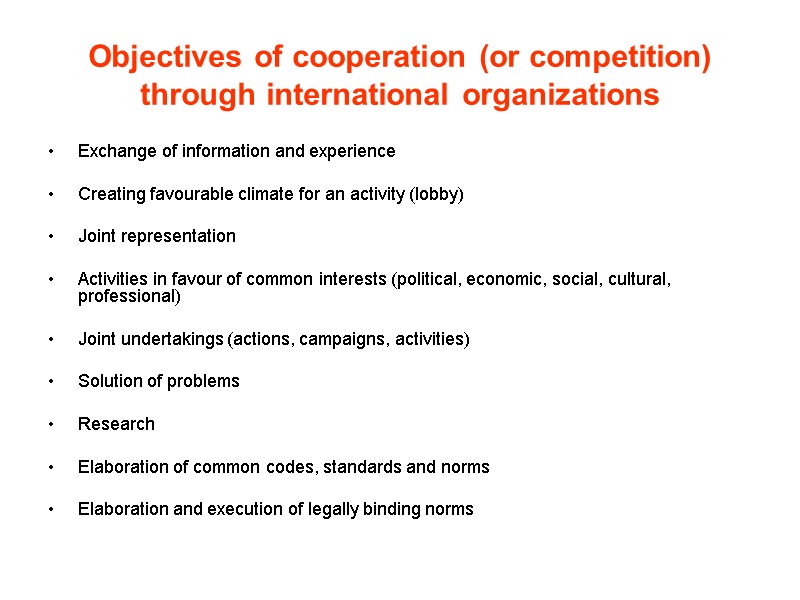
Objectives of cooperation (or competition) through international organizations Exchange of information and experience Creating favourable climate for an activity (lobby) Joint representation Activities in favour of common interests (political, economic, social, cultural, professional) Joint undertakings (actions, campaigns, activities) Solution of problems Research Elaboration of common codes, standards and norms Elaboration and execution of legally binding norms
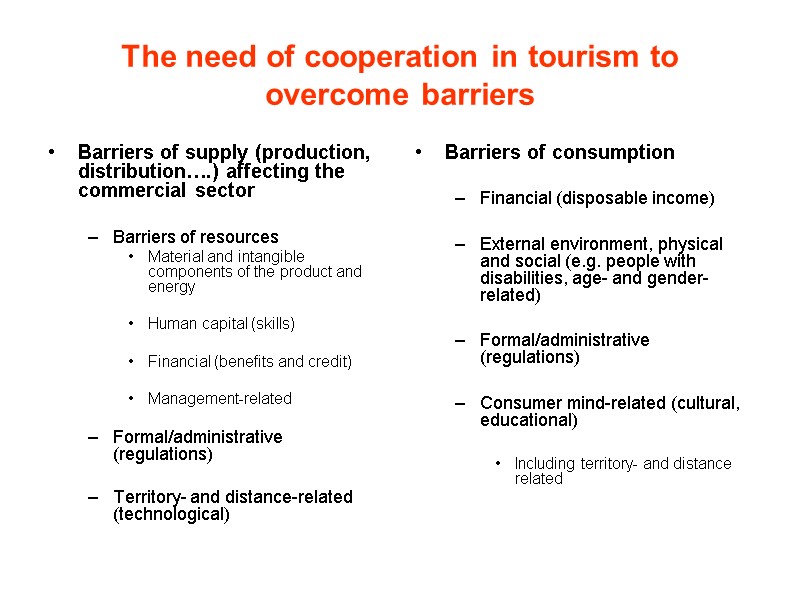
The need of cooperation in tourism to overcome barriers Barriers of supply (production, distribution….) affecting the commercial sector Barriers of resources Material and intangible components of the product and energy Human capital (skills) Financial (benefits and credit) Management-related Formal/administrative (regulations) Territory- and distance-related (technological) Barriers of consumption Financial (disposable income) External environment, physical and social (e.g. people with disabilities, age- and gender-related) Formal/administrative (regulations) Consumer mind-related (cultural, educational) Including territory- and distance related
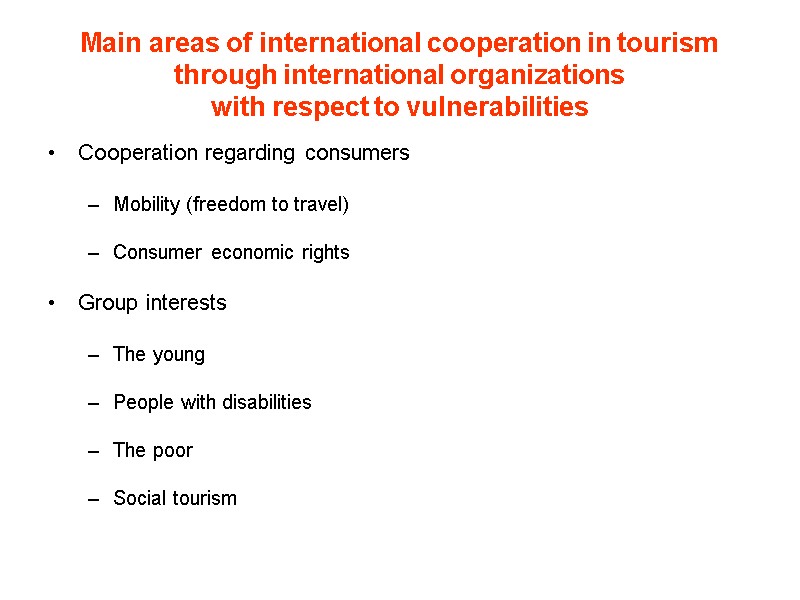
Main areas of international cooperation in tourism through international organizations with respect to vulnerabilities Cooperation regarding consumers Mobility (freedom to travel) Consumer economic rights Group interests The young People with disabilities The poor Social tourism
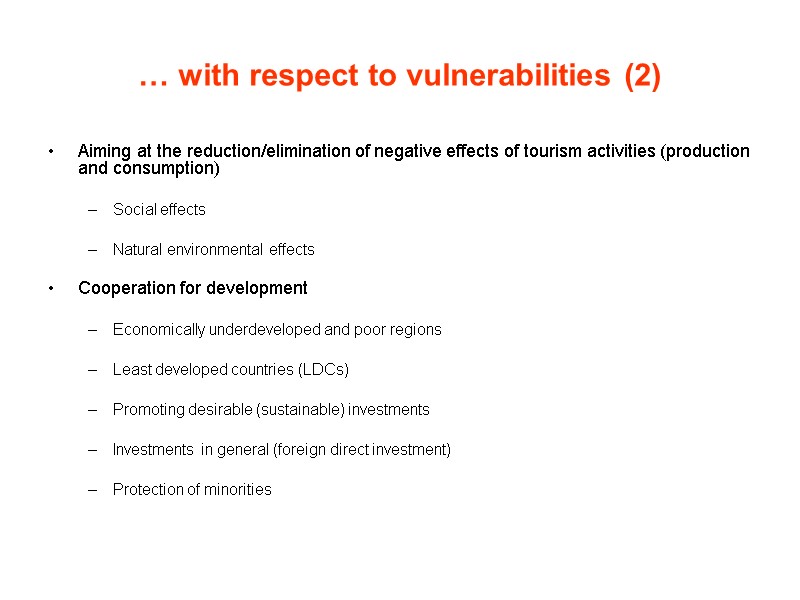
… with respect to vulnerabilities (2) Aiming at the reduction/elimination of negative effects of tourism activities (production and consumption) Social effects Natural environmental effects Cooperation for development Economically underdeveloped and poor regions Least developed countries (LDCs) Promoting desirable (sustainable) investments Investments in general (foreign direct investment) Protection of minorities
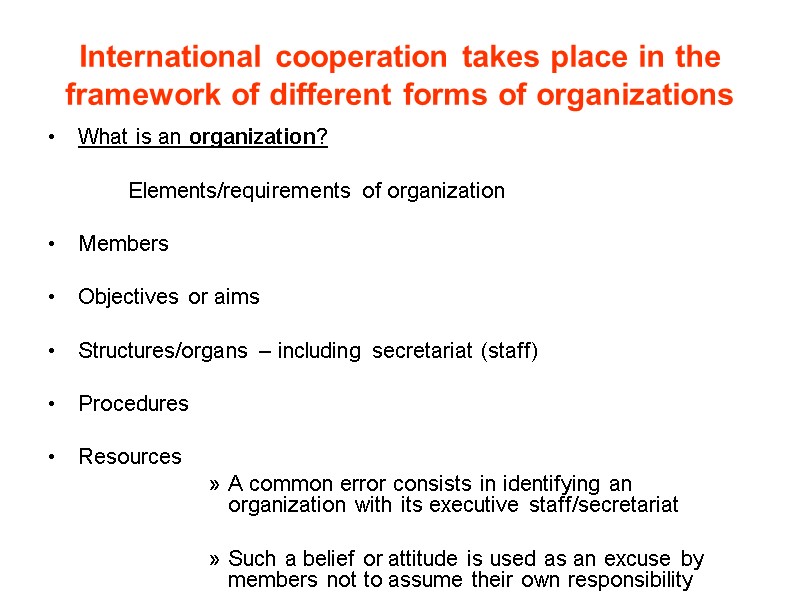
International cooperation takes place in the framework of different forms of organizations What is an organization? Elements/requirements of organization Members Objectives or aims Structures/organs – including secretariat (staff) Procedures Resources A common error consists in identifying an organization with its executive staff/secretariat Such a belief or attitude is used as an excuse by members not to assume their own responsibility
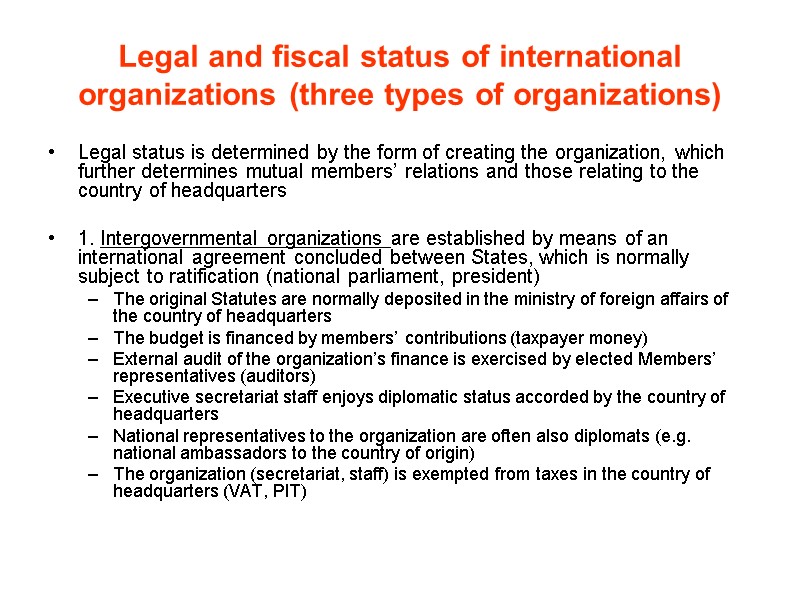
Legal and fiscal status of international organizations (three types of organizations) Legal status is determined by the form of creating the organization, which further determines mutual members’ relations and those relating to the country of headquarters 1. Intergovernmental organizations are established by means of an international agreement concluded between States, which is normally subject to ratification (national parliament, president) The original Statutes are normally deposited in the ministry of foreign affairs of the country of headquarters The budget is financed by members’ contributions (taxpayer money) External audit of the organization’s finance is exercised by elected Members’ representatives (auditors) Executive secretariat staff enjoys diplomatic status accorded by the country of headquarters National representatives to the organization are often also diplomats (e.g. national ambassadors to the country of origin) The organization (secretariat, staff) is exempted from taxes in the country of headquarters (VAT, PIT)
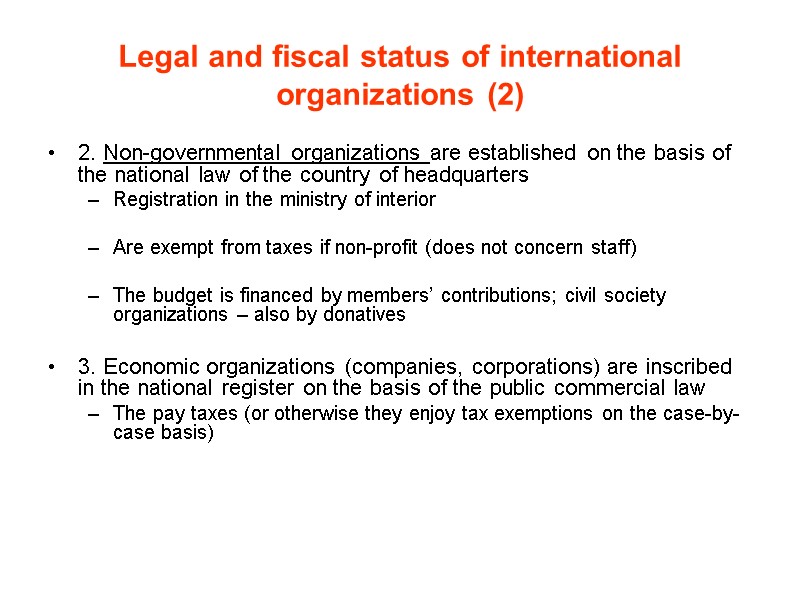
Legal and fiscal status of international organizations (2) 2. Non-governmental organizations are established on the basis of the national law of the country of headquarters Registration in the ministry of interior Are exempt from taxes if non-profit (does not concern staff) The budget is financed by members’ contributions; civil society organizations – also by donatives 3. Economic organizations (companies, corporations) are inscribed in the national register on the basis of the public commercial law The pay taxes (or otherwise they enjoy tax exemptions on the case-by-case basis)
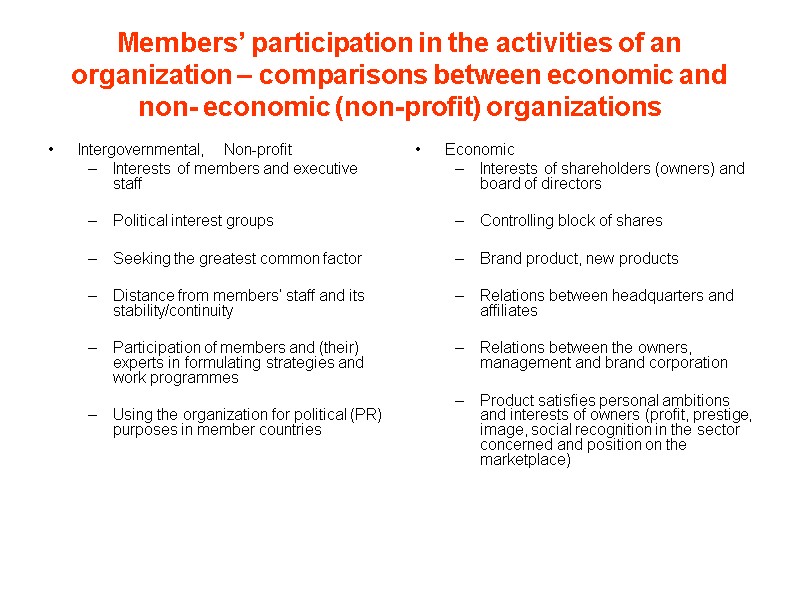
Members’ participation in the activities of an organization – comparisons between economic and non- economic (non-profit) organizations Intergovernmental, Non-profit Interests of members and executive staff Political interest groups Seeking the greatest common factor Distance from members’ staff and its stability/continuity Participation of members and (their) experts in formulating strategies and work programmes Using the organization for political (PR) purposes in member countries Economic Interests of shareholders (owners) and board of directors Controlling block of shares Brand product, new products Relations between headquarters and affiliates Relations between the owners, management and brand corporation Product satisfies personal ambitions and interests of owners (profit, prestige, image, social recognition in the sector concerned and position on the marketplace)
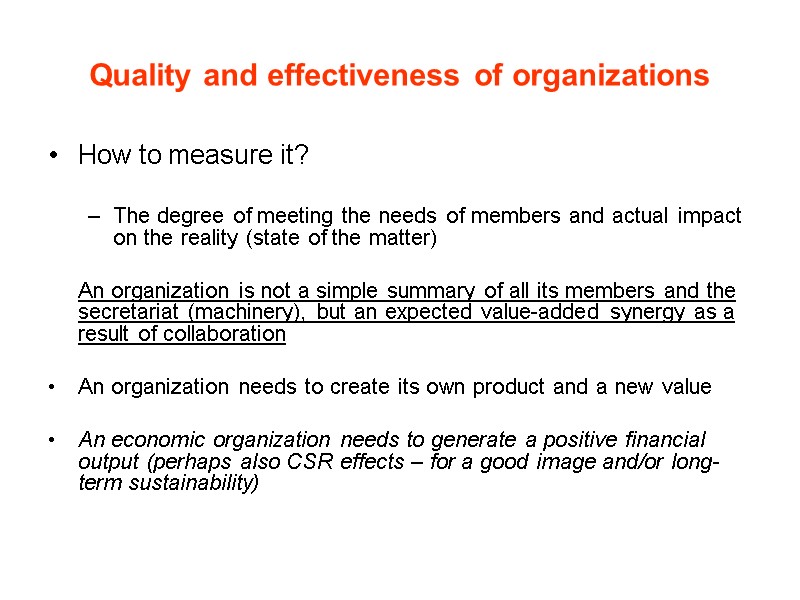
Quality and effectiveness of organizations How to measure it? The degree of meeting the needs of members and actual impact on the reality (state of the matter) An organization is not a simple summary of all its members and the secretariat (machinery), but an expected value-added synergy as a result of collaboration An organization needs to create its own product and a new value An economic organization needs to generate a positive financial output (perhaps also CSR effects – for a good image and/or long-term sustainability)
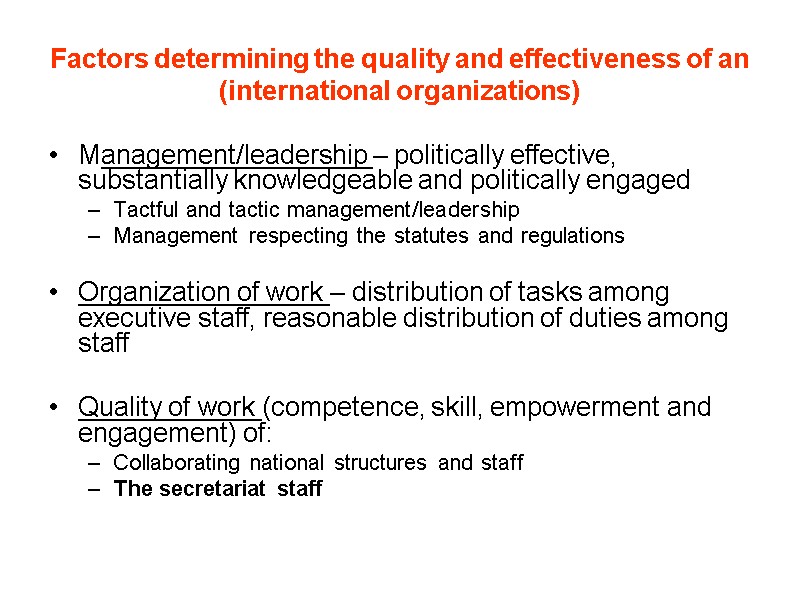
Factors determining the quality and effectiveness of an (international organizations) Management/leadership – politically effective, substantially knowledgeable and politically engaged Tactful and tactic management/leadership Management respecting the statutes and regulations Organization of work – distribution of tasks among executive staff, reasonable distribution of duties among staff Quality of work (competence, skill, empowerment and engagement) of: Collaborating national structures and staff The secretariat staff
Factors determining the quality and effectiveness of an (international organizations) (2) The degree of political engagement of members Existence of informed and continuously verified and monitored strategies of organizations and the identification of measures to these effects (Secretariat) Transparency allowing members and external/civil society control and monitoring Up-to-date substantial information on the internet Access to and timeliness of (working) documents Established, publicly-known and monitored procedures of decision taking Accountability on statements & deliverables (including by management)
Management in international organizations Organizations are perceived in relation to the personality/charisma of their leadership (e.g. secretary-general) (internal, external) Political criteria (political power) prevail over competence criteria in selecting persons to leadership positions Political drops-off, second-rank and career officials prevail in a selection process in intergovernmental organizations Politicians prefer careers at national level National procedures to select a competent candidate are lacking
Management in international organizations (2) Mainstream media, as a rule, do not keep track of nor pay attention to the leaders of international organizations (including tourism organizations), nevertheless the leaders (and their respective organizations) are recognized and considered by the professional media on an ad hoc basis The situation may change once the organization acquires more importance and competence in point in matters affecting media perceptions and awareness of citizens/consumers (example: International Monetary Fund) The situation is similar to that of international corporations – their CEOs are hardly known to the public at large (although their names are not secret)
Strategies of organizations from the secretariat perspective Alliances with other organizations Investment in the quality of their own staff Dialogue/close contact/continuous consultation with members Optimum use of resources (human, financial, members’ expertise) Co-responsibility De-centralization of tasks Centralization in the process of decision taking Competing with other organizations
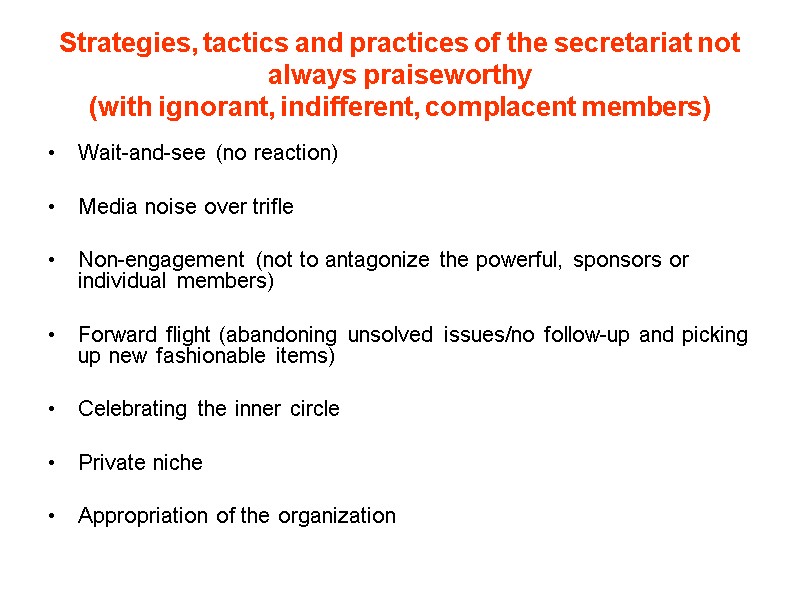
Strategies, tactics and practices of the secretariat not always praiseworthy (with ignorant, indifferent, complacent members) Wait-and-see (no reaction) Media noise over trifle Non-engagement (not to antagonize the powerful, sponsors or individual members) Forward flight (abandoning unsolved issues/no follow-up and picking up new fashionable items) Celebrating the inner circle Private niche Appropriation of the organization
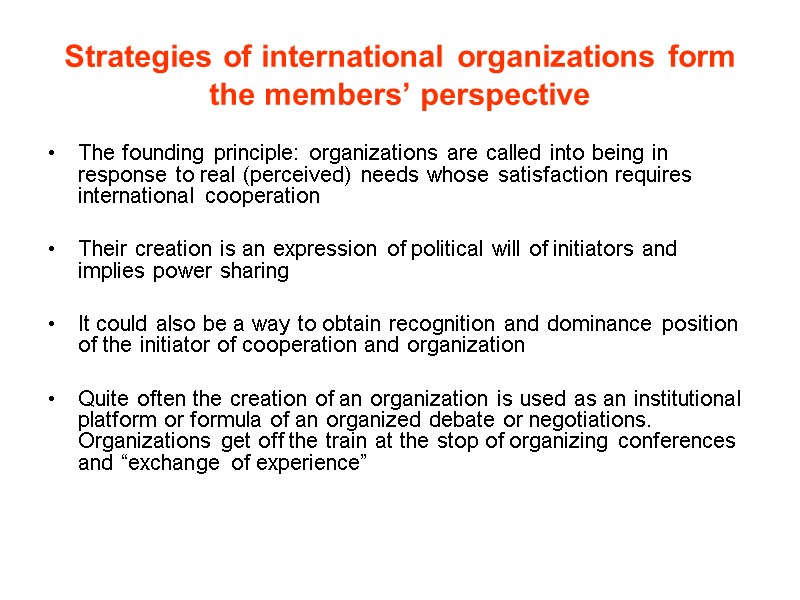
Strategies of international organizations form the members’ perspective The founding principle: organizations are called into being in response to real (perceived) needs whose satisfaction requires international cooperation Their creation is an expression of political will of initiators and implies power sharing It could also be a way to obtain recognition and dominance position of the initiator of cooperation and organization Quite often the creation of an organization is used as an institutional platform or formula of an organized debate or negotiations. Organizations get off the train at the stop of organizing conferences and “exchange of experience”
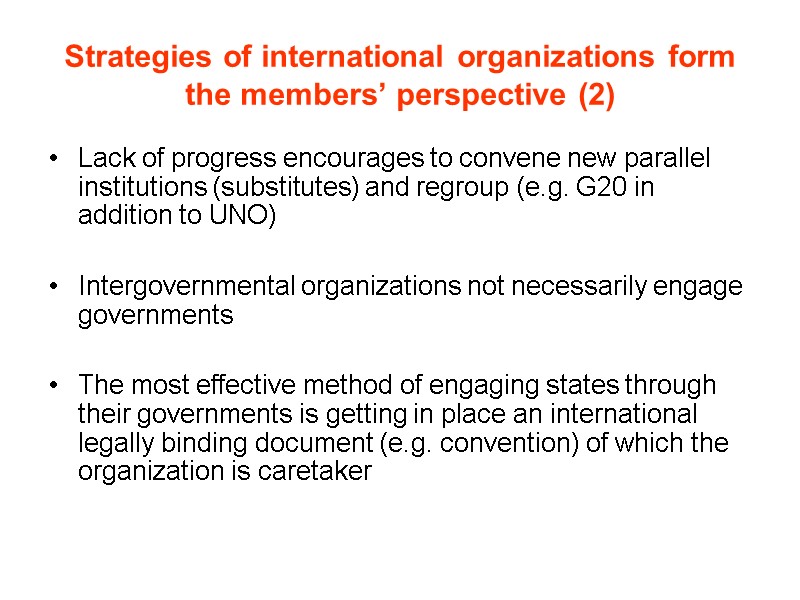
Strategies of international organizations form the members’ perspective (2) Lack of progress encourages to convene new parallel institutions (substitutes) and regroup (e.g. G20 in addition to UNO) Intergovernmental organizations not necessarily engage governments The most effective method of engaging states through their governments is getting in place an international legally binding document (e.g. convention) of which the organization is caretaker
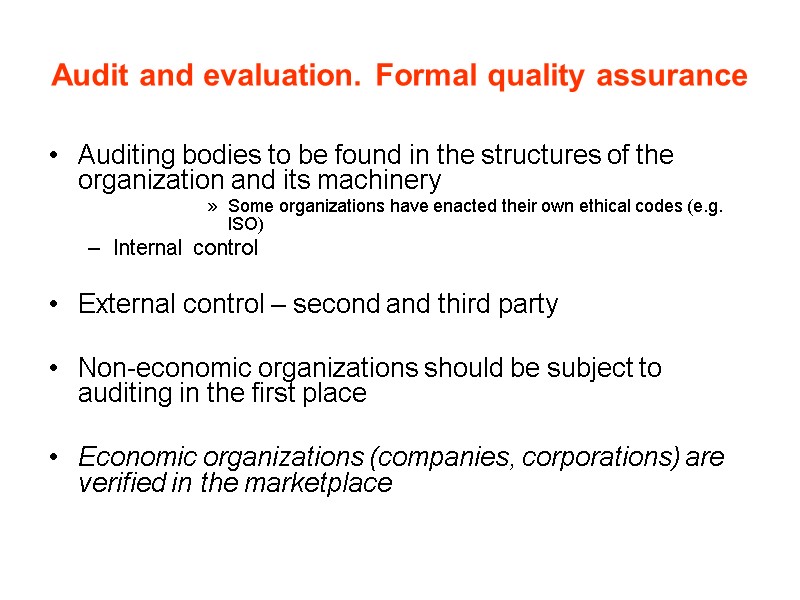
Audit and evaluation. Formal quality assurance Auditing bodies to be found in the structures of the organization and its machinery Some organizations have enacted their own ethical codes (e.g. ISO) Internal control External control – second and third party Non-economic organizations should be subject to auditing in the first place Economic organizations (companies, corporations) are verified in the marketplace
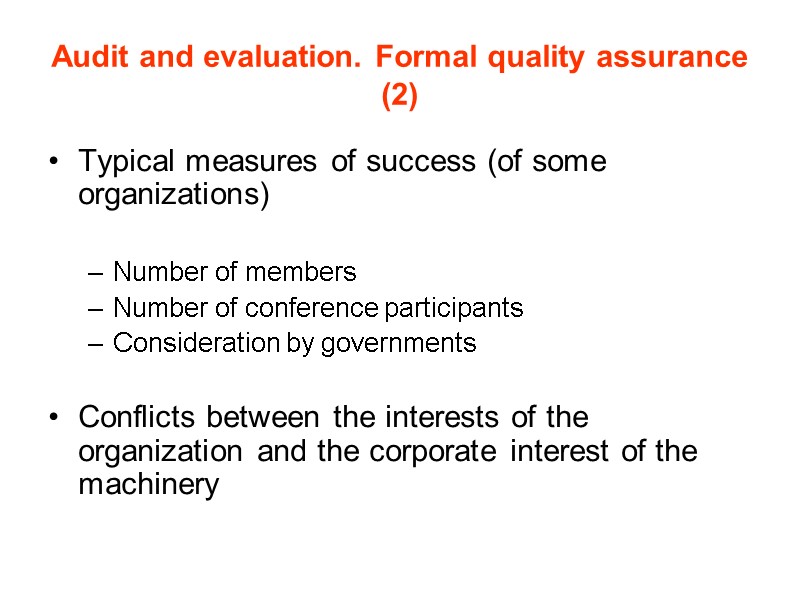
Audit and evaluation. Formal quality assurance (2) Typical measures of success (of some organizations) Number of members Number of conference participants Consideration by governments Conflicts between the interests of the organization and the corporate interest of the machinery
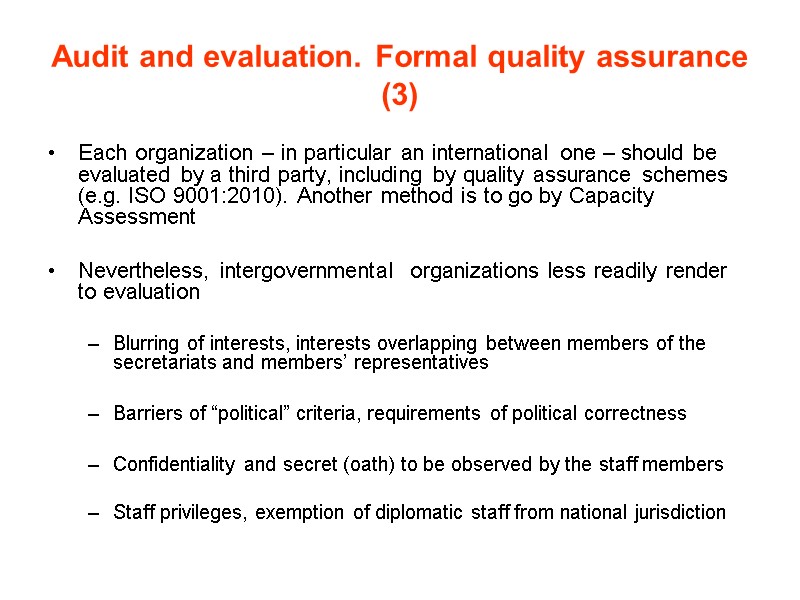
Audit and evaluation. Formal quality assurance (3) Each organization – in particular an international one – should be evaluated by a third party, including by quality assurance schemes (e.g. ISO 9001:2010). Another method is to go by Capacity Assessment Nevertheless, intergovernmental organizations less readily render to evaluation Blurring of interests, interests overlapping between members of the secretariats and members’ representatives Barriers of “political” criteria, requirements of political correctness Confidentiality and secret (oath) to be observed by the staff members Staff privileges, exemption of diplomatic staff from national jurisdiction
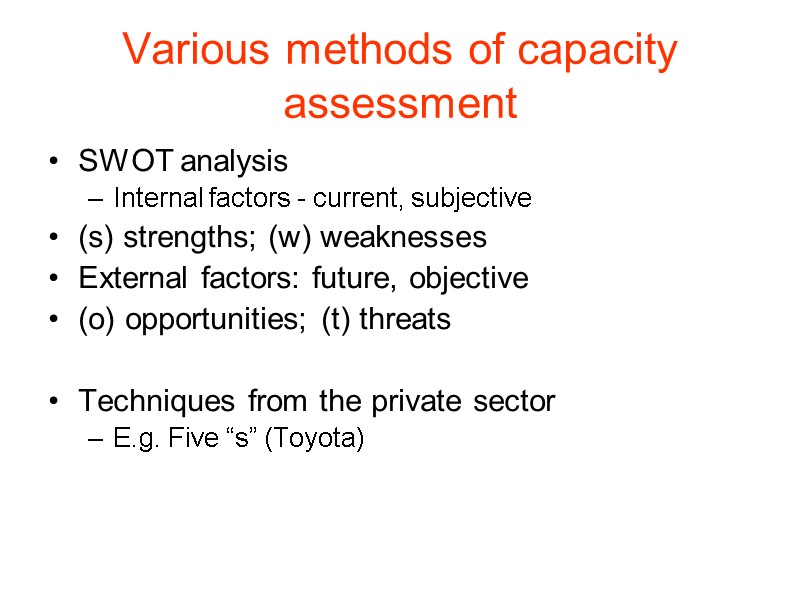
Various methods of capacity assessment SWOT analysis Internal factors - current, subjective (s) strengths; (w) weaknesses External factors: future, objective (o) opportunities; (t) threats Techniques from the private sector E.g. Five “s” (Toyota)
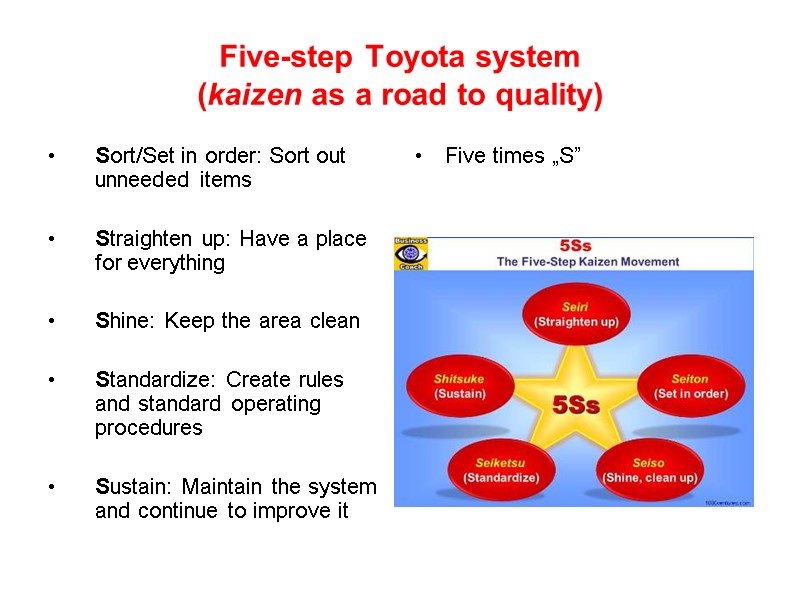
Five-step Toyota system (kaizen as a road to quality) Sort/Set in order: Sort out unneeded items Straighten up: Have a place for everything Shine: Keep the area clean Standardize: Create rules and standard operating procedures Sustain: Maintain the system and continue to improve it Five times „S”
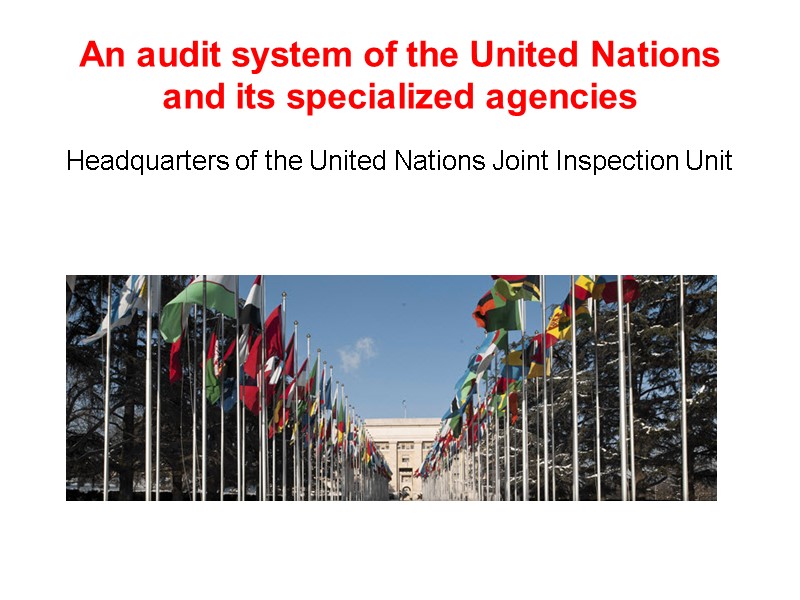
An audit system of the United Nations and its specialized agencies Headquarters of the United Nations Joint Inspection Unit
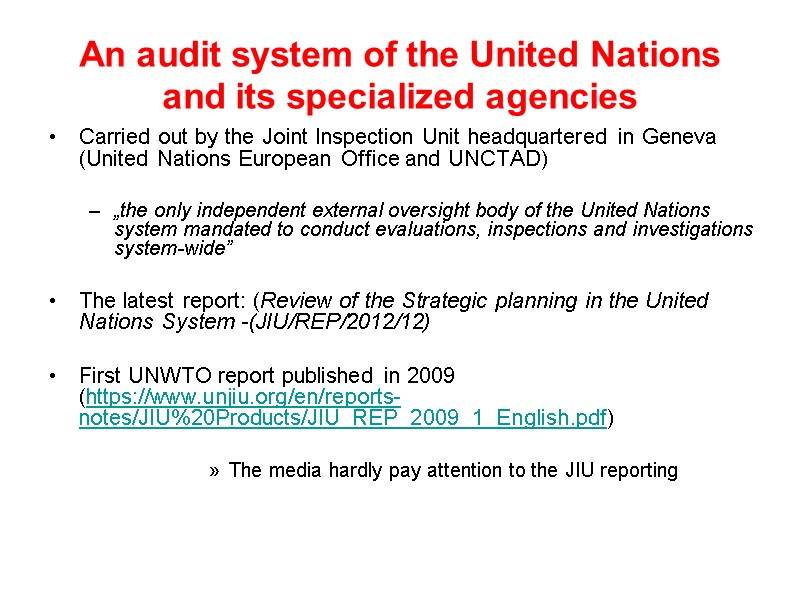
An audit system of the United Nations and its specialized agencies Carried out by the Joint Inspection Unit headquartered in Geneva (United Nations European Office and UNCTAD) „the only independent external oversight body of the United Nations system mandated to conduct evaluations, inspections and investigations system-wide” The latest report: (Review of the Strategic planning in the United Nations System -(JIU/REP/2012/12) First UNWTO report published in 2009 (https://www.unjiu.org/en/reports-notes/JIU%20Products/JIU_REP_2009_1_English.pdf) The media hardly pay attention to the JIU reporting
End of Part 1 (ITO)