

International Tourism Organizations (2) Henryk Handszuh Katowice School


 Скачать презентацию International Tourism Organizations (2) Henryk Handszuh Katowice School
34518-ito2.ppt
- Количество слайдов: 24
International Tourism Organizations (2) Henryk Handszuh Katowice School of Economics (GWSH) Plenipotentiary, International Documentation and Research Centre on Industrial Heritage for Tourism Madrid – Zabrze Fmr. Director, Market Department World Tourism Organization – UNWTO, Madrid
Part 2 United Nations and its organs
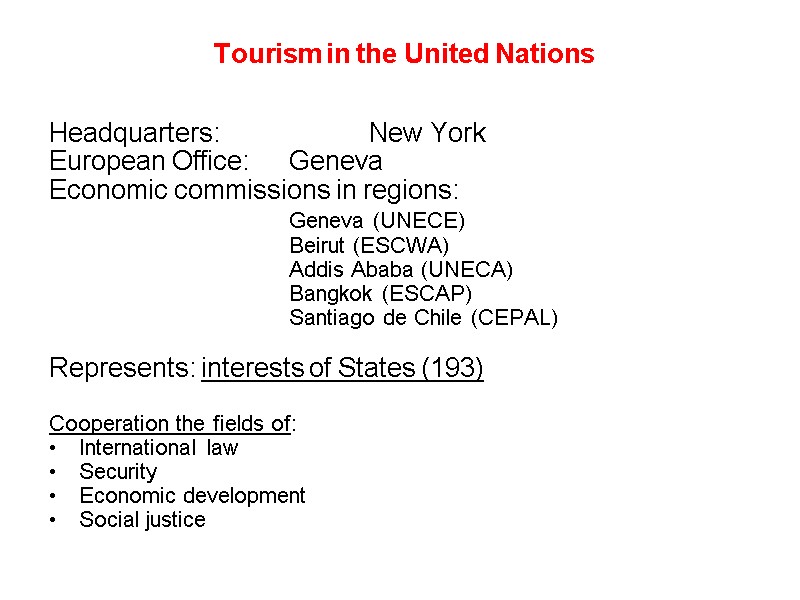
Tourism in the United Nations Headquarters: New York European Office: Geneva Economic commissions in regions: Geneva (UNECE) Beirut (ESCWA) Addis Ababa (UNECA) Bangkok (ESCAP) Santiago de Chile (CEPAL) Represents: interests of States (193) Cooperation the fields of: International law Security Economic development Social justice
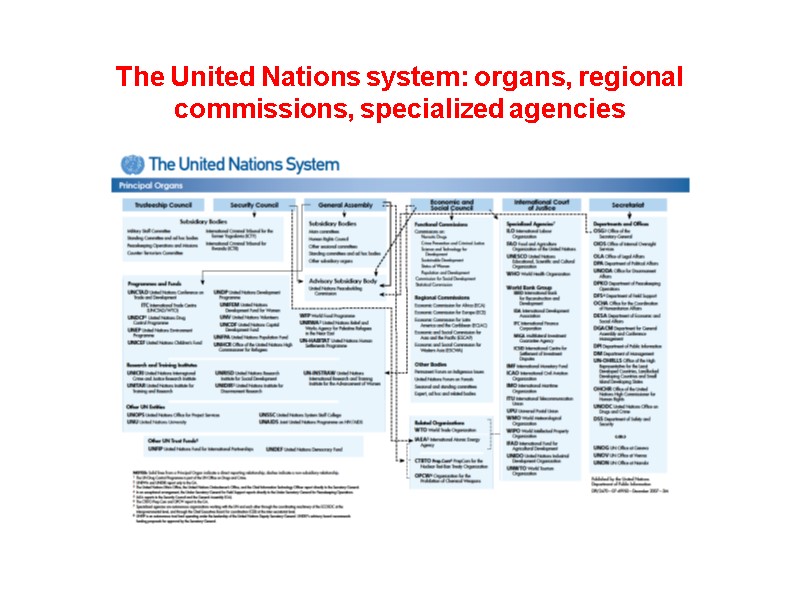
The United Nations system: organs, regional commissions, specialized agencies
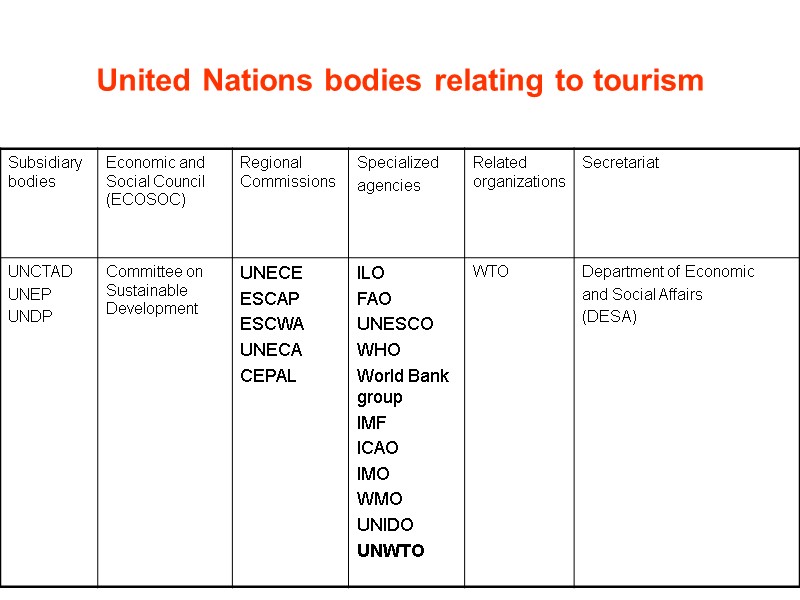
United Nations bodies relating to tourism
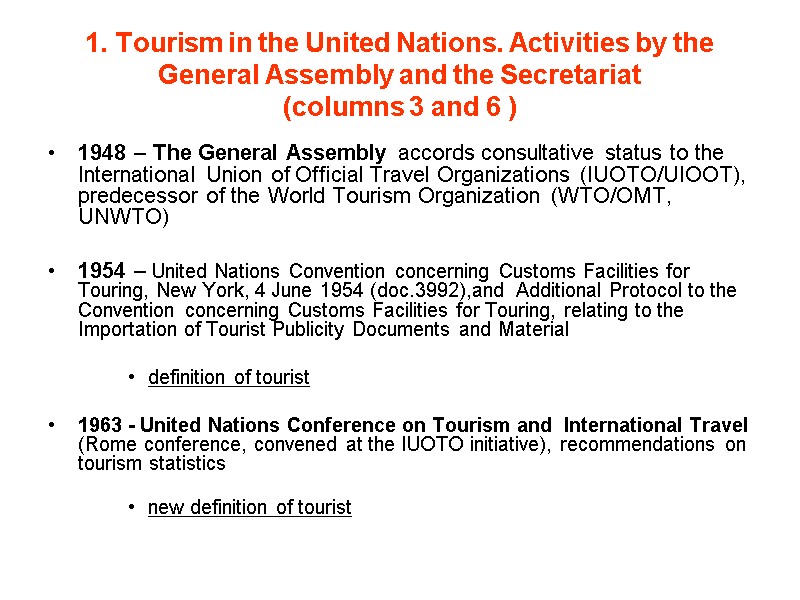
1. Tourism in the United Nations. Activities by the General Assembly and the Secretariat (columns 3 and 6 ) 1948 – The General Assembly accords consultative status to the International Union of Official Travel Organizations (IUOTO/UIOOT), predecessor of the World Tourism Organization (WTO/OMT, UNWTO) 1954 – United Nations Convention concerning Customs Facilities for Touring, New York, 4 June 1954 (doc.3992),and Additional Protocol to the Convention concerning Customs Facilities for Touring, relating to the Importation of Tourist Publicity Documents and Material definition of tourist 1963 - United Nations Conference on Tourism and International Travel (Rome conference, convened at the IUOTO initiative), recommendations on tourism statistics new definition of tourist
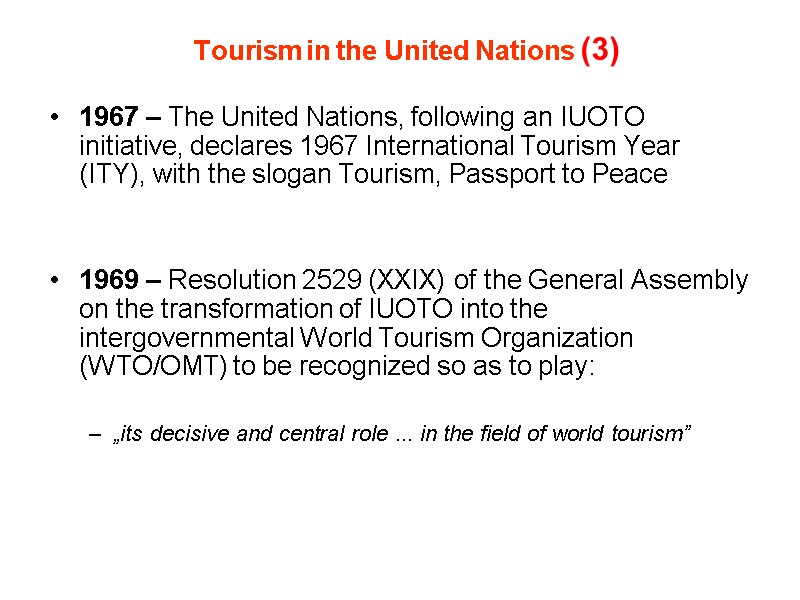
Tourism in the United Nations (3) 1967 – The United Nations, following an IUOTO initiative, declares 1967 International Tourism Year (ITY), with the slogan Tourism, Passport to Peace 1969 – Resolution 2529 (XXIX) of the General Assembly on the transformation of IUOTO into the intergovernmental World Tourism Organization (WTO/OMT) to be recognized so as to play: „its decisive and central role ... in the field of world tourism”
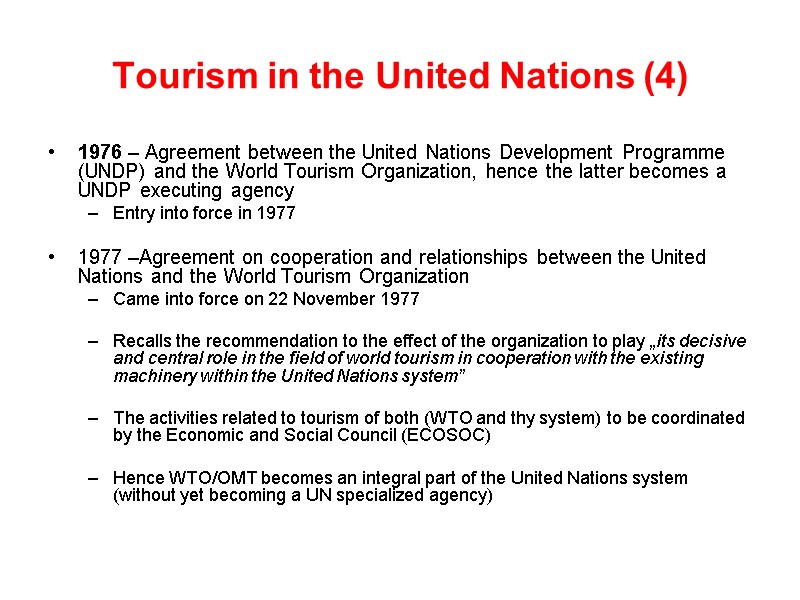
Tourism in the United Nations (4) 1976 – Agreement between the United Nations Development Programme (UNDP) and the World Tourism Organization, hence the latter becomes a UNDP executing agency Entry into force in 1977 1977 –Agreement on cooperation and relationships between the United Nations and the World Tourism Organization Came into force on 22 November 1977 Recalls the recommendation to the effect of the organization to play „its decisive and central role in the field of world tourism in cooperation with the existing machinery within the United Nations system” The activities related to tourism of both (WTO and thy system) to be coordinated by the Economic and Social Council (ECOSOC) Hence WTO/OMT becomes an integral part of the United Nations system (without yet becoming a UN specialized agency)
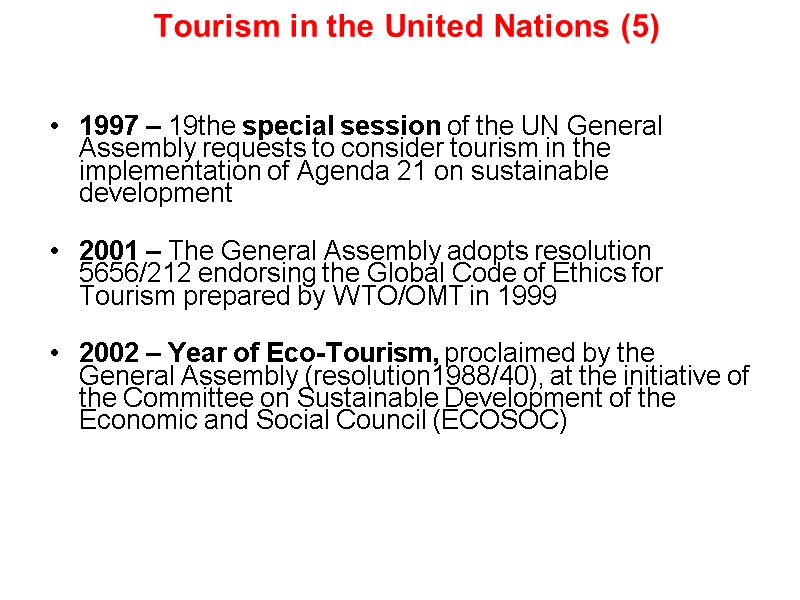
Tourism in the United Nations (5) 1997 – 19the special session of the UN General Assembly requests to consider tourism in the implementation of Agenda 21 on sustainable development 2001 – The General Assembly adopts resolution 5656/212 endorsing the Global Code of Ethics for Tourism prepared by WTO/OMT in 1999 2002 – Year of Eco-Tourism, proclaimed by the General Assembly (resolution1988/40), at the initiative of the Committee on Sustainable Development of the Economic and Social Council (ECOSOC)
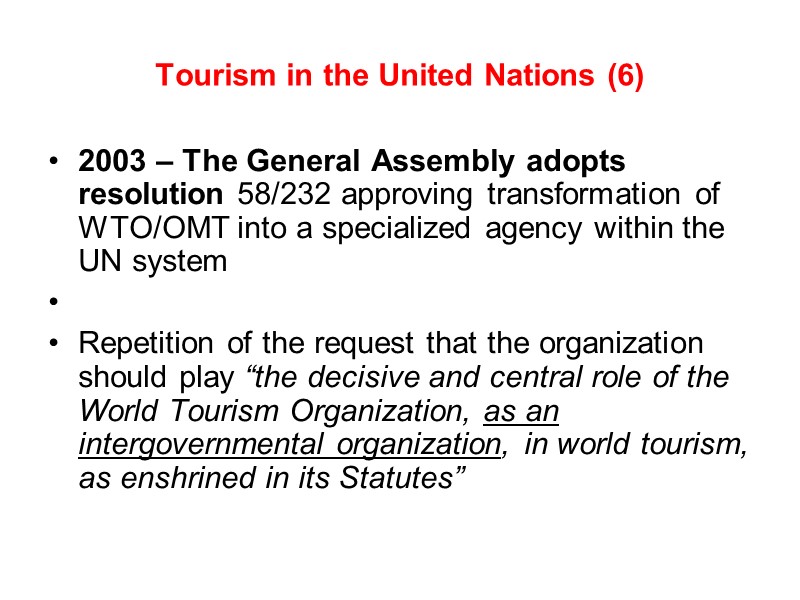
Tourism in the United Nations (6) 2003 – The General Assembly adopts resolution 58/232 approving transformation of WTO/OMT into a specialized agency within the UN system Repetition of the request that the organization should play “the decisive and central role of the World Tourism Organization, as an intergovernmental organization, in world tourism, as enshrined in its Statutes”
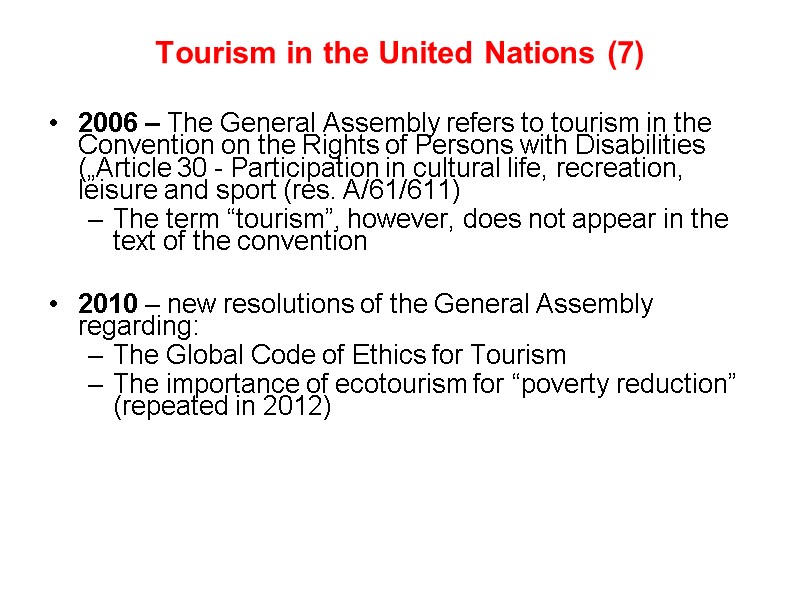
Tourism in the United Nations (7) 2006 – The General Assembly refers to tourism in the Convention on the Rights of Persons with Disabilities („Article 30 - Participation in cultural life, recreation, leisure and sport (res. A/61/611) The term “tourism”, however, does not appear in the text of the convention 2010 – new resolutions of the General Assembly regarding: The Global Code of Ethics for Tourism The importance of ecotourism for “poverty reduction” (repeated in 2012)
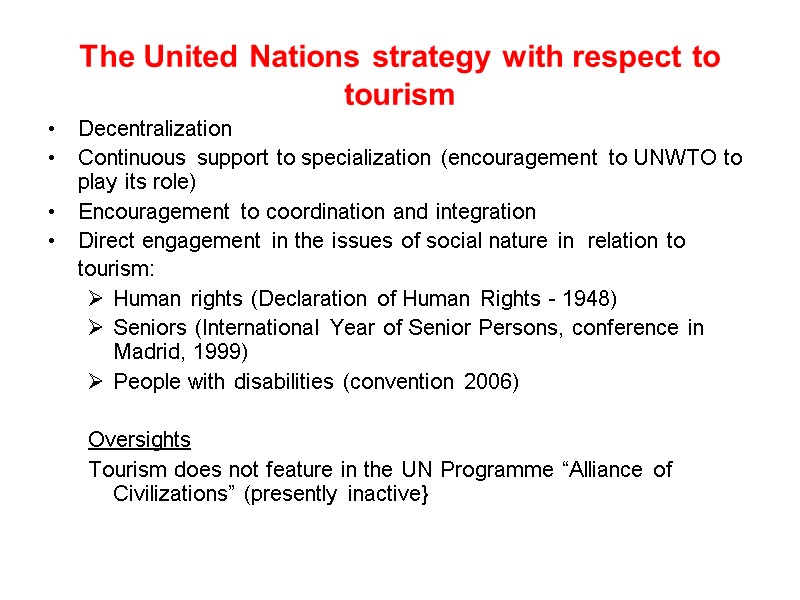
The United Nations strategy with respect to tourism Decentralization Continuous support to specialization (encouragement to UNWTO to play its role) Encouragement to coordination and integration Direct engagement in the issues of social nature in relation to tourism: Human rights (Declaration of Human Rights - 1948) Seniors (International Year of Senior Persons, conference in Madrid, 1999) People with disabilities (convention 2006) Oversights Tourism does not feature in the UN Programme “Alliance of Civilizations” (presently inactive}
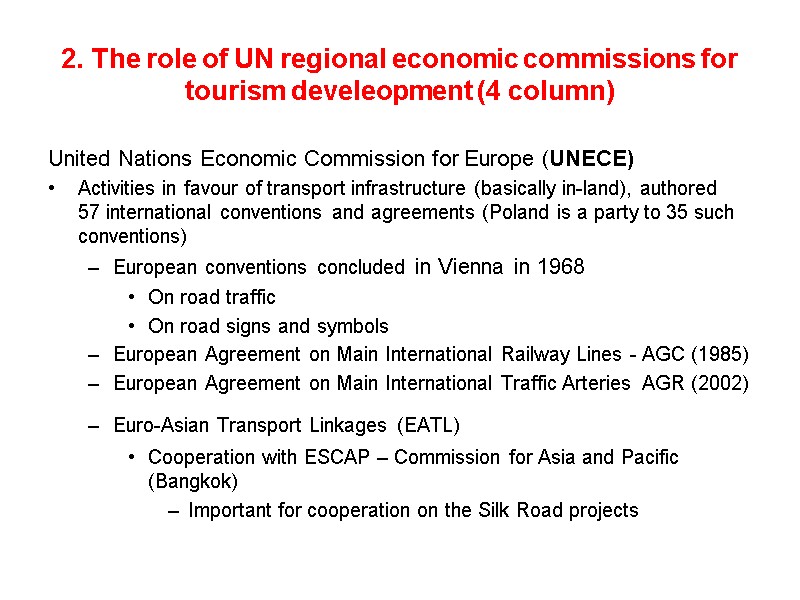
2. The role of UN regional economic commissions for tourism develeopment (4 column) United Nations Economic Commission for Europe (UNECE) Activities in favour of transport infrastructure (basically in-land), authored 57 international conventions and agreements (Poland is a party to 35 such conventions) European conventions concluded in Vienna in 1968 On road traffic On road signs and symbols European Agreement on Main International Railway Lines - AGC (1985) European Agreement on Main International Traffic Arteries AGR (2002) Euro-Asian Transport Linkages (EATL) Cooperation with ESCAP – Commission for Asia and Pacific (Bangkok) Important for cooperation on the Silk Road projects
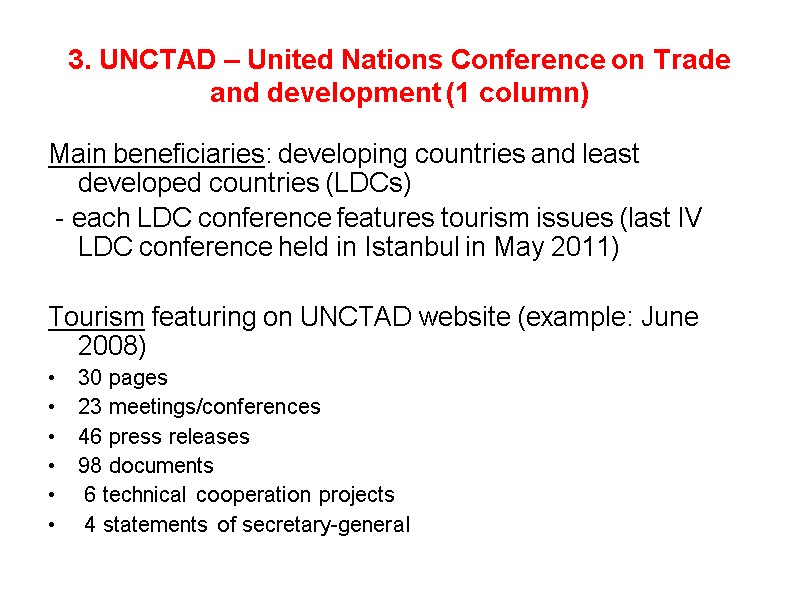
3. UNCTAD – United Nations Conference on Trade and development (1 column) Main beneficiaries: developing countries and least developed countries (LDCs) - each LDC conference features tourism issues (last IV LDC conference held in Istanbul in May 2011) Tourism featuring on UNCTAD website (example: June 2008) 30 pages 23 meetings/conferences 46 press releases 98 documents 6 technical cooperation projects 4 statements of secretary-general
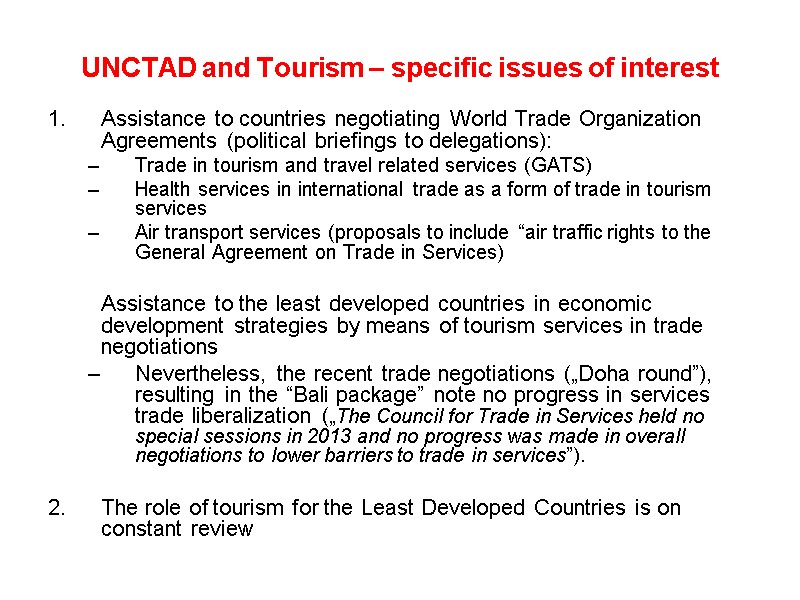
UNCTAD and Tourism – specific issues of interest Assistance to countries negotiating World Trade Organization Agreements (political briefings to delegations): Trade in tourism and travel related services (GATS) Health services in international trade as a form of trade in tourism services Air transport services (proposals to include “air traffic rights to the General Agreement on Trade in Services) Assistance to the least developed countries in economic development strategies by means of tourism services in trade negotiations Nevertheless, the recent trade negotiations („Doha round”), resulting in the “Bali package” note no progress in services trade liberalization („The Council for Trade in Services held no special sessions in 2013 and no progress was made in overall negotiations to lower barriers to trade in services”). The role of tourism for the Least Developed Countries is on constant review
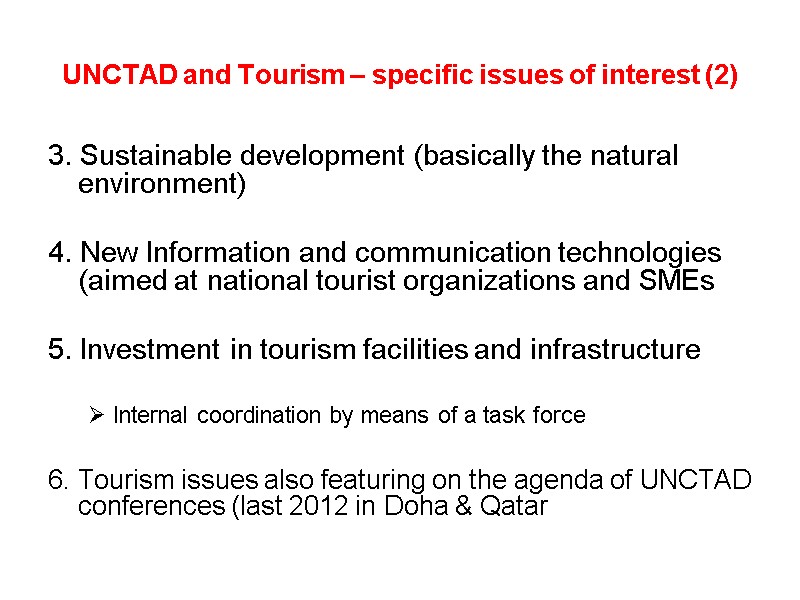
UNCTAD and Tourism – specific issues of interest (2) 3. Sustainable development (basically the natural environment) 4. New Information and communication technologies (aimed at national tourist organizations and SMEs 5. Investment in tourism facilities and infrastructure Internal coordination by means of a task force 6. Tourism issues also featuring on the agenda of UNCTAD conferences (last 2012 in Doha & Qatar
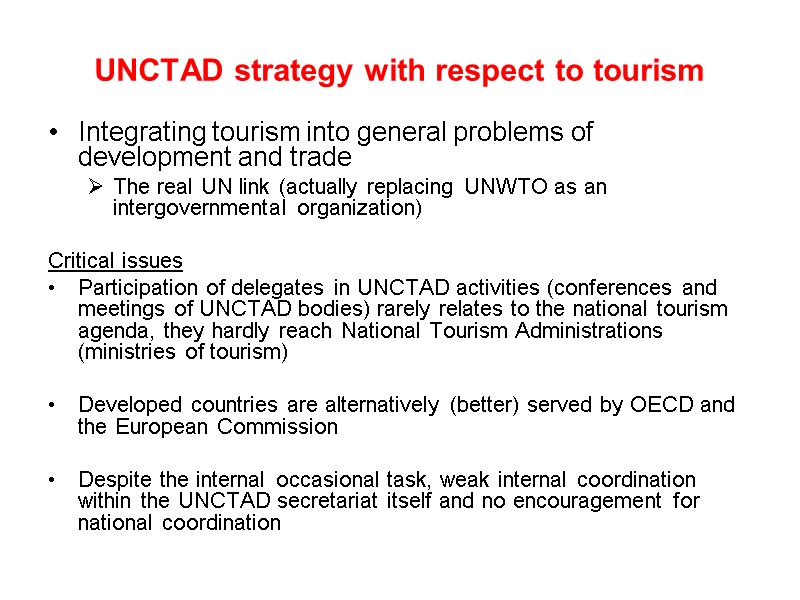
UNCTAD strategy with respect to tourism Integrating tourism into general problems of development and trade The real UN link (actually replacing UNWTO as an intergovernmental organization) Critical issues Participation of delegates in UNCTAD activities (conferences and meetings of UNCTAD bodies) rarely relates to the national tourism agenda, they hardly reach National Tourism Administrations (ministries of tourism) Developed countries are alternatively (better) served by OECD and the European Commission Despite the internal occasional task, weak internal coordination within the UNCTAD secretariat itself and no encouragement for national coordination
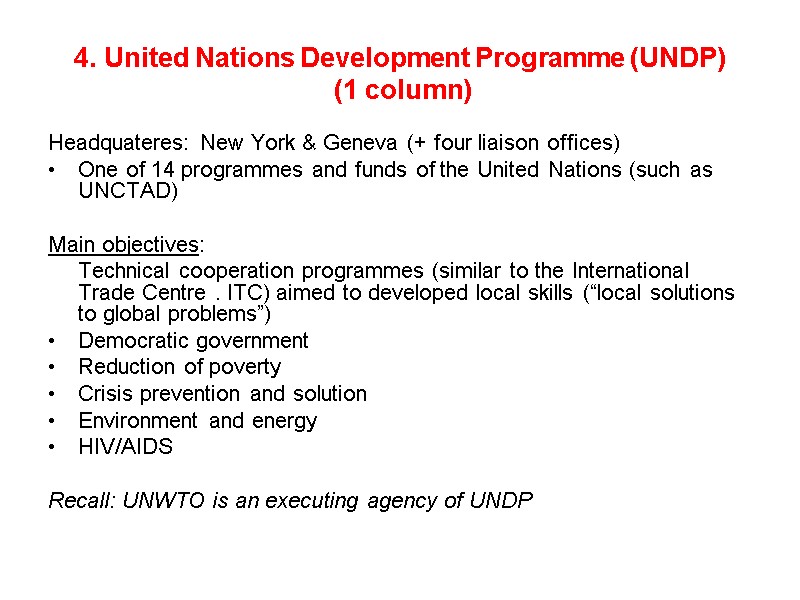
4. United Nations Development Programme (UNDP) (1 column) Headquateres: New York & Geneva (+ four liaison offices) One of 14 programmes and funds of the United Nations (such as UNCTAD) Main objectives: Technical cooperation programmes (similar to the International Trade Centre . ITC) aimed to developed local skills (“local solutions to global problems”) Democratic government Reduction of poverty Crisis prevention and solution Environment and energy HIV/AIDS Recall: UNWTO is an executing agency of UNDP
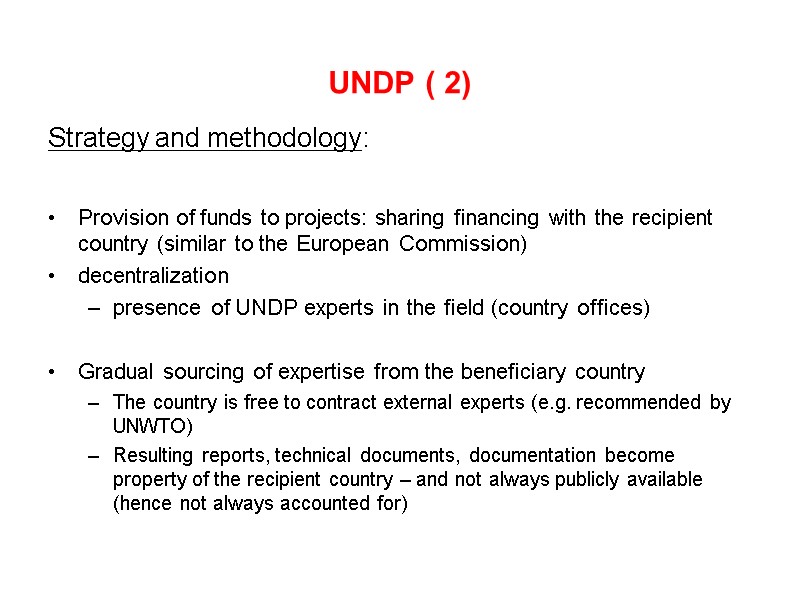
UNDP ( 2) Strategy and methodology: Provision of funds to projects: sharing financing with the recipient country (similar to the European Commission) decentralization presence of UNDP experts in the field (country offices) Gradual sourcing of expertise from the beneficiary country The country is free to contract external experts (e.g. recommended by UNWTO) Resulting reports, technical documents, documentation become property of the recipient country – and not always publicly available (hence not always accounted for)
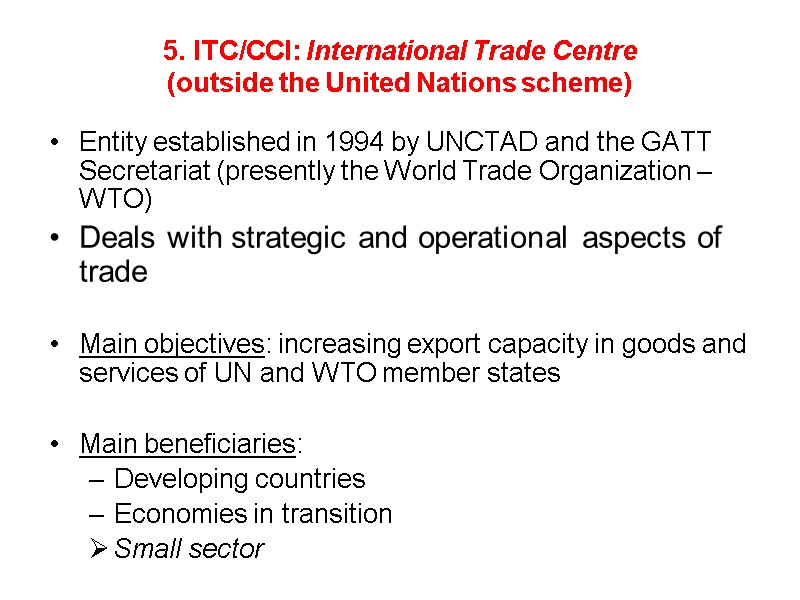
5. ITC/CCI: International Trade Centre (outside the United Nations scheme) Entity established in 1994 by UNCTAD and the GATT Secretariat (presently the World Trade Organization – WTO) Deals with strategic and operational aspects of trade Main objectives: increasing export capacity in goods and services of UN and WTO member states Main beneficiaries: Developing countries Economies in transition Small sector
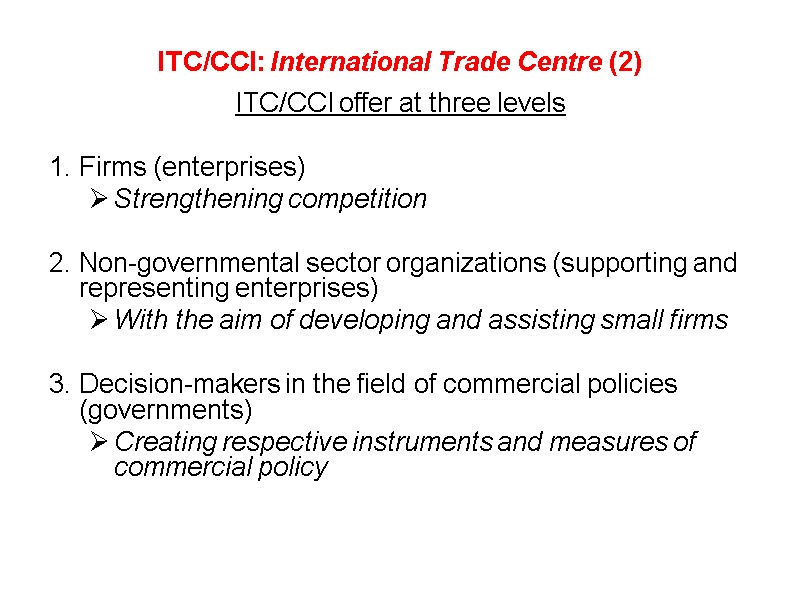
ITC/CCI: International Trade Centre (2) ITC/CCI offer at three levels 1. Firms (enterprises) Strengthening competition 2. Non-governmental sector organizations (supporting and representing enterprises) With the aim of developing and assisting small firms 3. Decision-makers in the field of commercial policies (governments) Creating respective instruments and measures of commercial policy
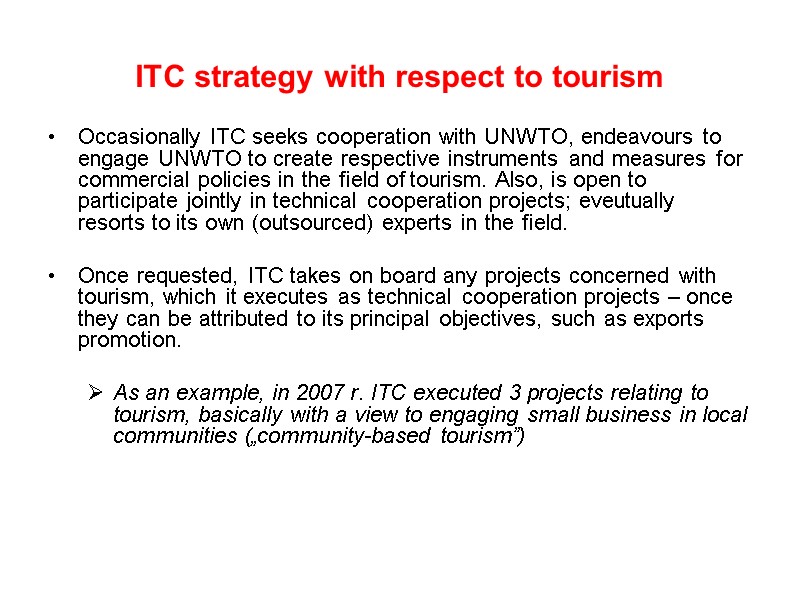
ITC strategy with respect to tourism Occasionally ITC seeks cooperation with UNWTO, endeavours to engage UNWTO to create respective instruments and measures for commercial policies in the field of tourism. Also, is open to participate jointly in technical cooperation projects; eveutually resorts to its own (outsourced) experts in the field. Once requested, ITC takes on board any projects concerned with tourism, which it executes as technical cooperation projects – once they can be attributed to its principal objectives, such as exports promotion. As an example, in 2007 r. ITC executed 3 projects relating to tourism, basically with a view to engaging small business in local communities („community-based tourism”)
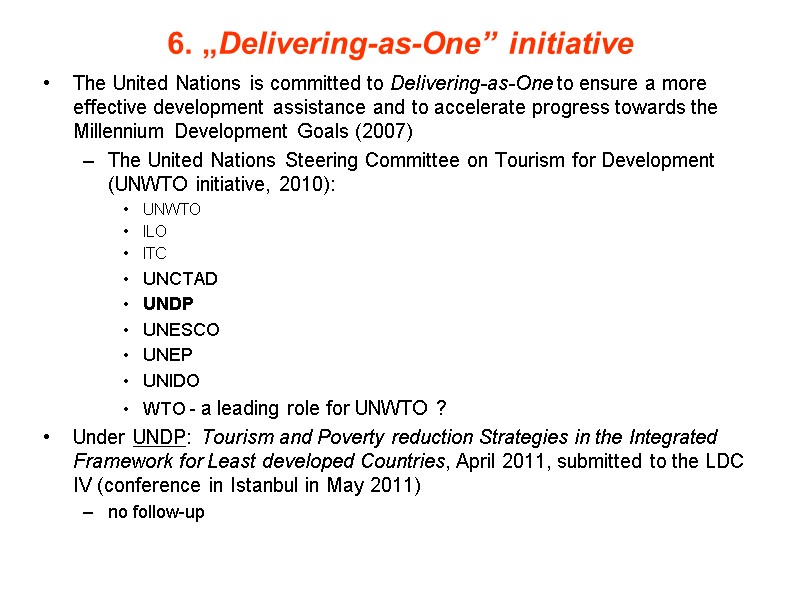
6. „Delivering-as-One” initiative The United Nations is committed to Delivering-as-One to ensure a more effective development assistance and to accelerate progress towards the Millennium Development Goals (2007) The United Nations Steering Committee on Tourism for Development (UNWTO initiative, 2010): UNWTO ILO ITC UNCTAD UNDP UNESCO UNEP UNIDO WTO - a leading role for UNWTO ? Under UNDP: Tourism and Poverty reduction Strategies in the Integrated Framework for Least developed Countries, April 2011, submitted to the LDC IV (conference in Istanbul in May 2011) no follow-up
End of Part 2