


 Скачать презентацию International Tourism Market Part IV Henryk Handszuh Katowice
ITM-KA5.pptx
- Количество слайдов: 25
 International Tourism Market (Part IV) Henryk Handszuh Katowice School of Economics (GWSH) Plenipotentiary, International Documentation and Research Centre on Industrial Heritage for Tourism Madrid – Zabrze Fmr. Director, Market Department World Tourism Organization – UNWTO, Madrid
 Part IV. The International Tourism Market from the perspective of the world economy of today
 Current economy and economics essentials and their relevance for tourism • A “conservative” (retreat) or “neoliberal” revolution identified with politicians Margaret Thatcher (UK) and Ronald Reagan (USA)- going back to the twenties – as of 1973, identified with progressive (financial) market deregulation – strengthened by opportunistic approaches of social-democratic parties (e. g. Tony Blair’s “third way”, an in-between concept of state interventionism and free market economy) • “The End of History” (as seen from the West), declared by famed Francis Fukuyama (1989) – accompanied by the failure and fall of the bureaucrats` (technocrats’) planned economies and states implementing a sectarian communist doctrine of “scientific socialism”, basing their credentials on a peculiar interpretation of western Marxist philosophy applied to, and enforced upon, little or less economically developed countries
 Current economy and economics essentials and their relevance for tourism (2) • Moved the attention towards efficiency in economic management, expected to reward all layers of society – Macroeconomics managed by “natural and appropriate” allocation of investment through free financial markets – Efficient management seeking financial yield above all in microeconomics (at company level) • Hence proliferating management/MBA studies
 Current economy and economics essentials and their relevance for tourism (3) • Belief: The resulting abundance of goods and services (true!) would make the previous quest for aiding the poor or attain (more) economic equality less important or even irrelevant – everyone would eventually get more and better, the bottom layer will go upward • True in some ways (millions indeed got out of poverty in China, India, Brazil, but with continued, less rigid State regulation)
 Beliefs and results for the present economic system Result: Market deregulation or liberalization has progressed significantly with respect to financial markets – Financial markets and finance engineering have produced a myriad of “financial products” whose underlying aim is to reward capital (the majority holders of capital). This appeared detrimental to the other holders of the factors of production and resulted in the appropriation by the capital holders of the value added from real economy – Financial markets have taken control of the economy – Financial gain from a productive activity, at any cost, has become a driving force of the economy. All economy is viewed as a vulgar “business” • This replaced the former (expected) industry/producer/trade approach to satisfy the customer first at a fair price in order to gain a decent income
 The role of the financial sector • The market deregulation, especially the “finance-driven” liberalization, has made remarkable inroads into and impacted globalization. The tourism sector is part of it • The middle class and States had to borrow more and more money in order to keep up with access to the abundance of goods and services and to increased consumption as an economy driver. This brought about excessive and wasteful consumption, also in the tourism sector (waste of food is a telling example). • The banks’ and stocks’ policy was to keep lending and stimulate lending in order to facilitate consumption. They also forcefully engaged in finance speculation (contrary to the rule “don’t risk more than you are prepared to lose”), thus giving rise to a global gambling house
 Consequences at social and political level • The “financial markets” present the bills to the indebted States, the middle class (including the emerging or expectant would-be middle class) and companies in the “real economy”. – A vicious circle of indebtedness has been created • States are pressed to cut on public expenditure (funded by taxes from citizens and companies) and to privatize or sell public goods and companies in order to balance their budgets and pay their debts (e. g. bonds) with accumulating, elevated and floating interests
 Consequences at social and political level (2) • Increasing public/State costs of security and military; growing, extreme inequality and the new poor - “out-people”, social tensions and conflicts challenging the weakened and questionable democratic rule • Increasing or endemic unemployment, stagnant or shrinking GDP • Cutting on aid to underdeveloped countries • As “a driver of the economy”, consumption can hardly increase and provide new income to States. It will increase if there is new consumer confidence (which may be irrational)
 The way forward (? ) • The crisis and the “end of history” are viewed and sensed in a different manner from the underdeveloped (other than “Western”) world • The Arab Spring as an expression of frustration and accumulated envies against the ruling (economic) elites. Democracy expected to bring economic justice • The system nevertheless continues: Tax havens remain largely intact, States (including those of EU) find themselves unable to change the system because there continues to be “no alternative”. The eurozone continues under pressure and threatened; within EU, the weakened European Commission vis-à-vis the European Central Bank
 The way forward (? ) • Austerity (promoted from Germany and the European Commission) continues to be seen as a remedy to start anew, but also, when it comes to the banking system – back to business as usual, but under tighter bank controls under discussion in the years to come • A privileged position of the US dollar printed at will by Federal Reserve • New impetus to social economy undertakings: political debate
 Effects for tourism – the tourism sector resets and adjusts to uncertainty • The situation directly affects the seller and the buyer in the tourism market • Financial speculators disrupt airfares, marketing budgets, food prices • MNCs (including WT&TC members…) call for tax-breaks, while being targeted by tax authorities on suspicion of tax evasion
 Effects for tourism – the tourism sector resets and adjusts to uncertainty (2) • Genuine gambling houses on the increase (Asia – Pacific, South of Europe) • The genuine tourism consumer is still firm in his/her acquired habit of holidaymaking (e. g. when it comes to international travel in Europe and “new arrivals” in Asia) • The future (“up to 2030”…) perceived as slower numerical growth (UNWTO forecast 2011) – not confirmed by 2012 data in terms of the volume of trips by tourism consumers, but again strengthened by 2013 figures (volatility)
 Effects for tourism (3) • The tourism sector has largely “survived” at the expense of quality and stability: – Poorer, standard quality for the consumer – Jobs volatile and temporarily lost • a paradigm for the whole economy? – Under-utilized production capacity • Air transport (relative) • Hotels, apartments – Gaining on cancellation policy (similar to airlines) • Middlemen (travel agents), increase of online companies • Competition and fusion of reservation systems
 Effects for tourism (4) • Tourism accommodation: black and para-market, sharing economy travel, peer-to-peer (couchsurfing), ridesharing • Fiercer competition: innovation, new products, new destinations offering similar products (holiday breaks), lower prices • Growth of “low-cost” air carriers, trouble for flagship airlines (LOT, Iberia, American Airlines, Alitalia, KLM, Air France, Lufthansa…) • Growth of upper-class, upscale and elite travel
 Recent hotel developments and outcomes worldwide • Global hotel rates have increased 2% in the last year (2012), offset by a world inflation rate of 4. 2%, ” (Magnuson Worldwide, CEO Thomas Magnuson) – “Owners can no longer count on rate or demand increases for profitability, but they can regain profits quickly with a consistent low cost operating strategy. ” • Source: Annual Hotel Conference in Manchester UK, October 2013 at http: //www. hotelnewsnow. com
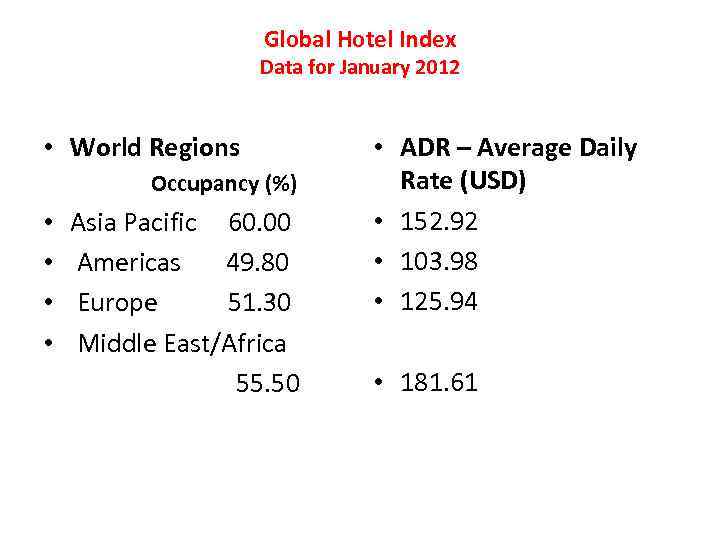 Global Hotel Index Data for January 2012 • World Regions Occupancy (%) • • Asia Pacific 60. 00 Americas 49. 80 Europe 51. 30 Middle East/Africa 55. 50 • ADR – Average Daily Rate (USD) • 152. 92 • 103. 98 • 125. 94 • 181. 61
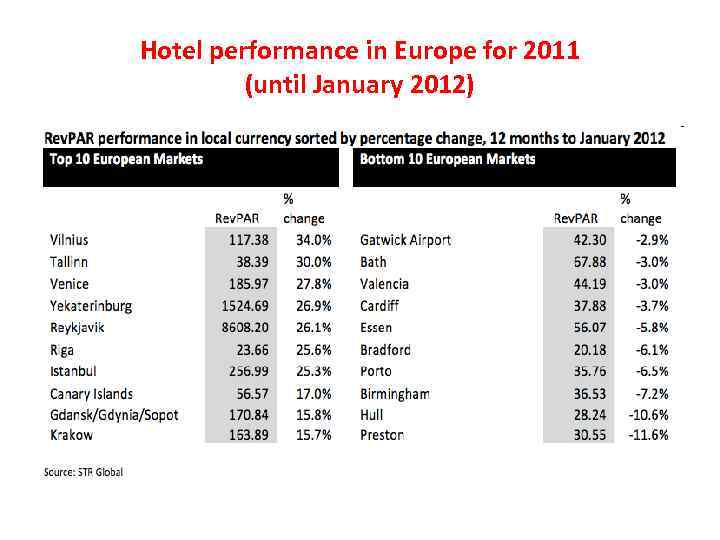 Hotel performance in Europe for 2011 (until January 2012)
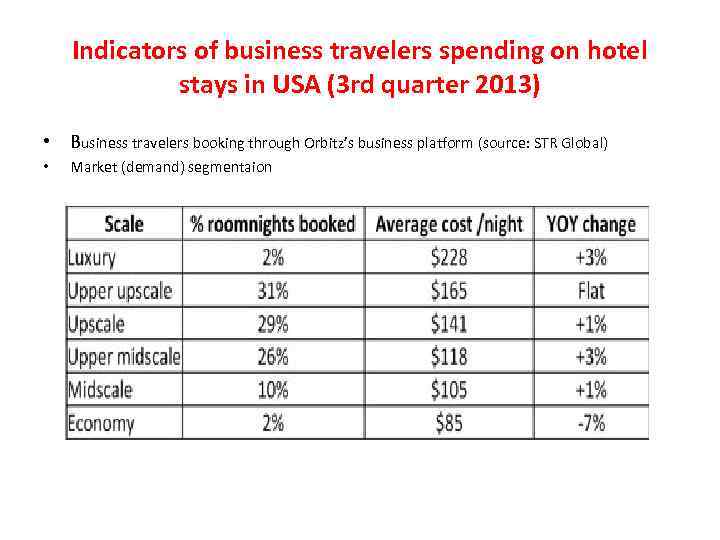 Indicators of business travelers spending on hotel stays in USA (3 rd quarter 2013) • Business travelers booking through Orbitz’s business platform (source: STR Global) • Market (demand) segmentaion
 Reactions seeking to amend and save face • Civil society movements, responsibility groups and charities (“the third sector”), occupy Wall Street and similar giving rise to new radical political parties (right and left) embarking upon tourism • (renewed) Focus on quality and standards • Appealing to professional ethics
 Reactions seeking to amend and save face (2) • Voluntary commitments by companies through Corporate Social Responsibility (CSR) – improving image • Appeals to sustainability (lingering and weakening) – Tourism/hotel professionals initiatives (e. g. SKAL International Ecotourism Awards since 2002) • An inconclusive, lingering debate on actions to undertake through international (intergovernmental) organizations
 Fashionable travel trends in opulent societies and middle class Tapping demand potential • Tapping the PANKs potential (“professional aunts with no kids” – 23 million in USA), childless aunts to connect with their nieces, nephews, godchildren or other kids in their lives – Before: tapping DINKS (“dual income with no kids”) • Europe, USA: Travel in the sharing economy by the young (new peer-topeer) • Multi-generational holidays (Africa: On safari - with the kids!)
 Fashionable travel trends in opulent societies and middle class (2) Information and Communication Technologies (ICT) • Concierge gone mobile • Chasing the 24 -hour traveler (e. g. selling workspaces by the day or hour in formerly unused lobby and meeting spaces, selling rooms on a similar short-term basis • Social media shake-up (eg. India)
 Conclusions • The tourism sector is part of the global picture • Both the producers (the tourism sector) and consumers have to adjust to the market situation at large • Remedies are seen in innovation, including “innovative” ways of seeking financial gains and savings
 End of Part V • To be followed by: • Status and prospects of product development in the international tourism market • Ethical tourism and fair trade • The market taking care of disadvantaged and impaied consumers