 Скачать презентацию International Telecommunication Union The Telecommunication Standardization Sector Fabio
359f79b0e1905cadf2222bd7ab64efce.ppt
- Количество слайдов: 55



International Telecommunication Union The Telecommunication Standardization Sector Fabio Bigi, Greg Jones ITU/TSB E-mail: fabio. bigi@itu. int, greg. jones@itu. int
ITU-T studies, products and priorities l Introduction l Market trends on IP and mobility l ITU-T studies l ITU-T products l ITU-T strategy and priorities l Conclusion 2
International Telecommunication Union l l A UN Specialized Agency Intergovernmental organization, governments represented through their telecommunication Administrations (constitutional Members) Other entities (Recognized Operating Agencies, Scientific Industrial Organizations, regional and international organizations) admitted as Sector members “Basic Law” = Convention and Constitution, to be modified by Plenipotentiary Conferences 3
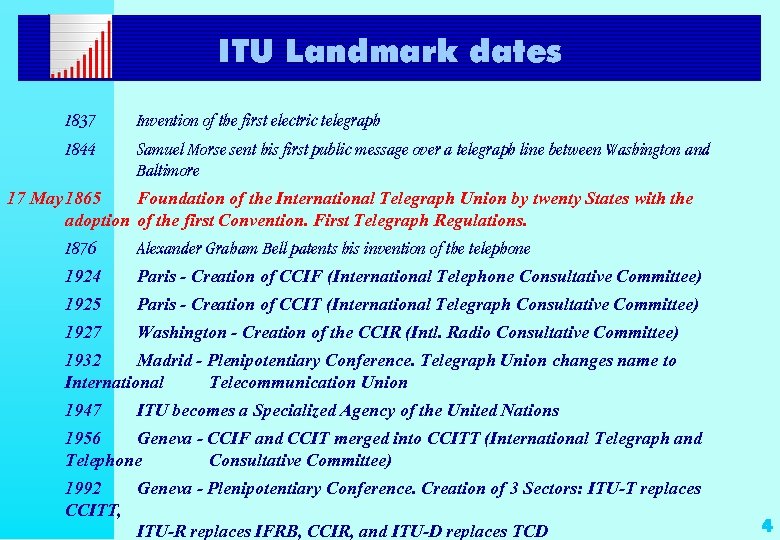
ITU Landmark dates 1837 Invention of the first electric telegraph 1844 Samuel Morse sent his first public message over a telegraph line between Washington and Baltimore 17 May 1865 Foundation of the International Telegraph Union by twenty States with the adoption of the first Convention. First Telegraph Regulations. 1876 Alexander Graham Bell patents his invention of the telephone 1924 Paris - Creation of CCIF (International Telephone Consultative Committee) 1925 Paris - Creation of CCIT (International Telegraph Consultative Committee) 1927 Washington - Creation of the CCIR (Intl. Radio Consultative Committee) 1932 Madrid - Plenipotentiary Conference. Telegraph Union changes name to International Telecommunication Union 1947 ITU becomes a Specialized Agency of the United Nations 1956 Geneva - CCIF and CCIT merged into CCITT (International Telegraph and Telephone Consultative Committee) 1992 Geneva - Plenipotentiary Conference. Creation of 3 Sectors: ITU-T replaces CCITT, ITU-R replaces IFRB, CCIR, and ITU-D replaces TCD 4
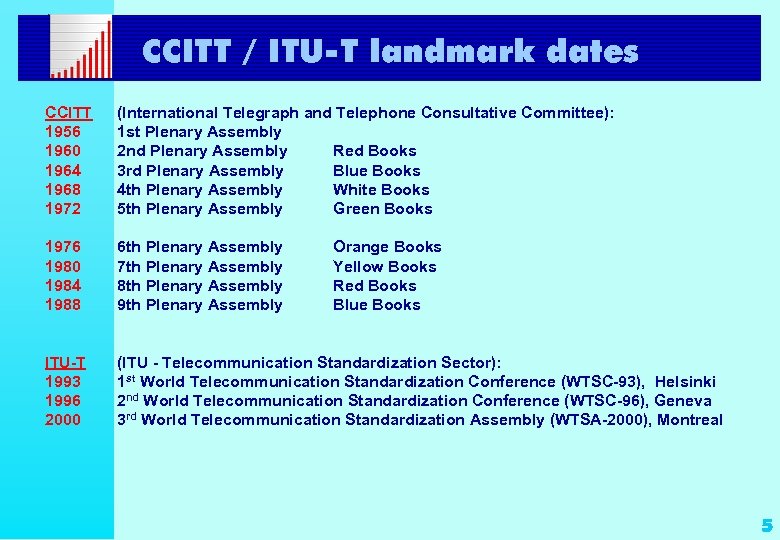
CCITT / ITU-T landmark dates CCITT 1956 1960 1964 1968 1972 (International Telegraph and Telephone Consultative Committee): 1 st Plenary Assembly 2 nd Plenary Assembly Red Books 3 rd Plenary Assembly Blue Books 4 th Plenary Assembly White Books 5 th Plenary Assembly Green Books 1976 1980 1984 1988 6 th Plenary Assembly 7 th Plenary Assembly 8 th Plenary Assembly 9 th Plenary Assembly ITU-T 1993 1996 2000 (ITU - Telecommunication Standardization Sector): 1 st World Telecommunication Standardization Conference (WTSC-93), Helsinki 2 nd World Telecommunication Standardization Conference (WTSC-96), Geneva 3 rd World Telecommunication Standardization Assembly (WTSA-2000), Montreal Orange Books Yellow Books Red Books Blue Books 5
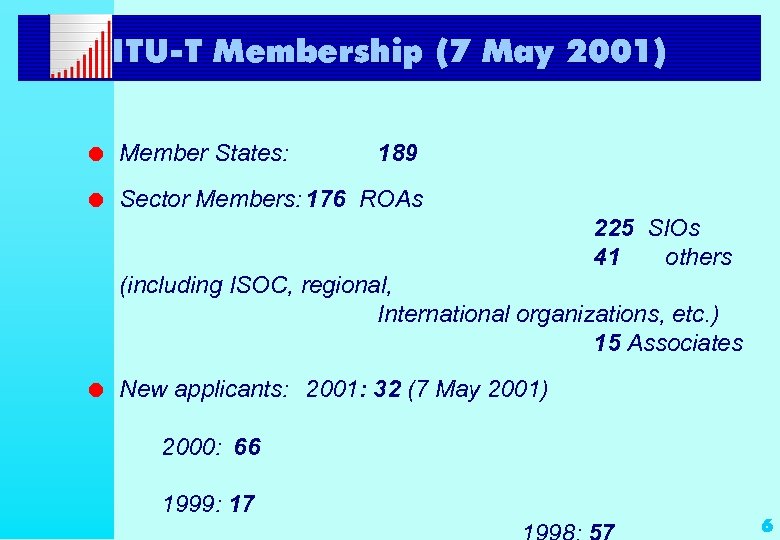
ITU-T Membership (7 May 2001) l Member States: 189 l Sector Members: 176 ROAs 225 SIOs 41 others (including ISOC, regional, International organizations, etc. ) 15 Associates l New applicants: 2001: 32 (7 May 2001) 2000: 66 1999: 17 6
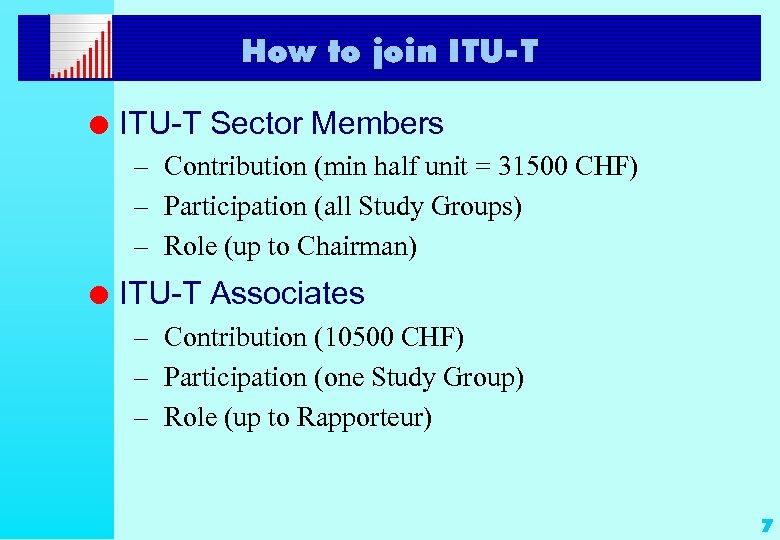
How to join ITU-T l ITU-T Sector Members – Contribution (min half unit = 31500 CHF) – Participation (all Study Groups) – Role (up to Chairman) l ITU-T Associates – Contribution (10500 CHF) – Participation (one Study Group) – Role (up to Rapporteur) 7
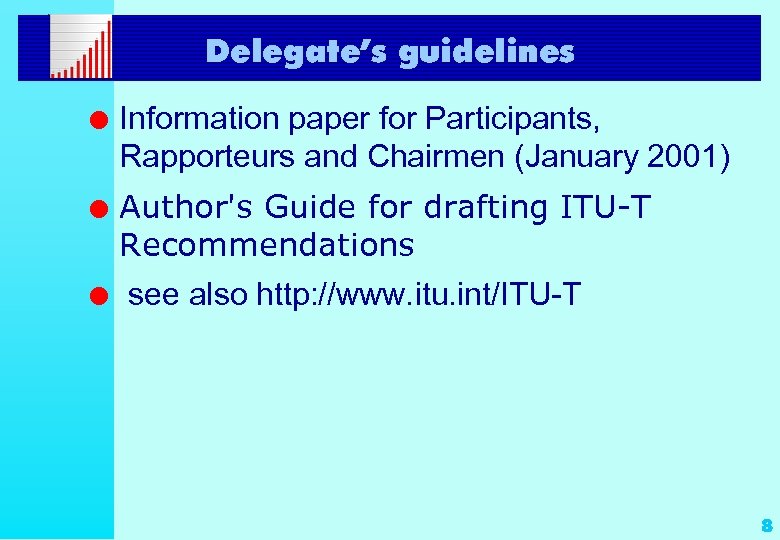
Delegate’s guidelines l l l Information paper for Participants, Rapporteurs and Chairmen (January 2001) Author's Guide for drafting ITU-T Recommendations see also http: //www. itu. int/ITU-T 8
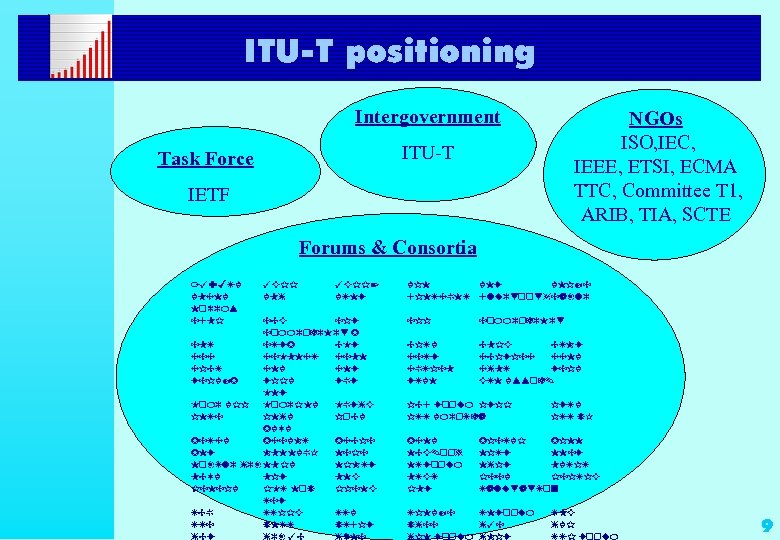
ITU-T positioning Intergovernment NGOs ISO, IEC, IEEE, ETSI, ECMA TTC, Committee T 1, ARIB, TIA, SCTE ITU-T Task Force IETF Forums & Consortia 1394 TA AOEMA Modems CBOP 3 GPP AOW 3 GPP 2 ATMF CDG CIF Commerce. Net J COS CTFJ DHF ECE ECHONET ECOM EIDX EMA EMF FCIA-J FIPA FRF HNF Home API Home. PNA HRFWG IMTC IMWA Ir. DA JAVA JCTEA JECALS JEDIC JMF LONMARK MCPC Mobile Web. MOPA MPLSF ODVA OIF OMG PCMCIA PHS Mo. U PICMG SCF SDR SSIPG STA TSC UMTS USBIF AIM AMF AMI-C BINTERMS Bluetooth. Cable CII Commerce. Net DISA ECTF ERTICO FSAN DOPG DSLF EDIFICE EEMA EWOS FCIA GSM Assoc. IDB Forum IFIP ITS America IFSA ITS UK JEMA MDG. org MSForum OSGi POF JICSAP JIMM MITF MMCF MWIF OASIS PCCA PCISIG Salutation TINA-C UWCC TMForum W 3 C TOG WAP 9
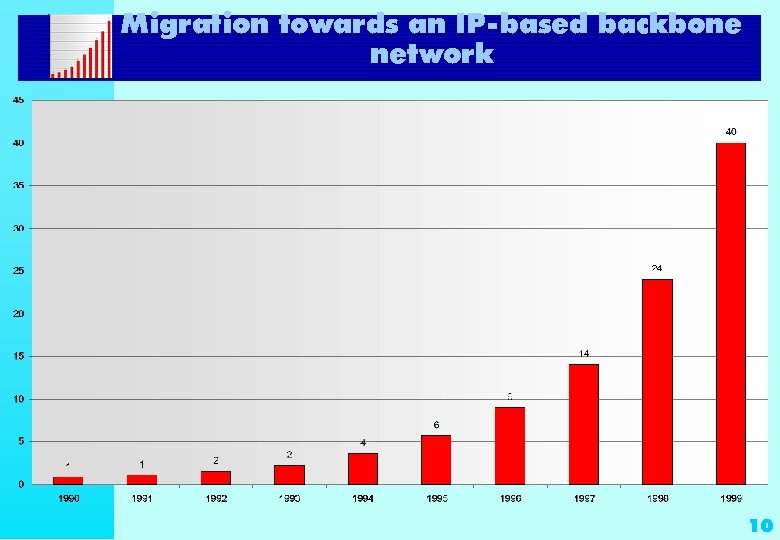
Migration towards an IP-based backbone network 10
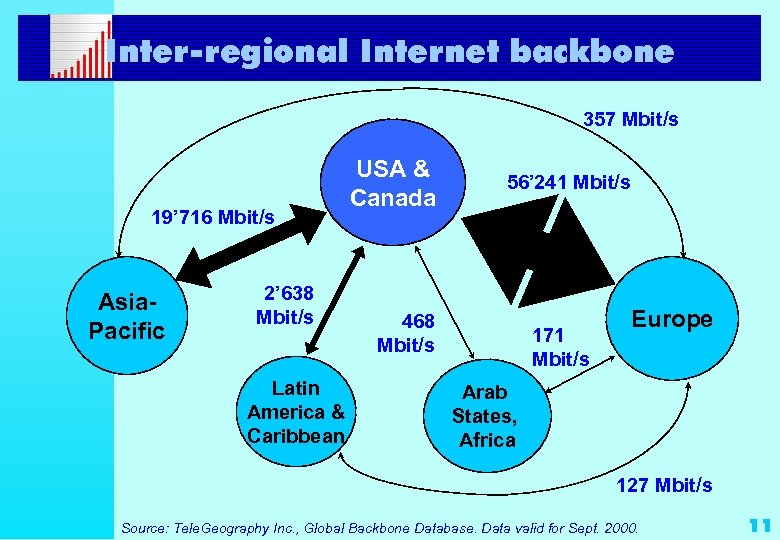
Inter-regional Internet backbone 357 Mbit/s 19’ 716 Mbit/s Asia. Pacific 2’ 638 Mbit/s Latin America & Caribbean USA & Canada 56’ 241 Mbit/s 468 Mbit/s 171 Mbit/s Europe Arab States, Africa 127 Mbit/s Source: Tele. Geography Inc. , Global Backbone Database. Data valid for Sept. 2000. 11
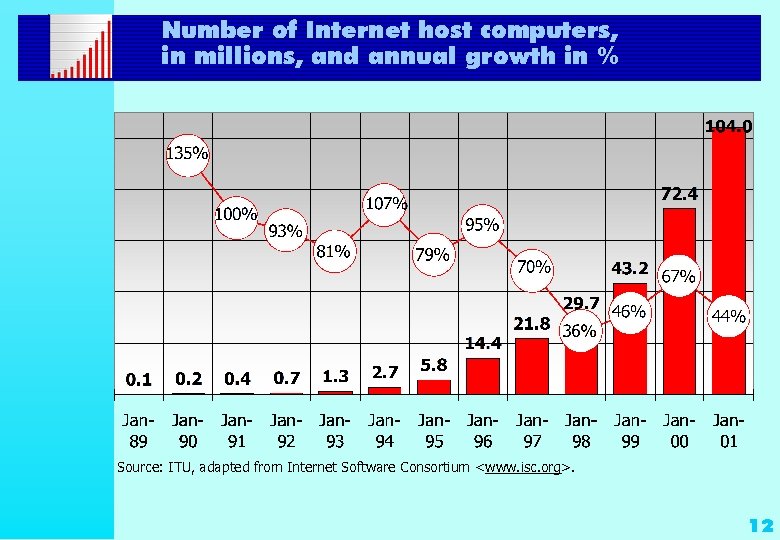
Number of Internet host computers, in millions, and annual growth in % Source: ITU, adapted from Internet Software Consortium <www. isc. org>. 12
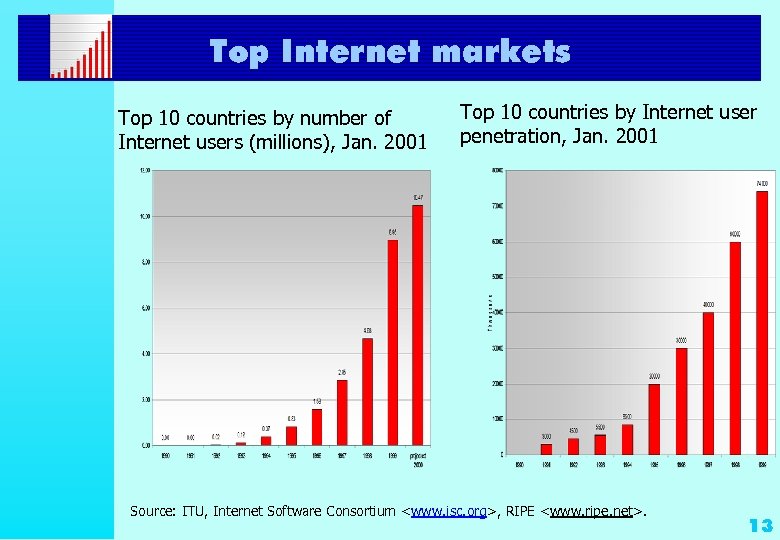
Top Internet markets Top 10 countries by number of Internet users (millions), Jan. 2001 Top 10 countries by Internet user penetration, Jan. 2001 Source: ITU, Internet Software Consortium <www. isc. org>, RIPE <www. ripe. net>. 13
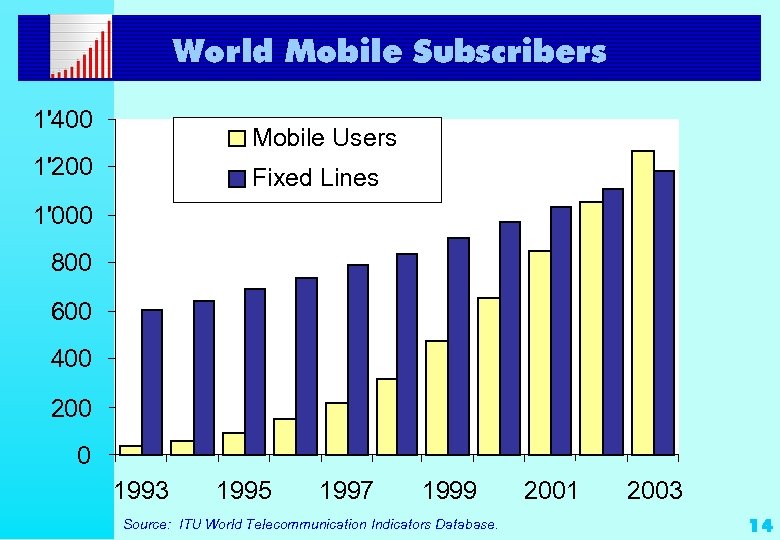
World Mobile Subscribers 1'400 Mobile Users 1'200 Fixed Lines 1'000 800 600 400 200 0 1993 1995 1997 1999 Source: ITU World Telecommunication Indicators Database. 2001 2003 14
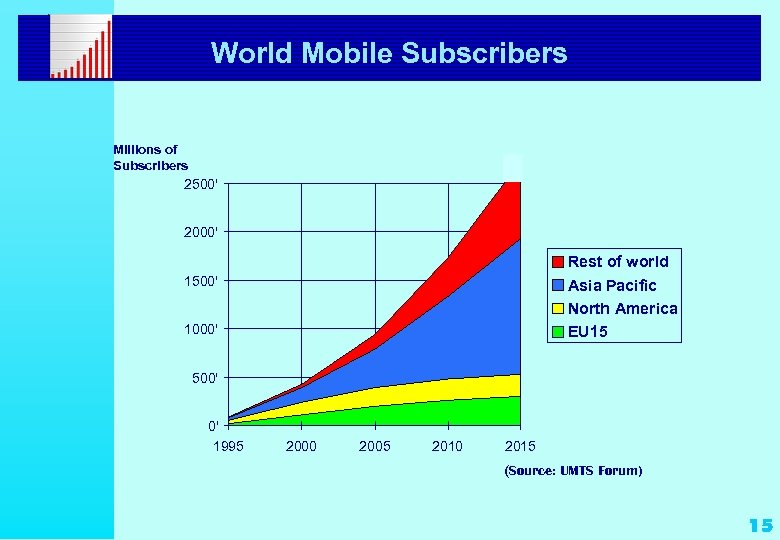
World Mobile Subscribers Millions of Subscribers 2500' 2000' Rest of world Asia Pacific North America EU 15 1500' 1000' 500' 0' 1995 2000 2005 2010 2015 (Source: UMTS Forum) 15
Estimated Internet users - EU 16
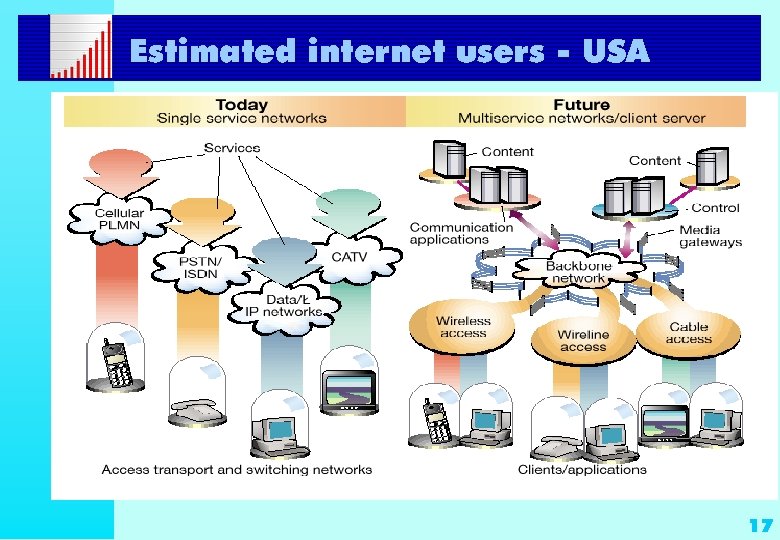
Estimated internet users - USA 17
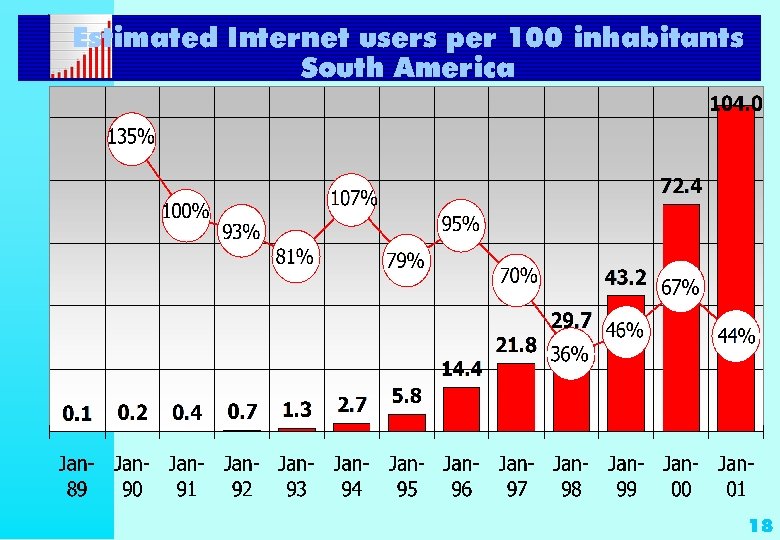
Estimated Internet users per 100 inhabitants South America 18
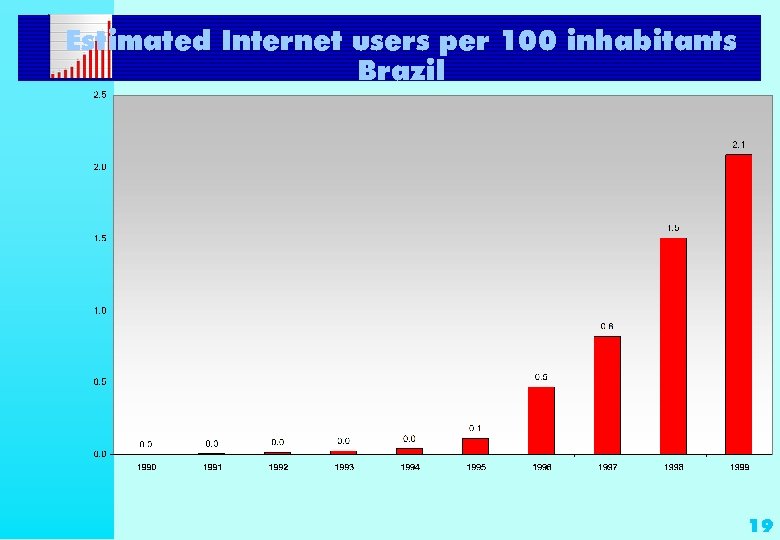
Estimated Internet users per 100 inhabitants Brazil 19
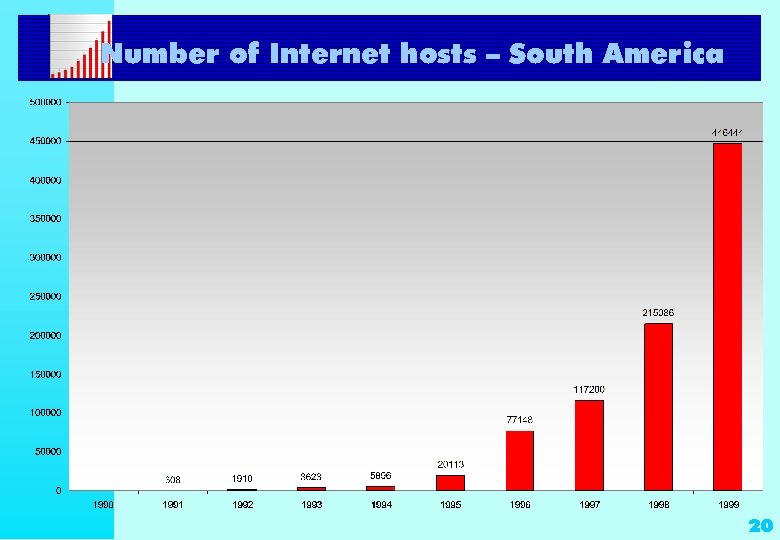
Number of Internet hosts – South America 20
Number of internet hosts - Brazil 21
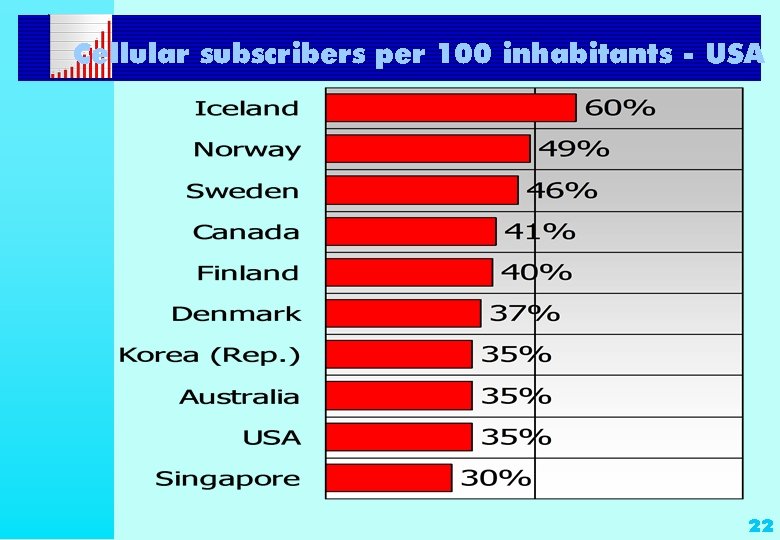
Cellular subscribers per 100 inhabitants - USA 22
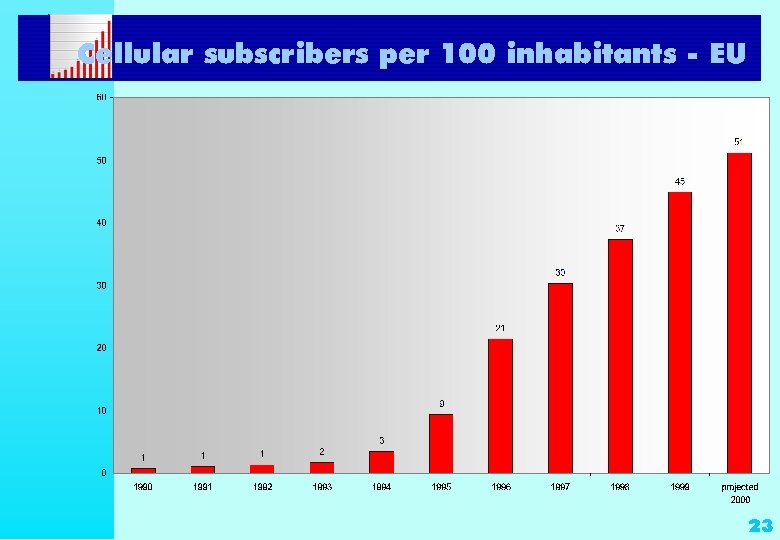
Cellular subscribers per 100 inhabitants - EU 23
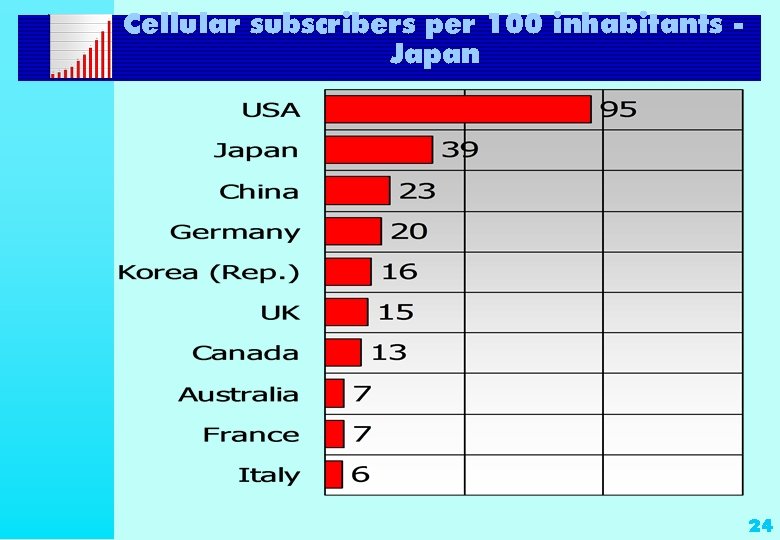
Cellular subscribers per 100 inhabitants Japan 24
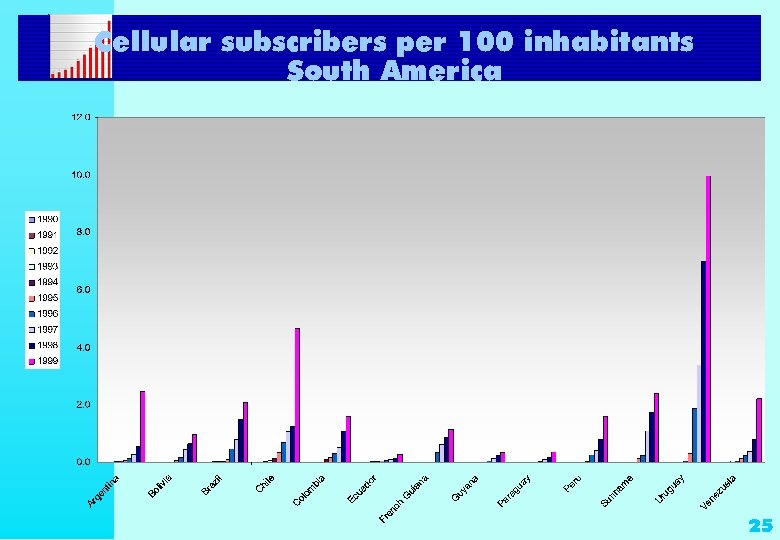
Cellular subscribers per 100 inhabitants South America 25

Cellular subscribers per 100 inhabitants Brazil 26
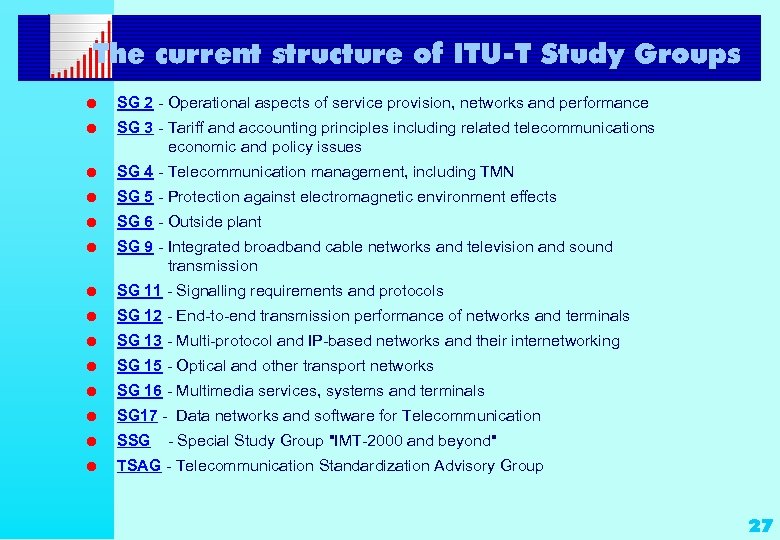
The current structure of ITU-T Study Groups l SG 2 - Operational aspects of service provision, networks and performance l SG 3 - Tariff and accounting principles including related telecommunications economic and policy issues l SG 4 - Telecommunication management, including TMN l SG 5 - Protection against electromagnetic environment effects l SG 6 - Outside plant l SG 9 - Integrated broadband cable networks and television and sound transmission l SG 11 - Signalling requirements and protocols l SG 12 - End-to-end transmission performance of networks and terminals l SG 13 - Multi-protocol and IP-based networks and their internetworking l SG 15 - Optical and other transport networks l SG 16 - Multimedia services, systems and terminals l SG 17 - Data networks and software for Telecommunication l SSG - Special Study Group "IMT-2000 and beyond" l TSAG - Telecommunication Standardization Advisory Group 27
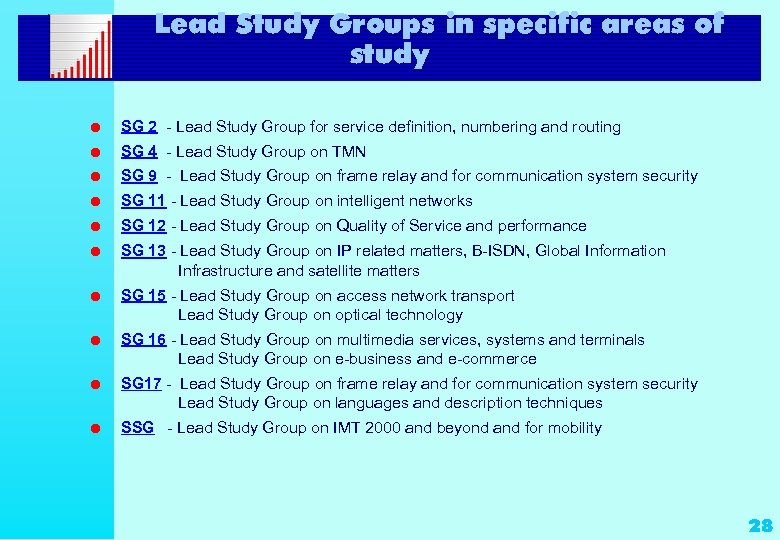
Lead Study Groups in specific areas of study l SG 2 - Lead Study Group for service definition, numbering and routing l SG 4 - Lead Study Group on TMN l SG 9 - Lead Study Group on frame relay and for communication system security l SG 11 - Lead Study Group on intelligent networks l SG 12 - Lead Study Group on Quality of Service and performance l SG 13 - Lead Study Group on IP related matters, B-ISDN, Global Information Infrastructure and satellite matters l SG 15 - Lead Study Group on access network transport Lead Study Group on optical technology l SG 16 - Lead Study Group on multimedia services, systems and terminals Lead Study Group on e-business and e-commerce l SG 17 - Lead Study Group on frame relay and for communication system security Lead Study Group on languages and description techniques l SSG - Lead Study Group on IMT 2000 and beyond and for mobility 28
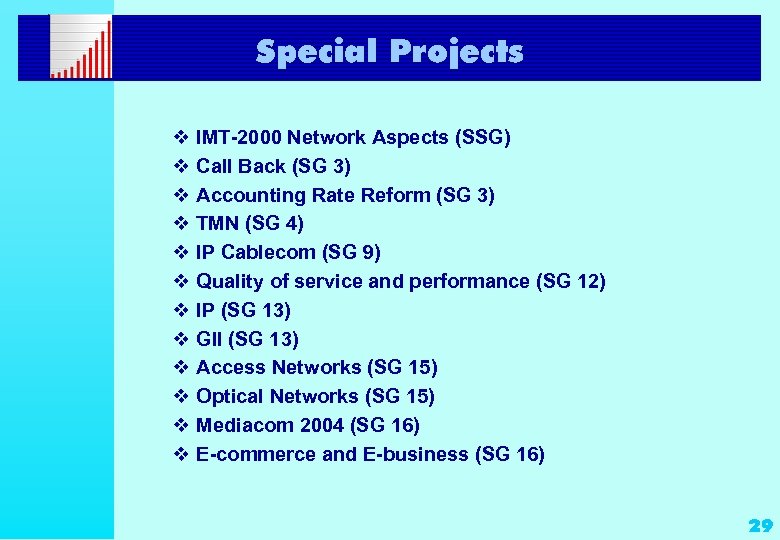
Special Projects v IMT-2000 Network Aspects (SSG) v Call Back (SG 3) v Accounting Rate Reform (SG 3) v TMN (SG 4) v IP Cablecom (SG 9) v Quality of service and performance (SG 12) v IP (SG 13) v GII (SG 13) v Access Networks (SG 15) v Optical Networks (SG 15) v Mediacom 2004 (SG 16) v E-commerce and E-business (SG 16) 29
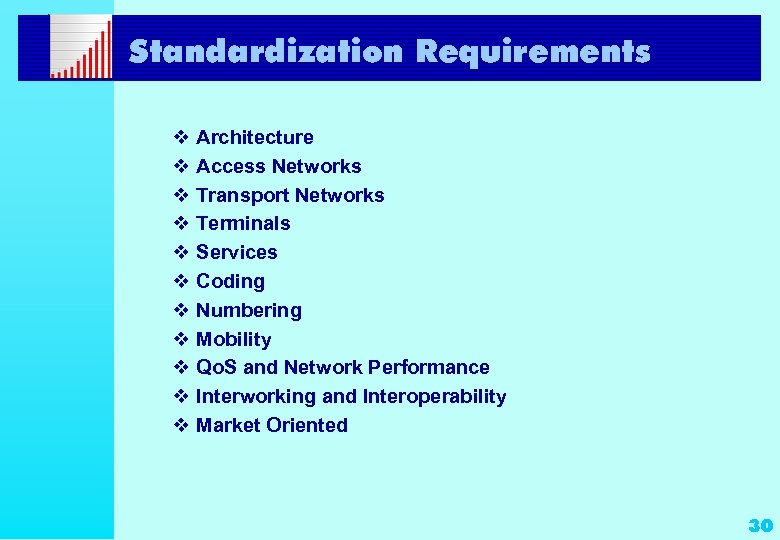
Standardization Requirements v Architecture v Access Networks v Transport Networks v Terminals v Services v Coding v Numbering v Mobility v Qo. S and Network Performance v Interworking and Interoperability v Market Oriented 30
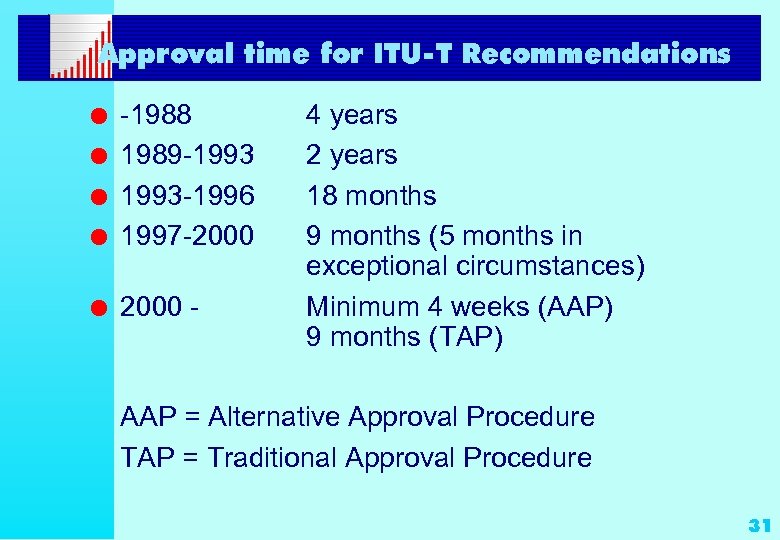
Approval time for ITU-T Recommendations l -1988 1989 -1993 -1996 1997 -2000 l 2000 - l l l 4 years 2 years 18 months 9 months (5 months in exceptional circumstances) Minimum 4 weeks (AAP) 9 months (TAP) AAP = Alternative Approval Procedure TAP = Traditional Approval Procedure 31
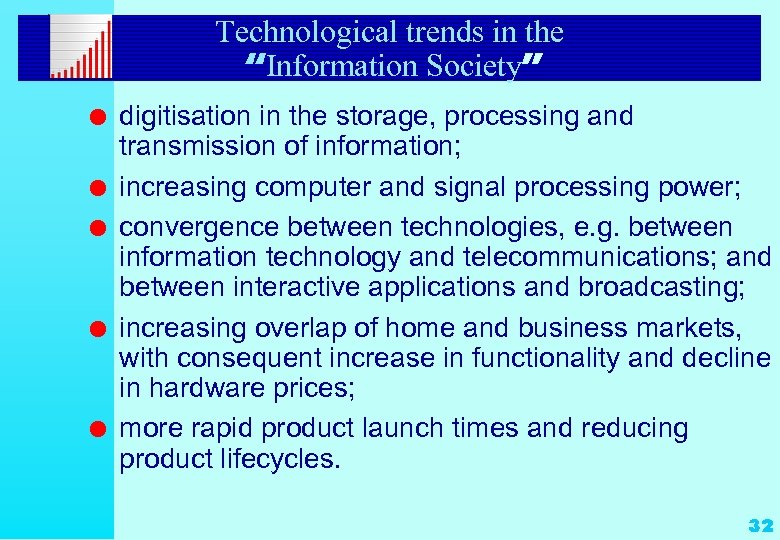
Technological trends in the “Information Society” l l l digitisation in the storage, processing and transmission of information; increasing computer and signal processing power; convergence between technologies, e. g. between information technology and telecommunications; and between interactive applications and broadcasting; increasing overlap of home and business markets, with consequent increase in functionality and decline in hardware prices; more rapid product launch times and reducing product lifecycles. 32
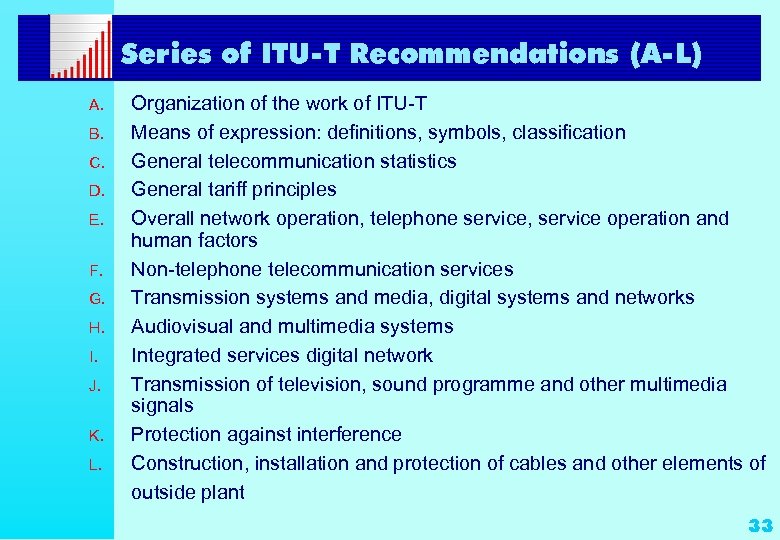
Series of ITU-T Recommendations (A-L) A. B. C. D. E. F. G. H. I. J. K. L. Organization of the work of ITU-T Means of expression: definitions, symbols, classification General telecommunication statistics General tariff principles Overall network operation, telephone service, service operation and human factors Non-telephone telecommunication services Transmission systems and media, digital systems and networks Audiovisual and multimedia systems Integrated services digital network Transmission of television, sound programme and other multimedia signals Protection against interference Construction, installation and protection of cables and other elements of outside plant 33
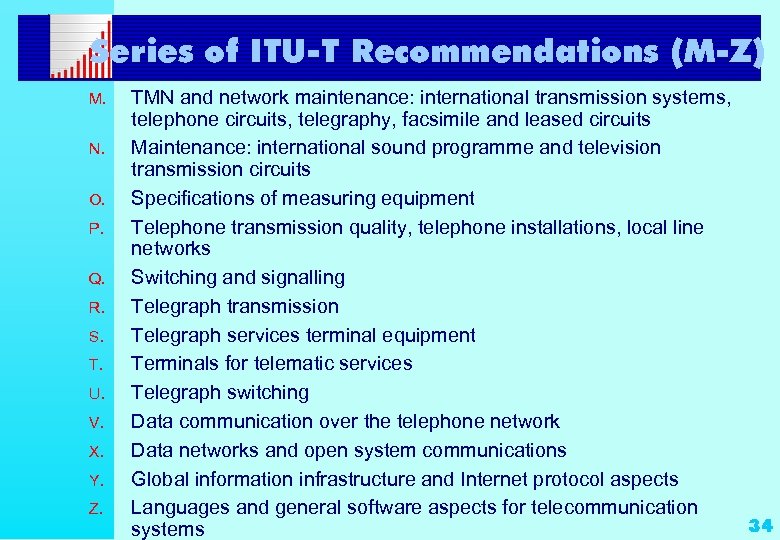
Series of ITU-T Recommendations (M-Z) M. N. O. P. Q. R. S. T. U. V. X. Y. Z. TMN and network maintenance: international transmission systems, telephone circuits, telegraphy, facsimile and leased circuits Maintenance: international sound programme and television transmission circuits Specifications of measuring equipment Telephone transmission quality, telephone installations, local line networks Switching and signalling Telegraph transmission Telegraph services terminal equipment Terminals for telematic services Telegraph switching Data communication over the telephone network Data networks and open system communications Global information infrastructure and Internet protocol aspects Languages and general software aspects for telecommunication 34 systems
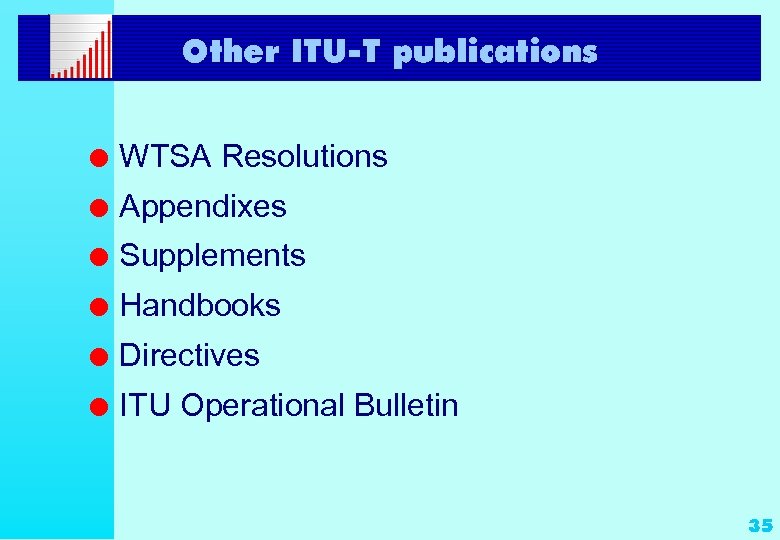
Other ITU-T publications l WTSA Resolutions l Appendixes l Supplements l Handbooks l Directives l ITU Operational Bulletin 35
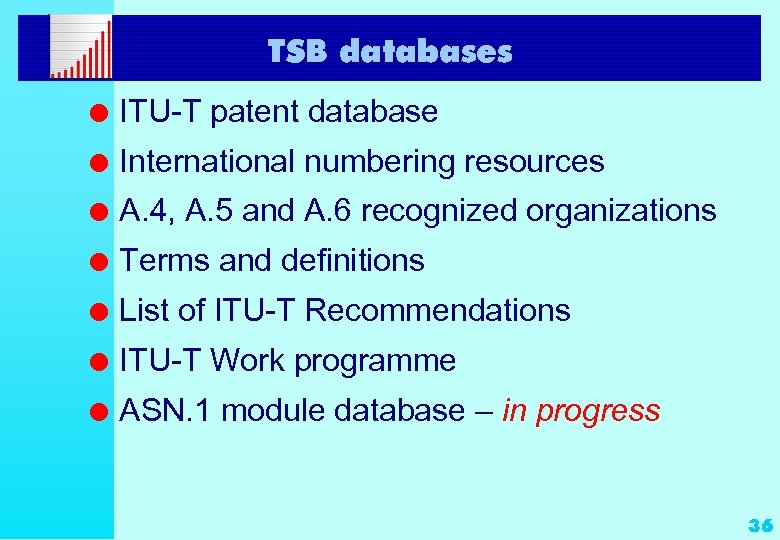
TSB databases l ITU-T patent database l International numbering resources l A. 4, A. 5 and A. 6 recognized organizations l Terms and definitions l List of ITU-T Recommendations l ITU-T Work programme l ASN. 1 module database – in progress 36
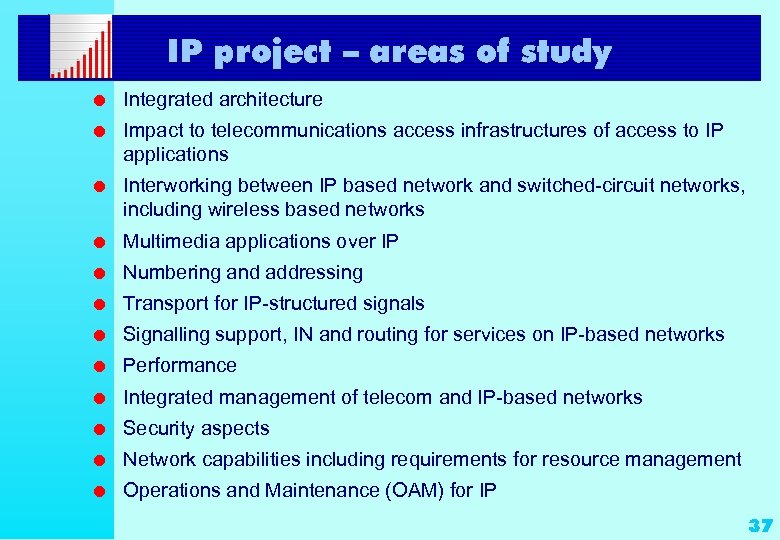
IP project – areas of study l Integrated architecture l Impact to telecommunications access infrastructures of access to IP applications l Interworking between IP based network and switched-circuit networks, including wireless based networks l Multimedia applications over IP l Numbering and addressing l Transport for IP-structured signals l Signalling support, IN and routing for services on IP-based networks l Performance l Integrated management of telecom and IP-based networks l Security aspects l Network capabilities including requirements for resource management l Operations and Maintenance (OAM) for IP 37
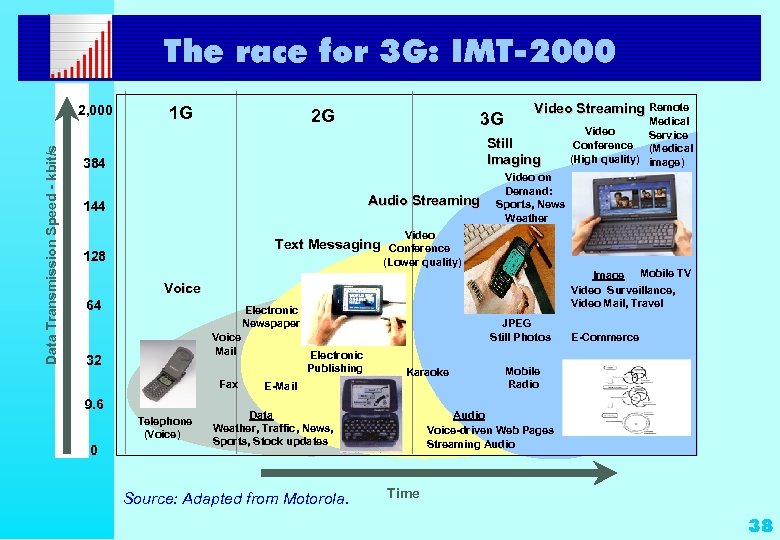
The race for 3 G: IMT-2000 Data Transmission Speed - kbit/s 2, 000 1 G 2 G 3 G Video Streaming Remote Still Imaging 384 Audio Streaming 144 Text Messaging 128 Video on Demand: Sports, News Weather Video Conference (Lower quality) Image Mobile TV Video Surveillance, Video Mail, Travel Voice 64 Electronic Newspaper Voice Mail 32 Fax 9. 6 Telephone (Voice) 0 JPEG Still Photos Electronic Publishing Karaoke E-Mail E-Commerce Mobile Radio Audio Voice-driven Web Pages Streaming Audio Data Weather, Traffic, News, Sports, Stock updates Source: Adapted from Motorola. Medical Video Service Conference (Medical (High quality) image) Time 38
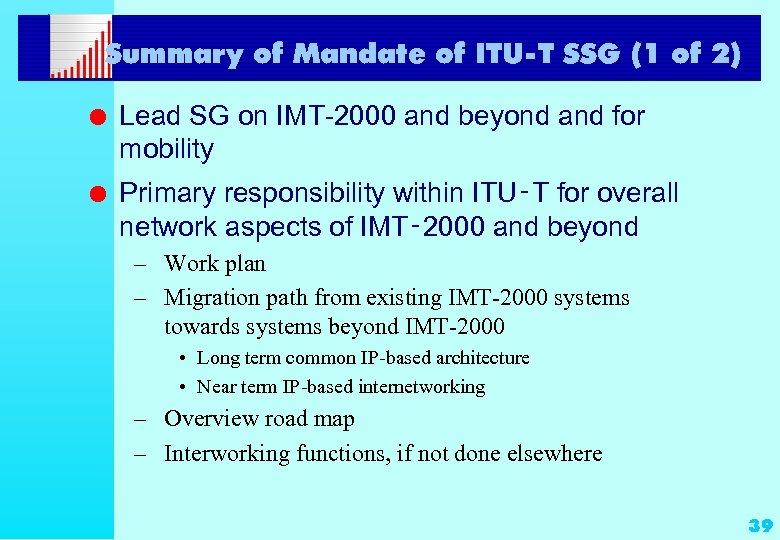
Summary of Mandate of ITU-T SSG (1 of 2) l Lead SG on IMT-2000 and beyond and for mobility l Primary responsibility within ITU‑T for overall network aspects of IMT‑ 2000 and beyond – Work plan – Migration path from existing IMT-2000 systems towards systems beyond IMT-2000 • Long term common IP-based architecture • Near term IP-based internetworking – Overview road map – Interworking functions, if not done elsewhere 39
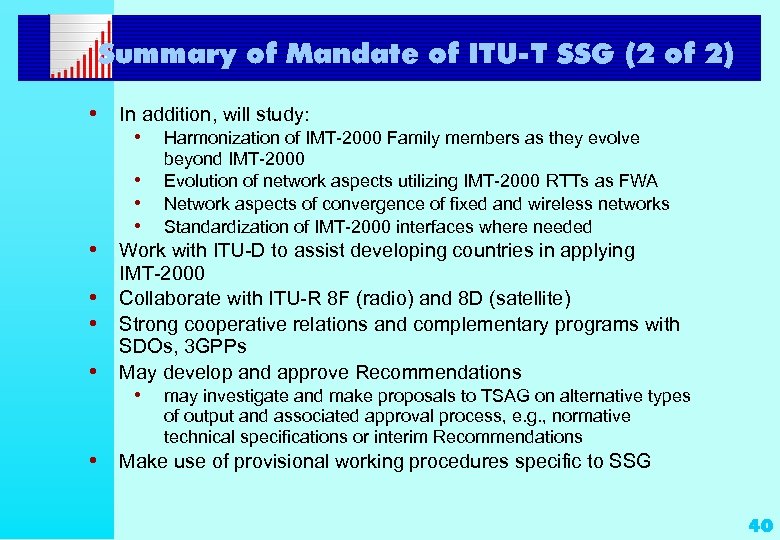
Summary of Mandate of ITU-T SSG (2 of 2) • In addition, will study: • • • Harmonization of IMT-2000 Family members as they evolve beyond IMT-2000 Evolution of network aspects utilizing IMT-2000 RTTs as FWA Network aspects of convergence of fixed and wireless networks Standardization of IMT-2000 interfaces where needed • • • Work with ITU-D to assist developing countries in applying IMT-2000 Collaborate with ITU-R 8 F (radio) and 8 D (satellite) Strong cooperative relations and complementary programs with SDOs, 3 GPPs May develop and approve Recommendations • may investigate and make proposals to TSAG on alternative types of output and associated approval process, e. g. , normative technical specifications or interim Recommendations • Make use of provisional working procedures specific to SSG 40
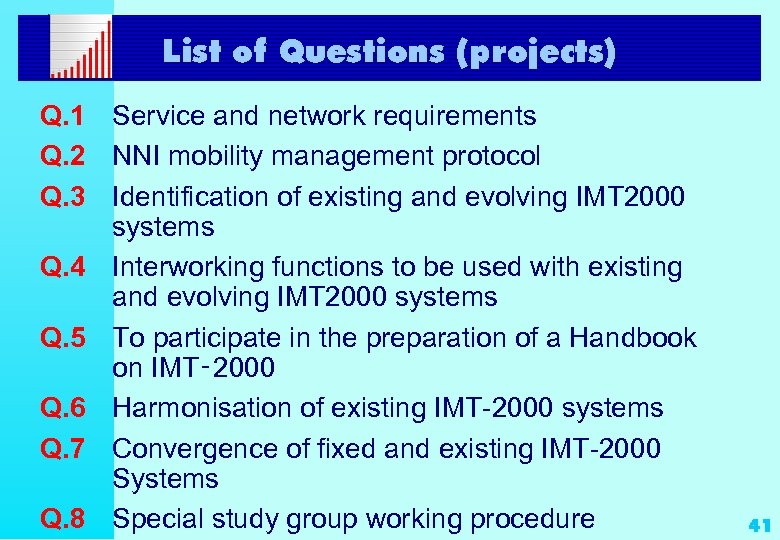
List of Questions (projects) Q. 1 Service and network requirements Q. 2 NNI mobility management protocol Q. 3 Identification of existing and evolving IMT 2000 systems Q. 4 Interworking functions to be used with existing and evolving IMT 2000 systems Q. 5 To participate in the preparation of a Handbook on IMT‑ 2000 Q. 6 Harmonisation of existing IMT-2000 systems Q. 7 Convergence of fixed and existing IMT-2000 Systems Q. 8 Special study group working procedure 41
IPCablecom l l A set of interface specifications and protocols that have been developed by the cable television industry and product vendors to deliver voice and video services over the hybrid fiber coax (HFC) cable systems utilizing the J. 112 data delivery Recommendation. Utilizes a network superstructure that overlays the two-way, data-ready broadband cable access network. – While the initial IPCablecom offering is packet-based voice communications for existing and new cable subscribers, the long-term project vision encompasses a large suite of packet -based services. 42
Planned Workshops l IP/Optical (24 -26 April 2002) l MEDIACOM/IP Cablecom (9 -11 October 2002) l IP/Mobility (March 2003) l Convergence/Future Evolution (October 2003) l Other possible items to be considered on the basis of requirements 43
Meetings with Workshops in other Regions in 2001 l Future Network Evolution: (Caracas 14 May 2001, SG 13 Meeting) l Multimedia in the 21 st Century – Systems, services and terminals: (Puerto Seguro, 4 -5 June 2001, SG 16 Meeting) l ITU-T and ITU-D Promotion of and Highlight on SG 17 (SGs 7 & 10): (Bangalore, 30 -31 August 2001, SG 7 Meeting) l Qo. S and User-Perceived Transmission on Quality in Evolving Networks (Dakar, 12 -19 October 2001, SG 12 Meeting) l SG 5 in Vietnam (date and subject to be agreed upon) 44
Draft ITU-T Strategic Plan for 2003 -2006 Mission l l l Facilitate the identification of areas where recommendations (standards) should be developed for the Information Society Efficiently develop high-quality, global, consensus-based recommendations (standards) in its core competency areas on a market-driven and timely basis Facilitate the interoperability of networks and services 45
Draft ITU-T Strategic Plan for 2003 -2006 Mission - continued l l Be able to develop recommendations that may have regulatory or policy implications Be flexible and constantly look for ways to improve Give appropriate consideration to the particular needs of developing countries Cooperate and, where appropriate, collaborate with others so as not to duplicate effort 46
Draft ITU-T Strategic Plan for 2003 -2006 Strategies/Processes l bottom-up mode of operating and production of work (rather than top-down), l flexibility in responding to market demands, l ongoing review of the Strategic Plan, proposing adjustments as needed, l through TSAG, monitoring the performance of the Sector against identified milestones, 47
Draft ITU-T Strategic Plan for 2003 -2006 Strategies/Processes - continued l development and strengthening of the linkage among financial, strategic, and operational planning, l clear and transparent working methods and processes, to encourage transparency, inclusiveness, and representation of a broad range of participants and views, l an environment in which interested parties can work together in partnership effectively and efficiently, l development and execution of an aggressive plan to communicate the value of the ITU-T, stressing its global recognition and credibility and the high quality of its Recommendations, as well as its willingness to change, 48
Draft ITU-T Strategic Plan for 2003 -2006 Strategies/Processes - continued l working with ITU-D with special attention to telecommunication development in developing countries, including supporting ITU-D’s efforts to improve access to the Information Society in developing countries, l offering an organization that is attractive to industry entities as a place to do their standardization development work, and l willingness to change. 49
Draft ITU-T Strategic Plan for 2003 -2006 Relationship with other standardization bodies l foster awareness within ITU-T of the work done by other bodies (such as SDOs, forums and consortia), l coordinate and cooperate with such groups in order to reduce duplication, avoid inconsistencies, and assure that ITU-T work provides added value, l continue to participate in appropriate coordinating bodies, l coordinate and cooperate with the Radiocommunication and Telecommunication Development Sectors, and with the General Secretariat and officials of the Union. 50
Possible Items for Consideration l l l l IP-based networks and their interconnection with telecommunication networks; IP cablecom project; establishment of GII; IMT-2000 and mobility; e-business and e-commerce; reform of accounting rates and tariff studies; MEDIACOM-2004 project and related multimedia activities; security aspects of networks and services; optical transport network; access networks enhancements with x. DSL techniques; numbering and routing; network performances and quality of services; protocols for new services and intelligent networks. 51
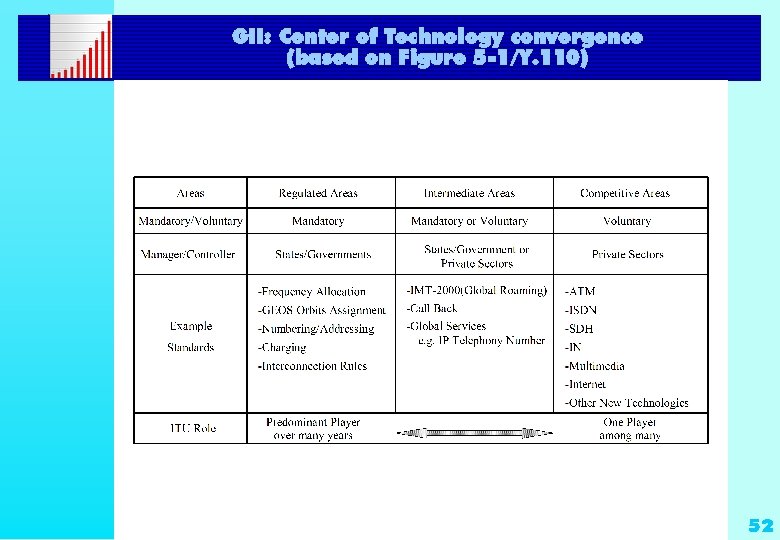
GII: Center of Technology convergence (based on Figure 5 -1/Y. 110) 52
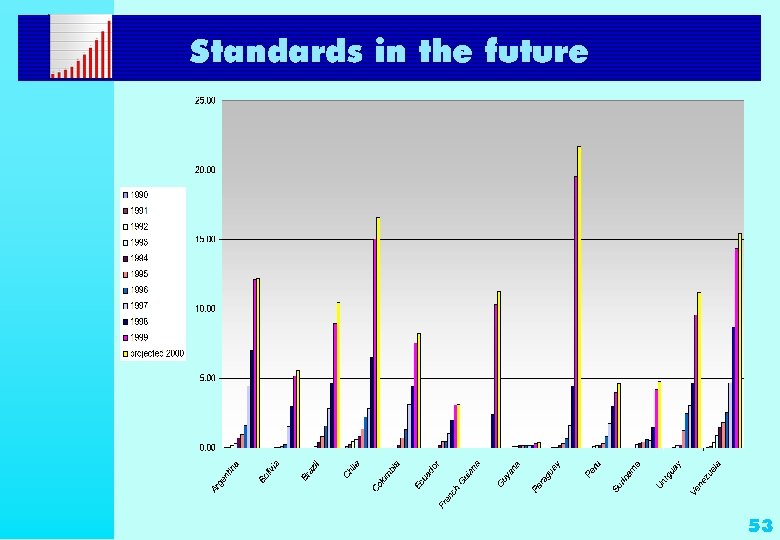
Standards in the future 53
Conclusion l ITU Reform l New Standardization Requirements l Consensus standard (Regulators, Operators, Industry, Users) l Membership requirements l End user requirements 54

International Telecommunication Union The Telecommunication Standardization Sector Fabio Bigi / Greg Jones ITU/TSB Place des Nations CH-1211 Geneva 20 Switzerland Tel: +41 22 730 5515 Fax: +41 22 730 5853 e-mail: greg. jones@ itu. int
Скачать презентацию International Telecommunication Union The Telecommunication Standardization Sector Fabio
359f79b0e1905cadf2222bd7ab64efce.ppt