


 Скачать презентацию International Telecommunication Union Digital Convergence Challenges and Opportunities
6336b347bcdb3066e85af4e1956ecf2a.ppt
- Количество слайдов: 13
 International Telecommunication Union Digital Convergence: Challenges and Opportunities Houlin Zhao Deputy Secretary-General, ITU IT Ministerial Conference, Seoul 19 April 2007
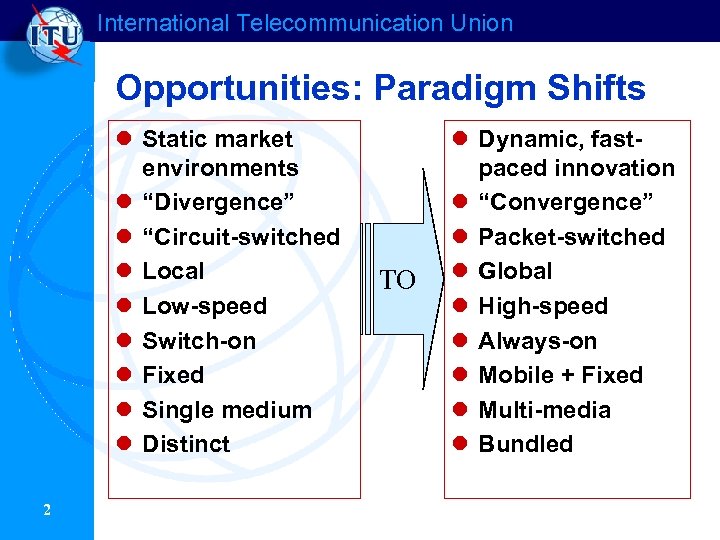 International Telecommunication Union Opportunities: Paradigm Shifts l Static market environments l “Divergence” l “Circuit-switched l Local l Low-speed l Switch-on l Fixed l Single medium l Distinct 2 TO l Dynamic, fastpaced innovation l “Convergence” l Packet-switched l Global l High-speed l Always-on l Mobile + Fixed l Multi-media l Bundled
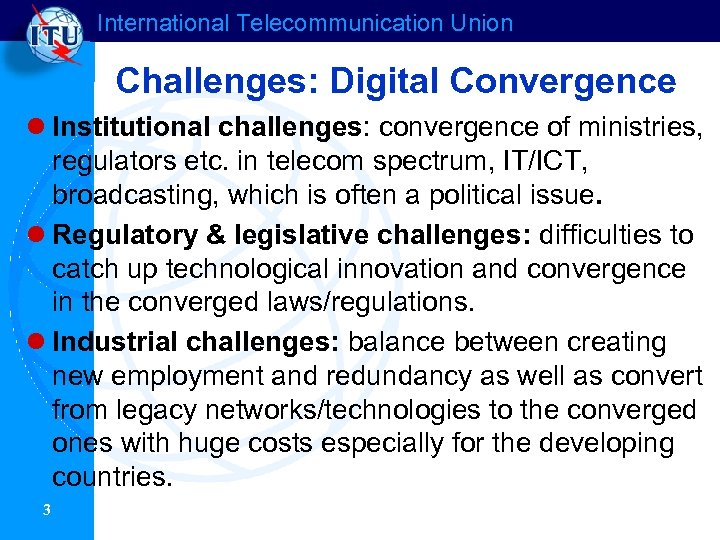 International Telecommunication Union Challenges: Digital Convergence l Institutional challenges: convergence of ministries, regulators etc. in telecom spectrum, IT/ICT, broadcasting, which is often a political issue. l Regulatory & legislative challenges: difficulties to catch up technological innovation and convergence in the converged laws/regulations. l Industrial challenges: balance between creating new employment and redundancy as well as convert from legacy networks/technologies to the converged ones with huge costs especially for the developing countries. 3
 International Telecommunication Union Challenges: Convergence (e. g. , NGN) 4 l Pricing: Will offer prices that are significantly lower than those available today? l Bundling and billing: How to distinguish real price of bundled services? l Interconnection: Will current interconnection models (based on per-minute settlement) work ? l Security: If much greater capacity is available at the edges of the network, how to guarantee security? l Investment: Will unbundling discourage new infrastructural investment? l Traffic prioritization: Is the Net really “neutral”? l Emergency services: What level of universal service obligation to impose? l Competition policy: Significant market power will not go away in the converged (e. g. , NGN) environment ? l Consultation: compensation for stranded assets?
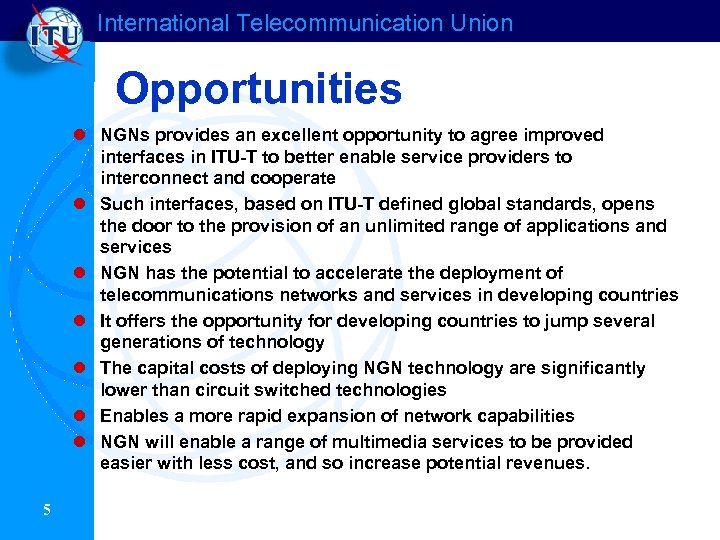 International Telecommunication Union Opportunities l NGNs provides an excellent opportunity to agree improved interfaces in ITU-T to better enable service providers to interconnect and cooperate l Such interfaces, based on ITU-T defined global standards, opens the door to the provision of an unlimited range of applications and services l NGN has the potential to accelerate the deployment of telecommunications networks and services in developing countries l It offers the opportunity for developing countries to jump several generations of technology l The capital costs of deploying NGN technology are significantly lower than circuit switched technologies l Enables a more rapid expansion of network capabilities l NGN will enable a range of multimedia services to be provided easier with less cost, and so increase potential revenues. 5
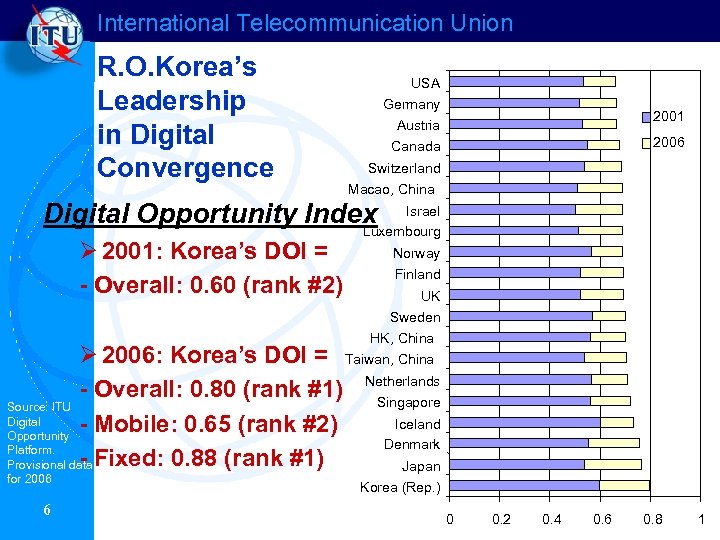 International Telecommunication Union R. O. Korea’s Leadership in Digital Convergence USA Germany Austria 2001 Canada 2006 Switzerland Macao, China Digital Opportunity Index Israel Luxembourg Ø 2001: Korea’s DOI = - Overall: 0. 60 (rank #2) Norway Finland UK Sweden HK, China Ø 2006: Korea’s DOI = Taiwan, China - Overall: 0. 80 (rank #1) Netherlands Singapore Source: ITU Digital Iceland - Mobile: 0. 65 (rank #2) Opportunity Denmark Platform. Provisional data Fixed: 0. 88 (rank #1) Japan for 2006 6 Korea (Rep. ) 0 0. 2 0. 4 0. 6 0. 8 1
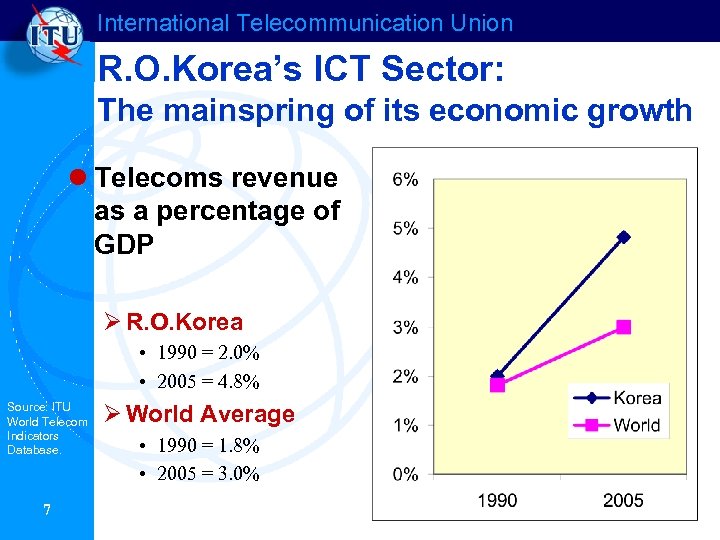 International Telecommunication Union R. O. Korea’s ICT Sector: The mainspring of its economic growth l Telecoms revenue as a percentage of GDP Ø R. O. Korea • 1990 = 2. 0% • 2005 = 4. 8% Source: ITU World Telecom Indicators Database. 7 Ø World Average • 1990 = 1. 8% • 2005 = 3. 0%
 International Telecommunication Union ITU’s mandates and leadership in digital information society l ITU-R: allocation for the appropriate frequency/spectrum for the converged technologies, networks and services, and develop technical standards for radio access and other radiocommunication services. l ITU-T: set international standards (i. e. , Recommendations) to ensure interoperability, security etc. in the converged telecoms/ICts, bridge the standardization gap. l ITU-D: assist members in developing and moving towards the converged telecom/ICT environment through providing expert support, trainings to equipments/facilities. l Closer collaboration between the three ITU Sectors. 8 More
 International Telecommunication Union ITU - WSIS Action Line C 2 ICT infrastructure facilitation: ITU “Information and Communication Infrastructure” 9 l Main orientation for actions in C 2: Ø Facilitation of large scale initiatives Ø Development of thematic activities. l Strategy to link national, regional and international initiatives to facilitate large scale infrastructure projects. l C 2 Group, endorsed five (5) large scale ITU projects: Ø Harmonization of ICT Policies for 43 African States Ø Harmonization of ICT Policies for 17 Caribbean States Ø Capacity Building on ICT Policies for 14 Pacific States Ø International fibre optics: Infinity project West Africa, Ø ICT Applications and Connectivity : Pacific Island States, studied by ITU, funding to be secured
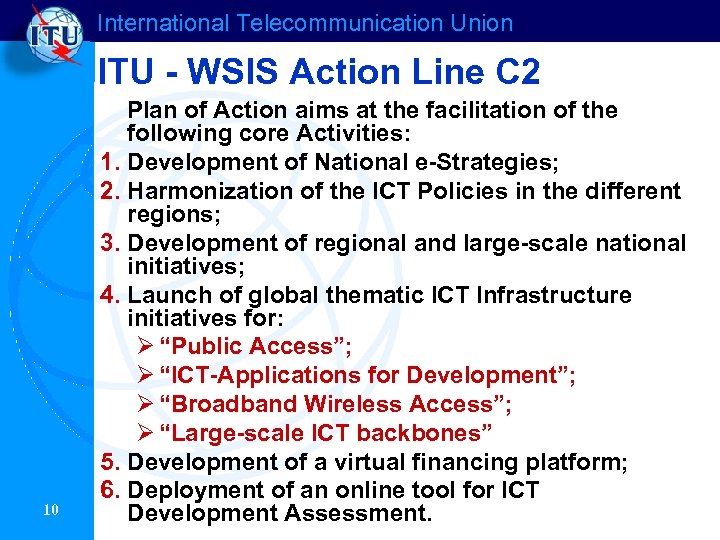 International Telecommunication Union ITU - WSIS Action Line C 2 10 Plan of Action aims at the facilitation of the following core Activities: 1. Development of National e-Strategies; 2. Harmonization of the ICT Policies in the different regions; 3. Development of regional and large-scale national initiatives; 4. Launch of global thematic ICT Infrastructure initiatives for: Ø “Public Access”; Ø “ICT-Applications for Development”; Ø “Broadband Wireless Access”; Ø “Large-scale ICT backbones” 5. Development of a virtual financing platform; 6. Deployment of an online tool for ICT Development Assessment.
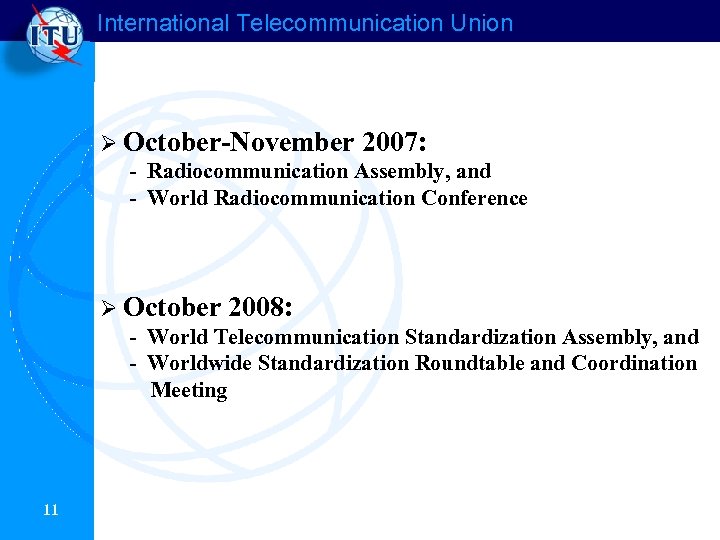 International Telecommunication Union Ø October-November 2007: - Radiocommunication Assembly, and - World Radiocommunication Conference Ø October 2008: - World Telecommunication Standardization Assembly, and - Worldwide Standardization Roundtable and Coordination Meeting 11
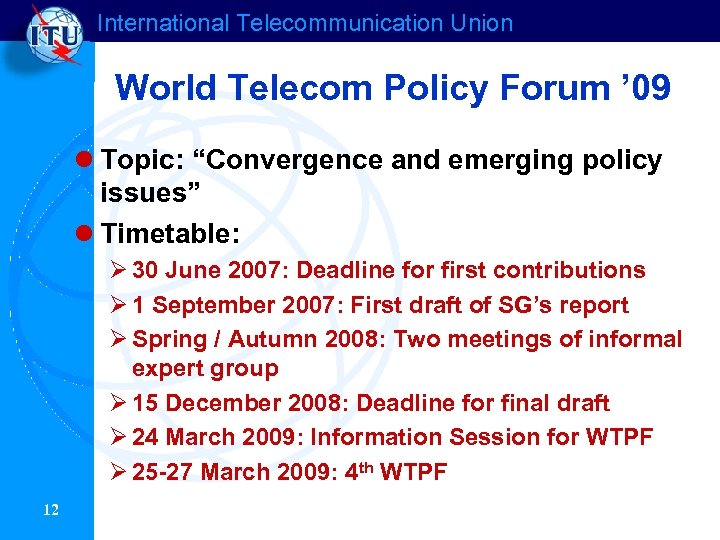 International Telecommunication Union World Telecom Policy Forum ’ 09 l Topic: “Convergence and emerging policy issues” l Timetable: Ø 30 June 2007: Deadline for first contributions Ø 1 September 2007: First draft of SG’s report Ø Spring / Autumn 2008: Two meetings of informal expert group Ø 15 December 2008: Deadline for final draft Ø 24 March 2009: Information Session for WTPF Ø 25 -27 March 2009: 4 th WTPF 12
 International Telecommunication Union Thank you Houlin Zhao ITU Deputy Secretary-General DSG@itu. int Tel. : +41 22 730 5595 Fax: +41 22 730 5137 13