


 Скачать презентацию International Technology Education Association Gallup Poll 2004 Power
82adaced8f195448eb39bc1392a3adf3.ppt
- Количество слайдов: 42
 International Technology Education Association Gallup Poll 2004 Power. Point Presentation
 The Second Installment of the ITEA/Gallup Poll on What It Reveals as to How Americans Think About Technology
 Background: 1 st ITEA/Gallup Poll in 2001 -2002 ® Research funded by National Science Foundation and National Aeronautics and Space Administration ® Process for this research: ® Developed questions (based on Standards for Technological Literacy and 1 st ITEA/Gallup Poll) (January 2004) ® Gallup conducted survey in March 2004 (800 interviews, random sample by telephone) ® Analyzed data and wrote report (Summer, 2004) ® Released report in September 2004 issue of The Technology Teacher ® Five questions from 2001 -2002 ITEA/Gallup Poll were repeated in 2004 survey (#1, 2, 5, 13, 15) ®
 ITEA/Gallup Poll Survey Committee ® ® ® Larry Bell, Senior Vice President, Research, Development, and Production, Museum of Science, Boston, MA William E. Dugger, Jr. , Director, Technology for All Americans Project, Blacksburg, VA Dan Engstrom, Assistant Professor, California University of Pennsylvania, California, PA Dale Hanson, Principal, Wilson Middle School, Appleton, WI Ethan Lipton, Assistant Vice President for Academic Affairs Planning and Resources/Dean, Educational Support Services, California State University Los Angeles, CA Donald Mc. Coy, Program Manager, IBM Multicultural People in Technology, Research Triangle Park, NC
 ITEA/Gallup Poll Survey Committee (Cont. ) ® ® ® Jon D. Miller, Professor and Director, Center for Biomedical Communication, Feinberg School of Medicine, Northwestern University, Chicago, IL Greg Pearson, Program Officer, National Academy of Engineering, Washington, DC Sharif Shakrani, Deputy Executive Director, National Assessment Governing Board, Washington, DC Kendall Starkweather, Executive Director, International Technology Education Association, Reston, VA Len Sterry, Senior Curriculum Associate, Center to Advance the Teaching of Technology and Science, Reston, VA Joyce Winterton, Associate Director of Education Programs, USA TODAY, Mc. Lean, VA
 Survey Demographics were also Analyzed by: ® Gender ® Age ® Education ® Ethnicity ® Region of Country
 Gallup Poll Major Categories of 16 Questions ® The Public’s Concept of Technology ® The Importance Assigned to Being Knowledgeable about Technology ® The Impact of Technology on our Daily Lives and on the World Around Us ® What People Want to Know and What They Know About Technology
 Gallup Poll Major Categories of 16 Questions (Cont. ) ® Decision Making Regarding Technology and Technological Literacy ® Differences Based on Gender ® Technology and Education
 The Public’s Concept of Technology
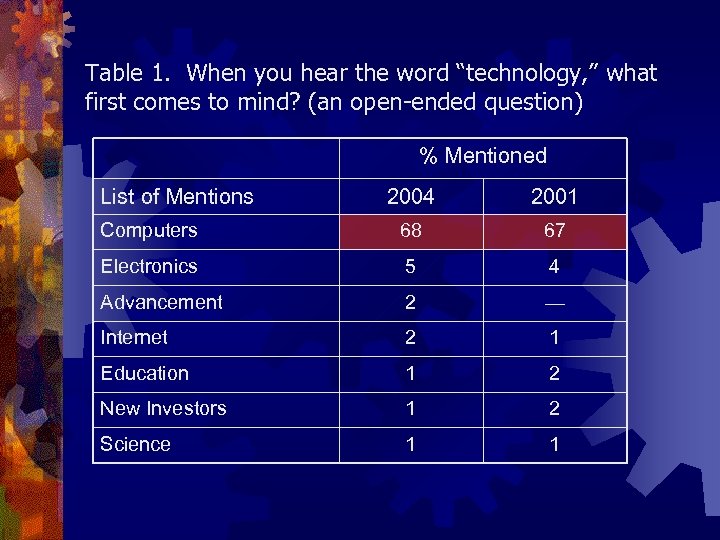 Table 1. When you hear the word “technology, ” what first comes to mind? (an open-ended question) % Mentioned List of Mentions 2004 2001 Computers 68 67 Electronics 5 4 Advancement 2 — Internet 2 1 Education 1 2 New Investors 1 2 Science 1 1
 The Importance Assigned to Being Knowledgeable about Technology
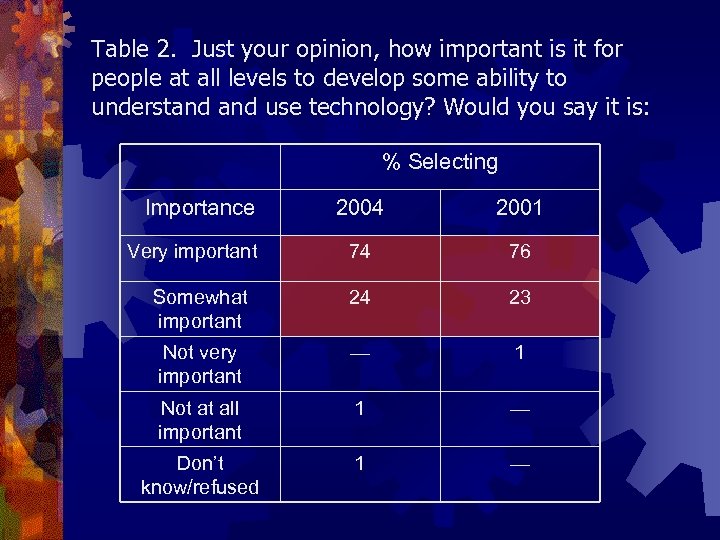 Table 2. Just your opinion, how important is it for people at all levels to develop some ability to understand use technology? Would you say it is: % Selecting Importance 2004 2001 74 76 Somewhat important 24 23 Not very important — 1 Not at all important 1 — Don’t know/refused 1 — Very important
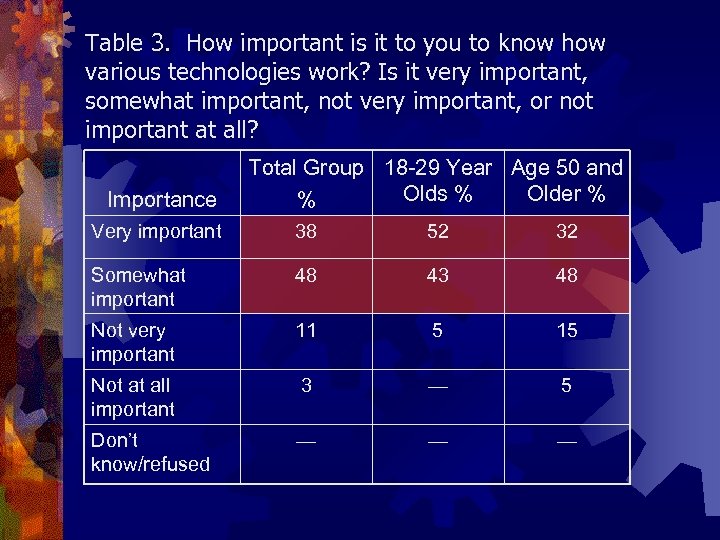 Table 3. How important is it to you to know how various technologies work? Is it very important, somewhat important, not very important, or not important at all? Importance Total Group 18 -29 Year Age 50 and Olds % Older % % Very important 38 52 32 Somewhat important 48 43 48 Not very important 11 5 15 Not at all important 3 — 5 Don’t know/refused — — —
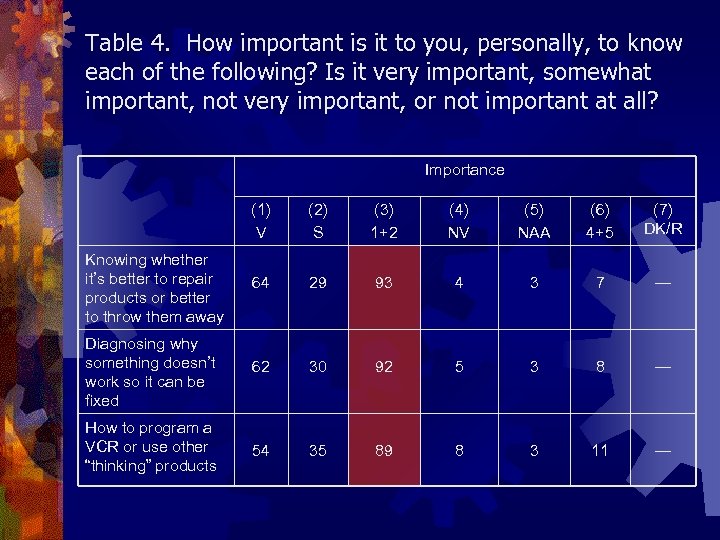 Table 4. How important is it to you, personally, to know each of the following? Is it very important, somewhat important, not very important, or not important at all? Importance (1) V (2) S (3) 1+2 (4) NV (5) NAA (6) 4+5 (7) DK/R Knowing whether it’s better to repair products or better to throw them away 64 29 93 4 3 7 — Diagnosing why something doesn’t work so it can be fixed 62 30 92 5 3 8 — How to program a VCR or use other “thinking” products 54 35 89 8 3 11 —
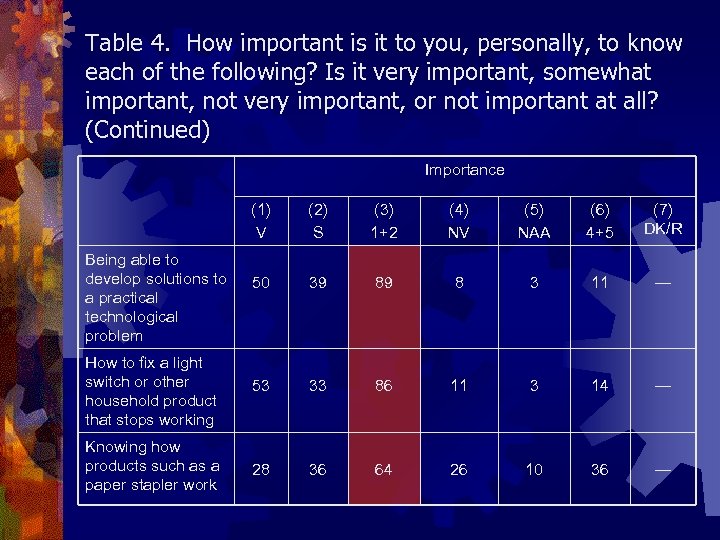 Table 4. How important is it to you, personally, to know each of the following? Is it very important, somewhat important, not very important, or not important at all? (Continued) Importance (1) V (2) S (3) 1+2 (4) NV (5) NAA (6) 4+5 (7) DK/R 50 39 89 8 3 11 — How to fix a light switch or other household product that stops working 53 33 86 11 3 14 — Knowing how products such as a paper stapler work 28 36 64 26 10 36 — Being able to develop solutions to a practical technological problem
 The Impact of Technology on Our Daily Lives and on the World Around Us
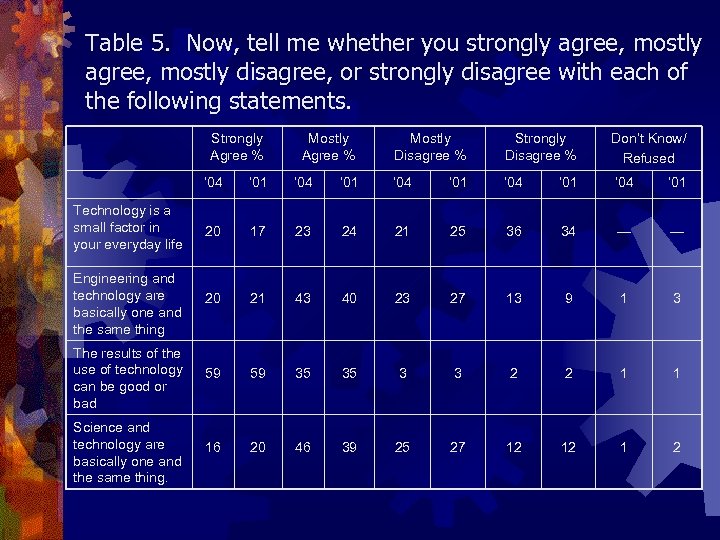 Table 5. Now, tell me whether you strongly agree, mostly disagree, or strongly disagree with each of the following statements. Strongly Agree % Mostly Disagree % Strongly Disagree % Don’t Know/ Refused ‘ 04 ‘ 01 ‘ 04 ‘ 01 Technology is a small factor in your everyday life 20 17 23 24 21 25 36 34 — — Engineering and technology are basically one and the same thing 20 21 43 40 23 27 13 9 1 3 The results of the use of technology can be good or bad 59 59 35 35 3 3 2 2 1 1 Science and technology are basically one and the same thing. 16 20 46 39 25 27 12 12 1 2
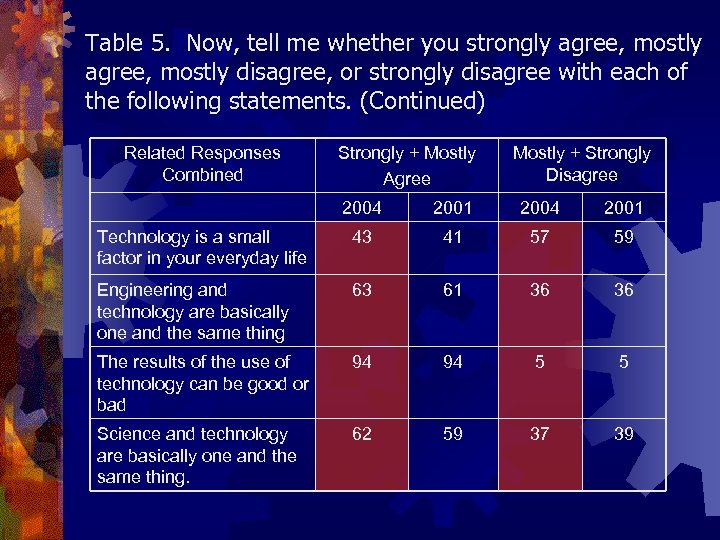 Table 5. Now, tell me whether you strongly agree, mostly disagree, or strongly disagree with each of the following statements. (Continued) Related Responses Combined Strongly + Mostly Agree Mostly + Strongly Disagree 2004 2001 Technology is a small factor in your everyday life 43 41 57 59 Engineering and technology are basically one and the same thing 63 61 36 36 The results of the use of technology can be good or bad 94 94 5 5 Science and technology are basically one and the same thing. 62 59 37 39
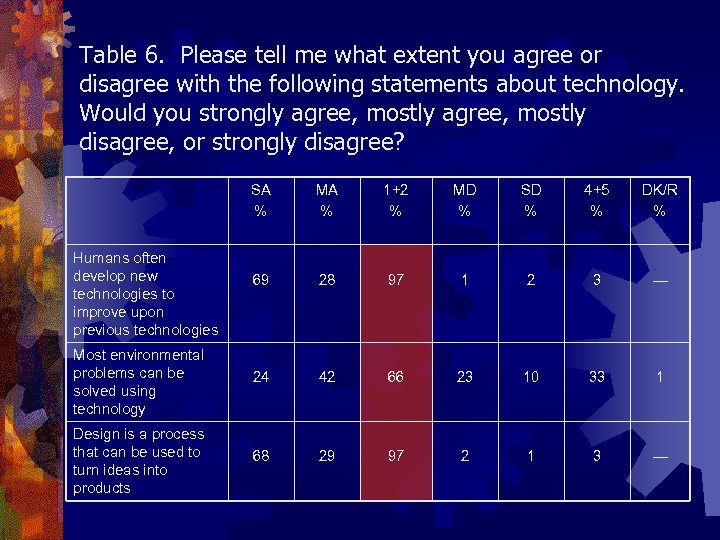 Table 6. Please tell me what extent you agree or disagree with the following statements about technology. Would you strongly agree, mostly disagree, or strongly disagree? SA % MA % 1+2 % MD % SD % 4+5 % DK/R % 69 28 97 1 2 3 — Most environmental problems can be solved using technology 24 42 66 23 10 33 1 Design is a process that can be used to turn ideas into products 68 29 97 2 1 3 — Humans often develop new technologies to improve upon previous technologies
 What People Want to Know and What They Know About Technology
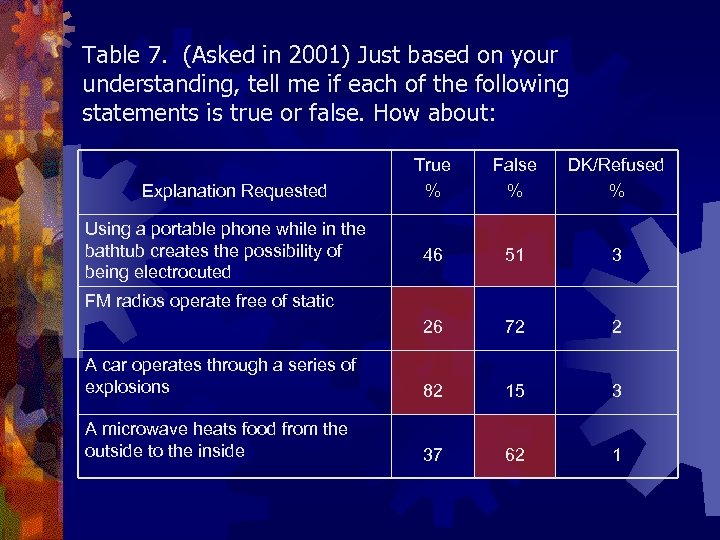 Table 7. (Asked in 2001) Just based on your understanding, tell me if each of the following statements is true or false. How about: True % False % DK/Refused % 46 51 3 26 72 2 A car operates through a series of explosions 82 15 3 A microwave heats food from the outside to the inside 37 62 1 Explanation Requested Using a portable phone while in the bathtub creates the possibility of being electrocuted FM radios operate free of static
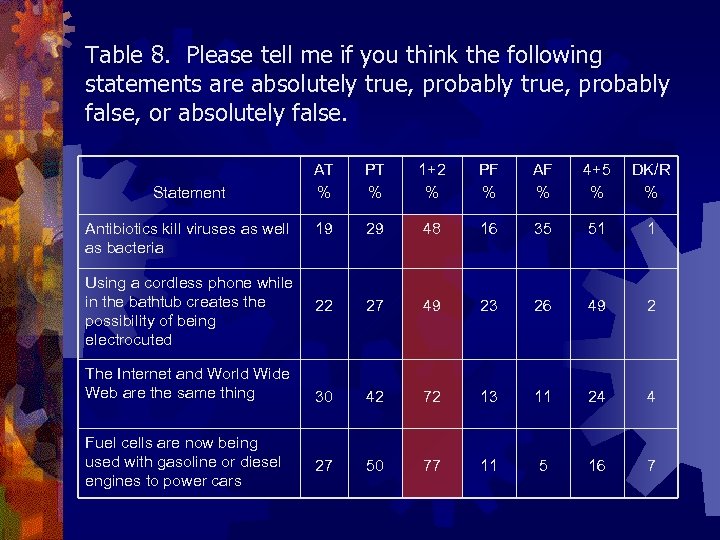 Table 8. Please tell me if you think the following statements are absolutely true, probably false, or absolutely false. Statement Antibiotics kill viruses as well as bacteria Using a cordless phone while in the bathtub creates the possibility of being electrocuted The Internet and World Wide Web are the same thing Fuel cells are now being used with gasoline or diesel engines to power cars AT % PT % 1+2 % PF % AF % 4+5 % DK/R % 19 29 48 16 35 51 1 22 27 49 23 26 49 2 30 42 72 13 11 24 4 27 50 77 11 5 16 7
 Decision Making Regarding Technology and Technological Literacy
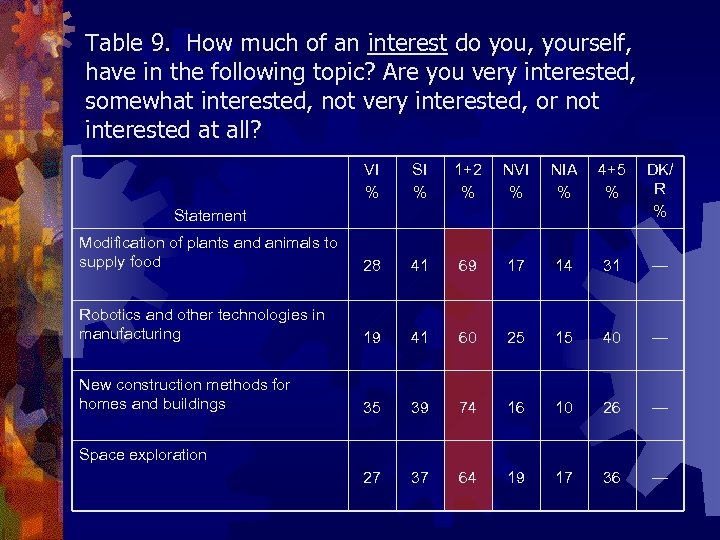 Table 9. How much of an interest do you, yourself, have in the following topic? Are you very interested, somewhat interested, not very interested, or not interested at all? VI % SI % 1+2 % NVI % NIA % 4+5 % DK/ R % Modification of plants and animals to supply food 28 41 69 17 14 31 — Robotics and other technologies in manufacturing 19 41 60 25 15 40 — New construction methods for homes and buildings 35 39 74 16 10 26 — 27 37 64 19 17 36 — Statement Space exploration
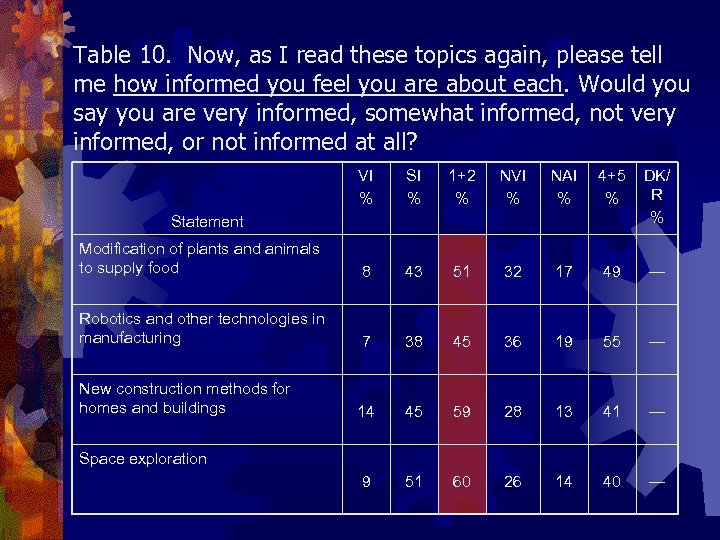 Table 10. Now, as I read these topics again, please tell me how informed you feel you are about each. Would you say you are very informed, somewhat informed, not very informed, or not informed at all? VI % SI % 1+2 % NVI % NAI % 4+5 % DK/ R % Modification of plants and animals to supply food 8 43 51 32 17 49 — Robotics and other technologies in manufacturing 7 38 45 36 19 55 — New construction methods for homes and buildings 14 45 59 28 13 41 — 9 51 60 26 14 40 — Statement Space exploration
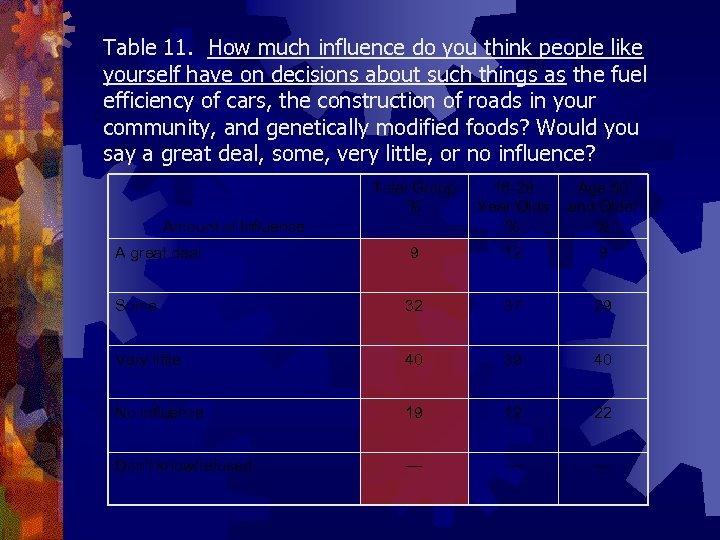 Table 11. How much influence do you think people like yourself have on decisions about such things as the fuel efficiency of cars, the construction of roads in your community, and genetically modified foods? Would you say a great deal, some, very little, or no influence? Total Group % 18 -29 Year Olds % Age 50 and Older % A great deal 9 12 9 Some 32 37 29 Very little 40 39 40 No influence 19 12 22 Don’t know/refused — — — Amount of Influence
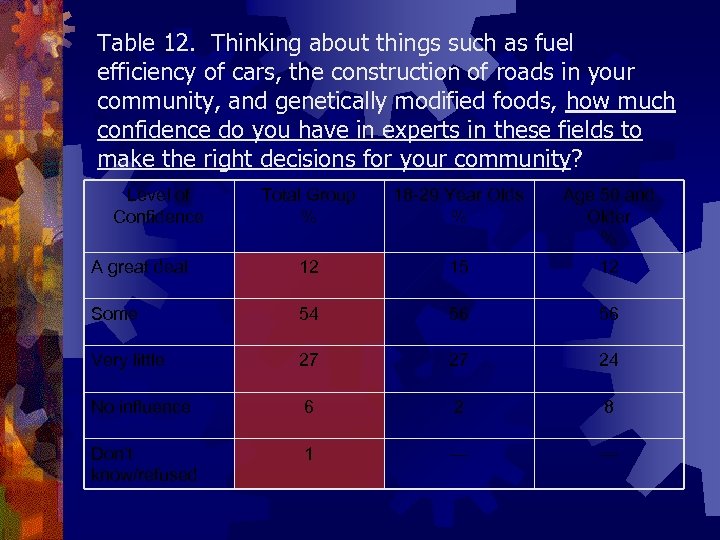 Table 12. Thinking about things such as fuel efficiency of cars, the construction of roads in your community, and genetically modified foods, how much confidence do you have in experts in these fields to make the right decisions for your community? Level of Confidence Total Group % 18 -29 Year Olds % Age 50 and Older % A great deal 12 15 12 Some 54 56 56 Very little 27 27 24 No influence 6 2 8 Don’t know/refused 1 — —
 Differences Based on Gender
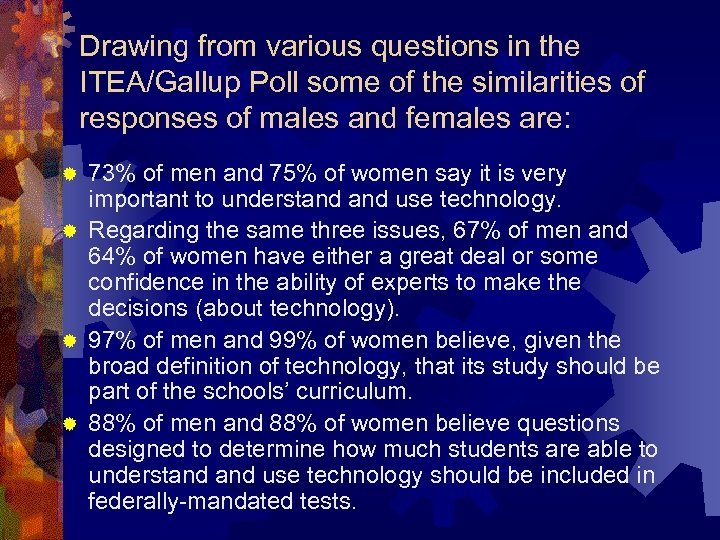 Drawing from various questions in the ITEA/Gallup Poll some of the similarities of responses of males and females are: 73% of men and 75% of women say it is very important to understand use technology. ® Regarding the same three issues, 67% of men and 64% of women have either a great deal or some confidence in the ability of experts to make the decisions (about technology). ® 97% of men and 99% of women believe, given the broad definition of technology, that its study should be part of the schools’ curriculum. ® 88% of men and 88% of women believe questions designed to determine how much students are able to understand use technology should be included in federally-mandated tests. ®
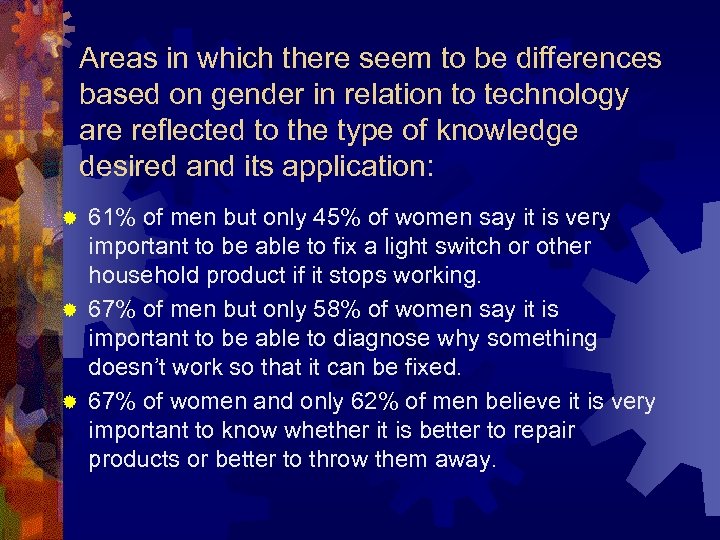 Areas in which there seem to be differences based on gender in relation to technology are reflected to the type of knowledge desired and its application: 61% of men but only 45% of women say it is very important to be able to fix a light switch or other household product if it stops working. ® 67% of men but only 58% of women say it is important to be able to diagnose why something doesn’t work so that it can be fixed. ® 67% of women and only 62% of men believe it is very important to know whether it is better to repair products or better to throw them away. ®
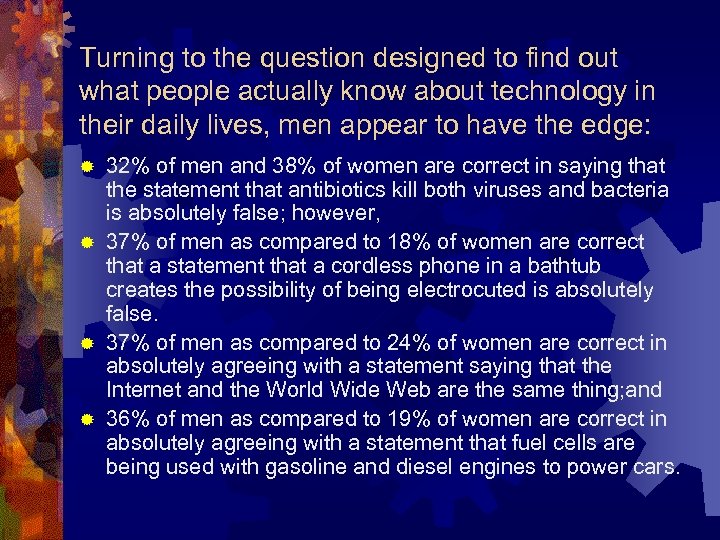 Turning to the question designed to find out what people actually know about technology in their daily lives, men appear to have the edge: 32% of men and 38% of women are correct in saying that the statement that antibiotics kill both viruses and bacteria is absolutely false; however, ® 37% of men as compared to 18% of women are correct that a statement that a cordless phone in a bathtub creates the possibility of being electrocuted is absolutely false. ® 37% of men as compared to 24% of women are correct in absolutely agreeing with a statement saying that the Internet and the World Wide Web are the same thing; and ® 36% of men as compared to 19% of women are correct in absolutely agreeing with a statement that fuel cells are being used with gasoline and diesel engines to power cars. ®
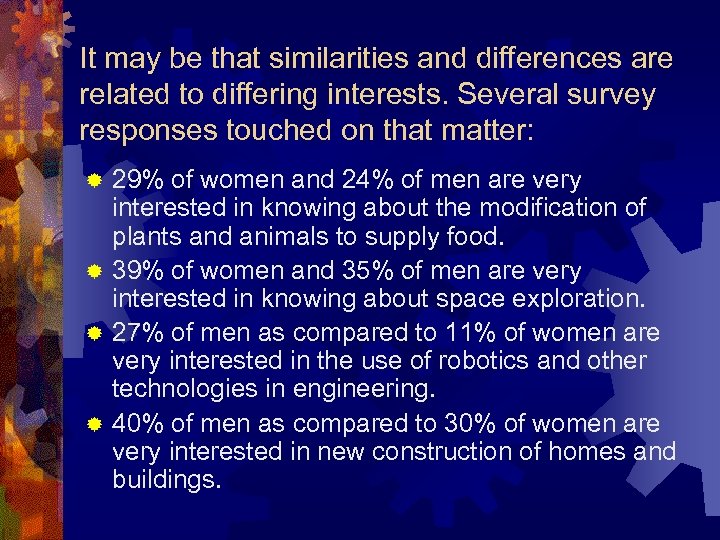 It may be that similarities and differences are related to differing interests. Several survey responses touched on that matter: 29% of women and 24% of men are very interested in knowing about the modification of plants and animals to supply food. ® 39% of women and 35% of men are very interested in knowing about space exploration. ® 27% of men as compared to 11% of women are very interested in the use of robotics and other technologies in engineering. ® 40% of men as compared to 30% of women are very interested in new construction of homes and buildings. ®
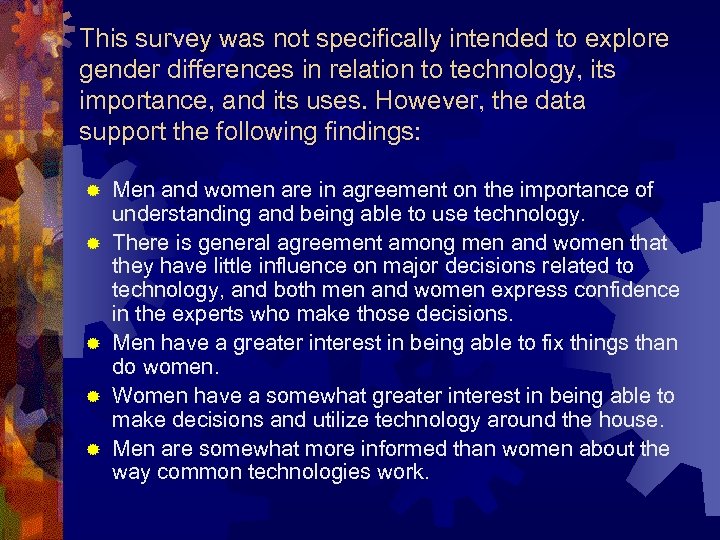 This survey was not specifically intended to explore gender differences in relation to technology, its importance, and its uses. However, the data support the following findings: ® ® ® Men and women are in agreement on the importance of understanding and being able to use technology. There is general agreement among men and women that they have little influence on major decisions related to technology, and both men and women express confidence in the experts who make those decisions. Men have a greater interest in being able to fix things than do women. Women have a somewhat greater interest in being able to make decisions and utilize technology around the house. Men are somewhat more informed than women about the way common technologies work.
 Technology and Education
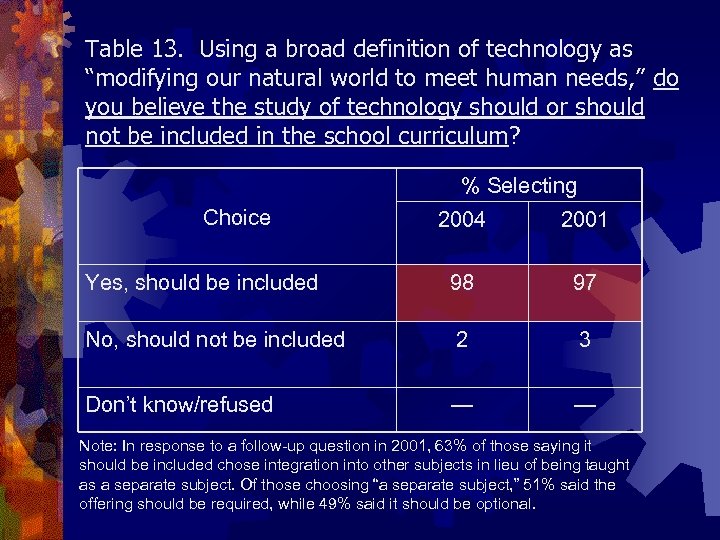 Table 13. Using a broad definition of technology as “modifying our natural world to meet human needs, ” do you believe the study of technology should or should not be included in the school curriculum? % Selecting Choice 2004 2001 Yes, should be included 98 97 No, should not be included 2 3 Don’t know/refused — — Note: In response to a follow-up question in 2001, 63% of those saying it should be included chose integration into other subjects in lieu of being taught as a separate subject. Of those choosing “a separate subject, ” 51% said the offering should be required, while 49% said it should be optional.
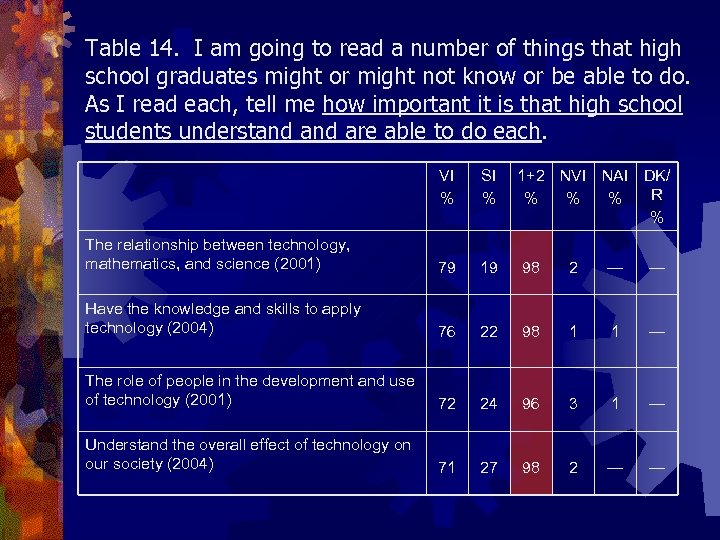 Table 14. I am going to read a number of things that high school graduates might or might not know or be able to do. As I read each, tell me how important it is that high school students understand are able to do each. VI % SI % 1+2 NVI NAI DK/ R % % The relationship between technology, mathematics, and science (2001) 79 19 98 2 — — Have the knowledge and skills to apply technology (2004) 76 22 98 1 1 — The role of people in the development and use of technology (2001) 72 24 96 3 1 — Understand the overall effect of technology on our society (2004) 71 27 98 2 — —
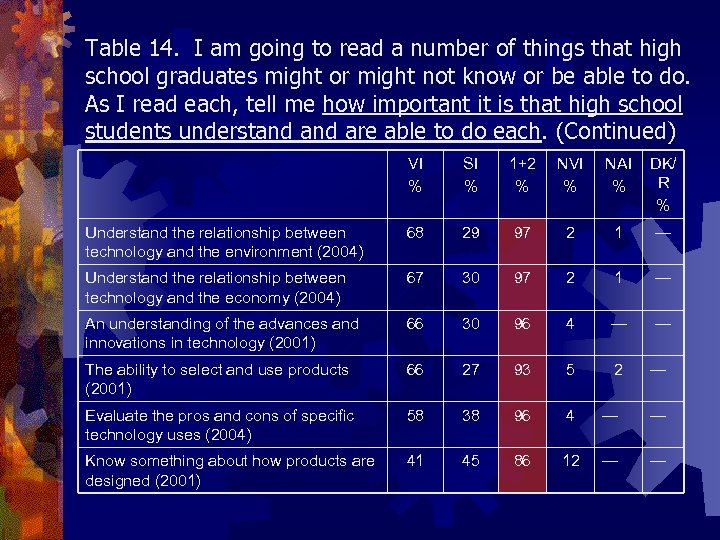 Table 14. I am going to read a number of things that high school graduates might or might not know or be able to do. As I read each, tell me how important it is that high school students understand are able to do each. (Continued) VI % SI % 1+2 % NVI % NAI % DK/ R % Understand the relationship between technology and the environment (2004) 68 29 97 2 1 — Understand the relationship between technology and the economy (2004) 67 30 97 2 1 — An understanding of the advances and innovations in technology (2001) 66 30 96 4 — — The ability to select and use products (2001) 66 27 93 5 2 Evaluate the pros and cons of specific technology uses (2004) 58 38 96 4 — — Know something about how products are designed (2001) 41 45 86 12 — — —
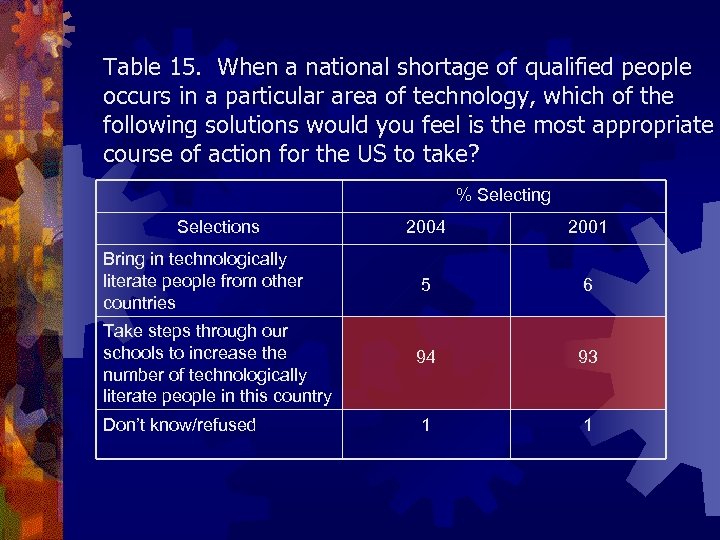 Table 15. When a national shortage of qualified people occurs in a particular area of technology, which of the following solutions would you feel is the most appropriate course of action for the US to take? % Selecting Selections 2004 2001 Bring in technologically literate people from other countries 5 6 Take steps through our schools to increase the number of technologically literate people in this country 94 93 Don’t know/refused 1 1
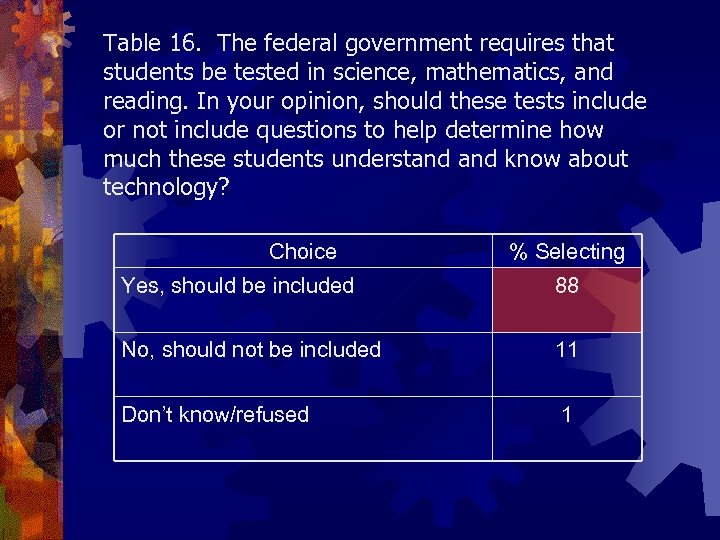 Table 16. The federal government requires that students be tested in science, mathematics, and reading. In your opinion, should these tests include or not include questions to help determine how much these students understand know about technology? Choice % Selecting Yes, should be included 88 No, should not be included 11 Don’t know/refused 1
 A Full Report of the ITEA/Gallup Poll is in the September 2004 The Technology Teacher and on the Web (www. iteawww. org).
 ITEA encourages additional research based on this Gallup Poll (complete set of data tables available) (www. iteawww. org)
 Summary URL: http: //www. iteawww. org Email: standards@itea-tfaap. org Thank you!