


 Скачать презентацию International Taxation 3 rd part Transfer prices Prof
part-3-Transfer_prices 2014.ppt
- Количество слайдов: 27
 International Taxation 3 rd part: Transfer prices Prof. Dr. Gerrit Frotscher International Tax Institute University of Hamburg Associate Prof. Stepan Lyubavskiy, Unecon Master of International Business 21 - 23 November, 2014 St Petersburg 1
 Transfer Prices Significance • About 50 % of import and export of goods are between group companies • Therefore huge potential for profit transfers • In practice, however, limited: Ø Ø Interference with responsibility of profit centres Can lead to wrong management decisions High risk due to tax audits Risk of (economic) double taxation Master of International Business 21 - 23 November, 2014 St Petersburg 2
 Transfer Prices Applicable Law • National law: Ø Hidden profit distribution • International: Ø Art. 9 OECD-MA arm’s length principle Ø legal basis in contracting state necessary Ø If an adjustment is made by one state the other state has to make a corresponding adjustment but only if the first adjustment was in line with Art. 9 OECD-MA (arm’s length principle), what may be disputed by the other state • All legal rules follow the arm‘s-length-principle • Business transactions between affiliated companies have to be structured as between third parties Master of International Business 21 - 23 November, 2014 St Petersburg 3
 Transfer Prices Basics of arm‘s-length-principle • Partly fictitious, since transactions between affiliated companies follow other rules than those between third parties (e. g. : group backing) • Direct comparison with third party behaviour rarely possible • Therefore „notional“ comparison („what would a third party have done if…“ • Functional analysis Ø What function is fulfilled by what company? Ø Functions eg: Production Sales Research/ownership of intangibles storage • Appropriate reward for functions and risks Master of International Business 21 - 23 November, 2014 St Petersburg 4
 Transfer Prices Methods • OECD-report 2010 Ø Standard methods Ø Profit-oriented methods Ø Global methods • National Guidelines, eg Germany: Ø Ø Ø Administrative principles 1983 Administrative principles Cost Contribution Agreements (1999) Administrative principles Expatriates (2001) Administrative principles Procedures (2005) Regulation re. documentation Master of International Business 21 - 23 November, 2014 St Petersburg 5
 Transfer Prices Internationally used methods: • Standard methods Ø Comparable uncontrolled price method (CUP) Ø Cost-plus method Ø Resale price method • Profit-oriented methods Ø Profit-split method Ø Transactional net margin method (TNMM) • Global method • Germany: Standard methods and TNMM; Russia: only standard methods • USA allows global methods, Brazil uses lump-sum standards Master of International Business 21 - 23 November, 2014 St Petersburg 6
 Transfer Prices Standard methods • Comparable uncontrolled price method Ø Direct application of arm‘s-length-principle Ø Comparison with transactions between third parties, between taxpayer and a third party or between affiliate of taxpayer and a third party Ø Intra-group deals are not “comparable” because not “uncontrolled” Ø State-controlled prices are not “uncontrolled” Ø Requires knowledge of all details of the transaction (volume, quality, freight, risk of losses, currency, payment terms, guaranties etc) Ø Full knowledge of details of third-party transaction in practice not available Ø Risk that fiscal authorities use „better knowledge of hindsight“ Master of International Business 21 - 23 November, 2014 St Petersburg 7
 Transfer Prices Standard methods • Cost-plus-method Ø Remuneration for producer are costs plus (limited) profit element Ø Applicable for processing agreements, turn-key contracts, professional services Ø Apart from this hardly in line with arm‘s-length-principle Ø Problem: What are „costs“ (eg different depreciation regimes)? generally accepted accounting standards Ø Full costs or only variable costs? Master of International Business 21 - 23 November, 2014 St Petersburg 8
 Transfer Prices Standard methods • Resale-minus method Ø Remuneration for Marketing company are costs plus (limited) profit element Ø Market risk is borne by producer Ø Applicable, if marketing company has the role of a mere agent/ commissionaire Ø Not applicable, if marketing company bears full market risk/fulfills full functions of a trader Ø Not freely exchangeable with cost-plus-method Master of International Business 21 - 23 November, 2014 St Petersburg 9
 Transfer Prices Profit-oriented methods • Profit-split method Ø Profit of a transaction is split between seller and buyer • Transactional net margin method – TNMM Ø Comparison of the net margin of a transaction between affiliated companies with a margin of a third-party-transaction Ø Frequently used Ø Data banks for margin analysis available • Wrong conclusions possible if cost level of the partners differs substantially (overheads, inefficiencies) Ø Correctness of this method depends on the issue what factors are included in “margin” Ø If data banks are used, knowledge required how data are computed Master of International Business 21 - 23 November, 2014 St Petersburg 10
 Transfer Prices Global methods • Total profit of a group of companies is allocated to local companies according to a key Ø eg return on investment/capital Ø eg margin as percentage of proceeds • Global methods are not in line with arm‘s-length-principle, therefore not in line with Art. 9 OECD-MA • Are used by USA Master of International Business 21 - 23 November, 2014 St Petersburg 11
 Transfer Prices Price range • Special problem if price range exists: • Average of the prices within the range? Ø Argument: If the tax payer acts in line with the market the agreed prices will in medium/long run equal the average of the market prices • Prices of second and third quartile? Ø Argument: Prices in the first and fourth quartile are likely to be special cases and therefore not “comparable” • The price most favourable for the tax payer? Ø Argument: Every price in the price range is a market price and therefore a “comparable” price Master of International Business 21 - 23 November, 2014 St Petersburg 12
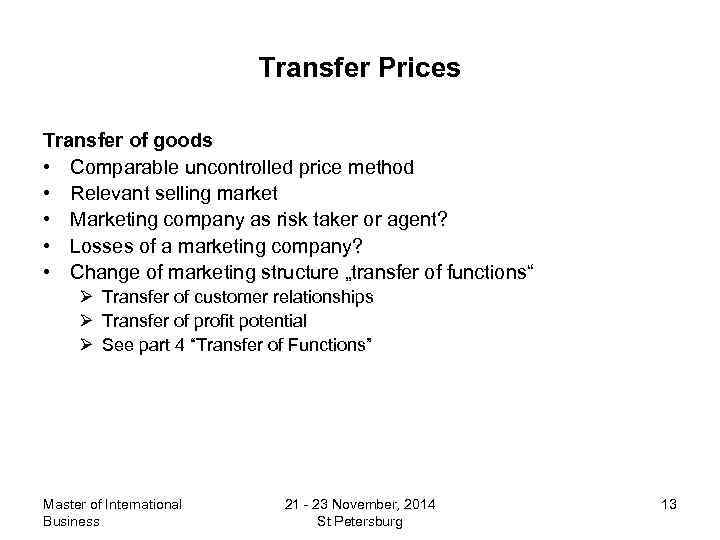 Transfer Prices Transfer of goods • Comparable uncontrolled price method • Relevant selling market • Marketing company as risk taker or agent? • Losses of a marketing company? • Change of marketing structure „transfer of functions“ Ø Transfer of customer relationships Ø Transfer of profit potential Ø See part 4 “Transfer of Functions” Master of International Business 21 - 23 November, 2014 St Petersburg 13
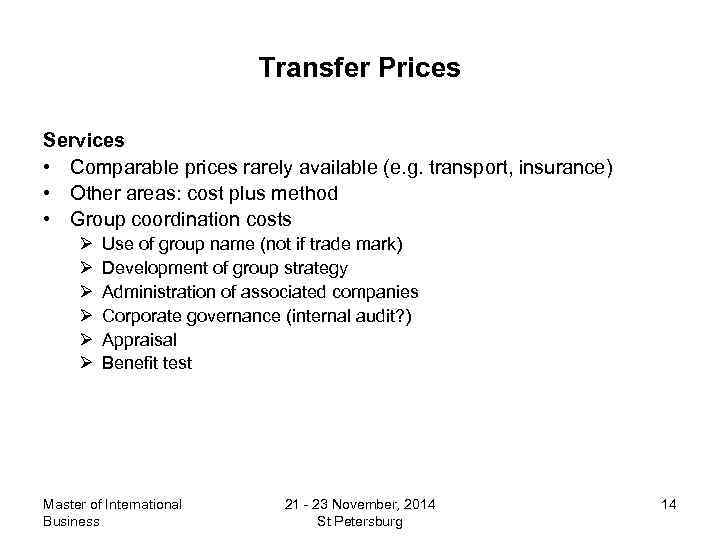 Transfer Prices Services • Comparable prices rarely available (e. g. transport, insurance) • Other areas: cost plus method • Group coordination costs Ø Ø Ø Use of group name (not if trade mark) Development of group strategy Administration of associated companies Corporate governance (internal audit? ) Appraisal Benefit test Master of International Business 21 - 23 November, 2014 St Petersburg 14
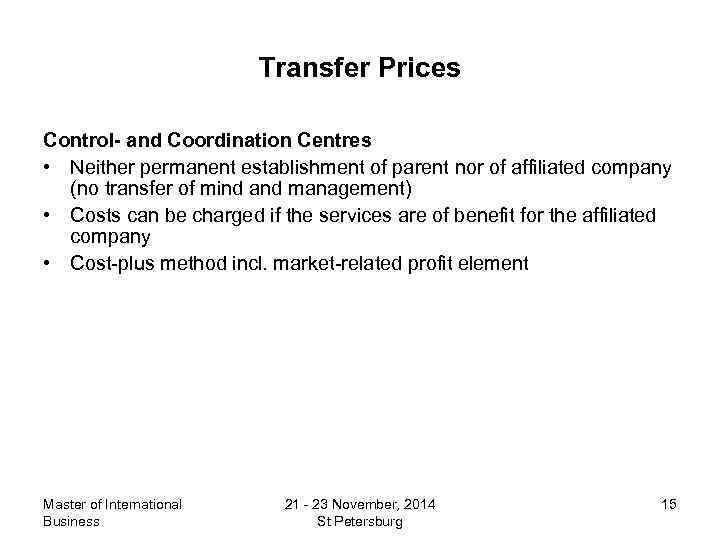 Transfer Prices Control- and Coordination Centres • Neither permanent establishment of parent nor of affiliated company (no transfer of mind and management) • Costs can be charged if the services are of benefit for the affiliated company • Cost-plus method incl. market-related profit element Master of International Business 21 - 23 November, 2014 St Petersburg 15
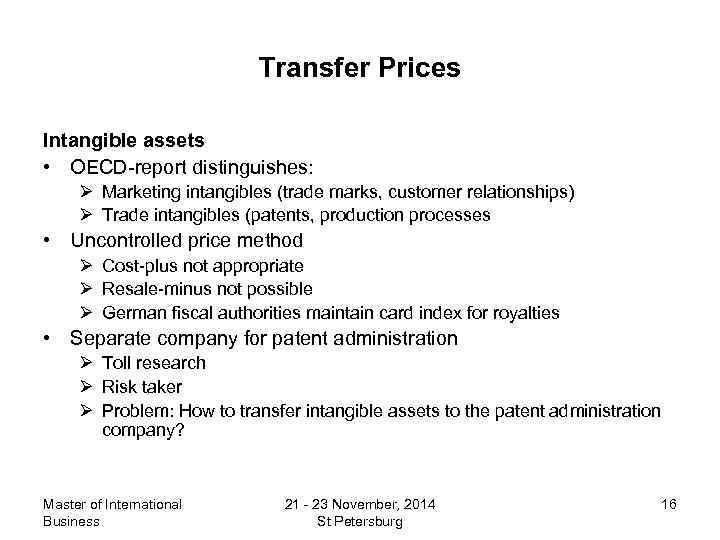 Transfer Prices Intangible assets • OECD-report distinguishes: Ø Marketing intangibles (trade marks, customer relationships) Ø Trade intangibles (patents, production processes • Uncontrolled price method Ø Cost-plus not appropriate Ø Resale-minus not possible Ø German fiscal authorities maintain card index for royalties • Separate company for patent administration Ø Toll research Ø Risk taker Ø Problem: How to transfer intangible assets to the patent administration company? Master of International Business 21 - 23 November, 2014 St Petersburg 16
 Transfer Prices Financing • Market interests Ø Ø Currency Relevant market Securities Financing period • Thin capitalisation (Germany): Interest expenses are only deductible to the amount of interest income plus 30 % of EBITDA; excess carried forward • Thin capitalisation (Russia): Applicable if non-resident legal entity holds more than 20 % of resident company; equity-debt ration 1: 3 (banks and leasing companies: 1: 12, 5). Excess reclassified as dicvidends Master of International Business 21 - 23 November, 2014 St Petersburg 17
 Transfer Prices Documentation • Internationally widely used by fiscal authorities • In principle: Tax payer has to explain what he has done and why; fiscal authorities have the burden of proof • Documentation requirements Ø Documentation of facts: Type and clauses of transactions Ø Documentation that the arm‘s-length-principle was complied with • Issues: Ø Has the documentation to be done immediately after the event? Ø Under what circumstances can the fiscal authorities ask for the documentation? Ø Has the documentation to be handed over immediately after the request of tax authorities Master of International Business 21 - 23 November, 2014 St Petersburg 18
 Transfer Prices Documentation/Sanctions – Example Germany • If documentation is not available or not useable: Ø Assumption that due to transfer prices profits have been reduced (change of burden of proof), and Ø In case of a price range: use of the most unfavourable price, and Ø Surcharge of 5 -10 % of additional income • In case of late handover: 100 € per day, up to a maximum of 1 Mio € (per year, per transaction, per request? ) Master of International Business 21 - 23 November, 2014 St Petersburg 19
 Transfer Prices Mutual agreement procedure: • Legal basis: Art. 25 OECD-MA • Request has to be put forward within 3 years after the measure resulting in a double taxation • Inefficient because: Ø Ø Ø Initiation of the process at the discretion of authorities Tax payer is not involved Risk that authorities come to a solution at the cost of the tax payer Takes long times Possibility to agree to disagree • DTA US-Germany: Arbitration with “first best offer” Master of International Business 21 - 23 November, 2014 St Petersburg 20
 Transfer Prices Arbitration procedure: • Legal basis: EC-convention • 3 steps: Ø Ø Information Mutual Agreement Procedure: 2 years Arbitration procedure: 6 months Fiscal authorities can accept the arbitration decision or agree within 6 month to another solution • Arbitration has the character of a legal procedure • Tax payer is party to the process • A solution has to be found which avoids double taxation Master of International Business 21 - 23 November, 2014 St Petersburg 21
 Transfer Prices Rulings: • In OECD-states possible, however costly • Advanced Pricing Agreements (APA) Ø Agreement with the fiscal authorities that a certain method to calculate transfer prices is valid Ø Can be with more than one fiscal authority (multi-party APA) • Valid only if actual prices are calculated in accordance with APA Ø APA can lead to additional taxes if not followed: If APA was correct, all other methods are not suitable for the specific case therefore fiscal challenge • Risks: Ø Content of ruling can be worse than hoped Ø Fiscal authorities are put on the alert Ø Premature information of fiscal authorities Master of International Business 21 - 23 November, 2014 St Petersburg 22
 Transfer Prices Controlled Foreign Companies (CFC): • Avoidance of profit transfers to companies with reduced functions • 4 Steps: Ø Ø Companies without economic function: abuse of law Management in Germany: unrestricted taxation Company with reduced function in a low-tax area: CFC rules apply Company with full function: transfer prices • Transfer pricing rules would be sufficient Master of International Business 21 - 23 November, 2014 St Petersburg 23
 Transfer Prices CFC‘s/ legal consequences - Germany: • CFC must be controlled by German residents • Passive income as defined by law • Resident in low-tax-country: tax rate less than 25 % • Income of CFC is allocated to shareholder as deemed dividend • Foreign taxes of the CFC can be deducted or credited • Tax exemption/reduction of tax base available for „normal“ dividends is not applied to „deemed dividend“ of CFC • However, dividend later actually paid by the CFC is tax-exempt. Russia: • No CFC regulation, however currency regulations restricting domestic investors in respect of investments outside Russia have a similar effect. Master of International Business 21 - 23 November, 2014 St Petersburg 24
 Transfer Prices ECJ dated 12/9/06 (Cadbury-Schweppes) • Establishment in another state with the aim at using the beneficial tax system is protected by the freedom of establishment • Discrimination since profits of a UK based affiliate are not taxed at the level of the parent company • Only possible justification is prevention of abuse of law • Establishment of an affiliate in a low tax country is no abuse of law • However, company must carry out actual and true business activities Ø Can be business relationships to affiliated companies Master of International Business 21 - 23 November, 2014 St Petersburg 25
 Transfer Prices ECJ on CFC rules: • Criteria for abuse of law: Ø Material presence Ø Deliveries/performances on own account Ø Activities with added value • Standardised assumptions possible • Taxpayer must have the right to prove the contrary • German CFC-rules to a large extent not in line with EC law, therefore limited application if CFC is located in EC country Master of International Business 21 - 23 November, 2014 St Petersburg 26
 Transfer Prices Transfer of business functions • Transfer of assets Ø Ø Material assets Immaterial assets Customer relationships Good will • Transfer of “transfer package” Ø Profit potential Ø Who has the right to tax profit achieved in a low tax/low cost country? Master of International Business 21 - 23 November, 2014 St Petersburg 27