 Скачать презентацию International tax applications of XML Peter Horsburgh World
6121c3855fd080107915a153925065e1.ppt
- Количество слайдов: 37



International tax applications of XML Peter Horsburgh World Wide Taxation Industry Manager Microsoft Corporation peterhor@microsoft. com 425 -703 -7491
Agenda International tax scene v Problem space v International applications of XML v Uses of XML: v. Wrapper v. Data dictionary v What is e-Government v Futures for US – Taxml / XBRL / X 12 etc?
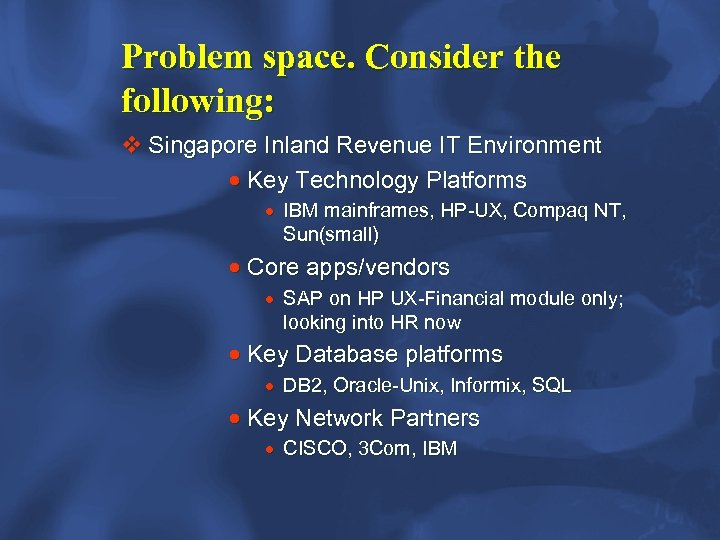
Problem space. Consider the following: v Singapore Inland Revenue IT Environment · Key Technology Platforms · IBM mainframes, HP-UX, Compaq NT, Sun(small) · Core apps/vendors · SAP on HP UX-Financial module only; looking into HR now · Key Database platforms · DB 2, Oracle-Unix, Informix, SQL · Key Network Partners · CISCO, 3 Com, IBM
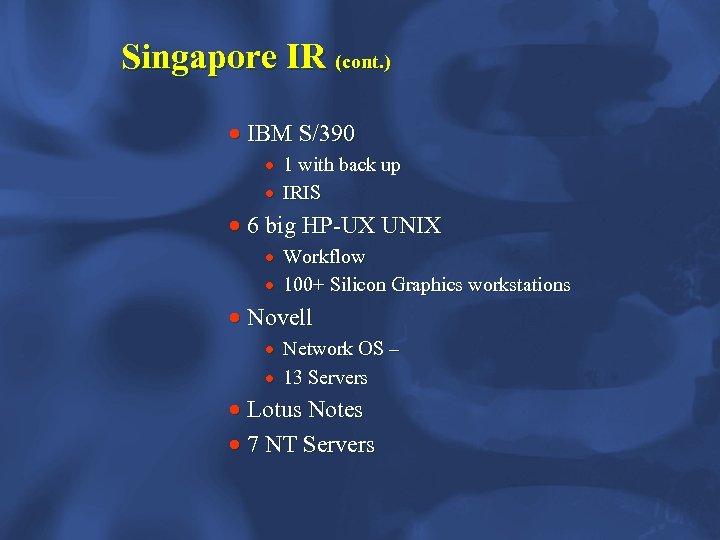
Singapore IR (cont. ) · IBM S/390 · 1 with back up · IRIS · 6 big HP-UX UNIX · Workflow · 100+ Silicon Graphics workstations · Novell · Network OS – · 13 Servers · Lotus Notes · 7 NT Servers
Singapore IR (cont. ) Issues: Although as single solutions the list above has provided Singapore with effective results, the impacts include: v Difficult connectivity scenario’s v Workflow inefficiencies v Very costly maintenance v C 2 G; B 2 G and G 2 G transactions require a lot of effort – and this is Singapore, a country noted for its IT savvy
Quick word on global tax modernization v Tax agencies lead other government agencies in renewal and updating of systems, that said, most rely on systems deployed many years ago v Pressures of the ‘new economy’ which implies risk to the tax base – greater number of taxable transactions per taxpayer type especially capital gains related v All taxpayer types are demanding greater access to: v. Current & prior year tax information v. Problem resolution v. Advanced rulings / interpretation of legislation
Quick word on global tax modernization (cont. ) v Internal consumers of tax data are demanding greater ease of access to data (digital dashboards) v All ‘systems’, in an effective workflow environment must be able to connect and operate to meet the demand of the consumers of tax information – which means logical, consistent and reusable data objects v Latest business models for tax agencies reflect the ‘Internet Age’, openness of Government, and greater levels of taxpayer services
XML’s role v What is the role of XML in the tax administration environment? v How can it help with: v. Connectivity v. Operability v. Workflow v. Efficiencies v. Extended services to the consumers of tax information?
International examples of XML v UK Inland Revenue v Australian Tax Office v Canada Customs and Revenue Agency (CCRA)
Inland Revenue v Modernization (Phase 1) initiatives include: v. Citizen to Government (C 2 G) v. EF tax returns v. Access anywhere, anytime (24 x 7 x 365) v. Business to Government (B 2 G) v. PAYE (W 2) EF filing & payment via web v. VAT filing & payment via web v. Government to Government (G 2 G) v. Data sharing
Inland Revenue (cont. ) Technology – consumer filing v Major turn key solution, deployed overtime which includes: v. Direct internet filing using http post and 128 bit encryption, initially for individual tax returns, overtime all tax return types: - corps, p/ships, trusts v. Digital signature legislation for paperless system v. Initially PIN (PKI) goal Smartcards v. Accessibility, file anywhere, anytime goal v. Standard for data management – XML schema
Inland Revenue (cont. ) Technology (Phase 2) – long term goals. v Back end goals include: -. v. Real time processing. v. Accessibility to data (XML schema -- conduit) for risk management, profiling, black box, taxpayer enquiries etc. v C 2 G, B 2 G enhancements such as all communications electronic, secure messaging etc. v. Connectivity goals for sharing data between IR & other government departments: -. v. HMS exercise & customs (VAT). v. Dept of social security (DSS). v. Companies house……. .
Why did IR UK adopt XML? v XML schema efficiencies over existing EDI schema: v. Cost! v. Development & maintenance v. Efficient – data sharing / Reusable objects v. Manage only raw data v. Coding efficiencies v. View anywhere, anytime, in any format
Why did IR UK adopt XML? (cont. ) v. Reduces dependencies on accepting only current year processing data (why stop defaulters filing past year returns) v. XML low maintenance cost v. Maintenance to back-end processing can be mutually exclusive to front-end v. Schema can be customerised by other agencies, business v. XSL ~ HTML the customer friendly face!
UK Government v Major modernization strategy led by Prime Minister, Tony Blair – Government White paper goal states 100% electronic communications by 2005 v First examples: v MAFF - applications by farmers for EU subsidies v DSS - pension claims by citizens about to retire v HMCE - VAT returns, and export statistics by businesses v Accessibly objective: v C 2 G v B 2 G v G 2 G v Smarter, efficient & productive government v Cabinet plans shortly to announce the first set of XML Schema’s, XML toolkits and best practice adopting ‘UK Gov. Talk’
Australian Taxation Office (ATO) v Over 75% of all correspondence by individual taxpayers completed electronically (via tax agent community and direct filing services). Response typically exceed the taxpayer charter commitment of 14 days v All tax returns: - Individual, corporations, partnerships, trusts, & pension funds can be filed electronically, with bill pay / presentment / refunds processing options available
ATO (cont. ) v Major taxation reform in Australia that included the introduction of a Goods & Services Tax 1 July 2000. Reform includes all tax events (Income, Sales, Fringe Benefits, Provisional…. tax etc) v Business Activity Statements (BAS) for GST first major XML application – foundation for all business types forms to file in the future using XML v. BAS electronically filed using 128 bit / https v. Can be completed on or off line v XML selected for same reasons as UK IR
ATO XML selection reasons: v Cost! v. Development v. Efficient – data sharing / Reusable objects – BAS data shared between a number of tax departments, states & other federal government departments. v Manage only raw data v Coding efficiencies v View anywhere, anytime, in any format v XML low maintenance cost v. New tax regime will require ‘adjustments’ v XSL ~ HTML the customer friendly face!
ATO (cont. ) XML can be used in multiple scenario’s – ATO Assist http: //www. ato. gov. au ATO Web services are using XML in three main ways: v navigation hierarchies (sitemaps) are stored in static XML files. This is used to dynamically build the navigation pages of the site (by transforming using XSLT) and linking into the publishing tools to allow users to publish content to particular parts of the site. Storing the sitemap in a single XML file means that one change is instantly reflected in all parts of the site and tools.
v COM components generate results internally as XML. The methods which are called from ASP pages all pass in an XSL stylesheet which is used to render the output in different ways on different parts of the sites. For example, the content renderer generates the Tables of Contents as XML, and the Doc. List and Search objects produce lists of documents as XML. The XSLT provides a UI customisation layer - so that is possible to completely change the output of an existing component just by building new XSL - leaving the COM and ASP the same. v Small amounts of structured data (i. e. . News headlines, important dates) are stored internally in an SQL Server and the useful data for display on the site is written to XML. These can be deployed to live servers over FTP/HTTP and result in quicker performance and eliminates SQL synchronisation over firewalls
ATO - summary v Still have a number of modernization initiatives to further enable their business. v. Mass role-out to the community of digital signatures. v. Secure messaging. v. Group reconciliation (W 2 equivalent) electronic filing. v. Efficiency gains via real time processing. v. Interconnectivity & interoperability of existing legacy systems with new technology v. Numerous GST initiatives – including new cross matching systems to check reported business tax gross sales against GST filings. v. All potential XML applications!
Canada Customs and Revenue Agency (CCRA) v NETFILE – CCRA goal to offer Canadian taxpayers convenient tax-filing options v. Direct filing over the internet, implemented using XML wrapper around existing EDI schema v. Taxpayer prepares return using commercially available tax preparation software, software validates return, then prepares EF output v. Taxpayer goes to CCRA web page, and submits file, which is encrypted using the browser 128 bit encrypt
CCRA – NETFILE (cont) v Once tax return is filed using the post & encrypt mechanism, the receiving server sends a receipt (confirmation number) and accept / reject validation report v Initially, existing data schema (EDI based) used for NETFILE, speed to web enabled by wrapping the EDI schema in an XML wrapper to allow http post. Ultimately a new data schema for the same benefits for Gov as described for UK v Goal for NETFILE same as UK – accessibility to gov for its citizens
CCRA - summary v Revenue Canada & customs under one organization long term goals include: v. Electronic submission & ecommerce for small business – reduce burden & cost of compliance (W 2 equivalents, benefits, indirect tax issues, payments etc) v. Timely response on dispute / query items, acknowledging closure v. All correspondence to gov capable of electronic transaction, supported by secure mail, automated phone systems, and increased accessibility v. Maintaining & extending existing relationships
XML applications As a: v. Wrapper v. Taxonomy v. XSL for viewing data
What is e-Government v Why is important ? v Details…. v How can it look
Reinventing the Government “Governments all over the world are reforming and reinventing themselves so that they are smaller, smarter and more responsive to change in this fastchanging information age” USA Vice President Al Gore Excerpt from transcripts of 21 st Century Government Reinvention Jan 1999
Reinventing the Government Basic Challenges v Size and place does matter v. The Smaller the Better v. Local vs Centralized one v Effectiveness v. The best ROI for tax payers, improve quality of service v Searching for a new relationship v. Trust failure and new customer focus v From Industrial to Information Age v. Never ending process of change, on World-Wide scale v. Building the technology infrastructure Excerpt from transcripts of 21 st Century Government Reinvention, Jan 1999
Reinventing the Government Strategies and Tactics v Search for a smaller Government through efficiency gains rather than cutting programs v Development of new processes like reingeneering of service systems, contracting out, performance management and accrual accounting v A new focus on transparency of Government operations v A strong emphasys on Customer Service v Leveraging the Information Technology Excerpt from transcripts of 21 st Century Government Reinvention
Electronic Government (Microsoft’s Gov. Talk) “When software speaks the language of Government” v An open process, involving customers and industry partners, which facilitates the adoption of electronic government services v A framework of standardized specifications - leveraging XML technologies - to enable integrated service delivery anytime, anywhere, on any device v Participate in the Electronic Government Forum community and apply to specific scenarios, to design interoperable, reusable, and sharable services
Government Portal “Architecture for integrated electronic government” v Secure technology platform to catalyze ecommerce, integrate applications and support on-line personalized communication with and within government v Access point to integrated government services from any device, any where, any time v Leverage portal momentum to educate, empower, and employ
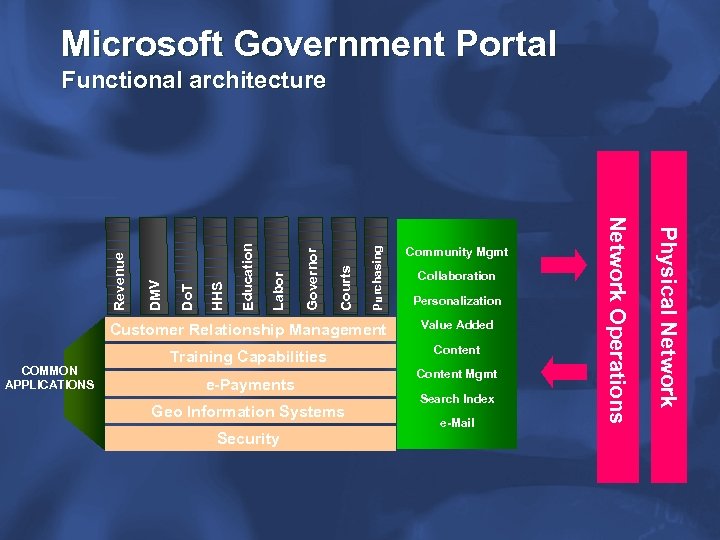
Microsoft Government Portal Purchasing Courts Governor Labor Education HHS Do. T DMV Collaboration Personalization Customer Relationship Management COMMON APPLICATIONS Value Added Training Capabilities Content e-Payments Geo Information Systems Security Content Mgmt Search Index e-Mail Physical Network Community Mgmt Network Operations Revenue Functional architecture
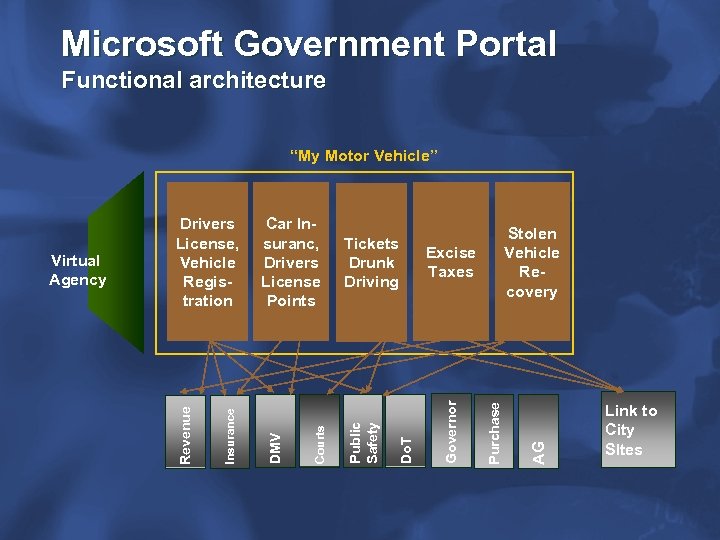
Microsoft Government Portal Functional architecture “My Motor Vehicle” Purchase AG Stolen Vehicle Recovery Excise Taxes Governor Do. T Tickets Drunk Driving Public Safety Courts Car Insuranc, Drivers License Points DMV Insurance Revenue Virtual Agency Drivers License, Vehicle Registration Link to City SItes
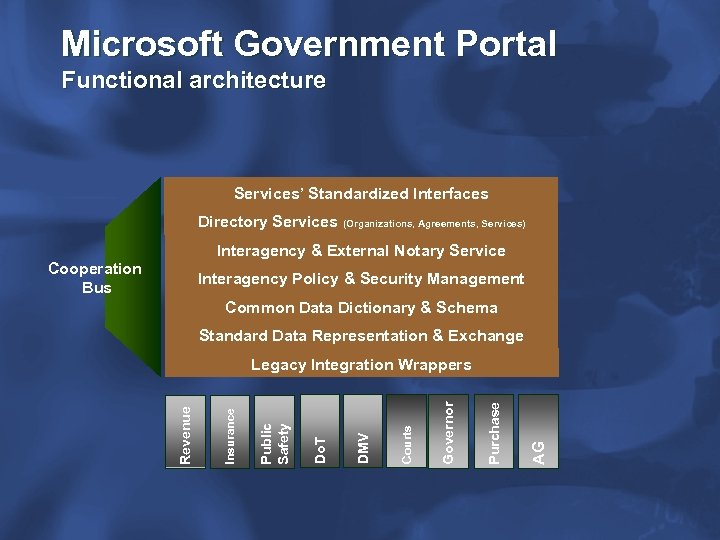
Microsoft Government Portal Functional architecture Services’ Standardized Interfaces Directory Services (Organizations, Agreements, Services) Interagency & External Notary Service Cooperation Bus Interagency Policy & Security Management Common Data Dictionary & Schema Standard Data Representation & Exchange AG Purchase Governor Courts DMV Do. T Public Safety Insurance Revenue Legacy Integration Wrappers
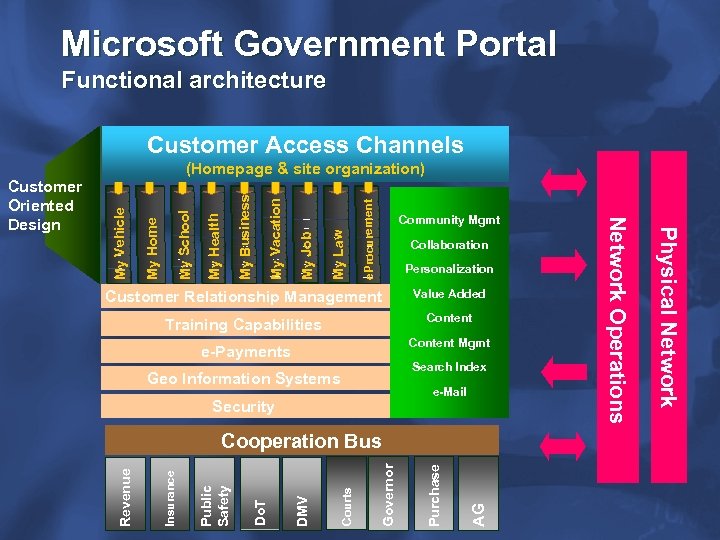
Microsoft Government Portal Functional architecture Customer Access Channels Purchasing e. Procurement Courts My Law Governor My Job Labor My Vacation Education My Business HHS My Health Do. T My School DMV My Home Revenue My Vehicle Collaboration Personalization Customer Relationship Management Value Added Training Capabilities Content Mgmt e-Payments Search Index Geo Information Systems e-Mail Security AG Purchase Governor Courts DMV Do. T Public Safety Insurance Revenue Cooperation Bus Physical Network Community Mgmt Network Operations Customer Oriented Design (Homepage & site organization)
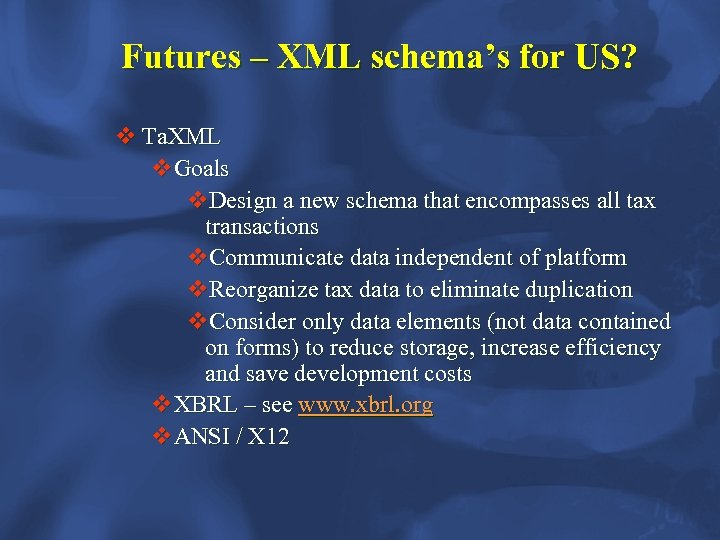
Futures – XML schema’s for US? v Ta. XML v. Goals v. Design a new schema that encompasses all tax transactions v. Communicate data independent of platform v. Reorganize tax data to eliminate duplication v. Consider only data elements (not data contained on forms) to reduce storage, increase efficiency and save development costs v. XBRL – see www. xbrl. org v. ANSI / X 12

Questions?
Скачать презентацию International tax applications of XML Peter Horsburgh World
6121c3855fd080107915a153925065e1.ppt