 Скачать презентацию International Symposium on Sustainable Cities Empowering Local Governments
524e6ac429daf123ad3498576fe00e11.ppt
- Количество слайдов: 42



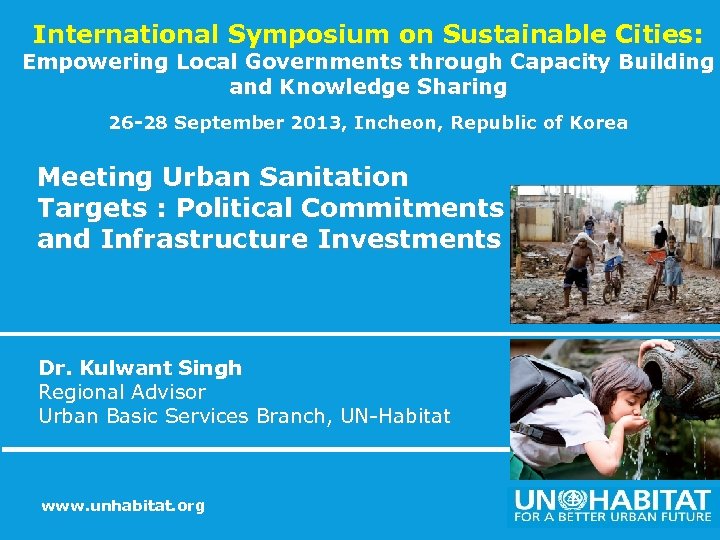
International Symposium on Sustainable Cities: Empowering Local Governments through Capacity Building and Knowledge Sharing 26 -28 September 2013, Incheon, Republic of Korea Meeting Urban Sanitation Targets : Political Commitments and Infrastructure Investments Dr. Kulwant Singh Regional Advisor Urban Basic Services Branch, UN-Habitat 1 www. unhabitat. org
Sources of Funds for water • Water Users: Households, Farmers & Businesses Householders invest their cash, labour and materials in wells, pipes, basic sanitation and other facilities. Farmers invest large sums in tubewells, pumps and surface irrigation systems, either on their own or as members of associations and user groups. Industrial and commercial firms often develop their own water supplies and effluent treatment facilities. Some large firms even supply the general population. Users also cross-subsidise each other through paying different tariffs. • Informal suppliers. In cities where growth has outstripped the public network, local entrepreneurs, often acting outside the law, fill the vacuum by selling water in bulk from tankers— or in containers and bottles. 2
Sources of Funds for Water • Public water authorities and utilities fund recurrent spending and some new investment from revenues provided by user charges (gross operating cash flow), loans and sometimes public subsidies. • Private companies, either local or foreign, providing funds from sources similar to public utilities, plus equity injection. • Non-governmental organisations and local communities, raising funds from voluntary private contributions or grants from international agencies. • Local banks and other financial institutions offer shortterm or medium-term loans at market rates. • International banks and export credit agencies, providing larger volumes of finance than local sources, against corporate guarantees or project cash flow 3
Sources of Funds for water • International aid from multilateral and bilateral sources, available as loans on concessional terms or grants • Multilateral financial institutions: Loans on near-market terms • Environmental and Water and Sanitation Trust Funds • National Central and Local governments, providing subsidies, guarantees of loans, and proceeds of bond issues 4
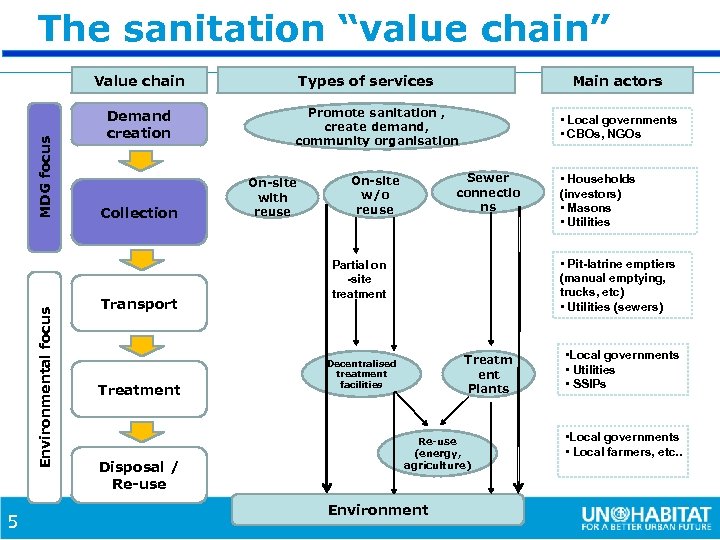
The sanitation “value chain” Environmental focus MDG focus Value chain 5 Demand creation Collection Transport Treatment Disposal / Re-use Types of services Main actors Promote sanitation , create demand, community organisation On-site with reuse • Local governments • CBOs, NGOs Sewer connectio ns On-site w/o reuse • Households (investors) • Masons • Utilities • Pit-latrine emptiers (manual emptying, trucks, etc) • Utilities (sewers) Partial on -site treatment Treatm ent Plants Decentralised treatment facilities Re-use (energy, agriculture) Environment • Local governments • Utilities • SSIPs • Local governments • Local farmers, etc. .
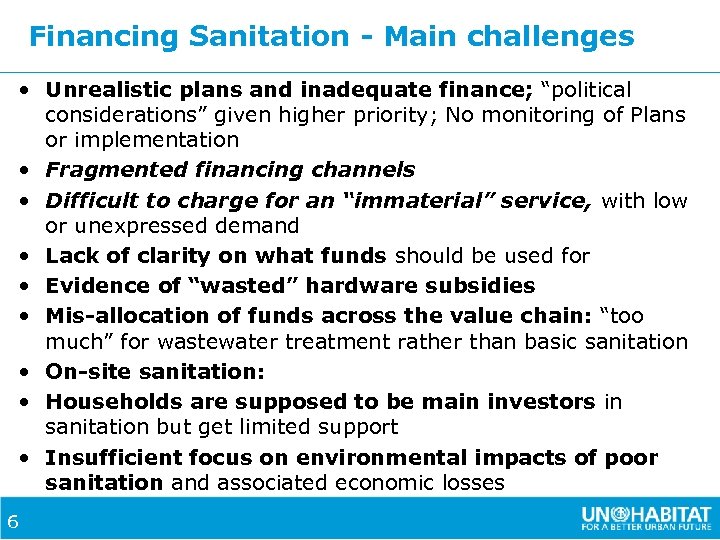
Financing Sanitation - Main challenges • Unrealistic plans and inadequate finance; “political considerations” given higher priority; No monitoring of Plans or implementation • Fragmented financing channels • Difficult to charge for an “immaterial” service, with low or unexpressed demand • Lack of clarity on what funds should be used for • Evidence of “wasted” hardware subsidies • Mis-allocation of funds across the value chain: “too much” for wastewater treatment rather than basic sanitation • On-site sanitation: • Households are supposed to be main investors in sanitation but get limited support • Insufficient focus on environmental impacts of poor sanitation and associated economic losses 6
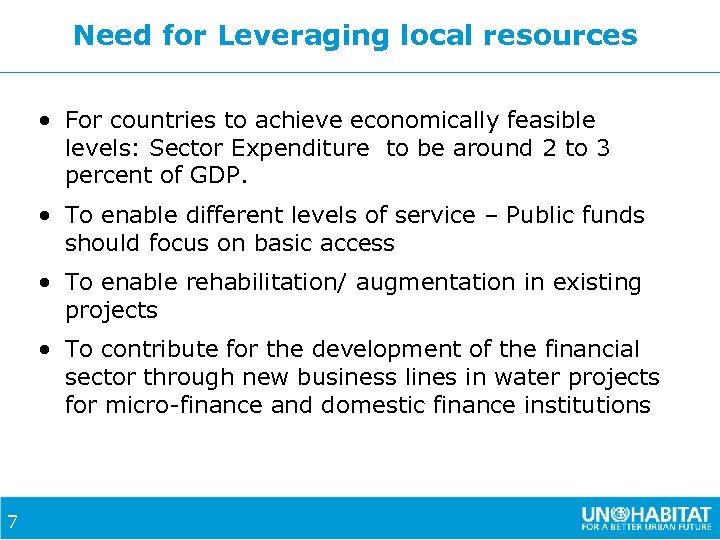
Need for Leveraging local resources • For countries to achieve economically feasible levels: Sector Expenditure to be around 2 to 3 percent of GDP. • To enable different levels of service – Public funds should focus on basic access • To enable rehabilitation/ augmentation in existing projects • To contribute for the development of the financial sector through new business lines in water projects for micro-finance and domestic finance institutions 7
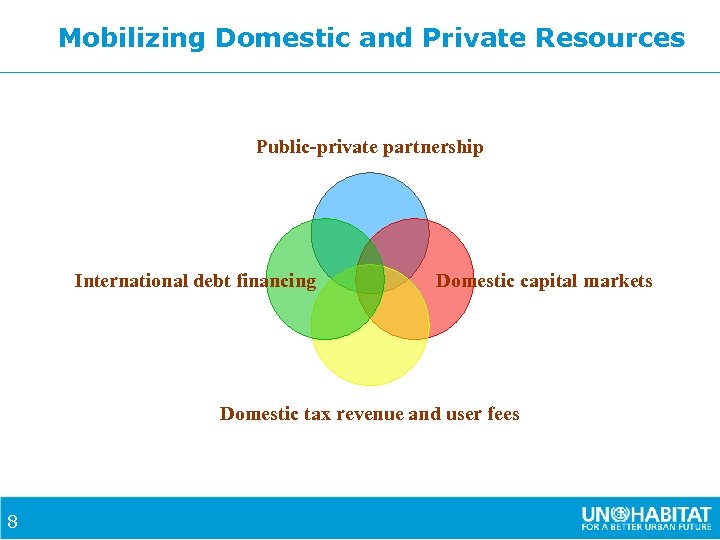
Mobilizing Domestic and Private Resources Public-private partnership International debt financing Domestic capital markets Domestic tax revenue and user fees 8
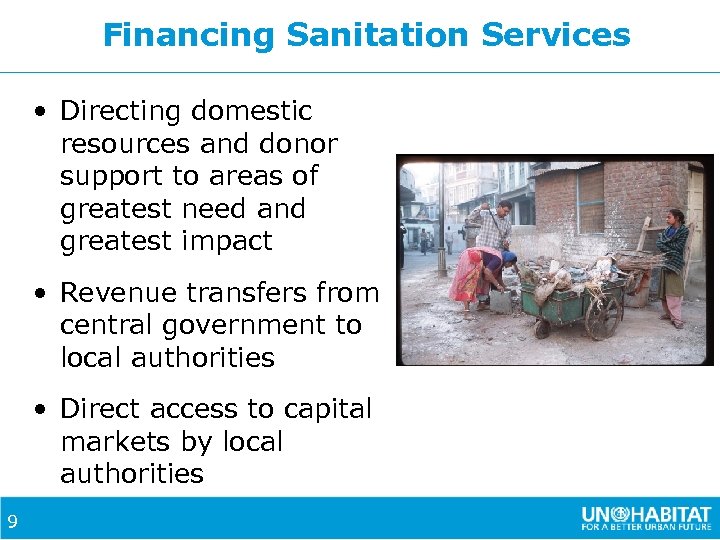
Financing Sanitation Services • Directing domestic resources and donor support to areas of greatest need and greatest impact • Revenue transfers from central government to local authorities • Direct access to capital markets by local authorities 9
Financing Sanitation Services • Mobilization of financial support to bankable project and programme proposals • Cost recovery policy • Micro credit schemes 10
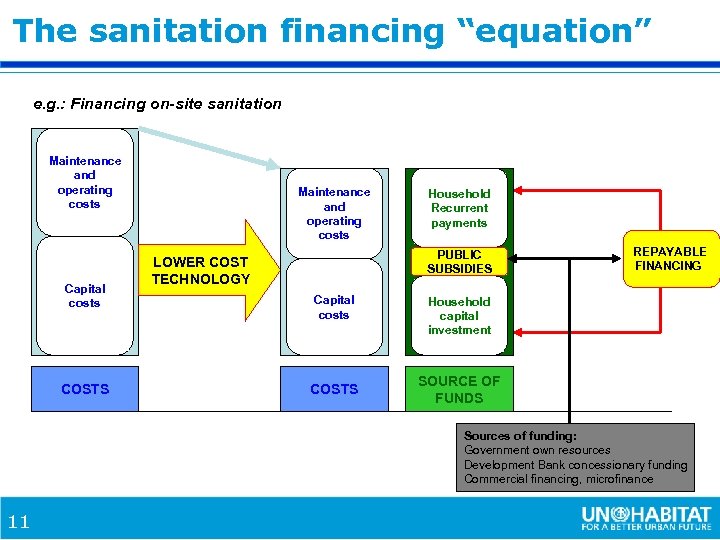
The sanitation financing “equation” e. g. : Financing on-site sanitation Maintenance and operating costs Capital costs COSTS Maintenance and operating costs Household recurrent Recurrent payments FUNDING PUBLIC GAP SUBSIDIES GAP LOWER COST TECHNOLOGY Capital costs COSTS REPAYABLE FINANCING Household capital investment SOURCE OF FUNDS Sources of funding: Government own resources Development Bank concessionary funding Commercial financing, microfinance 11
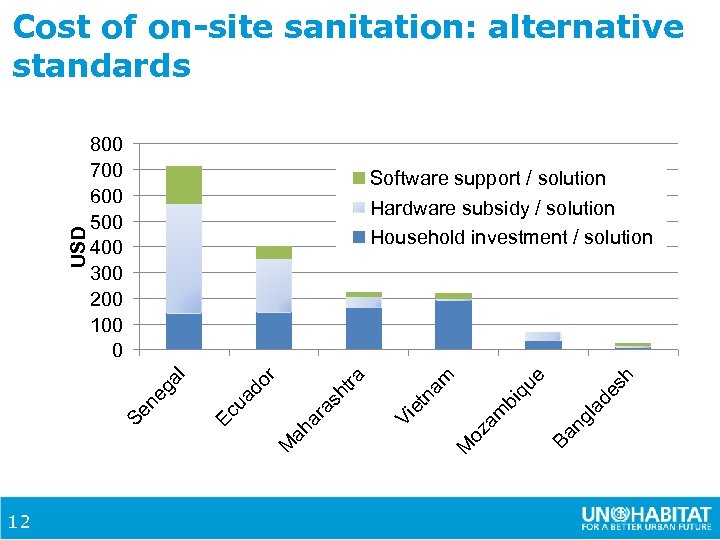
800 700 600 500 400 300 200 100 0 12 es h la d Ba ng qu e bi oz am M et na m Vi tra M ah ar as h ua do Ec Se r Software support / solution Hardware subsidy / solution Household investment / solution ne ga l USD Cost of on-site sanitation: alternative standards
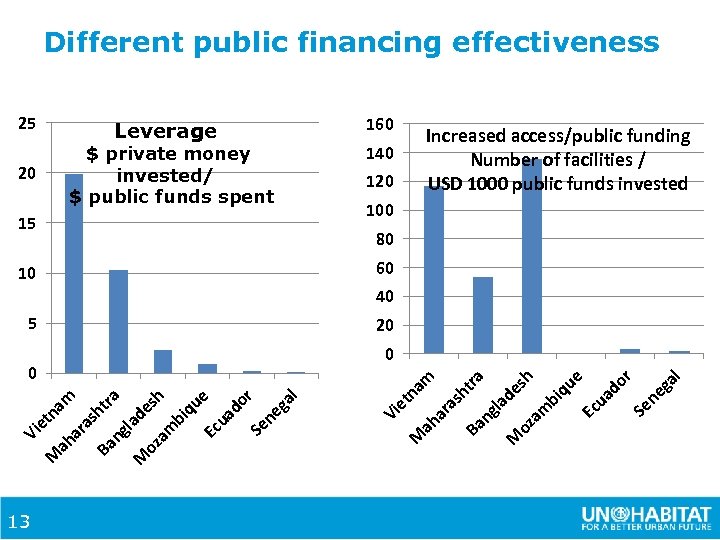
Different public financing effectiveness 25 20 Leverage $ private money invested/ $ public funds spent 15 10 160 Increased access/public funding Number of facilities / USD 1000 public funds invested 140 120 100 80 60 40 13 M l ga Se ne or Ec u ad e oz am bi de la ng Ba qu sh ra ht as ar ah et na m 0 M Vi et M na ah m ar as Ba htr a ng la M de oz s am h bi qu Ec e ua do Se r ne ga l 0 20 Vi 5
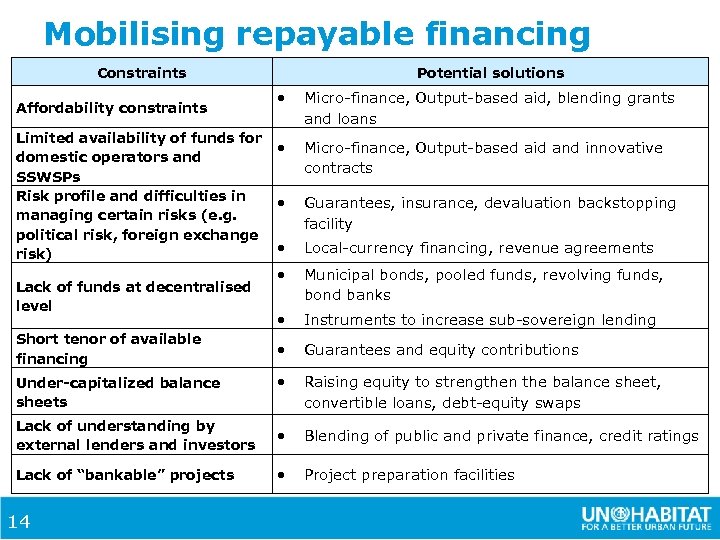
Mobilising repayable financing Constraints Affordability constraints Potential solutions Limited availability of funds for domestic operators and SSWSPs Risk profile and difficulties in managing certain risks (e. g. political risk, foreign exchange risk) Micro-finance, Output-based aid, blending grants and loans Micro-finance, Output-based aid and innovative contracts Guarantees, insurance, devaluation backstopping facility Local-currency financing, revenue agreements Municipal bonds, pooled funds, revolving funds, bond banks Instruments to increase sub-sovereign lending Guarantees and equity contributions Raising equity to strengthen the balance sheet, convertible loans, debt-equity swaps Lack of understanding by external lenders and investors Blending of public and private finance, credit ratings Lack of “bankable” projects Project preparation facilities Lack of funds at decentralised level Short tenor of available financing Under-capitalized balance sheets 14
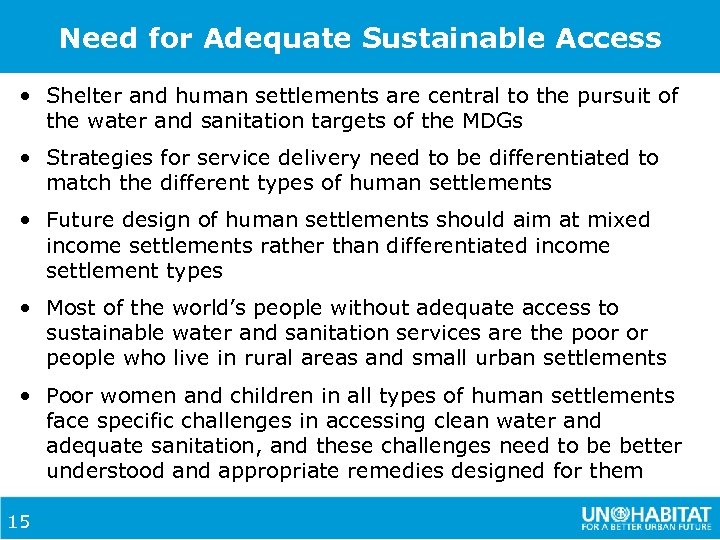
Need for Adequate Sustainable Access • Shelter and human settlements are central to the pursuit of the water and sanitation targets of the MDGs • Strategies for service delivery need to be differentiated to match the different types of human settlements • Future design of human settlements should aim at mixed income settlements rather than differentiated income settlement types • Most of the world’s people without adequate access to sustainable water and sanitation services are the poor or people who live in rural areas and small urban settlements • Poor women and children in all types of human settlements face specific challenges in accessing clean water and adequate sanitation, and these challenges need to be better understood and appropriate remedies designed for them 15
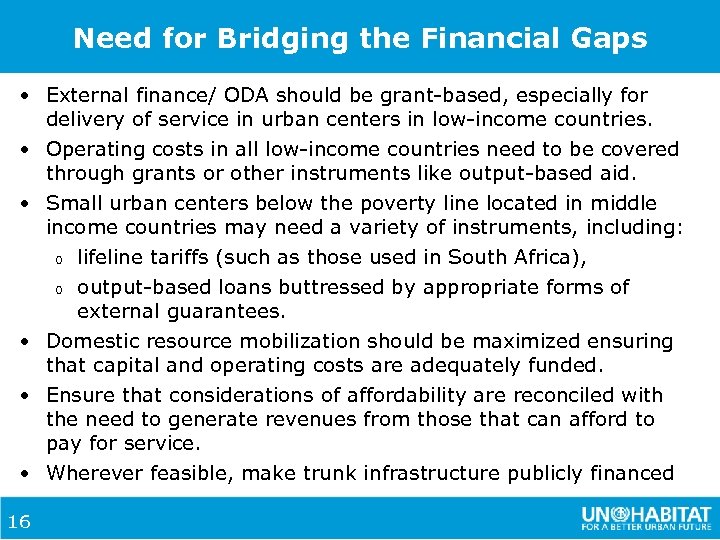
Need for Bridging the Financial Gaps • External finance/ ODA should be grant-based, especially for delivery of service in urban centers in low-income countries. • Operating costs in all low-income countries need to be covered through grants or other instruments like output-based aid. • Small urban centers below the poverty line located in middle income countries may need a variety of instruments, including: o lifeline tariffs (such as those used in South Africa), o output-based loans buttressed by appropriate forms of external guarantees. • Domestic resource mobilization should be maximized ensuring that capital and operating costs are adequately funded. • Ensure that considerations of affordability are reconciled with the need to generate revenues from those that can afford to pay for service. • Wherever feasible, make trunk infrastructure publicly financed 16
Closing the Gap: Two Cardinal Sets of Principles • While ensuring the delivery of water and sanitation services is squarely the responsibility of each national government. But to be successful they will need, above all, determined leadership and the political will that is absolutely necessary to maintain the commitment that will be needed. • Given the record of delayed projects or initiatives that have been reversed, short duration projects, using fast track mechanisms, which begin to deliver safe and affordable water and sanitation, within the span of a political cycle can protect the interests of poor communities from the effects of political changes, which can result from a competitive political environment. 17
Need for Monitoring • Monitor trends and progress within the water supply and sanitation sector • Build national capacity for monitoring, and • Inform policy makers and civil society of the status of the sector. 18
What do we need to know… Understanding sanitation costs • Software costs: including all the costs, evaluating the comparative effectiveness of software support • Estimating lifecycle costs to guide appropriate investment (incorporating opex and maintenance costs) • Improve and redesign M&E frameworks so as to keep track of critical financing information Sources of financing • Assess drivers and constraints for investment at household level • Explore the potential for using “innovative” financing mechanisms, such as micro-finance • Identify how public finance can be better targeted • Leverage other financing sources (“social investors”) • Evaluate potential for “payments for environmental services” 19
What do we need to know… Understanding the potential for microfinance • Micro-finance schemes have potential to leverage substantial private (hh) investments BUT limited and mixed experiences in sanitation; • Need to understand why and how they can work to mobilize financing for MDGs with limited public funds: for households and for small-scale entrepreneurs; Allocating financing at the right “level” based on benefits • Where coverage is low, channeling financing to the utility may miss a large component of the “sanitation market”: financing households and small-scale entrepreneurs also to be considered • Where coverage is high, need to better understand the potential benefits from increasing treatment levels (at the extreme, evidence of some declining returns to further tightening standards) 20
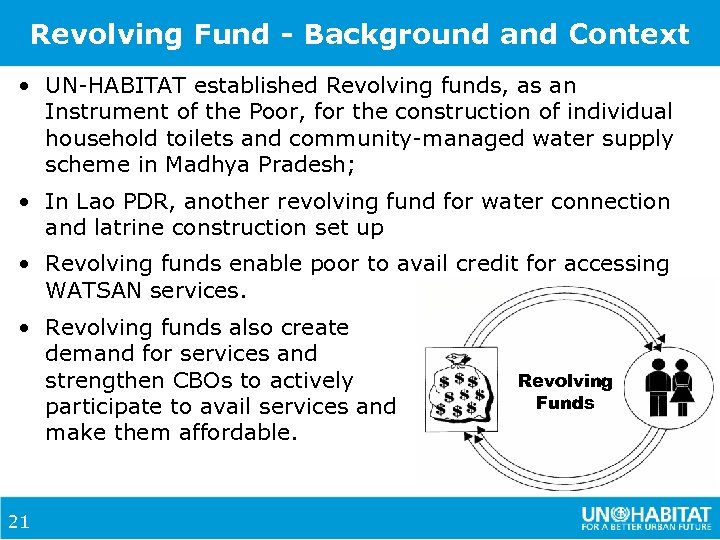
Revolving Fund - Background and Context • UN-HABITAT established Revolving funds, as an Instrument of the Poor, for the construction of individual household toilets and community-managed water supply scheme in Madhya Pradesh; • In Lao PDR, another revolving fund for water connection and latrine construction set up • Revolving funds enable poor to avail credit for accessing WATSAN services. • Revolving funds also create demand for services and strengthen CBOs to actively participate to avail services and make them affordable. 21 Revolving Funds
Operational Revolving Fund for Community Managed Water Supply Scheme (CMWSS) in India • Demonstrate ways that how a community can be empowered/ enabled to execute and manage adequate safe drinking water as per their needs and affordability. • Small network of Community Water and Sanitation Committees (CWASCs) ensure water supply to the poor immediately and operates the system for a certain time • Capital cost investment under CMWSS of Rs. 3. 0 million (US$ 68000) • Providing water connection to 1200 to 1500 households • The rapid connection (3 -6 months vs. 3 -6 years) of people to piped water as a means of attaining the Millennium Development Goals • Pay back recovery of distribution/connection costs in 3 -5 years 22
Institutional Responsibilities of the Partners to Implement CMWSS Projects UN-HABITAT • Conceptualisation of CMWSS Projects; Social mobilisation, capacity development, communication and project management • Coordination between Municipal Corporation (MC)/ District Urban Developmental Agency (DUDA) and CWASC • Monitoring and evaluation of physical and financial performance and management of the water supply projects Municipal Corporations/ DUDA • Project feasibility study and survey of community mobilization activities and formulation of CMWSS Projects • Entering into cooperation agreement with UN-HABITAT for creating revolving fund • Guiding the CWASC in designing and supervising the physical implementation and Scale up CMWSS in other slums of the city UN-HABITAT • Execute safe drinking water scheme for the area; Carry out billing and collection systems • Manage operation and maintenance of water supply system • Paying loan amount to MC/ DUDA in installments 23
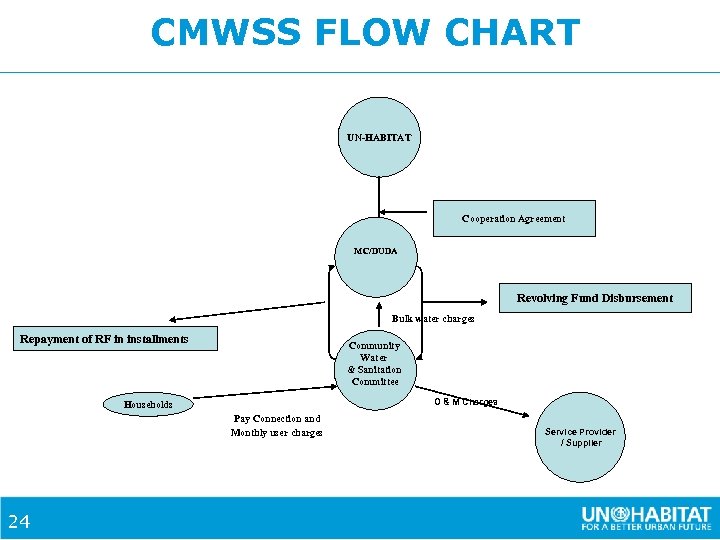
CMWSS FLOW CHART UN-HABITAT Cooperation Agreement MC/DUDA Revolving Fund Disbursement Bulk water charges Repayment of RF in installments Community Water & Sanitation Committee O & M Charges Households Pay Connection and Monthly user charges 24 Service Provider / Supplier
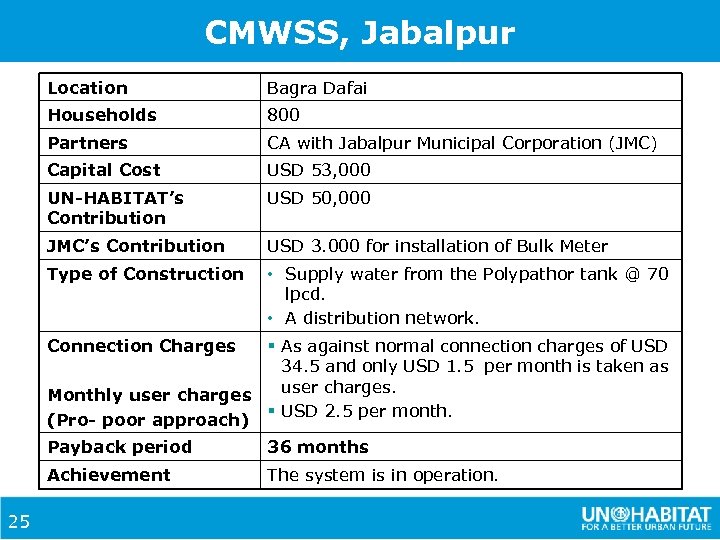
CMWSS, Jabalpur Location Bagra Dafai Households 800 Partners CA with Jabalpur Municipal Corporation (JMC) Capital Cost USD 53, 000 UN-HABITAT’s Contribution USD 50, 000 JMC’s Contribution USD 3. 000 for installation of Bulk Meter Type of Construction • Supply water from the Polypathor tank @ 70 lpcd. • A distribution network. Connection Charges § As against normal connection charges of USD 34. 5 and only USD 1. 5 per month is taken as user charges. Monthly user charges (Pro- poor approach) § USD 2. 5 per month. Payback period Achievement 25 36 months The system is in operation.
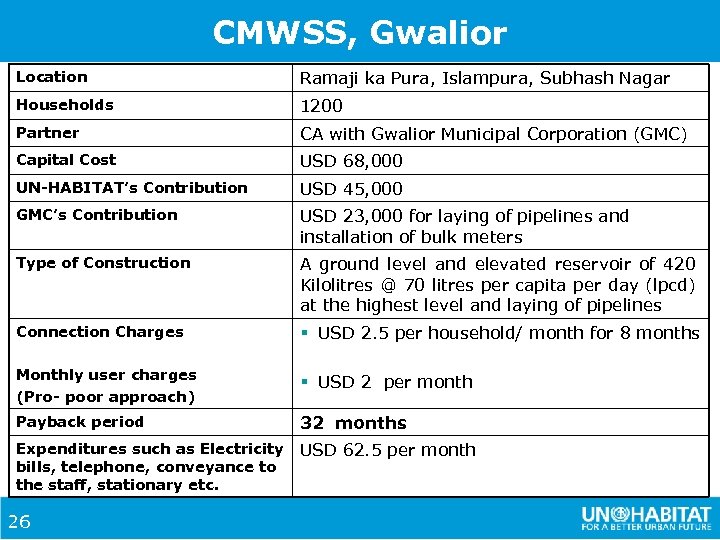
CMWSS, Gwalior Location Ramaji ka Pura, Islampura, Subhash Nagar Households 1200 Partner CA with Gwalior Municipal Corporation (GMC) Capital Cost USD 68, 000 UN-HABITAT’s Contribution USD 45, 000 GMC’s Contribution USD 23, 000 for laying of pipelines and installation of bulk meters Type of Construction A ground level and elevated reservoir of 420 Kilolitres @ 70 litres per capita per day (lpcd) at the highest level and laying of pipelines Connection Charges § USD 2. 5 per household/ month for 8 months Monthly user charges (Pro- poor approach) § USD 2 per month Payback period 32 months Expenditures such as Electricity USD 62. 5 per month bills, telephone, conveyance to the staff, stationary etc. 26
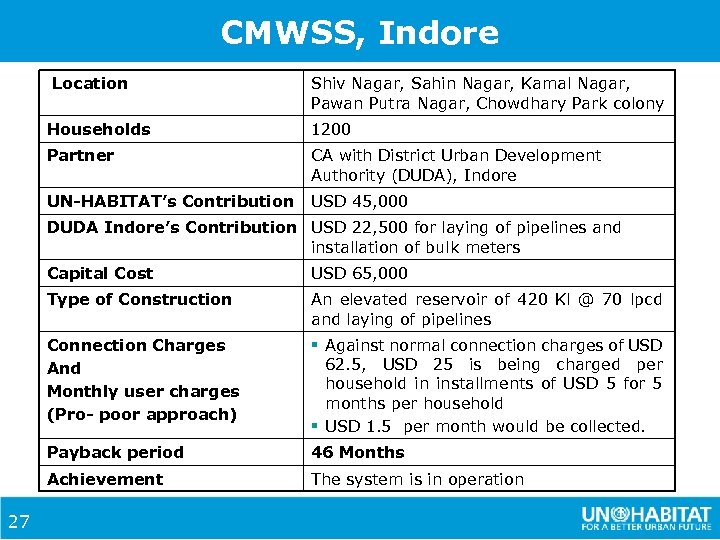
CMWSS, Indore Location Shiv Nagar, Sahin Nagar, Kamal Nagar, Pawan Putra Nagar, Chowdhary Park colony Households 1200 Partner CA with District Urban Development Authority (DUDA), Indore UN-HABITAT’s Contribution USD 45, 000 DUDA Indore’s Contribution USD 22, 500 for laying of pipelines and installation of bulk meters Capital Cost Type of Construction An elevated reservoir of 420 Kl @ 70 lpcd and laying of pipelines Connection Charges And Monthly user charges (Pro- poor approach) § Against normal connection charges of USD 62. 5, USD 25 is being charged per household in installments of USD 5 for 5 months per household § USD 1. 5 per month would be collected. Payback period 46 Months Achievement 27 USD 65, 000 The system is in operation
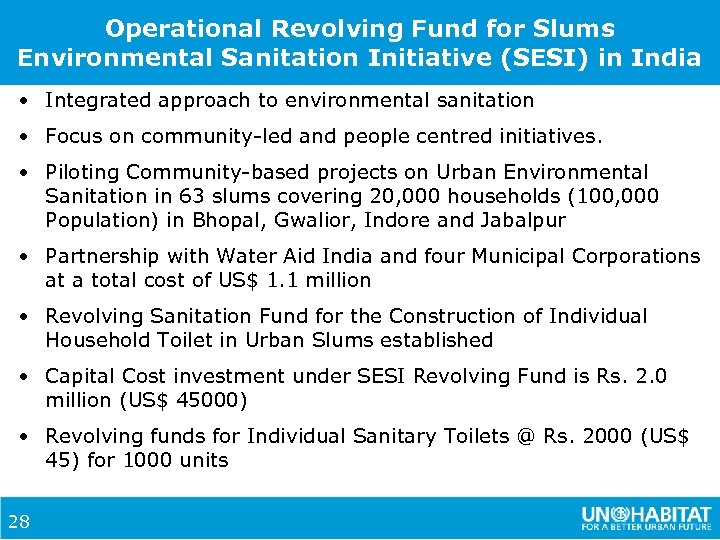
Operational Revolving Fund for Slums Environmental Sanitation Initiative (SESI) in India • Integrated approach to environmental sanitation • Focus on community-led and people centred initiatives. • Piloting Community-based projects on Urban Environmental Sanitation in 63 slums covering 20, 000 households (100, 000 Population) in Bhopal, Gwalior, Indore and Jabalpur • Partnership with Water Aid India and four Municipal Corporations at a total cost of US$ 1. 1 million • Revolving Sanitation Fund for the Construction of Individual Household Toilet in Urban Slums established • Capital Cost investment under SESI Revolving Fund is Rs. 2. 0 million (US$ 45000) • Revolving funds for Individual Sanitary Toilets @ Rs. 2000 (US$ 45) for 1000 units 28
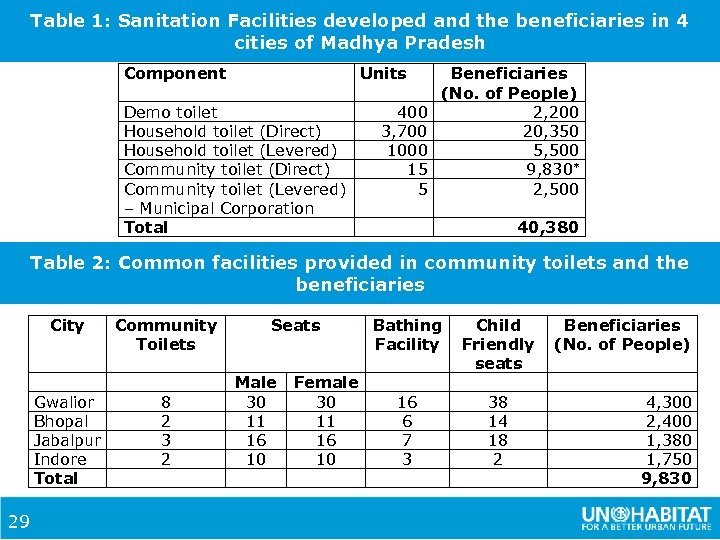
Table 1: Sanitation Facilities developed and the beneficiaries in 4 cities of Madhya Pradesh Component Units Demo toilet Household toilet (Direct) Household toilet (Levered) Community toilet (Direct) Community toilet (Levered) – Municipal Corporation Total 400 3, 700 1000 15 5 Beneficiaries (No. of People) 2, 200 20, 350 5, 500 9, 830* 2, 500 40, 380 Table 2: Common facilities provided in community toilets and the beneficiaries City Gwalior Bhopal Jabalpur Indore Total 29 Community Toilets 8 2 3 2 Seats Male 30 11 16 10 Female 30 11 16 10 Bathing Child Beneficiaries Facility Friendly (No. of People) seats 16 6 7 3 38 14 18 2 4, 300 2, 400 1, 380 1, 750 9, 830
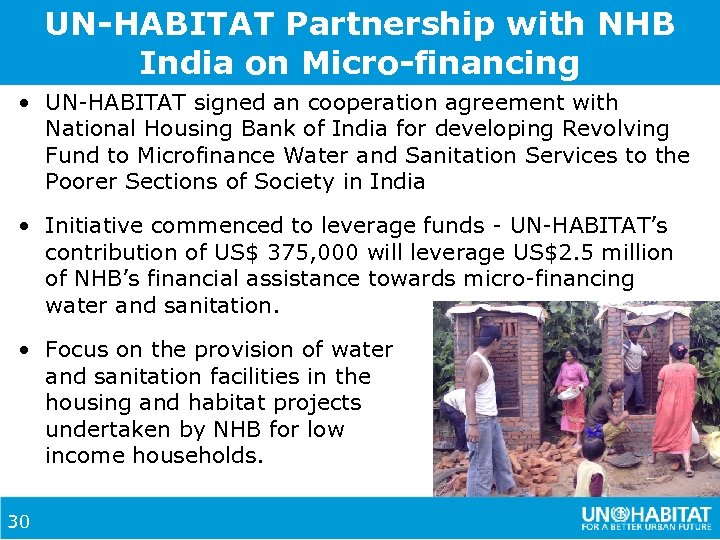
UN-HABITAT Partnership with NHB India on Micro-financing • UN-HABITAT signed an cooperation agreement with National Housing Bank of India for developing Revolving Fund to Microfinance Water and Sanitation Services to the Poorer Sections of Society in India • Initiative commenced to leverage funds - UN-HABITAT’s contribution of US$ 375, 000 will leverage US$2. 5 million of NHB’s financial assistance towards micro-financing water and sanitation. • Focus on the provision of water and sanitation facilities in the housing and habitat projects undertaken by NHB for low income households. 30
UN-Habitat and NHB Project objectives • Develop a Revolving Fund to microfinance water and sanitation services to the poor in India. • Demonstrate the approach of revolving fund for microfinancing the water and sanitation services through pilot demonstration projects for the poor in India. • Undertake research studies on various habitat related issues including in microfinance and its role in addressing the issues relating to habitat development for the unserved and the underserved building sustainable financing systems, etc. • Organize workshops/seminars and other capacity building activities at city/ state/ national levels in India for promoting revolving fund for water and sanitation. 31
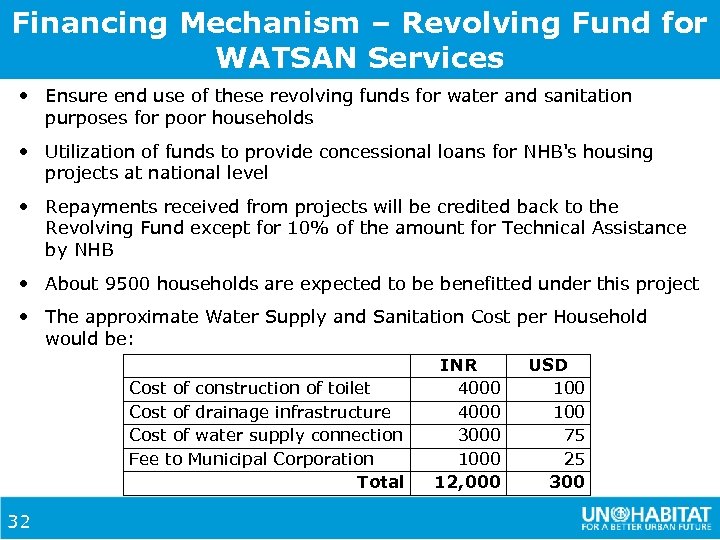
Financing Mechanism – Revolving Fund for WATSAN Services • Ensure end use of these revolving funds for water and sanitation purposes for poor households • Utilization of funds to provide concessional loans for NHB's housing projects at national level • Repayments received from projects will be credited back to the Revolving Fund except for 10% of the amount for Technical Assistance by NHB • About 9500 households are expected to be benefitted under this project • The approximate Water Supply and Sanitation Cost per Household would be: Cost of construction of toilet Cost of drainage infrastructure Cost of water supply connection Fee to Municipal Corporation Total 32 INR 4000 3000 12, 000 USD 100 75 25 300
Governance Structure • Projects to be implemented through MFIs/NGOs. • A Steering Committee with officials from UN-Habitat and NHB for project implementation and monitoring. • NHB to receive project proposals from MFIs/NGOs. • Project appraisal by NHB as per it's existing appraisal standards under the guidance of the Steering Committee. • NHB to disburse funds as per it's existing disbursement procedures. • A Revolving Fund at NHB to credit the repayments received from various borrowers and on-lend the proceeds for fresh projects 33
Way Forward. . . • Few projects already under identification for 3000 toilets. • 500, 000 households expected to be covered for water and sanitation in the first 5 years. • Programme to provide water access to 2. 5 million poor people during the first five years. • Emphasis on sustainable water and sanitation programme for the poor. • Programme to strengthen the UN-HABITAT - NHB partnership by information through community based organisations 34
Guidelines Revolving Sanitation Fund for the Construction of Individual Household Toilet in Urban Slums • Prepared jointly by UWSEI Project and the UNHabitat. • Aim at facilitating provision of individual toilet facilities for creating open defecation free cities; • The Government of Madhya Pradesh has issued directives to all the ULBs of Madhya Pradesh to set up Revolving Sanitation Funds. 35
Revolving Funds for CMWSS & SESI in Madhya Pradesh • Capital cost investment under CMWSS of Rs. 3. 0 million (US$ 68000) • Providing water connection to 1200 to 1500 households • Total Payback period is 32 months • Capital Cost investment under SESI of Rs. 2. 0 million (US$ 45000) • Revolving funds for Individual Sanitary Toilets @ Rs. 2000 (US$ 45) for 1000 units 36
Issuance of Corporate Bonds in Nanjing, PR China • UN-Habitat conducted diagnostic study in the city of Nanjing • In support of WAC Programme, ADB provided technical assistance to Nanjing Water Utility • Long Term Capital Finance in Commercial Markets for the issue of Corporation Bonds of RMB 2 billion (US$ 25. 9 million) for water and environmental projects of Nanjing 37
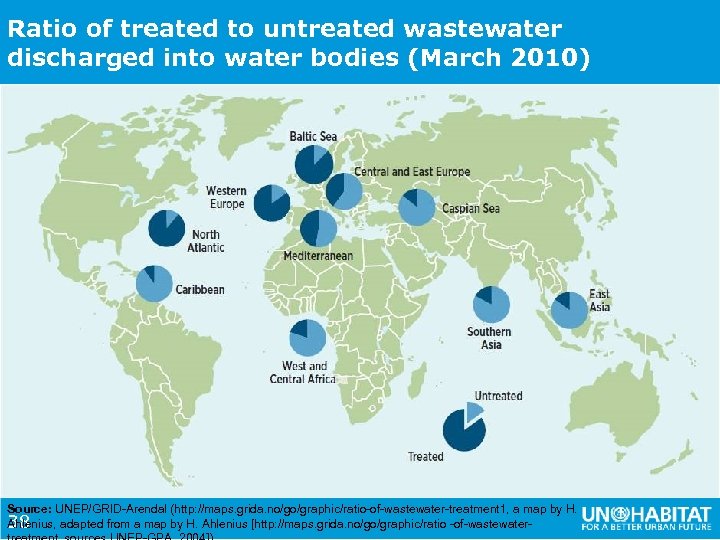
Ratio of treated to untreated wastewater discharged into water bodies (March 2010) Source: UNEP/GRID-Arendal (http: //maps. grida. no/go/graphic/ratio-of-wastewater-treatment 1, a map by H. Ahlenius, adapted from a map by H. Ahlenius [http: //maps. grida. no/go/graphic/ratio -of-wastewater 38
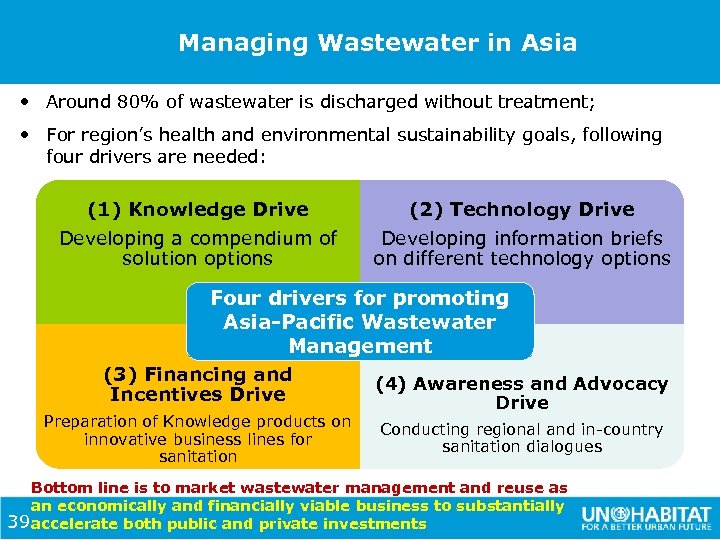
Managing Wastewater in Asia • Around 80% of wastewater is discharged without treatment; • For region’s health and environmental sustainability goals, following four drivers are needed: (1) Knowledge Drive (2) Technology Drive Developing a compendium of solution options Developing information briefs on different technology options Four drivers for promoting Asia-Pacific Wastewater Management (3) Financing and Incentives Drive Preparation of Knowledge products on innovative business lines for sanitation (4) Awareness and Advocacy Drive Conducting regional and in-country sanitation dialogues Bottom line is to market wastewater management and reuse as an economically and financially viable business to substantially 39 accelerate both public and private investments
Wastewater as a Business • Wastewater must be seen as a resource with potential financial returns and opportunities for green employment; employment • It is critical to move away from the high energy solutions—or no treatment at all—toward something affordable and doable; doable • Turn towards decentralized wastewater treatment systems, especially systems in peri-urban and coastal communities and public markets; • Organic fertilizer from ecosan toilets has turned farmers into entrepreneurs; whereas Biogas digesters connected to sanitation entrepreneurs facilities produced cheap energy source in the region; • Innovative financing mechanisms provide incentives for households to invest in on-site sanitation systems and cities to invest in wastewater management systems; • Involve public-private partnership (PPP) for enabling environment and economic regulatory framework to reduce risks to the investment 40
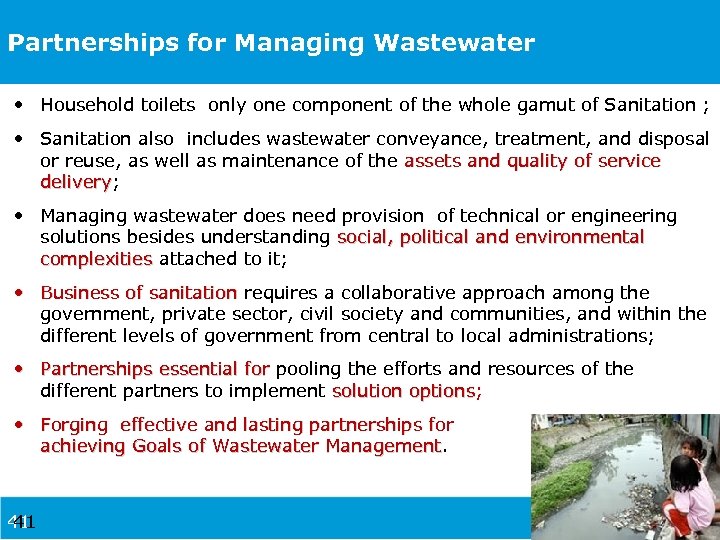
Partnerships for Managing Wastewater • Household toilets only one component of the whole gamut of Sanitation ; • Sanitation also includes wastewater conveyance, treatment, and disposal or reuse, as well as maintenance of the assets and quality of service delivery; delivery • Managing wastewater does need provision of technical or engineering solutions besides understanding social, political and environmental complexities attached to it; • Business of sanitation requires a collaborative approach among the government, private sector, civil society and communities, and within the different levels of government from central to local administrations; • Partnerships essential for pooling the efforts and resources of the different partners to implement solution options; options • Forging effective and lasting partnerships for achieving Goals of Wastewater Management 41 41

www. unhabitat. org Thanks for your Attention. . 42
Скачать презентацию International Symposium on Sustainable Cities Empowering Local Governments
524e6ac429daf123ad3498576fe00e11.ppt