


 Скачать презентацию INTERNATIONAL SYMPOSIUM 23 -25 May 2011 Social Protection
e639cec36da212eb331489598cf12d36.ppt
- Количество слайдов: 17
 INTERNATIONAL SYMPOSIUM 23 -25 May 2011 Social Protection in Southern Africa: New Opportunities for Social Development Poor Child Focus in Social Protection and Resultant Unsustainable Social Development in Ethiopia By Scelo Zibagwe, Lecturer, Ethiopian Civil Service College, IUDS, UMMP, CMC Campus, Box 5648, Addis Ababa. Email: zibagwes@gmail. com or zibagwes@yahoo. com Themba Nduna, Ph. D Candidate, Public Health Nutrition Research Group, University of Aberdeen, School of Medicine and Dentistry- Division of Applied Health Sciences, 1 st Floor Health Sciences Building, Forester hill, Aberdeen, AB 25 2 ZD, United Kingdom. Email: ndunx 2007@gmail. com. Gift Dafuleya, University of Venda, Department of Economics, Private Bag X 5050, Thohoyandou, 0950, South Africa. Email: giftdaff@gmail. com
 Introduction Social protection (SP) the current organizing concept and framework (Barrientos and Shepherd, 2003) to tackle chronic poverty. Child-conditioned SP to interrupt IGT of poverty (through increasing nutrition, health, education & reducing risk of abuse and exploitation)- when children’s interests are taken into consideration from the outset (CSSP Joint Statement, 2009). Double-pronged strategy: taking into account “the circumstances of the child and persons having responsibility for the maintenance of the child”.
 Introduction (cont) Significance of child-conditioned SP: comparisons of costs to obtain poverty reversals through adult interventions versus poverty avoidance through child interventions. (Yaqub, 2001). Antipoverty interventions should be prioritized when the worst damage from poverty can be avoided (ibid). ‘what comes first takes most and sets patterns, and what comes last may never come at all’ (Chambers 1988: 219)
 Ethiopia’s Productive Safety Net Program (PSNP) PSNP is the largest SP scheme in Africa outside of South Africa’s social grants schemes delivering social transfers (cash or food) covering 8 million rural citizens in 300 woredas; with an annual budget of approximately US$347 million. Response to chronic food insecurity - 14 million people (about 20% of the population) in rural areas required food assistance every year (Mo. ARD, 2006). 14% of these were children. Transfers are largely conditional - public works program (PWP) 80%: direct support program (DSP) 20%. Complimented by Other Food Security Program (OFSP)
 PSNP: Direct & Indirect Child Focus Direct: Transfers targeted at individuals (currently modified to focus on households). Indirect: Temporary transfer of pregnant (at the sixth month of pregnancy ) and lactating women (until 10 months after the birth) from PWP to DSP. Linkage to the Nutrition Project: to improve child and maternal care behavior. Outcomes of the Legambo Child Care Practices Project (p 8): WATSAN & nutrition education had a significant impact in reducing malnutrition (SCUK, 2011)
 PSNP Child Effects Achievements on food security in the form of marginally reduced hunger months by 0. 36, Path dependence on the design: embeded errors Unintended negative effects (child labour & schooling) mainly because of: a. PWP: DSP ratio b. Overestimated HH Labour Capacity c. PWP Timetabling Errors wrt child welfare d. Income effects
 PWP: DSP ratio ‘ 80: 20 principle’. DSP ceilings/quotas pre-determined @ 20% Not reflective of the 42% child population among targeted individuals. Nature of PWP: output-based; i. e. transfers linked not to the prescribed number of days worked but on task completion & number of community assets produced (e. g. , gully controls, roads, bridges, market storage facilities, shallow, wells, water ponds). HH strategy: use of child labour directly and/or indirectly.
 PWP: DSP ratio HH strategy: use of child labour directly and/or indirectly. Incidence where task teams expected to take up the slack for pregnant and lactating women. During the temporary transfer of pregnant and lactating women to DSP: household’s total work requirement is not reduced if there are two adults in a household (Devereux, et al. 2008). Access to the entitlements stretches HH’s labour and child labour used. Also the estimated value of annual transfer per average household in DSP is 84% of that of PWP
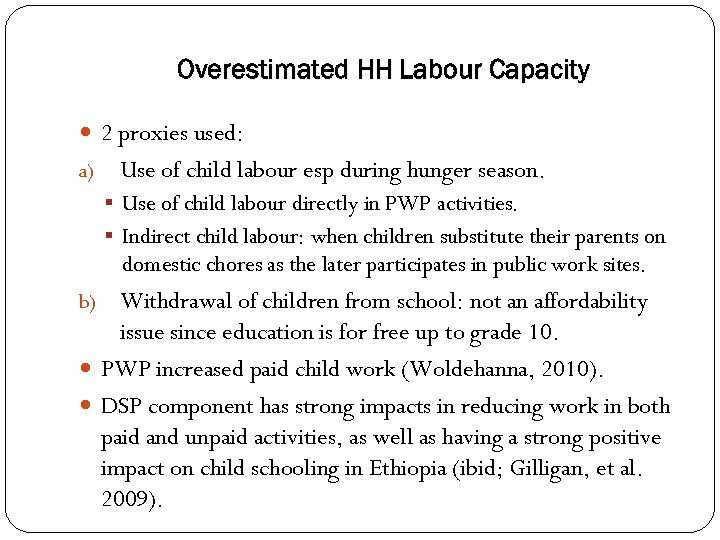 Overestimated HH Labour Capacity 2 proxies used: a) Use of child labour esp during hunger season. § Use of child labour directly in PWP activities. § Indirect child labour: when children substitute their parents on domestic chores as the later participates in public work sites. Withdrawal of children from school: not an affordability issue since education is for free up to grade 10. PWP increased paid child work (Woldehanna, 2010). DSP component has strong impacts in reducing work in both paid and unpaid activities, as well as having a strong positive impact on child schooling in Ethiopia (ibid; Gilligan, et al. 2009). b)
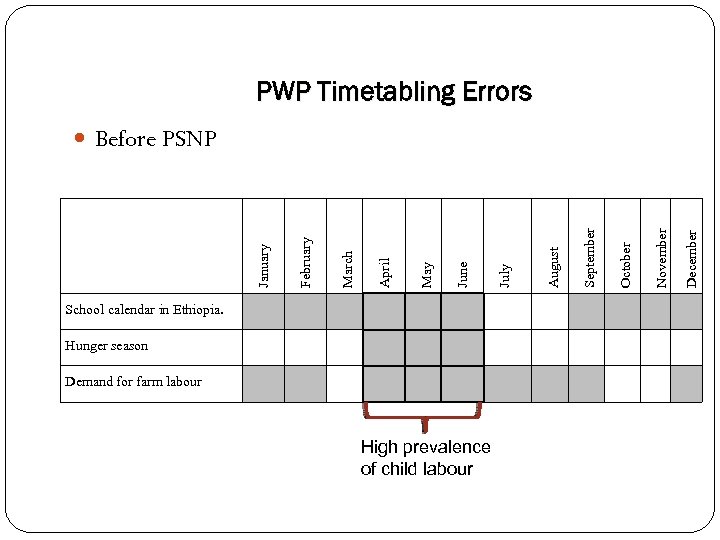 PWP Timetabling Errors School calendar in Ethiopia. Hunger season Demand for farm labour High prevalence of child labour December November October September August July June May April March February January Before PSNP
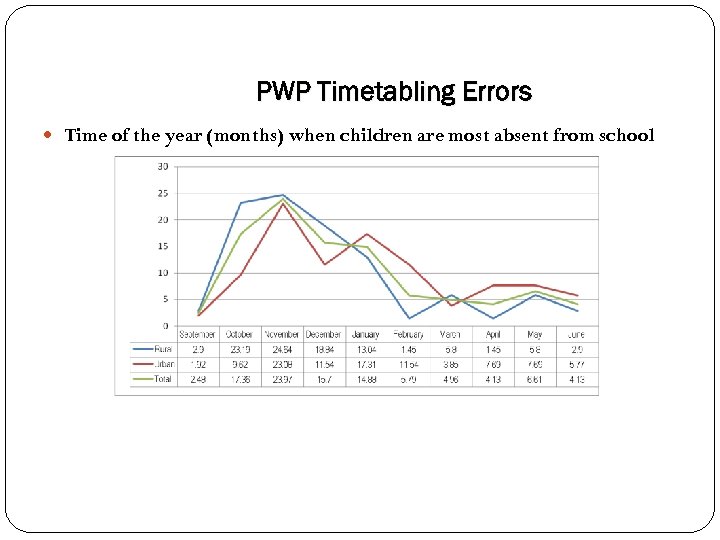 PWP Timetabling Errors Time of the year (months) when children are most absent from school
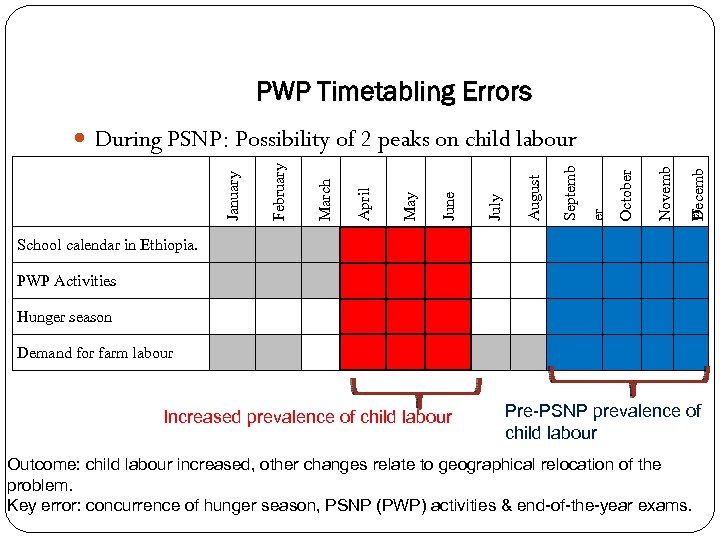 PWP Timetabling Errors er Decemb Novemb October er Septemb August July June May April March February January During PSNP: Possibility of 2 peaks on child labour School calendar in Ethiopia. PWP Activities Hunger season Demand for farm labour Increased prevalence of child labour Pre-PSNP prevalence of child labour Outcome: child labour increased, other changes relate to geographical relocation of the problem. Key error: concurrence of hunger season, PSNP (PWP) activities & end-of-the-year exams.
 PSNP Income effects The income effect is expected to lead to children working less and spending more time in school and studying. PSNP (PWP) income is low : 11% the households’ consumption expenditure. PSNP+OFSP: significantly reduces child paid and unpaid work and increases hours of schooling time per day. But PWP households receiving support from at least one component of the OFSP varies: e. g. in Tigray (69%), Amhara (29%), SNNPR (20%) & Oromia (12%) of PWP.
 PSNP Income effects Inflation & seasonal price changes eroded the value of the ‘preferred’ cash transfers. Timeliness of transfers: within 45 days after the previous month for 70% of transfers to beneficiaries. Delays: e. g in 2008, the first disbursement was in June. Result: with ETB 8 a household could purchase 2. 77 kg of cereal in February 2008, with the same amount purchasing only 1. 2 kgs in July 2008.
 Other Missing Point Failure to discretely isolate ‘child labour saving assets’ (Cockburn, 2001) such as nearby wells and wheel-burrows.
 Lesson(s) for Southern Africa’s CSSP Double pronged: children & guardians Child-conditioned SP @ design stage: child welfare outcomes (nutrition, health, education & risk of abuse and exploitation) and children’s time use (rest/sleep, leisure or play, work and education). Positive CSSP outcomes from unconditional transfers Child-labour saving assets: types of physical assets accumulated do matter. Timing of antipoverty interventions improves impact: failure to mainstream CSSP resources in an antipoverty intervention may arrive too late (Yaqub, 2001). Path dependence: 'what comes first takes most and sets patterns, and what comes last may never come at all’ (Chambers 1988: 219)
 Amasegenalehu! Siyabonga! Thank you!