


 Скачать презентацию INTERNATIONAL SUPPORT TO PROMOTE TECHNOLOGY TRANSFER AND DEPLOYMENT
247d56ea63e91bb114605ae14b23a2cc.ppt
- Количество слайдов: 20
 INTERNATIONAL SUPPORT TO PROMOTE TECHNOLOGY TRANSFER AND DEPLOYMENT, FOR RENEWABLE ENERGY AND EFFICIENCY IN GHANA BY WILLIAM GBONEY INTERNATIONAL INSTITUTE OF INFRASTRUCTURAL ECONOMICS AND MANAGEMENT (I 3 EM) ACCRA, GHANA. April 8, 2009. 1
 Presentation Format 1. • • • Summary of Phase 1: Objectives Policy Description Barriers 2. Phase II • Study Objective • Link between Phase I and II • Suggested Approach • Key Issues to be addressed 2
 1. 0 Phase 1 of Case Study: Analysis of existing policy, Legal and Regulatory Frameworks for Renewable Energy (RE) and Energy Efficiency (EE) Sectors in Ghana (a) Objectives: (i) Identify key domestic polices which are SLOW – MOVING, and would require international support and cooperation (ii) Identify domestic barriers affecting Renewable Energy (RE) and Energy Efficiency (EE) development (iii) Explore how international cooperation and support, can be used to increase the scale and scope of RE and EE 3
 2. 0 Summary: Policy Description (a) (ii) Resource Capacity Development: Expand exploitation and development of RETs Achieve at least 10% RE in overall energy mix by 2020 (b) (i) Increase Thermal Plant Efficiency: Convert existing single-cycle oil-fired plants to combined cycle, gas fired plants Fuel switching: Light crude oil (LCO) to natural gas: West African Gas Pipeline Project (ii) (c ) Energy Efficiency in energy intensive industries: (i) Undertake energy audit projects (ii) Power Factor (PF) enhancement projects for industries to achieve 0. 90 4
 2. 0 Summary of Policy Description: Continued (d) Energy efficiency labeling and standards: For equipment and appliances (e) Market Development: Create and expand market for RE Service Promote use of solar PV, solar water heater and solar crop drying (f) Renewable Energy Law: (i) Establish conducive enabling environment (i. e. policy, legal regulatory frameworks (etc) to promote: (ii) Grid-connected RE systems (iii) Stand-Alone systems (g) Bio-fuel development: § Encourage cultivation of Jatropha plant § Bio-diesel production 5
 3. 0 SUMMARY OF BARRIERS FROM PHASE 1 a. b. c. d. e. • • Policy Legal and Regulatory Economic and Financial Market expansion and technology deployment Barrier analysis was done with respect to: Grid Connected systems Mini-grid systems Stand-Alone systems Energy Efficiency 6
 3. 1 Barriers: Grid Connected Systems (a) • • • Policy Barriers: Lack of coherent and comprehensive policy The electricity structure can act as a barrier Lack of regulatory framework to support private sector participation (b) Economic Barriers: (i) Subsidizing of fossil – fuelled electricity (direct or indirect) Types of subsides: Direct Financial transfer, energy services at less than full cost etc. (ii) Not accounting for the socio – environmental cost of fossil fuels (iii) Not accounting for risks associated with future fossil – fuel price fluctuations 7
 3. 1 Barriers: Grid connected System – cont’d (c) Legal and Regulatory: (i) Lack of legal and regulatory framework for renewables (ii) Lack of basic laws and regulations. Example: Lack of transparent pricing principles lack of access pricing rules, technical standards (iii) RE do not receive full credit for the “value” of power generated (d) Financial Barriers: (i) High up – front capital requirement, high interconnection costs and lack of financing structures for small projects (ii) Lack of access to credit (iii) Perception: That RETs are relatively new, not sufficiently field proven and expensive to purchase, install and maintain (iv) High transaction costs (v) Lack of appropriate skills (vi) Information on cost is imprecise. 8
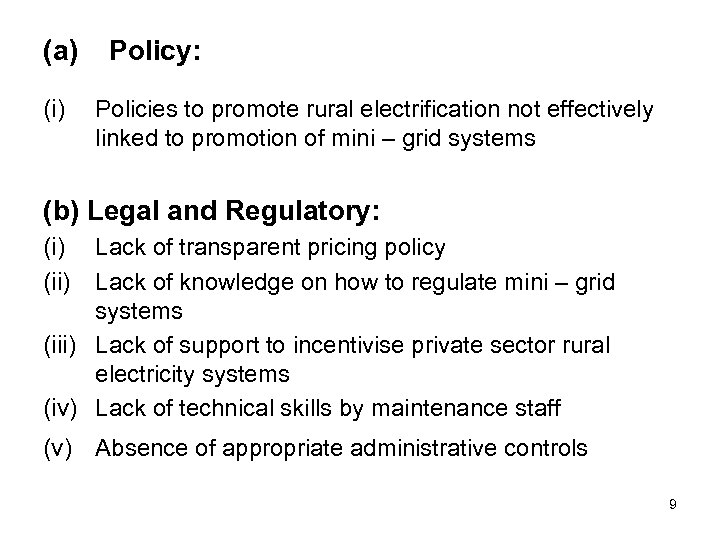 (a) (i) Policy: Policies to promote rural electrification not effectively linked to promotion of mini – grid systems (b) Legal and Regulatory: (i) (ii) Lack of transparent pricing policy Lack of knowledge on how to regulate mini – grid systems (iii) Lack of support to incentivise private sector rural electricity systems (iv) Lack of technical skills by maintenance staff (v) Absence of appropriate administrative controls 9
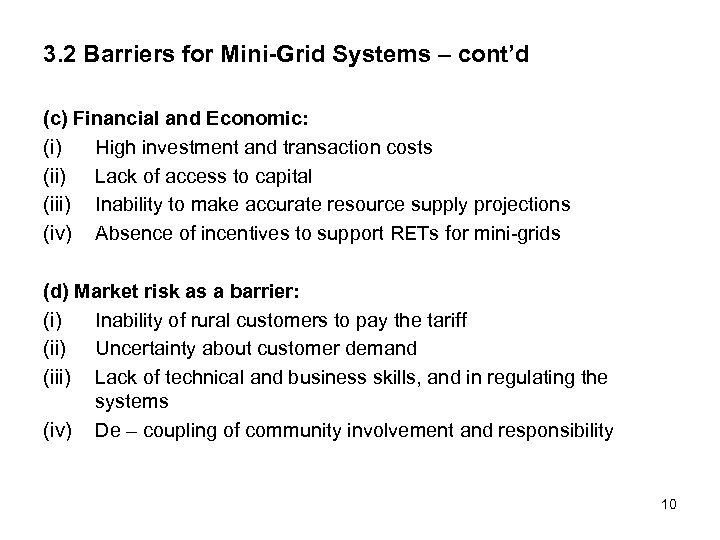 3. 2 Barriers for Mini-Grid Systems – cont’d (c) Financial and Economic: (i) High investment and transaction costs (ii) Lack of access to capital (iii) Inability to make accurate resource supply projections (iv) Absence of incentives to support RETs for mini-grids (d) Market risk as a barrier: (i) Inability of rural customers to pay the tariff (ii) Uncertainty about customer demand (iii) Lack of technical and business skills, and in regulating the systems (iv) De – coupling of community involvement and responsibility 10
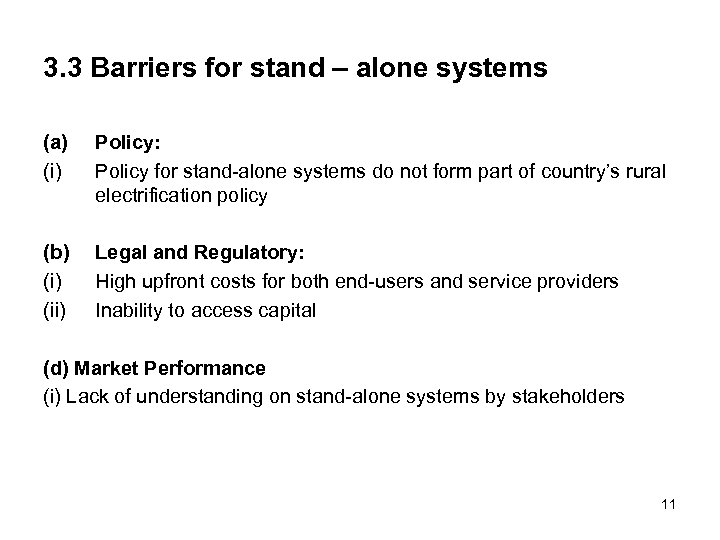 3. 3 Barriers for stand – alone systems (a) (i) Policy: Policy for stand-alone systems do not form part of country’s rural electrification policy (b) (ii) Legal and Regulatory: High upfront costs for both end-users and service providers Inability to access capital (d) Market Performance (i) Lack of understanding on stand-alone systems by stakeholders 11
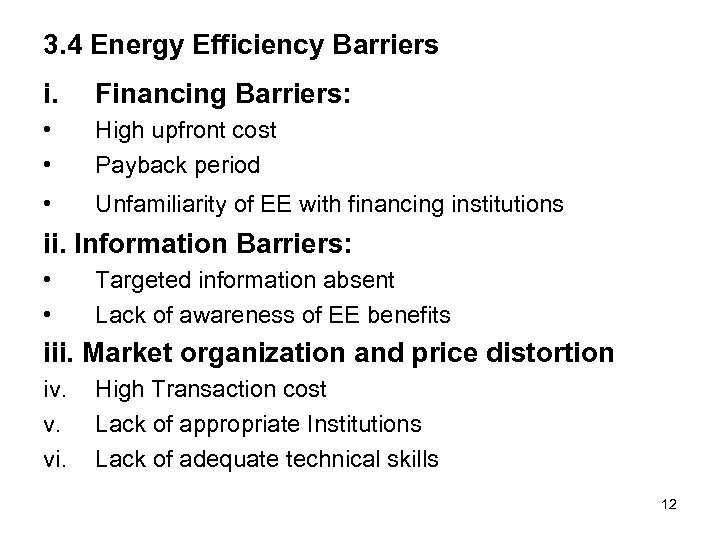 3. 4 Energy Efficiency Barriers i. Financing Barriers: • • High upfront cost Payback period • Unfamiliarity of EE with financing institutions ii. Information Barriers: • • Targeted information absent Lack of awareness of EE benefits iii. Market organization and price distortion iv. v. vi. High Transaction cost Lack of appropriate Institutions Lack of adequate technical skills 12
 4. 0 Phase II: International Support and Cooperation to promote RE/EE technology development. (a) Objective: To overcome the barriers identified in phase I Investigate how international support and cooperation can be used to build on domestic policy, to promote technology transfer and deployment in Ghana. 13
 5. 0 What is technology transfer? i. It means more than just providing the hardware ii. Involves knowledge sharing and ability to adapt technology to local environment iii. • • Technology transfer also involves: Building human and institutional capacity Raising awareness among users/stakeholders iv. Technology transfer is also about the structures, institutions and organizations v. Ability to adapt the technology to fit into the country’s local and political institutions 14
 Technology assistance and transfer – cont’d i. Phase II to explore: (a) South-South technology transfer (b) North-South technology transfer ii. Identify mechanisms for large scale transfer of technology. Example: Promote International cooperation with equipment suppliers. Requires dealing with Intellectual Property Right (IPR) iii. Technology transfer should also build upon sound and existing local polices (i. e. bottom-up approach) 15
 6. 0 Link between Phase I and II (a) • i. iii. Phase I: Identified the following as being necessary: Credible Policy. Legal and regulatory frameworks: Grid-connected RE systems Mini-grid RE Systems Stand-Alone Re systems (b) i. iii. iv. International cooperation, technical and financial support for: Large-scale grid-connected RE systems Mini-grid RE and ESCOs Stand-Alone RETs Intensification of Energy Efficiency activities (c ) Capacity building: For policymakers, regulators, technicians, financing institutions 16
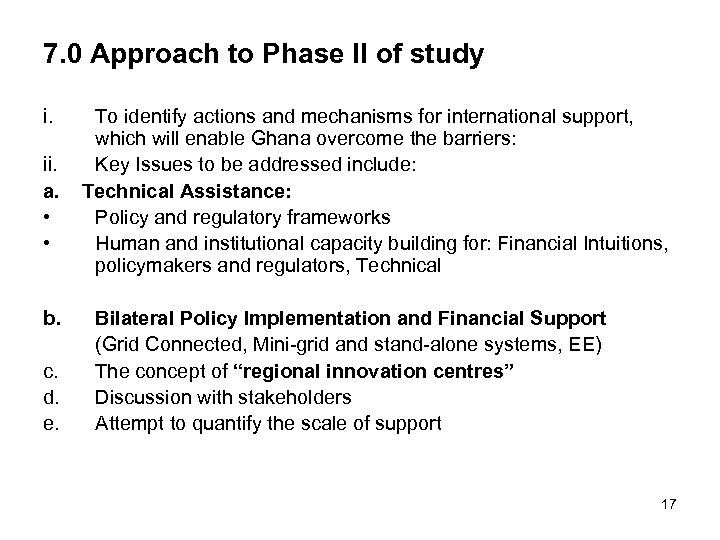 7. 0 Approach to Phase II of study i. ii. a. • • b. c. d. e. To identify actions and mechanisms for international support, which will enable Ghana overcome the barriers: Key Issues to be addressed include: Technical Assistance: Policy and regulatory frameworks Human and institutional capacity building for: Financial Intuitions, policymakers and regulators, Technical Bilateral Policy Implementation and Financial Support (Grid Connected, Mini-grid and stand-alone systems, EE) The concept of “regional innovation centres” Discussion with stakeholders Attempt to quantify the scale of support 17
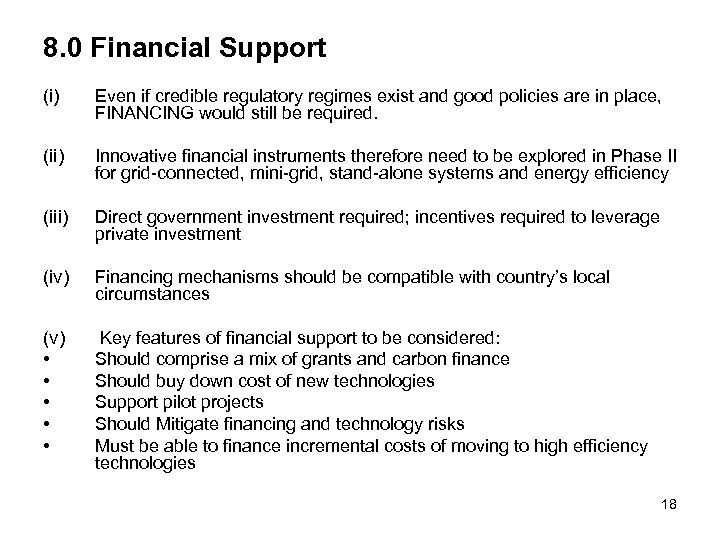 8. 0 Financial Support (i) Even if credible regulatory regimes exist and good policies are in place, FINANCING would still be required. (ii) Innovative financial instruments therefore need to be explored in Phase II for grid-connected, mini-grid, stand-alone systems and energy efficiency (iii) Direct government investment required; incentives required to leverage private investment (iv) Financing mechanisms should be compatible with country’s local circumstances (v) • • • Key features of financial support to be considered: Should comprise a mix of grants and carbon finance Should buy down cost of new technologies Support pilot projects Should Mitigate financing and technology risks Must be able to finance incremental costs of moving to high efficiency technologies 18
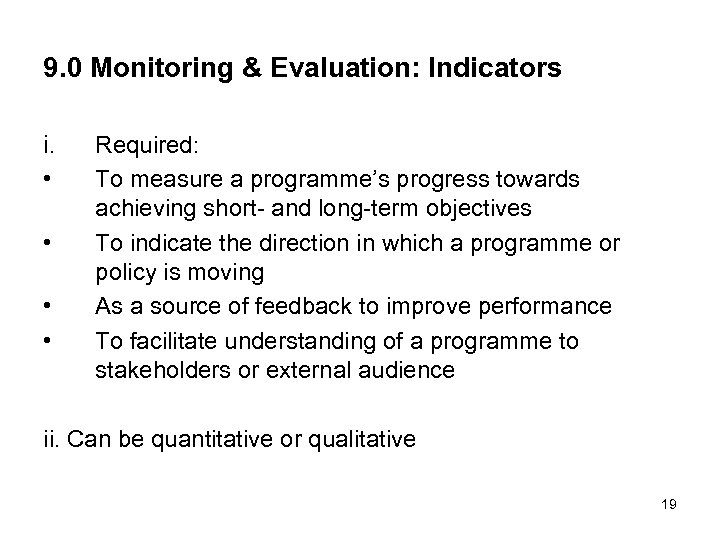 9. 0 Monitoring & Evaluation: Indicators i. • • Required: To measure a programme’s progress towards achieving short- and long-term objectives To indicate the direction in which a programme or policy is moving As a source of feedback to improve performance To facilitate understanding of a programme to stakeholders or external audience ii. Can be quantitative or qualitative 19
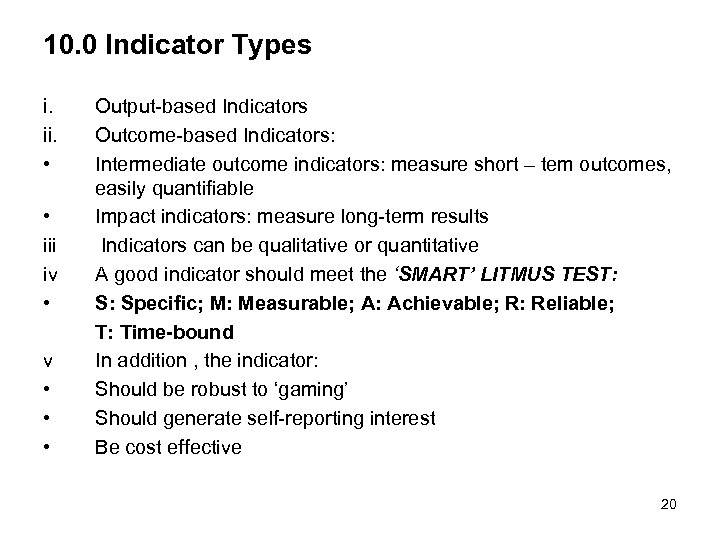 10. 0 Indicator Types i. ii. • • iii iv • • • Output-based Indicators Outcome-based Indicators: Intermediate outcome indicators: measure short – tem outcomes, easily quantifiable Impact indicators: measure long-term results Indicators can be qualitative or quantitative A good indicator should meet the ‘SMART’ LITMUS TEST: S: Specific; M: Measurable; A: Achievable; R: Reliable; T: Time-bound In addition , the indicator: Should be robust to ‘gaming’ Should generate self-reporting interest Be cost effective 20