


 Скачать презентацию International Success Stories in Wastewater Treatment and Reuse
e2122a86d5a09dd22ec8e9361331038f.ppt
- Количество слайдов: 72
 International Success Stories in Wastewater Treatment and Reuse MEDAWARE
 Outline n n Introduction: Benefits and Domains of Wastewater Reuse Success Stories in Mediterranean Region: ¨ ¨ ¨ n Spain: Vitoria and Tenerife Plants Greece: Chalkis Island Plant Italy: Catania Projects Palestine: Dan Region Project Cyprus: Larnaca Plant Other Examples Success Stories all over the World: Australia: Bolivar Project ¨ USA: Monterey, California ¨
 Introduction n Best Practices and Success Stories in Wastewater Treatment Systems are: ¨ Systems employing an effective treatment technology leading to a good quality effluent ¨ Systems with high contribution into the overall increase of wastewater reuse in the relevant country ¨ Systems achieving sustainable wastewater treatment and reuse practices
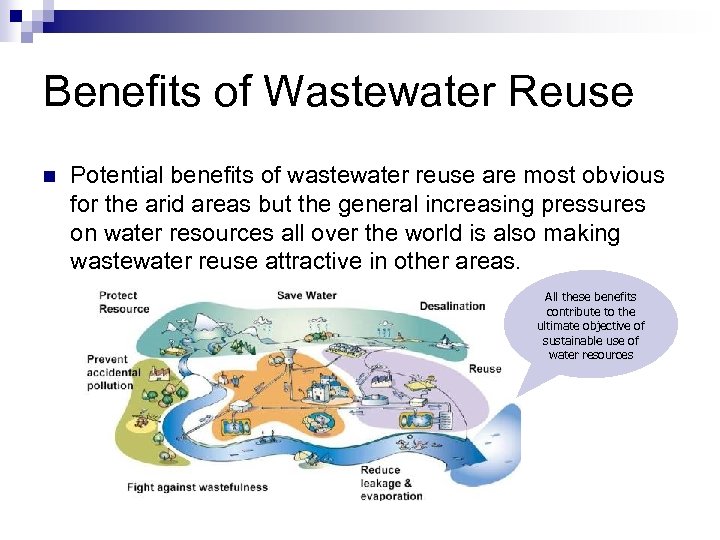 Benefits of Wastewater Reuse n Potential benefits of wastewater reuse are most obvious for the arid areas but the general increasing pressures on water resources all over the world is also making wastewater reuse attractive in other areas. All these benefits contribute to the ultimate objective of sustainable use of water resources
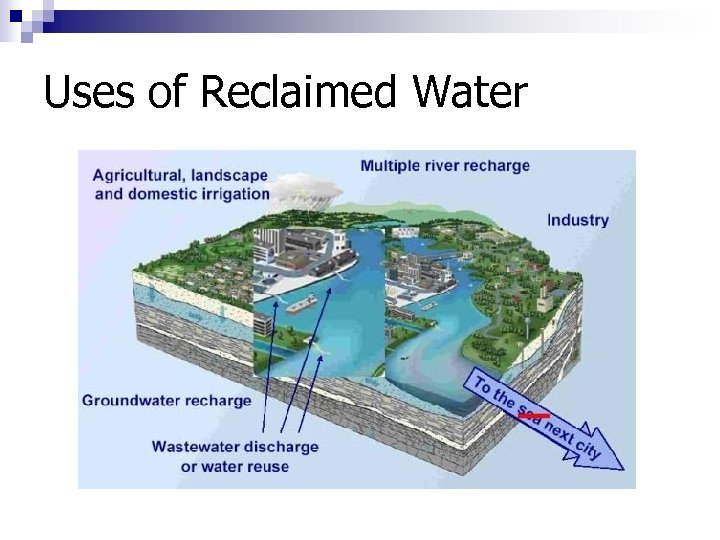 Uses of Reclaimed Water
 Success Stories Mediterranean Region
 The Mediterranean Region: The Need for Wastewater Reuse n It is characterised by the low level and irregularity of water resources, through time (summer drought, interannual droughts) and space (dry in the South). n It includes 60% of the world population with renewable natural resources of less than 1, 000 m 3 of water/inhabitant/year. n The strong growth in urbanisation, tourism, irrigation and population can only increase tensions on water demand.
 Spain: Vitoria-Gasteiz North of Spain
 Objectives of the Reuse Scheme n A Tertiary Treatment Station was added in 1995 to the Municipal Wastewater Treatment Plant to obtain a better effluent capable of: ¨ Increasing water supply to Vitoria and Bilbao cities ¨ Replacing ecological flows to the Zadorra dams when they are deficient ¨ Irrigating 10, 000 ha of agricultural land ¨ Protecting the trout fish of the Zadorra River
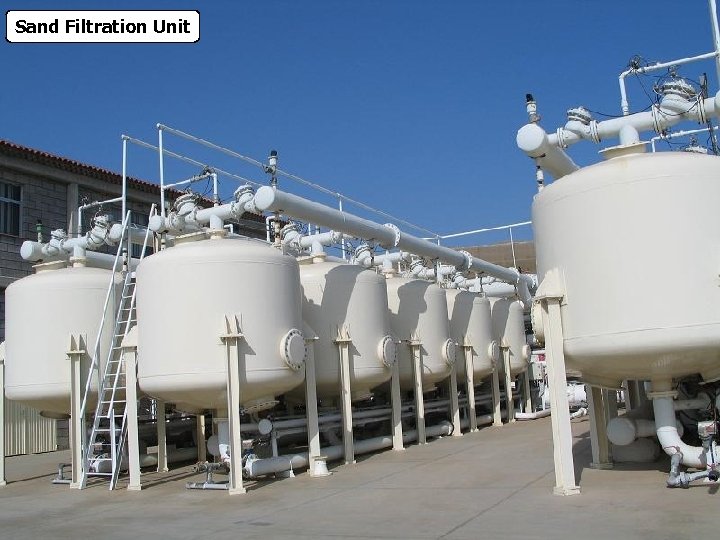
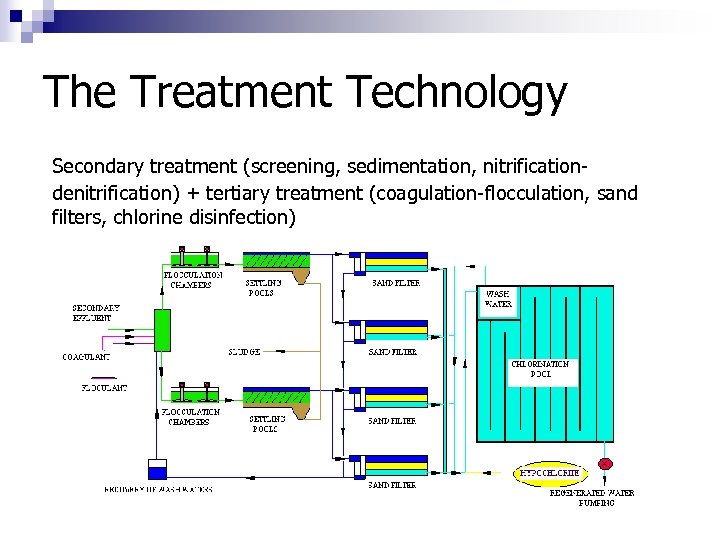 The Treatment Technology Secondary treatment (screening, sedimentation, nitrificationdenitrification) + tertiary treatment (coagulation-flocculation, sand filters, chlorine disinfection)
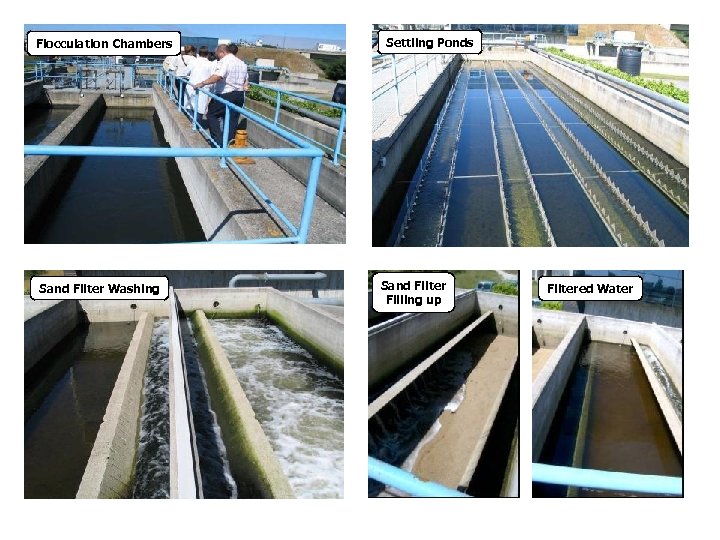 Flocculation Chambers Sand Filter Washing Settling Ponds Sand Filter Filling up Filtered Water
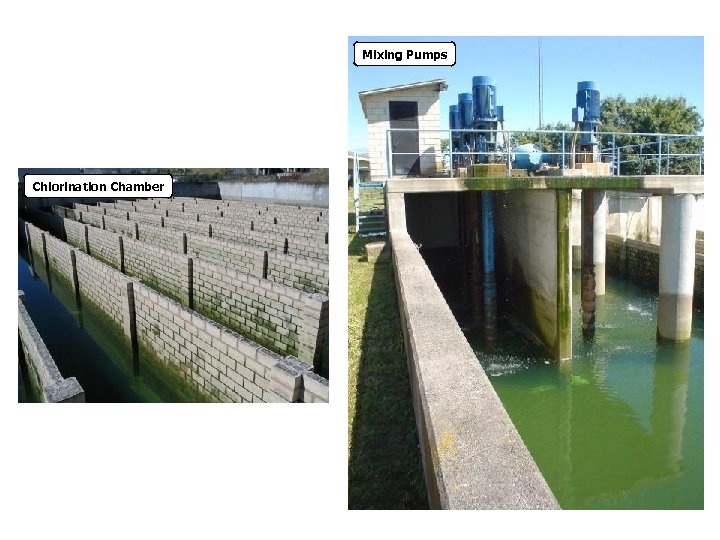 Mixing Pumps Chlorination Chamber
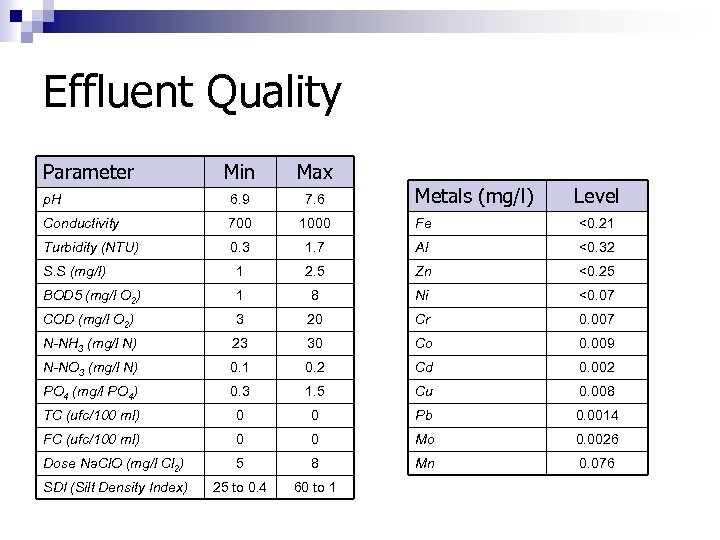 Effluent Quality Parameter Min Max p. H 6. 9 7. 6 Conductivity 700 1000 Fe <0. 21 Turbidity (NTU) 0. 3 1. 7 Al <0. 32 S. S (mg/l) 1 2. 5 Zn <0. 25 BOD 5 (mg/l O 2) 1 8 Ni <0. 07 COD (mg/l O 2) 3 20 Cr 0. 007 N-NH 3 (mg/l N) 23 30 Co 0. 009 N-NO 3 (mg/l N) 0. 1 0. 2 Cd 0. 002 PO 4 (mg/l PO 4) 0. 3 1. 5 Cu 0. 008 TC (ufc/100 ml) 0 0 Pb 0. 0014 FC (ufc/100 ml) 0 0 Mo 0. 0026 Dose Na. Cl. O (mg/l Cl 2) 5 8 Mn 0. 076 SDI (Silt Density Index) 25 to 0. 4 60 to 1 Metals (mg/l) Level
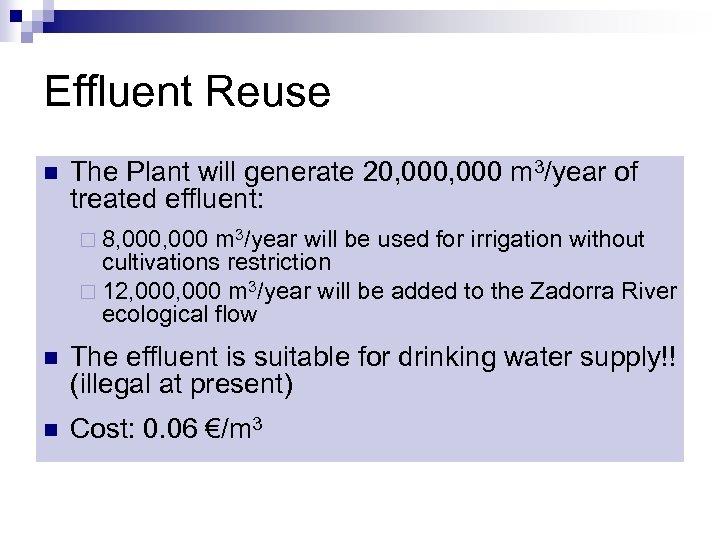 Effluent Reuse n The Plant will generate 20, 000 m 3/year of treated effluent: ¨ 8, 000 m 3/year will be used for irrigation without cultivations restriction ¨ 12, 000 m 3/year will be added to the Zadorra River ecological flow n The effluent is suitable for drinking water supply!! (illegal at present) n Cost: 0. 06 €/m 3
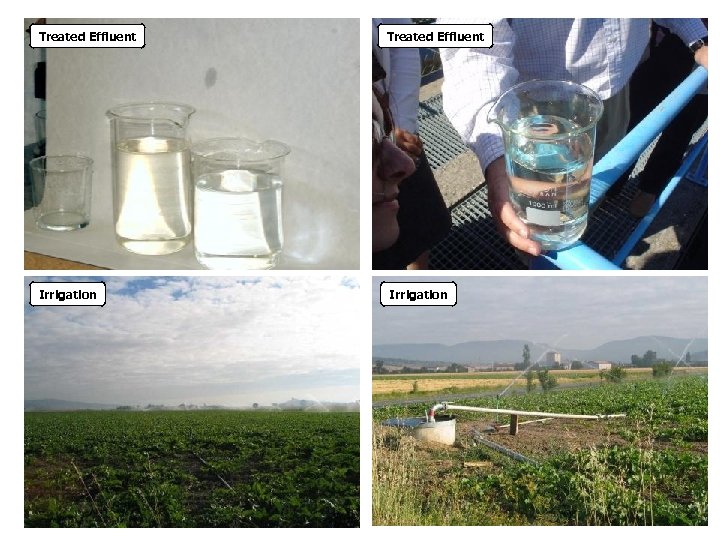 Treated Effluent Irrigation
 Spain: Tenerife Santa Cruz de Tenerife
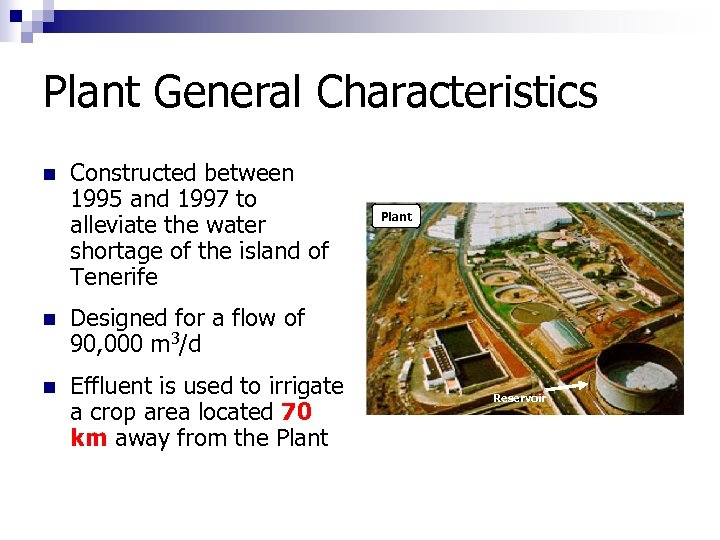 Plant General Characteristics n Constructed between 1995 and 1997 to alleviate the water shortage of the island of Tenerife n Designed for a flow of 90, 000 m 3/d n Effluent is used to irrigate a crop area located 70 km away from the Plant Reservoir
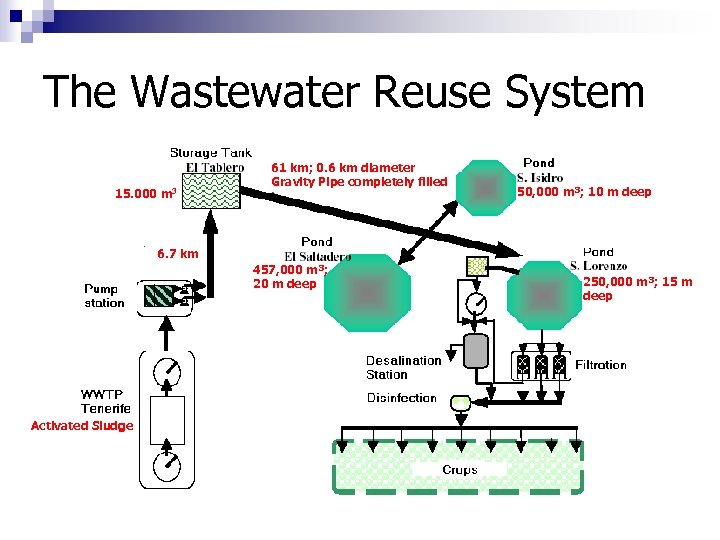 The Wastewater Reuse System 15. 000 m 3 61 km; 0. 6 km diameter Gravity Pipe completely filled 50, 000 m³; 10 m deep 6. 7 km 457, 000 m³; 20 m deep Activated Sludge 250, 000 m³; 15 m deep
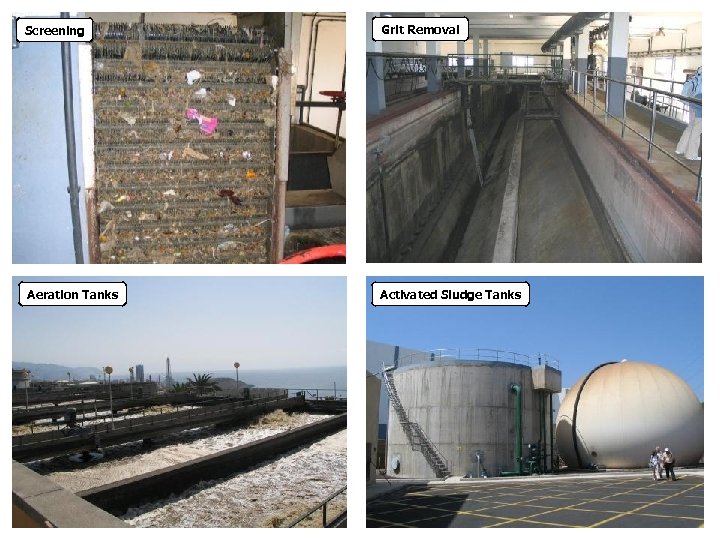 Screening Grit Removal Aeration Tanks Activated Sludge Tanks
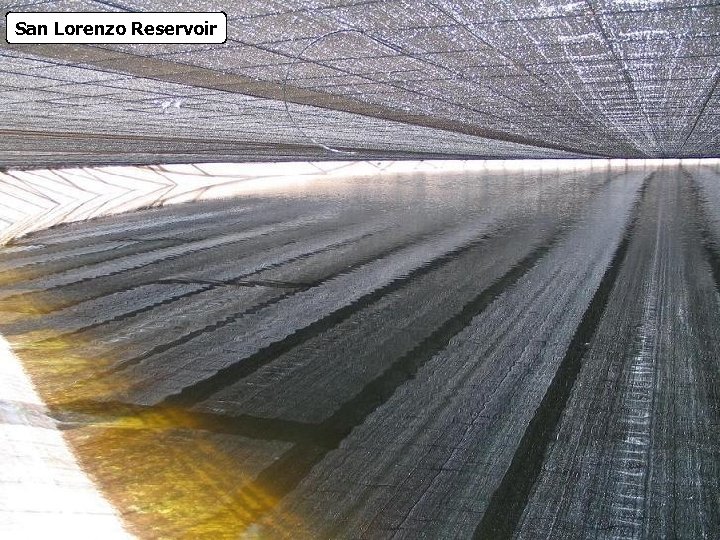
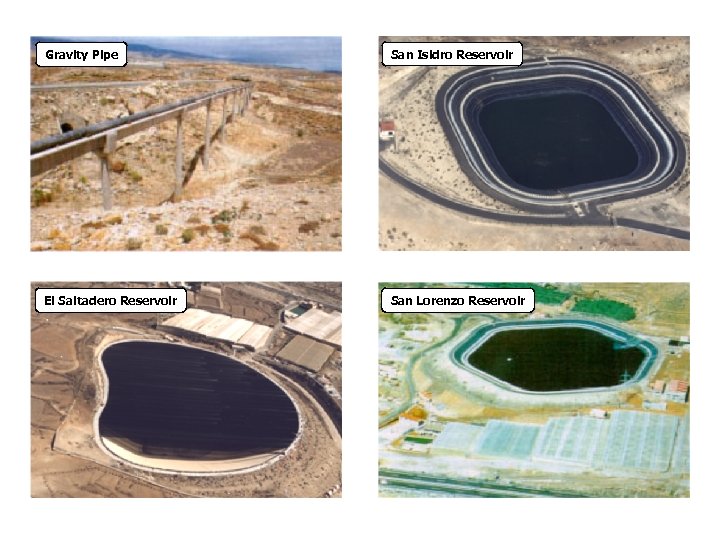 Gravity Pipe San Isidro Reservoir El Saltadero Reservoir San Lorenzo Reservoir
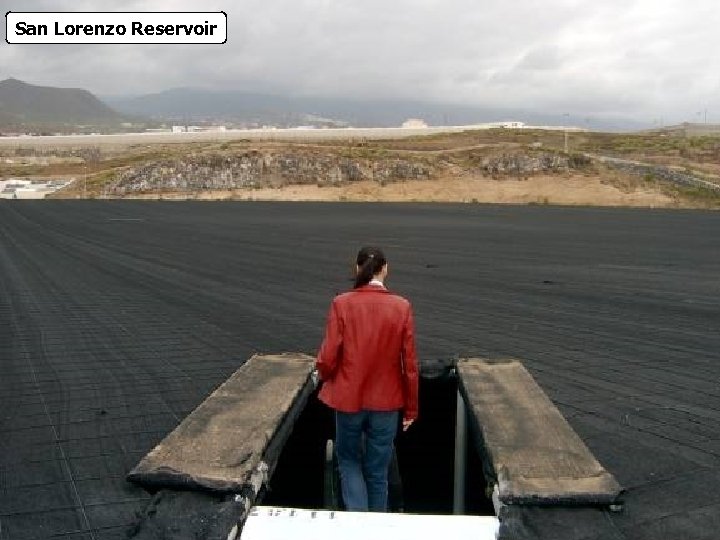 San Lorenzo Reservoir
 San Lorenzo Reservoir
 San Lorenzo Reservoir
 Desalination Unit
 Sand Filtration Unit
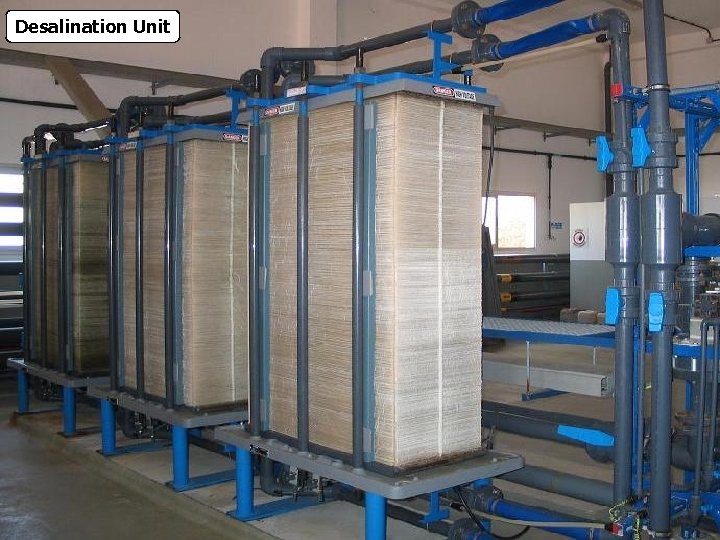
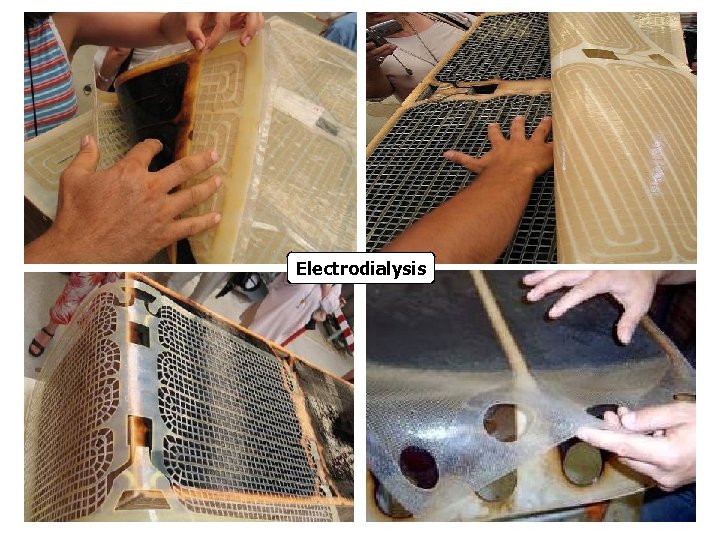 Electrodialysis
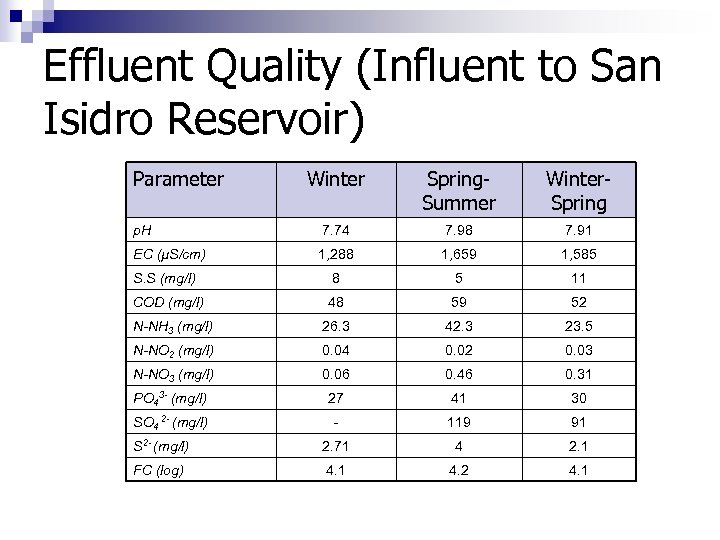 Effluent Quality (Influent to San Isidro Reservoir) Parameter Winter Spring. Summer Winter. Spring p. H 7. 74 7. 98 7. 91 EC (µS/cm) 1, 288 1, 659 1, 585 S. S (mg/l) 8 5 11 COD (mg/l) 48 59 52 N-NH 3 (mg/l) 26. 3 42. 3 23. 5 N-NO 2 (mg/l) 0. 04 0. 02 0. 03 N-NO 3 (mg/l) 0. 06 0. 46 0. 31 PO 43 - (mg/l) 27 41 30 SO 4 2 - (mg/l) - 119 91 S 2 - (mg/l) 2. 71 4 2. 1 FC (log) 4. 1 4. 2 4. 1
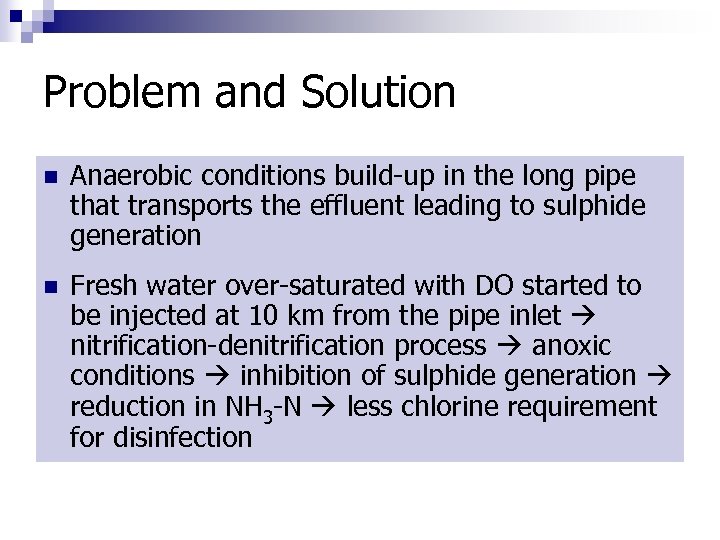 Problem and Solution n Anaerobic conditions build-up in the long pipe that transports the effluent leading to sulphide generation n Fresh water over-saturated with DO started to be injected at 10 km from the pipe inlet nitrification-denitrification process anoxic conditions inhibition of sulphide generation reduction in NH 3 -N less chlorine requirement for disinfection
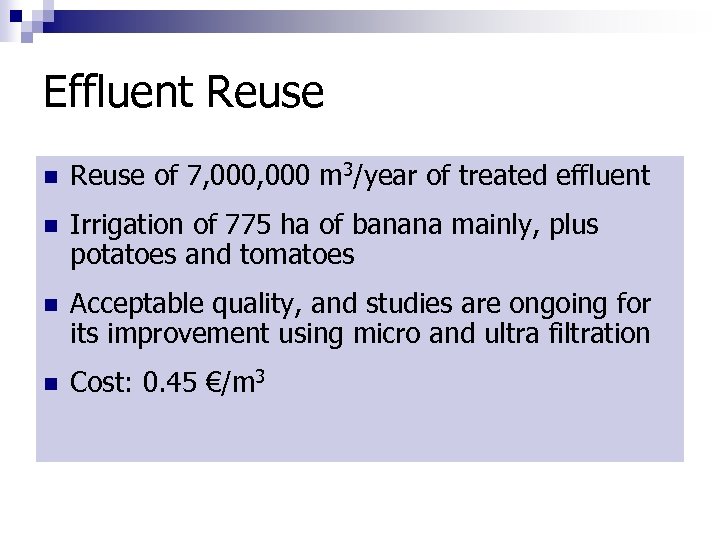 Effluent Reuse n Reuse of 7, 000 m 3/year of treated effluent n Irrigation of 775 ha of banana mainly, plus potatoes and tomatoes n Acceptable quality, and studies are ongoing for its improvement using micro and ultra filtration n Cost: 0. 45 €/m 3
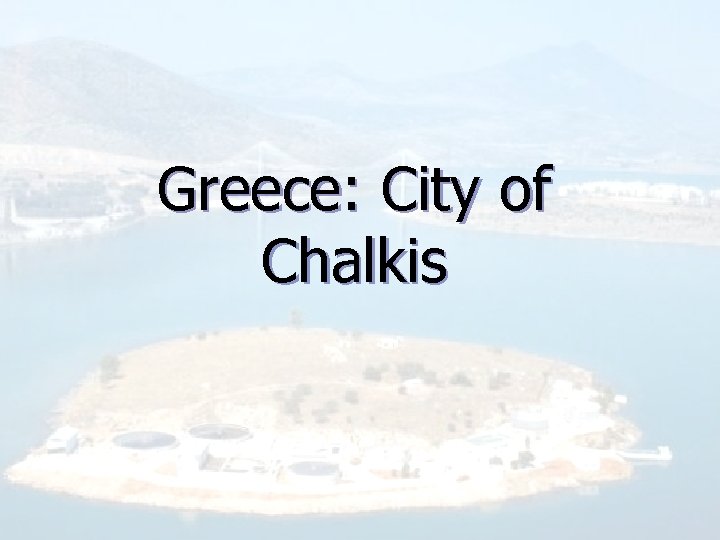 Greece: City of Chalkis
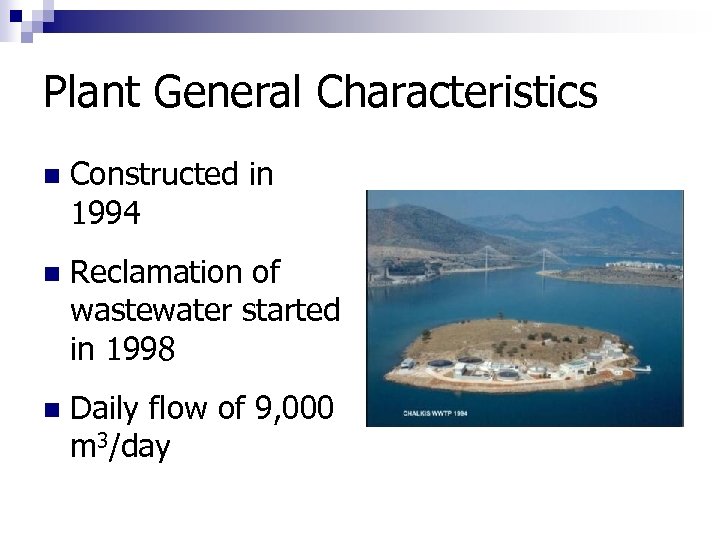 Plant General Characteristics n Constructed in 1994 n Reclamation of wastewater started in 1998 n Daily flow of 9, 000 m 3/day
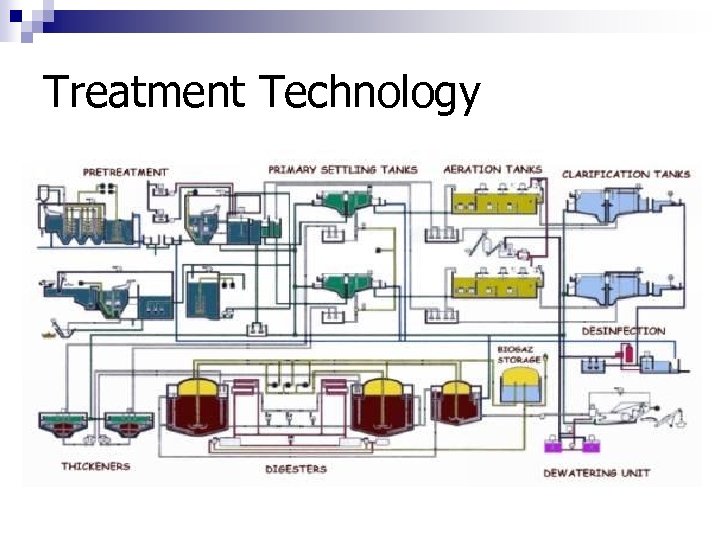 Treatment Technology
 Disinfection Process n In 1998, ultraviolet disinfection using two types of UV systems (closed and open type) and chlorination was introduced n The first UV bank produced 55 m. Ws/cm 2. After test, it was decided to increase the total dose of the UV lamps to 120 m. Ws/cm 2
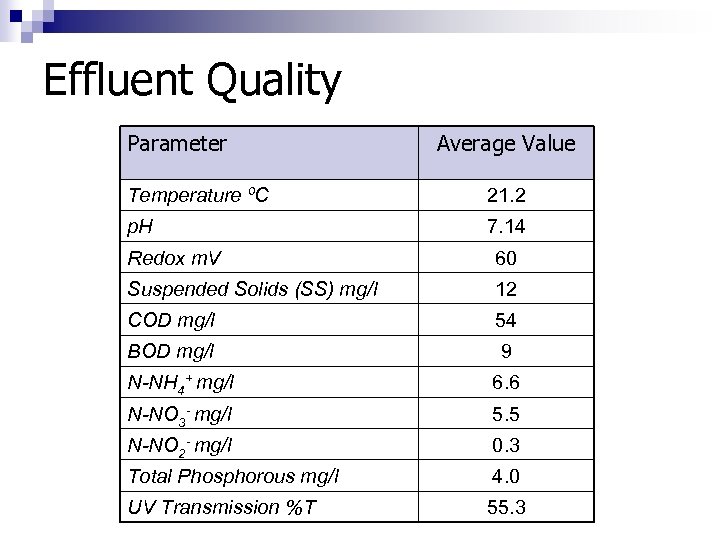 Effluent Quality Parameter Average Value Temperature ºC 21. 2 p. H 7. 14 Redox m. V 60 Suspended Solids (SS) mg/l 12 COD mg/l 54 BOD mg/l 9 N-NH 4+ mg/l 6. 6 N-NO 3 - mg/l 5. 5 N-NO 2 - mg/l 0. 3 Total Phosphorous mg/l 4. 0 UV Transmission %T 55. 3
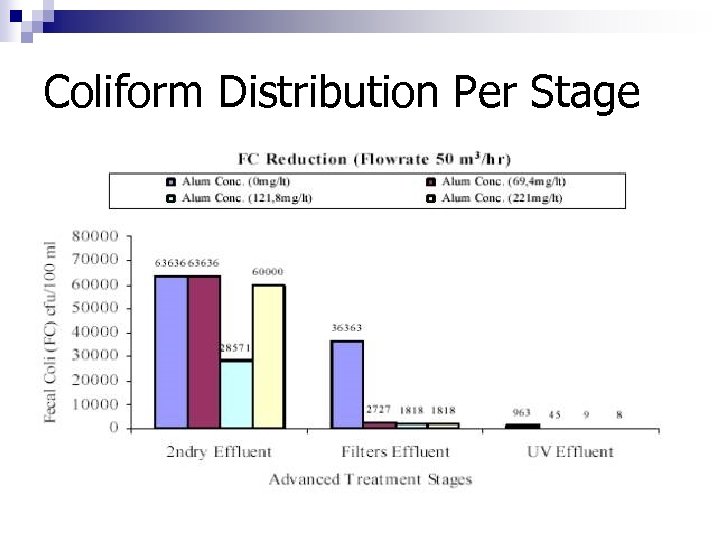 Coliform Distribution Per Stage
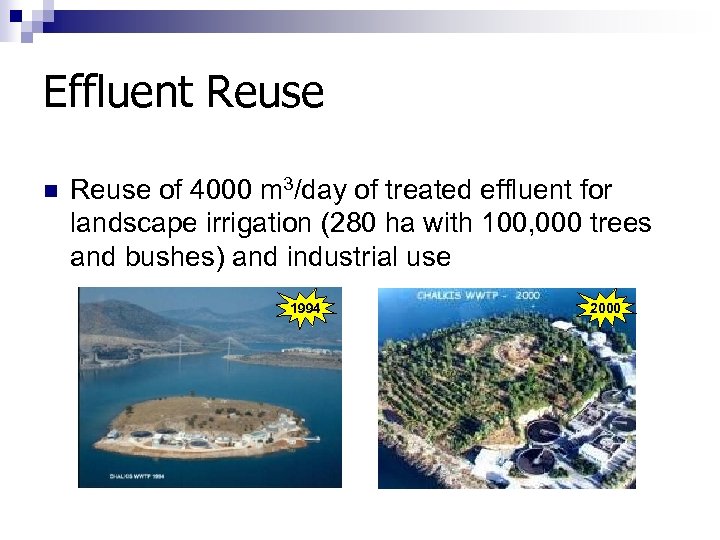 Effluent Reuse n Reuse of 4000 m 3/day of treated effluent for landscape irrigation (280 ha with 100, 000 trees and bushes) and industrial use 1994 2000
 Italy: Catania Caltagirone and Grammichelle Projects
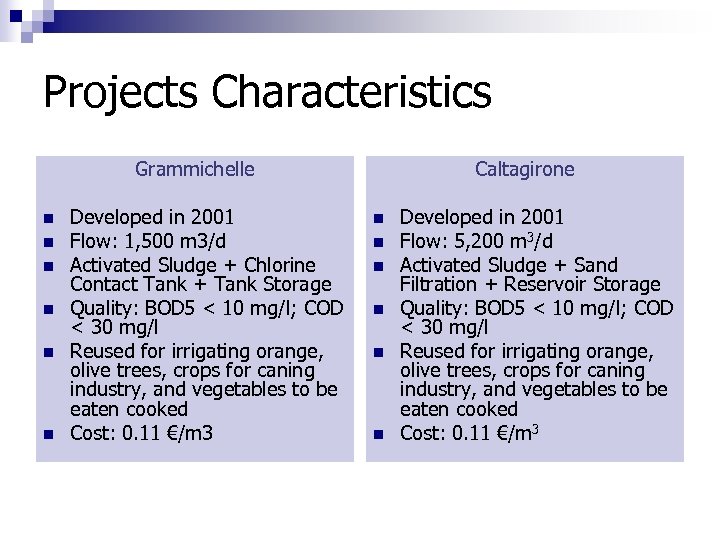 Projects Characteristics Grammichelle n n n Developed in 2001 Flow: 1, 500 m 3/d Activated Sludge + Chlorine Contact Tank + Tank Storage Quality: BOD 5 < 10 mg/l; COD < 30 mg/l Reused for irrigating orange, olive trees, crops for caning industry, and vegetables to be eaten cooked Cost: 0. 11 €/m 3 Caltagirone n n n Developed in 2001 Flow: 5, 200 m 3/d Activated Sludge + Sand Filtration + Reservoir Storage Quality: BOD 5 < 10 mg/l; COD < 30 mg/l Reused for irrigating orange, olive trees, crops for caning industry, and vegetables to be eaten cooked Cost: 0. 11 €/m 3
 Palestine Dan Region Project Tel Aviv
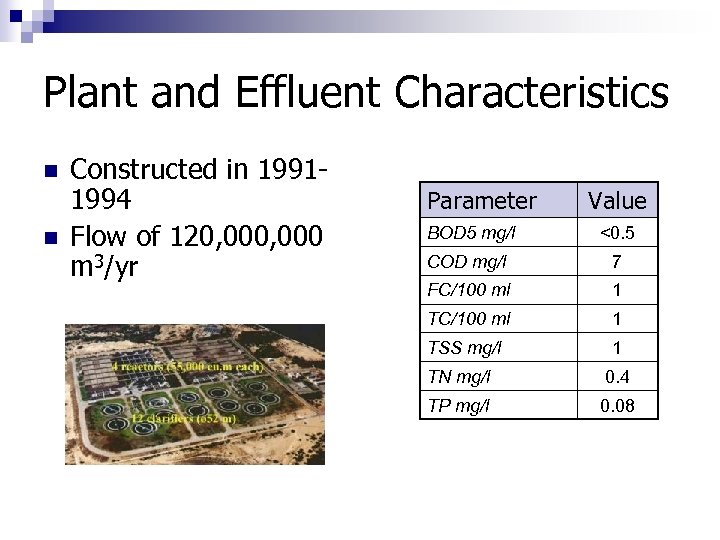 Plant and Effluent Characteristics n n Constructed in 19911994 Flow of 120, 000 m 3/yr Parameter Value BOD 5 mg/l <0. 5 COD mg/l 7 FC/100 ml 1 TSS mg/l 1 TN mg/l 0. 4 TP mg/l 0. 08
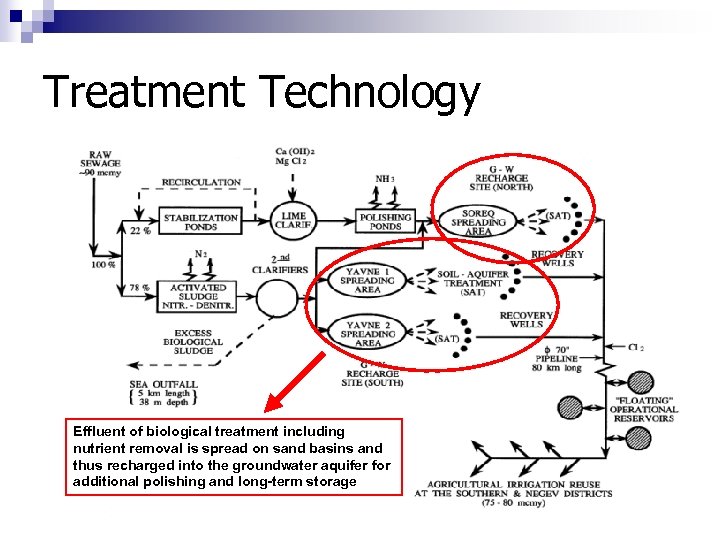 Treatment Technology Effluent of biological treatment including nutrient removal is spread on sand basins and thus recharged into the groundwater aquifer for additional polishing and long-term storage
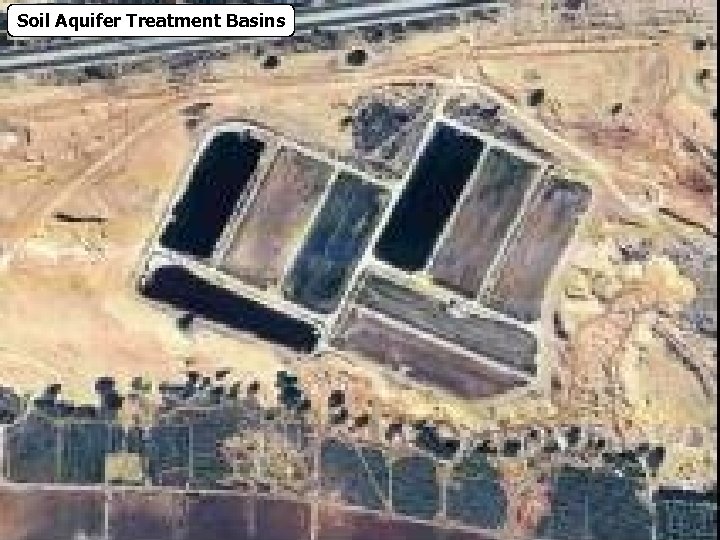 Soil Aquifer Treatment Basins
 Effluent Reuse n n In 1993, 75 out of 87 Mm 3 of treated wastewater was recharged and about 100 Mm 3 (together with groundwater) was used for agricultural irrigation in Negev of an area of ~ 16, 000 ha of field-crops (cotton, cereals, sunflower, etc. ), fruit plantations, vegetables, and flowers aimed for export Cost: 0, 45 US$/m 3
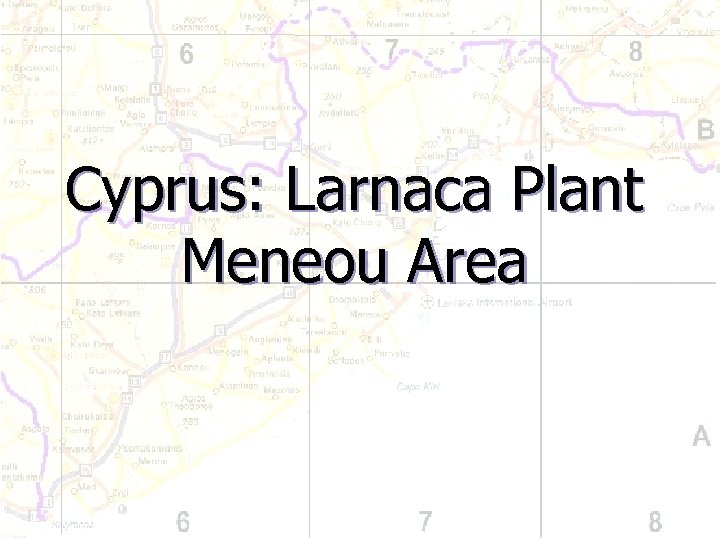 Cyprus: Larnaca Plant Meneou Area
 Plant General Characteristics n Located behind the International Airport of Cyprus n Operation started in 1995, and reuse for irrigation purposes in 2000 n Design capacity: 8, 500 m 3/d; In summer: 5, 500 m 3/d and in winter: 4, 500 m 3/d
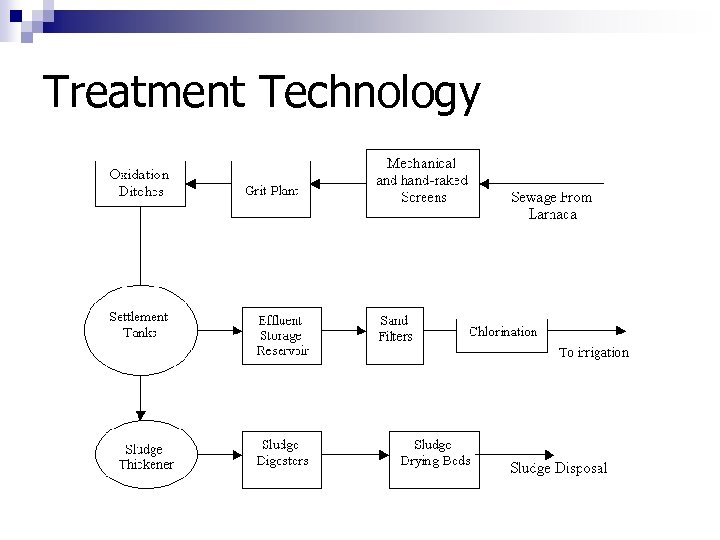 Treatment Technology
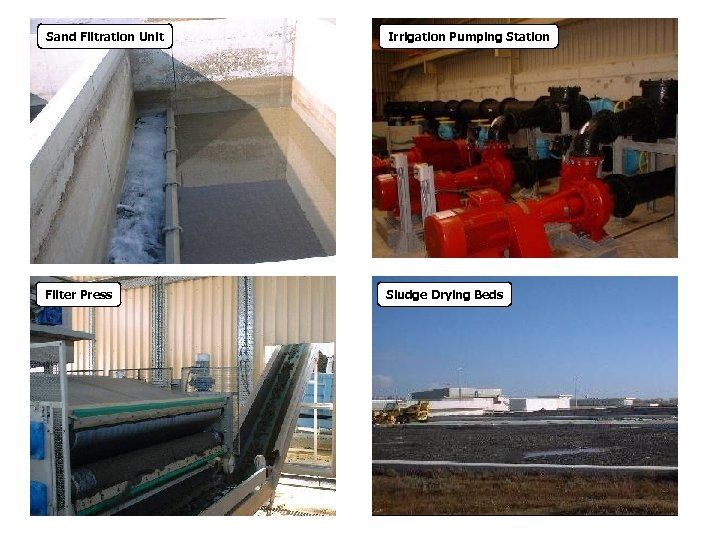 Sand Filtration Unit Irrigation Pumping Station Filter Press Sludge Drying Beds
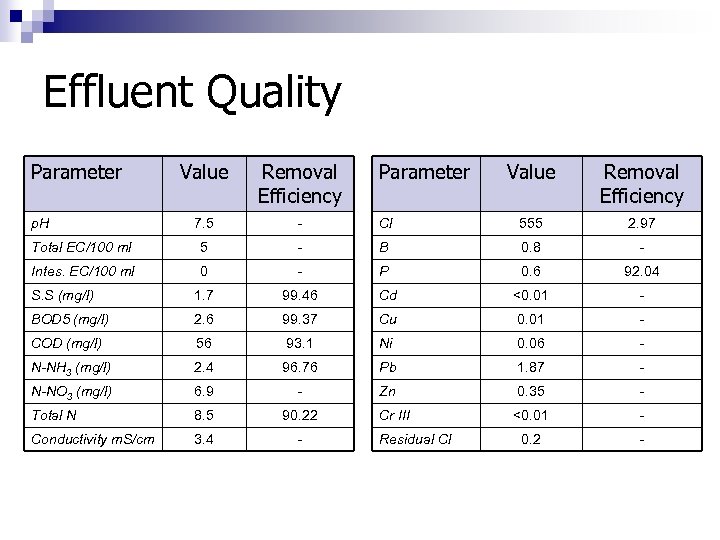 Effluent Quality Parameter Value Removal Efficiency 7. 5 - Cl 555 2. 97 Total EC/100 ml 5 - B 0. 8 - Intes. EC/100 ml 0 - P 0. 6 92. 04 S. S (mg/l) 1. 7 99. 46 Cd <0. 01 - BOD 5 (mg/l) 2. 6 99. 37 Cu 0. 01 - COD (mg/l) 56 93. 1 Ni 0. 06 - N-NH 3 (mg/l) 2. 4 96. 76 Pb 1. 87 - N-NO 3 (mg/l) 6. 9 - Zn 0. 35 - Total N 8. 5 90. 22 Cr III <0. 01 - Conductivity m. S/cm 3. 4 - 0. 2 - p. H Parameter Residual Cl
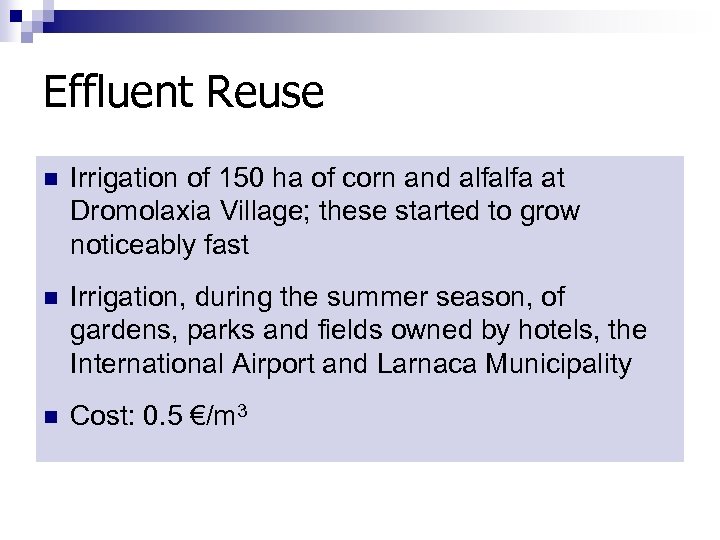 Effluent Reuse n Irrigation of 150 ha of corn and alfalfa at Dromolaxia Village; these started to grow noticeably fast n Irrigation, during the summer season, of gardens, parks and fields owned by hotels, the International Airport and Larnaca Municipality n Cost: 0. 5 €/m 3
 Other Success Stories Mediterranean Region
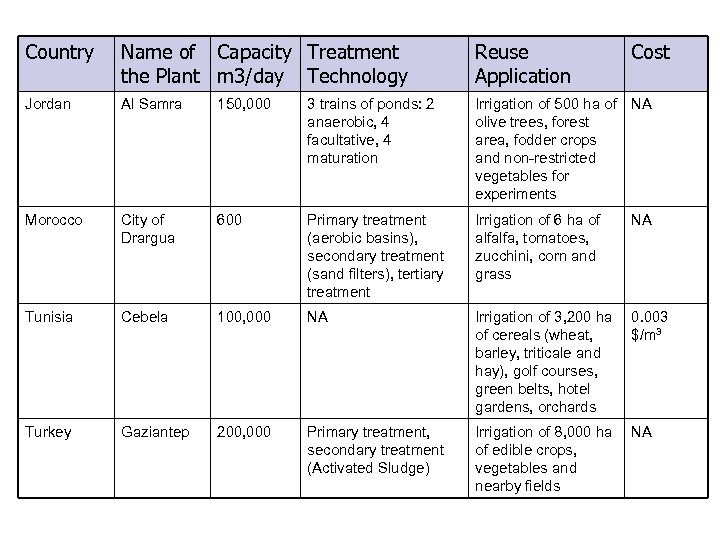 Country Name of Capacity Treatment the Plant m 3/day Technology Reuse Application Cost Jordan Al Samra 150, 000 3 trains of ponds: 2 anaerobic, 4 facultative, 4 maturation Irrigation of 500 ha of NA olive trees, forest area, fodder crops and non-restricted vegetables for experiments Morocco City of Drargua 600 Primary treatment (aerobic basins), secondary treatment (sand filters), tertiary treatment Irrigation of 6 ha of alfalfa, tomatoes, zucchini, corn and grass NA Tunisia Cebela 100, 000 NA Irrigation of 3, 200 ha of cereals (wheat, barley, triticale and hay), golf courses, green belts, hotel gardens, orchards 0. 003 $/m 3 Turkey Gaziantep 200, 000 Primary treatment, secondary treatment (Activated Sludge) Irrigation of 8, 000 ha of edible crops, vegetables and nearby fields NA
 Success Stories Non-Mediterranean Region
 Australia Bolivar Project
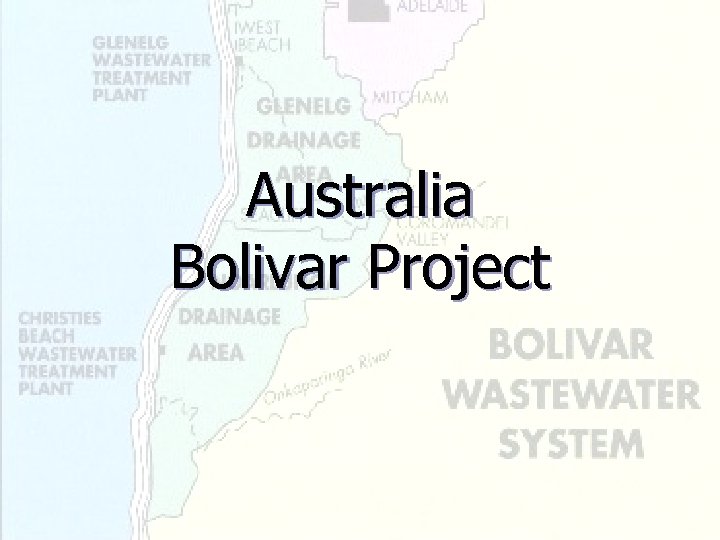
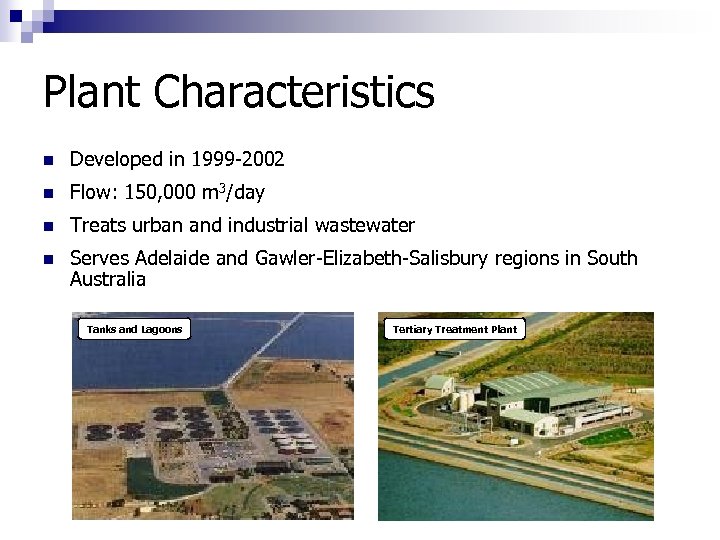 Plant Characteristics n Developed in 1999 -2002 n Flow: 150, 000 m 3/day n Treats urban and industrial wastewater n Serves Adelaide and Gawler-Elizabeth-Salisbury regions in South Australia Tanks and Lagoons Tertiary Treatment Plant
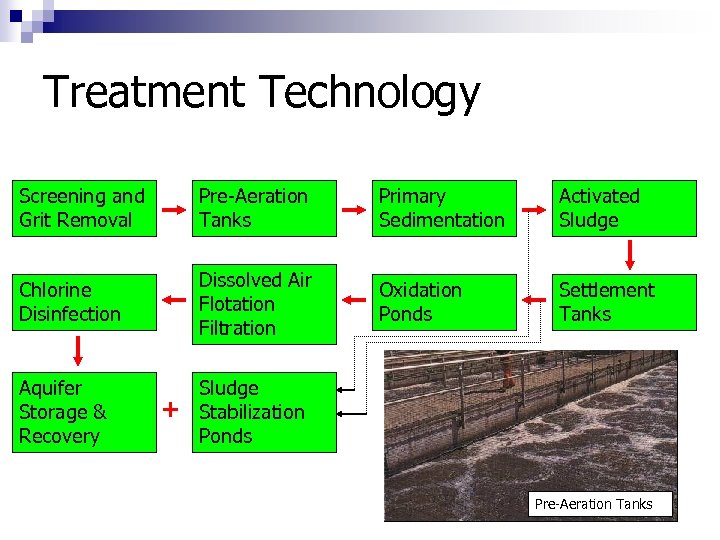 Treatment Technology Screening and Grit Removal Pre-Aeration Tanks Primary Sedimentation Activated Sludge Chlorine Disinfection Dissolved Air Flotation Filtration Oxidation Ponds Settlement Tanks Aquifer Storage & Recovery Sludge Stabilization Ponds + Pre-Aeration Tanks
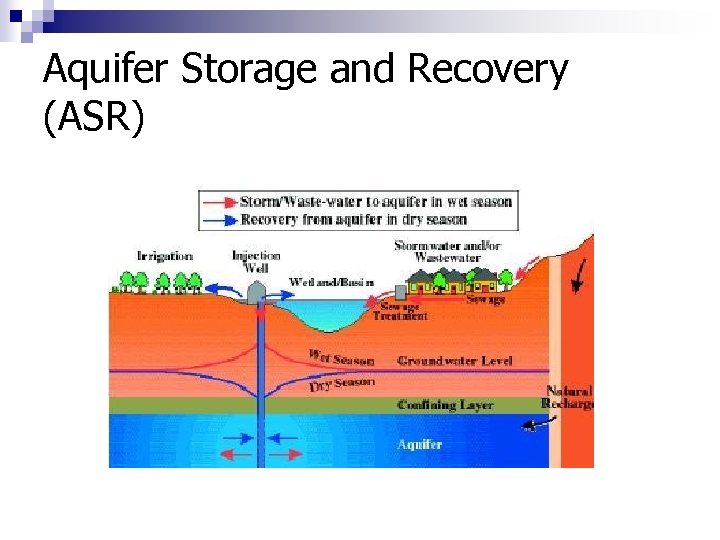 Aquifer Storage and Recovery (ASR)
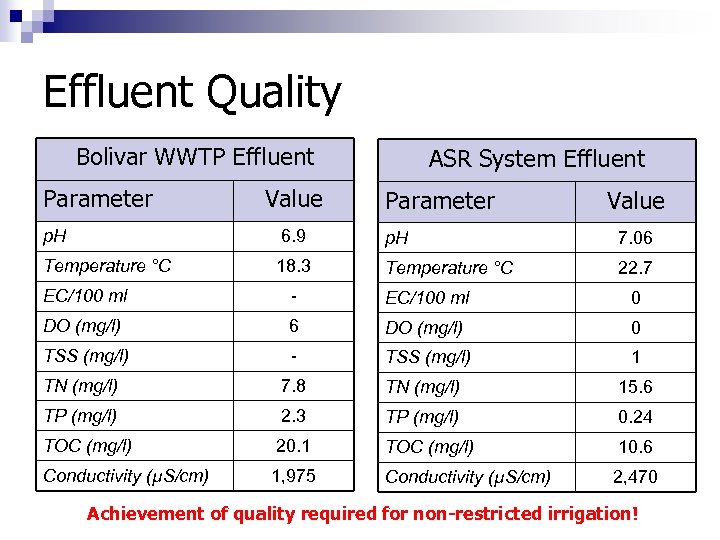 Effluent Quality Bolivar WWTP Effluent Parameter Value ASR System Effluent Parameter Value p. H 6. 9 p. H 7. 06 Temperature °C 18. 3 Temperature °C 22. 7 EC/100 ml - EC/100 ml 0 DO (mg/l) 6 DO (mg/l) 0 TSS (mg/l) - TSS (mg/l) 1 TN (mg/l) 7. 8 TN (mg/l) 15. 6 TP (mg/l) 2. 3 TP (mg/l) 0. 24 TOC (mg/l) 20. 1 TOC (mg/l) 10. 6 Conductivity (µS/cm) 1, 975 Conductivity (µS/cm) 2, 470 Achievement of quality required for non-restricted irrigation!
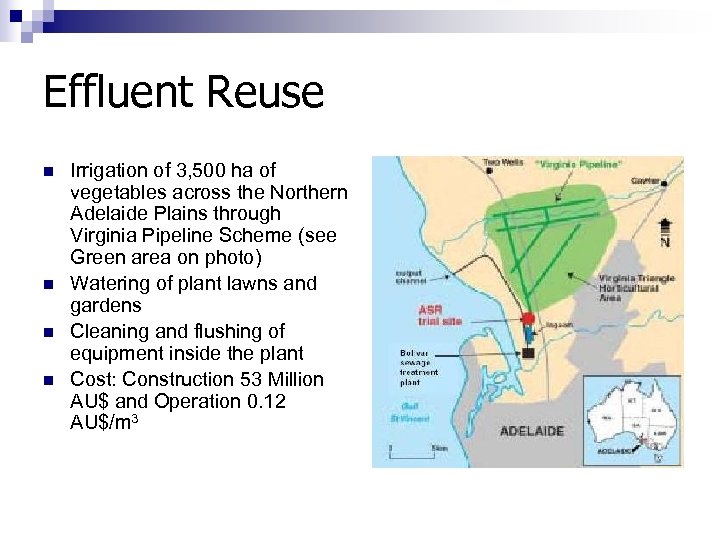 Effluent Reuse n n Irrigation of 3, 500 ha of vegetables across the Northern Adelaide Plains through Virginia Pipeline Scheme (see Green area on photo) Watering of plant lawns and gardens Cleaning and flushing of equipment inside the plant Cost: Construction 53 Million AU$ and Operation 0. 12 AU$/m 3
 USA: California
 Wastewater Reuse in California Wastewater reuse has been practiced since 1890 n Historically, agricultural reuse has been practiced n Over the last decade landscape irrigation in urban areas and groundwater recharge have been increasingly practiced n
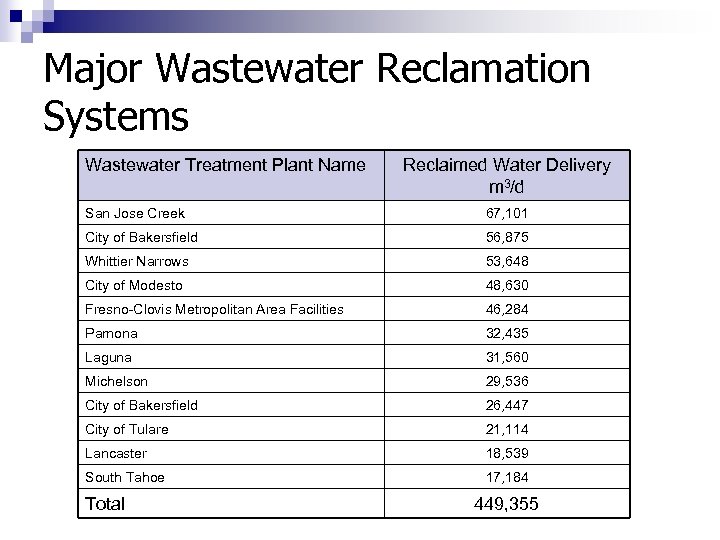 Major Wastewater Reclamation Systems Wastewater Treatment Plant Name Reclaimed Water Delivery m 3/d San Jose Creek 67, 101 City of Bakersfield 56, 875 Whittier Narrows 53, 648 City of Modesto 48, 630 Fresno-Clovis Metropolitan Area Facilities 46, 284 Pamona 32, 435 Laguna 31, 560 Michelson 29, 536 City of Bakersfield 26, 447 City of Tulare 21, 114 Lancaster 18, 539 South Tahoe 17, 184 Total 449, 355
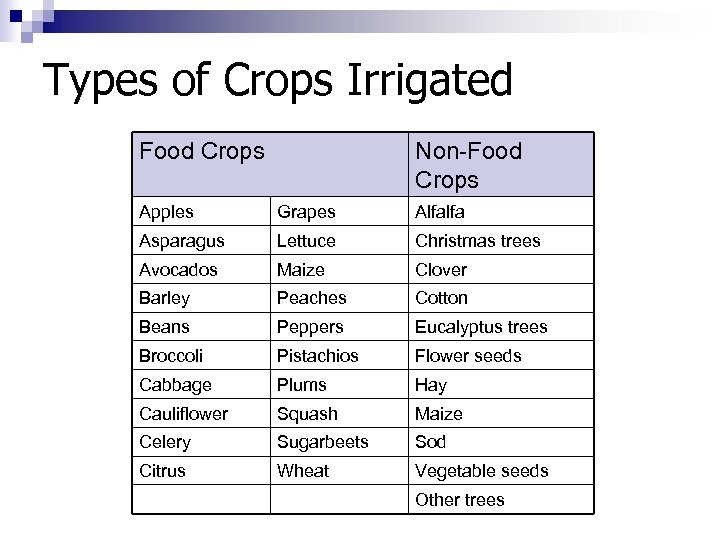 Types of Crops Irrigated Food Crops Non-Food Crops Apples Grapes Alfalfa Asparagus Lettuce Christmas trees Avocados Maize Clover Barley Peaches Cotton Beans Peppers Eucalyptus trees Broccoli Pistachios Flower seeds Cabbage Plums Hay Cauliflower Squash Maize Celery Sugarbeets Sod Citrus Wheat Vegetable seeds Other trees
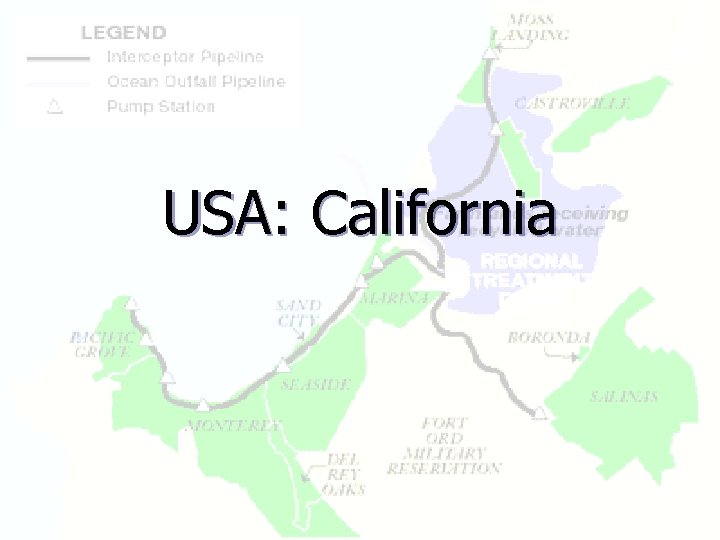
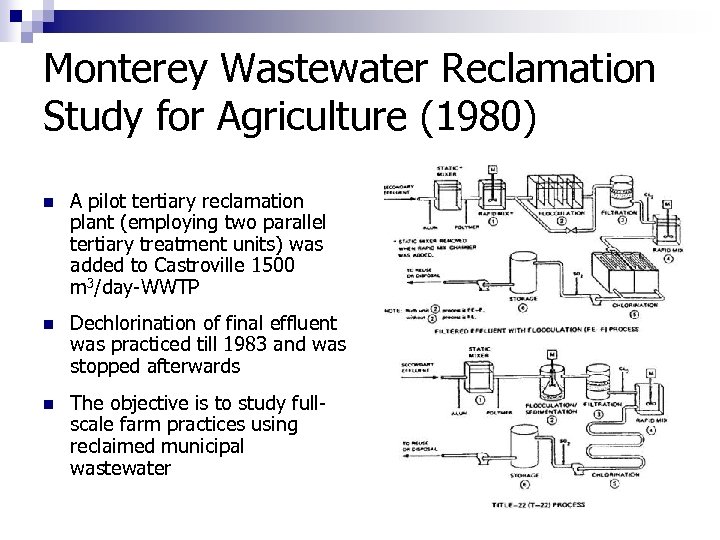 Monterey Wastewater Reclamation Study for Agriculture (1980) n A pilot tertiary reclamation plant (employing two parallel tertiary treatment units) was added to Castroville 1500 m 3/day-WWTP n Dechlorination of final effluent was practiced till 1983 and was stopped afterwards n The objective is to study fullscale farm practices using reclaimed municipal wastewater
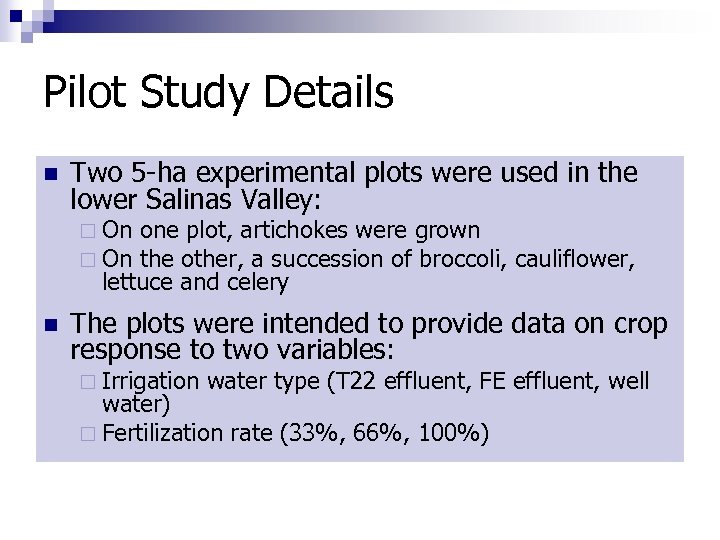 Pilot Study Details n Two 5 -ha experimental plots were used in the lower Salinas Valley: ¨ On one plot, artichokes were grown the other, a succession of broccoli, cauliflower, lettuce and celery n The plots were intended to provide data on crop response to two variables: ¨ Irrigation water type (T 22 effluent, FE effluent, well water) ¨ Fertilization rate (33%, 66%, 100%)
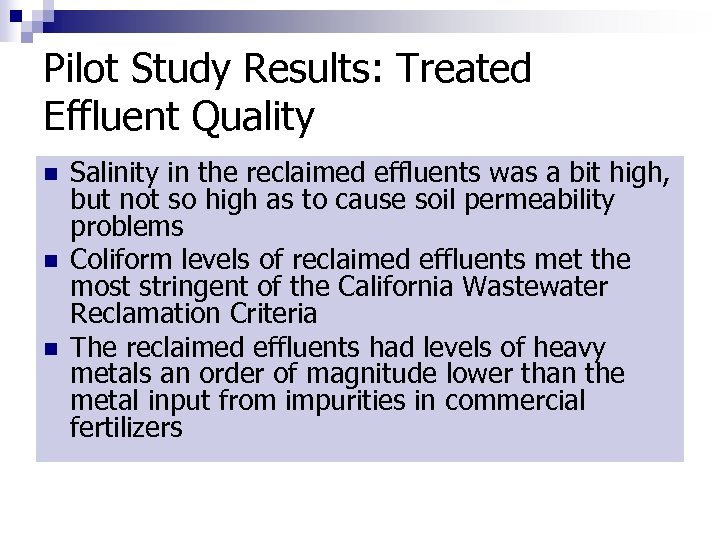 Pilot Study Results: Treated Effluent Quality n n n Salinity in the reclaimed effluents was a bit high, but not so high as to cause soil permeability problems Coliform levels of reclaimed effluents met the most stringent of the California Wastewater Reclamation Criteria The reclaimed effluents had levels of heavy metals an order of magnitude lower than the metal input from impurities in commercial fertilizers
 Pilot Study Results: Plant Tissues n Analysis of plant edible tissues showed that there was no difference, between plants irrigated with reclaimed effluents and plants irrigated with well water, in the level of: ¨ Heavy metals ¨ Total and Faecal Coliforms
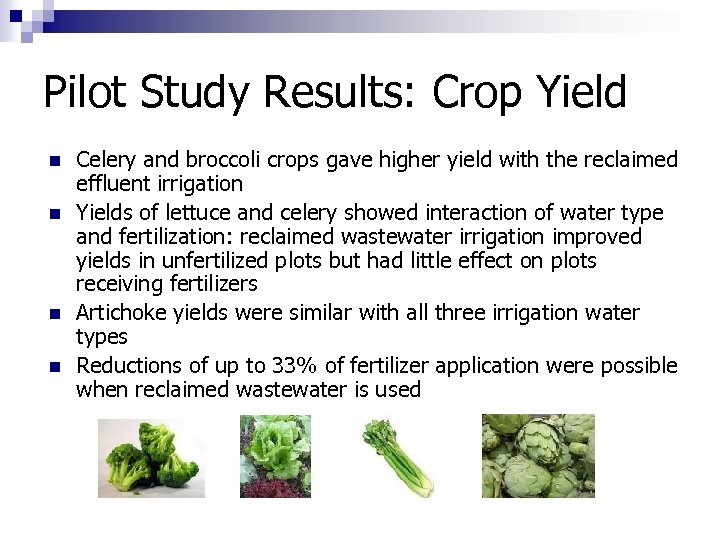 Pilot Study Results: Crop Yield n n Celery and broccoli crops gave higher yield with the reclaimed effluent irrigation Yields of lettuce and celery showed interaction of water type and fertilization: reclaimed wastewater irrigation improved yields in unfertilized plots but had little effect on plots receiving fertilizers Artichoke yields were similar with all three irrigation water types Reductions of up to 33% of fertilizer application were possible when reclaimed wastewater is used
 Other Pilot Study Results n n n No leaf damage due to residual chlorine (that’s why dechlorination practice was stopped in 1983) No difference in plant appearance for all 3 types of irrigation water Cold storage tests showed no unexpected deterioration of produce The shelf life of produce irrigated with reclaimed wastewater was sometimes superior to that irrigated with well water No adverse impacts in terms of soil or groundwater quality degradation No health problems with project personnel
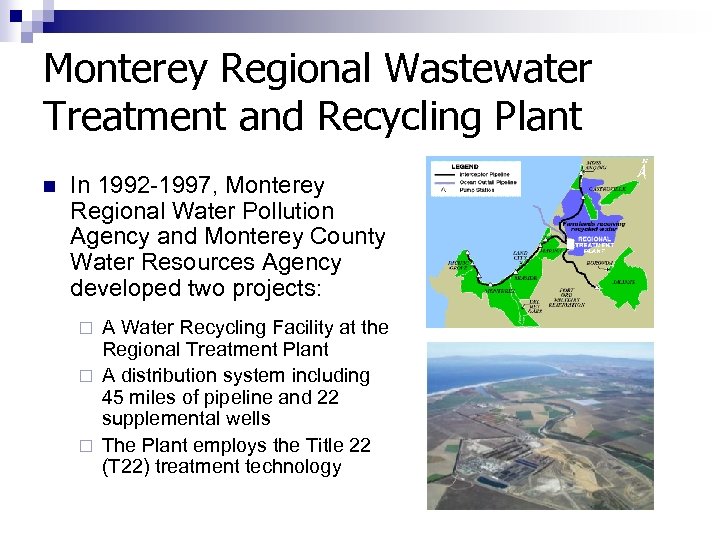 Monterey Regional Wastewater Treatment and Recycling Plant n In 1992 -1997, Monterey Regional Water Pollution Agency and Monterey County Water Resources Agency developed two projects: A Water Recycling Facility at the Regional Treatment Plant ¨ A distribution system including 45 miles of pipeline and 22 supplemental wells ¨ The Plant employs the Title 22 (T 22) treatment technology ¨
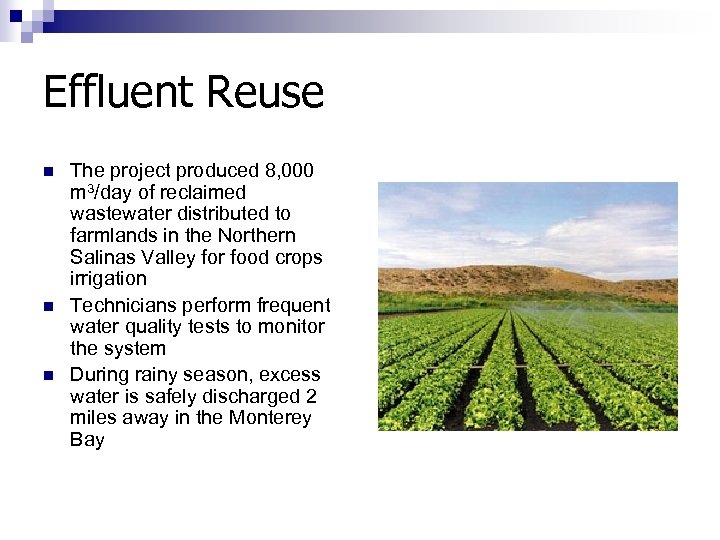 Effluent Reuse n n n The project produced 8, 000 m 3/day of reclaimed wastewater distributed to farmlands in the Northern Salinas Valley for food crops irrigation Technicians perform frequent water quality tests to monitor the system During rainy season, excess water is safely discharged 2 miles away in the Monterey Bay
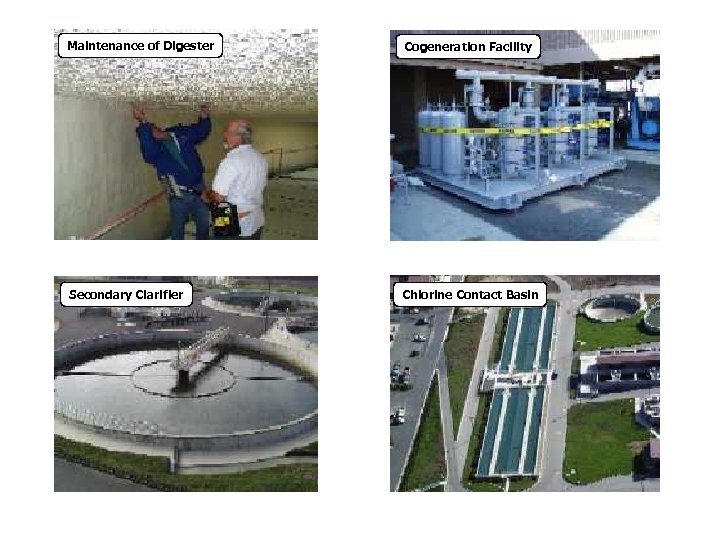 Maintenance of Digester Cogeneration Facility Secondary Clarifier Chlorine Contact Basin
 THANK YOU