 Скачать презентацию International Student Mobility between Europe and the United
8bcc0a101e76115b0dd1b672e35ab5fa.ppt
- Количество слайдов: 30



International Student Mobility between Europe and the United States: Trends and Resources Maria Paniakova Program and Student Adviser Fulbright Commission in the Slovak Republic NAFSA Region 1 Conference, Boise, Idaho October 20, 2006
International Educational Advisers U. S. Department of State affiliated Advising Centers called Education. USA n http: //educationusa. state. gov/centers. htm
Outline of the Session n International Student Mobility – Global Overview (IIE statistics) n Bologna Process Highlights n 10 Action Lines for EHEA by 2010 n Reform of Higher Education in the Slovak Republic n EU-US Co-operation Program in Higher Education and Vocational Training 2006 -2013
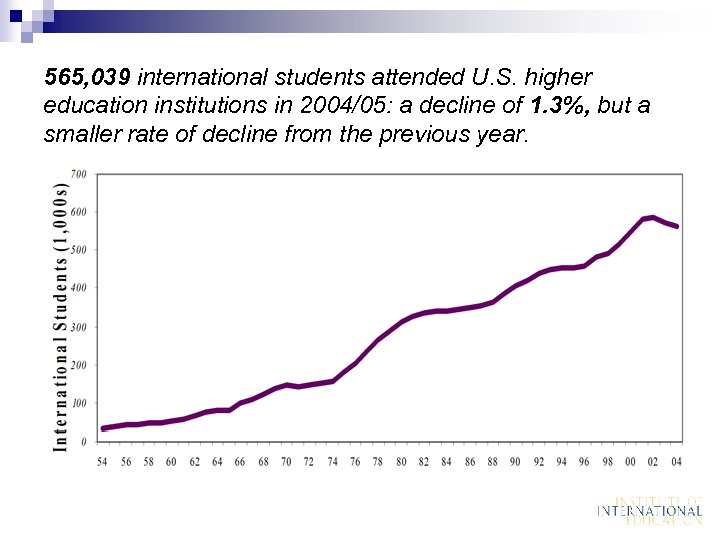
565, 039 international students attended U. S. higher education institutions in 2004/05: a decline of 1. 3%, but a smaller rate of decline from the previous year.
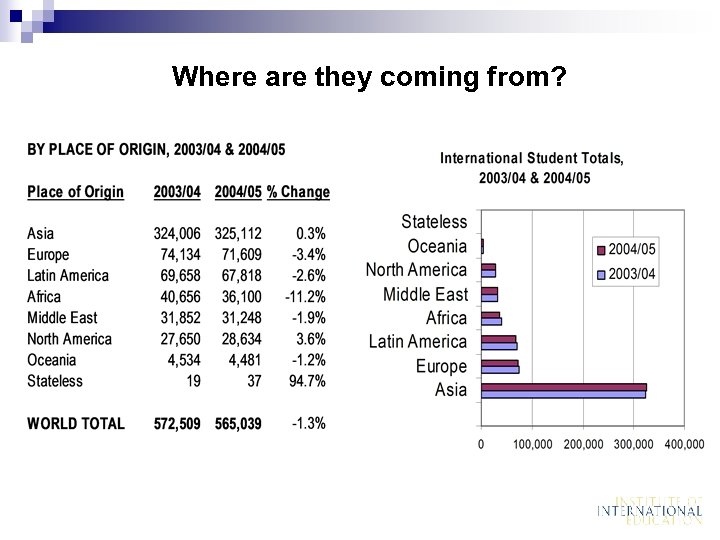
Where are they coming from?
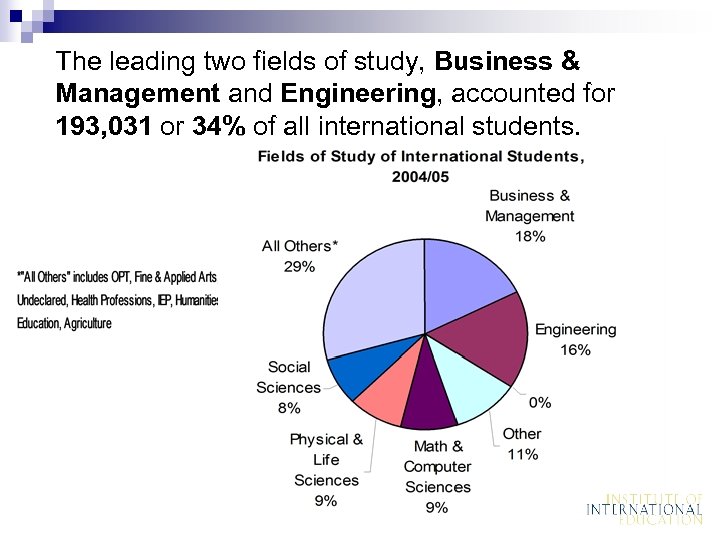
The leading two fields of study, Business & Management and Engineering, accounted for 193, 031 or 34% of all international students.
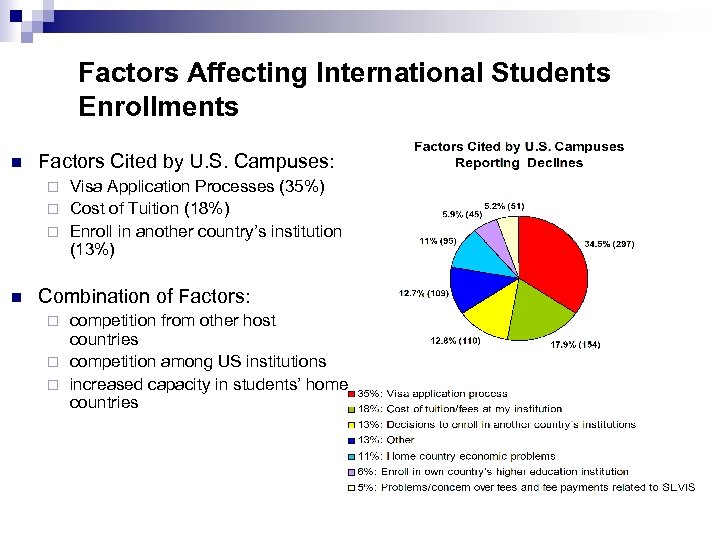
Factors Affecting International Students Enrollments n Factors Cited by U. S. Campuses: Visa Application Processes (35%) ¨ Cost of Tuition (18%) ¨ Enroll in another country’s institution (13%) ¨ n Combination of Factors: competition from other host countries ¨ competition among US institutions ¨ increased capacity in students’ home countries ¨
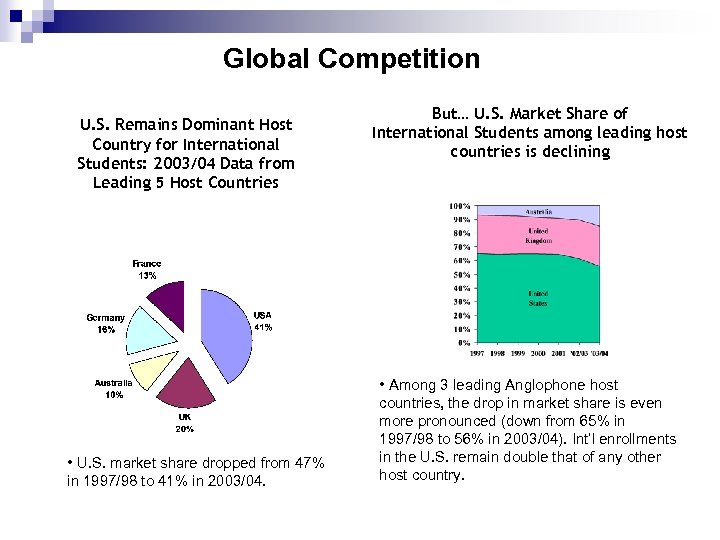
Global Competition U. S. Remains Dominant Host Country for International Students: 2003/04 Data from Leading 5 Host Countries • U. S. market share dropped from 47% in 1997/98 to 41% in 2003/04. But… U. S. Market Share of International Students among leading host countries is declining • Among 3 leading Anglophone host countries, the drop in market share is even more pronounced (down from 65% in 1997/98 to 56% in 2003/04). Int’l enrollments in the U. S. remain double that of any other host country.
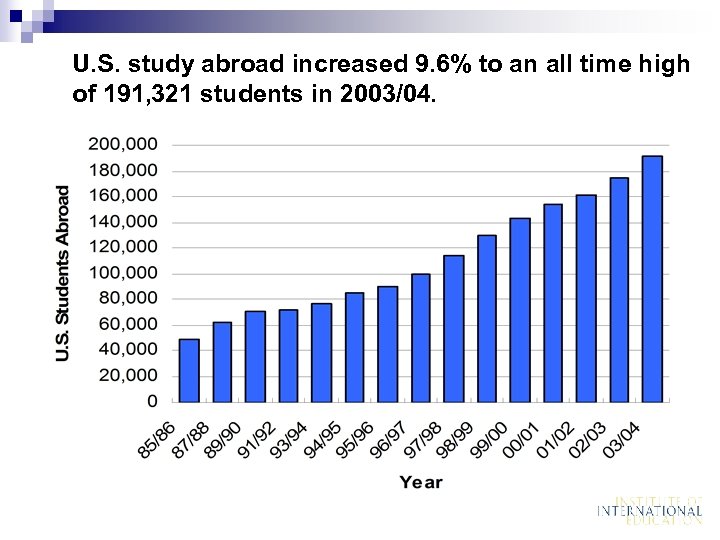
U. S. study abroad increased 9. 6% to an all time high of 191, 321 students in 2003/04.
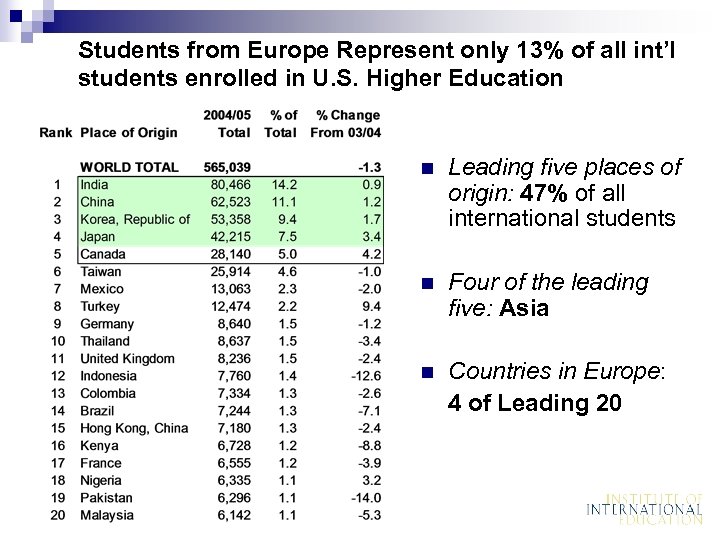
Students from Europe Represent only 13% of all int’l students enrolled in U. S. Higher Education n Leading five places of origin: 47% of all international students n Four of the leading five: Asia n Countries in Europe: 4 of Leading 20
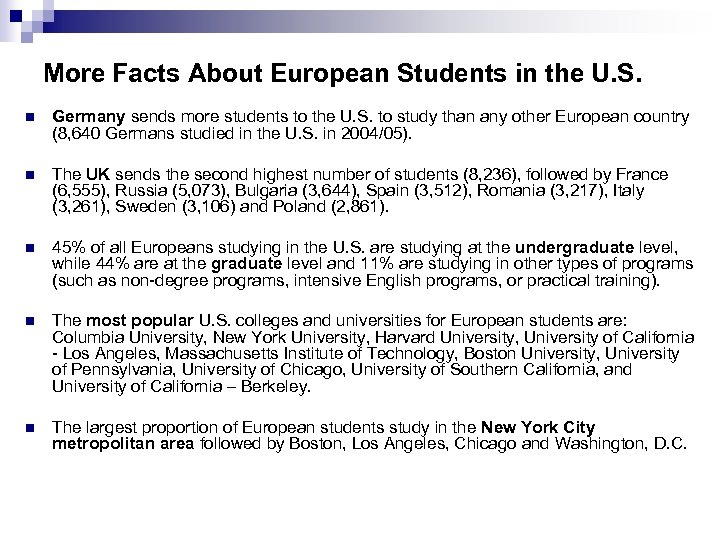
More Facts About European Students in the U. S. n Germany sends more students to the U. S. to study than any other European country (8, 640 Germans studied in the U. S. in 2004/05). n The UK sends the second highest number of students (8, 236), followed by France (6, 555), Russia (5, 073), Bulgaria (3, 644), Spain (3, 512), Romania (3, 217), Italy (3, 261), Sweden (3, 106) and Poland (2, 861). n 45% of all Europeans studying in the U. S. are studying at the undergraduate level, while 44% are at the graduate level and 11% are studying in other types of programs (such as non-degree programs, intensive English programs, or practical training). n The most popular U. S. colleges and universities for European students are: Columbia University, New York University, Harvard University, University of California - Los Angeles, Massachusetts Institute of Technology, Boston University, University of Pennsylvania, University of Chicago, University of Southern California, and University of California – Berkeley. n The largest proportion of European students study in the New York City metropolitan area followed by Boston, Los Angeles, Chicago and Washington, D. C.
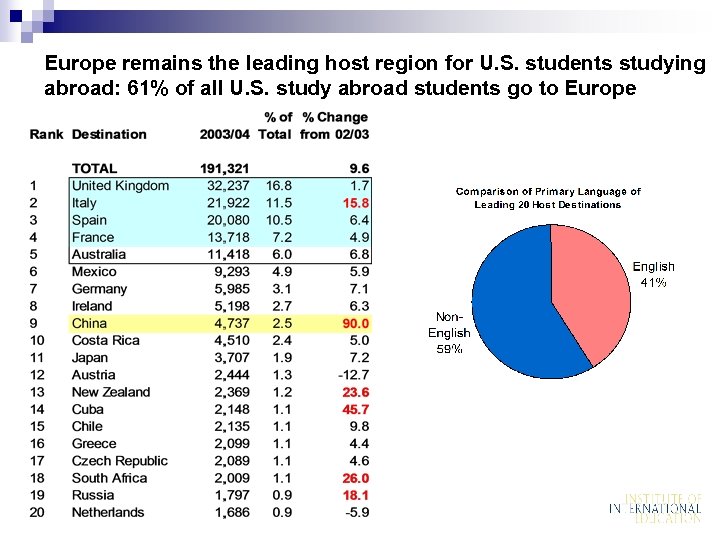
Europe remains the leading host region for U. S. students studying abroad: 61% of all U. S. study abroad students go to Europe
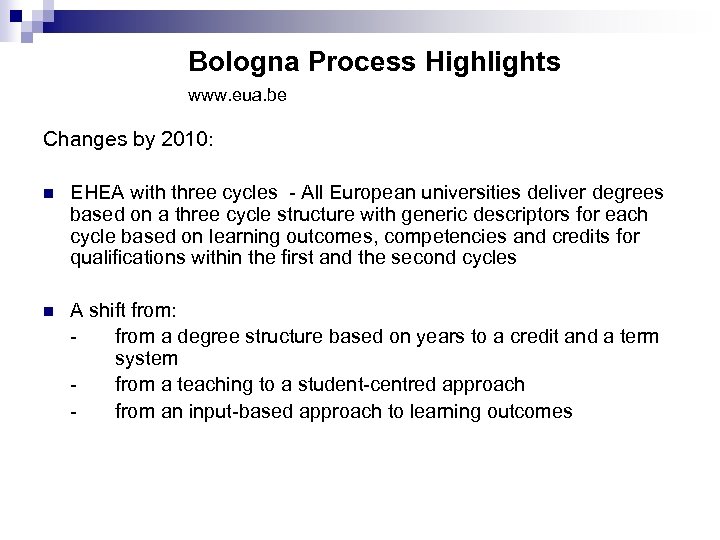
Bologna Process Highlights www. eua. be Changes by 2010: n EHEA with three cycles - All European universities deliver degrees based on a three cycle structure with generic descriptors for each cycle based on learning outcomes, competencies and credits for qualifications within the first and the second cycles n A shift from: from a degree structure based on years to a credit and a term system from a teaching to a student-centred approach from an input-based approach to learning outcomes
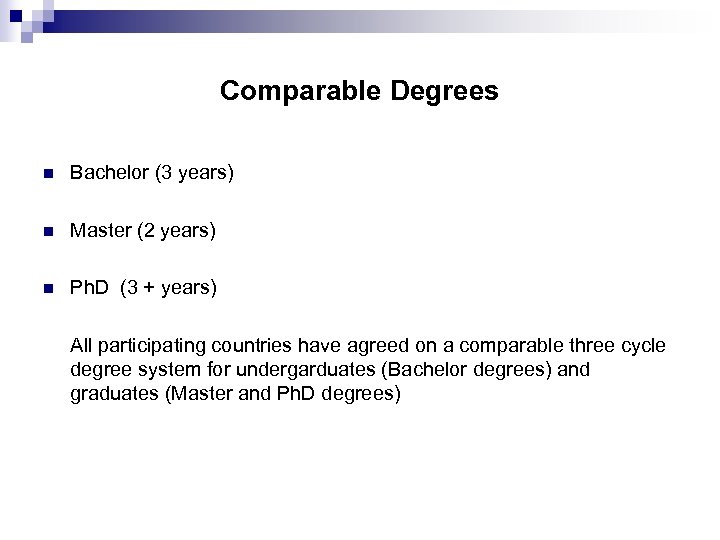
Comparable Degrees n Bachelor (3 years) n Master (2 years) n Ph. D (3 + years) All participating countries have agreed on a comparable three cycle degree system for undergarduates (Bachelor degrees) and graduates (Master and Ph. D degrees)
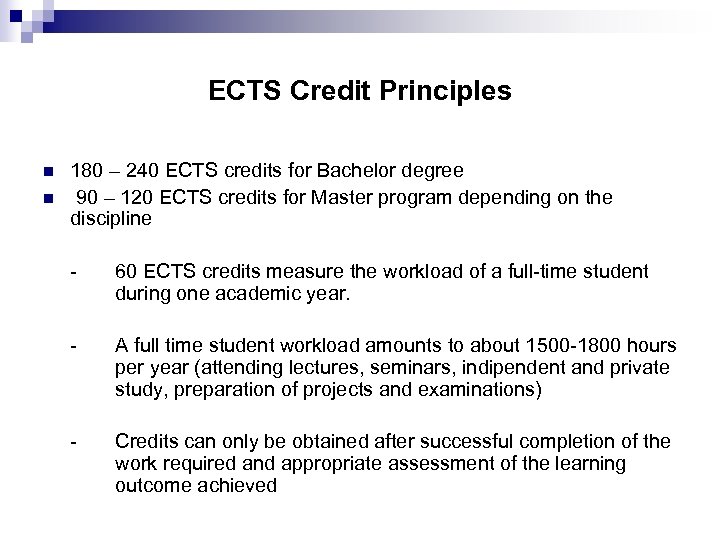
ECTS Credit Principles n n 180 – 240 ECTS credits for Bachelor degree 90 – 120 ECTS credits for Master program depending on the discipline - 60 ECTS credits measure the workload of a full-time student during one academic year. - A full time student workload amounts to about 1500 -1800 hours per year (attending lectures, seminars, indipendent and private study, preparation of projects and examinations) - Credits can only be obtained after successful completion of the work required and appropriate assessment of the learning outcome achieved
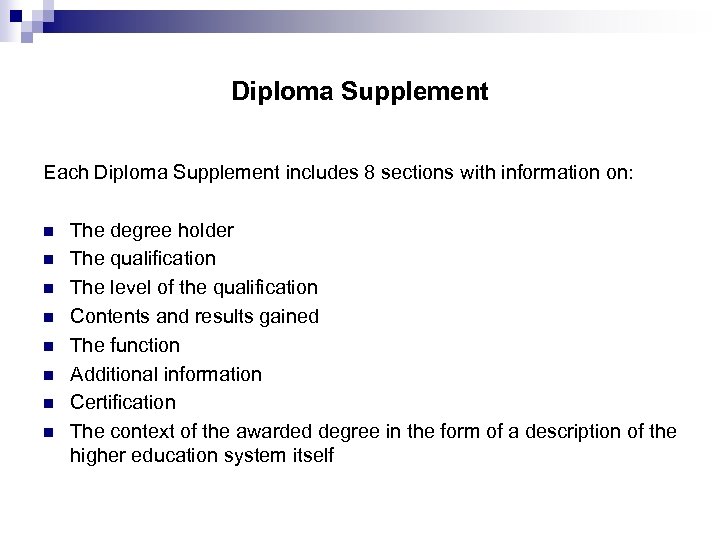
Diploma Supplement Each Diploma Supplement includes 8 sections with information on: n n n n The degree holder The qualification The level of the qualification Contents and results gained The function Additional information Certification The context of the awarded degree in the form of a description of the higher education system itself
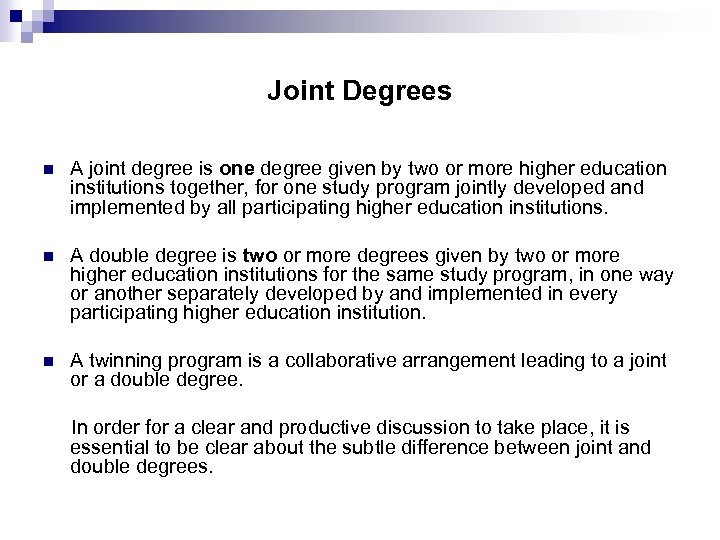
Joint Degrees n A joint degree is one degree given by two or more higher education institutions together, for one study program jointly developed and implemented by all participating higher education institutions. n A double degree is two or more degrees given by two or more higher education institutions for the same study program, in one way or another separately developed by and implemented in every participating higher education institution. n A twinning program is a collaborative arrangement leading to a joint or a double degree. In order for a clear and productive discussion to take place, it is essential to be clear about the subtle difference between joint and double degrees.
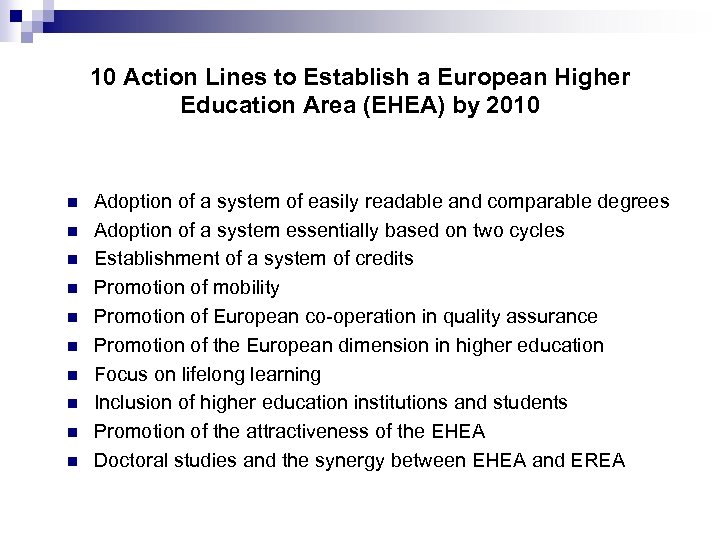
10 Action Lines to Establish a European Higher Education Area (EHEA) by 2010 n n n n n Adoption of a system of easily readable and comparable degrees Adoption of a system essentially based on two cycles Establishment of a system of credits Promotion of mobility Promotion of European co-operation in quality assurance Promotion of the European dimension in higher education Focus on lifelong learning Inclusion of higher education institutions and students Promotion of the attractiveness of the EHEA Doctoral studies and the synergy between EHEA and EREA
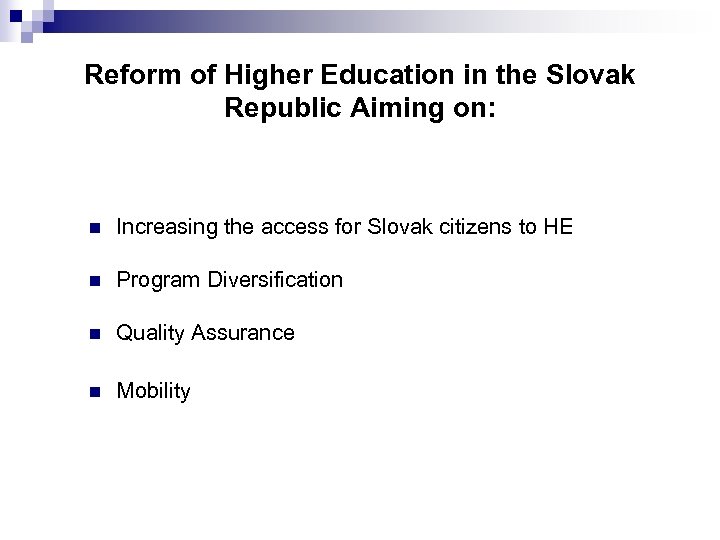
Reform of Higher Education in the Slovak Republic Aiming on: n Increasing the access for Slovak citizens to HE n Program Diversification n Quality Assurance n Mobility
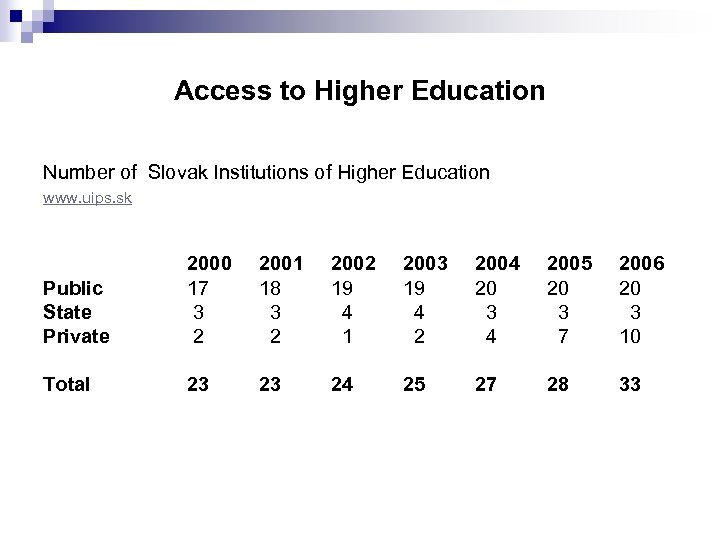
Access to Higher Education Number of Slovak Institutions of Higher Education www. uips. sk Public State Private 2000 17 3 2 2001 18 3 2 2002 19 4 1 2003 19 4 2 2004 20 3 4 2005 20 3 7 2006 20 3 10 Total 23 23 24 25 27 28 33
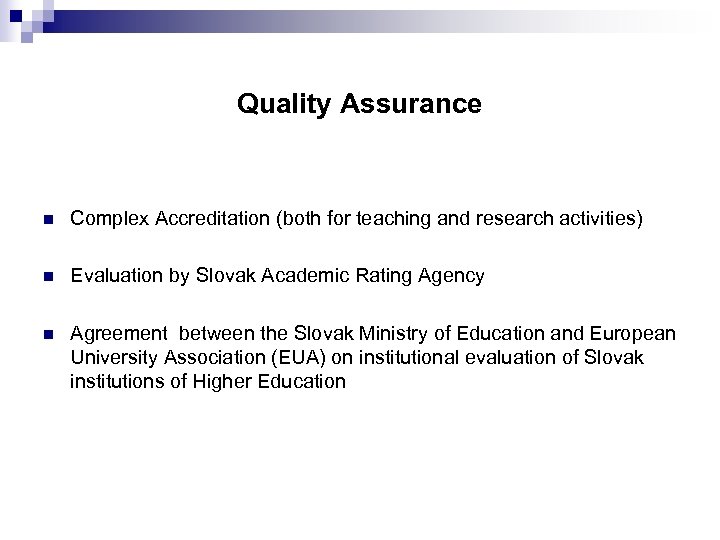
Quality Assurance n Complex Accreditation (both for teaching and research activities) n Evaluation by Slovak Academic Rating Agency n Agreement between the Slovak Ministry of Education and European University Association (EUA) on institutional evaluation of Slovak institutions of Higher Education
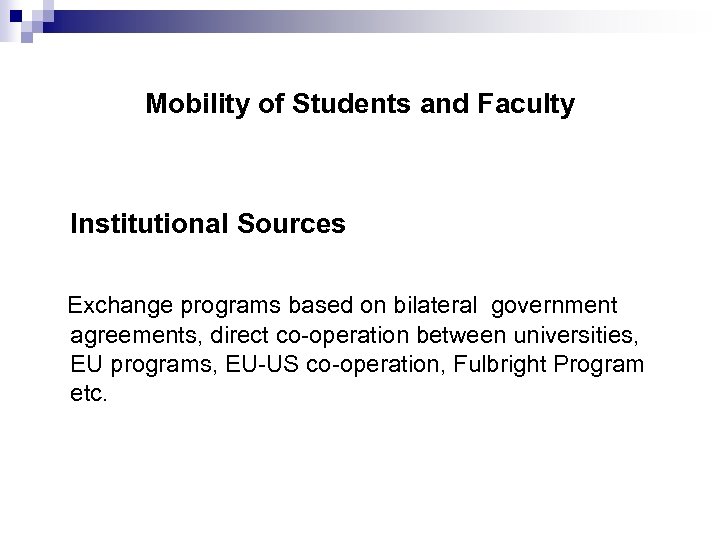
Mobility of Students and Faculty Institutional Sources Exchange programs based on bilateral government agreements, direct co-operation between universities, EU programs, EU-US co-operation, Fulbright Program etc.
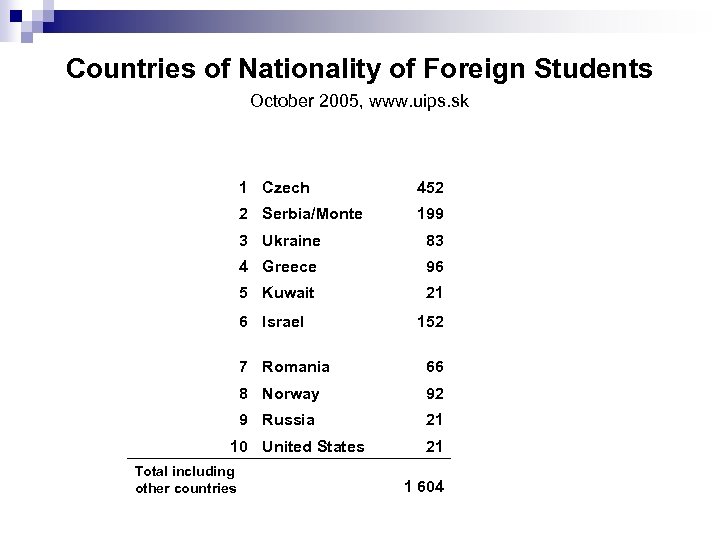
Countries of Nationality of Foreign Students October 2005, www. uips. sk 1 Czech 452 2 Serbia/Monte 199 3 Ukraine 83 4 Greece 96 5 Kuwait 21 6 Israel 152 7 Romania 66 8 Norway 92 9 Russia 21 10 United States Total including other countries 21 1 604
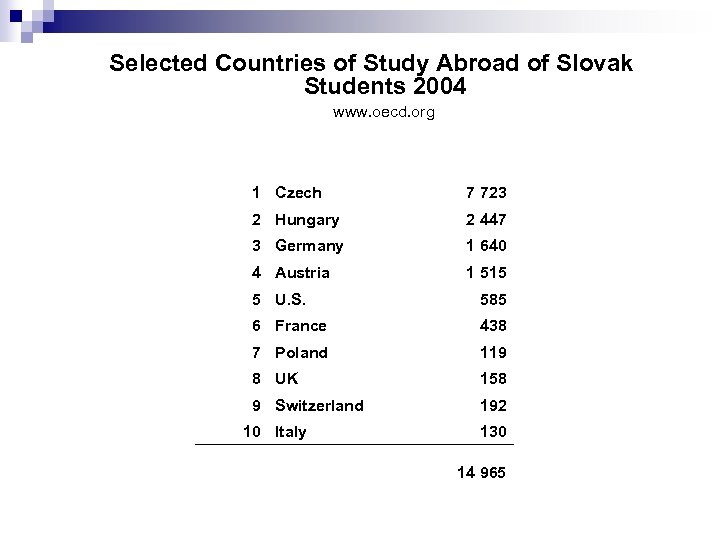
Selected Countries of Study Abroad of Slovak Students 2004 www. oecd. org 1 Czech 7 723 2 Hungary 2 447 3 Germany 1 640 4 Austria 1 515 5 U. S. 585 6 France 438 7 Poland 119 8 UK 158 9 Switzerland 192 10 Italy 130 14 965
National Stipend Program of the Slovak Government 2006 - 2010 n Scholarships for Slovak students of HE for a part of their Master’s study for 1 -2 semesters at any foreign accredited institution of HE n Scholarships for Slovak Ph. D. Students for study and research at any foregn institution of HE or research institution n Travel grans for Slovak students, Ph. D. Students and faculty supporting their study, research or lecturing abroad
M. R. Štefánik Program 2006 - 2010 Grants for doctoral or Ph. D. study in the field of economy, sociology, public administration, MBA, law n n All expenses except travel, the participants have to return to Slovak Republic and work for 2 years for the Slovak government
EU-US Co-operation Program in Higher Education and Vocational Education and Training 2006 - 2013 n Transtlantic Degree Action - joint study programs and n Excellence Mobility Projects – financial support for student n Policy Oriented Measures – comparative higher education and n Schuman-Fulbright Action – scholarships to highly qualified joint/double degrees mobility to join well functioting translatlantic consortia vocational training issues (including comparative studies and analysis, language and content integration, software and web development, e-learning, etc. professionals in specific areas
Transtlantic Degree Action n The European Commission and the US Department of Education Fund for the Improvement of Post Secondary Education (FIPSE) are promoting the Program that can contribute to innovation and recognition of curricula and teaching methods and to the acquisition of skills required to meet the challenges of the global knowledgebased economy. n Proposals for Transatlantic Degrees may focus on any postsecondary programme of study provided that they clearly demonstrate how an international degree program will prepare students better for work in an international context. The 2006 call for proposals focuses on the undergraduate level (first cycle). n The new programme plans to implement over 200 projects with some 6. 000 EU and US individuals participating in mobility activities over the eight year period from 2006 to 2013.
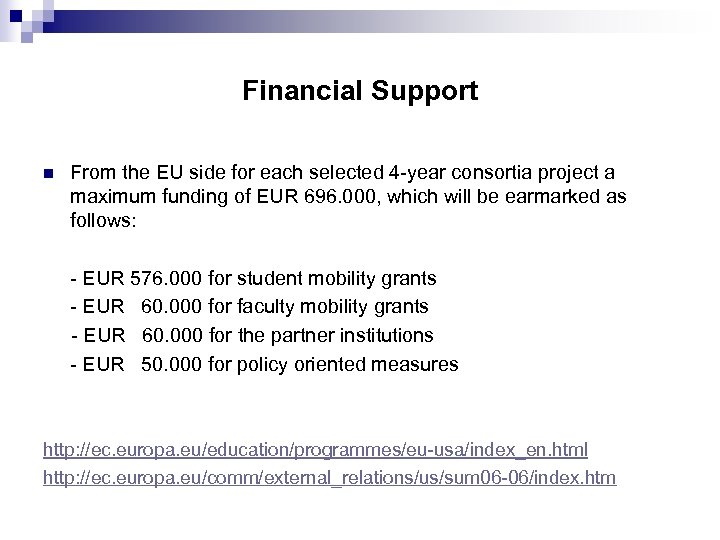
Financial Support n From the EU side for each selected 4 -year consortia project a maximum funding of EUR 696. 000, which will be earmarked as follows: - EUR 576. 000 for student mobility grants - EUR 60. 000 for faculty mobility grants - EUR 60. 000 for the partner institutions - EUR 50. 000 for policy oriented measures http: //ec. europa. eu/education/programmes/eu-usa/index_en. html http: //ec. europa. eu/comm/external_relations/us/sum 06 -06/index. htm
Thank You! Maria Paniakova Fulbright Commission Levicka 3 821 08 Bratislava 2 Slovak Republic Phone: +421 -2 -5542 5606 Fax: +421 -2 -5557 7491 Email: maria@fulbright. gov. sk http: //www. fulbright. sk
Скачать презентацию International Student Mobility between Europe and the United
8bcc0a101e76115b0dd1b672e35ab5fa.ppt