


 Скачать презентацию International Red Cross and Red Crescent Movement
state reg.pptx
- Количество слайдов: 13
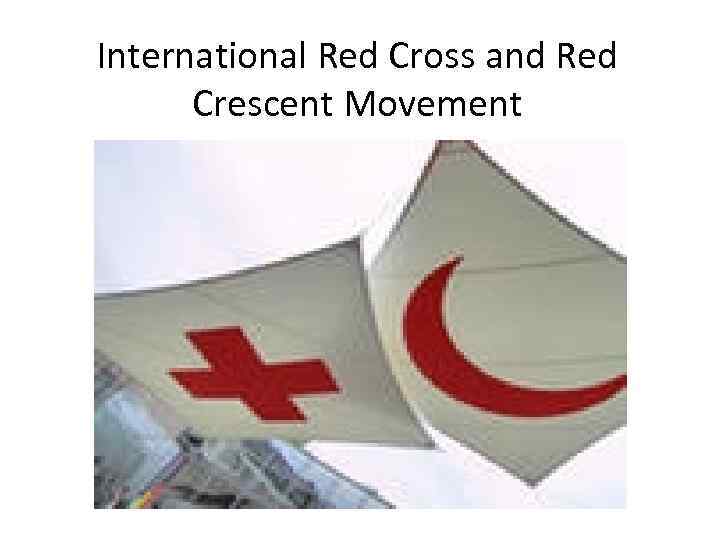 International Red Cross and Red Crescent Movement
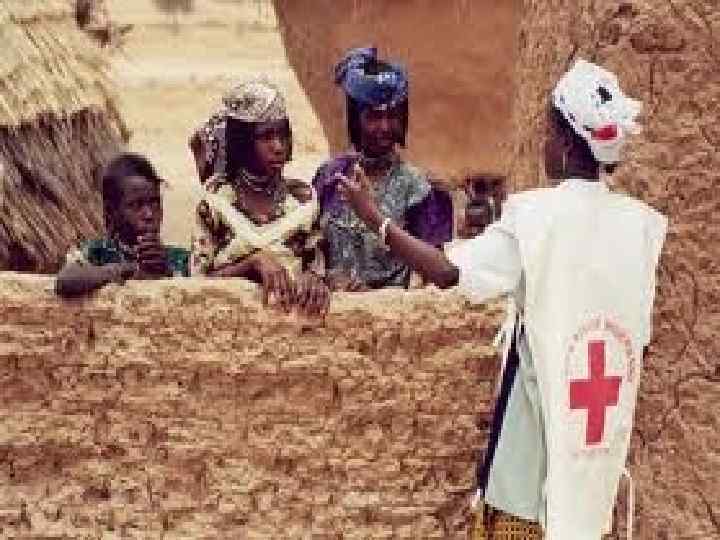
 • • • The International Red Cross and Red Crescent Movement is an international humanitarian movement with approximately 97 million volunteers, members and staff worldwide which was founded to protect human life and health, to ensure respect for all human beings, and to prevent and alleviate human suffering, without any discrimination based on nationality, race, sex, religious beliefs, class or political opinions The movement's parts are: The International Committee of the Red Cross (ICRC) is a private humanitarian institution founded in 1863 in Geneva, Switzerland, by Henry Dunant. Its 25 member committee has a unique authority under international humanitarian law to protect the life and dignity of the victims of international and internal armed conflicts. The ICRC was awarded the Nobel Peace Prize on three occasions (in 1917, 1944 and 1963). The International Federation of Red Cross and Red Crescent Societies (IFRC) was founded in 1919 and today it coordinates activities between the 187 National Red Cross and Red Crescent Societies within the Movement. National Red Cross and Red Crescent Societies exist in nearly every country in the world. Currently 186 National Societies are recognized by the ICRC and admitted as full members of the Federation. Each entity works in its home country according to the principles of international humanitarian law and the statutes of the international Movement. Depending on their specific circumstances and capacities, National Societies can take on additional humanitarian tasks that are not directly defined by international humanitarian law or the mandates of the international Movement. In many countries, they are tightly linked to the respective national health care system by providing emergency medical services.
 History of Movement • Until the middle of the 19 th century, there were no organized and/or well-established army nursing systems for casualties and no safe and protected institutions to accommodate and treat those who were wounded on the battlefield. Back in his home in Geneva, he decided to write a book entitled A Memory of Solferino which he published with his own money in 1862. He sent copies of the book to leading political and military figures throughout Europe
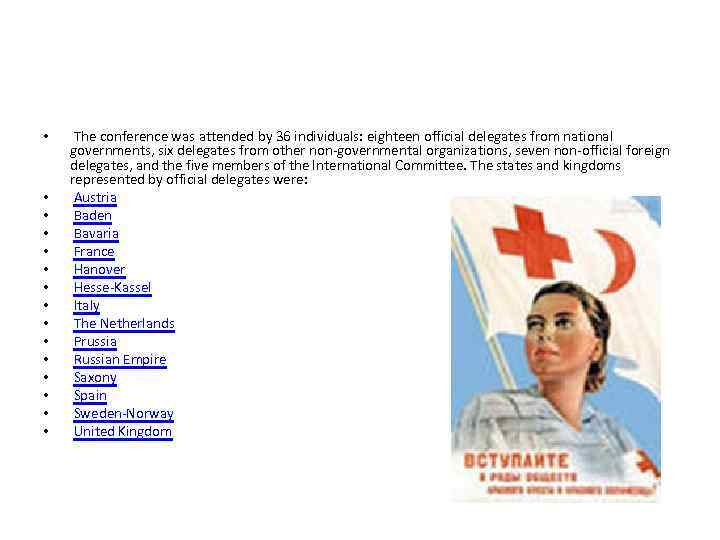 • • • • The conference was attended by 36 individuals: eighteen official delegates from national governments, six delegates from other non-governmental organizations, seven non-official foreign delegates, and the five members of the International Committee. The states and kingdoms represented by official delegates were: Austria Baden Bavaria France Hanover Hesse-Kassel Italy The Netherlands Prussia Russian Empire Saxony Spain Sweden-Norway United Kingdom
 he ICRC during World War I • French postcard celebrating the role of Red Cross nurses during the First World War, 1915 • Ernest Hemingway in uniform as a Red Cross ambulance driver • With the outbreak of World War I, the ICRC found itself confronted with enormous challenges that it could handle only by working closely with the national Red Cross societies. Red Cross nurses from around the world, including the United States and Japan, came to support the medical services of the armed forces of the European countries involved in the war. On October 15, 1914, immediately after the start of the war, the ICRC set up its International Prisoners -of-War (POW) Agency, which had about 1, 200 mostly volunteer staff members by the end of 1914. By the end of the war, the Agency had transferred about 20 million letters and messages, 1. 9 million parcels, and about 18 million Swiss francs in monetary donations to POWs of all affected countries
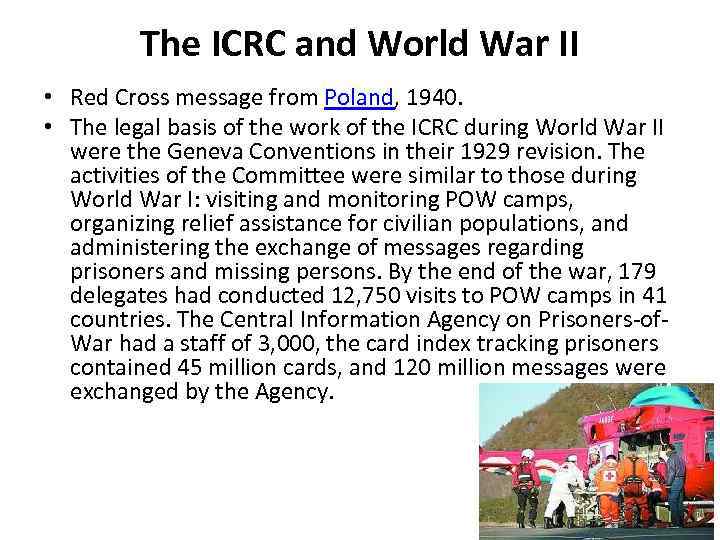 The ICRC and World War II • Red Cross message from Poland, 1940. • The legal basis of the work of the ICRC during World War II were the Geneva Conventions in their 1929 revision. The activities of the Committee were similar to those during World War I: visiting and monitoring POW camps, organizing relief assistance for civilian populations, and administering the exchange of messages regarding prisoners and missing persons. By the end of the war, 179 delegates had conducted 12, 750 visits to POW camps in 41 countries. The Central Information Agency on Prisoners-of. War had a staff of 3, 000, the card index tracking prisoners contained 45 million cards, and 120 million messages were exchanged by the Agency.
 Afghanistan • ICRC is active in the Afghanistan conflict areas and has set up six physical rehabilitation centers to help landmine victims. Their support extends to the national and international armed forces, civilians and the armed opposition. They regularly visit detainees under the custody of the Afghan government and the international armed forces, but have also occasionally had access since 2009 to people detained by the Taliban. They have provided basic first aid training and aid kits to both the Afghan security forces and Taliban members because, according to an ICRC spokesperson, "ICRC's constitution stipulates that all parties harmed by warfare will be treated as fairly as possible".
 Legal status and organization • The IFRC has its headquarters in Geneva. It also runs five zone offices (Africa, Americas, Asia Pacific, Europe, Middle East-North Africa), 14 permanent regional offices and has about 350 delegates in more than 60 delegations around the world. The legal basis for the work of the IFRC is its constitution. • The highest decision making body of the IFRC is its General Assembly, which convenes every two years with delegates from all of the national societies. Among other tasks, the General Assembly elects the Secretary General. Between the convening of General Assemblies, the Governing Board is the leading body of the IFRC. • The symbol of the IFRC is the combination of the Red Cross (left) and Red Crescent (right) on a white background surrounded by a red rectangular frame.
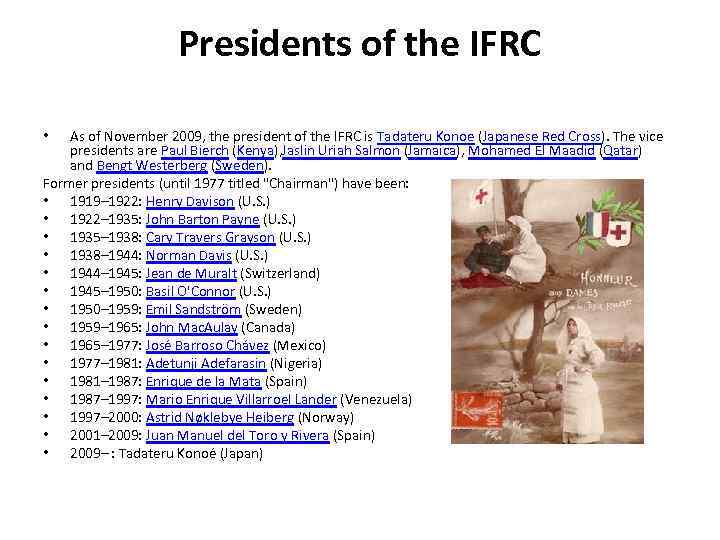 Presidents of the IFRC As of November 2009, the president of the IFRC is Tadateru Konoe (Japanese Red Cross). The vice presidents are Paul Bierch (Kenya), Jaslin Uriah Salmon (Jamaica), Mohamed El Maadid (Qatar) and Bengt Westerberg (Sweden). Former presidents (until 1977 titled "Chairman") have been: • 1919– 1922: Henry Davison (U. S. ) • 1922– 1935: John Barton Payne (U. S. ) • 1935– 1938: Cary Travers Grayson (U. S. ) • 1938– 1944: Norman Davis (U. S. ) • 1944– 1945: Jean de Muralt (Switzerland) • 1945– 1950: Basil O'Connor (U. S. ) • 1950– 1959: Emil Sandström (Sweden) • 1959– 1965: John Mac. Aulay (Canada) • 1965– 1977: José Barroso Chávez (Mexico) • 1977– 1981: Adetunji Adefarasin (Nigeria) • 1981– 1987: Enrique de la Mata (Spain) • 1987– 1997: Mario Enrique Villarroel Lander (Venezuela) • 1997– 2000: Astrid Nøklebye Heiberg (Norway) • 2001– 2009: Juan Manuel del Toro y Rivera (Spain) • 2009– : Tadateru Konoé (Japan) •
 Organization of the Movement • Entry to the International Red Cross and Red Crescent Museum in Geneva. • Altogether, there about 97 million people worldwide who serve with the ICRC, the International Federation, and the National Societies. • The 1965 International Conference in Vienna adopted seven basic principles which should be shared by all parts of the Movement, and they were added to the official statutes of the Movement in 1986. • Humanity • Impartiality • Neutrality • Independence • Voluntary Service • Unity • Universality
 Thank you for your attention!!!