


 Скачать презентацию International Radio for Disaster Relief IRDR There is
9d72a250ac81ed34d44e58de65514940.ppt
- Количество слайдов: 11
 International Radio for Disaster Relief (IRDR) "There is no singular media or network that represents the most appropriate means of relaying information in disaster-stricken areas; such media should be diverse in nature. " (M. Sugaya MIC-ITU symposium on disaster communications, Sendai, March 2012)
 Life-saving role of shortwave radio Recognised since the discovery in 1920 s Radioamateurs demonstrated its use for disaster risk reduction many times The Trial of International Radio for Disaster Relief project during the Jakarta Summit is the very first test of shortwave radio for disaster relief
 Frequency co-ordination Success of any wireless emergency system relies on pre-selected, clear frequency channels This is realistic now after Global frequency coordination replaced in the early 1990 s shortwave chaos associated with the Cold War Two channels have been selected for Jakarta Trial
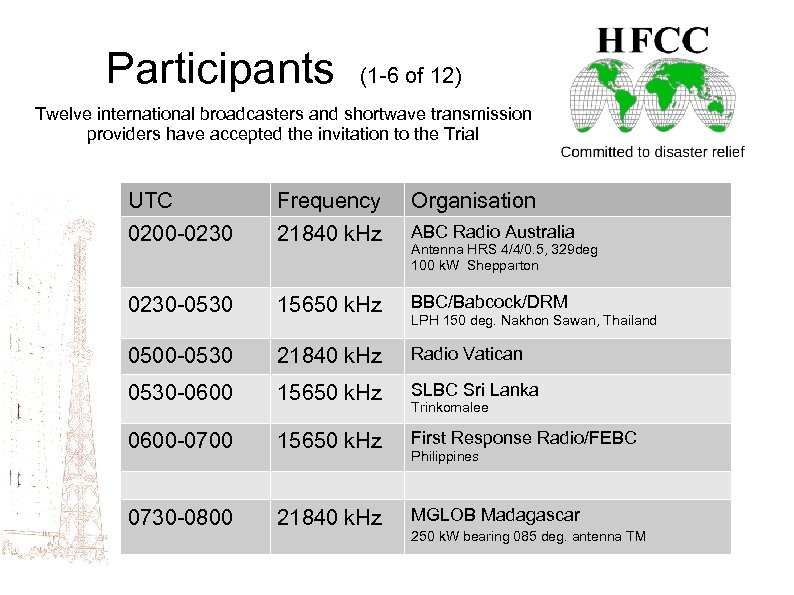 Participants (1 -6 of 12) Twelve international broadcasters and shortwave transmission providers have accepted the invitation to the Trial UTC Frequency Organisation 0200 -0230 21840 k. Hz ABC Radio Australia 0230 -0530 15650 k. Hz BBC/Babcock/DRM 0500 -0530 21840 k. Hz Radio Vatican 0530 -0600 15650 k. Hz SLBC Sri Lanka 0600 -0700 15650 k. Hz First Response Radio/FEBC 0730 -0800 21840 k. Hz MGLOB Madagascar Antenna HRS 4/4/0. 5, 329 deg 100 k. W Shepparton LPH 150 deg. Nakhon Sawan, Thailand Trinkomalee Philippines 250 k. W bearing 085 deg. antenna TM
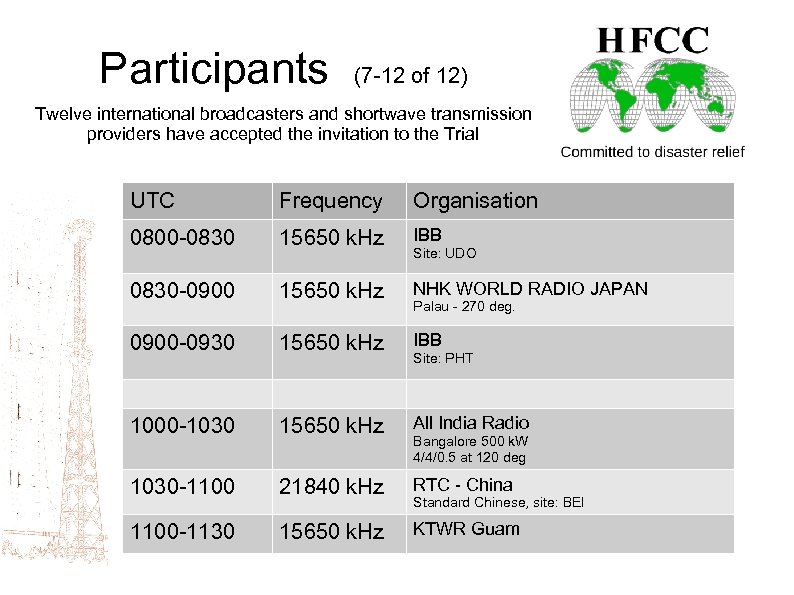 Participants (7 -12 of 12) Twelve international broadcasters and shortwave transmission providers have accepted the invitation to the Trial UTC Frequency Organisation 0800 -0830 15650 k. Hz IBB 0830 -0900 15650 k. Hz NHK WORLD RADIO JAPAN 0900 -0930 15650 k. Hz IBB 1000 -1030 15650 k. Hz All India Radio 1030 -1100 21840 k. Hz RTC - China 1100 -1130 15650 k. Hz KTWR Guam Site: UDO Palau - 270 deg. Site: PHT Bangalore 500 k. W 4/4/0. 5 at 120 deg Standard Chinese, site: BEI
 Participants Taking part in the Jakarta Trial does not commit any participant to any future action This is only an effort to show that shortwave radio has unique properties in disaster situations
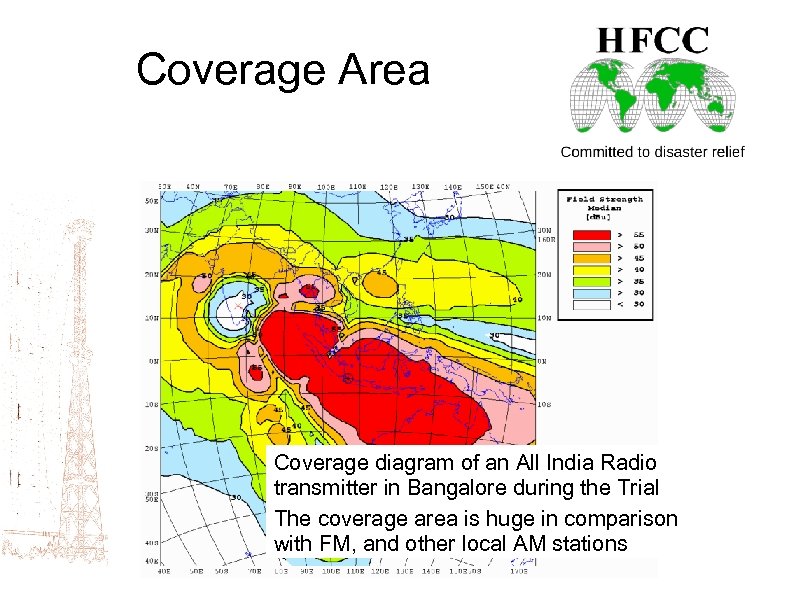 Coverage Area Coverage diagram of an All India Radio transmitter in Bangalore during the Trial The coverage area is huge in comparison with FM, and other local AM stations
 Monitoring The Quality of reception of all Jakarta Trial programmes is continuously monitored at an IBB Monitoring station Jakarta and also at Singapore Monitoring checks are at 10 minute intervals and brief sound example is taken Results will be made available to all participants Shortwave listeners and DX- hobbyists have been invited to send in reception reports to stations and/or to the HFCC The HFCC is going to issue a special QSL - card
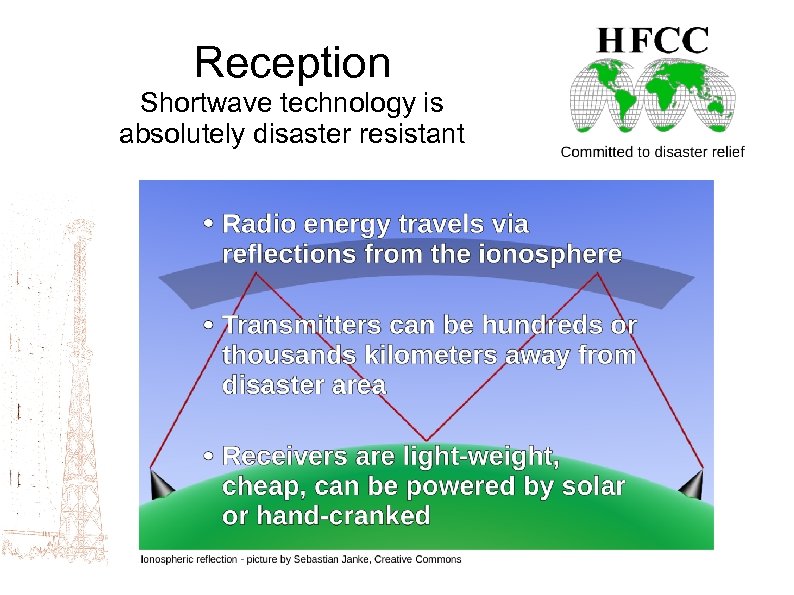 Reception Shortwave technology is absolutely disaster resistant Ionospheric reflection - picture by Sebastian Janke, Creative Commons
 Future Digital DRM - also on the agenda of this Summit has an alarm warning functionality. This will increase the value of shortwave in disasters The present management/coordination of global shortwave broadcasting has a completely voluntary framework The HFCC is ready to provide tools and services also for the world-wide implementation of emergency broadcasting There is a certain urgency about it since the ongoing cuts of important shortwave installations around the globe could prevent it happening
 Thanks The HFCC - International Broadcasting Delivery wants to thank Amal Punchihewa - ABU Director of Technology, Jacqueline Dalton - The BBC Media Action, Arto Mujunen - IBB Monitoring and Mike Adams - First Response Radio for their help in making the Trial happen. Thank you for your attention! Oldrich Cip, Chairman, HFCC