 Скачать презентацию International Pricing Chapter VIII 2 10 2018 Presentation by Prof
2010 - IMM VIII.pptx
- Количество слайдов: 16



International Pricing Chapter VIII 2/10/2018 Presentation by Prof. H. Ganguly. 1
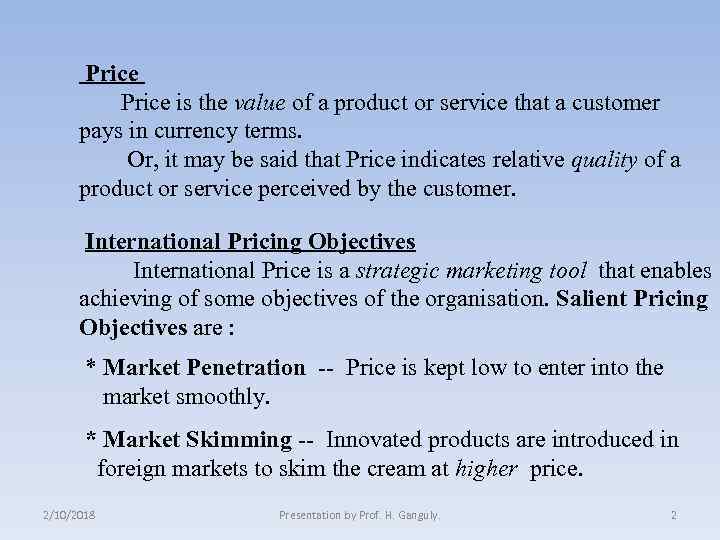
Price is the value of a product or service that a customer pays in currency terms. Or, it may be said that Price indicates relative quality of a product or service perceived by the customer. International Pricing Objectives International Price is a strategic marketing tool that enables achieving of some objectives of the organisation. Salient Pricing Objectives are : * Market Penetration -- Price is kept low to enter into the market smoothly. * Market Skimming -- Innovated products are introduced in foreign markets to skim the cream at higher price. 2/10/2018 Presentation by Prof. H. Ganguly. 2
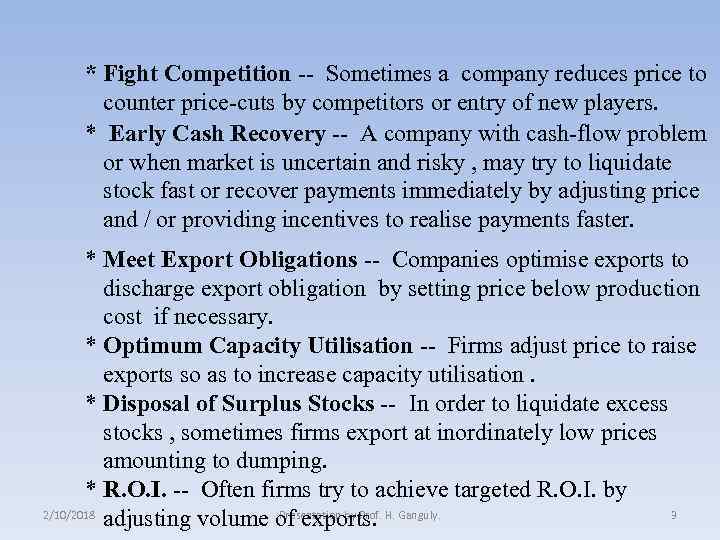
* Fight Competition -- Sometimes a company reduces price to counter price-cuts by competitors or entry of new players. * Early Cash Recovery -- A company with cash-flow problem or when market is uncertain and risky , may try to liquidate stock fast or recover payments immediately by adjusting price and / or providing incentives to realise payments faster. * Meet Export Obligations -- Companies optimise exports to discharge export obligation by setting price below production cost if necessary. * Optimum Capacity Utilisation -- Firms adjust price to raise exports so as to increase capacity utilisation. * Disposal of Surplus Stocks -- In order to liquidate excess stocks , sometimes firms export at inordinately low prices amounting to dumping. * R. O. I. -- Often firms try to achieve targeted R. O. I. by 2/10/2018 Presentation by Prof. 3 adjusting volume of exports. H. Ganguly.
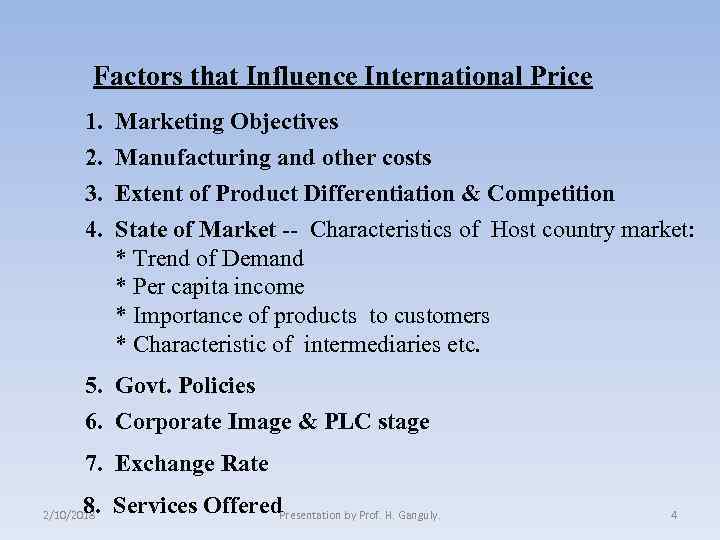
Factors that Influence International Price 1. Marketing Objectives 2. Manufacturing and other costs 3. Extent of Product Differentiation & Competition 4. State of Market -- Characteristics of Host country market: * Trend of Demand * Per capita income * Importance of products to customers * Characteristic of intermediaries etc. 5. Govt. Policies 6. Corporate Image & PLC stage 7. Exchange Rate 8. Services Offered. Presentation by Prof. H. Ganguly. 2/10/2018 4
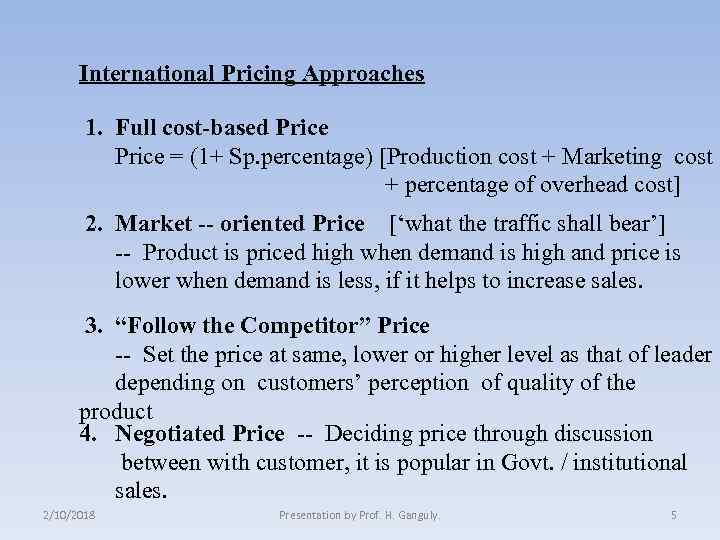
International Pricing Approaches 1. Full cost-based Price = (1+ Sp. percentage) [Production cost + Marketing cost + percentage of overhead cost] 2. Market -- oriented Price [‘what the traffic shall bear’] -- Product is priced high when demand is high and price is lower when demand is less, if it helps to increase sales. 3. “Follow the Competitor” Price -- Set the price at same, lower or higher level as that of leader depending on customers’ perception of quality of the product 4. Negotiated Price -- Deciding price through discussion between with customer, it is popular in Govt. / institutional sales. 2/10/2018 Presentation by Prof. H. Ganguly. 5
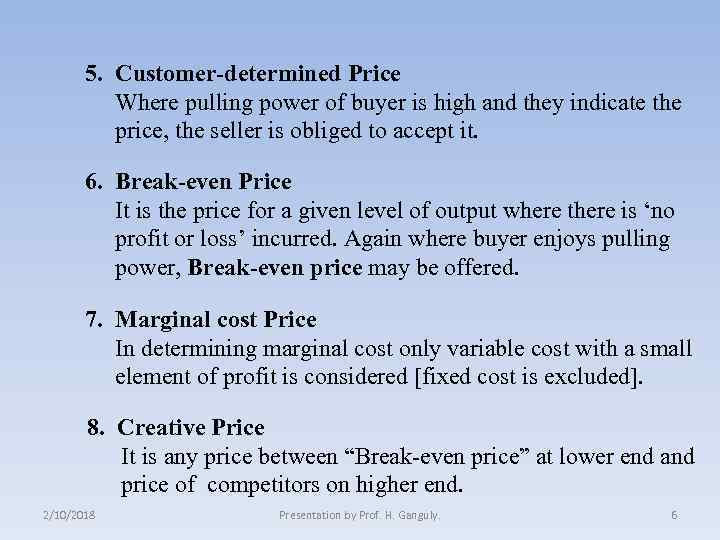
5. Customer-determined Price Where pulling power of buyer is high and they indicate the price, the seller is obliged to accept it. 6. Break-even Price It is the price for a given level of output where there is ‘no profit or loss’ incurred. Again where buyer enjoys pulling power, Break-even price may be offered. 7. Marginal cost Price In determining marginal cost only variable cost with a small element of profit is considered [fixed cost is excluded]. 8. Creative Price It is any price between “Break-even price” at lower end and price of competitors on higher end. 2/10/2018 Presentation by Prof. H. Ganguly. 6
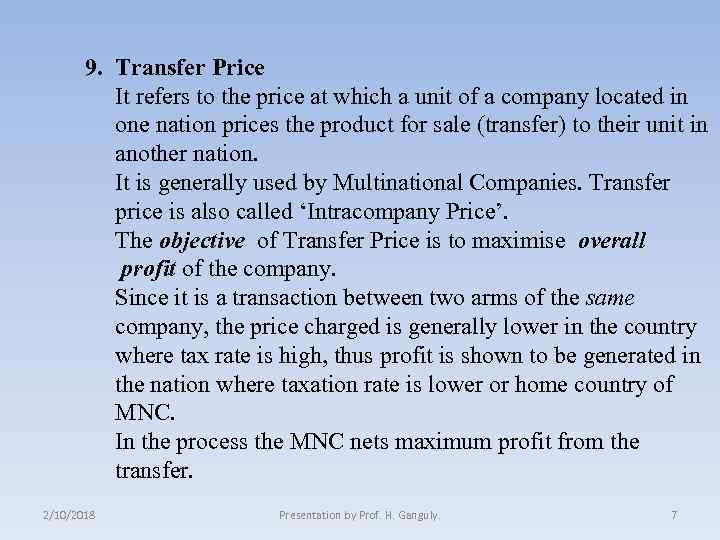
9. Transfer Price It refers to the price at which a unit of a company located in one nation prices the product for sale (transfer) to their unit in another nation. It is generally used by Multinational Companies. Transfer price is also called ‘Intracompany Price’. The objective of Transfer Price is to maximise overall profit of the company. Since it is a transaction between two arms of the same company, the price charged is generally lower in the country where tax rate is high, thus profit is shown to be generated in the nation where taxation rate is lower or home country of MNC. In the process the MNC nets maximum profit from the transfer. 2/10/2018 Presentation by Prof. H. Ganguly. 7
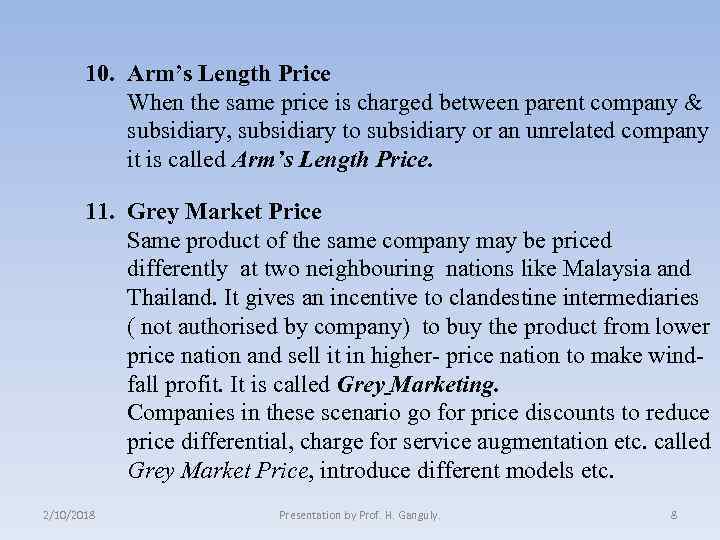
10. Arm’s Length Price When the same price is charged between parent company & subsidiary, subsidiary to subsidiary or an unrelated company it is called Arm’s Length Price. 11. Grey Market Price Same product of the same company may be priced differently at two neighbouring nations like Malaysia and Thailand. It gives an incentive to clandestine intermediaries ( not authorised by company) to buy the product from lower price nation and sell it in higher- price nation to make windfall profit. It is called Grey Marketing. Companies in these scenario go for price discounts to reduce price differential, charge for service augmentation etc. called Grey Market Price, introduce different models etc. 2/10/2018 Presentation by Prof. H. Ganguly. 8
12. Dumping Price When a company sells a product in a host country at a price lower than its home country price or below its cost of manufacture , it is called Dumping and this price is called Dumping Price. WTO member nations generally condemn dumping and are within their rights to levy Antidumping duty under prescribed conditions. 2/10/2018 Presentation by Prof. H. Ganguly. 9
International Commercial Terms (INCOTERMS) ----- Trade practices of nations may differ on various aspects of transaction. It may give rise to doubts regarding Which costs are to be borne by exporters, which by importers Which documents are to be procured by exporters and who will pay the expenses When the title to goods and responsibility shall pass on from exporters to importers and Where and when the goods are to be delivered ? International Chamber of Commerce, Paris addressed themselves to these problems and arrived at a set of abbreviated commercial terms explaining the above for international trade called INCOTERMS. 2/10/2018 Presentation by Prof. H. Ganguly. 10
Commonly Used INCOTERMS 1. EXW -- Ex Works (named place e. g. factory, show room etc) -- The exporters’ obligation under this term is to deliver goods at the place named above ( goods are to be cleared for export by importer ). In addition, it is importers’ obligation to bear all costs and risk from this point to their premises. 2. FCA -- Free Carrier (named place) -- In this term, exporters’ obligation is complete when goods are delivered duly cleared for export to nominated carrier at the place indicated. From here, it is buyers’ responsibility. 3. FAS -- Free Alongside Ship (named port of shipment) -- Exporters’ obligation is to get the goods cleared for export and placing it alongside the vessel at the port named. This term is used only Presentation by Prof. H. sea or inland waterway transport. in cases of Ganguly. 2/10/2018 11
4. FOB – Free on Board (named port of shipment) -- Exporters’ responsibility under this term is to deliver goods at board of ship beyond its rail after getting goods cleared for export. Importer has to bear all costs and responsibility from this point. 5. CFR -- Cost & Freight (named port of destination) -- The exporters’ responsibility in this term too is to get goods cleared for export, deliver it beyond rail of ship at the port of shipment and pay freight charges up to the destination port. Rest is importers’ risk and responsibility. 6. CIF-- Cost, Insurance & Freight (named port of destination) -- Exporter has to get goods cleared for export, deliver it at port of shipment beyond rail of ship and pay the freight and insurance premium up to destination port, but responsibility of 2/10/2018 Presentation by Prof. H. 12 goods are transferred to buyer Ganguly. delivery. after
7. DAF -- Delivered at Frontier (named place) -- This term is generally used for export by land route. Here responsibility of exporter is to deliver the goods by placing it at the disposal of importer on the inland transport not unloaded, but cleared for exports but not for imports at the named place at frontier. 8. DDP -- Delivered Duty Paid (named place at destination) -- Under this term exporter has to deliver the goods to importer cleared for import but not unloaded from arriving means of transport at the named place of destination. -- The exporter has to bear all expenses, charges and duties if any up to the destination. It involves minimum obligation on part of importer and maximum for exporters. 2/10/2018 Presentation by Prof. H. Ganguly. 13
Counter Trade It is a practice where price setting and trade financing are tied together. When importer is not in position to make payment in hard currencies, some other form of trade is undertaken called counter trade. Factors that lead to counter trade are : * Importing country’s inability to pay in hard currencies * Importing countries regulation to conserve hard currencies * Importing country’s concern about Balance of Trade * Exploring opportunities in new markets etc. Major Types of Counter Trade are 1. Barter -- It is the simplest form of counter trade practiced since ancient times where direct and simultaneous exchange of products of equal value is carried out. In this process 2/10/2018 Presentation by medium 14 money is not required as. Prof. H. Ganguly. of exchange.
2. Clearing Arrangement -- In this mode exchange of goods and services with another nation extends over long time. For example, erstwhile USSR exported heavy machineries to India during 1970’s and 80’s against payment in rupees. From late 1980’s India started exporting consumer goods to USSR against payment in those rupees. USSR had similar “Clearing Arrangement” with Morocco. 3. Switch Trading -- It makes use of a third party in the transaction. Suppose an importer in nation A imports goods or service from an exporter in nation B, but does not have hard currency or item of B’s choice to pay. In that case, A exports goods or service to a third party in nation Z, who in turn pays in cash or goods of choice to the party in nation B. 2/10/2018 Presentation by Prof. H. Ganguly. 15
4. Counter Purchase -- It is known as ‘Parallel Barter’, it involves two sets of barter. In it an exporter in nation A exports certain goods to an importer in nation B which is not required by B. So B sells those to another party to realise cash. For example, Pepsi. Co sold Pepsi concentrate to USSR and received in barter Vodka which was of no use to Pepsi. Co, so they sold Vodka to a third party to realise cash. 5. Offset Purchase -- When importers have foreign exchange constraint, they may import goods and services under an agreement to pay in foreign currency for a part and balance in goods sourced from the nation of exporters’ choice. 6. Buy-Back Arrangement -- Suppliers of capital goods and technologies may agree to accept full or part payment in produce of the technology and balance in hard currency. 2/10/2018 Presentation by Prof. H. Ganguly. 16 -----
Скачать презентацию International Pricing Chapter VIII 2 10 2018 Presentation by Prof
2010 - IMM VIII.pptx