


 Скачать презентацию International Positioning Strategy for Hanoi s Manufacturing Sector Hanoi
473d016113468cd6e84475d6c45af5c0.ppt
- Количество слайдов: 32
 International Positioning Strategy for Hanoi’s Manufacturing Sector Hanoi Dec. 2006 Kenichi Ohno Co-leader, VDF
 Topics (1) Introducing VDF (2) Policy orientation for Vietnam and Hanoi (3) Policy formulation method (4) Glass ceiling, China challenge and integral manufacturing (5) Strategic thinking and targeting
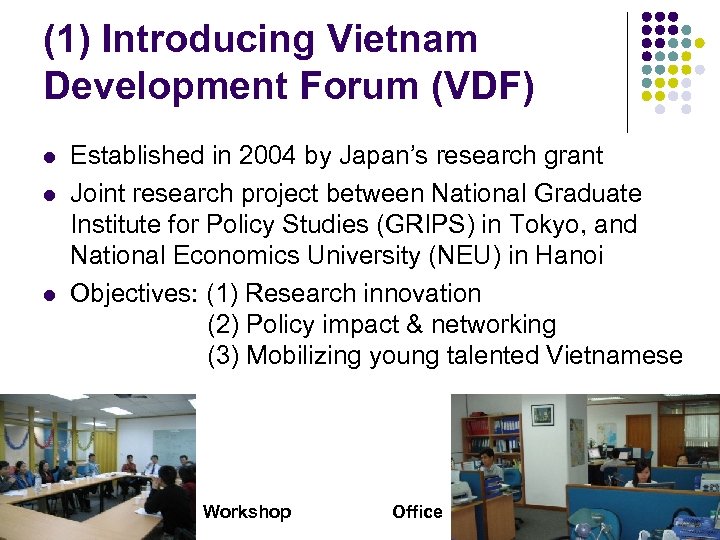 (1) Introducing Vietnam Development Forum (VDF) l l l Established in 2004 by Japan’s research grant Joint research project between National Graduate Institute for Policy Studies (GRIPS) in Tokyo, and National Economics University (NEU) in Hanoi Objectives: (1) Research innovation (2) Policy impact & networking (3) Mobilizing young talented Vietnamese Workshop Office
 Industrial Policy Support by VDF l l l Research and surveys on electronics, motorbike, automobile, steel, power, supporting industries, infrastructure, business architecture, database, etc. Joint missions with Ministry of Industry (MOI) to Thailand, Malaysia, Japan comparing policy drafting method, master plans, business involvement Supporting Industry Master Plan—working with MOI to conduct surveys and related research Motorbike Master Plan—VDF is a coordinator among MOI, businesses and experts; new drafting method Hanoi’s development (this conference)
 VDF Publications on Industry, 2005 -2007 l Improving Industrial Policy Formulation (Eng & Vn, March 2005). l l Industrial Policy Formulation in Thailand, Malaysia and Japan (Eng & Vn, Sep. 2006). “Supporting Industries in Vietnam from the Perspective of Japanese Manufacturing Firms” (Eng, Vn & Jpn, June 2006). Industrialization of Developing Countries: Analyses of Japanese Economists (Eng & Jpn, Nov. 2006). Business Environment and Policies of Hanoi (Eng & VN, Dec. 2006)
 VDF Publications (cont. ) l Economic Development of Japan (Ohno/GRIPS, Japanese 2005, Eng & Chinese 2006) l Building Supporting Industries in Vietnam (Eng & Vn, forthcoming in early 2007).
 (2) Policy Orientation for Vietnam l Open up trade and FDI boldly Step-by-step liberalization is not effective; create freest business environment in East Asia, and use it to market Vietnam l Promote FDI-local linkage vigorously Analyze why other ASEAN countries are slow to link up with FDI and foreign buyers l Learn integral manufacturing This strategy is needed to avoid direct clash with China and to overcome the “glass ceiling” l Strategic Thinking and Targeting General marketing and promotion do not work
 Hanoi’s Issues l Become a better business host Improve policy method, business involvement, businessfriendly attitude < VCCI’s Provincial Competitive Index > -Hanoi no. 14 among 42 (2005) -Hanoi no. 40 among 64 (2006) l Strategic issues in industrial planning --Possibility of China-Northern Vietnam production linkage? --Agglomeration of printer/copier and motorbike production? --Targeted marketing: invite specific high-skill FDI firms
 Hanoi’s Issues (cont. ) l Geography of industry activity Industrial zone expansion from Hanoi to neighboring provinces; Greater Hanoi being formed l Transportation and logistics --Faster and reliable access to Haiphong and Cailan --Reducing urban congestion --More speed and capacity for Noibai Airport --Inviting foreign logistic/forwarding companies to come l Adopting international standards --Hanoi should lead the nation in environment, traffic management, intellectual property rights, etc
 (3) Policy Formulation Method
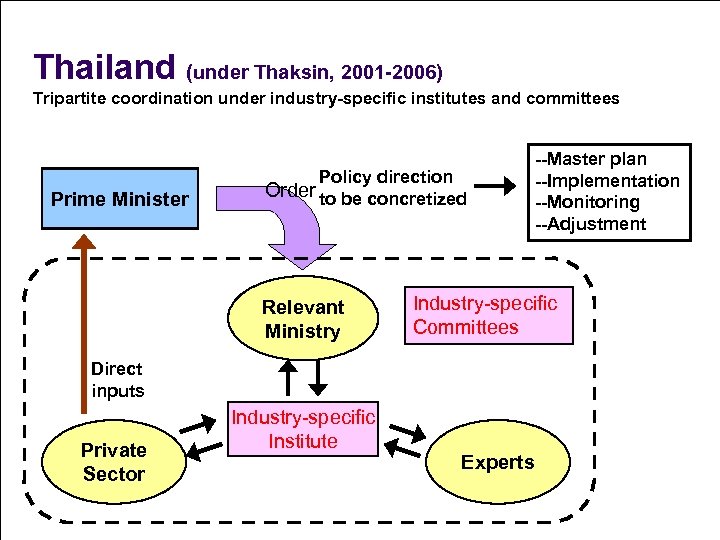 Thailand (under Thaksin, 2001 -2006) Tripartite coordination under industry-specific institutes and committees Prime Minister Policy direction Order to be concretized Relevant Ministry Industry-specific Committees Direct inputs Private Sector Industry-specific Institute --Master plan --Implementation --Monitoring --Adjustment Experts
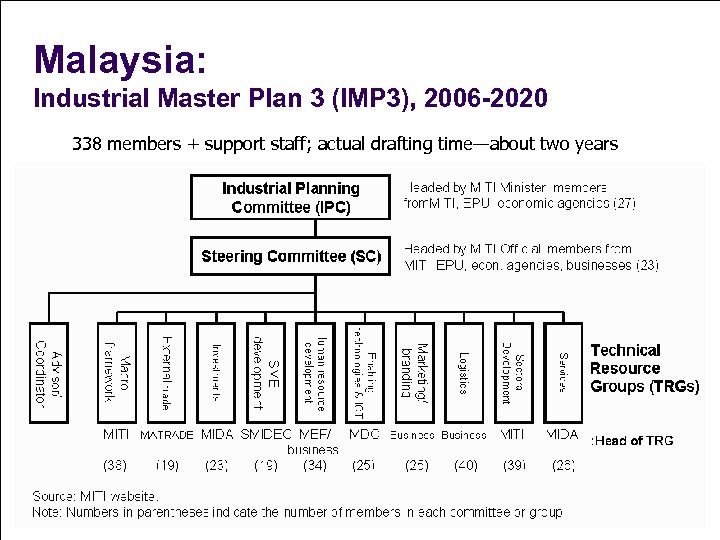 Malaysia: Industrial Master Plan 3 (IMP 3), 2006 -2020 338 members + support staff; actual drafting time—about two years
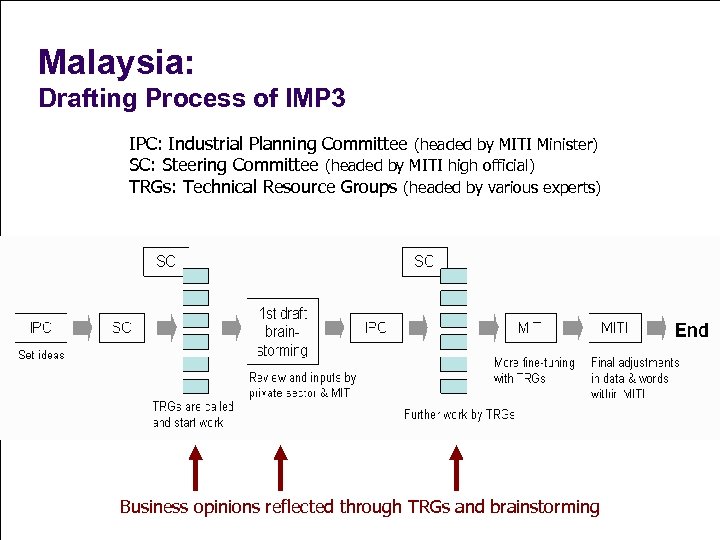 Malaysia: Drafting Process of IMP 3 IPC: Industrial Planning Committee (headed by MITI Minister) SC: Steering Committee (headed by MITI high official) TRGs: Technical Resource Groups (headed by various experts) Business opinions reflected through TRGs and brainstorming
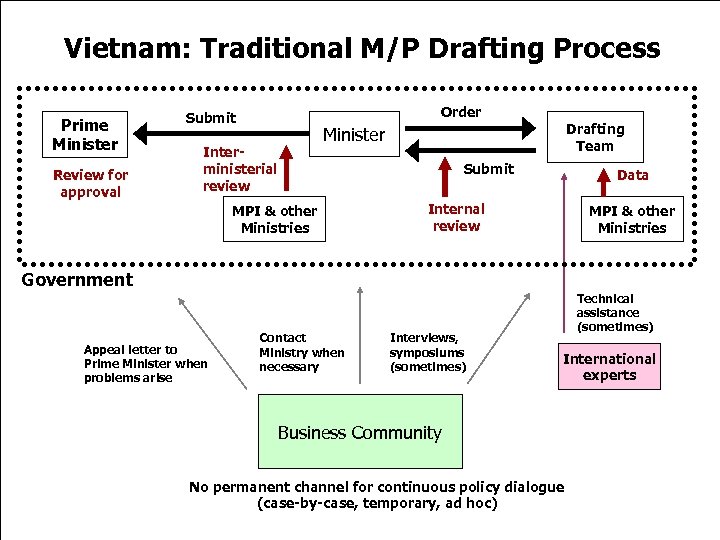 Vietnam: Traditional M/P Drafting Process Prime Minister Review for approval Order Submit Drafting Team Minister Interministerial review Submit MPI & other Ministries Data Internal review MPI & other Ministries Government Appeal letter to Prime Minister when problems arise Contact Ministry when necessary Interviews, symposiums (sometimes) Technical assistance (sometimes) International experts Business Community No permanent channel for continuous policy dialogue (case-by-case, temporary, ad hoc)
 Does Hanoi Interact Effectively with Stakeholders? (chapter 1 of book) l l l No agency specializes in comprehensive business support like HCMC’s Investment & Trade Promotion Center (ITPC). Hanoi’s DPI is too busy and short-staffed. SME Support Center (2005)? Motorbike registration ban lacked support of businesses and consumers, and was ineffective Hanoi received $1. 6 billion of FDI in 2005; but maybe due to locational advantage, not because of excellent policy
 Interact with Stakeholders? (cont. ) l l Socio-economic development plan, 2001 -2005 & 2006 -2010 (HAPI) -- drafting process generally lacked business involvement Hanoi Integrated Development and Environmental Program (HAIDEP) by Hanoi PC & JICA -- public exhibition (Aug. 2006) Improving, but not yet nation’s leader
 VDF’s Support for MOI’s Motorbike Master Plan l l In Spring 2006, Joint Working Group (JWG) was organized to draft Motorbike Master Plan 17 members from IPSI/MOI, motorbike assemblers, experts, and VDF Improving business involvement and interministerial coordination Final draft by end May 2007 www. vdf. org. vn/jwg. htm
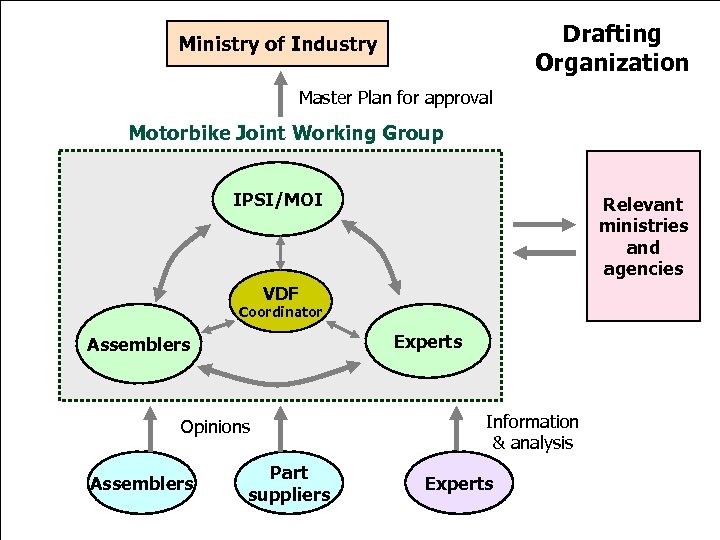 Drafting Organization Ministry of Industry Master Plan for approval Motorbike Joint Working Group IPSI/MOI Relevant ministries and agencies VDF Coordinator Experts Assemblers Opinions Assemblers Part suppliers Information & analysis Experts
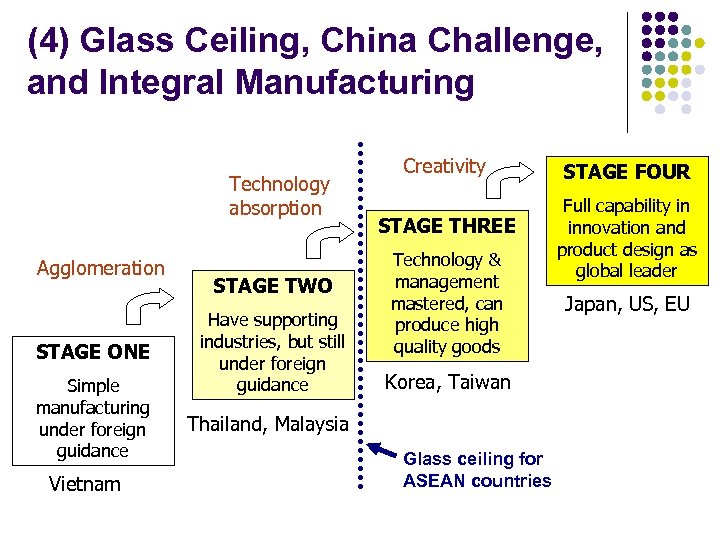 (4) Glass Ceiling, China Challenge, and Integral Manufacturing Technology absorption Agglomeration STAGE ONE Simple manufacturing under foreign guidance Vietnam STAGE TWO Have supporting industries, but still under foreign guidance Creativity STAGE THREE Technology & management mastered, can produce high quality goods Korea, Taiwan Thailand, Malaysia Glass ceiling for ASEAN countries STAGE FOUR Full capability in innovation and product design as global leader Japan, US, EU
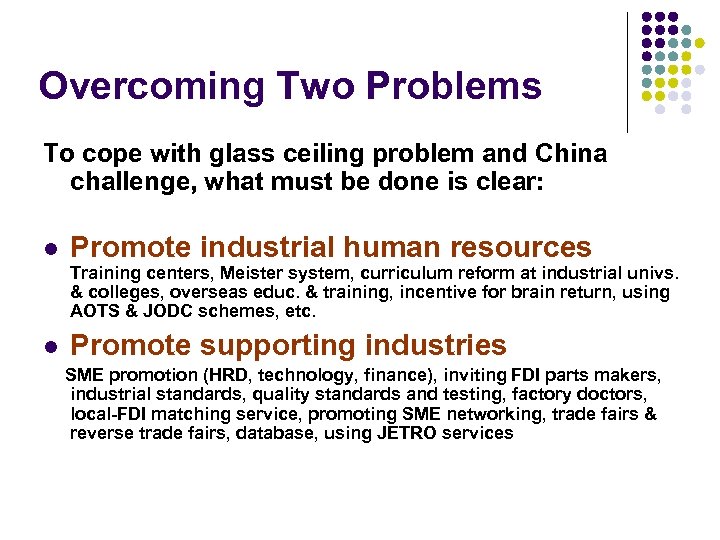
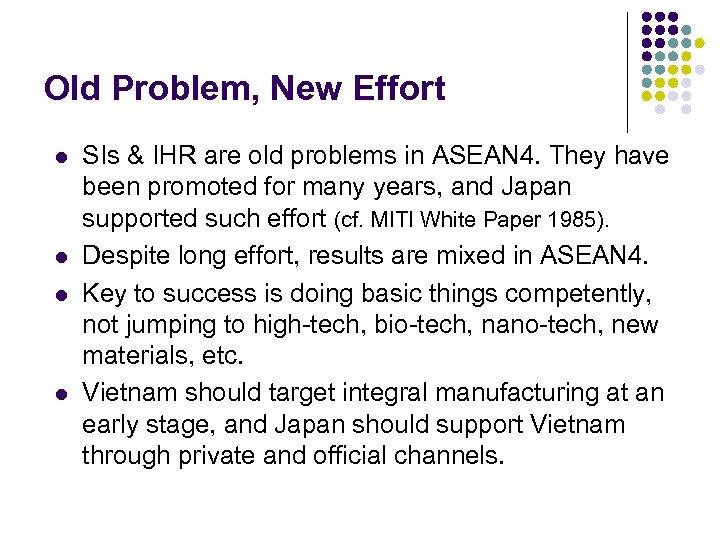
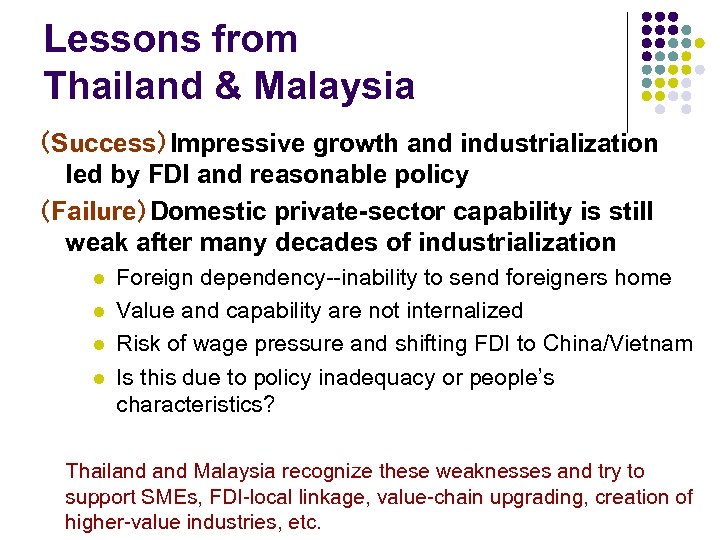 Lessons from Thailand & Malaysia (Success)Impressive growth and industrialization led by FDI and reasonable policy (Failure)Domestic private-sector capability is still weak after many decades of industrialization l l Foreign dependency--inability to send foreigners home Value and capability are not internalized Risk of wage pressure and shifting FDI to China/Vietnam Is this due to policy inadequacy or people’s characteristics? Thailand Malaysia recognize these weaknesses and try to support SMEs, FDI-local linkage, value-chain upgrading, creation of higher-value industries, etc.
 Coping with China l l It is foolish to directly compete with China, in the same product, market and technology. Vietnam should take a complementary position vis-à -vis China (use Chinese inputs but do not compete with Chinese products) l l To do this, business architecture theory is useful. To cope with China, go integral rather than modular For business architecture theory by Prof. Fujimoto (Tokyo Univ. ), see VDF publications, Sep. 2006 & Nov. 2006.
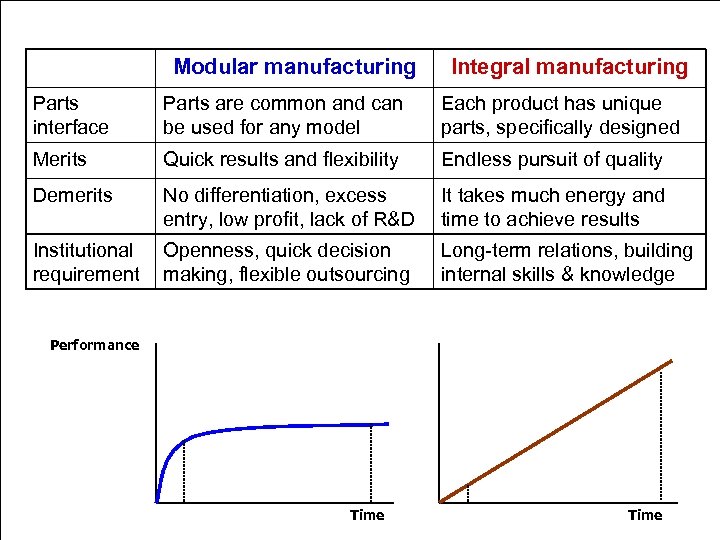 Modular manufacturing Integral manufacturing Parts interface Parts are common and can be used for any model Each product has unique parts, specifically designed Merits Quick results and flexibility Endless pursuit of quality Demerits No differentiation, excess entry, low profit, lack of R&D It takes much energy and time to achieve results Institutional requirement Openness, quick decision making, flexible outsourcing Long-term relations, building internal skills & knowledge Performance Time
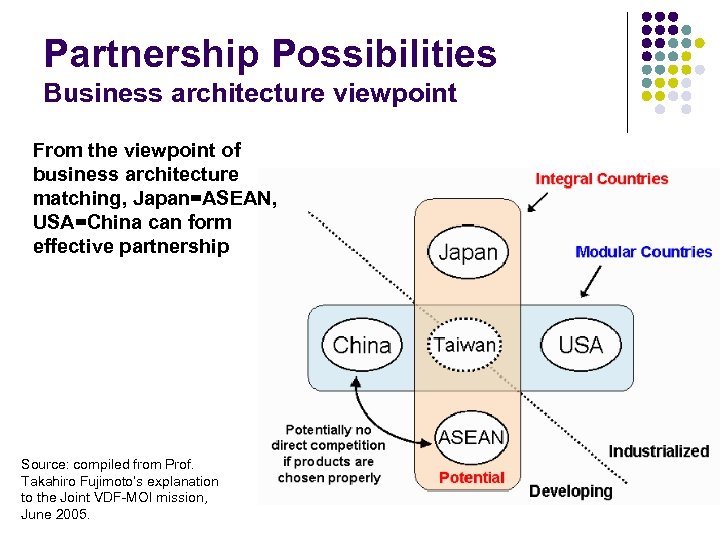 Partnership Possibilities Business architecture viewpoint From the viewpoint of business architecture matching, Japan=ASEAN, USA=China can form effective partnership Source: compiled from Prof. Takahiro Fujimoto’s explanation to the Joint VDF-MOI mission, June 2005.
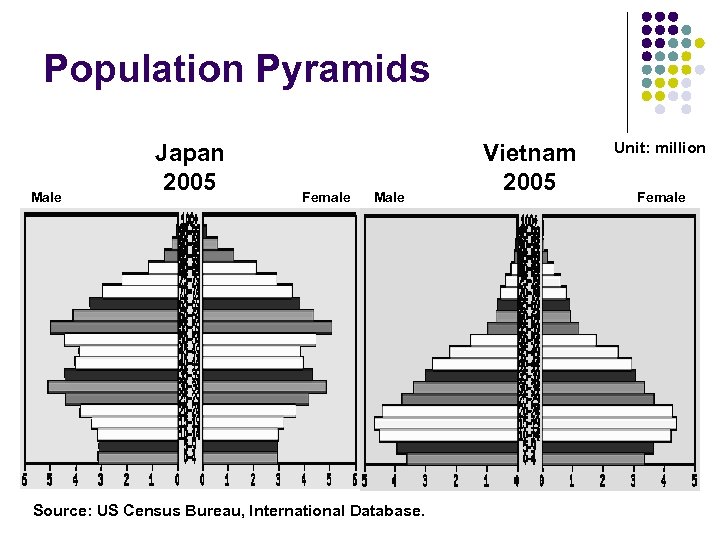
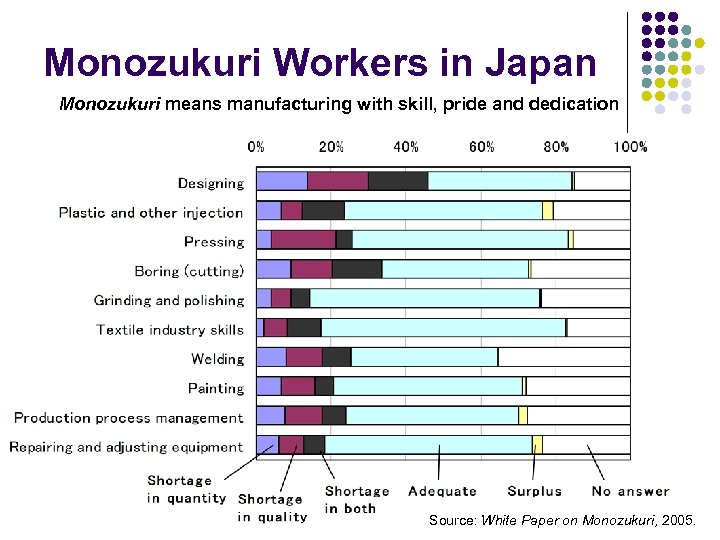
 Japan: Ageing Problem l l Japan has high technology, high wages, and ageing population “The 2007 Problem”—Postwar baby boomers (born 1947 -49) with high skills will retire soon Merit of integral manufacturing cannot be fully exploited by using unskilled labor in developing countries Japan needs a young developing country as a reliable partner in integral manufacturing
 Population Pyramids Male Japan 2005 Female Male Source: US Census Bureau, International Database. Vietnam 2005 Unit: million Female
 Monozukuri Workers in Japan Monozukuri means manufacturing with skill, pride and dedication Source: White Paper on Monozukuri, 2005.
 Overcoming Two Problems To cope with glass ceiling problem and China challenge, what must be done is clear: l Promote industrial human resources Training centers, Meister system, curriculum reform at industrial univs. & colleges, overseas educ. & training, incentive for brain return, using AOTS & JODC schemes, etc. l Promote supporting industries SME promotion (HRD, technology, finance), inviting FDI parts makers, industrial standards, quality standards and testing, factory doctors, local-FDI matching service, promoting SME networking, trade fairs & reverse trade fairs, database, using JETRO services
 Old Problem, New Effort l l SIs & IHR are old problems in ASEAN 4. They have been promoted for many years, and Japan supported such effort (cf. MITI White Paper 1985). Despite long effort, results are mixed in ASEAN 4. Key to success is doing basic things competently, not jumping to high-tech, bio-tech, nano-tech, new materials, etc. Vietnam should target integral manufacturing at an early stage, and Japan should support Vietnam through private and official channels.
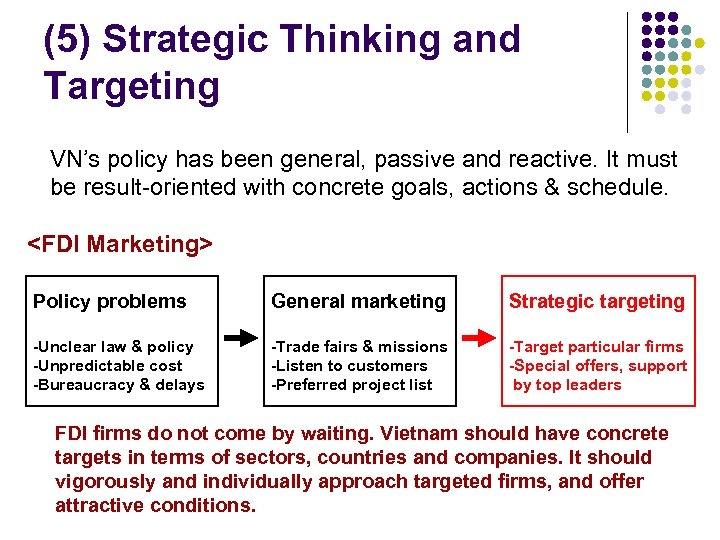 (5) Strategic Thinking and Targeting VN’s policy has been general, passive and reactive. It must be result-oriented with concrete goals, actions & schedule.
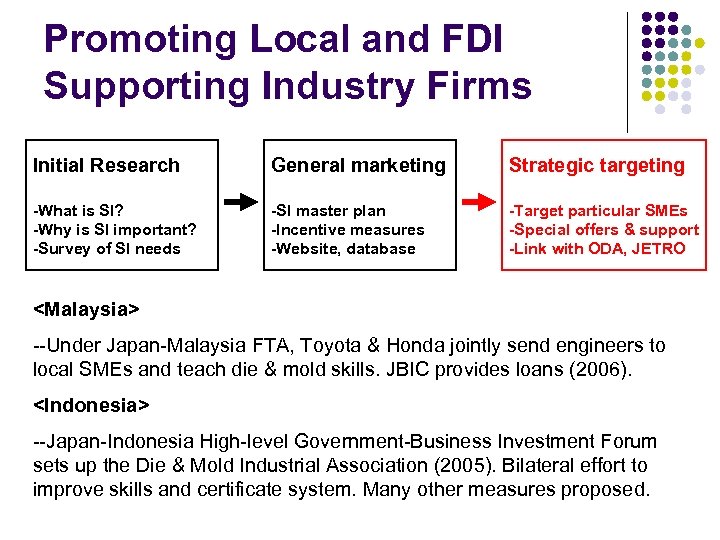 Promoting Local and FDI Supporting Industry Firms Initial Research General marketing Strategic targeting -What is SI? -Why is SI important? -Survey of SI needs -SI master plan -Incentive measures -Website, database -Target particular SMEs -Special offers & support -Link with ODA, JETRO
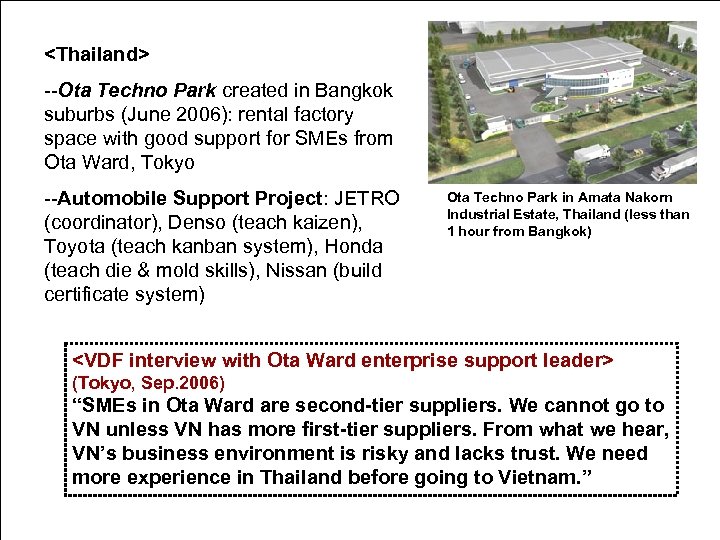
 THE END