 Скачать презентацию International Positioning Dr Robert Coelen International Positioning
c97c1b0d9bab37053fe374e5ba7c9cb5.ppt
- Количество слайдов: 55




International Positioning Dr Robert Coelen

International Positioning Dr Robert Coelen
This presentation - Positioning Quality perception local & international Price – Quality link Internationalisation Academic vs. Commercial Approach The Leiden Model

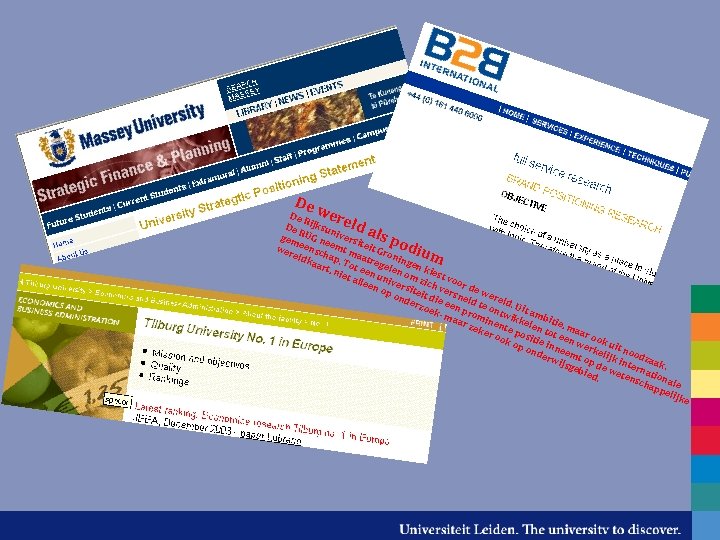
De wer De R De ijksu n RU gem G ne iversi teit em een wer t eld schap maat Gronin r kaa. rt, n Tot ee egelen gen ki e n iet alle unive om zic st voo r h en op rsiteit vers de we ond nel d reld d erz ie ee n p te on. Uit a oek rom twi -m kk mbit aar in zek ente elen t ie, ma er o pos ot e ar o i e ok o op tie inn n wer k uit ond noo eem kel ij erw d t ijsg op de k inte zaak. rna ebi ti ed. weten sch onale app elij ke eld als pod ium

Positioning, what for ? - Must be clear about the motives - Are you well positioned ? - Most European universities are currently positioned not as the result of deliberate action in relation to international attention - Must have a clearly defined and realistic goal
Strategic positioning: World Class - Want to be world class • • The region deserves it - Edinburgh The country must have it – Australia We’re building it – Virginia Tech Must get there in the next decade: – “The goal of strategic positioning is to make the University of Minnesota one of the top three public research universities in the world within a decade. “ - How many world class universities can there be ? (250 – T. van Raan at Leiden University) - What is world class ?
Strategic Positioning: Regional Relevance - Service the region • No aspirations to be world class • local issues to service the region • Provide opportunity for disadvantaged groups - Specialist environment • Tropical environment – Great Barrier Reef – can be world beater !
Strategic positioning: Specialisation - University focussed on a few related disciplines • Medical • Engineering • Economics
Positioning - How your target market sees you in relation to your competition - It is about the students’ perception of you - The defining characteristics of your university have placed you where you are now - Mismatch (? ) between how you see yourself and how your prospective students see you
Image and Reputation - Reputation: result of past actions (academic) - Image: the portrayal over a short period: snapshot (marketing communication) - Successful service business (high reputation) characterised by high demand high sales - HE institution’s high reputation linked to high demand ‘low sales’ (=selectivity) - Reflect: unable to buy a service would deteriorate reputation – use pricing to control demand - quality in service industry is coupled to price
Transactional vs Relationship Marketing - Related to international student segment - TM = focuses on one-off interaction - RM = longer term relationships with a network of stakeholders - Framing activities in the: - TM model • uses 4 Ps: price, place, promotion, product • Dependent on snapshot assessment • Significantly affected by ranking - RM model • Development of relationships, beyond just exchange of education for money • Network of stakeholders including, existing students, colleagues abroad, alumni, captains of industry, etc • Less affected by ranking
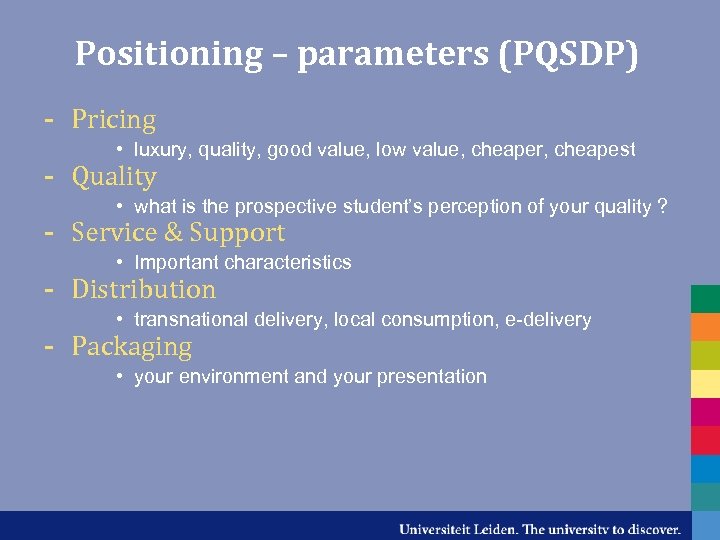
Positioning – parameters (PQSDP) - Pricing • luxury, quality, good value, low value, cheaper, cheapest - Quality • what is the prospective student’s perception of your quality ? - Service & Support • Important characteristics - Distribution • transnational delivery, local consumption, e-delivery - Packaging • your environment and your presentation

International Student Concerns - Quality of the education - Prospects of a job - Life style - Personal Security - Affordability
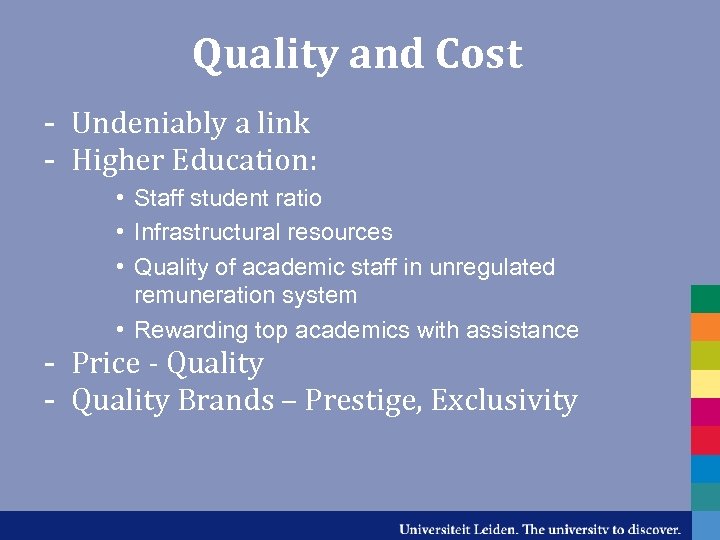
Quality and Cost - Undeniably a link - Higher Education: • Staff student ratio • Infrastructural resources • Quality of academic staff in unregulated remuneration system • Rewarding top academics with assistance - Price - Quality Brands – Prestige, Exclusivity
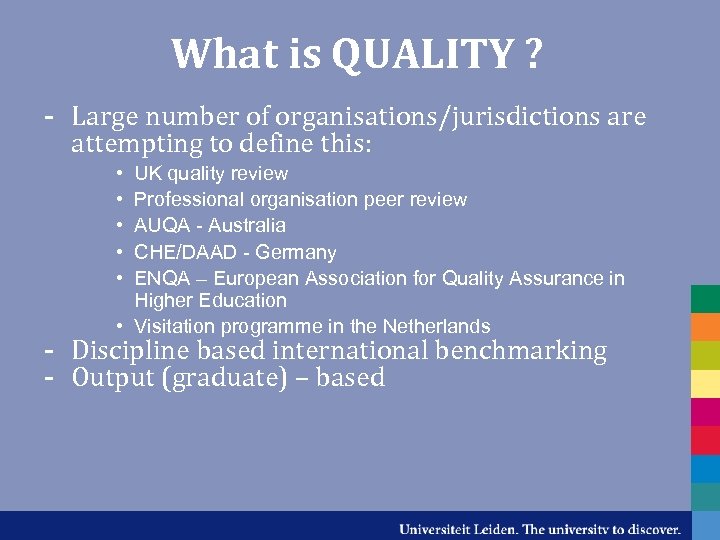
What is QUALITY ? - Large number of organisations/jurisdictions are attempting to define this: • • • UK quality review Professional organisation peer review AUQA - Australia CHE/DAAD - Germany ENQA – European Association for Quality Assurance in Higher Education • Visitation programme in the Netherlands - Discipline based international benchmarking - Output (graduate) – based
Good quality - Education is an experience good - If the quality is good - Education is a good experience
Quality Enhancement - Enhancement is an innate feature of the academic process - Obligation towards alumni - Local/national community expectation
Which quality counts ? - In the current context: • Perceived quality (local & foreign) • If based on substance - Recommendation by non-local academics Successful alumni Internationally successful staff Big differences between local and foreign perception may exist
Local versus International Perception - Local: - historical, longitudinal perception, slow to change, collective memory - International: - often no history, must resort to ‘snapshot’ assessment - Country profile very relevant • Underpins importance of country strategy
Snapshot assessment - Local knowledgeable and trusted sources: • Academic community • Successful alumni • Agencies - Third party ‘independent’ and accessible assessment • Repetitive occurrence strengthens this type • Government issued • Ranking lists
Q. U. A. L. I. T. Y - Quasi Universal Agreement on a Litany of Interesting Tests to promote Your university
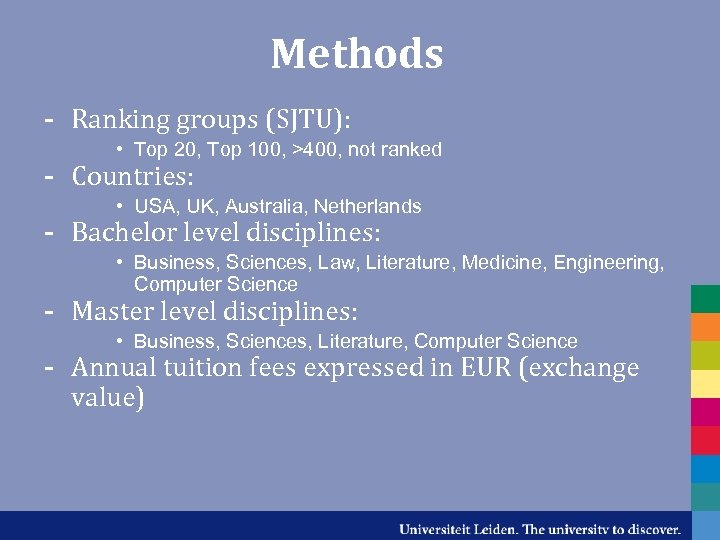
Methods - Ranking groups (SJTU): • Top 20, Top 100, >400, not ranked - Countries: • USA, UK, Australia, Netherlands - Bachelor level disciplines: • Business, Sciences, Law, Literature, Medicine, Engineering, Computer Science - Master level disciplines: • Business, Sciences, Literature, Computer Science - Annual tuition fees expressed in EUR (exchange value)
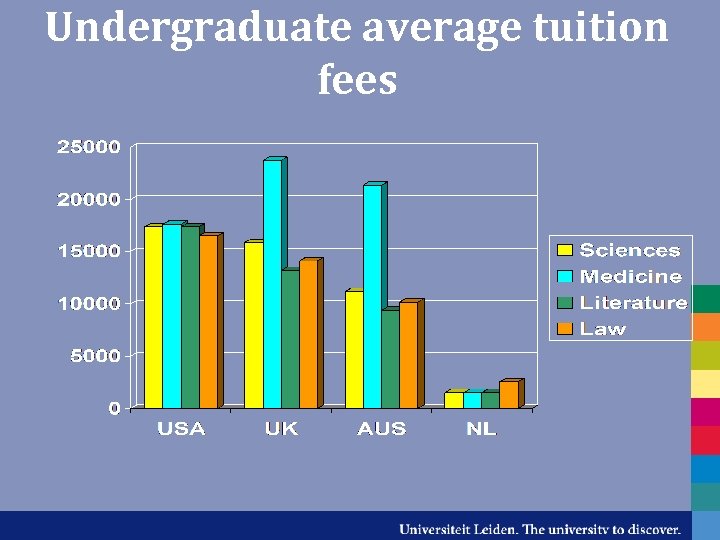
Undergraduate average tuition fees
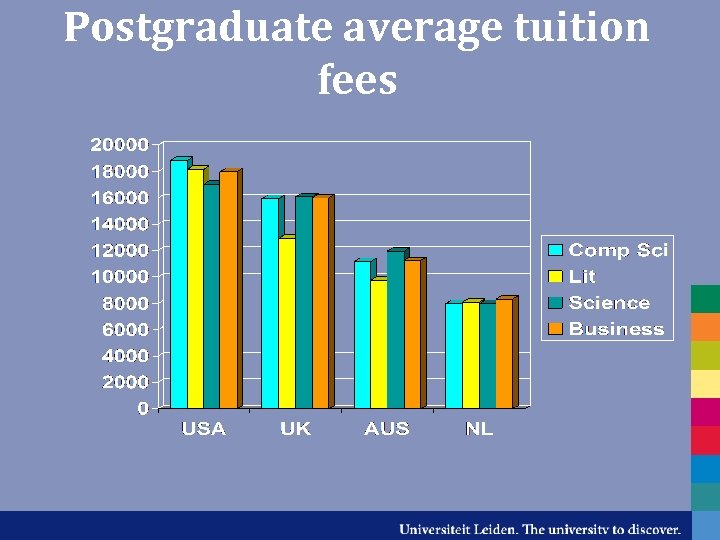
Postgraduate average tuition fees
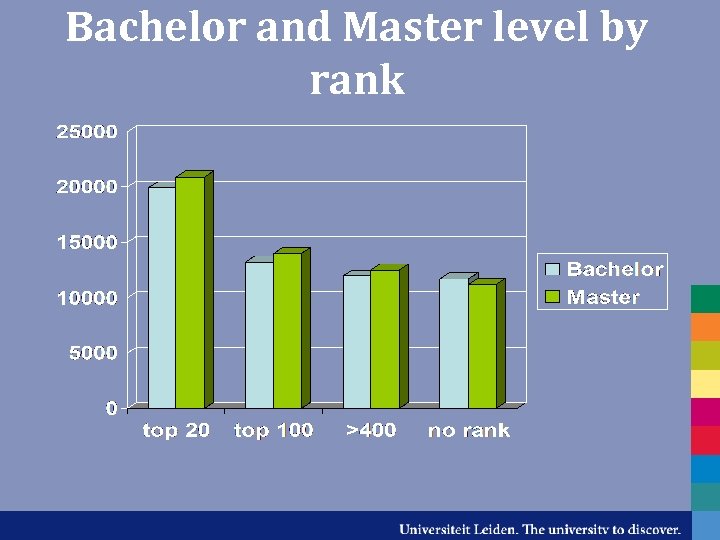
Bachelor and Master level by rank
Ranking…. . - Public/accessible Global rankings are relatively new: • THES – Malaysian issue • Berlin Principles • Universities are also responding: – Leiden University Symposium on ranking 16/2/06 – International Ranking Symposium in Leiden, 2 -3 February 2007: Institutional, National, and International Response to University Ranking - Like it or hate it, we have to deal with it
IREG Meeting Berlin - Berlin Principles on Ranking of Higher Education Institutes - International Experts Ranking Group (IREG) - http: //www. ihep. org/Organization/Press/Be rlin_Principles_Release. pdf - Those who producing rankings and league tables should hold themselves accountable for quality of their own data collection, methodology, and dissemination
Internationalisation of: - Teaching and learning Admission, Credit, and support Graduate outcomes Governance and Administration Staff Foreign operations Collaboration Culture and environment Student recruitment
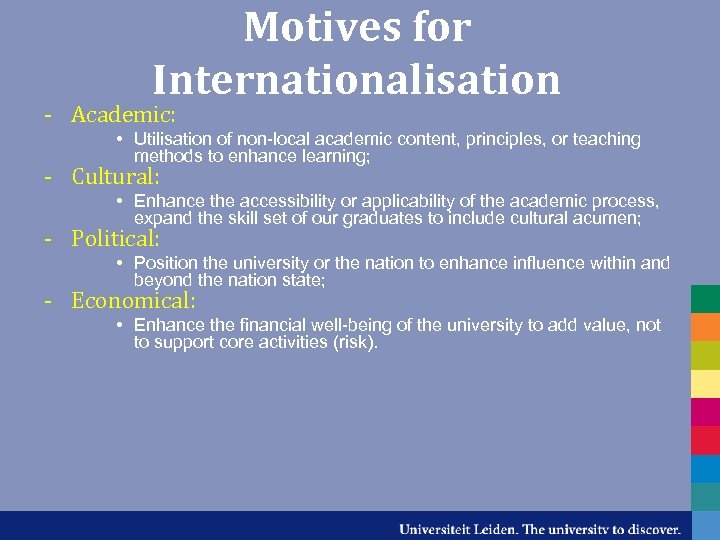
Motives for Internationalisation - Academic: • Utilisation of non-local academic content, principles, or teaching methods to enhance learning; - Cultural: • Enhance the accessibility or applicability of the academic process, expand the skill set of our graduates to include cultural acumen; - Political: • Position the university or the nation to enhance influence within and beyond the nation state; - Economical: • Enhance the financial well-being of the university to add value, not to support core activities (risk).
The mix of motives - Strong determinant in how the university carries out internationalisation; - Influenced by external factors that impinge on the university; - Determines how the university measures progress
Leiden University’s motives - Internationalisation as a quality enhancement: • Attract excellent students • Added dimension of intercultural adaptability of our graduates • Attract excellent staff • Added dimension of intercultural adaptability of our staff - Better graduates - Better academic environment
Internationalisation – means to an end - Must lead to improvement in quality and the perception of quality (image/brand) of the university - It must therefore be woven into the processes that enhance the quality of our university and not become an end by itself; - Internationalisation through existing international relationships
Components of a foreign academic relationship driven strategy - Primarily mobility driven, both staff en students - Normal academic activities - Inward and Outgoing mobility - ‘Organically’ grown, but strategic choice of partners
Outcomes of Inter-university Relationships - Students and staff have the opportunity to gain international experience; - Collaboration in teaching: • Recognition of useful mutuality in teaching programs and exclusive specialisations (allowing coordinated exchange and expansion of study options); • Synchronised curriculum to allow free-flow of students; • Jointly taught programs; - Collaboration in research; - Increased availability of resources.
Other Outcomes………. - Expands influence of the university - Expands knowledge about the university in other countries - Can build on the reputation of the university, but: • Need to brand activities that are carried out; • Ensure home players have an ambassadorial role; • Selection of partners is important;
We’re doing this already……… - Much of the mobility and collaboration activities have been occurring for a long time - We’re internationalised already
We’re doing this already……… - Much of the mobility and collaboration activities have been occurring for a long time - We’re internationalised already - Professionalisation and addition of structure and systems to: • Streamline existing systems • enhance the reputational yield from existing activities - Increasing the extent of internationalisation (depth and breadth)
Full Fee-paying International students (a ‘traditional’ view) - Australia: • 80 – 85% of foreign students are Asian • Business, IT, Engineering, Law – 80% - Market segmentation: • Power, wealth, status, and prestige: Asia – South America - Africa • Academic opportunity: North America (degree seeking) – Europe - Scholarship Students • Life style/study opportunity – North America, Europe (study abroad)
Academic vs. Commercial approach - Academic approach: overriding foreign activities (to increase awareness) are academic in nature - Commercial approach: overriding foreign activities (to increase awareness) are commercial in nature - Why not recruit full fee paying students on the basis of commercial marketing techniques ?
How does a commercial approach address the issues of concern ? - To a lay audience or a less well informed market an education exhibition approach can impart significant apparent markers of quality (augmented by input from alumni, agents); - Successful alumni can send a message about job prospects; - Issues of lifestyle, personal safety, and affordability can be very well addressed.
Academic approach - Carry out such activities as to enhance the reputation of the university: • Increase success research funding, multilateral programs • Increase success in commercialisation of IP; • Recruit highly talented academics • Partner with like-minded institutes to become locally (and more globally) recognised as having excellent academic qualities: Produce excellent graduates who become successful alumni. - Communicate these successes
What approach ? - Begin to build a relationship with the environment of the prospective target • Academic approach - Support academic approach to create greater visibility - Building the image with the right values - Must choose target countries over time (limited resources) - National or supra-national (e. g. EU, consortia) support
Make your programs accessible - Leiden teaches almost all of its Master level programs in English (about 80) - Leiden teaches about 200 undergraduate subjects in English - Research supervision has been possible in English for a long time
Primary method - Leiden aims to increase its internationalisation efforts through the use of existing academic relationships: • Not to 280 or so agreements in IO • Based on working academic relationships - Carry out increased internationally visible academic activities
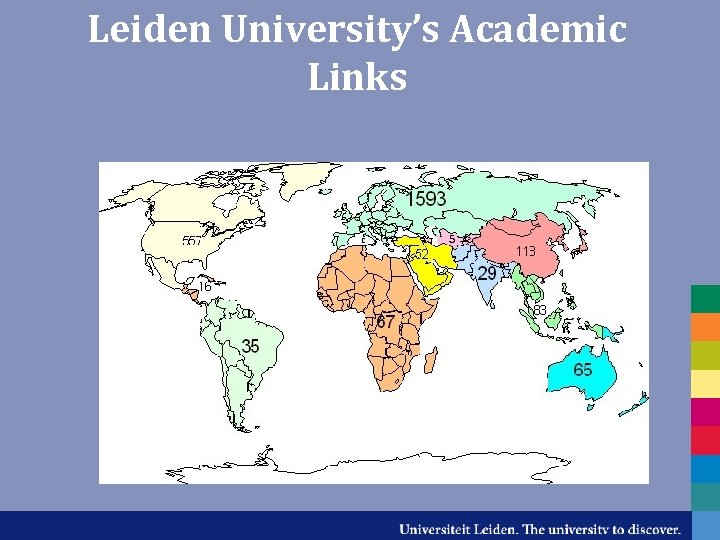
Leiden University’s Academic Links
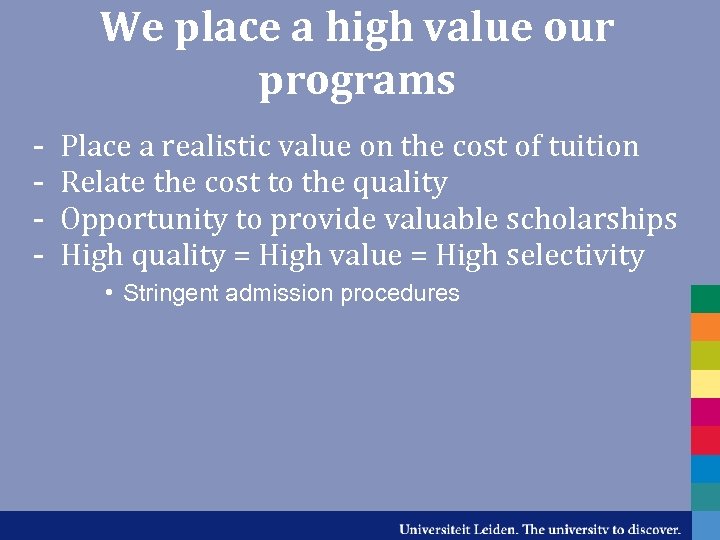
We place a high value our programs - Place a realistic value on the cost of tuition Relate the cost to the quality Opportunity to provide valuable scholarships High quality = High value = High selectivity • Stringent admission procedures
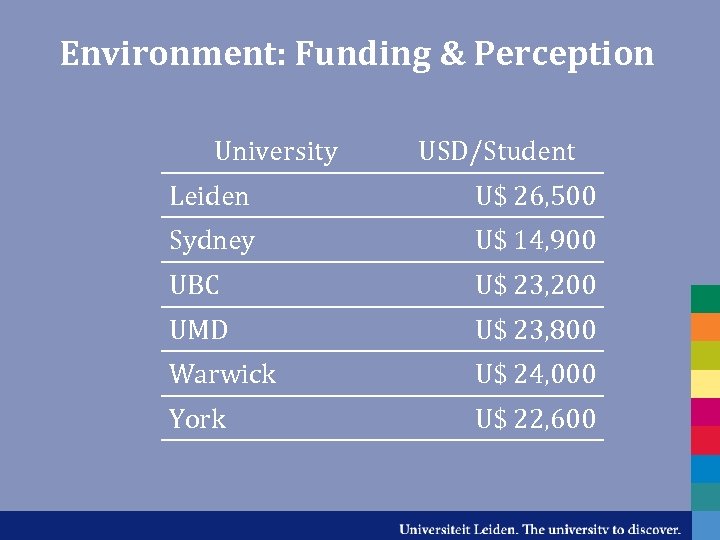
Environment: Funding & Perception University USD/Student Leiden U$ 26, 500 Sydney U$ 14, 900 UBC U$ 23, 200 UMD U$ 23, 800 Warwick U$ 24, 000 York U$ 22, 600

What are we doing ? - Improve our processes involved in mobility of staff and students (scalability): • Fine tuned IT support for logistics in mobility – e-decision facility for visa processes – Make process visible to all stakeholders from one database (Oracle/PHP) – Include visa, housing, communication • Housing, housing - Realise that if you charge fees, you must provide service & support • Students are consumers/customers
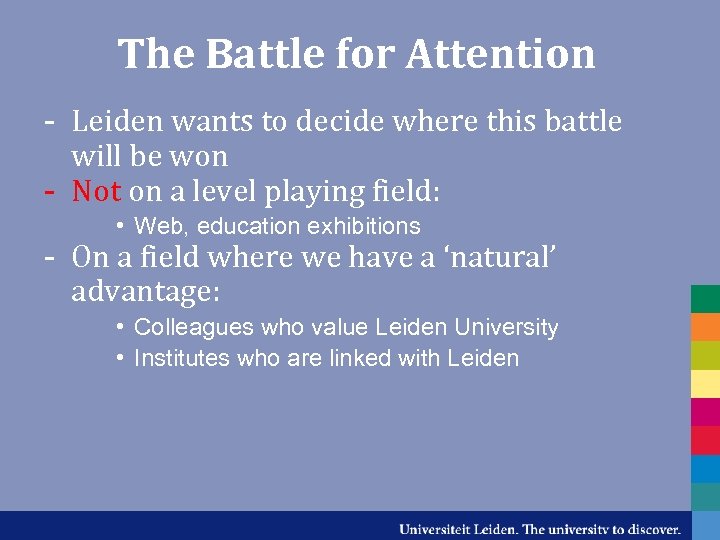
The Battle for Attention - Leiden wants to decide where this battle will be won - Not on a level playing field: • Web, education exhibitions - On a field where we have a ‘natural’ advantage: • Colleagues who value Leiden University • Institutes who are linked with Leiden
Synergy between discipline-specific knowledge and International Office - International Office: models/mechanisms of approach and communication - Academics have discipline specific knowledge: • Potential sources of students • Good locations to send students • Funding opportunities - Combine for synergistic effects
Create Country Approach Plans - Know what your programs want - Allow faculties to bring their strategy to bear on program wishes - Know your real academic links • Contacts • Academics with extensive in country experience - Combine links knowledge with needs and ambitions, adjusted with country knowledge
USP - Globally unique features of the program - European, nationally unique - The academics involved - Who ? • Local • Structurally invited - What ? • Honours, prizes, grants, etc - Alumni
Communication - Difficult to combine local and international - Do not create vastly different perceptions/expectations - Need one image with different expressions – suitability for situation - Web - Print
Non-Anglophone EU - Let people know (where it is true) that English outside the classroom is OK !!
Скачать презентацию International Positioning Dr Robert Coelen International Positioning
c97c1b0d9bab37053fe374e5ba7c9cb5.ppt