


 Скачать презентацию International Organization for Migration Plan 1 Migration and
4 Lecture.pptx
- Количество слайдов: 34
 International Organization for Migration Plan: 1. Migration and development activities. 2. Challenges identified in carrying out IOM work. 3. Key gaps in the global migration and development sphere. 4. Recommendations for the High-level Dialogue.
 New words: asylum-seeker - беженец; countries of origin and destination – страны происхождения и назначения; global footprint – глобальное присутствие; showcased – продемонстрированы; to combat racism & xenophobia – по борьбе с расизмом и ксенофобией (неприязнь к иностранцам); diaspora – диаспора; livelihood – средства к существованию; dignity – достоинство; enhance – усиливать; replicate – повторять.
 The International Organization for Migration (IOM) is the leading global agency on migration, mandated by its Constitution to address the full spectrum of migration issues. The Organization acts in close partnership with the UN and the international community to advance understanding of migration issues and to encourage social and economic development through migration.
 IOM promotes comprehensive migration approaches (protect the migrants’ rights, safety and dignity) and ensures that migration is beneficial for sustainable development in home and host communities. The Organization’s activities broadly include direct assistance and protection population in different circumstances, research, data collection and analysis, advice and support on migration policies and international migration law.
 Today IOM has a global footprint, with 151 Member States, 12 Observer States and numerous observer international and nongovernmental organizations. The Organization’s broad mandate for migration is reflected in its Constitution IOM implements close to 3, 000 projects annually.
 With IOM assistance, States have put in place laws on the protection of migrants and their families; broader laws that provide for benefits in education, health and other areas; laws to facilitate and manage labour migration at all skills levels; and anti-trafficking laws. Only when migrants’ rights are protected and migrants are healthy and well-integrated it’s possible to support development in both countries of origin and destination.
 IOM has enhanced service provision to migrants by training health-care workers, equipping rural health centers and setting up child-care and psychosocial services accessible to migrants and their families. IOM promotes a rights-based approach to migration through engagement with migrants and host societies, including innovative national and local integration strategies.
 For example, in France IOM helped develop a network of European city partners and a training module for migrant associations and local administrations, to engage migrants in local decisionmaking. The project was subsequently showcased as a good practice by the European Commission, and the training element is being replicated in other localities in France.
 In Ukraine, IOM and UN co-chair the multi-partner Diversity Initiative started in 2007 to combat racism and xenophobia. In South Africa, the anti xenophobia activities of IOM date back to 2007, when a movement was initiated by the “I Am a Migrant Too” campaign in 2012.
 IOM trained media professionals and journalism students to accurately report on migration issues, and equipped migrants with skills and media access to share their own stories. IOM protects the rights and well-being of migrants by promoting informed migration and ensuring that migrants and potential migrants are aware of their rights, obligations and the conditions for entry, stay and employment in the host country.
 IOM has helped establish and institutionalize national and regional networks of state-run migrant resource centers to inform and support prospective and returning migrant workers and the diaspora. IOM has also assisted states in offering large-scale pre-departure training for their nationals migrating for work abroad, as well as pre departure training and cultural orientation in support of resettlement to countries such as Australia, Canada, Norway, the United Kingdom and the United States of America.
 IOM has supported information campaigns for potential migrants on the risks of irregular migration and on legal migration options and to increase the employability of youth in foreign labor markets. In some countries, such support has included language training and pre-departure orientation, as well as a gender focus in skills training.
 For example, IOM recently carried out a project in southern Mexico to promote the education and validation of studies of foreign workers’ children both in their communities of origin (usually Guatemala) and destination. IOM has also strengthened guardianship institutions to offer adequate standards of protection and assistance to unaccompanied minor asylum-seekers in Bulgaria, the Czech Republic, Hungary, Poland, Romania, Slovakia and Slovenia.
 A project in Tunisia (2009– 2013), for instance, targets disadvantaged youth from rural areas through measures to improve productivity and conditions of work, and to upgrade informal enterprises, with the aim to minimize recourse to irregular migration. IOM has also helped improve livelihoods in areas of low socioeconomic development, disaster risk and conflict. For example, a three-year project (2009– 2012) in Colombia has benefited coffee grower families affected by violence through income generation and strengthened commercial and productive capabilities.
 In recent years, research has also focused on the impacts of the global economic crisis on migrants and migration. IOM views an important opportunity to improve the governance of migration at the local, national, regional and global levels, while keeping the rights and well-being of migrants at the center of the debate. Over the course of its 60 years of experience, IOM has built the capacities of policymakers, and has gathered, developed good practices pertaining to various aspects of migration, which it implements through its projects and makes available through the following tools:
 • training, technical assistance and capacity-building for policymakers in international migration law, labor migration management; • the International Dialogue on Migration, which synthesizes lessons learned, policy options and good practices from around the world; • support at the national and regional levels in developing migration laws and policies, upon request by governments and institutions, consistent with international standards and good practice.
 Key gaps in the global migration and development sphere. Despite progress in dialogue and cooperation at the global level, a balanced appreciation of the interactions between migration and the social, economic and environmental dimensions of sustainable development have not been fully realized in either policy or practice.
 Specific gaps: (a) Migration remains inadequately reflected in development frameworks and broader sectorial policies at both the national and local levels and in global development agenda, including the Millennium Development Goals (MDGs). Given the relevance of migration for sustainable development in economic, social and environmental terms, coherent policy frameworks must consider how migration could be a help in achieving sustainable developmental goals.
 (b) While there is a growing awareness of how migration affects development, there may be merit in re-focusing the debate on how development, including achieving the MDGs, may in turn impact migration; (c) There is a lack of understanding of how migration affects sustainable development in developing countries; (d) Resulting xenophobia and discrimination threaten social cohesion and the overall rights and well-being of migrants.
 (e) The impacts of humanitarian crises on migrants and migration are emerging as an important concern and can have implications for development, for example, the loss of employment and income for migrants and their families; the sudden departure of an important labor force from destination countries; and the serious reintegration challenges for countries of origin; (f) The relationship between human mobility and climate change and environmental factors has not been sufficiently factored into policies that aim to bridge disaster preparedness, climate change adaptation and sustainable development.
 Recommendations for the High-level Dialogue: Protect the human rights of all migrants. Ensure respect for and protection of the human rights of all migrants. Specifically, promote a more rights-based approach to migration that ensures migrants’ access to their social and economic rights, taking into account gender, age, health, legal status and other factors. Manage migration in crisis situations. Draw attention to the implications of humanitarian crises for migration and migrant populations, including in terms of protection and development.
 Consider the role of human mobility in disaster risk reduction strategies, disaster preparedness, national climate change adaptation programs and sustainable urban planning. Recognize the important role that temporary and circular migration can play in facilitating post-crisis recovery and adaptation to climate change and environmental degradation.
 NGO Committee on Migration Plan: 1. Migration and development activities. 2. Support provided to the Global Forum on Migration and Development. 3. Challenges identified in carrying out the Committee’s work. 4. Gaps evident within the migration and development sphere. 5. Recommendations for the High-level Dialogue.
 New words: status – статус; enhancement – усовершенствование; compliant – уступчивый; framework- основа, структура; panel – комиссия; panel discussion – дискуссия.
 The NGO Committee on Migration is an outcome of the 2006 UN High-level Dialogue (HLD) on International Migration and Development, and was formed and accredited as a result of its contributions to this first HLD. From the start, its mission has been to advocate for the protection and enhancement of the human rights of migrants and their families worldwide, in accordance with the UN Charter.
 To this end, the Committee supported all meetings of the Global Forum on Migration and Development (GFMD) since 2007. The Committee advocates for the protection of the human rights of migrants in countries of origin, transit and destination via such measures as the formulation and implementation of national, regional and international legal instruments and effective protection regimes for migrants such as women, children, third-country migrants and mixed populations, regardless of their legal status.
 The Office of the High Commissioner for Human Rights (OHCHR) has a unique mandate from the international community to promote and protect all human rights. The Office strives to achieve the protection of all human rights for all people, empower people to realize their rights. The High Commissioner works to mainstream human rights standards throughout all UN programs, to ensure that peace and security, development and human rights.
 OHCHR has developed tools on migration and human rights for governments, judges, lawyers, national human rights institutions and civil society organizations. It has provided technical assistance to governments and lawmakers to develop and reform legal and administrative frameworks related to migration, to become compliant with international human rights standards. Around the world, national human rights institutions are becoming increasingly involved in the protection and promotion of the human rights of migrants.
 In November 2009, in West Africa, OHCHR organized a capacity-building workshop on the role that national human rights institutions could play in the context of migration in the region. The workshop focused on following up on the commitments made within the Santa Cruz Declaration, which was adopted during the 8 th International Conference of National Institutions for the Promotion and Protection of Human Rights.
 In June 2010 OHCHR started a project in South Africa to strengthen the South African Human Rights Commission (SAHRC) in its work in combating discrimination and xenophobia against migrants. The project aimed to build the capacity of the SAHRC to provide legal support to migrants. In 2012 the Office collaborated with the Mixed Migration Working Group of the UN Country Team in Senegal to carry out a mapping of actors involved in mixed migration in the country.
 Since 2011 OHCHR has provided technical assistance to, and cooperated with, the European Agency for the Management of Operational Cooperation at the External Chapter 9: Office of the High Commissioner for Human Rights Borders of the Member States of the European Union (FRONTEX) in developing human rights training materials for border guards. In October 2011, in collaboration with the Diplomacy Training Programe and Migrant Forum in Asia, OHCHR organized a training workshop on the human rights of migrants in order to pilot these materials. The workshop was attended by 25 participants from national human rights institutions and non-governmental organizations in the Asia-Pacific region.
 In May 2011 the High Commissioner welcomed the February 2012 decision of the European Court of Human Rights in the case of Hirsi Jamaa and others v. Italy, which reaffirmed the human rights of all migrants at sea. OHCHR had submitted a legal brief before the Court as an intervening party. In 2011, at the annual conference of the EU Agency for Fundamental Rights, with theme “Dignity and Rights of Irregular Migrants, ” the Deputy High Commissioner stressed that irregular migration is not a crime. In addition, OHCHR organized a panel discussion New York on the issue of migration, racism and discrimination in May 2011.
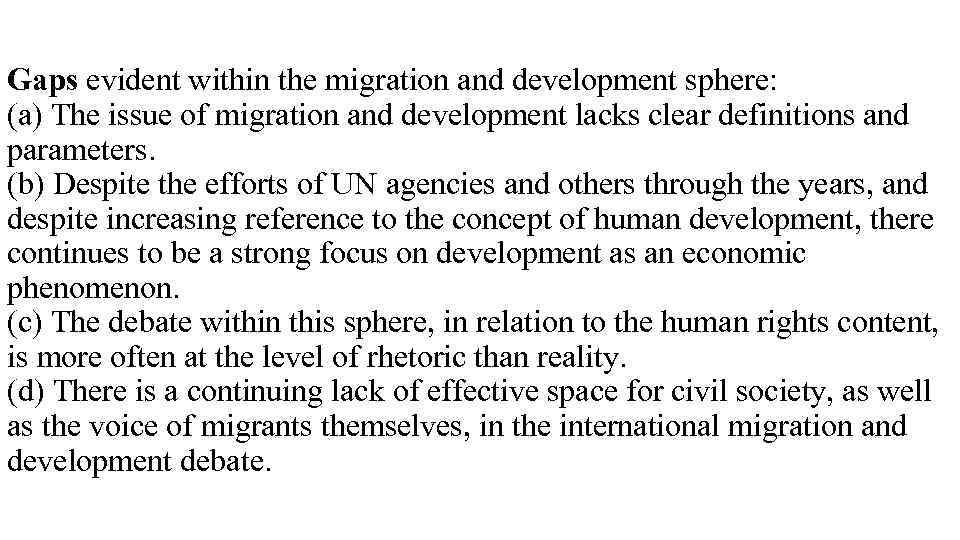 Gaps evident within the migration and development sphere: (a) The issue of migration and development lacks clear definitions and parameters. (b) Despite the efforts of UN agencies and others through the years, and despite increasing reference to the concept of human development, there continues to be a strong focus on development as an economic phenomenon. (c) The debate within this sphere, in relation to the human rights content, is more often at the level of rhetoric than reality. (d) There is a continuing lack of effective space for civil society, as well as the voice of migrants themselves, in the international migration and development debate.
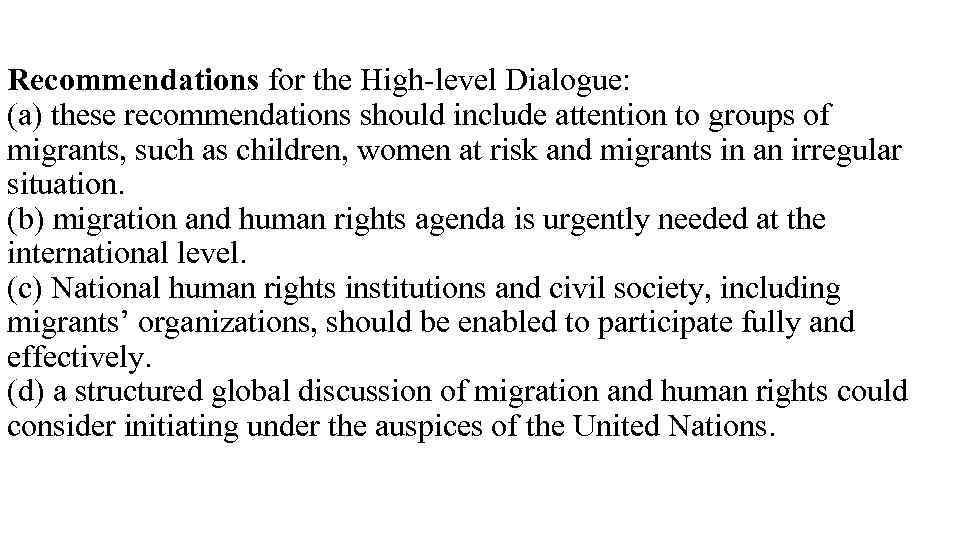 Recommendations for the High-level Dialogue: (a) these recommendations should include attention to groups of migrants, such as children, women at risk and migrants in an irregular situation. (b) migration and human rights agenda is urgently needed at the international level. (c) National human rights institutions and civil society, including migrants’ organizations, should be enabled to participate fully and effectively. (d) a structured global discussion of migration and human rights could consider initiating under the auspices of the United Nations.