 Скачать презентацию International Monetary Markets Mikkeli 2005 Compiled by Rulzion
822fa24e2298b587804d14003c7f071b.ppt
- Количество слайдов: 12



International Monetary Markets Mikkeli 2005 Compiled by Rulzion Rattray
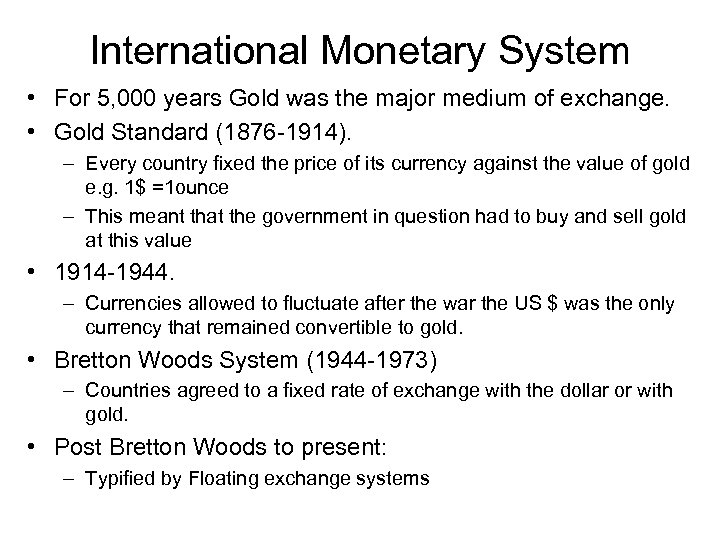
International Monetary System • For 5, 000 years Gold was the major medium of exchange. • Gold Standard (1876 -1914). – Every country fixed the price of its currency against the value of gold e. g. 1$ =1 ounce – This meant that the government in question had to buy and sell gold at this value • 1914 -1944. – Currencies allowed to fluctuate after the war the US $ was the only currency that remained convertible to gold. • Bretton Woods System (1944 -1973) – Countries agreed to a fixed rate of exchange with the dollar or with gold. • Post Bretton Woods to present: – Typified by Floating exchange systems
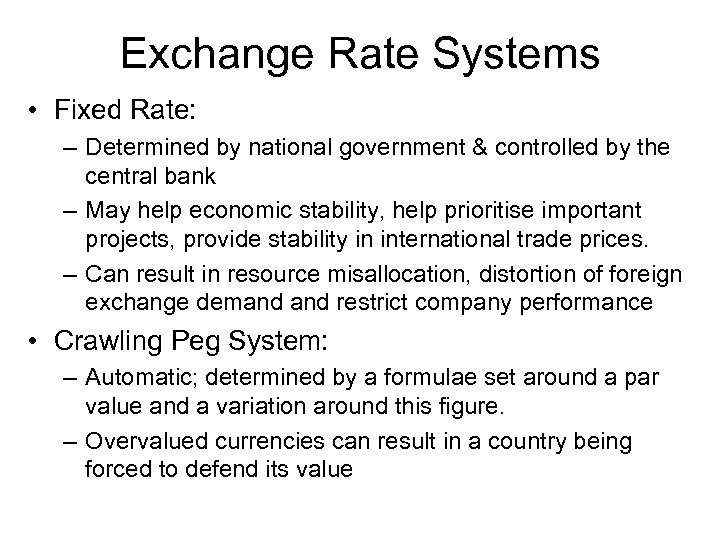
Exchange Rate Systems • Fixed Rate: – Determined by national government & controlled by the central bank – May help economic stability, help prioritise important projects, provide stability in international trade prices. – Can result in resource misallocation, distortion of foreign exchange demand restrict company performance • Crawling Peg System: – Automatic; determined by a formulae set around a par value and a variation around this figure. – Overvalued currencies can result in a country being forced to defend its value
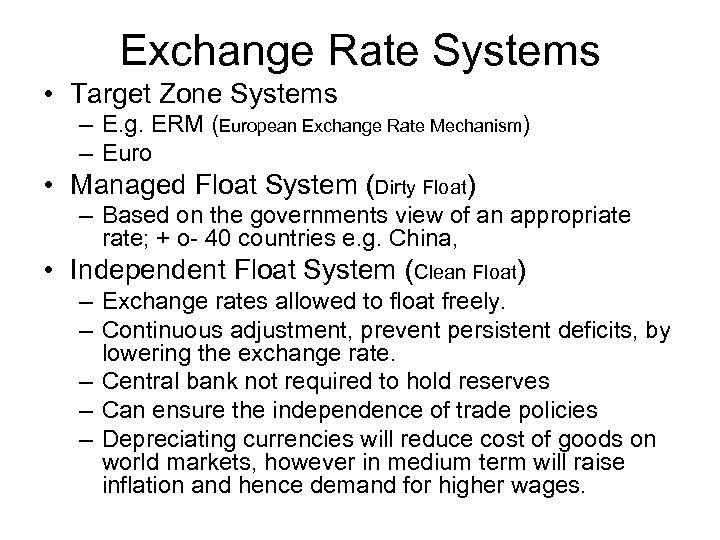
Exchange Rate Systems • Target Zone Systems – E. g. ERM (European Exchange Rate Mechanism) – Euro • Managed Float System (Dirty Float) – Based on the governments view of an appropriate rate; + o- 40 countries e. g. China, • Independent Float System (Clean Float) – Exchange rates allowed to float freely. – Continuous adjustment, prevent persistent deficits, by lowering the exchange rate. – Central bank not required to hold reserves – Can ensure the independence of trade policies – Depreciating currencies will reduce cost of goods on world markets, however in medium term will raise inflation and hence demand for higher wages.
Determination of Exchange Rates • Purchasing Power Parity (PPP) – Exchange rates between countries should in long run should equalise the price of goods. – Absolute PPP argues that exchange rates should be determined by relative prices of same goods. Difficult in practice because of different products. – Relative PPP this concentrates on using the change in prices between countries to change the exchange rate.
Exchange Rates PPP • PPP principles assume free movement of all goods ignoring barriers to trade. • Many items not traded e. g. land buildings etc. Can allow departures from PPP to persist. • Fails to recognise cross border transportation costs • PPP ignores the importance of capital flows
Exchange Rates Interest Rate Parity (IRP) • IRP principle looks at how interest rates are linked between different countries. – IRP suggests difference in national interest rates for securities of similar risk should be equal but opposite to forward rate discount or premium for the foreign currency. • Forward Rate: – The rate at which a bank is willing to exchange one currency for another at some point in the future.
Interest Rate Parity (IRP) • Like PPP, IRP can be deviated by transaction costs, tax factors and political risk. Investors will expect to be rewarded for the greater risk of investing on a foreign country. • International Fisher Effect argues that the spot exchange rate should change in equal amount but in the opposite direction to the difference in interest rates between two countries. – 10 year yen bond earning 4% compared to 6% interest available in $, assumes a 2% appreciation per year in the value of the Yen against the $.
Predicting Exchange Rates • PPP suggest that in the long run exchange rates determined by price of identical goods • IRP holds that the interest difference will be matched by the premium of forward exchange rates. • Forecasting future exchange rates requires the analysis of economic and non economic factors as well as reference to black market exchange rates.
Interpretation • Balance of Payments: – Summary of all economic transactions carried out by a country, using double entry bookkeeping. – Increasing globalisation has meant that MNE’s investing abroad and exporting back products can increase Balance of payments deficit, but be seen as positive. • E. g. $52. 6 billion trade deficit with China but a large proportion of this is US MNE’s exporting to US
Foreign Exchange Markets • Markets where currencies are bought and sold, average daily turnover $1. 5 Trillion, in 2001 80% of this in US $. – London largest FE market in world. – Main functions; international payment, short term supply of foreign currencies and hedging against FE risk • Stock Markets – Increasingly global & interconnected
References • Cesarano, F. , (1999), “Competitive money supply: the international monetary system in perspective”, Journal of Economic Studies, Vol. 26 No. 3, pp. 188 -200. , MCB University Press. (Available Emerald) • Eichengreen, B. (1995), ``The endogeneity of exchange-rate regimes'', in Kenen, P. B. (Ed. ) (1995), “Understanding Interdependence”, Princeton University Press, Princeton, NJ. • Griffiths, A. , and Wall, S. , (Eds), (1999), “Applied Economics”, Prentice Hall. • Jackson, J. H. , (1997), “The World Trading System”, Cambridge, MA: MIT Press. • Kenen, P. B. , Papadia, F. and Saccomanni, F. (Eds) (1994), “The International Monetary System”, Cambridge University Press, Cambridge. • Pilbeam, K. , (2001), “The East Asian financial crisis: getting to the heart of the issues”, Managerial Finance, Vol 27 pp 111 -133. (Available Emerald) • Shenkar, O. and Luo, Y. (2004), “International Business”, John Wiley and Sons, Inc. (Available Library)
Скачать презентацию International Monetary Markets Mikkeli 2005 Compiled by Rulzion
822fa24e2298b587804d14003c7f071b.ppt