


 Скачать презентацию International Module 503 Noise Measurement Its
02df67975bf6d38a3d3c1f661ca8b69a.ppt
- Количество слайдов: 22
 International Module – 503 Noise: Measurement & Its Effects Day 5 1.
 Today’s Learning Outcomes • Write –up of Practical exercise • Discussion on practical aspects of noise assessments • Noise Control Program Evaluation • Mock Exam Review 2. © 2009 Associates in Acoustics, Inc , BP International Limited & University of Wollongong
 Guidelines For an Effective Hearing Conservation Programme • Outline “best practice” approach 3. © 2009 Associates in Acoustics, Inc , BP International Limited & University of Wollongong
 Best Practice • Procedures for measuring the noise • Determination of employee noise exposure • Noise controls – engineering and administrative • Provision of hearing protectors • Audiometric testing • Training 4. © 2009 Associates in Acoustics, Inc , BP International Limited & University of Wollongong
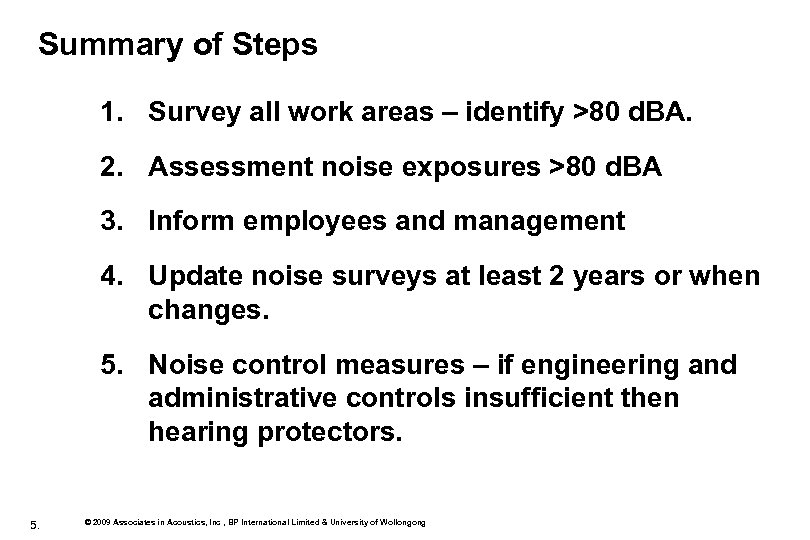 Summary of Steps 1. Survey all work areas – identify >80 d. BA. 2. Assessment noise exposures >80 d. BA 3. Inform employees and management 4. Update noise surveys at least 2 years or when changes. 5. Noise control measures – if engineering and administrative controls insufficient then hearing protectors. 5. © 2009 Associates in Acoustics, Inc , BP International Limited & University of Wollongong
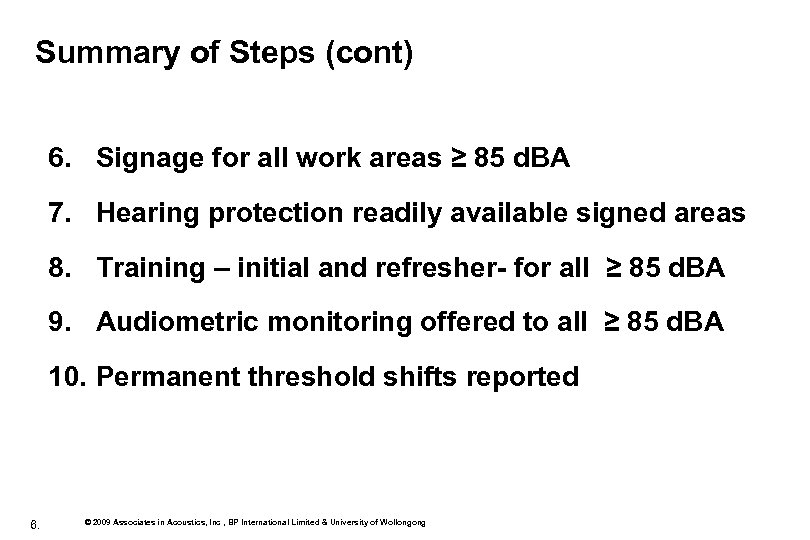 Summary of Steps (cont) 6. Signage for all work areas ≥ 85 d. BA 7. Hearing protection readily available signed areas 8. Training – initial and refresher- for all ≥ 85 d. BA 9. Audiometric monitoring offered to all ≥ 85 d. BA 10. Permanent threshold shifts reported 6. © 2009 Associates in Acoustics, Inc , BP International Limited & University of Wollongong
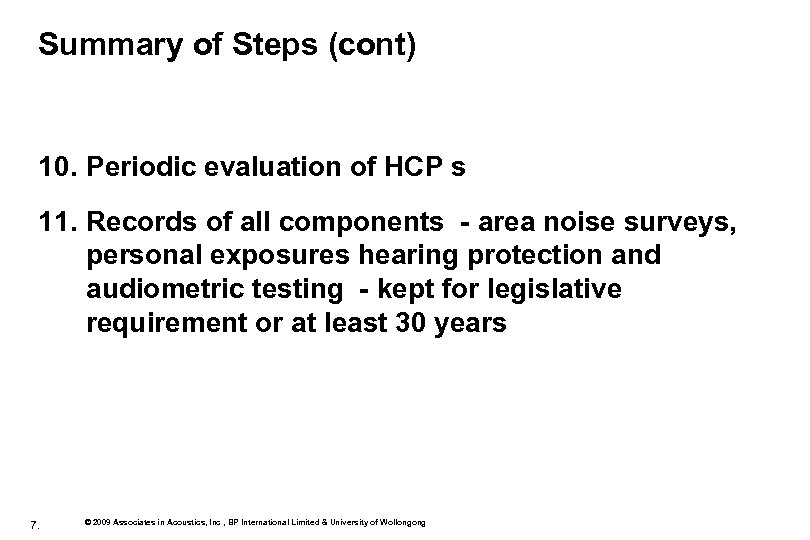 Summary of Steps (cont) 10. Periodic evaluation of HCP s 11. Records of all components - area noise surveys, personal exposures hearing protection and audiometric testing - kept for legislative requirement or at least 30 years 7. © 2009 Associates in Acoustics, Inc , BP International Limited & University of Wollongong
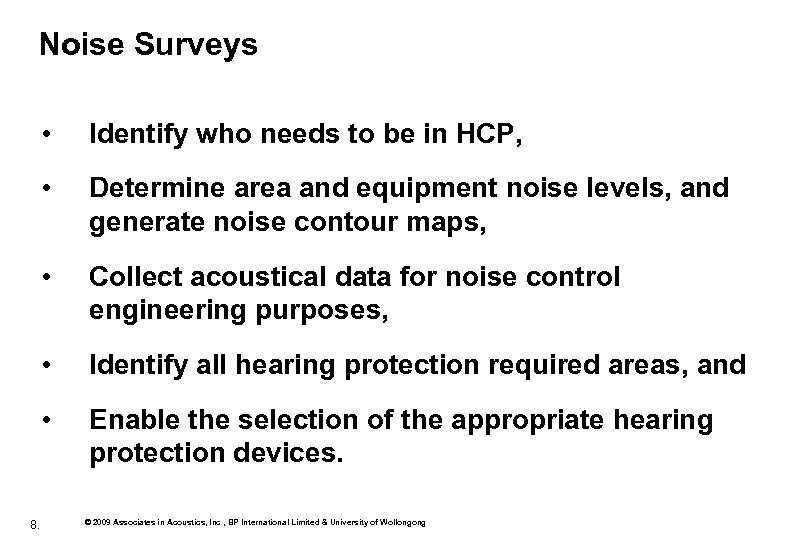 Noise Surveys • • Determine area and equipment noise levels, and generate noise contour maps, • Collect acoustical data for noise control engineering purposes, • Identify all hearing protection required areas, and • 8. Identify who needs to be in HCP, Enable the selection of the appropriate hearing protection devices. © 2009 Associates in Acoustics, Inc , BP International Limited & University of Wollongong
 Surveys • • Area surveys measure and document all areas >80 d. BA, • Exposure surveys for all working >80 d. BA • Training for those doing surveys • 9. Instruments must meet standards and be properly maintained Re-evaluations every 2 -5 years or when changes © 2009 Associates in Acoustics, Inc , BP International Limited & University of Wollongong
 Survey Data • Area surveys as contours by machine, work area or map • Exposure survey data in terms of LAeq, 8 hr • Always check if LCPeak excess and document • Clear documentation for future reference 10. © 2009 Associates in Acoustics, Inc , BP International Limited & University of Wollongong
 Noise Control • • 11. Engineering noise control – at source by replacement or remedial measures Administrative control – work practices to limit time of exposure © 2009 Associates in Acoustics, Inc , BP International Limited & University of Wollongong
 Personal Hearing Protectors • Only reduce the noise at the ear when properly selected and properly worn • Provide adequate reduction - 75 -80 d. BA in ear • Avoid overprotection • Suitable for the work environment • Training in use and Motiviation 12. © 2009 Associates in Acoustics, Inc , BP International Limited & University of Wollongong
 Audiometric Monitoring • • Regular audiometric checks for those >85 d. BA • At termination of employment • 13. Baseline before exposure Data analysed © 2009 Associates in Acoustics, Inc , BP International Limited & University of Wollongong
 Intervention when Threshold Shift • Notify employee and counsel the employee. • If not using HPDs, provide and train in use. • If using HPDs, check, refit, retrain in use • Repeat audiometric check within 30 days 14. © 2009 Associates in Acoustics, Inc , BP International Limited & University of Wollongong
 Confirmed Threshold Shift • Investigation noise exposure, • Investigation of noise control options • Inform employee and advise follow-up actions 15. © 2009 Associates in Acoustics, Inc , BP International Limited & University of Wollongong
 Checking HCP Effectiveness • Individual – from audiometric checks • Overall – – Noise control compliance audits – Audiometric data base analysis – Check for temporary threshold shifts 16. © 2009 Associates in Acoustics, Inc , BP International Limited & University of Wollongong
 Record Keeping • • Noise exposure assessments • Employees included in the HCP • Audiometric testing and notifications • All HPDs available • 17. Noise measurements data Training records © 2009 Associates in Acoustics, Inc , BP International Limited & University of Wollongong
 Record Keeping (cont) • • HCP program and policy documents • Hearing protection effectiveness checks • Audits of HCP • 18. Noise control studies, Calibration of instruments. © 2009 Associates in Acoustics, Inc , BP International Limited & University of Wollongong
 Intervention Strategies • • Identify problem job/work areas • Buy Quiet • Engineering solutions • 19. Identify employees at risk Hearing protector refit/retrain © 2009 Associates in Acoustics, Inc , BP International Limited & University of Wollongong
 Intervention Strategies (cont) • • Special events motivation • Audits of hearing protector use • Training course • 20. Audiometric test schedule Encourage hearing protectors in non work © 2009 Associates in Acoustics, Inc , BP International Limited & University of Wollongong
 Conclusion “best practice” approach may be challenging in some workplaces But there are many options And proper implementation ► prevention hearing loss from occupational noise exposure 21. © 2009 Associates in Acoustics, Inc , BP International Limited & University of Wollongong
 Today’s Learning Outcomes • Write – up of practical exercise • Discussion on practical aspects of noise assessments • Noise Control Program Evaluation • Mock Exam Review 22. © 2009 Associates in Acoustics, Inc , BP International Limited & University of Wollongong