 Скачать презентацию International Mobility and Trade Corridor IMTC Freight Technology
b9deb2df5b4500d555900df034495054.ppt
- Количество слайдов: 27



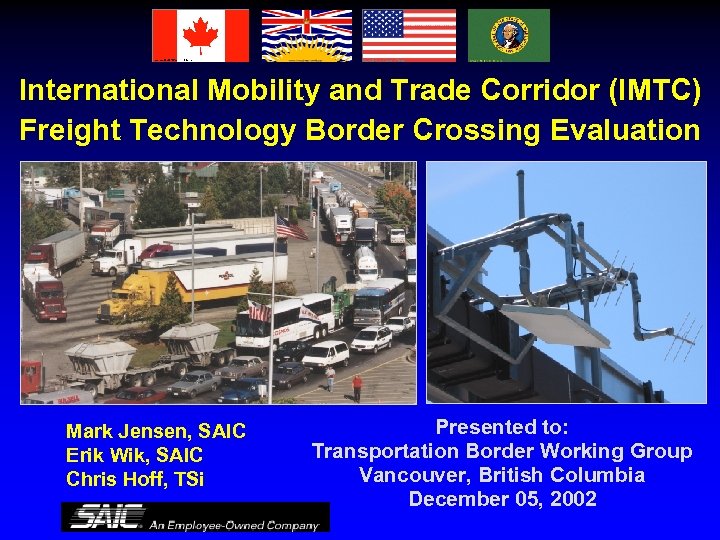
International Mobility and Trade Corridor (IMTC) Freight Technology Border Crossing Evaluation Mark Jensen, SAIC Erik Wik, SAIC Chris Hoff, TSi Presented to: Transportation Border Working Group Vancouver, British Columbia December 05, 2002
Background l $4. 35 Million Dollar Investment (Phase 1 & 2) l Phase 1: $1. 85 M l Phase 2: $ 2. 5 M TEA-21 grant to IMTC with match from Transport Canada, WSDOT, BC Transportation Finance Authority, and ICBC l First ITS enabled bi-national CVO system in North America l $32 million a day in Canadian-American cross border trade l $40 million lost annually due to border congestion l Support Border Crossing Goals l Improve trade facilitation and commercial vehicle safety l Border Delay Performance Measurements l Cost and Benefit inputs supporting Mitretek databases SAIC Transportation Research Division 2
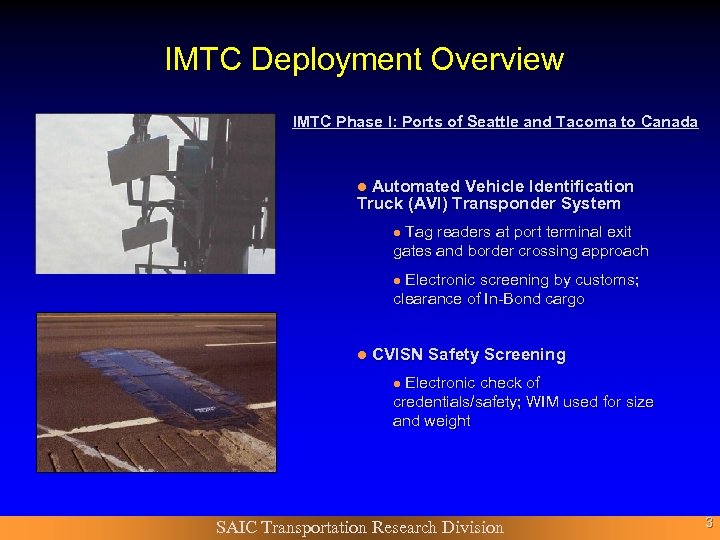
IMTC Deployment Overview IMTC Phase I: Ports of Seattle and Tacoma to Canada Automated Vehicle Identification Truck (AVI) Transponder System l Tag readers at port terminal exit gates and border crossing approach l Electronic screening by customs; clearance of In-Bond cargo l l CVISN Safety Screening Electronic check of credentials/safety; WIM used for size and weight l SAIC Transportation Research Division 3
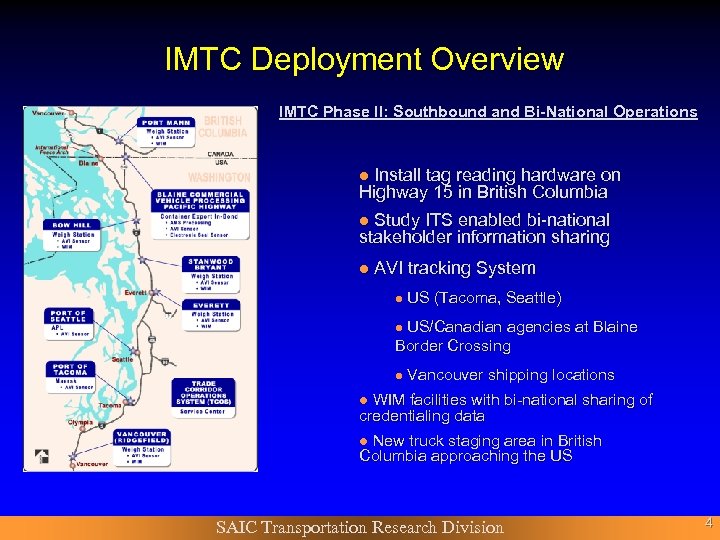
IMTC Deployment Overview IMTC Phase II: Southbound and Bi-National Operations Install tag reading hardware on Highway 15 in British Columbia l Study ITS enabled bi-national stakeholder information sharing l l AVI tracking System l US (Tacoma, Seattle) US/Canadian agencies at Blaine Border Crossing l l Vancouver shipping locations WIM facilities with bi-national sharing of credentialing data l New truck staging area in British Columbia approaching the US l SAIC Transportation Research Division 4
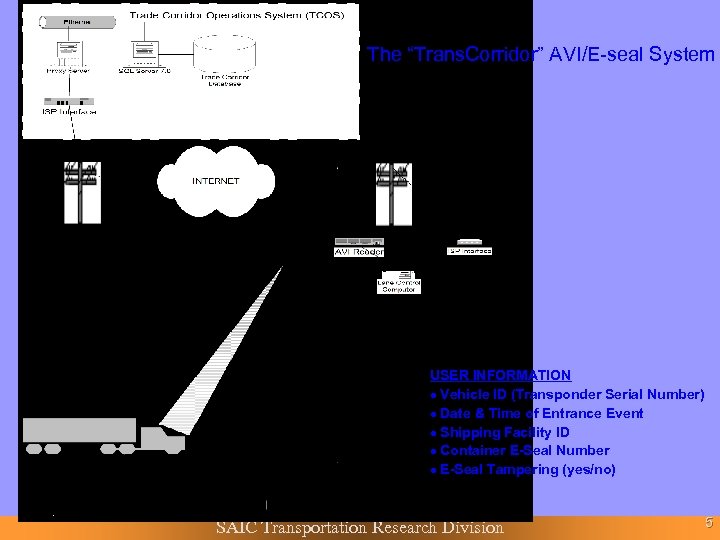
The “Trans. Corridor” AVI/E-seal System USER INFORMATION · Vehicle ID (Transponder Serial Number) · Date & Time of Entrance Event · Shipping Facility ID · Container E-Seal Number · E-Seal Tampering (yes/no) SAIC Transportation Research Division 5
Evaluation Goals l IMTC ITS Objectives l Examine how ITS systems improve vehicle and freight operational efficiency throughout the logistics chain by minimizing total commercial motor vehicle delay at border crossings, commercial vehicle inspection stations, at participating ports, and Intermodal yards. l Examine how ITS systems enhance commercial freight trade and regulatory efficiency via improved collection, transmission and analysis of vehicle, driver, and freight information between regulatory and enforcement officials, customs brokers, and shippers. SAIC Transportation Research Division 6
Evaluation Technical Approach l Evaluation Methodology l l Benefit/Cost Evaluation l l Data Collection Implementation Challenges Evaluation Study Areas l Commercial Motor Vehicle Operations l Commercial Freight Trade and Regulatory Operations l International Institutional Challenges l Stakeholder Satisfaction SAIC Transportation Research Division 7
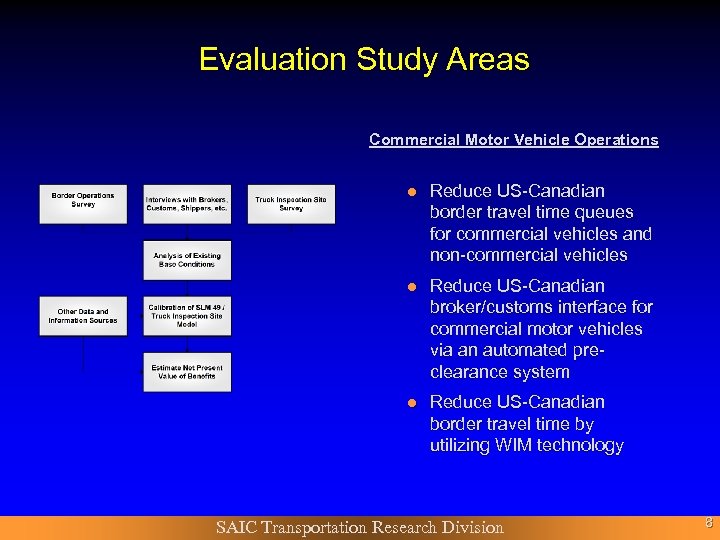
Evaluation Study Areas Commercial Motor Vehicle Operations l Reduce US-Canadian border travel time queues for commercial vehicles and non-commercial vehicles l Reduce US-Canadian broker/customs interface for commercial motor vehicles via an automated preclearance system l Reduce US-Canadian border travel time by utilizing WIM technology SAIC Transportation Research Division 8
Evaluation Study Areas l Commercial Freight Trade and Regulatory Operations l Paperwork reduction, error reduction and resource savings by commercial trucking industry l Paperwork reduction, error reduction and resource savings by the commercial brokerage industry l Paperwork reduction and resource savings by the sharing of electronic credentialing data SAIC Transportation Research Division 9
Evaluation Study Areas l International Institutional Challenges l Document the impact of ITS technology on information sharing and coordination processes between IMTC core participants l Assess international institutional challenges relative to developing information-sharing agreements SAIC Transportation Research Division 10
Evaluation Study Areas l Stakeholder Satisfaction l Identify the specific perceived benefits of the ITS systems to stakeholders l Assess users’ ITS technology acceptance level l Assess users’ ability to utilize ITS-generated data to more effectively conduct international freight transactions including tracking and pre-clearance capabilities SAIC Transportation Research Division 11
Border Operations Survey l Purpose: systematically collect border operations data l Scope: 4 days in each direction (8 hrs/day) l Captured: l Travel time by segment l Congestion l Brokerage l Customs booth processing l Queue length l Vehicle classification l Empty/laden trucks l Parking lot occupancy SAIC Transportation Research Division 12
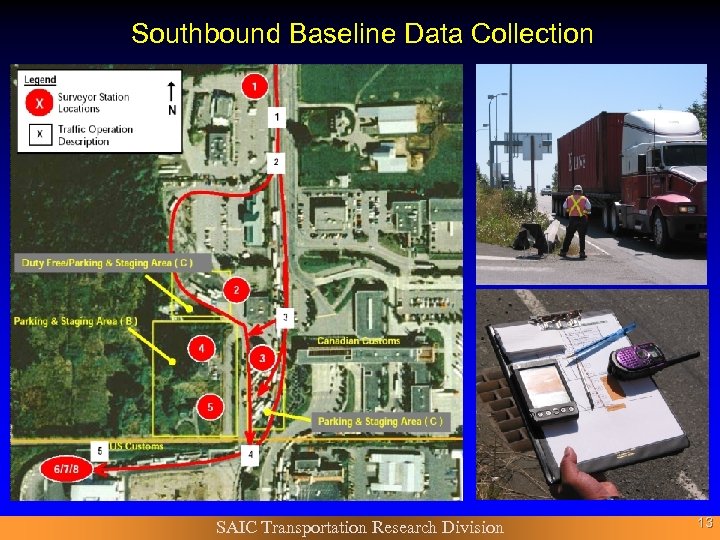
Southbound Baseline Data Collection SAIC Transportation Research Division 13
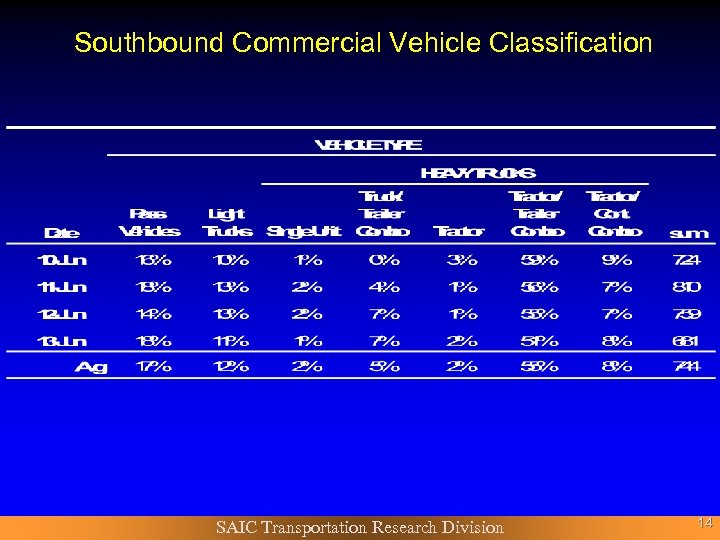
Southbound Commercial Vehicle Classification SAIC Transportation Research Division 14
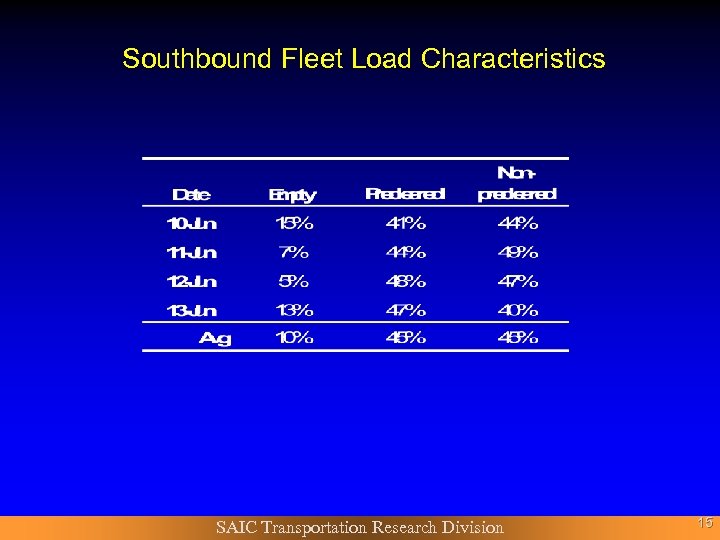
Southbound Fleet Load Characteristics SAIC Transportation Research Division 15
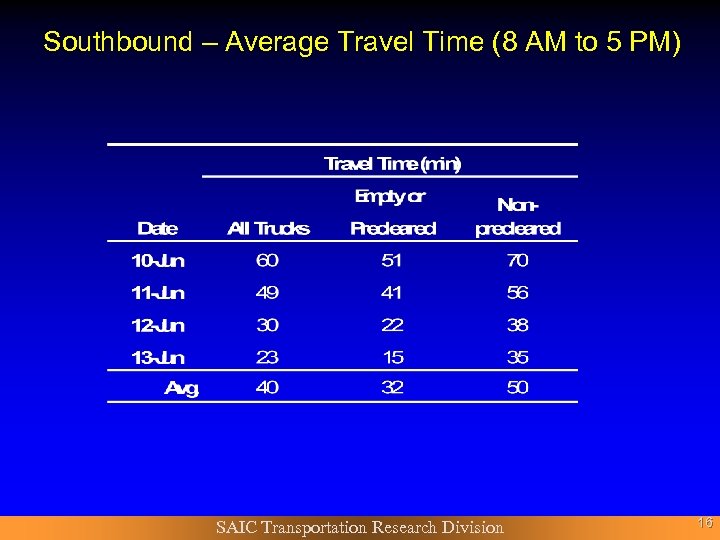
Southbound – Average Travel Time (8 AM to 5 PM) SAIC Transportation Research Division 16
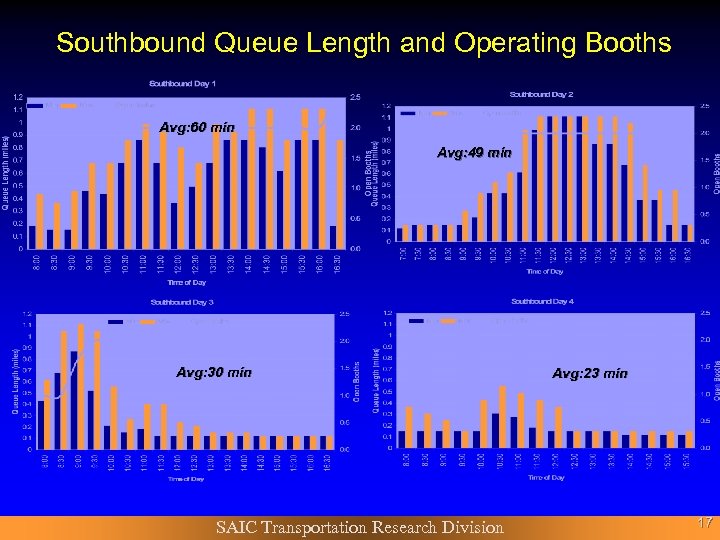
Southbound Queue Length and Operating Booths Avg: 60 min Avg: 49 min Avg: 30 min SAIC Transportation Research Division Avg: 23 min 17
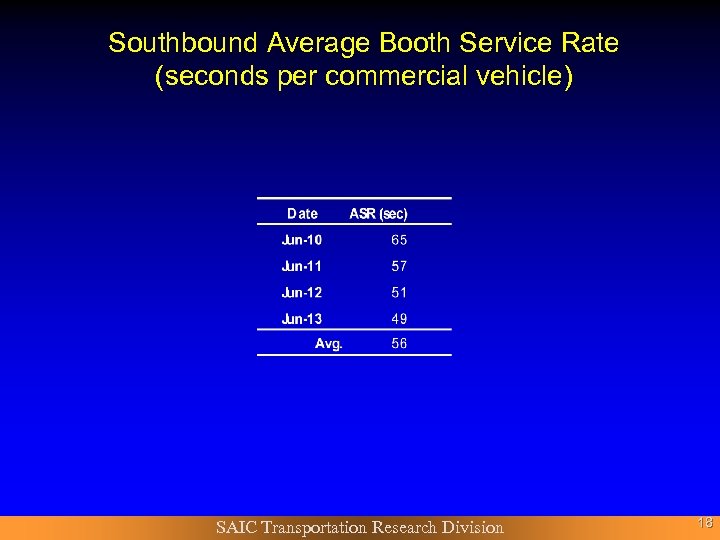
Southbound Average Booth Service Rate (seconds per commercial vehicle) SAIC Transportation Research Division 18
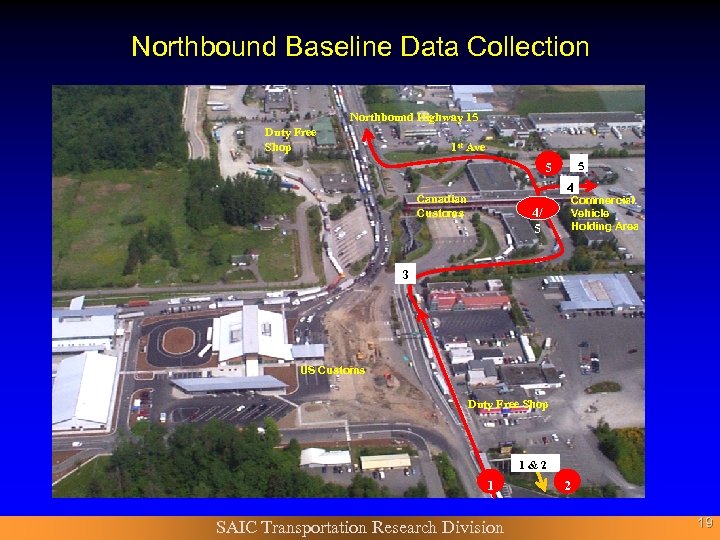
Northbound Baseline Data Collection Northbound Highway 15 Duty Free Shop 1 st Ave 5 5 4 Canadian Customs Commercial Vehicle Holding Area 4/ 5 3 US Customs Duty Free Shop 1&2 1 SAIC Transportation Research Division 2 19
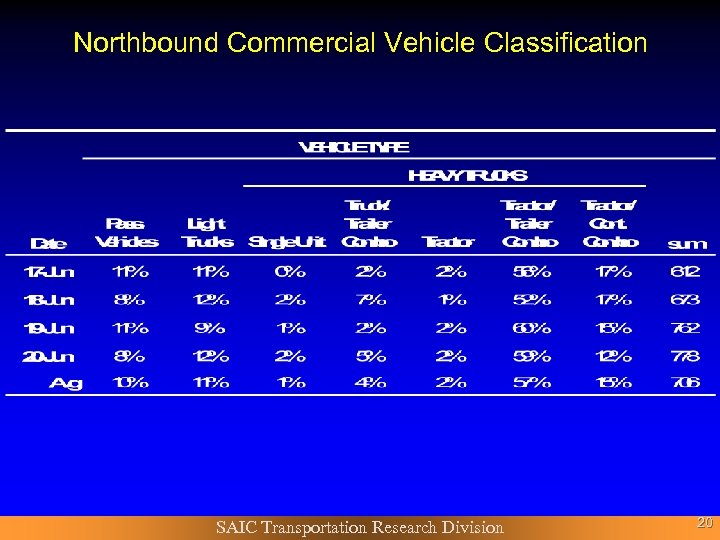
Northbound Commercial Vehicle Classification SAIC Transportation Research Division 20
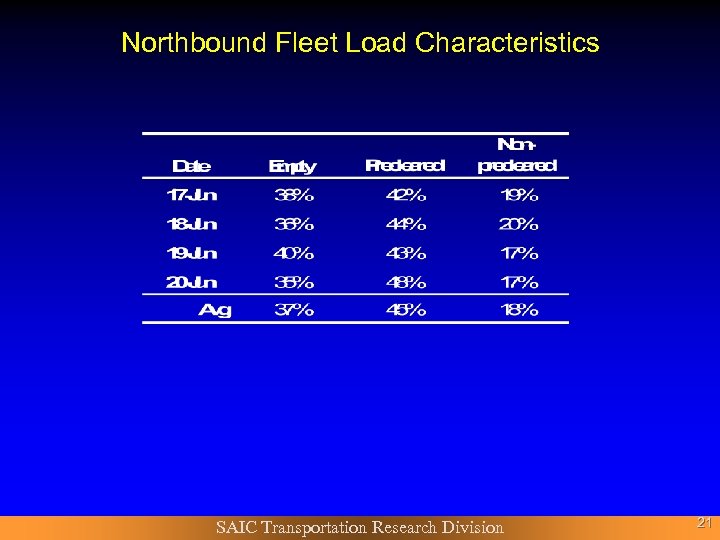
Northbound Fleet Load Characteristics SAIC Transportation Research Division 21
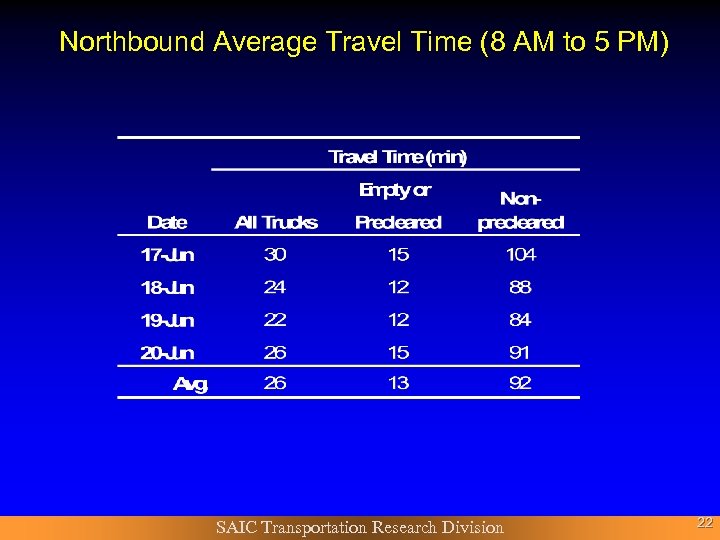
Northbound Average Travel Time (8 AM to 5 PM) SAIC Transportation Research Division 22
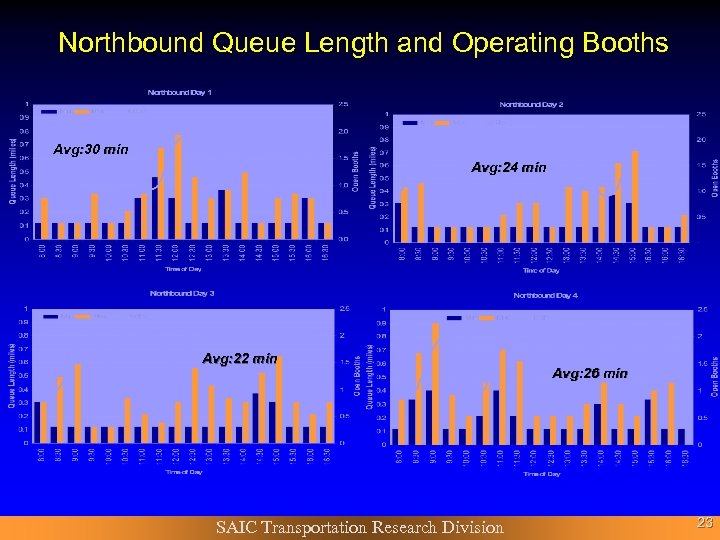
Northbound Queue Length and Operating Booths Avg: 30 min Avg: 24 min Avg: 22 min SAIC Transportation Research Division Avg: 26 min 23
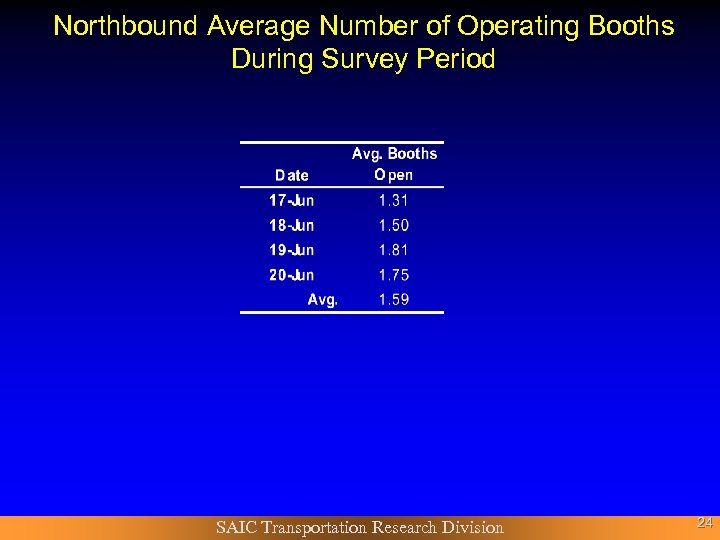
Northbound Average Number of Operating Booths During Survey Period SAIC Transportation Research Division 24
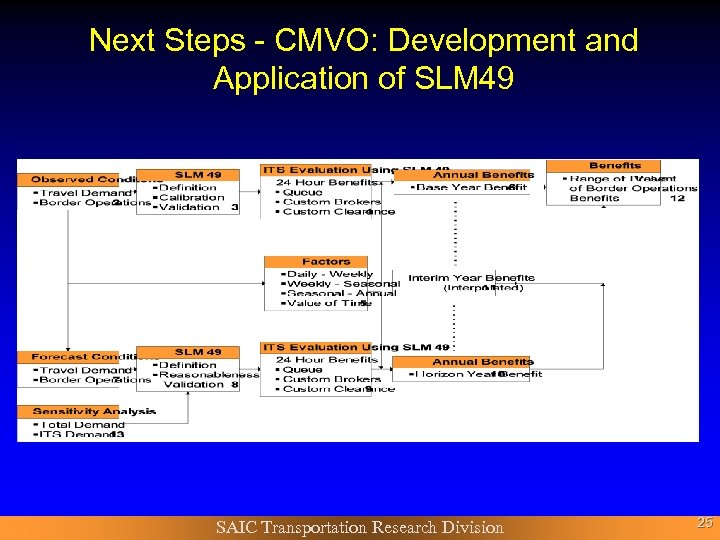
Next Steps - CMVO: Development and Application of SLM 49 SAIC Transportation Research Division 25
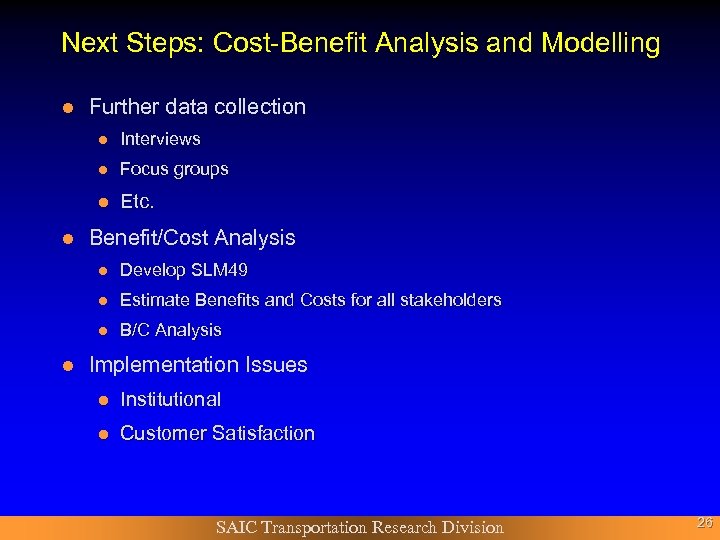
Next Steps: Cost-Benefit Analysis and Modelling l Further data collection l l Focus groups l l Interviews Etc. Benefit/Cost Analysis l l Estimate Benefits and Costs for all stakeholders l l Develop SLM 49 B/C Analysis Implementation Issues l Institutional l Customer Satisfaction SAIC Transportation Research Division 26
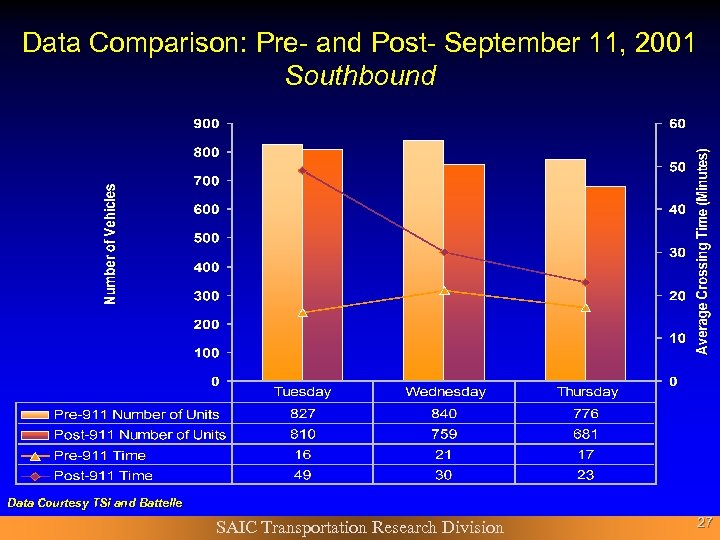
Data Comparison: Pre- and Post- September 11, 2001 Southbound Data Courtesy TSi and Battelle SAIC Transportation Research Division 27
Скачать презентацию International Mobility and Trade Corridor IMTC Freight Technology
b9deb2df5b4500d555900df034495054.ppt