


 Скачать презентацию International Migration Poland to the United Kingdom
9a6f2219d38ad792e549f16b30ce985b.ppt
- Количество слайдов: 18
 International Migration Poland to the United Kingdom
 Migration w Migration is one of the main components influencing the size of a population. w Migration is the movement of people from one place to another involving a permanent change of residence. w Migration is dependent on push factors and pull factors.
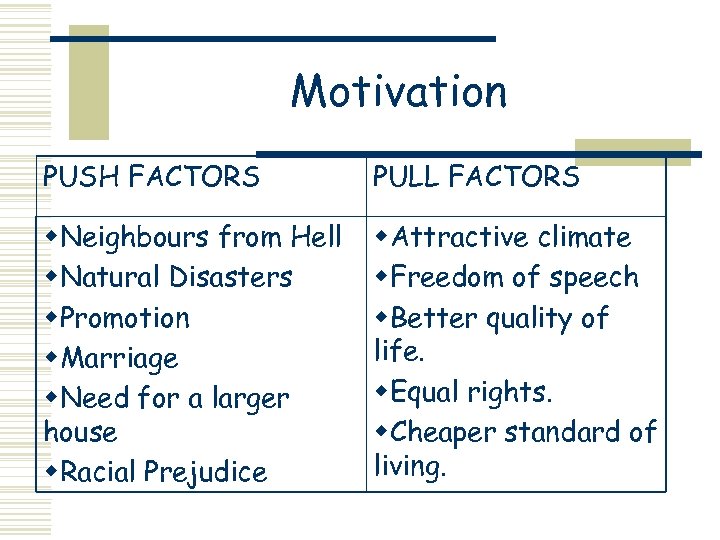 Motivation PUSH FACTORS PULL FACTORS w. Neighbours from Hell w. Natural Disasters w. Promotion w. Marriage w. Need for a larger house w. Racial Prejudice w. Attractive climate w. Freedom of speech w. Better quality of life. w. Equal rights. w. Cheaper standard of living.
 Obstacles to migration w Language barriers w Cultural differences. w Change of lifestyle. w Money/funds w Migration laws/red tape.
 Types of Migration w International. w Voluntary. w Forced. w Rural to urban. w Urban to rural.
 Selectivity w Age w Sex w Education
 How many more can we squeeze in? w For a named example of International Migration. w Poland to the UK. n n Discuss the reasons for the migration. Discuss the impact on the losing and gaining countries.
 The Facts w 427, 000 workers from eight EU accession states successfully applied for work in UK. w Over half (62%) are Polish w 82% are aged 18 -34 w 56% work in factories w : Home Office All figures May 2004 -Jun 2006 except *Jul 2004 -Jun 2006
 The Third Polish Employment Fair in London w This time, there were some 5, 000 Polish people queuing patiently in a west London suburb for a chance to hand over a CV to 40 employment agencies. As they queued to enter the hall that was filled to its legal safety capacity, they scribbled away at resumes, going over their pitch time and time again. w Most were in their mid-20 s. Some had only recently arrived, having stuffed a few belongings into a backpack, bought a oneway no-frills airline ticket. Like Dick Whittington so many centuries before, were they expecting streets paved with gold?
 Personal experience 1… w Back home in Poland, David was a teacher, taking home the equivalent of £ 200 a month. But thrusting flyers nets him £ 600. w "I've got no idea how long I am going to stay, " said David, "But I'm earning so much more I now know why so many people are doing it. My sister came first and suggested that I follow. I'm living pretty cheaply with her at the moment.
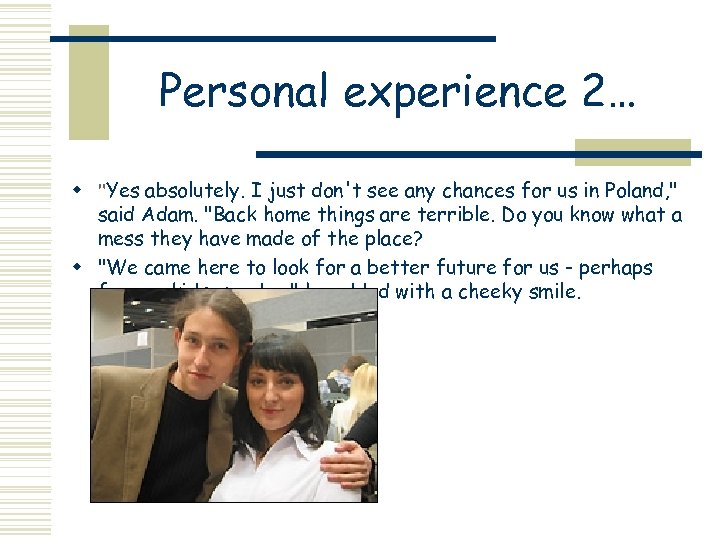 Personal experience 2… w "Yes absolutely. I just don't see any chances for us in Poland, " said Adam. "Back home things are terrible. Do you know what a mess they have made of the place? w "We came here to look for a better future for us - perhaps for our kids one day, " he added with a cheeky smile.
 Types of Jobs…. w The work can be difficult - sometimes it's a job in the food industry where people are working up to 10 hours in a chiller, for instance. w "With one of our clients [in the chilled food industry], most of the workforce are Lithuanian, some are Indian. None of them are British. " w Today employers in more and more sectors have latched on to the idea of picking up cheap Eastern European workers. w ……. . offering work in everything from catering and hospitality to care services, clerical, technical and engineering.
 What attracts employers? ? w That willingness to do jobs that employers say British workers don't want, was at the heart of the boom, said Bob Owen of Polcat, a Doncaster safety training firm targeting the Polish employees market. w "I must admit it, I have never seen a workforce like the Poles, " said Mr Owen. "They want to work, you can see it in their eyes. But here's the thing - they're not in competition with the British workforce - they are finding ways of fulfilling a need that just wasn't being met and that's why they are being welcomed. "
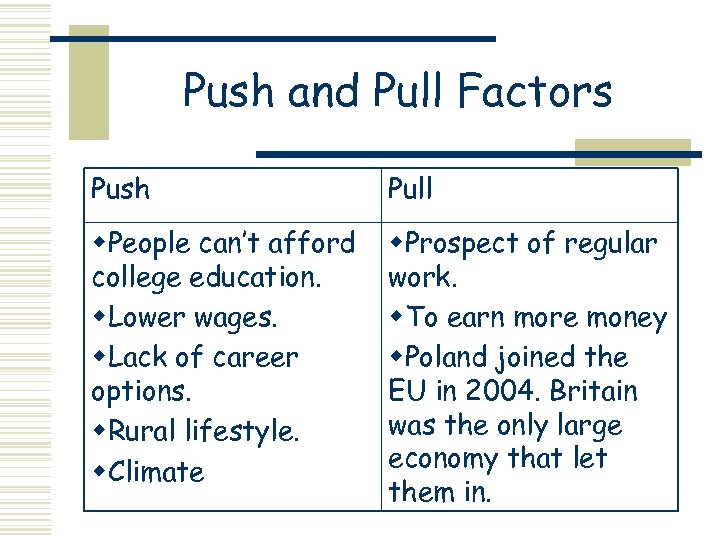 Push and Pull Factors Push Pull w. People can’t afford college education. w. Lower wages. w. Lack of career options. w. Rural lifestyle. w. Climate w. Prospect of regular work. w. To earn more money w. Poland joined the EU in 2004. Britain was the only large economy that let them in.
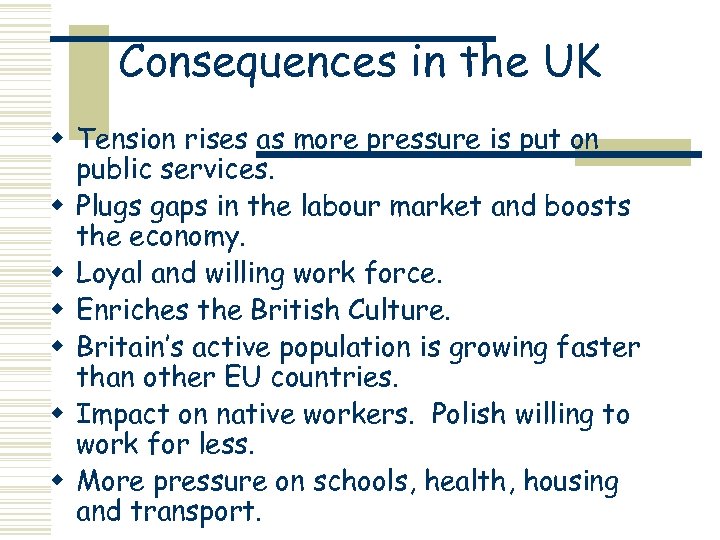 Consequences in the UK w Tension rises as more pressure is put on public services. w Plugs gaps in the labour market and boosts the economy. w Loyal and willing work force. w Enriches the British Culture. w Britain’s active population is growing faster than other EU countries. w Impact on native workers. Polish willing to work for less. w More pressure on schools, health, housing and transport.
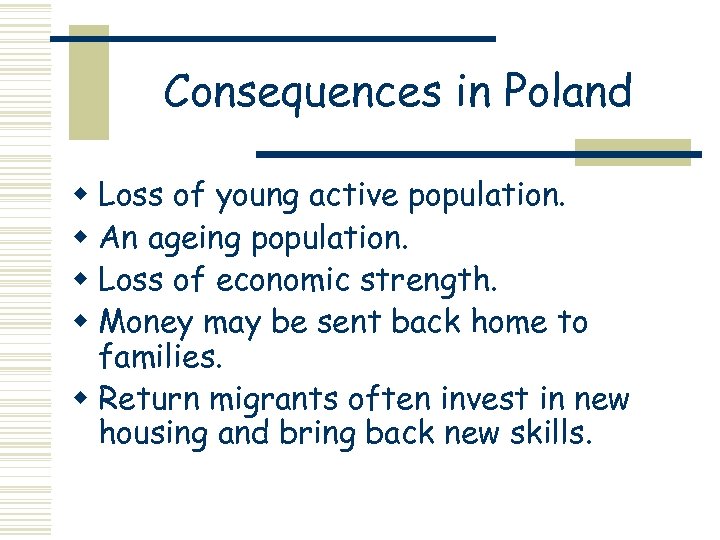 Consequences in Poland w Loss of young active population. w An ageing population. w Loss of economic strength. w Money may be sent back home to families. w Return migrants often invest in new housing and bring back new skills.
 Questions w Where are most people who arrive in the UK migrating from? w How has becoming part of the EU encouraged these people to move? w What other push factors encourage them to leave their home country? w What additional pull factors encourage them to migrate to the UK? w Describe the advantages and disadvantages for the UK of this migration. w How does International migration affect the loosing country?
 w Wedged Amid African Crises, a Neglected Nation Suffers w *Please Note: Archive articles do not include photos, charts or graphics. More information. April 2, 2007, Monday. By LYDIA POLGREEN (NYT); Foreign Desk. Late Edition - Final, Section A, Page 3, Column 1, 809 words DISPLAYING ABSTRACT - John Holmes, United Nations' new under secretary general for humanitarian affairs, visits Central African Republic, nation torn by scorched-earth tactics of its army; pledges more aid to help 210, 000 left homeless and urges aid groups and donors to do more to help nation, one of world's poorest and most unstable; crisis is now more than two years old and fighting has killed thousands of country's four million people and caused hundreds of thousands to flee their homes in flight so desperate that those who can have crossed border into Chad, neighbor that has its own troubles; unlike Chad, suffering of Central African Republic has largely escaped world's notice, resulting in little assistance for people who are utterly destitute