


 Скачать презентацию International Marketing Shlykov O V Ph D
International Marketing 2015.ppt
- Количество слайдов: 176
 International Marketing Shlykov O. V. – Ph. D (RF), МВА (EU) Southern Federal University
 Course Agenda Session 1. International Marketing Concept Session 2. International Marketing Environment Session 3. Foreign Market Entry Strategies Session 4. Portfolio Strategies Session 5. Product Decisions Session 6. Pricing Decisions Session 7. Promotional Decisions Session 8. Distribution decisions Session 9. Marketing-Mix: International Practice Session 10. Marketing Research and International Marketing Plan 2
 Session 1. International Marketing Concept l Marketing - the process of creating, distributing, promoting, and pricing goods, services, and ideas to facilitate satisfying exchange relationships in a dynamic environment l Marketing – winning and “locking-in” customers 3
 Marketing Concept A managerial philosophy that an organization exercise so as to satisfy customer needs through a coordinated set of activities, allowing the organization to achieve its goals as well l Industrial Era (1900) - strong demand, efficiency l Sales Era (1920) - weak demand, sales orientation (sell the produced goods) l Marketing Era (1950) - relationship marketing (long-term, mutually satisfying relationships), produce what is needed l 4
 International Marketing Definitions l Marketing «over political borders» l Marketing targeted at foreign consumer demands l Key decisions: foreign market entry decision specific market decision strategy decision marketing mix decision (5 «р» ) 5
 Famous Marketing Blunders Otis elevator in USSR- sign said good for sex l Parker Pen (ink) in Latin America - false impression that the product helped preventing pregnancies l Pepsi Cola in Germany- translated from Come Alive with Pepsi to Come out of the Grave with Pepsi l GM in Belgium- translation error made Body by Fisher as Corpse by Fisher l 6
 Famous Marketing Blunders l l l Exxon (gas) in Thailand - used meaningless tiger symbol Warner-Lampert (mouthwash) in Thailand - depicted love scenes in violation of local customs Mc. Donald Douglas (aircraft) in India - mistakenly depicted Pakistan people instead of Indians Goodyear Tire in Germany - made illegal claims of superiority General Mills (breakfast cereal) in England - appealed to kids 7
 Export Motives Internal proactive: l managerial urge, growth / profit goals, marketing skills, economies of scale, unique product l l Internal reactive: risk diversification, excess capacity, extend sales of a seasonable product l External proactive: foreign market opportunities, promoting organizations External reactive: foreign initiator, home market limitations, stagnant or declining home market, global company attack 8
 Possible Risks l Misunderstanding foreign consumer l Low product competitiveness l Different business culture l Lack of communication skills l Unfamiliar legal environment (extra costs) l Lack of managers with foreign experience l Political, legal, currency risks 9
 Marketing Strategy l Target market - a specific group of buyers whose needs and wants a company focuses its marketing efforts on l Marketing Mix - 4 «P» (+People), firmcontrolled marketing activities l Marketing environment - competitive, economic, political, legal, sociocultural, technological factors which face buyers and affect the marketing mix 10
 Global Economy l Internationalization (aspects - world trade, direct investments; drivers - market opportunities, excessive capacity) l Global segments l Blurring (deleting borders among states, industries, goods/services/impressions) l Acceleration of business (trades, product development, order execution; intangible assets; connectivity - people, firms, nations) 11
 Strategic Choice l l l Global marketing (Coca-Cola, Mc. Donalds, Levi Straus, Marlboro) / Multinational marketing (Unilever 1000 brandnames, P&G) Logic for standardization - homogeneity of needs, lower prices, higher quality, global segments growth, “one sight, one sound, one sale”, “echo” effect Logic for adaptation - heterogeneity of needs Mandatory adaptation - language, differing standards (electrical systems, measurement systems), legislation. . Voluntary adaptation - exporter’s decision Often- a compromise of the two strategies (“think globally, act locally”) 12
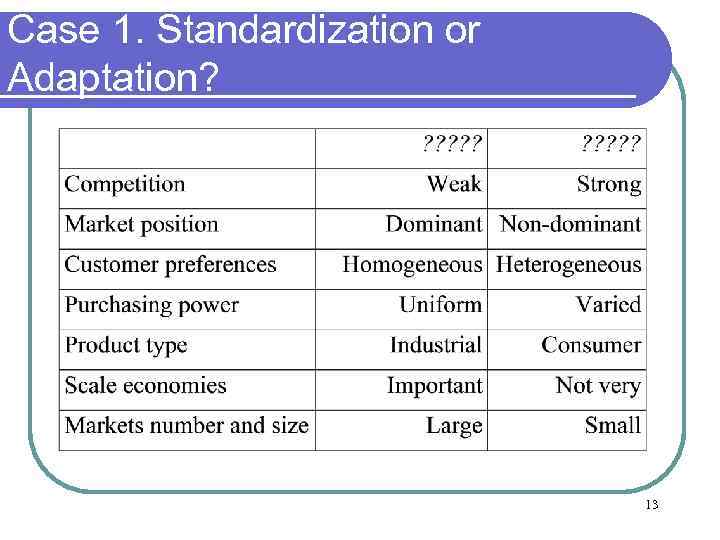 Case 1. Standardization or Adaptation? 13
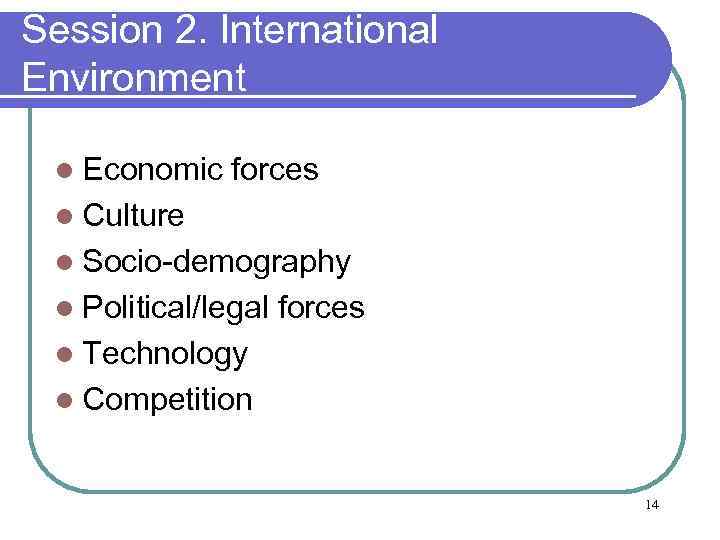 Session 2. International Environment l Economic forces l Culture l Socio-demography l Political/legal forces l Technology l Competition 14
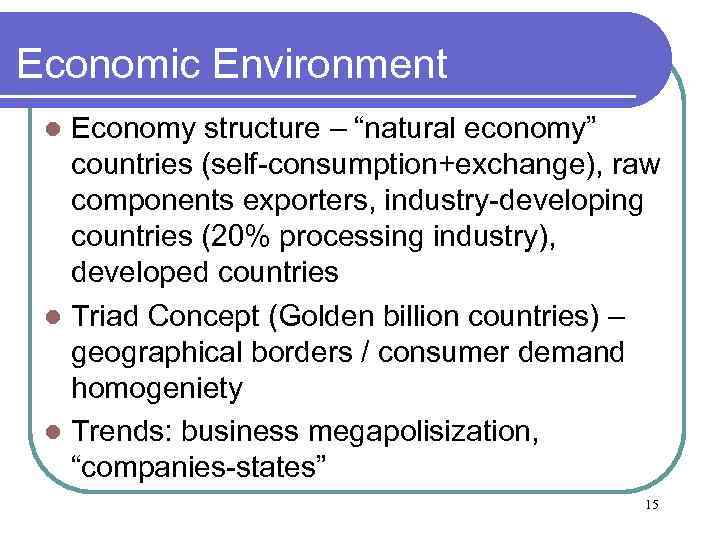 Economic Environment Economy structure – “natural economy” countries (self-consumption+exchange), raw components exporters, industry-developing countries (20% processing industry), developed countries l Triad Concept (Golden billion countries) – geographical borders / consumer demand homogeniety l Trends: business megapolisization, “companies-states” l 15
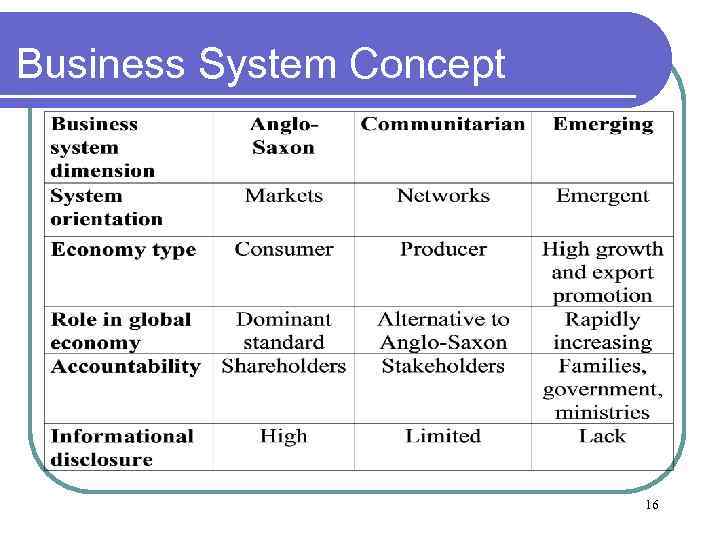 Business System Concept 16
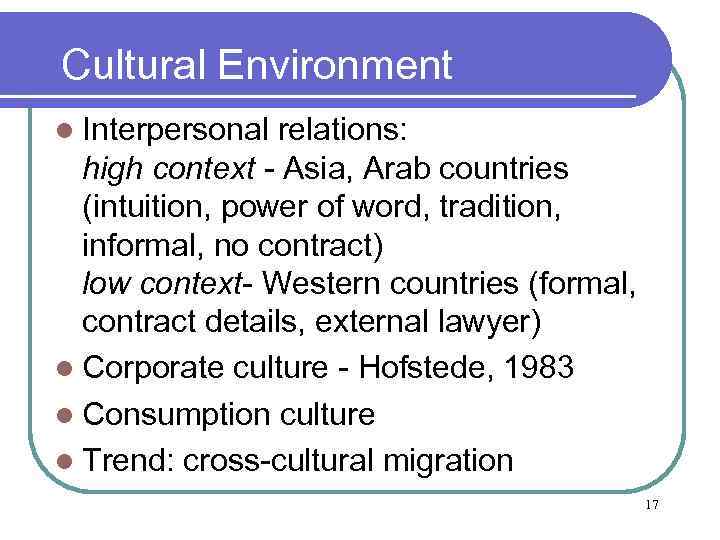 Cultural Environment l Interpersonal relations: high context - Asia, Arab countries (intuition, power of word, tradition, informal, no contract) low context- Western countries (formal, contract details, external lawyer) l Corporate culture - Hofstede, 1983 l Consumption culture l Trend: cross-cultural migration 17
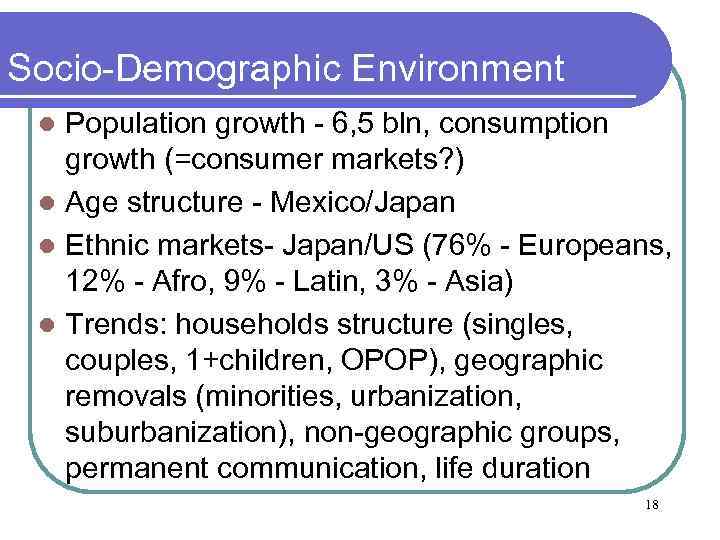 Socio-Demographic Environment Population growth - 6, 5 bln, consumption growth (=consumer markets? ) l Age structure - Mexico/Japan l Ethnic markets- Japan/US (76% - Europeans, 12% - Afro, 9% - Latin, 3% - Asia) l Trends: households structure (singles, couples, 1+children, ОРОР), geographic removals (minorities, urbanization, suburbanization), non-geographic groups, permanent communication, life duration l 18
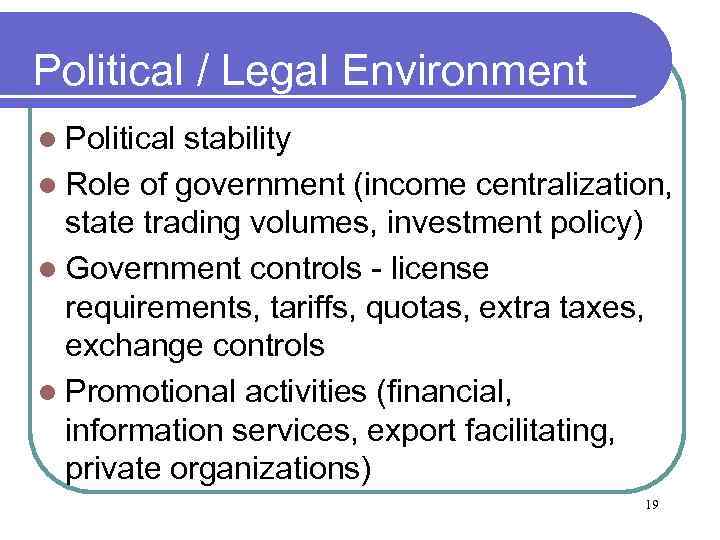 Political / Legal Environment l Political stability l Role of government (income centralization, state trading volumes, investment policy) l Government controls - license requirements, tariffs, quotas, extra taxes, exchange controls l Promotional activities (financial, information services, export facilitating, private organizations) 19
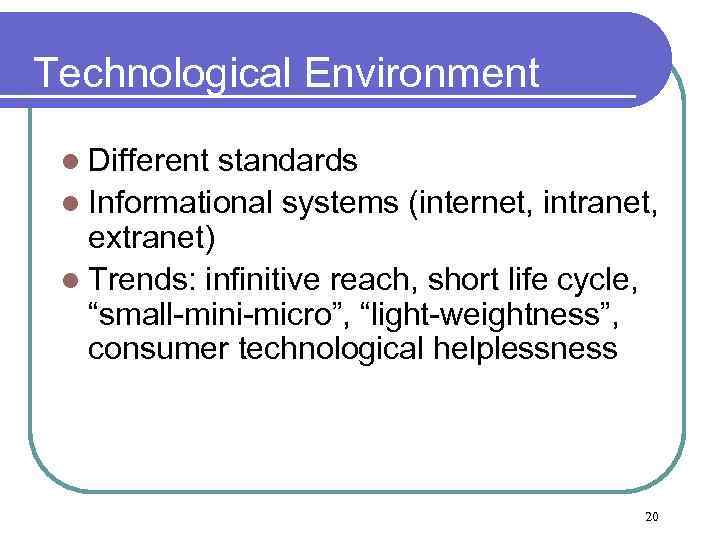 Technological Environment l Different standards l Informational systems (internet, intranet, extranet) l Trends: infinitive reach, short life cycle, “small-mini-micro”, “light-weightness”, consumer technological helplessness 20
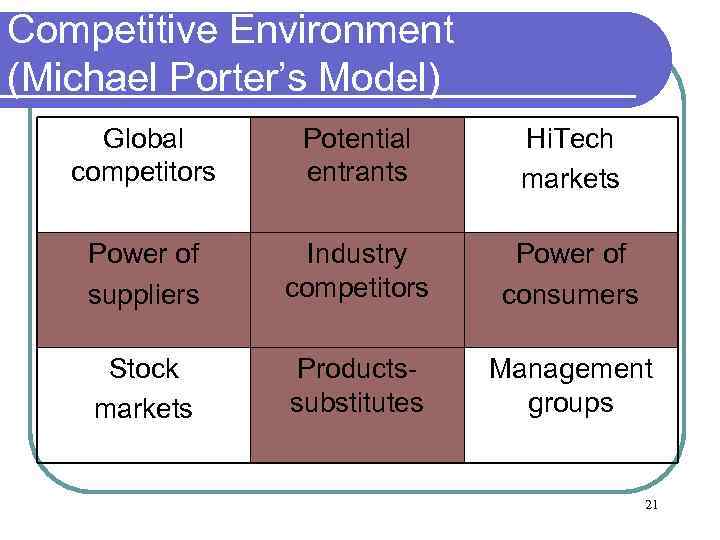 Competitive Environment (Michael Porter’s Model) Global competitors Potential entrants Hi. Tech markets Power of suppliers Industry competitors Power of consumers Stock markets Productssubstitutes Management groups 21
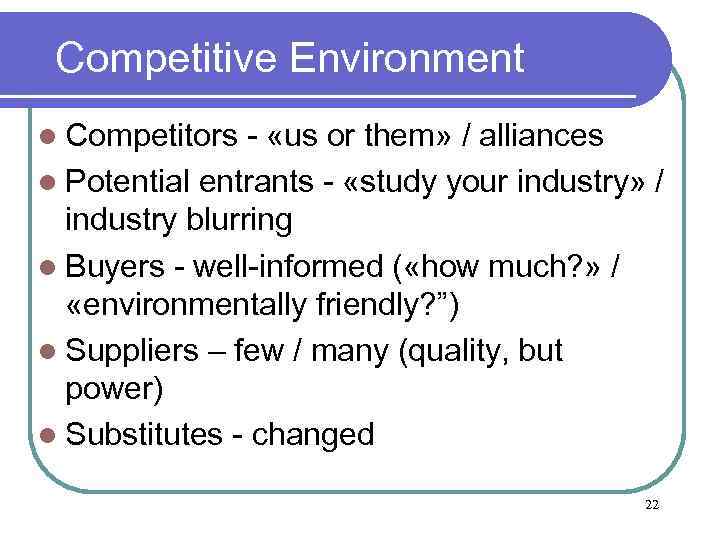 Competitive Environment l Competitors - «us or them» / alliances l Potential entrants - «study your industry» / industry blurring l Buyers - well-informed ( «how much? » / «environmentally friendly? ”) l Suppliers – few / many (quality, but power) l Substitutes - changed 22
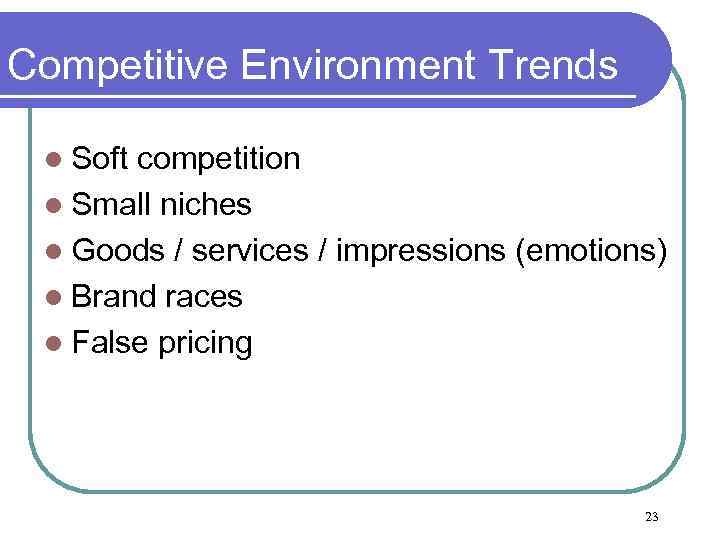 Competitive Environment Trends l Soft competition l Small niches l Goods / services / impressions (emotions) l Brand races l False pricing 23
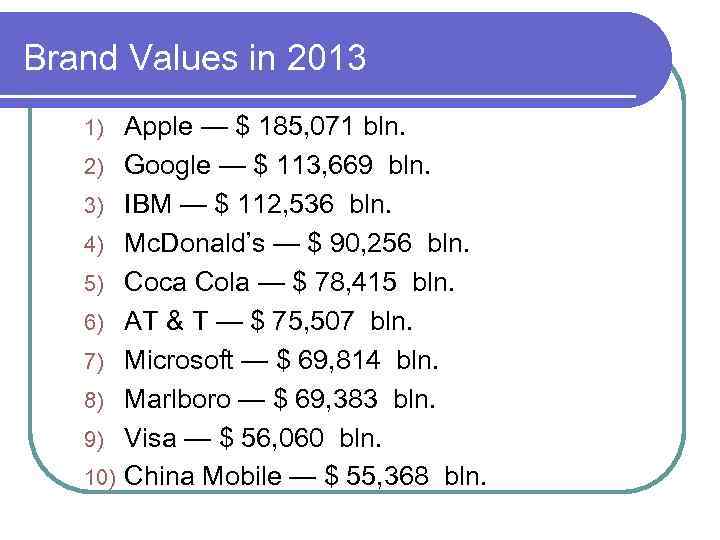 Brand Values in 2013 1) 2) 3) 4) 5) 6) 7) 8) 9) 10) Apple — $ 185, 071 bln. Google — $ 113, 669 bln. IBM — $ 112, 536 bln. Mc. Donald’s — $ 90, 256 bln. Coca Cola — $ 78, 415 bln. AT & T — $ 75, 507 bln. Microsoft — $ 69, 814 bln. Marlboro — $ 69, 383 bln. Visa — $ 56, 060 bln. China Mobile — $ 55, 368 bln.
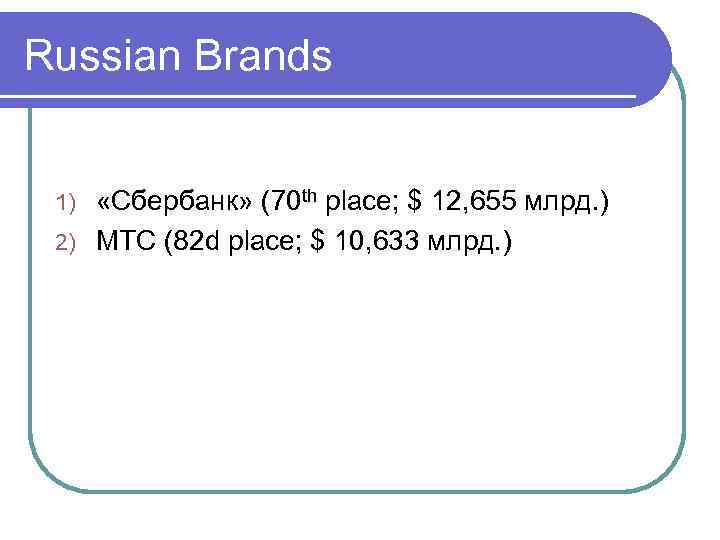 Russian Brands «Сбербанк» (70 th place; $ 12, 655 млрд. ) 2) МТС (82 d place; $ 10, 633 млрд. ) 1)
 Case 2. IKEA’s Expantion in the U. S. Market What are the reasons behind IKEA'S success in the United States market? Ø Why is advertising so important in the US market? Ø What are the risks associated with the kind of TV advertising campaign initiated by IKEA? Ø Why didn’t “word-of-mouth” work for IKEA? Ø
 Session 3. Foreign Market Entry Strategies Market Selection Methods l PEST-analysis l SWOT-analysis l Market Penetration Strategies l Target Market Segmentation l Competitive Differentiation and Positioning l 27
 Foreign Market Entry Goals l Profit l Market share l Market test l Risk diversification l Setting barriers to competitors 28
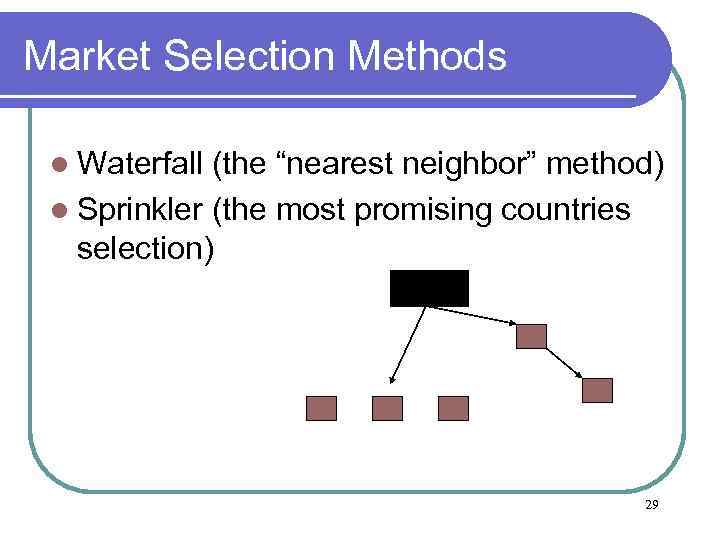 Market Selection Methods l Waterfall (the “nearest neighbor” method) l Sprinkler (the most promising countries selection) 29
 First-Rank Criteria l Measurability of segments (size, purchasing power) l Consumer accessibility (language, skills, understanding foreign culture) l Profitability (adaptation cost, tariffs, taxes, cost of resources) l Marketing effectiveness (consumer attitudes, education, feedback profile) 30
 “Sprinkler” Steps l Geographic segmentation - market indicators (barriers), product indicators (barriers), market potential evaluation l Socio-economic segmentation - demand indicators (qualitative, quantitative), supply indicators (competition, distribution, media) l Sales and profitability evaluation - matching to company goals and resources 31
 Indicators of Segmentation l Market indicators (not depend on a specific situation): country (economy, politics, culture, demography, population), consumer (demographic, socio-economic, phsicographic characteristics) l Product indicators: country (economic and legal barriers, market conditions, lifestyle), consumer (behavior - consumption, attitudes, loyalty, benefit) 32
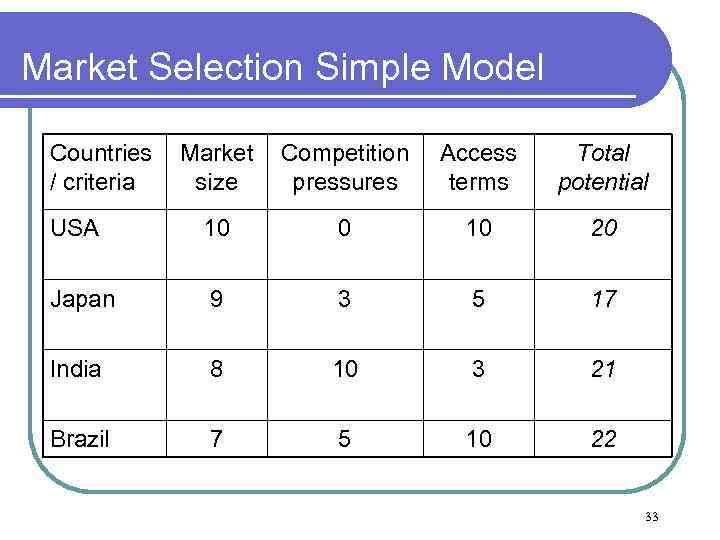 Market Selection Simple Model Countries Market Competition / criteria size pressures Access terms Total potential USA 10 0 10 20 Japan 9 3 5 17 India 8 10 3 21 Brazil 7 5 10 22 33
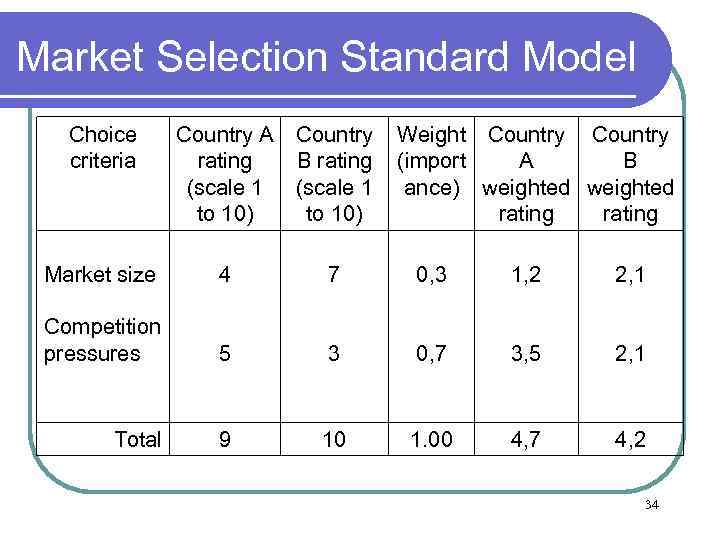 Market Selection Standard Model Choice criteria Country A Country Weight Country rating B rating (import A B (scale 1 ance) weighted to 10) rating Market size 4 7 0, 3 1, 2 2, 1 Competition pressures 5 3 0, 7 3, 5 2, 1 Total 9 10 1. 00 4, 7 4, 2 34
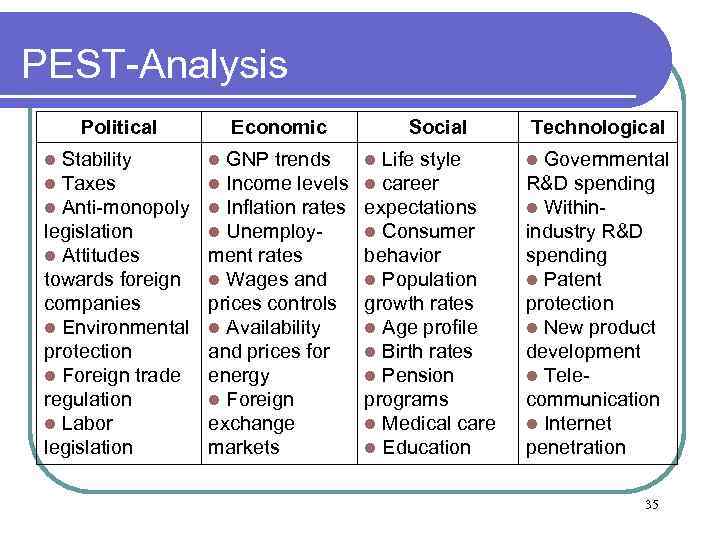 PEST-Analysis Political Economic l Stability l GNP trends l Taxes l Income levels l Anti-monopoly l Inflation rates legislation l Unemployl Attitudes ment rates towards foreign l Wages and companies l Environmental protection l Foreign trade regulation l Labor legislation prices controls l Availability and prices for energy l Foreign exchange markets Social l Life style l career expectations l Consumer behavior l Population growth rates l Age profile l Birth rates l Pension programs l Medical care l Education Technological l Governmental R&D spending l Withinindustry R&D spending l Patent protection l New product development l Telecommunication l Internet penetration 35
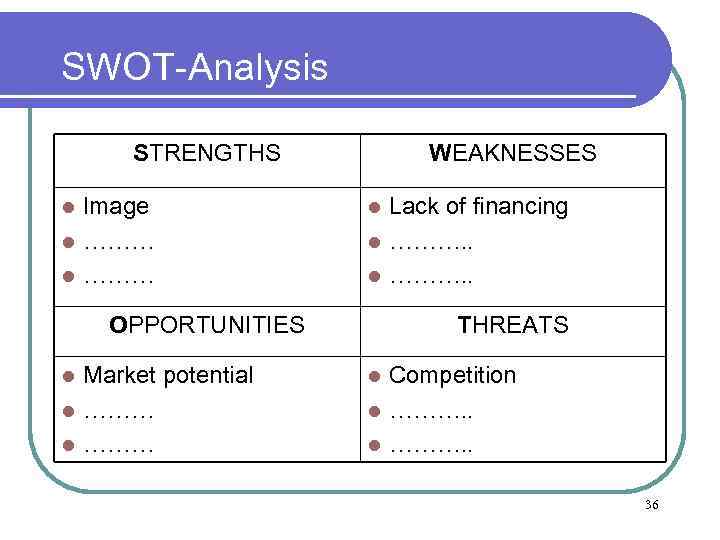 SWOT-Analysis STRENGTHS WEAKNESSES l Image l Lack of financing l ………. . OPPORTUNITIES THREATS l Market potential l Competition l ………. . 36
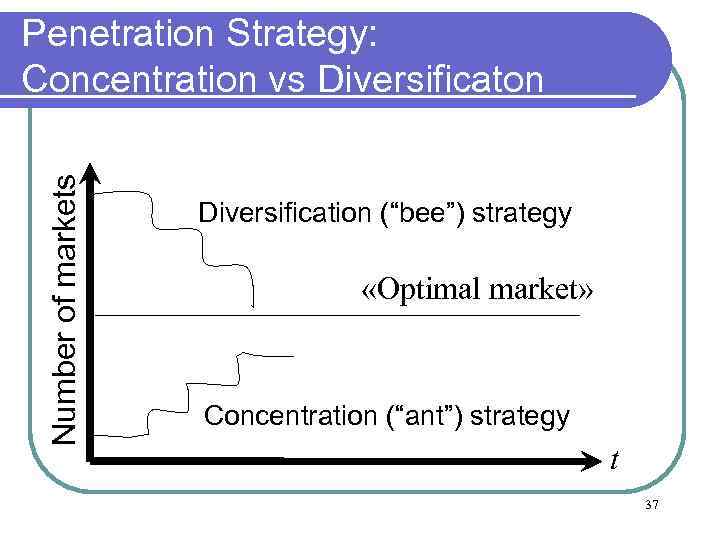 Number of markets Penetration Strategy: Concentration vs Diversificaton Diversification (“bee”) strategy «Optimal market» Concentration (“ant”) strategy t 37
 Concentration vs Diversificaton (Key Decision) 1) Competitive goal (diversificaton – setting barriers for entrants, concentration - achieving high market share and strong competitive position in a country) 2) Different efforts in marketing (diversificaton - rely on local distributors, concentration - invest in marketing mix, get more control over the market) 38
 Concentration vs. Diversification (Strengths) Concentration Diversification l Specialization l Greater flexibility l Market penetration l Less dependence l Market knowledge l Lower risk l Staff experience l Lower costs per l Networking country 39
 Target Market Segmentation l Breaking down the market for a particular product or service into segments of customers that differ in terms of response to marketing strategies l Geographical and demographic criteria l New marketing era (new criteria) l “Segments of one” (personalization) 40
 Positioning – creating and retaining a clear product image (perception) in customers’ mind Which differences are the most significant for customers? 2) What are the positions of competitors relatively to those differences? 3) What is the best position? 1)
 Positioning modes l Product functions l Advantages, problem solving l Usage method l User category l Relation (comparison) to (with) another product
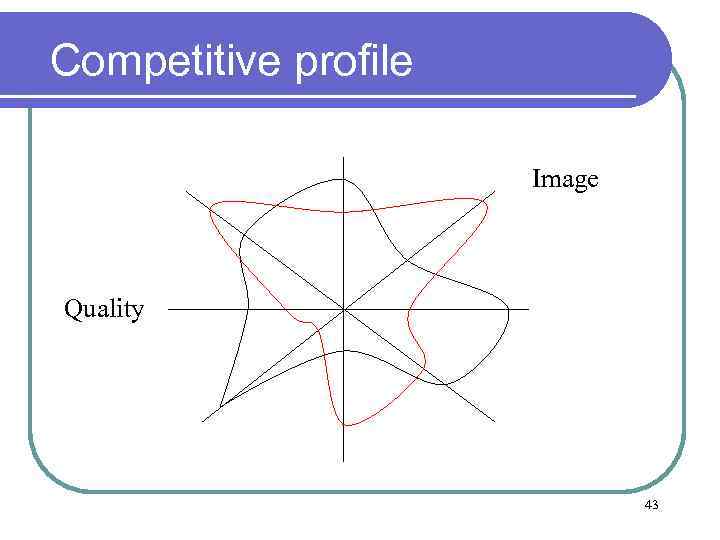 Competitive profile Image Quality 43
 Competitive differentiation l Competitive differentiation – designing differentiating characteristics of a product comparatively to competitors 44
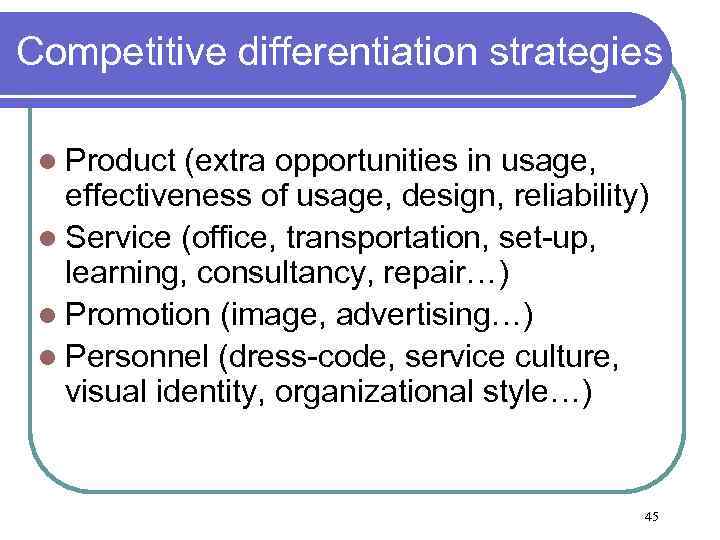 Competitive differentiation strategies l Product (extra opportunities in usage, effectiveness of usage, design, reliability) l Service (office, transportation, set-up, learning, consultancy, repair…) l Promotion (image, advertising…) l Personnel (dress-code, service culture, visual identity, organizational style…) 45
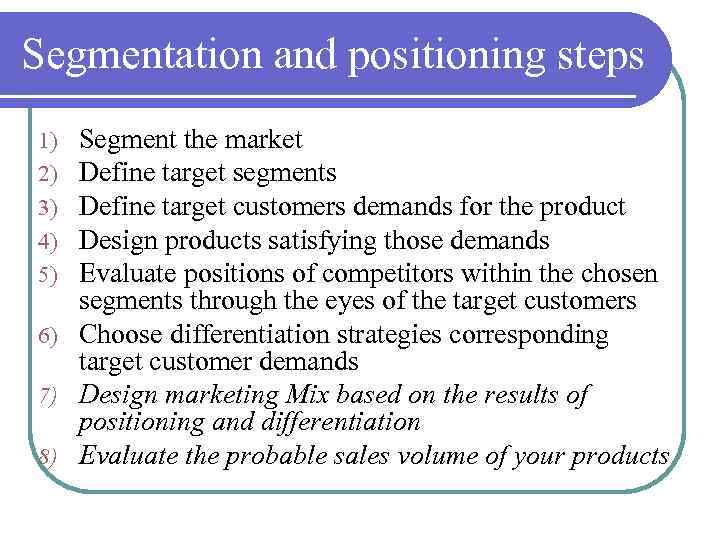 Segmentation and positioning steps Segment the market Define target segments Define target customers demands for the product Design products satisfying those demands Evaluate positions of competitors within the chosen segments through the eyes of the target customers 6) Choose differentiation strategies corresponding target customer demands 7) Design marketing Mix based on the results of positioning and differentiation 8) Evaluate the probable sales volume of your products 1) 2) 3) 4) 5)
 Case 3 a. Novo. Nordisk Segmentation What is the target market for a pharmaceutical company?
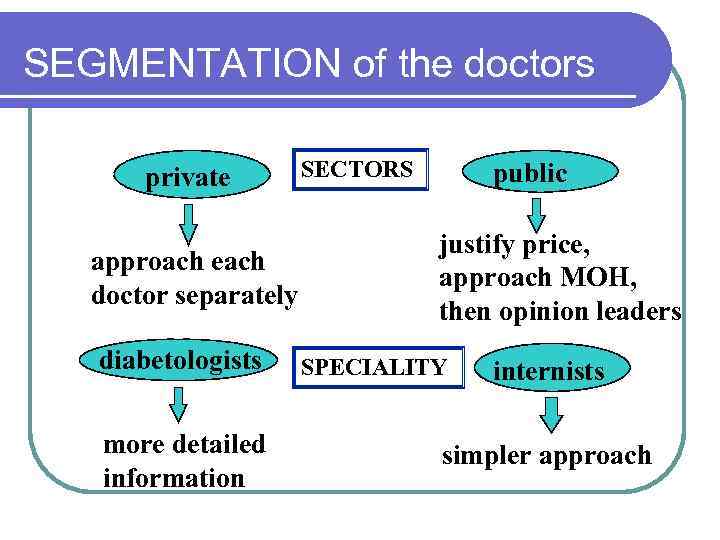 SEGMENTATION of the doctors private approach each doctor separately diabetologists more detailed information SECTORS public justify price, approach MOH, then opinion leaders SPECIALITY internists simpler approach
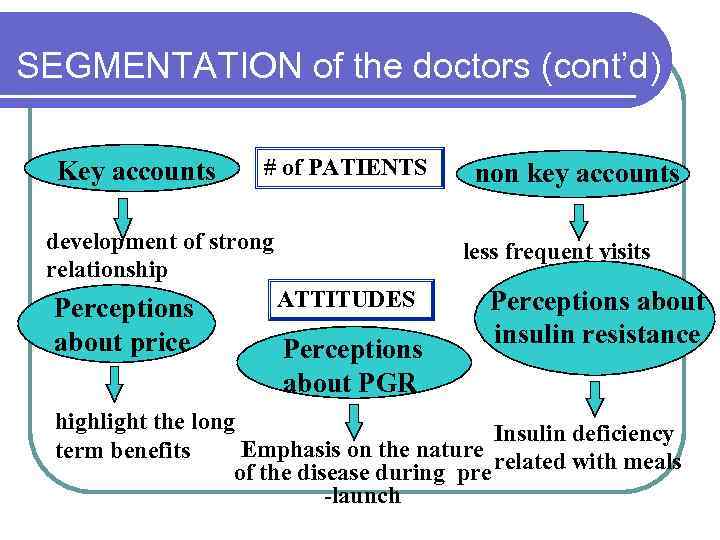 SEGMENTATION of the doctors (cont’d) Key accounts # of PATIENTS development of strong relationship Perceptions about price non key accounts less frequent visits ATTITUDES Perceptions about PGR Perceptions about insulin resistance highlight the long Insulin deficiency Emphasis on the nature term benefits of the disease during pre related with meals -launch
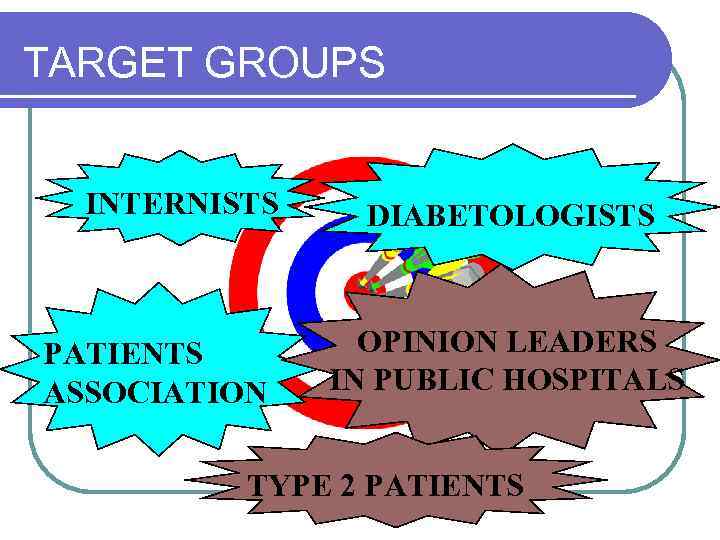 TARGET GROUPS INTERNISTS PATIENTS ASSOCIATION DIABETOLOGISTS OPINION LEADERS IN PUBLIC HOSPITALS TYPE 2 PATIENTS
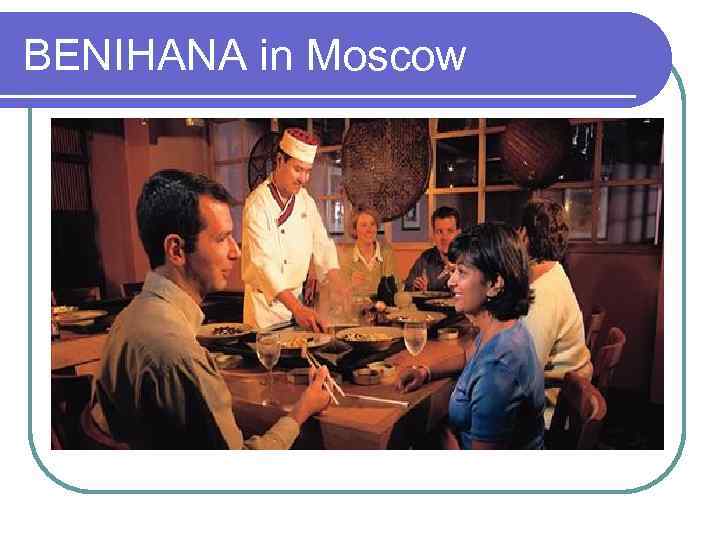
 Case 3 b. BENIHANA of TOKYO l Rocky Aoki Story – the first restaurant in New York l Characteristics of an American consumer l Japanese cooking in American style
 BENIHANA success factors l Low cost of employees l Low cost of food l Low cost of beverages l Good placing l Aggressive advertising
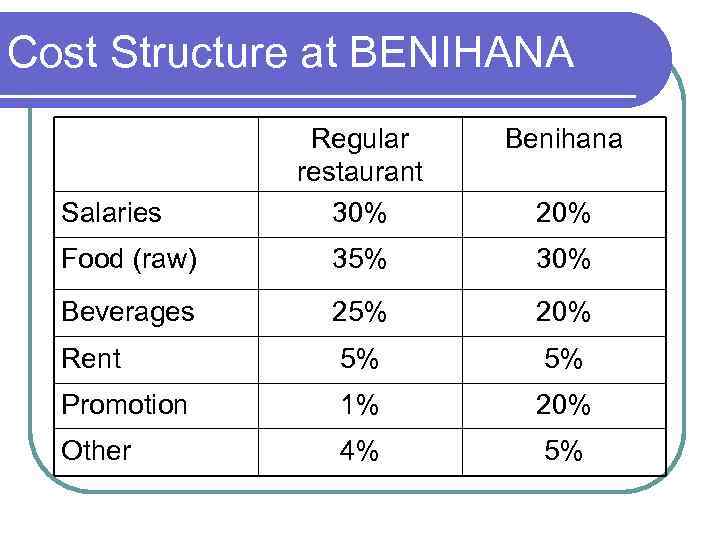 Cost Structure at BENIHANA Regular restaurant 30% Benihana Food (raw) 35% 30% Beverages 25% 20% Rent 5% 5% Promotion 1% 20% Other 4% 5% Salaries 20%
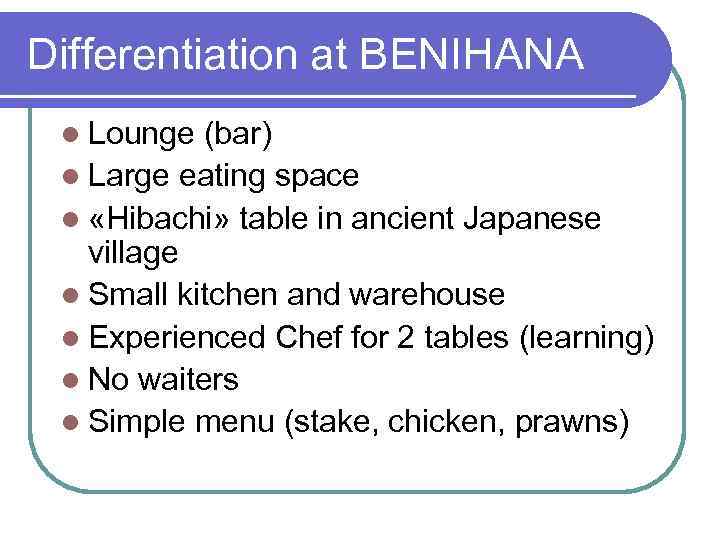 Differentiation at BENIHANA l Lounge (bar) l Large eating space l «Hibachi» table in ancient Japanese village l Small kitchen and warehouse l Experienced Chef for 2 tables (learning) l No waiters l Simple menu (stake, chicken, prawns)
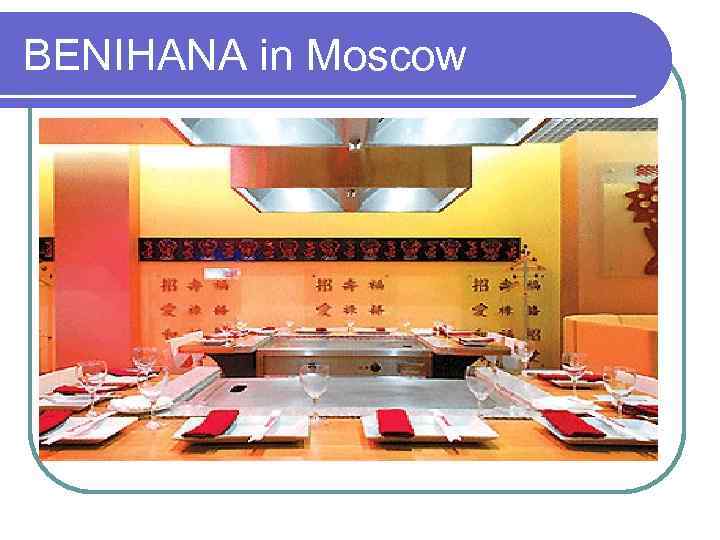 BENIHANA in Moscow
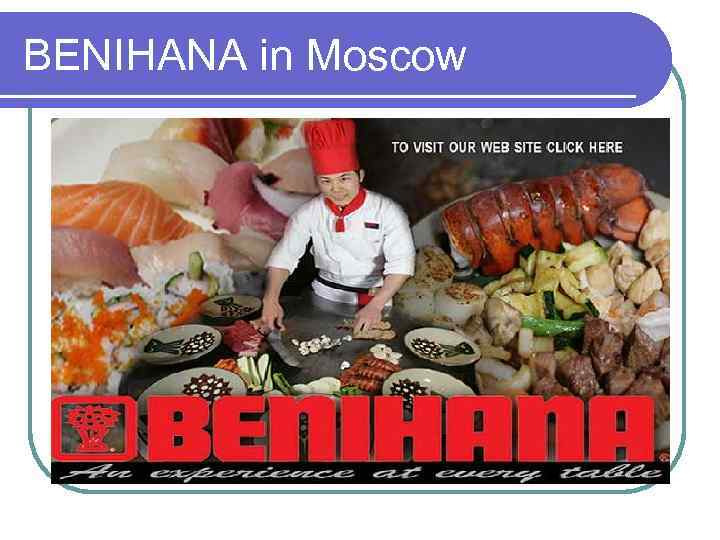 BENIHANA in Moscow
 BENIHANA in Moscow
 BENIHANA in Moscow
 Session 4. Portfolio Strategies l Boston Consulting Group Matrix l General Electric Matrix
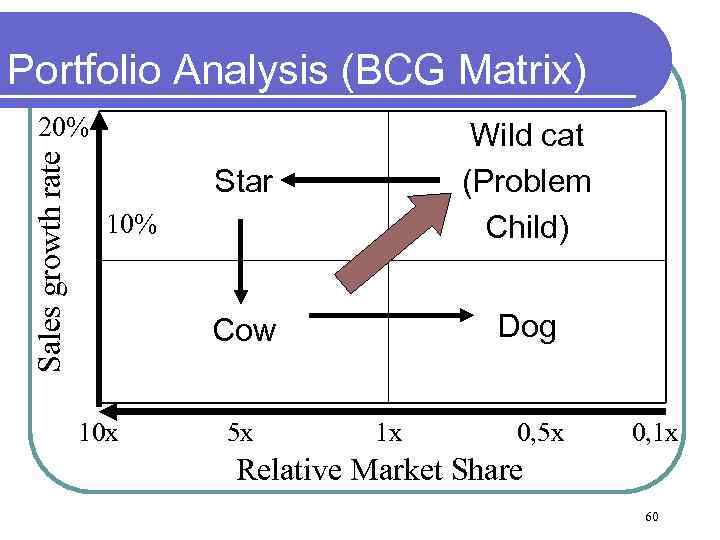 Portfolio Analysis (BCG Matrix) Sales growth rate 20% Star Wild cat (Problem Child) Cow Dog 10% 10 x 5 x 1 x 0, 5 x 0, 1 x Relative Market Share 60
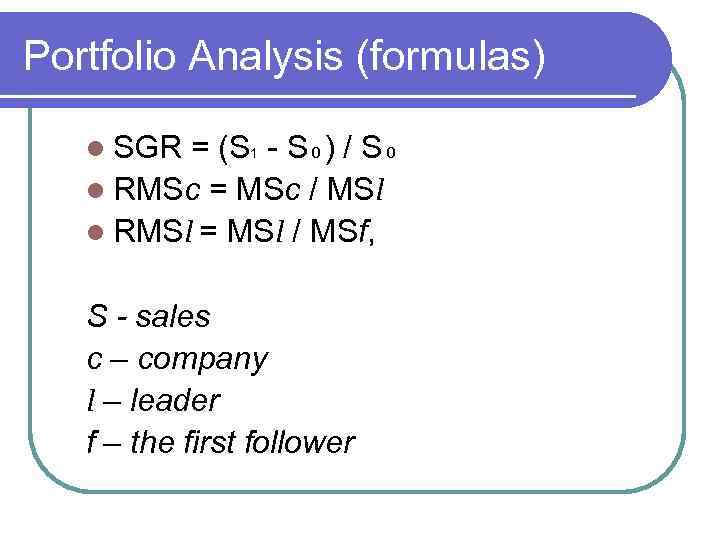 Portfolio Analysis (formulas) l SGR = (S 1 - S₀) / S₀ l RMSc = MSc / MSl l RMSl = MSl / MSf, S - sales c – company l – leader f – the first follower
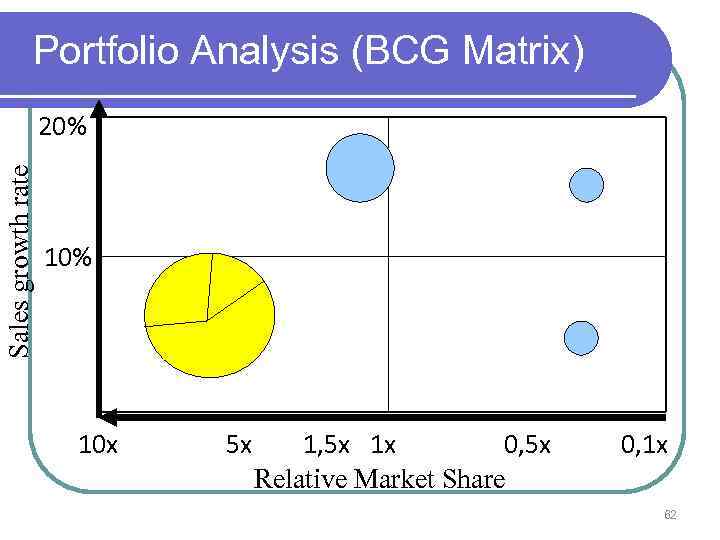 Portfolio Analysis (BCG Matrix) Sales growth rate 20% 10 x 5 x 1, 5 х 1 x 0, 5 x Relative Market Share 0, 1 x 62
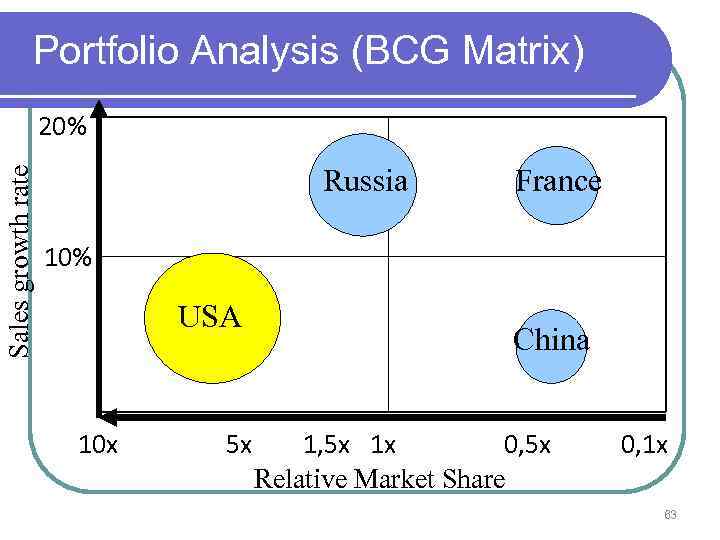 Portfolio Analysis (BCG Matrix) Sales growth rate 20% Russia France 10% USA 10 x 5 x China 1, 5 х 1 x 0, 5 x Relative Market Share 0, 1 x 63
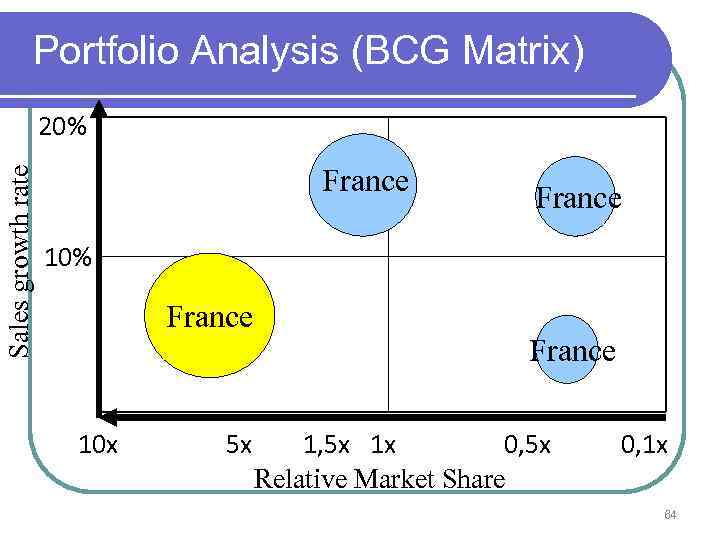 Portfolio Analysis (BCG Matrix) Sales growth rate 20% France 10% France 10 x 5 x France 1, 5 х 1 x 0, 5 x Relative Market Share 0, 1 x 64
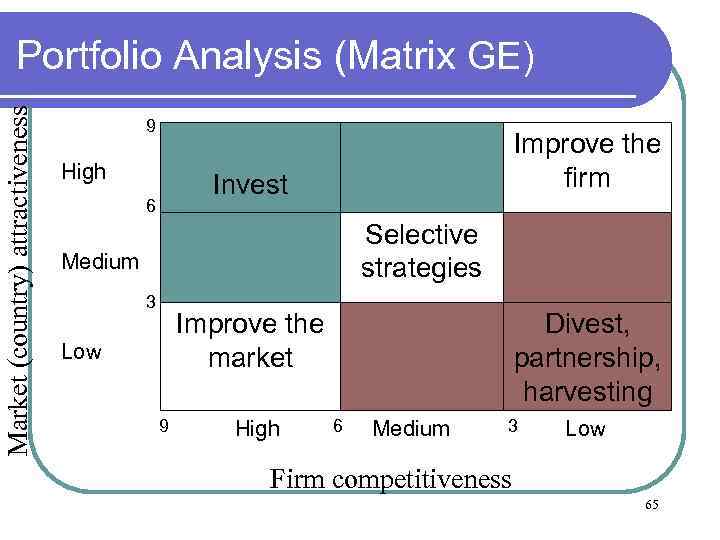 Market (country) attractiveness Portfolio Analysis (Matrix GE) 9 High 6 Invest Selective strategies Medium 3 Low Improve the firm Improve the market 9 High Divest, partnership, harvesting 6 Medium 3 Low Firm competitiveness 65
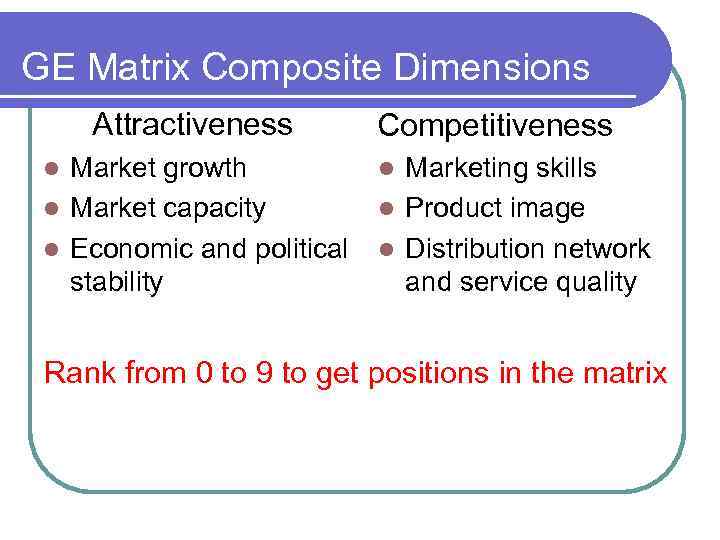 GE Matrix Composite Dimensions Attractiveness Competitiveness Market growth l Marketing skills l Market capacity l Product image l Economic and political l Distribution network stability and service quality l Rank from 0 to 9 to get positions in the matrix
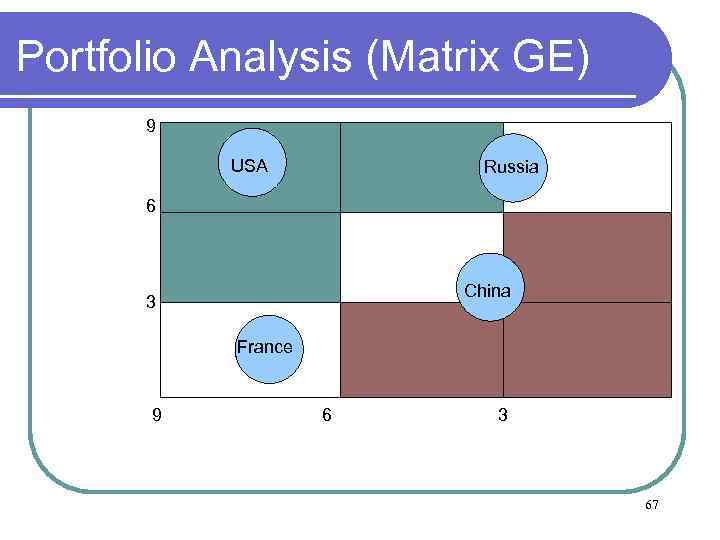 Portfolio Analysis (Matrix GE) 9 USA Russia 6 China 3 France 9 6 3 67
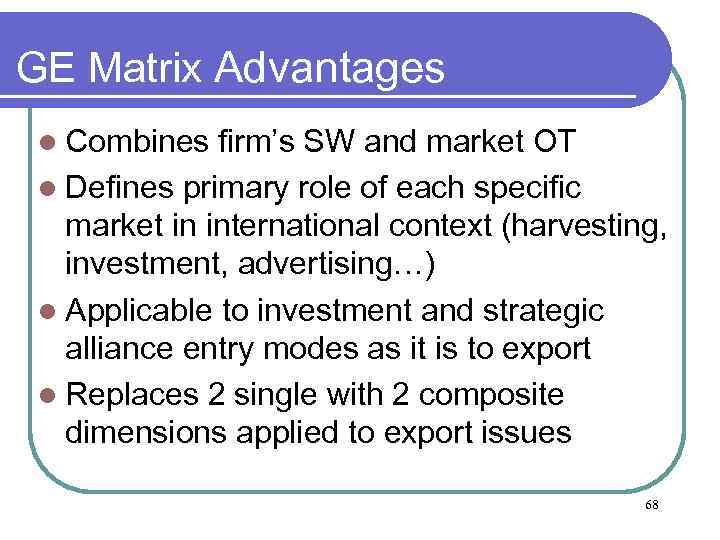 GE Matrix Advantages l Combines firm’s SW and market OT l Defines primary role of each specific market in international context (harvesting, investment, advertising…) l Applicable to investment and strategic alliance entry modes as it is to export l Replaces 2 single with 2 composite dimensions applied to export issues 68
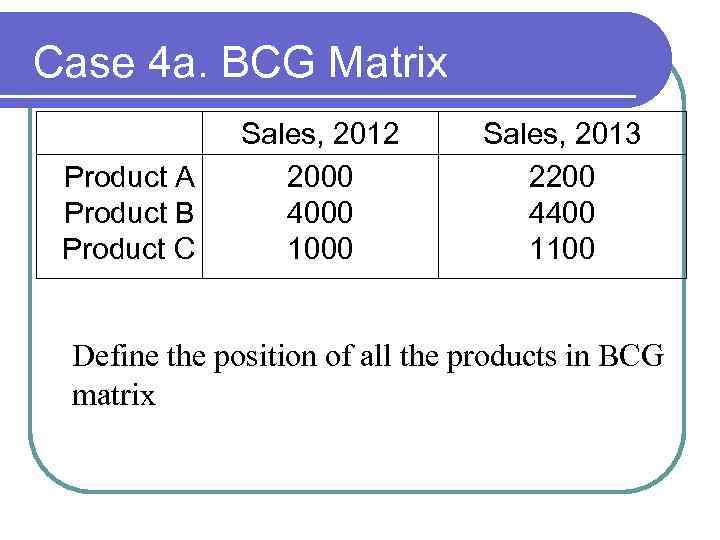 Case 4 a. BCG Matrix Product A Product B Product C Sales, 2012 2000 4000 1000 Sales, 2013 2200 4400 1100 Define the position of all the products in BCG matrix
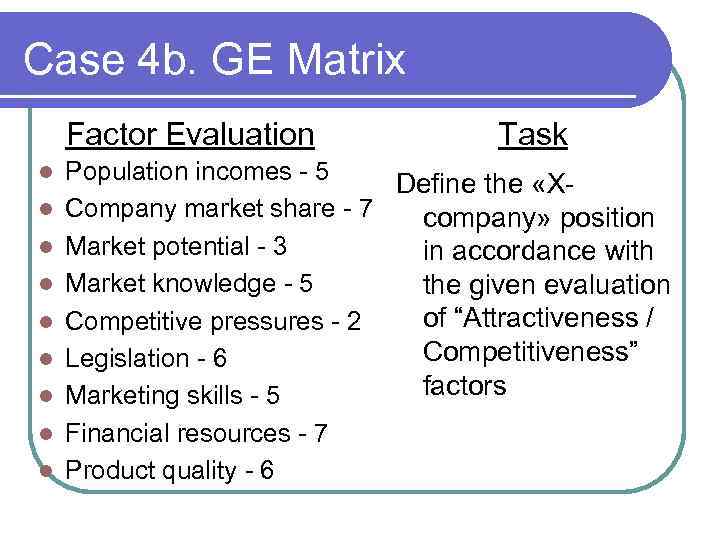 Case 4 b. GE Matrix Factor Evaluation l l l l l Task Population incomes - 5 Define the «ХCompany market share - 7 company» position Market potential - 3 in accordance with Market knowledge - 5 the given evaluation of “Attractiveness / Competitive pressures - 2 Competitiveness” Legislation - 6 factors Marketing skills - 5 Financial resources - 7 Product quality - 6
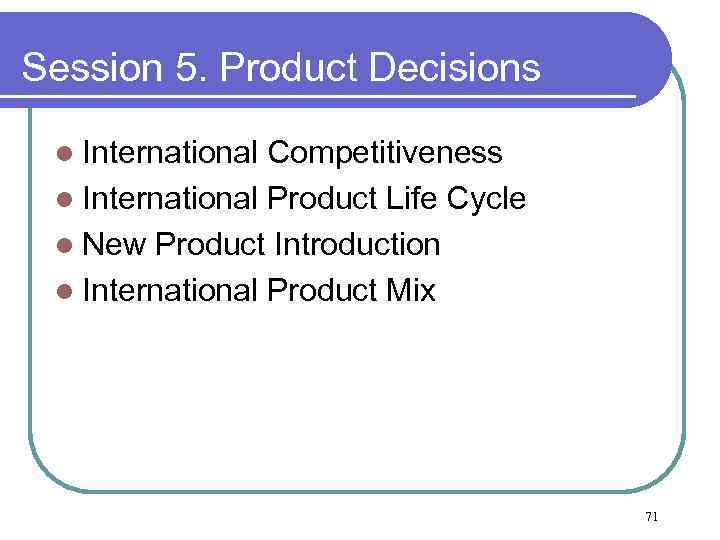 Session 5. Product Decisions l International Competitiveness l International Product Life Cycle l New Product Introduction l International Product Mix 71
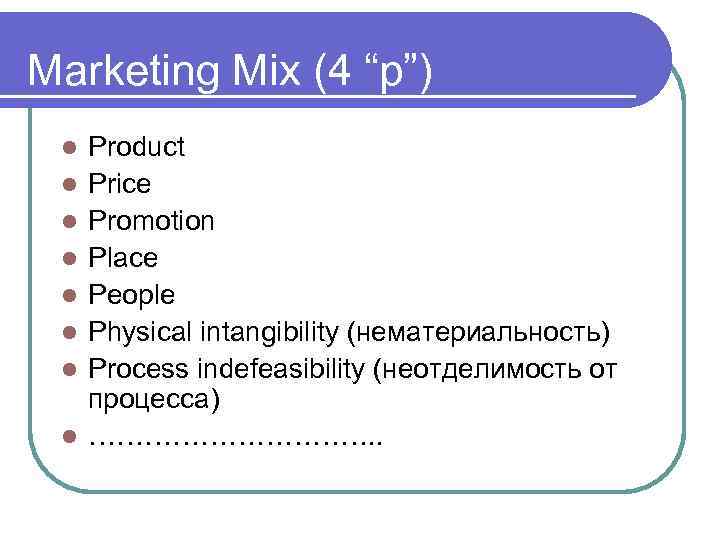 Marketing Mix (4 “p”) l l l l Product Price Promotion Place People Physical intangibility (нематериальность) Process indefeasibility (неотделимость от процесса) ……………. .
 Famous blunders and decisions l Apple vs IBM in Japan l P&G in Japan l General Motors of Canada l East-Indian company (1857) l “Speaking doll” of Gong-Kong l Ford in Europe 73
 International Competitiveness Product features (core and complementary) l Productivity, cost and price l Transfer of R&D to foreign subsidiaries instead of licensing l Quality improvement systems ( «quality circles» , TQM, TQC, “just-in-time”, “kaizen”, “camban”, “ 6 sigma”…. ) l Quality standards (ISO-9000, ISO-14000, JIS) l Country competitive position l 74
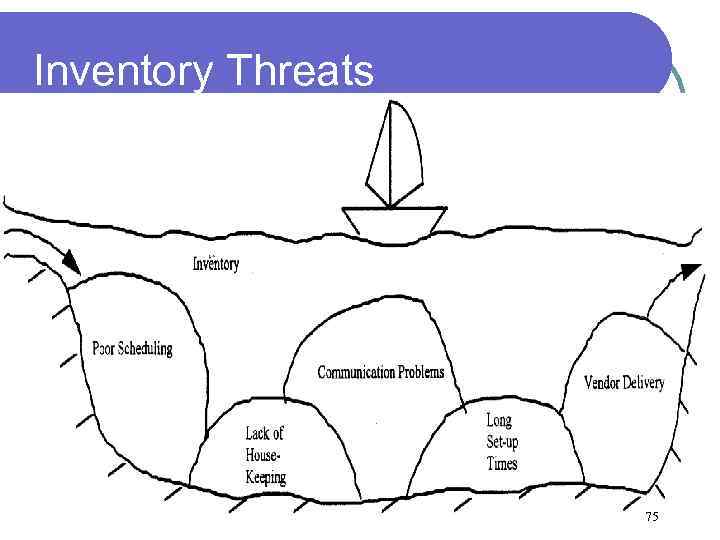 Inventory Threats 75
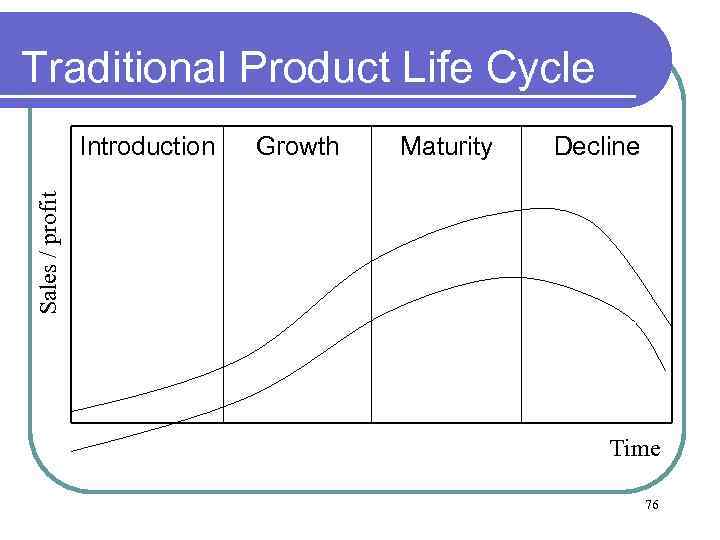 Traditional Product Life Cycle Growth Maturity Decline Sales / profit Introduction Time 76
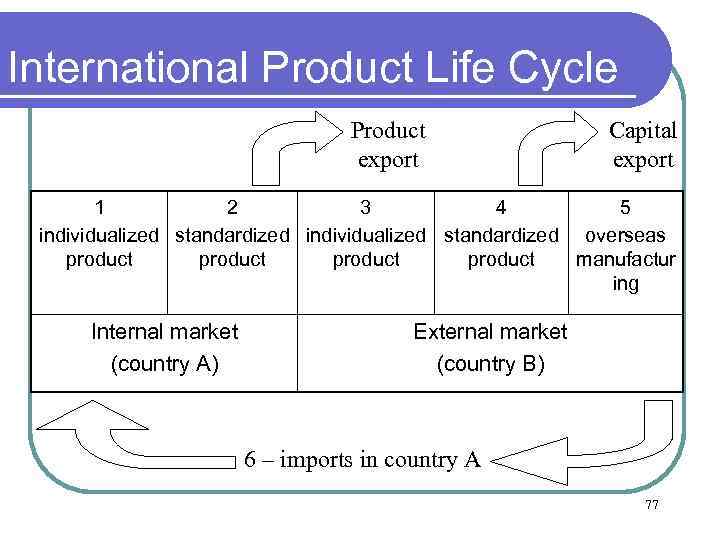 International Product Life Cycle Product export Capital export 1 2 3 4 5 individualized standardized overseas product manufactur ing Internal market (country A) External market (country B) 6 – imports in country A 77
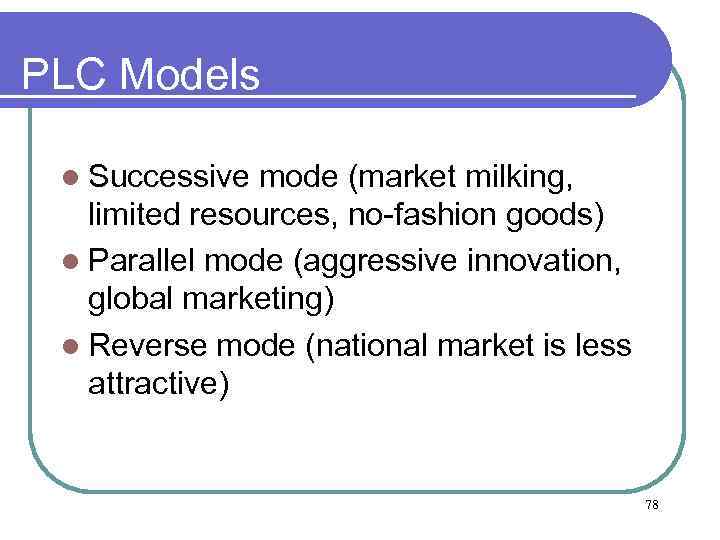 PLC Models l Successive mode (market milking, limited resources, no-fashion goods) l Parallel mode (aggressive innovation, global marketing) l Reverse mode (national market is less attractive) 78
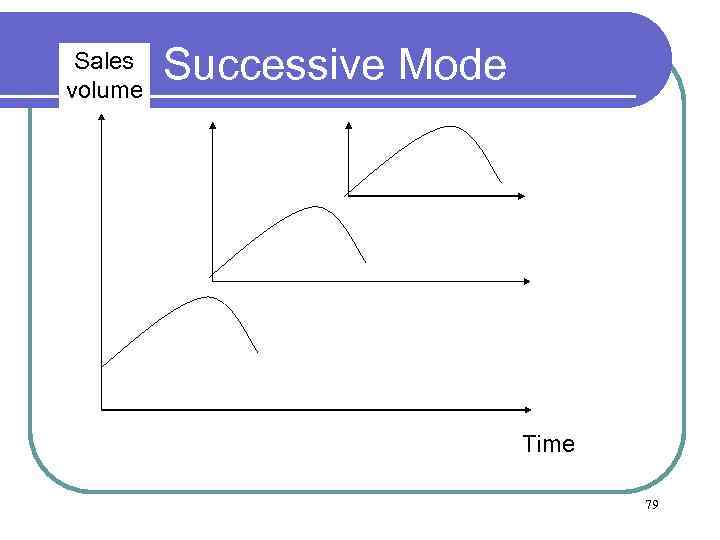 Sales volume Successive Mode Time 79
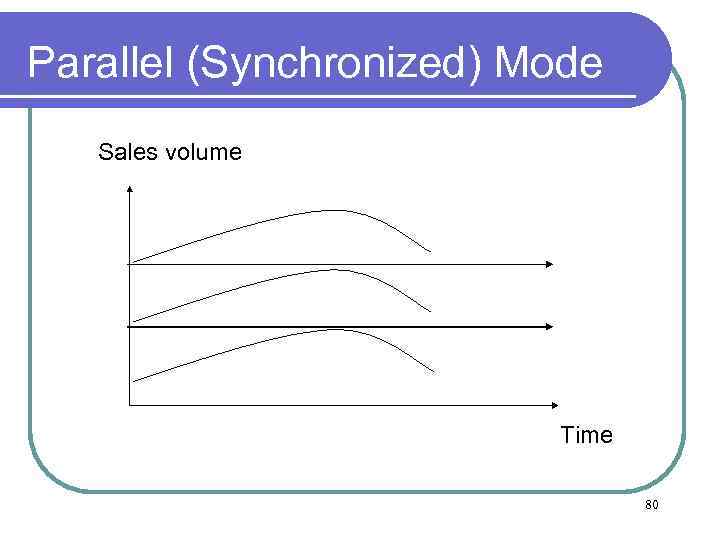 Parallel (Synchronized) Mode Sales volume Time 80
 Factors of PLC Reduction Trend l Foreign markets specific environment: Ø no competitors Ø foreign partner opportunity Ø policy change Ø trade limitations l National market environment: Ø intensive competition Ø aggressive innovative strategy 81
 New Product Introduction l Export domestic products l Piggyback marketing l Benchmarking l Changing existing products l Internal product development 82
 Changing Existing Products l Product modification l New uses for existing products Ø industrial use of home use product Ø male/female product Ø related application 83
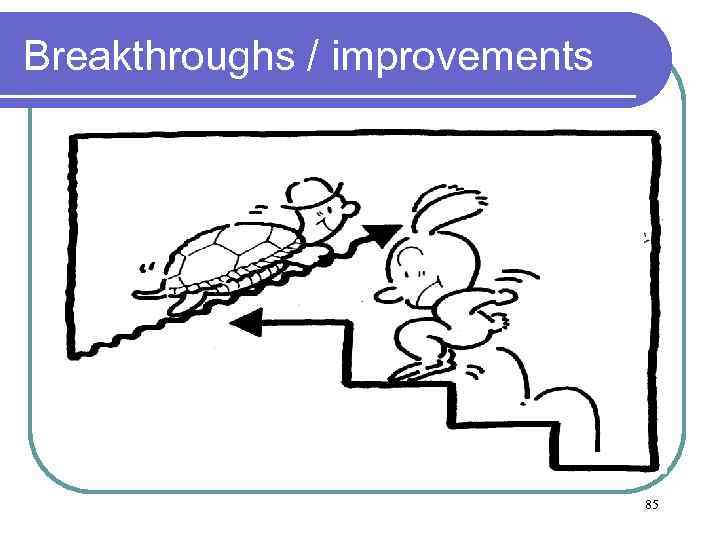
 Product Development l R&D location: centralization /decentralization l Breakthroughs / improvements (“kaizen tean”) l Trends: R&D transfer abroad; R&D transfer to subsidiaries (instead of licensing) 84
 Breakthroughs / improvements 85
 Marketing goals priorities Priority Фирмы США Фирмы Японии 1 ROI MS 2 Shares profitability ROI 3 MS Innovation 86
 Product Mix Strategies l Product Mix – a set of product lines l Short / long product line l Width, length, depth of Product Mix 87
 Product Mix: Internal Determinants l Goals - profit, market share, risk spreading l Resources - surplus production capacity, the better use of technology, managerial and marketing skills capacity l Philosophy of management (sales-oriented or marketing-oriented) 88
 Product Mix: External Determinants l Customer - values, product use, “built- in” images (“made in”) l Competition (penetration cost) l PEST-factors 89
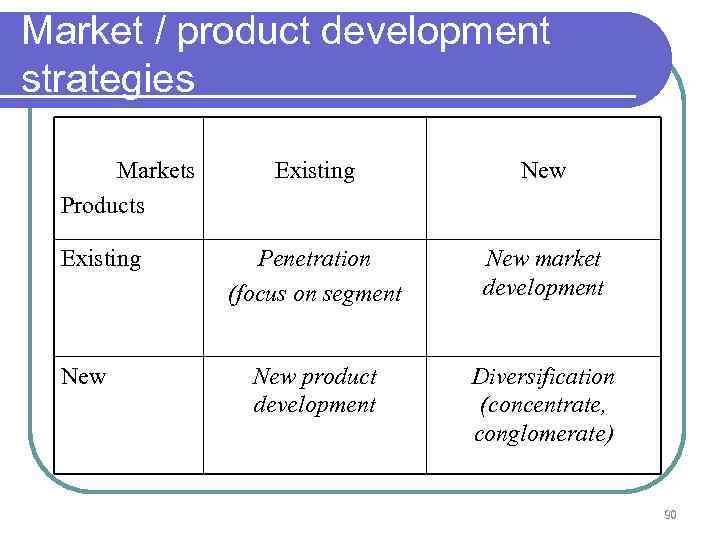 Market / product development strategies Markets Products Existing New Penetration (focus on segment New market development New product development Diversification (concentrate, conglomerate) 90
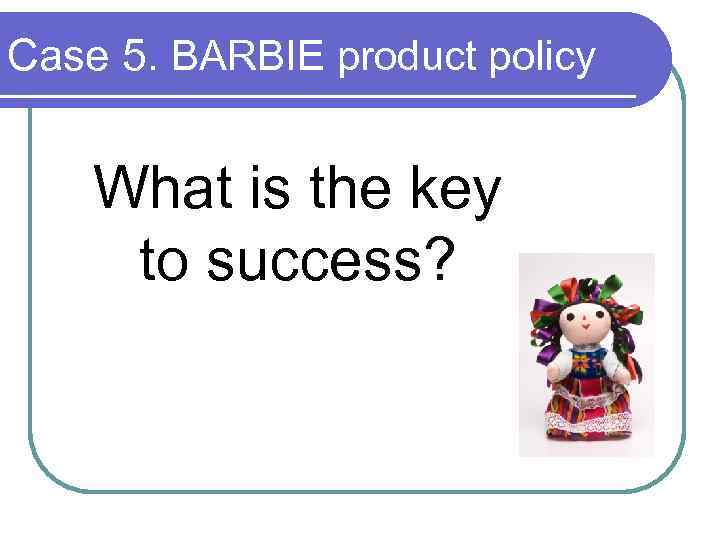 Case 5. BARBIE product policy What is the key to success?
 Session 6. Pricing Decisions l Export Price Determinants l Price Lines and the “Cannibalism Effect” l Export Price Escalation l Pricing Methods and Strategies 92
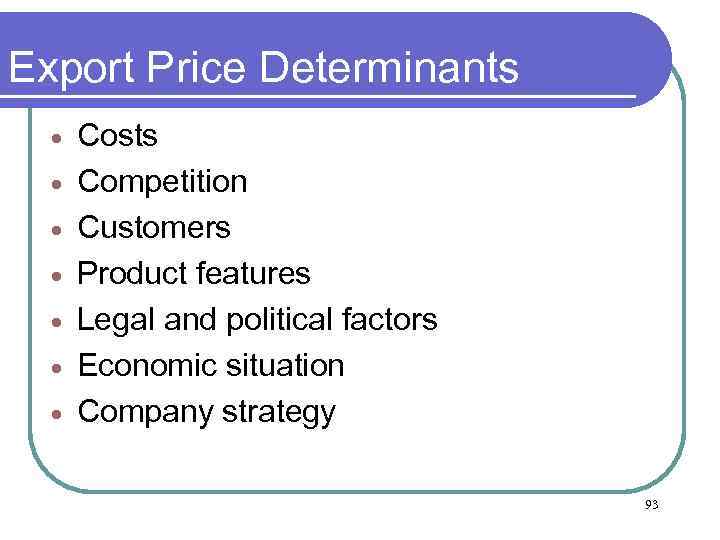 Export Price Determinants · · · · Costs Competition Customers Product features Legal and political factors Economic situation Company strategy 93
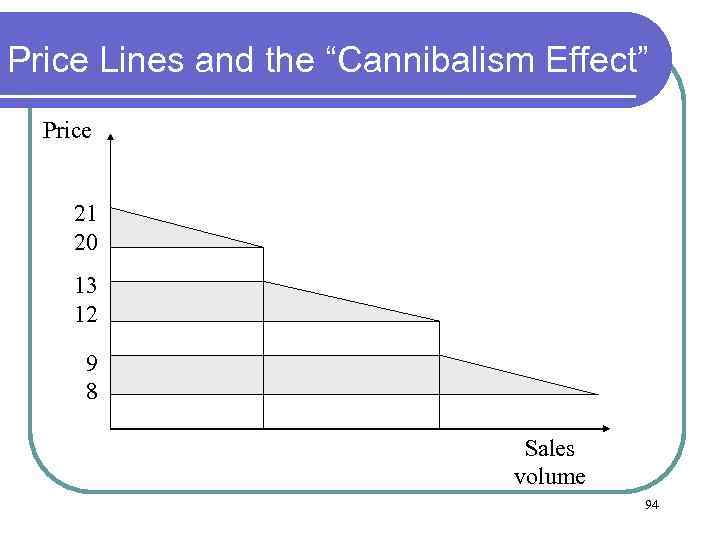 Price Lines and the “Cannibalism Effect” Price 21 20 13 12 9 8 Sales volume 94
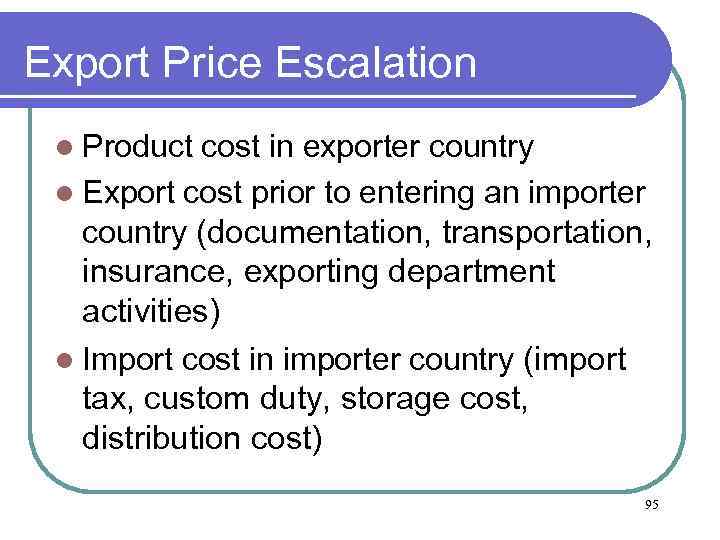 Export Price Escalation l Product cost in exporter country l Export cost prior to entering an importer country (documentation, transportation, insurance, exporting department activities) l Import cost in importer country (import tax, custom duty, storage cost, distribution cost) 95
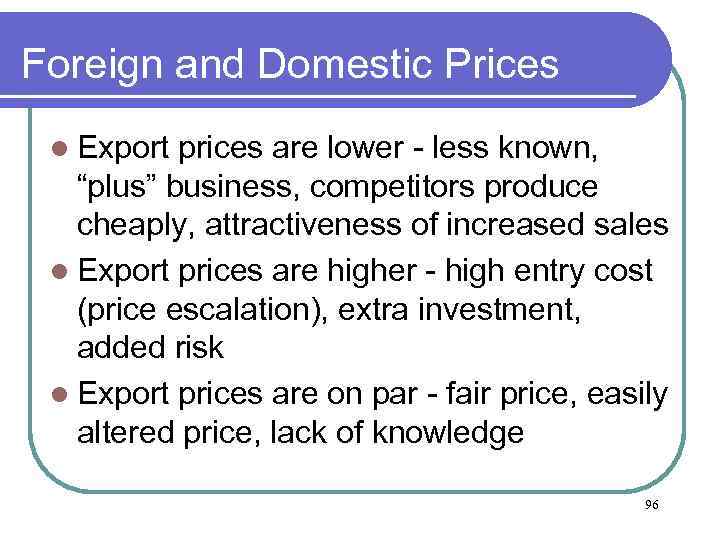 Foreign and Domestic Prices l Export prices are lower - less known, “plus” business, competitors produce cheaply, attractiveness of increased sales l Export prices are higher - high entry cost (price escalation), extra investment, added risk l Export prices are on par - fair price, easily altered price, lack of knowledge 96
 Cost Pricing l Marginal price l “Technical price” (break-even point) l “Cost plus” 97
 Competition-Based Pricing l Prices based on current international price levels l Prices based on international practices of pricing l Following the industry leader price l Following the competitors’ prices l Auction, bargaining, stock exchange pricing 98
 Pricing Strategies for New Products l Skimming the market l Penetration pricing 99
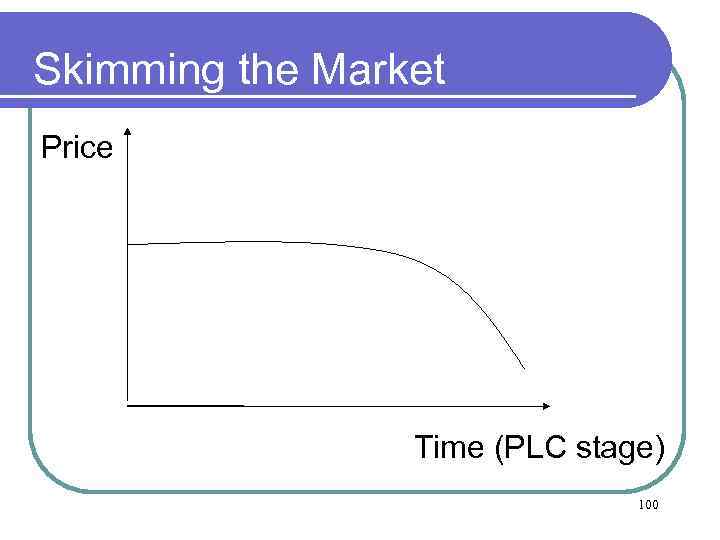 Skimming the Market Price Time (PLC stage) 100
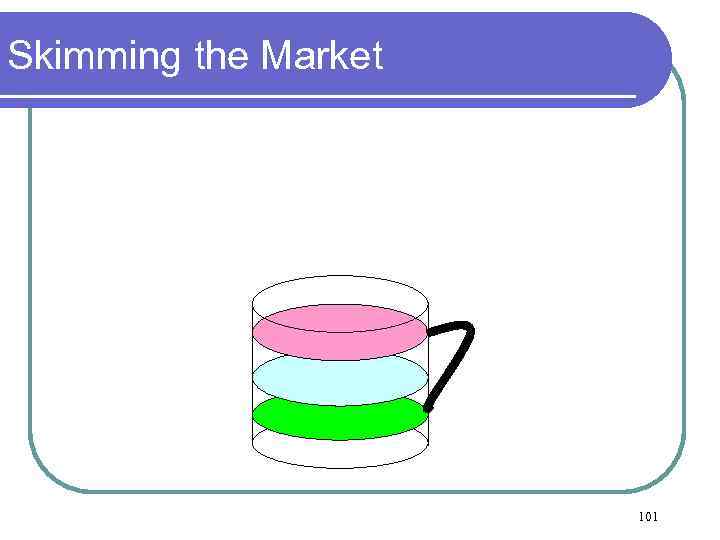 Skimming the Market 101
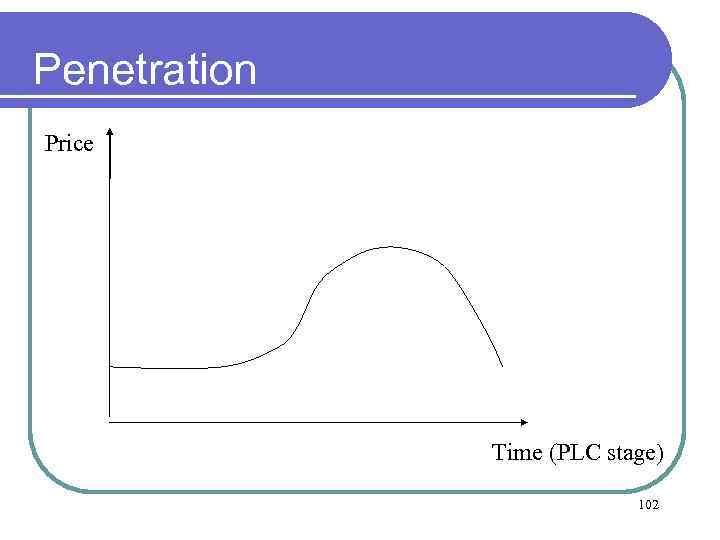 Penetration Price Time (PLC stage) 102
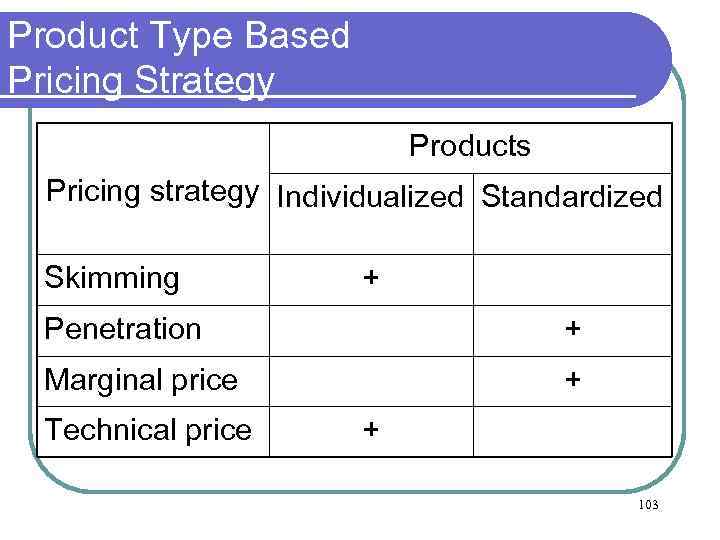 Product Type Based Pricing Strategy Products Pricing strategy Individualized Standardized Skimming + Penetration + Marginal price + Technical price + 103
 Differentiated Pricing Towards Different Countries l Discriminative pricing l Preferential pricing l Integration of price and product mix / country mix l Constant prices l Equal prices 104
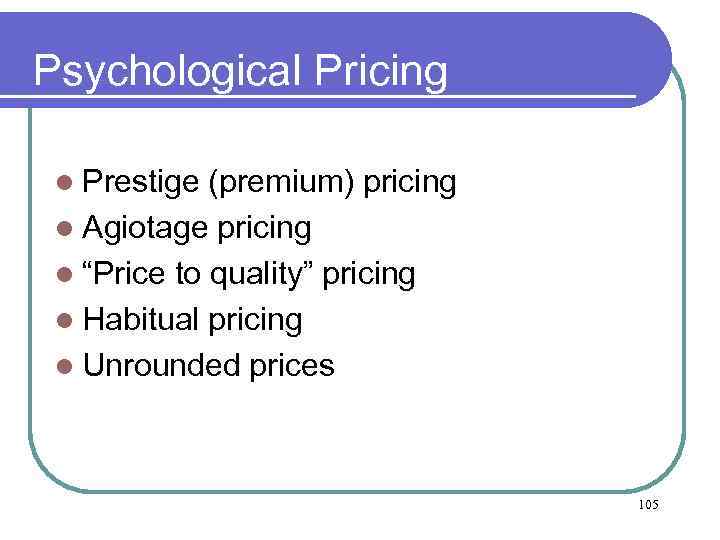 Psychological Pricing l Prestige (premium) pricing l Agiotage pricing l “Price to quality” pricing l Habitual pricing l Unrounded prices 105
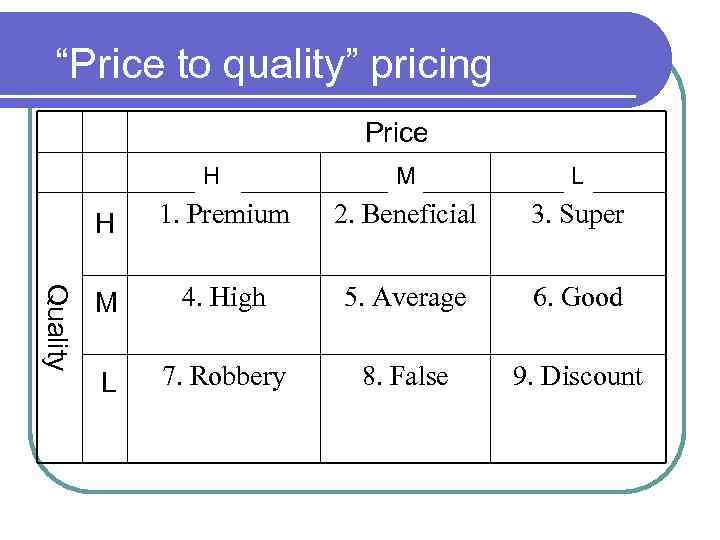 “Price to quality” pricing В H 1. Premium Price С M 2. Beneficial С M 4. High 5. Average 6. Good Н L 7. Robbery 8. False 9. Discount В H Н L 3. Super Quality
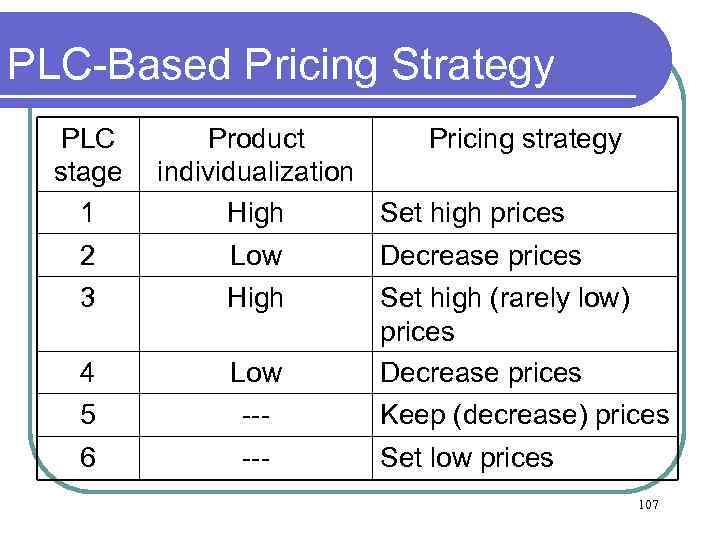 PLC-Based Pricing Strategy PLC stage 1 Product Pricing strategy individualization High Set high prices 2 Low Decrease prices 3 High 4 Low Set high (rarely low) prices Decrease prices 5 --- Keep (decrease) prices 6 --- Set low prices 107
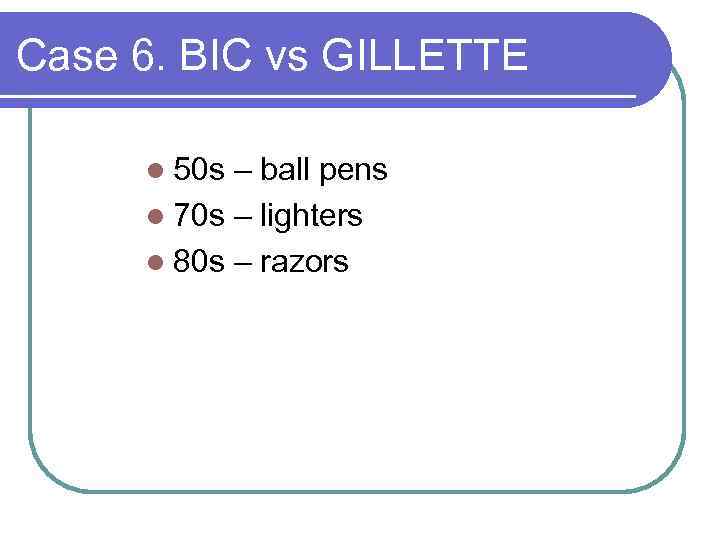 Case 6. BIC vs GILLETTE l 50 s – ball pens l 70 s – lighters l 80 s – razors
 Session 7. Promotional Decisions l Techniques of Promotion l International Promotional Strategy l Promotional Barriers l International Promotion Trends 109
 Techniques of Promotion l Advertising l Public relations l Personal selling l Sales promotion l Direct marketing l Package l Ad. Traction 110
 Advertising l Advertising – non-personal paid communication (TV, radio, street, internet, product placement…. ) 111
 Public relations l Public “out-door” activities (exhibitions, holiday sales, celebrations, events) l Company / product news l Press-conferences, interviews l Endowment activities 112
 Sales Promotion l Samples l Bonuses, gifts, “sales” l “In-door” activities (product presentations, competitions) l Handouts (brochures, posters, magazines, souvenirs) l Stationary aides (external zone, entrance, trading area, cashier area) l Distribution network promotion (personnel training, corporate meetings) 113
 Merchandizing l Product allocation l Purchase facilitation l “Space management” l Easy access to information 114
 Personal Sales l Company representatives l Experts l Public channels (network marketing) 115
 Direct Marketing l Direct mail l Telemarketing (phone, fax, call- service) l TV-shops l Electronic commerce l SPAMs l SMS-offers 116
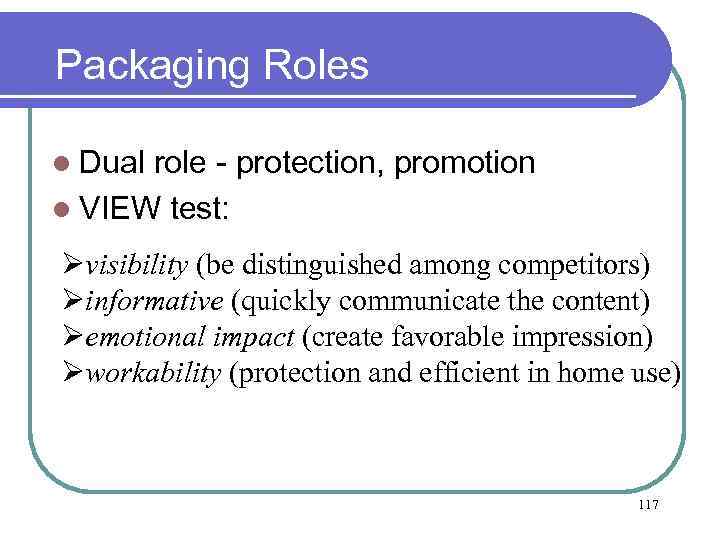 Packaging Roles l Dual role - protection, promotion l VIEW test: Øvisibility (be distinguished among competitors) Øinformative (quickly communicate the content) Øemotional impact (create favorable impression) Øworkability (protection and efficient in home use) 117
 Packaging Components l Language l Size l Color l Cost l Picture 118
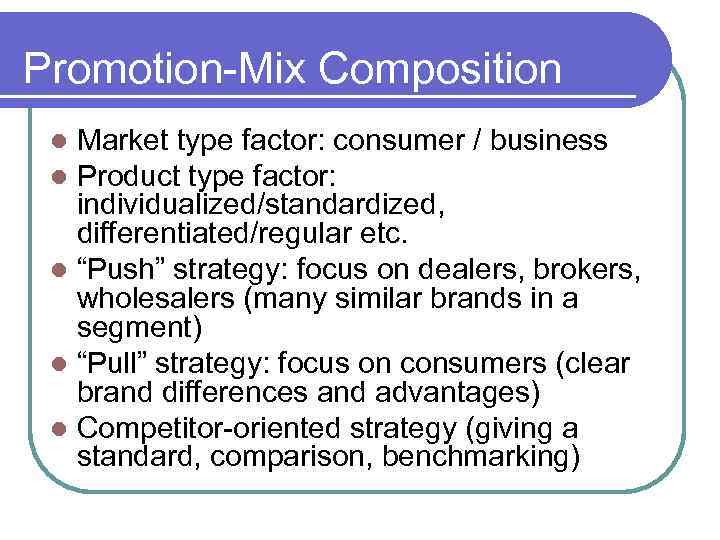 Promotion-Mix Composition Market type factor: consumer / business Product type factor: individualized/standardized, differentiated/regular etc. l “Push” strategy: focus on dealers, brokers, wholesalers (many similar brands in a segment) l “Pull” strategy: focus on consumers (clear brand differences and advantages) l Competitor-oriented strategy (giving a standard, comparison, benchmarking) l l
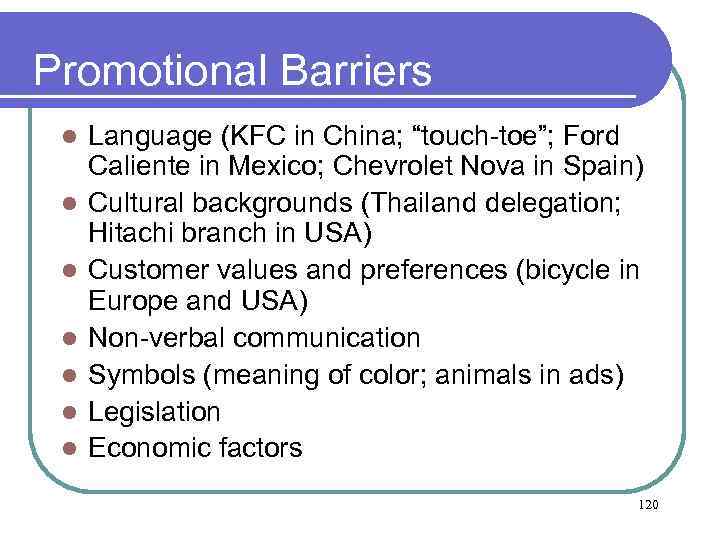 Promotional Barriers l l l l Language (KFC in China; “touch-toe”; Ford Caliente in Mexico; Chevrolet Nova in Spain) Cultural backgrounds (Thailand delegation; Hitachi branch in USA) Customer values and preferences (bicycle in Europe and USA) Non-verbal communication Symbols (meaning of color; animals in ads) Legislation Economic factors 120
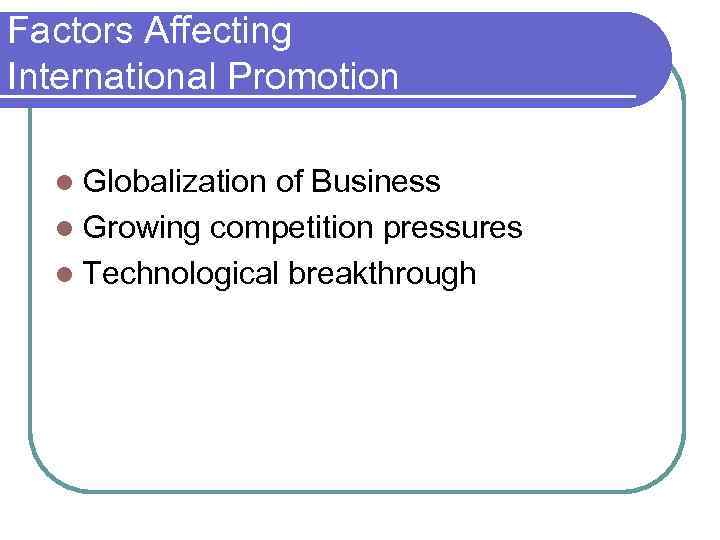 Factors Affecting International Promotion l Globalization of Business l Growing competition pressures l Technological breakthrough
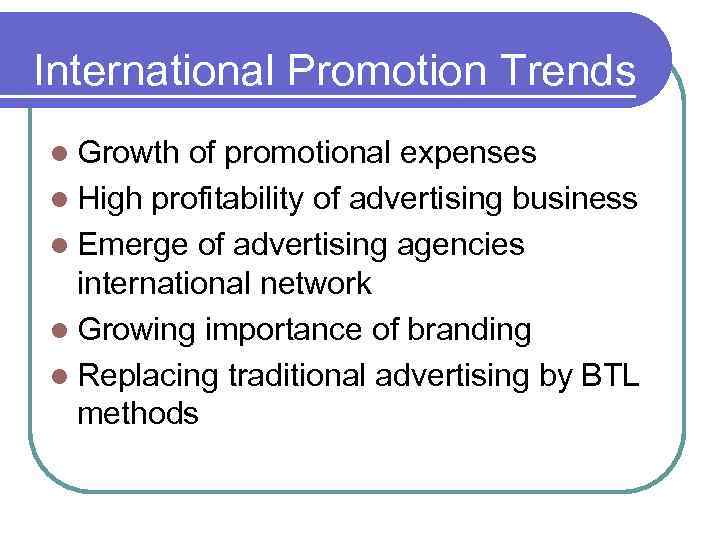 International Promotion Trends l Growth of promotional expenses l High profitability of advertising business l Emerge of advertising agencies international network l Growing importance of branding l Replacing traditional advertising by BTL methods
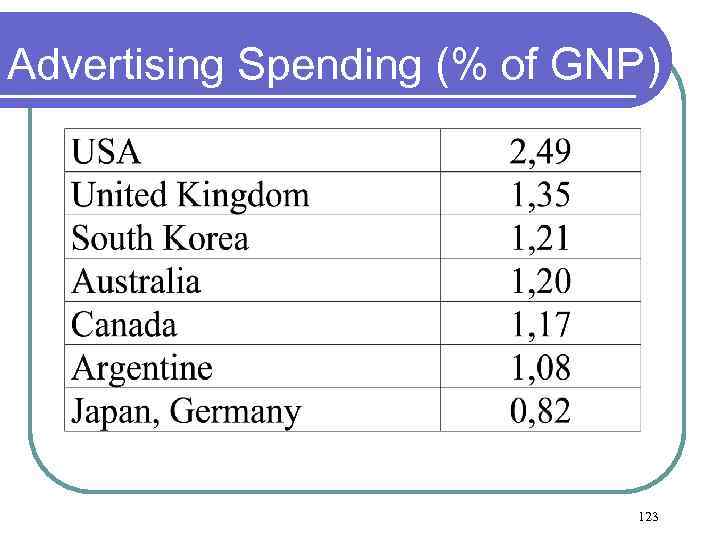 Advertising Spending (% of GNP) 123
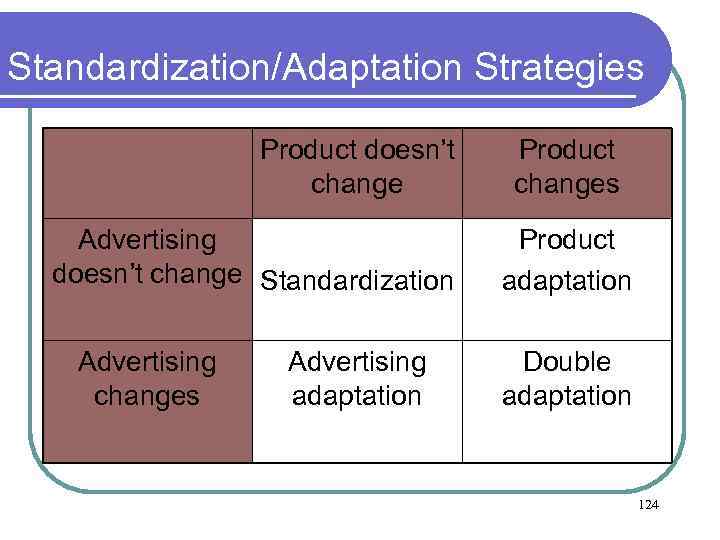 Standardization/Adaptation Strategies Product doesn’t change Advertising doesn’t change Standardization Advertising changes Advertising adaptation Product changes Product adaptation Double adaptation 124
 Preferred International Promotional Strategy l Global concept plus partially adapted promotional message (“Think globally, act locally”) l Movie adaptation l Slogan adaptation l Foreign media adaptation l Mandatory adaptation 125
 International Media l Global media (Time, Wall Street Journal, Financial Times, CNN, MTV, Euronews, Internet) l Local national media l “Covering” media (Russia – CIS, France – Belgium – Switzerland) l Product Placement
 The Biggest Advertising Agencies l l l l WPP Group, London Interpublic Group of Companies, NY Omnicom Group, NY Dentsu, Tokyo Cordiant, London (with Saatci & Saatchi) Young & Rubicam, NY Euro RSCG, Levallois. Perret l l l l Grey Advertising, NY Hakuhodo, Tokyo Leo Burnett, Chicago True North Communications, Chicago D’Arcy Masius Benton & Bowles, NY Publicis Communication, Paris BDDD Group, Paris 127
 Case 7 a. Repositioning in Kentucky Fried Chicken Why did “Kentucky Fried Chicken” change its name and logo for short “KFC” version in 1991?
 Case 7 b. Goodyear Tire and Rubber advertized products in 39 countries with slogan "Goodyear, take me home l Ad videos were different by country (in UK – slow and serious conversation? In Brazil – humor episode) l 129
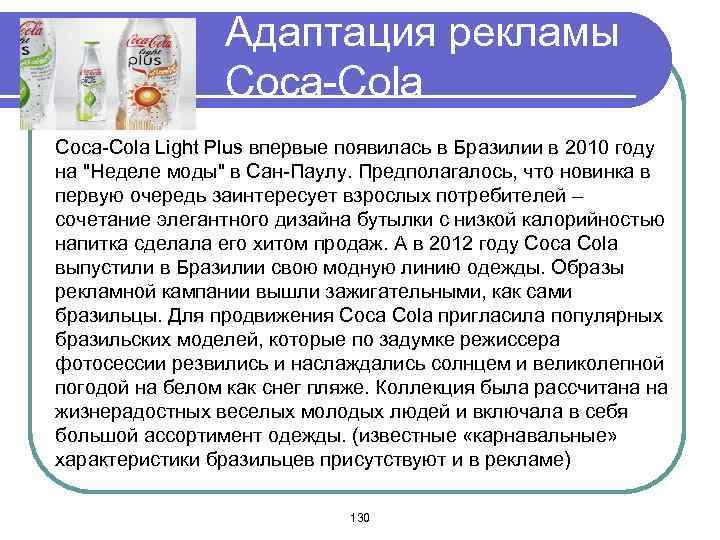 Адаптация рекламы Coca-Cola Light Plus впервые появилась в Бразилии в 2010 году на "Неделе моды" в Сан-Паулу. Предполагалось, что новинка в первую очередь заинтересует взрослых потребителей – сочетание элегантного дизайна бутылки с низкой калорийностью напитка сделала его хитом продаж. А в 2012 году Coca Cola выпустили в Бразилии свою модную линию одежды. Образы рекламной кампании вышли зажигательными, как сами бразильцы. Для продвижения Coca Cola пригласила популярных бразильских моделей, которые по задумке режиссера фотосессии резвились и наслаждались солнцем и великолепной погодой на белом как снег пляже. Коллекция была рассчитана на жизнерадостных веселых молодых людей и включала в себя большой ассортимент одежды. (известные «карнавальные» характеристики бразильцев присутствуют и в рекламе) 130
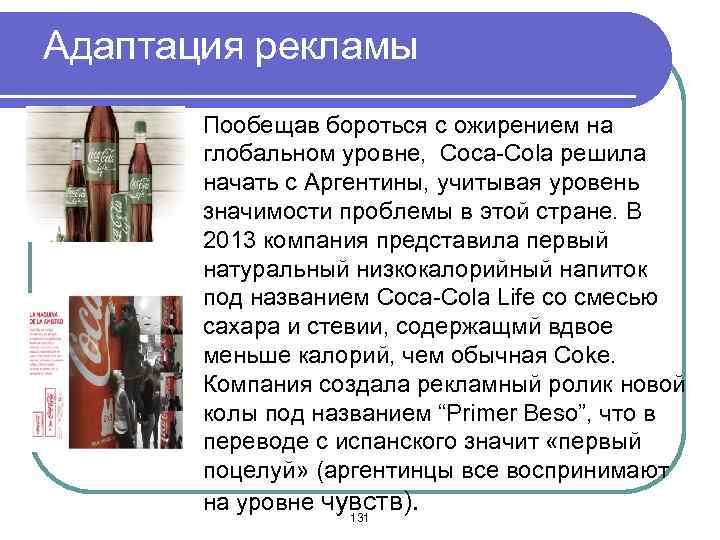 Адаптация рекламы Пообещав бороться с ожирением на глобальном уровне, Coca-Cola решила начать с Аргентины, учитывая уровень значимости проблемы в этой стране. В 2013 компания представила первый натуральный низкокалорийный напиток под названием Coca-Cola Life со смесью сахара и стевии, содержащмй вдвое меньше калорий, чем обычная Coke. Компания создала рекламный ролик новой колы под названием “Primer Beso”, что в переводе с испанского значит «первый поцелуй» (аргентинцы все воспринимают на уровне чувств). 131
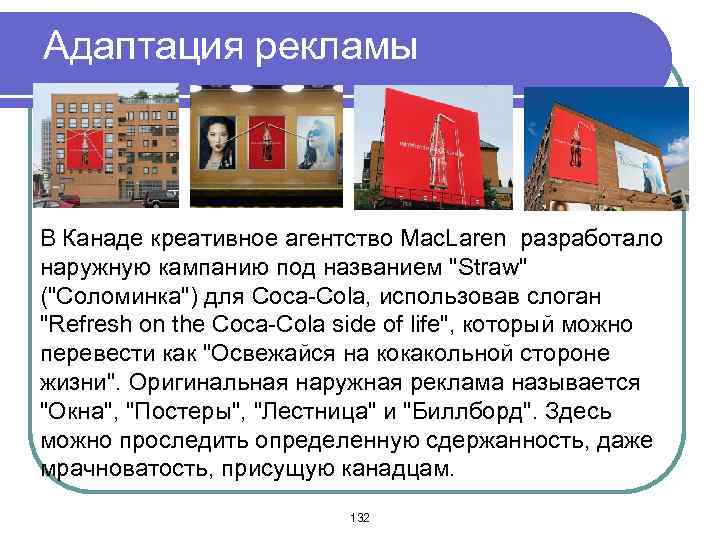 Адаптация рекламы В Канаде креативное агентство Mac. Laren разработало наружную кампанию под названием "Straw" ("Соломинка") для Coca-Cola, использовав слоган "Refresh on the Coca-Cola side of life", который можно перевести как "Освежайся на кокакольной стороне жизни". Оригинальная наружная реклама называется "Окна", "Постеры", "Лестница" и "Биллборд". Здесь можно проследить определенную сдержанность, даже мрачноватость, присущую канадцам. 132
 Session 8. Entry Modes l Indirect export l Direct export l Grey export (parallel trading) l Overseas production (manufacturing, assembly) l Contracting (license, franchising, contract manufacturing, management contracting, joint venture, strategic alliance) 133
 Indirect Export Home country based merchants (export merchant, trading company, “cable” merchant) l Home country based agents (commission house, confirming house, resident buyer, broker, export management company, manufacturer’s export agent) l Cooperative organizations: piggyback marketing, exporting combinations - associations, cartels l 134
 Evaluation of Independent Marketing Organizations l Difficult to categorize l Short time l Minimum financial outlay l Promote only the most profitable products l Inevitable conflict (differences in goals, target customers, channel design, channel policies) 135
 Direct Export l Home country based department (export manager, built-in or separate export department, export sales subsidiary) l Traveling salesperson l Foreign sales branch l Storage or warehousing facilities abroad l Foreign sales subsidiary l Foreign based distributors and agents 136
 Evaluation of Dependent Organizations Full return from sales (no sharing profits) l Complete control over marketing l Thorough knowledge of foreign markets l Export channels are permanent and reliable l Product goodwill accrues to manufacturer rather than to a marketing organization l Higher expenditures and risks l Specialist necessity l 137
 Grey Export (Parallel Trading) l Deteriorate pricing l Change cash flows l Accelerate market penetration l Market demand test l Access to risky and “closed” markets l Duracell case 138
 Manufacturing / Assembly l Location – “climate” foreign capital, production considerations, competition, political risk (transfer, operational, general instability, ownership/control) l Ownership - full (subsidiary) or partial (JV, stock company, merger) l Implementation - acquisition or greenfield 139
 Strategic Alliances Goal - enhance long-run competitiveness of partners l Advantages - sharing large investments (R&D), access to complementary resources (technologies), risks spreading, economies of scales, specialization, co-opetition, rationalization l Drivers - innovation, market globalization l Core dimensions - goal compatibility, strategic advantage, commitment, coordination, planning, communication and conflict resolution, dependence l 140
 Licensing l Licensing - the right to use: 1) technology, know-how, manufacturing processes 2) trademark, brand name, logos 3) product design 4) marketing knowledge 5) other trade secrets l Objectives: 1) foothold for later move 2) reciprocal know-how 3) revenue of the company-owned patents, trademarks, know-how 141
 Licensing Pros and Cons l Advantages - use licensee’s resources, royalties, market test l Drawbacks - lack of control and flexibility 142
 Franchising l Incomplete licensing - supplement of important ingredient of the finished product (Coca-Cola: syrup; Mc. Donalds: raw food) l Start-up loans l Mandatory training l Standardization of operations l “Soft” franchising 143
 Contract Manufacturing l Products manufactured by foreign partner are targeted for sales in this country or elsewhere l Retaining marketing and distribution, often transfer of technology and technical assistance l Applied under limited resources or exporting problems 144
 Contract Manufacturing Pros and Cons l Advantages - minimum investment/rapid entry, control over marketing and service (=trademark protection), avoids currency and financial risks, avoids pricing problems (which arise with subsidiary) l Drawbacks - profit transferred to contractor, trains a potential competitor (know-how), weak control over product quality, difficult to find satisfactory partner 145
 Management Contracting l Local investor provides capital, international marketer provides management know-how l One of the forms – “Turnkey operation” (construction of a plant, personnel training, initial operation of the plant) l Option to buy all or a part of a newly created firm 146
 Management Contracting Pros and Cons l Advantages - low risk, guaranteed income and quick return, functional control without legal responsibility, clarity in decision making (less arbitration) l Drawbacks - complicated contract (future problems and management limitations), hinder other operations 147
 Joint Venture l l l Shared ownership and control Technical and emotional effect Advantages - good for limited capital firms, low risk (easier adaptation, savings, government support), greater sales/profits (nationalistoriented consumers) Limitations - shared profits, managerial disputes Most important - local partner selection (difficult), anticipation of all possible disagreements 148
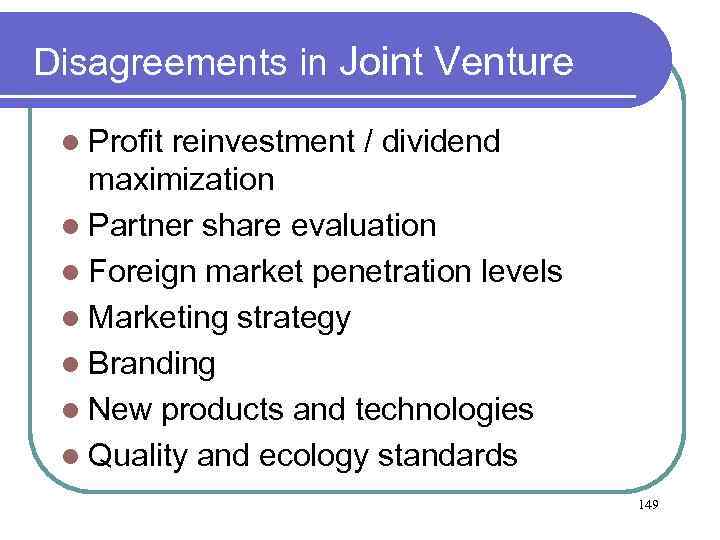 Disagreements in Joint Venture l Profit reinvestment / dividend maximization l Partner share evaluation l Foreign market penetration levels l Marketing strategy l Branding l New products and technologies l Quality and ecology standards 149
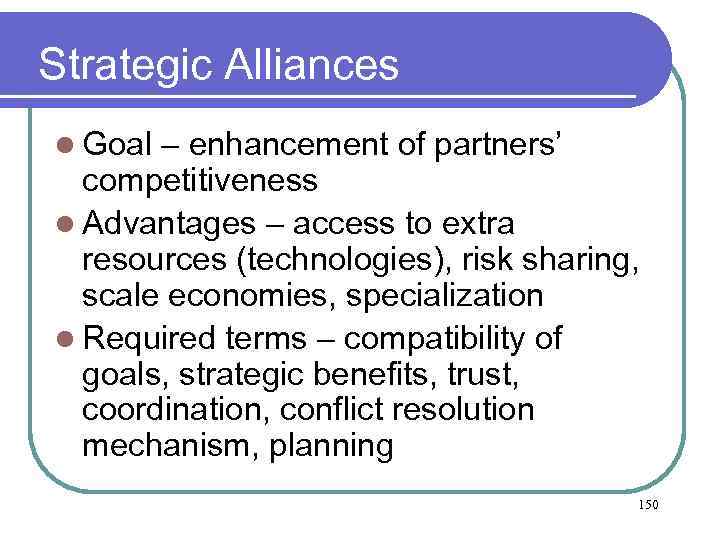 Strategic Alliances l Goal – enhancement of partners’ competitiveness l Advantages – access to extra resources (technologies), risk sharing, scale economies, specialization l Required terms – compatibility of goals, strategic benefits, trust, coordination, conflict resolution mechanism, planning 150
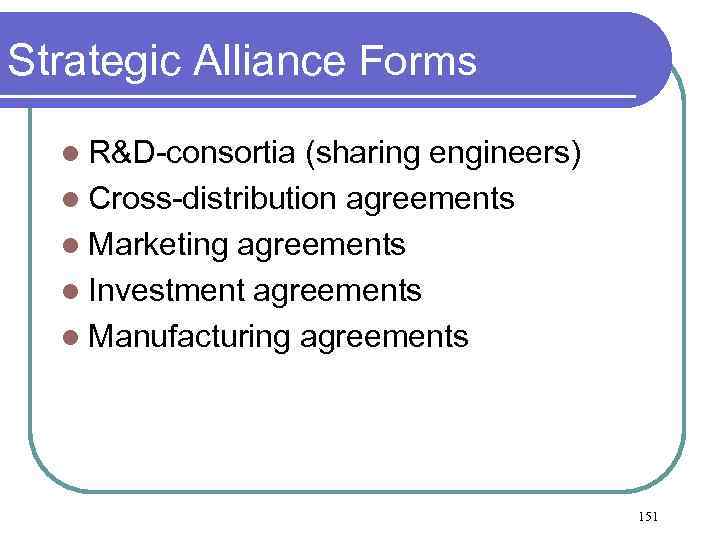 Strategic Alliance Forms l R&D-consortia (sharing engineers) l Cross-distribution agreements l Marketing agreements l Investment agreements l Manufacturing agreements 151
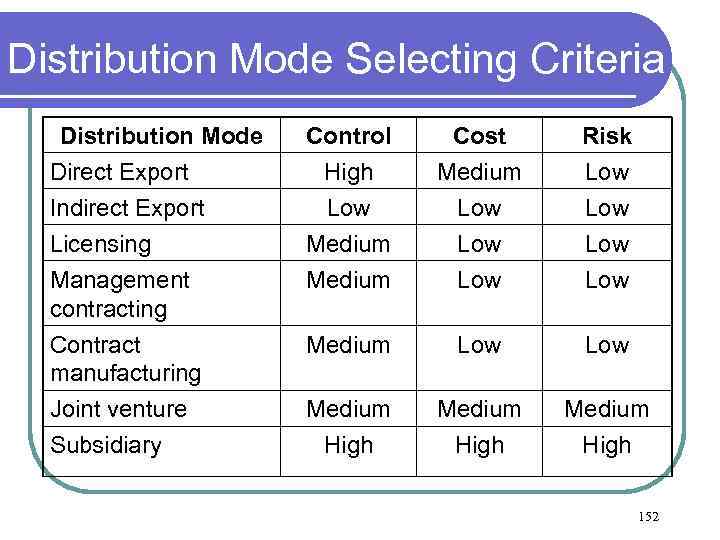 Distribution Mode Selecting Criteria Distribution Mode Control Cost Risk Direct Export High Medium Low Indirect Export Low Licensing Medium Low Management contracting Medium Low Contract manufacturing Medium Low Joint venture Medium High Subsidiary 152
 Case 8. KFC in Mexico Should KFC leave the Mexico market? ? ?
 Session 9. Marketing-Mix: International Practice l Mc. Donalds Product Decisions
 Case 9 a. Mc. Donalds Product Decisions Fast-food Fast-marketing
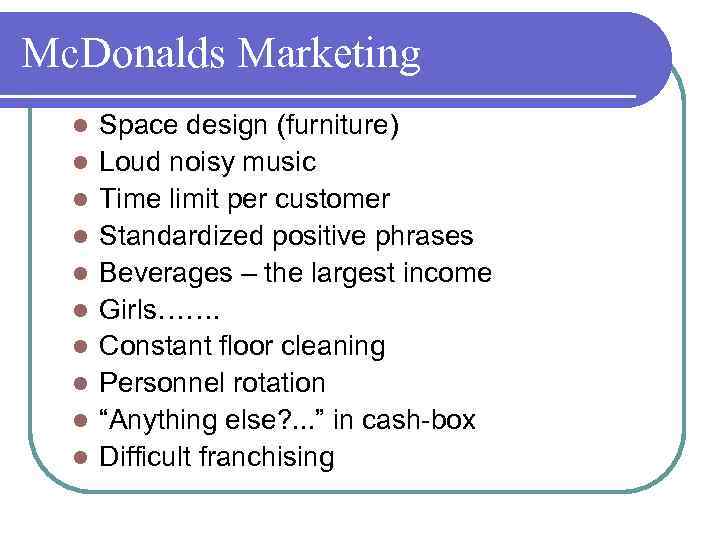 Mc. Donalds Marketing l l l l l Space design (furniture) Loud noisy music Time limit per customer Standardized positive phrases Beverages – the largest income Girls……. Constant floor cleaning Personnel rotation “Anything else? . . . ” in cash-box Difficult franchising
 Session 10. Marketing Research and International Marketing Plan
 International Marketing Plan 1. 2. 3. 4. 5. 6. Foreign market selection Situational analysis (PEST/ STEP/ STEEP, SWOT) Target market definition and segmentation Competitive differentiation and positioning Marketing mix (4 “p”) Sales forecast, budgeting, evaluation, control 158
 Маркетинговая информация позволяет предприятию: l Снизить финансовый и имиджевый риск l Получить конкурентные преимущества l Следить за маркетинговой средой l Координировать стратегию l Оценивать эффективность работы l Подкреплять интуицию менеджеров
 Виды маркетинговой информации l Первичная информация - данные, получаемые в результате специально проведенных для решения конкретной маркетинговой проблемы полевых исследований l Вторичная информация - данные, собранные ранее для целей, отличных от целей конкретного маркетингового исследования
 Достоинства и недостатки первичной информации: Достоинства первичной информации: - сбор в соответствии с поставленной целью; - известна и контролируема методология сбора; - результаты доступны для компании и могут ограждаться от конкурентов; - известна степень надежности. l Недостатки: - большое время на сбор и обработку; - дороговизна; - сама фирма не всегда может собрать все необходимые данные. l
 Внутренние источники вторичной информации (документация фирмы) l Бюджеты l Отчеты l Счета l Архивы l Предыдущие исследования и др.
 Внешние источники вторичной информации l l l l l Публикации национальных и международных официальных организаций Публикации государственных органов, министерств, муниципальных комитетов и организаций Публикации торгово-промышленных палат и объединений Сборники статистической информации Отчеты и издания отраслевых предприятий Книги, сообщения в журналах и газетах Публикации учебных, научно-исследовательских, проектных институтов и общественно-научных организаций, симпозиумов, конгрессов, конференций Прайс-листы, каталоги и другие фирменные публикации Материалы консалтинговых организаций
 Достоинства и недостатки вторичной информации Достоинства: - дешевизна по сравнению с первичной информацией; - возможность сопоставления нескольких источников; - быстрота получения по сравнению со сбором первичной информации. l Недостатки: - неполнота; - устареваемость; - иногда неизвестна методология сбора и обработки; - невозможность оценить достоверность. l
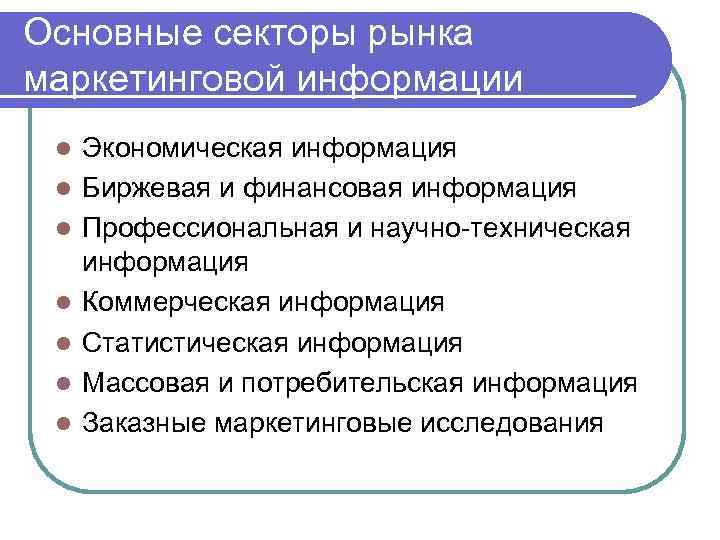 Основные секторы рынка маркетинговой информации l l l l Экономическая информация Биржевая и финансовая информация Профессиональная и научно-техническая информация Коммерческая информация Статистическая информация Массовая и потребительская информация Заказные маркетинговые исследования
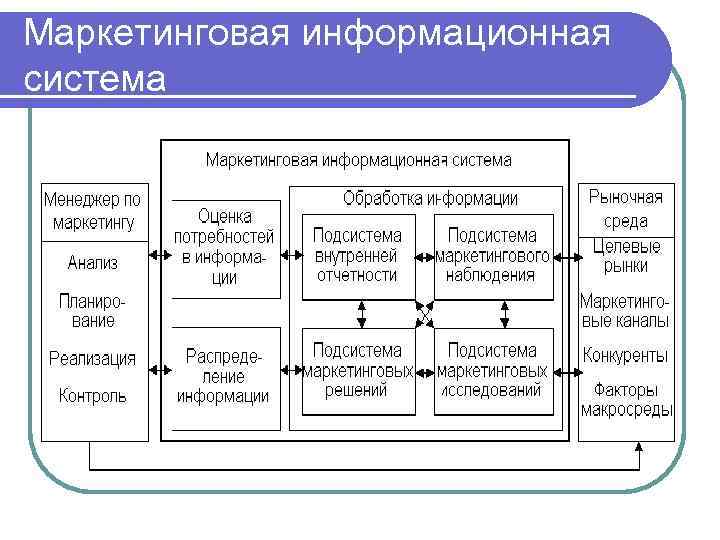 Маркетинговая информационная система
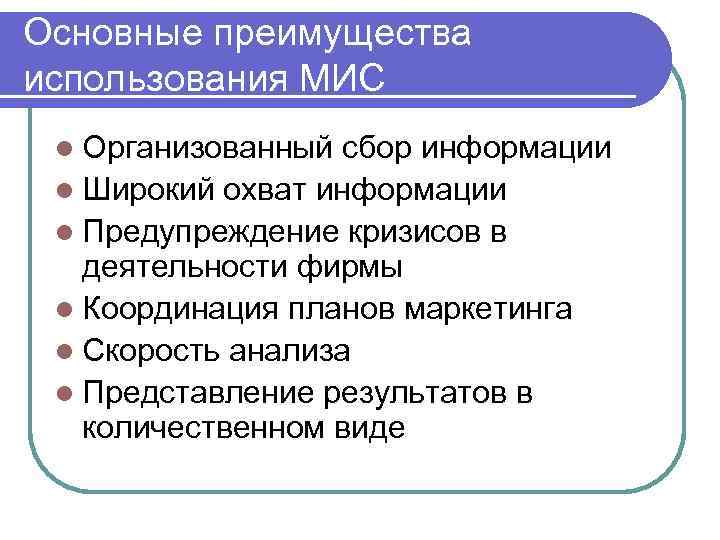 Основные преимущества использования МИС l Организованный сбор информации l Широкий охват информации l Предупреждение кризисов в деятельности фирмы l Координация планов маркетинга l Скорость анализа l Представление результатов в количественном виде
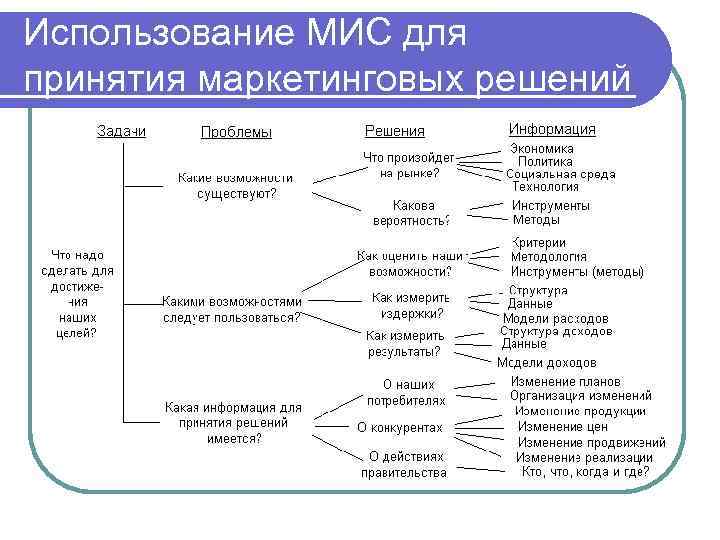 Использование МИС для принятия маркетинговых решений
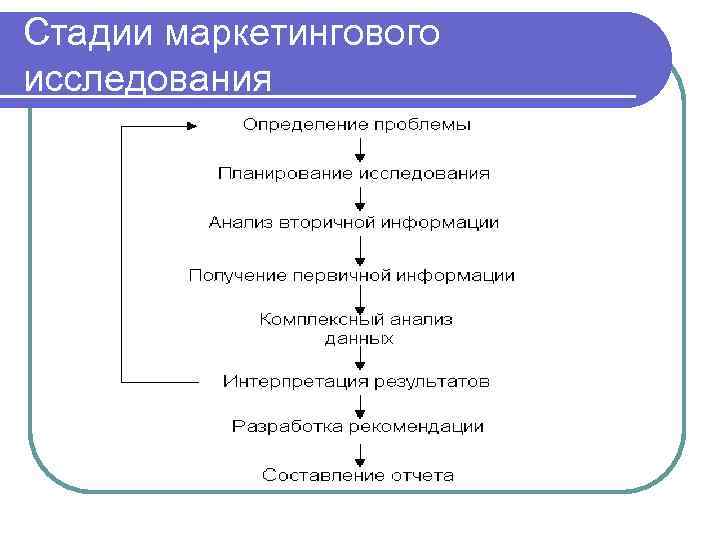 Стадии маркетингового исследования
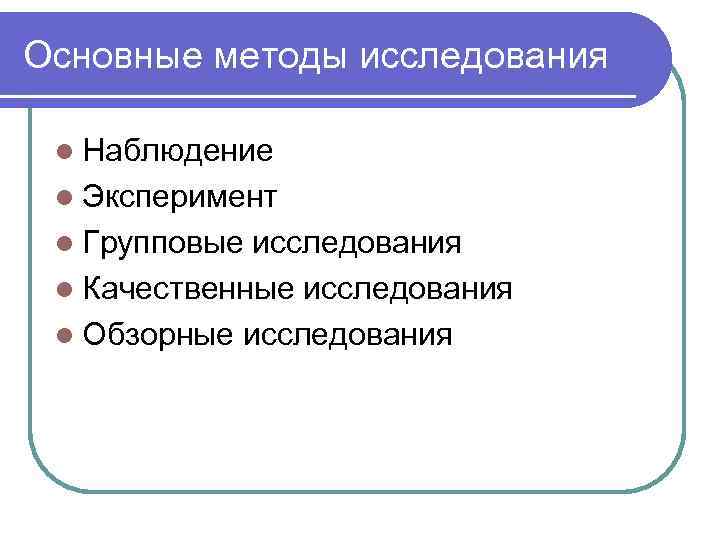 Основные методы исследования l Наблюдение l Эксперимент l Групповые исследования l Качественные исследования l Обзорные исследования
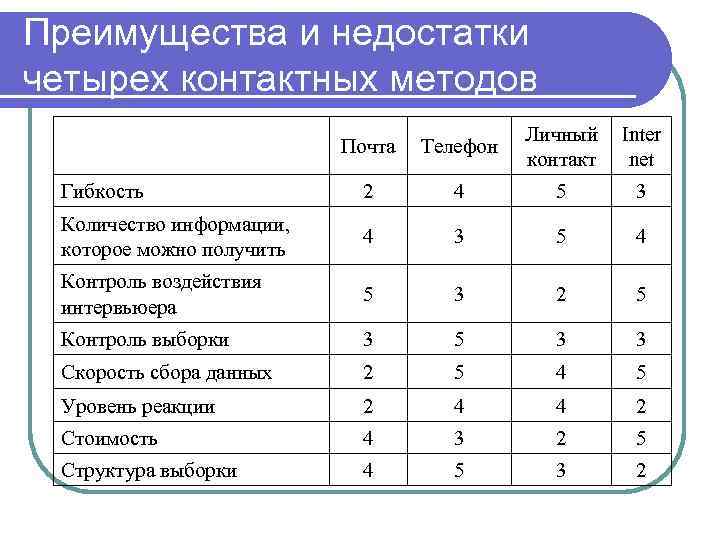 Преимущества и недостатки четырех контактных методов Личный Inter контакт net Почта Телефон Гибкость 2 4 5 3 Количество информации, которое можно получить 4 3 5 4 Контроль воздействия интервьюера 5 3 2 5 Контроль выборки 3 5 3 3 Скорость сбора данных 2 5 4 5 Уровень реакции 2 4 4 2 Стоимость 4 3 2 5 Структура выборки 4 5 3 2
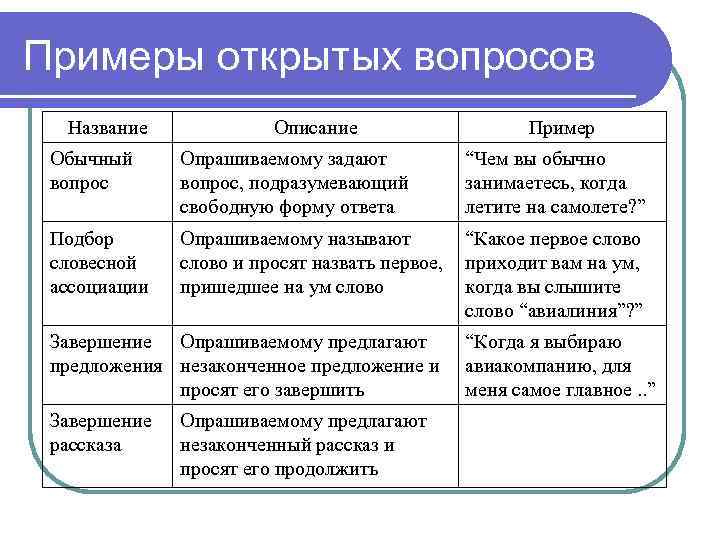 Примеры открытых вопросов Название Описание Пример Обычный вопрос Опрашиваемому задают вопрос, подразумевающий свободную форму ответа “Чем вы обычно занимаетесь, когда летите на самолете? ” Подбор словесной ассоциации Опрашиваемому называют “Какое первое слово и просят назвать первое, приходит вам на ум, пришедшее на ум слово когда вы слышите слово “авиалиния”? ” Завершение Опрашиваемому предлагают предложения незаконченное предложение и просят его завершить “Когда я выбираю авиакомпанию, для меня самое главное. . ” Завершение рассказа Опрашиваемому предлагают незаконченный рассказ и просят его продолжить
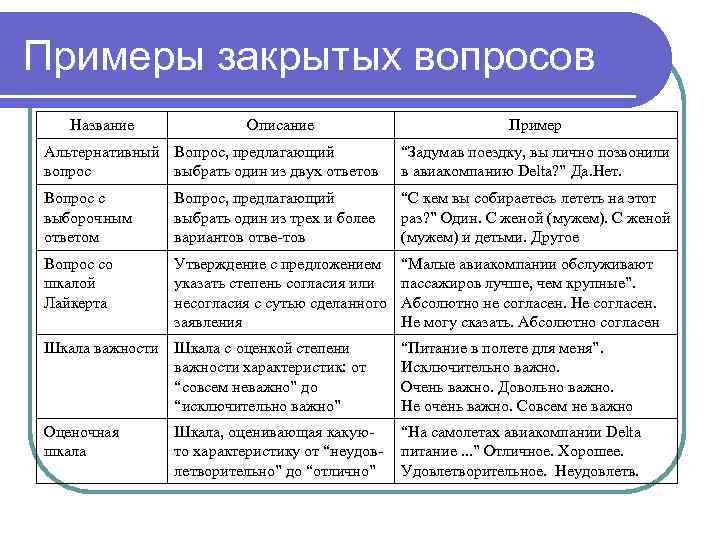 Примеры закрытых вопросов Название Описание Пример Альтернативный Вопрос, предлагающий вопрос выбрать один из двух ответов “Задумав поездку, вы лично позвонили в авиакомпанию Delta? ” Да. Нет. Вопрос с выборочным ответом Вопрос, предлагающий выбрать один из трех и более вариантов отве тов “С кем вы собираетесь лететь на этот раз? ” Один. С женой (мужем) и детьми. Другое Вопрос со шкалой Лайкерта Утверждение с предложением указать степень согласия или несогласия с сутью сделанного заявления “Малые авиакомпании обслуживают пассажиров лучше, чем крупные”. Абсолютно не согласен. Не согласен. Не могу сказать. Абсолютно согласен Шкала важности Шкала с оценкой степени важности характеристик: от “совсем неважно” до “исключительно важно” “Питание в полете для меня”. Исключительно важно. Очень важно. Довольно важно. Не очень важно. Совсем не важно Оценочная шкала “На самолетах авиакомпании Delta питание. . . ” Отличное. Хорошее. Удовлетворительное. Неудовлетв. Шкала, оценивающая какую то характеристику от “неудов летворительно” до “отлично”
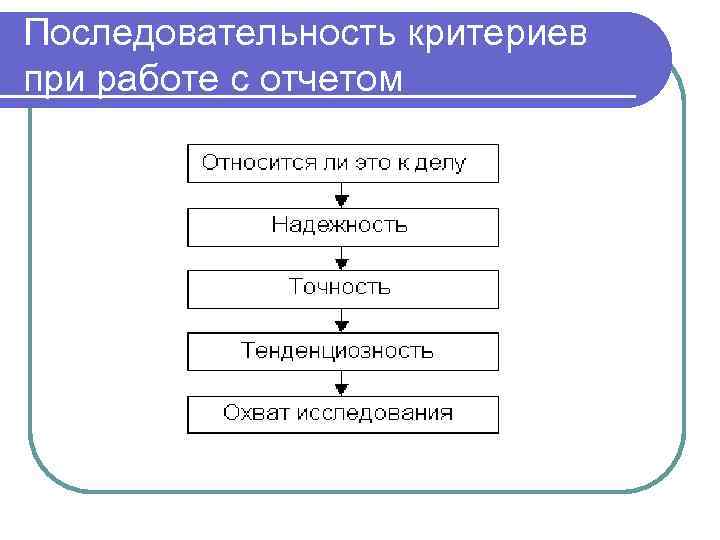 Последовательность критериев при работе с отчетом
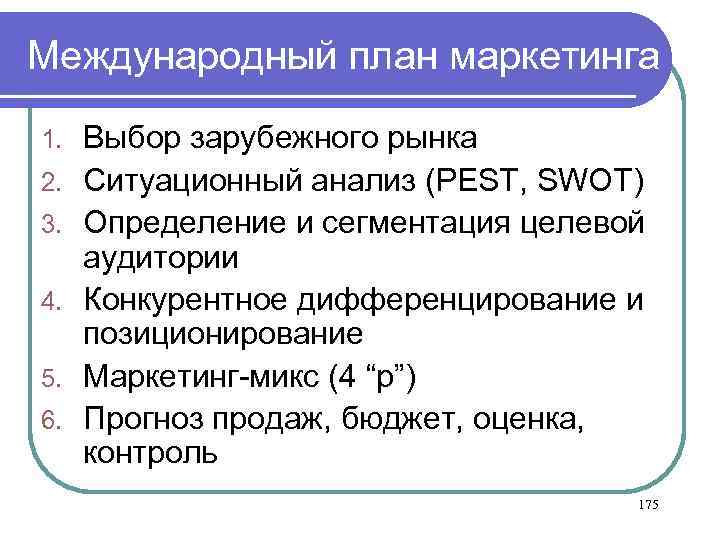 Международный план маркетинга 1. 2. 3. 4. 5. 6. Выбор зарубежного рынка Ситуационный анализ (PEST, SWOT) Определение и сегментация целевой аудитории Конкурентное дифференцирование и позиционирование Маркетинг-микс (4 “p”) Прогноз продаж, бюджет, оценка, контроль 175
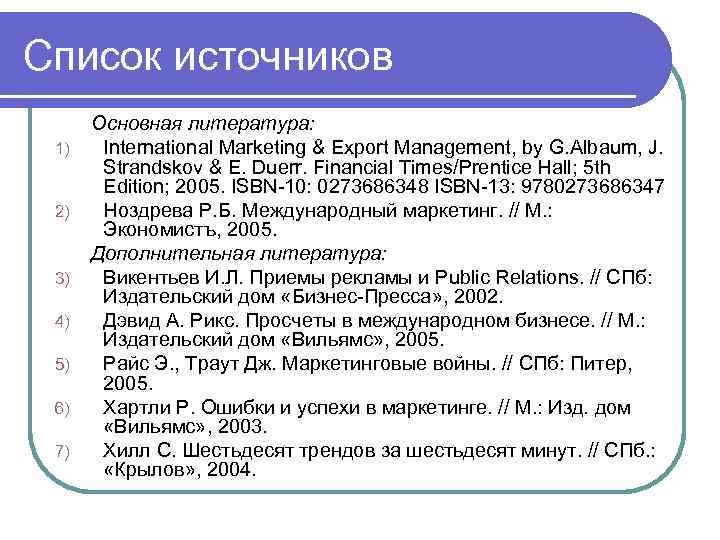 Список источников 1) 2) 3) 4) 5) 6) 7) Основная литература: International Marketing & Export Management, by G. Albaum, J. Strandskov & E. Duerr. Financial Times/Prentice Hall; 5 th Edition; 2005. ISBN-10: 0273686348 ISBN-13: 9780273686347 Ноздрева Р. Б. Международный маркетинг. // М. : Экономистъ, 2005. Дополнительная литература: Викентьев И. Л. Приемы рекламы и Public Relations. // СПб: Издательский дом «Бизнес-Пресса» , 2002. Дэвид А. Рикс. Просчеты в международном бизнесе. // М. : Издательский дом «Вильямс» , 2005. Райс Э. , Траут Дж. Маркетинговые войны. // СПб: Питер, 2005. Хартли Р. Ошибки и успехи в маркетинге. // М. : Изд. дом «Вильямс» , 2003. Хилл С. Шестьдесят трендов за шестьдесят минут. // СПб. : «Крылов» , 2004.