


 Скачать презентацию International Marketing Channels Logistics Chapter VI
2010 - IMM VI.pptx
- Количество слайдов: 32
 International Marketing Channels & Logistics Chapter VI
 International Marketing Channels -- Marketing channels in home country or abroad are required to create different utilities for products and services. -- The categories of Channel Utility are A. Place Utility Making product or service available at locations wanted by customer or potential customers. B. Time Utulity Making it available when wanted by customers or prospective customers, e. g. umbrellas in rainy season. C. Information Utility Providing desired knowledge to customers and prospective customers. 2/8/2018 Presentation by Prof. H. Ganguly 2
 -- The firm gains competitive advantages over other firms by providing these utilities to prospective customers through suitable marketing channels. Channels in International Marketing -- The traditional and time-tested channel to operate in foreign markets are through exports. In which goods are produced in home country and offered for sale or exchange abroad. -- The international marketing channels also act as modes of entry into foreign markets. -- Broadly, exports are carried out in two manner viz. I. Direct Export -- The producer of goods undertakes all activities related to locating, negotiation, supply and collection of payments themselves in direct exports. -- Direct exports generally result in greater sales and profit realisation with full control on international operations. 2/8/2018 Presentation by Prof. H. Ganguly 3
 II. Indirect Exports – After producing the goods in home country, manufacturer makes use of intermediaries to sell goods including collection of payments from customers abroad. -- Indirect export is convenient to initiate operations in international markets for new parties. But sales and profit are less and so is control on foreign market and buyers. -- Following intermediaries are used in Indirect Exports A. Through Resident Buyers – Large manufacturers, wholesalers, retail chains like Walmart maintain skeleton offices in exporters’ nations. Manufacturer hands over goods to resident buyers who undertake export-related operations. 2/8/2018 Presentation by Prof. H. Ganguly 4
 B. Through Merchant Exporter s -- In home country of manufacturers large exporters buy products from a number of producers and export those to different countries. -- Thus, small manufacturers derive benefits of merchant exporters’ knowledge, experience and foreign contacts, beside having no risk about payments. -- Firms like Tata International, Adani exports, STC, MMTC Ruchi International etc, act as merchant exporters. C. Through Export Management Companies [EMC] -- The EMCs act as common export department for a number of manufacturing firms. EMCs act as export agent i. e. they do not take title of stocks and work on pre-settled compensation. -- The manufacturers gain from rich experience and contacts of EMCs. 2/8/2018 Presentation by Prof. H. Ganguly 5
 D. Through Export Co-operatives -- Manufacturers of similar products like sugar, jute etc. form co-operatives to carry out export promotion and export operation together. -- Instead of incurring separate expenditure, members share expenses of ‘export-co-operative’. E. Through Piggyback Exports -- A manufacturer-exporter may take up export of non-competing items ( e. g. a shirtexporter takes up trousers manufactured by another firm to export) either by taking title of stocks or on commission basis, it is called Piggyback exports. -- It benefits manufacturers in finding export outlet without any effort and exporter in making use of his expertise and empty capacity. 2/8/2018 Presentation by Prof. H. Ganguly 6
 III. Presence through Foreign Manufacture -- When firm exports to a number of countries or transportation expenses increase or host country Govt. levies stiff tariff or non-tariff barrier, it becomes cost-effective to manufacture products in target nation before marketing -- The firm then adopts one or more of following approaches to manufacture their products in foreign country. A. Foreign Assembly -- The firm produces all or most of components in home country and ships those to host country for assembly in a small factory before marketing. -- Generally marketing is done by the firm or its subsidiary unit in host country. 2/8/2018 Presentation by Prof. H. Ganguly 7
 B. Contract Manufacture -- The firm’s products are produced in host country by another manufacturer according to specifications and quality standards contracted between them. -- Marketing in host country is done by the firm or its subsidiary. C. Licensing or Franchising -- It is a contract between the firm and another in host country to use their patent rights, trade marks etc. on products and /or process to produce and market in host country for a pre-decided fee. -- e. g. Mc. Donald’s, KFC, Pizza-Hut etc. enter into Franchising contract with local parties to produce and serve their recipes. D. Joint Ventures -- When the firm joins one or more firms in host country to achieve their objective , they form a third company called Joint venture through equity participation. 2/8/2018 Presentation by Prof. H. Ganguly 8
 -- The profit is shared among them in proportion to their equities. Control of joint-venture is decided by consent of equity holders. . -- For example, Hero Bicycles Co. Ltd. and Honda Motors Ltd. formed the JV under name style of Hero Honda ltd. E. Wholly-owned Subsidiaries -- The firm may set up a subsidiary in host country with 100% equity of their own to carry out manufacturing and other business activities. Total control and profit is enjoyed by the firm. -- e. g. , Hyundai Motors Ltd. has set up 100% subsidiary in India to manufacture and market automobiles. -- If the firm acquires a going concern in host country for operation, it is called brown field project. Whereas if it sets up a new facility from scrap it is called green field project. 2/8/2018 Presentation by Prof. H. Ganguly 9
 F. Strategic Alliance -- It is a non-equity contractual arrangement between two or more competitors to share their strength for mutual benefit. -- Strategic alliances are generally formed for a short period for strengthening efforts of both, e. g. Glaxo Ltd. entered into strategic alliance with E. Merck &Co. in Germany to launch their anti-ulcer drug Zantac. G. Third Country Manufacture -- A firm may decide to manufacture its product in a host country to market it there and its neighboring nations. For example, International automobile giants like General motors, Chevrolet , Hyundai, Mercedes Benz etc. have set up manufacturing units in India as “Hub” to feed neighboring countries. 2/8/2018 Presentation by Prof. H. Ganguly 10
 International Distribution Channel -- International distribution as an important international marketing function that adds value to products and services by making it available where and when it is wanted by customers or users along with relevant information. -- It is generally defined as under : “ Channels of Distribution are organised network of agencies and institutions which in combination perform the activities necessary to link producers with users or customers to accomplish marketing tasks. ” --- American Marketing Association. “ Distribution is a function that connects flow of ownership and physical flow of goods from producers to customers or users through specified path. ” 2/8/2018 Presentation by Prof. H. Ganguly 11
 International Distribution Channel Partners -- The players between producers and customers are referred to as middlemen or intermediaries are actually ‘Distribution Channel Partners’. They are classified into : 1. Manufacturer’s Representatives -- are agent middlemen who work on behalf of exporters without taking title of stocks. Their responsibility is to carry out specified services. -- When Manufacturer’s Representatives carry out specified service responsibility for whole nation they are called Sole Agents , but they do not assume any market risk. -- In exports of industrial items, Sole Agents act as Import Intermediaries to source products from world markets and alsofrom OEMs. They sell products to industrial users. 2/8/2018 Presentation by Prof. H. Ganguly 12
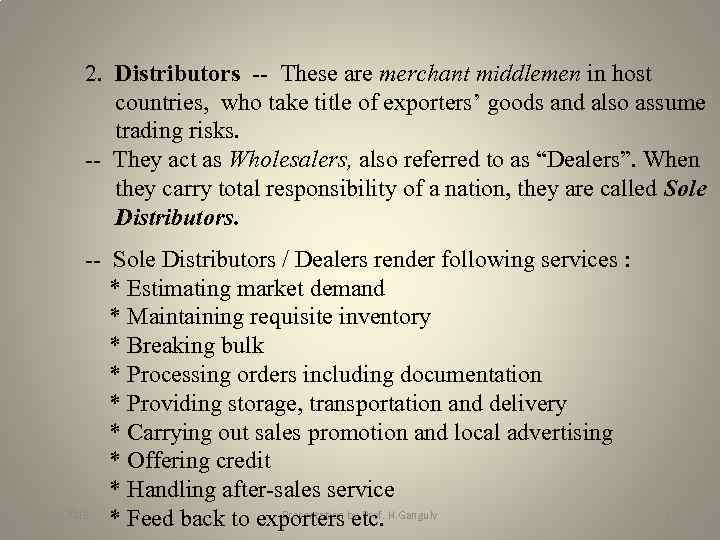 2. Distributors -- These are merchant middlemen in host countries, who take title of exporters’ goods and also assume trading risks. -- They act as Wholesalers, also referred to as “Dealers”. When they carry total responsibility of a nation, they are called Sole Distributors. -- Sole Distributors / Dealers render following services : * Estimating market demand * Maintaining requisite inventory * Breaking bulk * Processing orders including documentation * Providing storage, transportation and delivery * Carrying out sales promotion and local advertising * Offering credit * Handling after-sales service 2/8/2018 Presentation * Feed back to exporters by Prof. H. Ganguly etc. 13
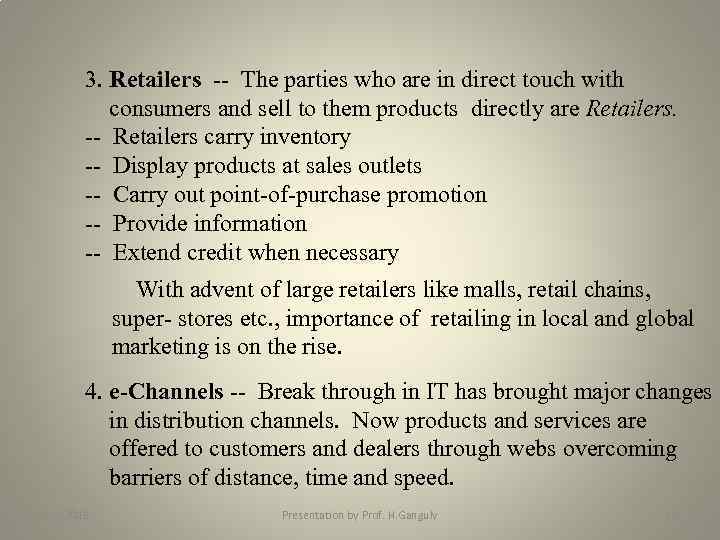 3. Retailers -- The parties who are in direct touch with consumers and sell to them products directly are Retailers. -- Retailers carry inventory -- Display products at sales outlets -- Carry out point-of-purchase promotion -- Provide information -- Extend credit when necessary With advent of large retailers like malls, retail chains, super- stores etc. , importance of retailing in local and global marketing is on the rise. 4. e-Channels -- Break through in IT has brought major changes in distribution channels. Now products and services are offered to customers and dealers through webs overcoming barriers of distance, time and speed. 2/8/2018 Presentation by Prof. H. Ganguly 14
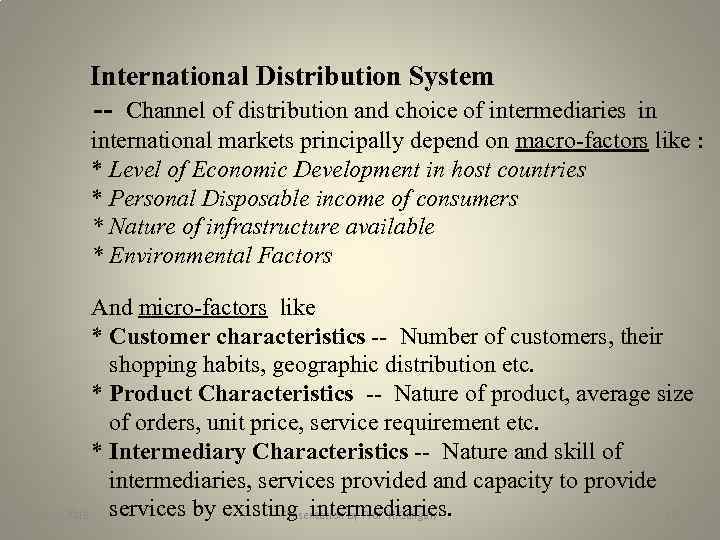 International Distribution System -- Channel of distribution and choice of intermediaries in international markets principally depend on macro-factors like : * Level of Economic Development in host countries * Personal Disposable income of consumers * Nature of infrastructure available * Environmental Factors And micro-factors like * Customer characteristics -- Number of customers, their shopping habits, geographic distribution etc. * Product Characteristics -- Nature of product, average size of orders, unit price, service requirement etc. * Intermediary Characteristics -- Nature and skill of intermediaries, services provided and capacity to provide services by existing intermediaries. 2/8/2018 Presentation by Prof. H. Ganguly 15
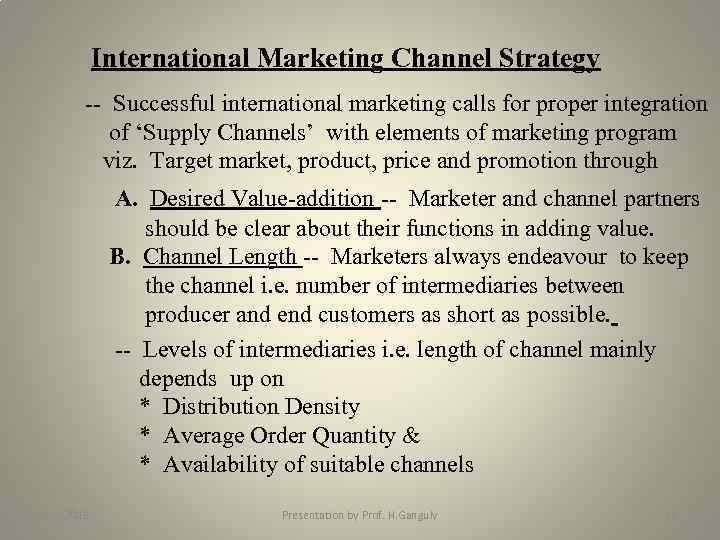 International Marketing Channel Strategy -- Successful international marketing calls for proper integration of ‘Supply Channels’ with elements of marketing program viz. Target market, product, price and promotion through A. Desired Value-addition -- Marketer and channel partners should be clear about their functions in adding value. B. Channel Length -- Marketers always endeavour to keep the channel i. e. number of intermediaries between producer and end customers as short as possible. -- Levels of intermediaries i. e. length of channel mainly depends up on * Distribution Density * Average Order Quantity & * Availability of suitable channels 2/8/2018 Presentation by Prof. H. Ganguly 16
 • Distribution Density -- Number of sales outlets required for efficient marketing of a product is called its density of distribution. -- It depends up on buying or shopping habits of consumers in host country. -- For consumer goods , extensive or wide distribution is desired i. e. large number outlets. It requires longer channels. -- Appliances, clothing etc. call for selective or limited distribution i. e. few outlets per market area. -- Speciality goods like automobiles, jewellery etc. need exclusive distribution i. e. very few outlets. -- Also the nature of products change from nation to nation depending on economic and cultural factors, so distribution channel is also decided accordingly. 2/8/2018 Presentation by Prof. H. Ganguly 17
 * Average Order Quantity -- In nations with lower per capita income, average quantity purchased at a time generally of food products is less, so more number of retail outlets are required i. e. a long distribution channel. In turn it pushes up distribution cost. • Availability of Suitable Channel Partners -- International marketers follow various methods of locating channel partners and evaluate them before commissioning, Distribution agreements duly okayed by legal experts of host country should be signed before initiating operation. C. Channel Management -- It is fast becoming a tool to manage ‘Distribution Strategy’ , particularly in cases of consumer products where channels are long. 2/8/2018 Presentation by Prof. H. Ganguly 18
 Channel partners are generally managed through : -- Regular communication in the form of conferences, PR releases, training of intermediary’s sales force etc. -- Continuous motivation through regular visits , financial incentives etc. -- Conflict resolution at the first sign when they appear. -- Channel Alignment i. e. , co-ordinating action of channel members so that they function smoothly, when channels become long, its importance goes up. -- Evaluation - Performance of channel partners on schemes, targets, etc. should be evaluated and reviewed. ---------------------------------------Intensity of Distribution is defined as the ratio of number of intermediaries that market the brand in a territory with total number of such intermediaries in the territory. 2/8/2018 Presentation by Prof. H. Ganguly 19
 D. Factors influencing Selection of Channel Partners 1. Size, nature of operation, experience of prospective parties. 2. Type of products handled. 3. Financial strength and source of finance. 4. Nature of infrastructure available e. g. delivery and transport, warehousing, credit facilities operated, after-sale service etc. 5. Goodwill, standing, reputation and relationship with consumers and other dealers etc. 2/8/2018 Presentation by Prof. H. Ganguly 20
 Emerging Distribution Media -- Two notable developments of last century are revolutionising marketing as a whole and distribution channels in particular. Those are : 1. Internet -- By setting up World Wide Web Internet has killed the distance. In the process has risen virtual distribution media of a sort that is replacing real channels through e-business and 2/8/2018 2. Global Retailing -- Organised retailing is continually penetrating into developing and underdeveloped nations. Thus customers are getting access to large volume of goods and services without multiple levels of channels. Goods are reaching customers conveniently and economically from producers via retailers directly. Presentation by Prof. H. Ganguly 21
 1. Internet and e-Channels -- Through integration of information technology and internet in the domain of marketing has evolved e-marketing, B 2 B marketing or e-business. -- Thus Internet has given birth to an entirely new businessmodel to open opportunities of global marketing. -- e-Commerce or e-marketing is a type of direct marketing where firm makes use of internet to promote and convince customers on any continent about their products and service in interactive manner. The orders are placed and payments are also made by customers electronically. -- The ordered consignment is carried by courier, transport or other suitable means. -- This is to the advantage of customers and company; middlemen viz. wholesalers and retailers are eliminated thus saving cost. 2/8/2018 Presentation by Prof. H. Ganguly 22
 2. Global Retailing -- With growth in size of retailing; Superstores, Supermarkets , Hypermarkets, Malls etc. are coming into existence even in smaller geographic areas -- As a result, number of retail outlets particularly smaller ones are on decline globally, though their average size and volume of purchase is rising. -- Secrets of success of these large retailers are that they offer greater value (i. e. lower price, better quality and features) for large number of items under one roof, -- In addition they provide * in-store display, * central location of stores * ample parking space 2/8/2018 * other customer Presentation by Prof. H. Ganguly services. 23
 Classification of Retail Outlets in Global Markets A. Neighbourhood Stores -- These are small stores located in residential areas selling food, grocery and stationery items, also called Pop-Mom stores having limited capital. B. Departmental Stores -- These stores offer several product lines viz. clothing, home furnishings electronic items etc. , divided into specific departments headed by merchandisers C. Supermarkets – These are large sized retail outlets offering low-cost, low-margin, high volume , self-service stores. D. Superstores -- Very large retail outlets selling regularly- purchased food and non-food items and services. E. Hypermarkets -- Hypermarkets combine supermarket, discount store etc. in very large geographic areas of 80000 to 200000 sq. ft. retailing all type of appliances and wide variety 2/8/2018 Presentation by Prof. H. Ganguly 24 of products.
 Relook into Traditional Retailing from Viewpoint of Organised Retailing -- Retailing is the second largest industry in India after agriculture. Retail sector is dominated by small, independent, owner-managed shops about 12. 5 million in number beside Push-cart retailers. -- Total value of Global Retailing is $16 trillion, out of which India’s share is $500 billion [ 3% for 6% of world population] -- Retail is the final link between manufacturer and customer. This link was so far was doing only ‘buying’ and ‘selling’. Now it is being realised that retailing creates economic utility generating value. 2/8/2018 Presentation by Prof. H. Ganguly 25
 -- We are at the verge of Great Indian Retail Explosion. Players in this game are going to be * Organised Retailers and * Strategic Traditional players. -- Organised Retail sector enjoys following strengths : * Trained and motivated manpower * Availability of food and non-food under one roof * Changing buying behaviour of customers -- Organised retailers are to face strengths of Traditional sector * Minimal labour cost * Negligible real estate cost * Hardly any labour or tax laws being complied -- Organised Retailers of tomorrow are going to be characterised by Strategies rather than size, profit margin or sales turnover. Presentation by Prof. H. Ganguly 2/8/2018 26
 -- Challenges to future Retailers are to develop and implement Strategies for -- More and More footfall -- Converting footfalls into sale and -- Increasing sales per customer. -- Aggressive organised retailers shall have to go for aggressive strategies in following lines : 1. Delivery of Perceived Value -- Customers shall buy more of those products and services that shall give them perceived value. As competitors shall copy those immediately, so Topbracket retailers should innovate continually. 2. Building Mutually Beneficial Relationship with Customers by providing Personalised Service [CRM] -- State of Retailing in Asia (excepting Japan), Latin America and Africa is going to beby Prof. H. Ganguly as India. 2/8/2018 Presentation the same 27
 International Logistics ‘International Logistics’ is concerned with physical movement of goods through distribution channels to international customers in right quantity at desired location at right time in usable condition in the most cost-efficient manner. Objectives of International logistics “To achieve maximum cost-effectiveness through effective co-ordination of material movement and stationary periods”. Major Issues in International Logistics * Traffic and Transportation management * Inventory management * Order Processing * Material Handling and Warehousing Fixed Facility management 2/8/2018 * Presentation by Prof. H. Ganguly 28
 Multiple Levels of Logistics Objectives -- The international company tries to meet its Service levels at lowest cost by making use of levels of logistics. Service level Objectives of International companies Service Level I : To maximise number of orders shipped. Service Level II : To minimise the time between receipt of order to its shipment. Service Level III : To minimise variance between promised and actual delivery. Service Level IV : To minimise damage to consignments in transit. Efficiency of Logistics system of an international firm is decided by its achievement of the Service levels progressively. 2/8/2018 Presentation by Prof. H. Ganguly 29
 Core Functions in Logistics Management International Transport and Traffic Management It deals with planning, implementation and control of : -- Modes of transport like air, sea, rail, road or multi-modal in inbound, outbound and inland traffic in different nations. -- Selection of mode of transport is based on transit time, predictability or reliability, cost of transportation and noneconomic factors like national carrier. -- Congestion in ports and other points of entry and exit. Inventory Management -- High inventory ties up working capital but its shortage lead to drop in sale. So optimum inventory is maintained to -- i) Reduce Order Cycle time through use of EDI -- ii) Setting Customer Service Levels and -- iii) Inventory is used strategically to penetrate into market. 2/8/2018 Presentation by Prof. H. Ganguly 30
 Processing of Orders -- Rapid processing of orders cut down order-cycle-time, allows lower inventory at customers, reducing their investment. -- Prompt communication through improved technology ensures accurate and quick order execution. Material Handling & Warehousing -- It refers to managing stationary period to boost efficiency. -- Containerisation improves efficiency and cuts down cost. -- Automated Warehouses facilitates proper storing and retrieving through fully controlled computer systems. -- Locating warehouses in SEZs / FTZs for tax benefits. Management of Fixed Facilities -- Fixed facilities (Production units) are created at convenient locations for trade-off between economy of scale manufacture and logistics costs e. g. Chevrolet factory in India. 2/8/2018 Presentation by Prof. H. Ganguly 31
 Role of IT in Logistics and Communication -- Development in Information Technology has brought about revolutionary changes in management of Logistics and Communication. -- ITC has set up e-choupals a device connecting more than three million farmers in thirty thousand villages to remain in touch with buyers of their produce and suppliers. -- e-choupals also provide latest information about rainfall, crops, their prices in different markets etc. all free of charge. -- Improved technology has also facilitated transportation by road, rail, air and ships and tracking the consignments. -- In Japan, Singapore etc. newer softwares are managing twenty level automated warehouses through computers and fork lifts. 2/8/2018 Presentation-----by Prof. H. Ganguly 32