 Скачать презентацию International Marketing BY RAJA MAZHAR HAMEED Chapter
96e20165eb8cb3d45ffcb8af926c8c53.ppt
- Количество слайдов: 79



International Marketing BY RAJA. MAZHAR HAMEED
Chapter 1 The Global Marketing Imperative
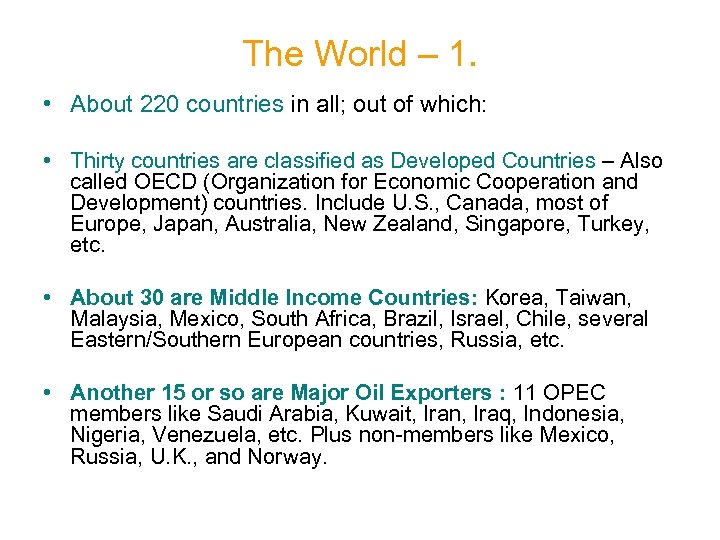
The World – 1. • About 220 countries in all; out of which: • Thirty countries are classified as Developed Countries – Also called OECD (Organization for Economic Cooperation and Development) countries. Include U. S. , Canada, most of Europe, Japan, Australia, New Zealand, Singapore, Turkey, etc. • About 30 are Middle Income Countries: Korea, Taiwan, Malaysia, Mexico, South Africa, Brazil, Israel, Chile, several Eastern/Southern European countries, Russia, etc. • Another 15 or so are Major Oil Exporters : 11 OPEC members like Saudi Arabia, Kuwait, Iran, Iraq, Indonesia, Nigeria, Venezuela, etc. Plus non-members like Mexico, Russia, U. K. , and Norway.
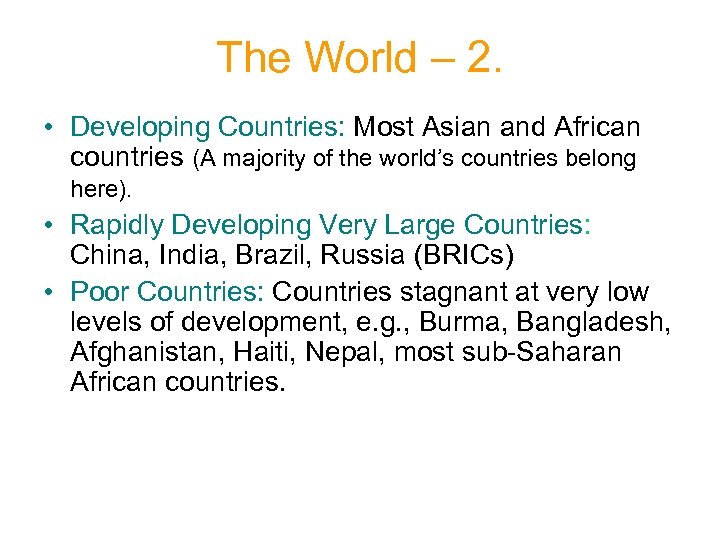
The World – 2. • Developing Countries: Most Asian and African countries (A majority of the world’s countries belong here). • Rapidly Developing Very Large Countries: China, India, Brazil, Russia (BRICs) • Poor Countries: Countries stagnant at very low levels of development, e. g. , Burma, Bangladesh, Afghanistan, Haiti, Nepal, most sub-Saharan African countries.
The World – 3. • Big Emerging Markets (BEMs): In the next 10 -20 years, BEMs such as the Chinese Economic Area (CEA: China + HK+ Taiwan), India, South Korea, Mexico, Brazil, Argentina, South Africa, Poland, Turkey, Russia, and the Association of Southeast Asian Nations (ASEAN: including Indonesia, Brunei, Malaysia, Thailand, the Philippines, and Vietnam) will provide major/dominant opportunities in global business.
Global Marketing Imperative • Saturation of domestic markets: especially, First World markets. • Global competition intensifying. • Need for global cooperation (Global competition brings global cooperation). • Internet: The Internet and electronic commerce (e-commerce) revolution • Expanding market opportunities.
The Importance of World Trade • World trade in merchandise: from $6. 2 trillion in 2000 to over $15. 1 trillion in 2008. • World trade in services: from $1. 5 trillion to $3. 3 trillion. • Global growth of trade has outperformed the growth of domestic economies in the past few decades. • Provides new marketing opportunities such as investment on a global scale, international specialization and cross-sourcing, increased quality and variety of goods, access to otherwise unavailable goods, access to talent, new management knowhow, use of technology to enhance business functioning, etc.
Advantages of International Trade for Consumers. - More quantity – Better quality – Greater variety within product categories – More customized products/Services – Lower prices – Choice of products not available without international trade (silk, diamonds, coffee, bananas, mica, chromium, and much more. )
Advantages of International Trade for Firms. Access to: – – Bigger markets Foreign resources New management knowledge New technologies Experience with selling to diverse markets Chance to deal with different forms of governments Chance to work in different competitive environments Enhanced ability to compete in home market
Arguments Against Free Trade. • Infant industry • Strategic industry • Protection of world species (CITES: Convention on International Trade in Endangered Species) • • Protection of local species, crops, etc Domestic environment & culture protection Domestic politics, jobs etc. Health & safety of domestic residents
Evolution of Global Marketing. Five stages in the evolution of global marketing 1. 2. 3. 4. 5. Domestic Marketing Export Marketing International Marketing (markets in many countries; polycentric orientation). Multinational Marketing (many markets; consolidation on regional basis). Global Marketing (global perspective; global products with local variations - Standardized efforts, Coordination across markets, Global integration).
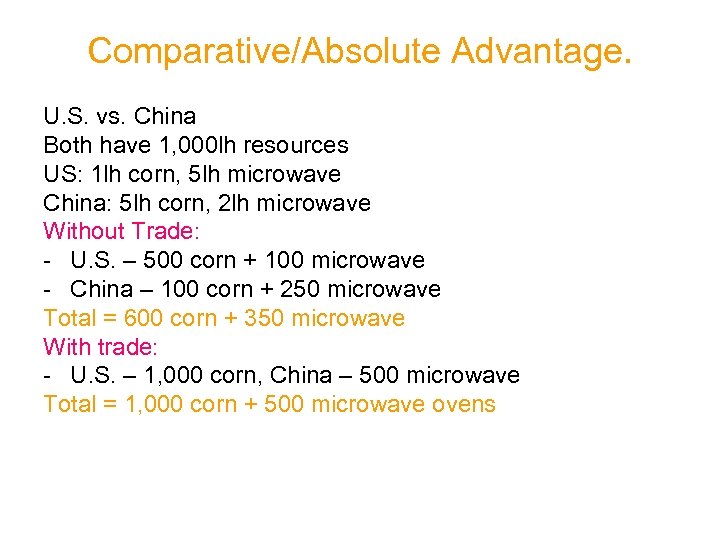
Comparative/Absolute Advantage. U. S. vs. China Both have 1, 000 lh resources US: 1 lh corn, 5 lh microwave China: 5 lh corn, 2 lh microwave Without Trade: - U. S. – 500 corn + 100 microwave - China – 100 corn + 250 microwave Total = 600 corn + 350 microwave With trade: - U. S. – 1, 000 corn, China – 500 microwave Total = 1, 000 corn + 500 microwave ovens
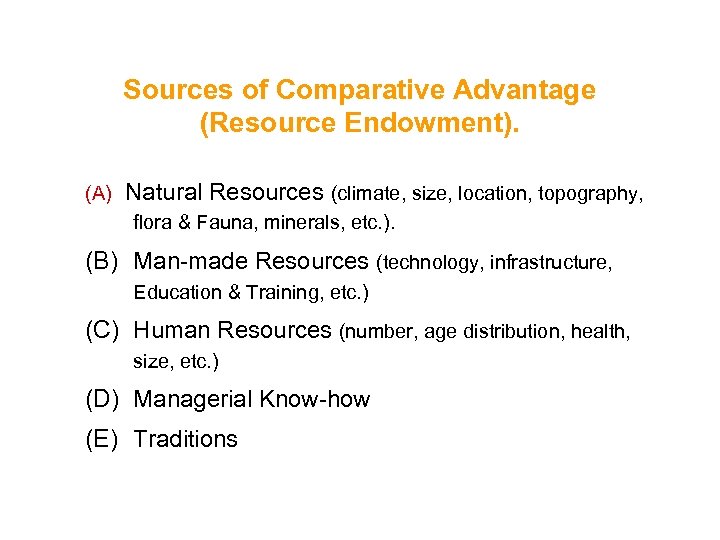
Sources of Comparative Advantage (Resource Endowment). (A) Natural Resources (climate, size, location, topography, flora & Fauna, minerals, etc. ). (B) Man-made Resources (technology, infrastructure, Education & Training, etc. ) (C) Human Resources (number, age distribution, health, size, etc. ) (D) Managerial Know-how (E) Traditions
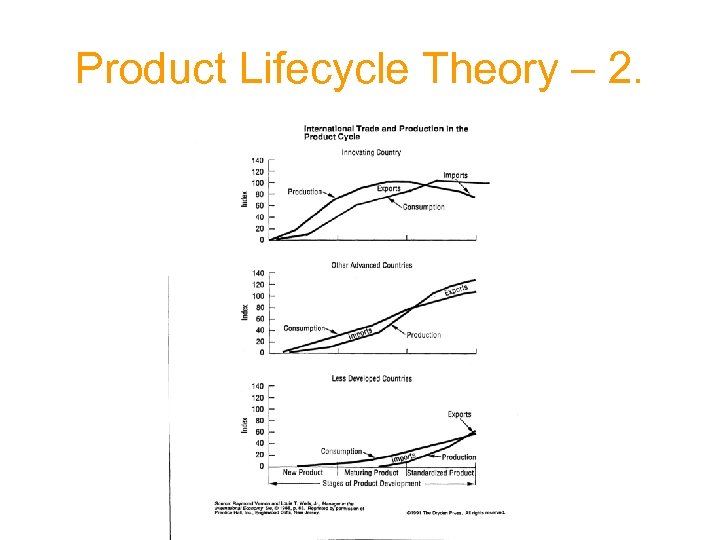
Product Lifecycle Theory – 2.
Chapter 2 Trade Institutions and Trade Policy BY RAJA. MAZHAR HAMEED
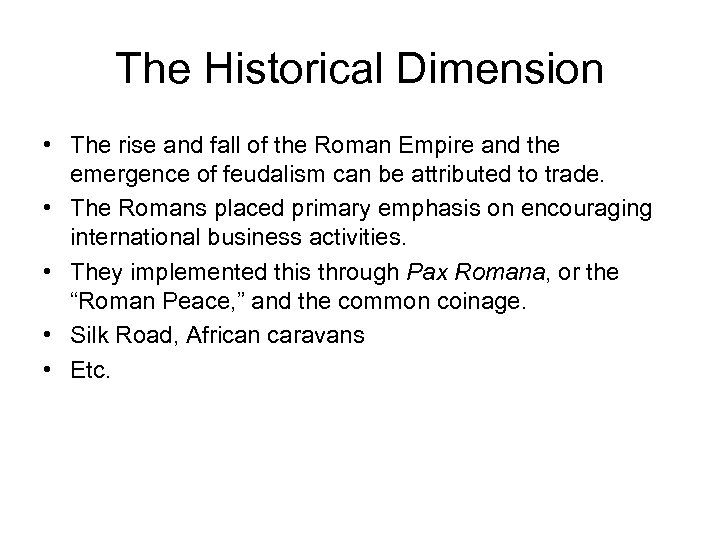
The Historical Dimension • The rise and fall of the Roman Empire and the emergence of feudalism can be attributed to trade. • The Romans placed primary emphasis on encouraging international business activities. • They implemented this through Pax Romana, or the “Roman Peace, ” and the common coinage. • Silk Road, African caravans • Etc.
More Recent History • The Smoot-Hawley Act (1930) raised import duties on 20, 000 products to reduce the volume of imports into the United States to help restore domestic employment → – in raising of duties and imposition of imports barriers by other nations → – worldwide depression and the collapse of the world financial system.
More Recent History • Post WW II: – The world was split into Eastern bloc led by the Soviet Union as the Western world led by the United States. – Soviet block focused on developing strong linkages among the members. Emphasis on centrally planned economies and heavy industry – United States created the Pax Americana and fostered international trade as a key to worldwide prosperity. Emphasis on market economies and balanced consumer/industrial goods sectors
Transnational Institutions Affecting World Trade ITO (International Trade Organization): Proposed at Bretton Woods Conference (1944) but was never ratified by the US Congress. GATT (General Agreement on Tariffs and Trade): A set of rules for non discrimination, transparent procedures and settlement of disputes in international trade. Agreed upon in Geneva and adopted by 23 countries in 1947. Purpose: provide an international forum to encourage free trade among member states Means: 1. regulation and reduction of tariffs on traded goods, 2. provision of a common mechanism for resolving trade disputes Name changed to World Trade Organization (WTO) on January 1, 1995 (by Uruguay Round)
Transnational Institutions Affecting World Trade WTO is the new legal and institutional foundation for a multilateral trading system. It currently it has 153 member countries. Functions: • Administering WTO trade agreements • Forum for trade negotiations • Handling trade disputes (empowered with ability to enforce rulings) • Monitoring national trade policies (countries found in violation of WTO rules are expected to change policies or else face sanctions) • • • Also responsible for General Agreement on Trade in Services (GATS), Trade related aspects of intellectual property rights (TRIPS), and Trade related investment measures (TRIMS). Its 9 th round of negotiations (Doha Round) was launched in 2001 in Doha, Qatar. It facilitated the way for China and Taiwan to get full membership in the WTO. As of now, the Doha Round is completely stalled because of unresolved subsidy issues
World Banking Group, 1944 Five major components: - International Bank for Reconstruction and Development (IBRD) - WB - International Development Association (IDA) - WB - International Finance Corporation (IFC) - WBG - Multilateral Investment Guarantee Agency (MIGA) - WBG - International Center for Settlement of Investment Disputes (ICSID) - WPG
World Bank: Current areas of focus - Sustainable growth and development. - - Clean technologies. Addressing higher commodity prices. Agricultural assistance for combating inflation in food. Liberalization of world trade. Greater participation of rising economic powers and developing nations in the bank’s governance. Reconstruction of war-torn countries. Assists fledging economies to participate in modern economic trade. Resolving debt problems of developing nations. Bringing market economy to former Eastern bloc nations.
Trade Positions • International trade positions have changed substantially when measured in terms of world market share. • The U. S share of total world export has declined precipitously since 1950 s. • Another important development is the rise of China, India and Brazil’s trade positions. • The impact of international trade and marketing on individuals is highlighted when trade is scrutinized from a per-capita perspective.
Trade Positions (contd. ) • Factors behind the decline in U. S. international competitiveness: – Attitude of the American policy makers. – Ignoring domestic firms in an attempt to boost the development of foreign economies (OK during Marshall Plan but disastrous when facing strong foreign competitors) – Perception amongst US manufacturers about international marketing being risky and complicated. – Lack of global interest (Technological arrogance, NIH syndrome, etc). – Inadequacy of information. – Unfamiliarity with international market conditions. – Complicated trade regulations.
The Impact of Trade and Investment • The effect of trade – Importance of Exports: – Create a trade balance by reducing trade deficits. – Affect the currency values and fiscal and monetary policies of the government. – Shape public perception about competitiveness. – Determine the affordable levels of imports for a country. – Help achieve economies of scale.
The Impact of Trade and Investment • The effect of trade – Importance of imports: – Firms are exposed to new competition. – Gives rise to new marketing approaches, better processes or better products and services. – Competitive pressures keep quality high and price low.
The Impact of Trade and Investment • The effect of international investment – Almost one in seven U. S. manufacturing employees works for a foreign affiliate. – To some extent, foreign direct investments substitute for trade activities. – Even though theory suggests open investment policy, some uneasiness exists about the rapid growth of such investment. • Restriction on investments may – Permit more domestic control over industries. – Deny access to foreign capital and often innovation. – Tightening up credit markets → higher interest rates, and a decrease in willingness to adapt to changing world market conditions

Chapter 3 The Cultural Environment BY RAJA. MAZHAR HAMEED
Culture Defined • Culture - An integrated system of learned behavior patterns that are distinguishing characteristics of the members of any given society. • It encompasses a wide variety of elements, from materialistic to the spiritual. • Enculturation – Absorbing one’s own culture Acculturation - Adjusting and adapting to a specific culture other than one’s own. • Adjusting to cultures is one of the keys to success in international operations.
Elements of Culture • • Language Religion Values & Attitudes Manners & Customs Material Elements Aesthetics Education Social Institutions • Cultural universals - Manifestations of the total way of life that are common to all cultures (elements such as body adornments, courtship, etiquette, family, gestures, joking, mealtimes, music, personal names, status differentiation, and trade etc. )
Elements of Culture Language • • • Written/Spoken/Body Language Forms of Address Direct/Contextual (high vs. low context) Hierarchy Diversity Etc.
Elements of Culture • Religion provides the basis for transcultural similarities under shared beliefs and behavior. • The major religions include: – Christianity - Lays stress on frugality and accumulation of wealth from hard work; consists of two significant groups Catholicism and Protestantism. – Islam - Plays a pervasive role in the life of its followers; it supports entrepreneurship and discourages exploitation.
Elements of Culture • The major religions – Hinduism - Family is an important element in Hindu society; the extended family structure has an impact on the purchasing power and consumption of Hindu families. – Buddhism - Views life as an existence of suffering; emphasizes on spiritual achievement rather than worldly goods. – Confucianism - Is characterized by a code of conduct; stresses on loyalty and relationships.
Elements of Culture • Values and attitudes – Values are shared beliefs or group norms that have been internalized by individuals. – Attitudes are evaluations of alternatives based on values. – Attitudes towards change is positive in industrialized countries, while in tradition bound societies change is viewed with suspicion.
Elements of Culture • Manners and customs – Understanding manners and customs is especially important in negotiations. – Potential problem areas for marketers arise from insufficient: • Understanding of different ways of thinking. • Attention to the necessity of saving face. • Recognition of the differences in decision-making process and the role of personal relations. • Allocation of time for negotiations.
Elements of Culture • Manners and customs – Concept of Time: • • Linear vs. cyclical Times of day Appointments, meetings Industrial discipline – Differences in the ways products are purchased and used. – Package sizes and labels must be adapted in many countries to suit the needs of the particular culture.
Elements of Culture • Material culture results from technology and is manifested in the availability and adequacy of the following basic infrastructures. – Economic - Consists of transportation, energy, and communications systems. – Social - Refers to housing, health, and educational systems. – Financial and marketing - Provide the facilitating agencies for the international firm’s operation in a given market; for example, banks and research firms. • Technological advancement also brings about cultural convergence.
Elements of Culture • Aesthetics – Each culture makes a clear statement concerning good taste, as expressed in the arts and in the particular symbolism of colors, form, music, etc. – Color is often used as a mechanism for brand identification, feature reinforcement, and differentiation.
Elements of Culture Education: • Levels of Participation • Technical, Professional • Administrative • Vocational • Literacy • etc.
Elements of Culture • Social institutions – Social organization - determines the way people relate to one another including the roles of managers and subordinates. – Kinship or blood relationships - family relations and family obligations. – Reference groups - Provide the values and attitudes that become influential in shaping behavior; can be primary or secondary. • Social stratification – Differences in the division of a particular population into classes (higher strata control most of the buying power and decision-making positions).
Cultural Analysis • Hofstede’s dimensions of culture: – Individualism – Power distance – Uncertainty avoidance – Masculinity – Long-term versus short-term orientation
Cultural Analysis • Self-reference criterion – The unconscious reference to one’s own cultural values. • Recommendations to reduce the influence of one’s own cultural values: – Define the problem in terms of domestic and foreign cultural traits, habits, or norms. – Isolate the self-reference criterion influence in the problem and examine it to see how it complicates the problem. – Redefine the problem without the self-reference criterion influence and solve for the optimal situation.
Cultural Analysis • Ethnocentricism - The belief that one’s own culture is superior to others. • It can be controlled only by acknowledging it and properly adjusting to its possible effects in managerial decision making.
The Training Challenge • The objective of training: foster preparedness, sensitivity, patience, and flexibility in managers and other personnel. • Internal cultural sensitivity training programs : – Culture specific information – Culture general information – Self-specific information
Cultural Training • Area studies - Provide factual preparation for a manager to operate in, or work with people from, a particular country. • Cultural assimilator - A program in which trainees must respond to scenarios of specific situations in a particular country. • Sensitivity training - Focuses on enhancing a manager’s flexibility in situations that are quite different from those at home. • Field experience - Exposes a manager to a different cultural environment for a limited amount of time.
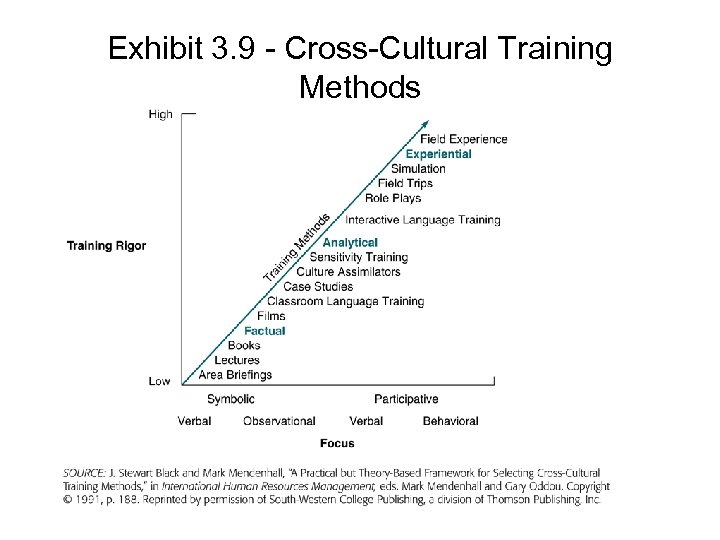
Exhibit 3. 9 - Cross-Cultural Training Methods
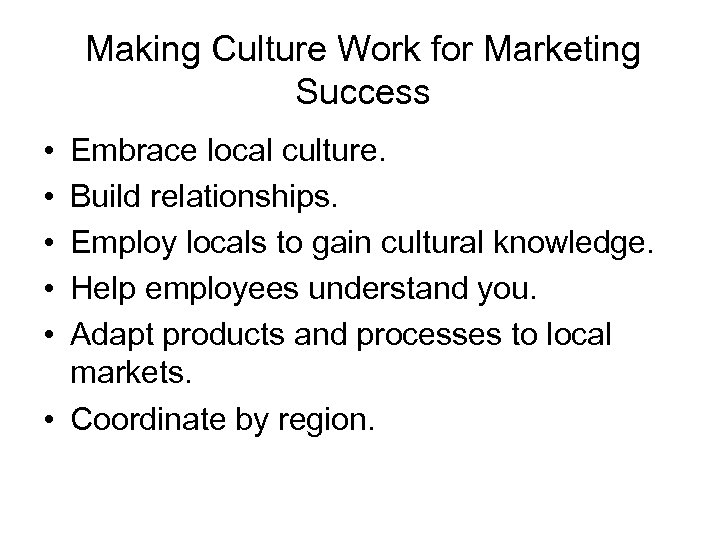
Making Culture Work for Marketing Success • • • Embrace local culture. Build relationships. Employ locals to gain cultural knowledge. Help employees understand you. Adapt products and processes to local markets. • Coordinate by region.
Chapter 4 The Economic Environment BY RAJA. MAZHAR HAMEED
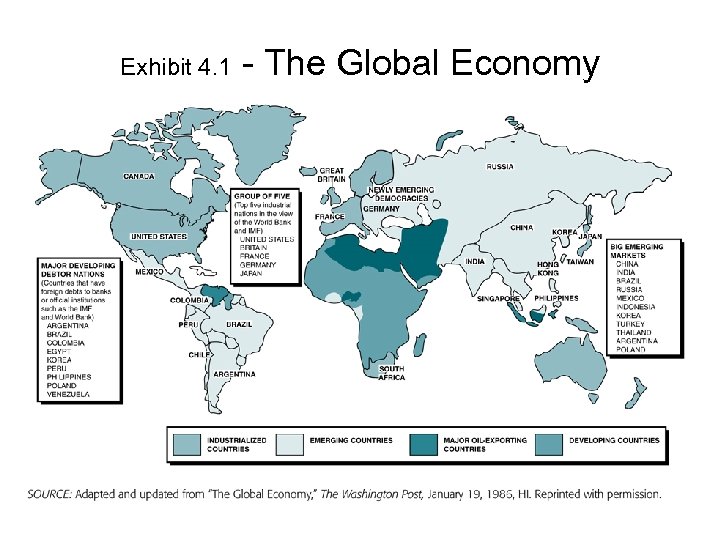
Exhibit 4. 1 - The Global Economy
Market Characteristics • Population – Figures classified to show specific characteristics of their respective markets. – Age distribution and life expectancy correlate heavily with the level of development of the market. – A household describes all the persons, both related and unrelated, who occupy a housing unit. – The degree of urbanization dictates the nature of the marketing task the company faces in terms of distribution, market potential, and buying habits.
Market Characteristics • Income – Income-distribution: can be classified as very low family incomes, low, medium, high, and very high family incomes (developed and near-developed countries have mostly medium family incomes). – Per capita GDP - often used as a primary indicator for purchasing power. – Purchasing power parities (PPP) show many units of currency are needed in one country to buy the amount of goods and services that one unit of the currency will buy in another country. – Income figures are useful in the initial screening of markets; however, in product-specific cases, income may not play a major role. – The lack of income in a market may preclude the marketing of a standardized product but, at the same time, provide an opportunity for an adjusted product.
Market Characteristics • Consumption patterns – Engel’s laws - As a family’s income increases, the percentage spent on food will decrease, the percentage spent on housing and household operations will be roughly constant, and the amount saved or spent on other purchases will increase. – Product saturation or diffusion provides information on the percentage of households in a market that own a particular product.
Market Characteristics • Infrastructure – Transportation networks by land, rail, waterway, or air are essential for distribution. – Communication systems for marketing include telephones, computers, broadcast media, print media, internet, and wireless technology. – The more extensive the firm’s international involvement, the more it can rely on its already existing support network of banks, advertising agencies, and distributors to assess new markets.
Impact of the Economic Environment on Social Development • Factors impeding economic growth: – Infrastructure limits – Labor shortages – Demand for greater political freedom – Environmental destruction – Urban congestion – Spread of drug addiction
Impact of the Economic Environment on Social Development • Physical Quality of Life Index (PQLI) – Is a composite measure of the level of welfare in a country. – Is composed of life expectancy, infant mortality, and adult literacy rates.
Impact of the Economic Environment on Social Development • Emotional well-being may be determined by: – Quality of social relationships – Enjoyment at work – Job stability – Overall conditions of the country
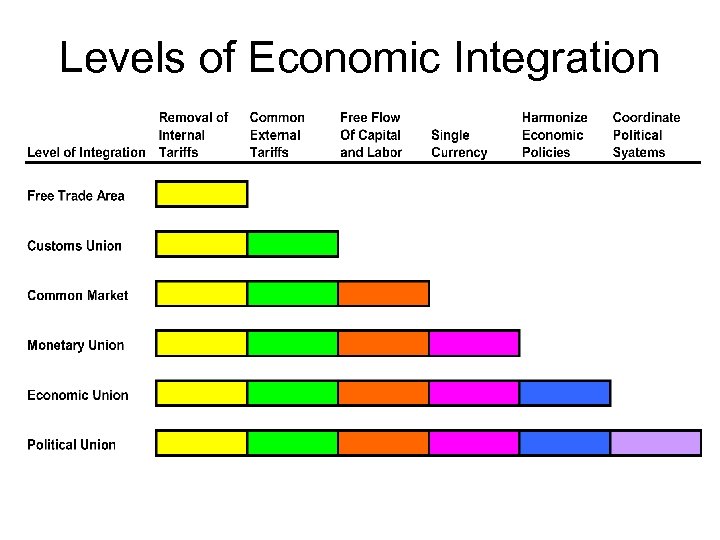
Levels of Economic Integration
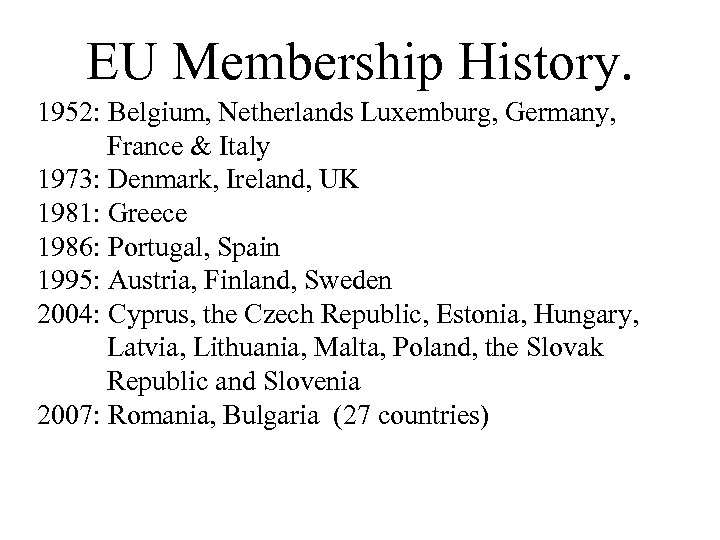
EU Membership History. 1952: Belgium, Netherlands Luxemburg, Germany, France & Italy 1973: Denmark, Ireland, UK 1981: Greece 1986: Portugal, Spain 1995: Austria, Finland, Sweden 2004: Cyprus, the Czech Republic, Estonia, Hungary, Latvia, Lithuania, Malta, Poland, the Slovak Republic and Slovenia 2007: Romania, Bulgaria (27 countries)
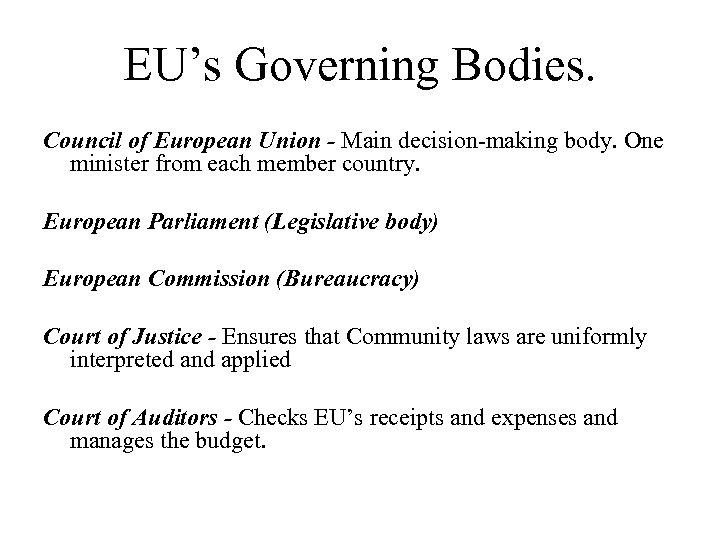
EU’s Governing Bodies. Council of European Union - Main decision-making body. One minister from each member country. European Parliament (Legislative body) European Commission (Bureaucracy) Court of Justice - Ensures that Community laws are uniformly interpreted and applied Court of Auditors - Checks EU’s receipts and expenses and manages the budget.
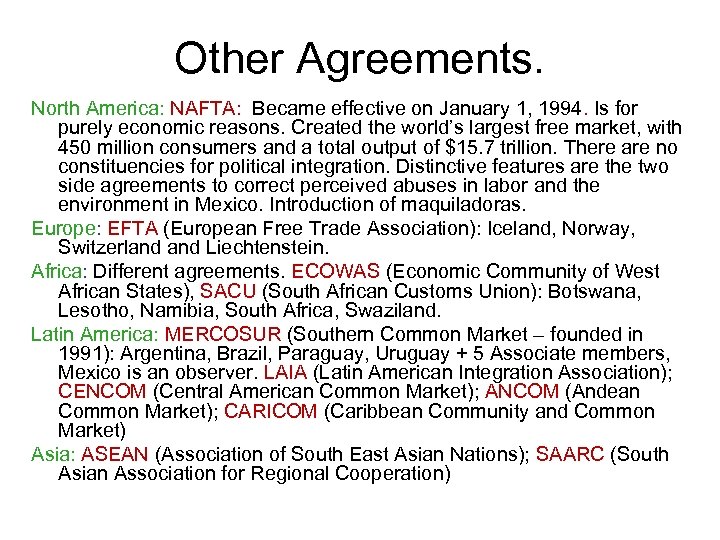
Other Agreements. North America: NAFTA: Became effective on January 1, 1994. Is for purely economic reasons. Created the world’s largest free market, with 450 million consumers and a total output of $15. 7 trillion. There are no constituencies for political integration. Distinctive features are the two side agreements to correct perceived abuses in labor and the environment in Mexico. Introduction of maquiladoras. Europe: EFTA (European Free Trade Association): Iceland, Norway, Switzerland Liechtenstein. Africa: Different agreements. ECOWAS (Economic Community of West African States), SACU (South African Customs Union): Botswana, Lesotho, Namibia, South Africa, Swaziland. Latin America: MERCOSUR (Southern Common Market – founded in 1991): Argentina, Brazil, Paraguay, Uruguay + 5 Associate members, Mexico is an observer. LAIA (Latin American Integration Association); CENCOM (Central American Common Market); ANCOM (Andean Common Market); CARICOM (Caribbean Community and Common Market) Asia: ASEAN (Association of South East Asian Nations); SAARC (South Asian Association for Regional Cooperation)
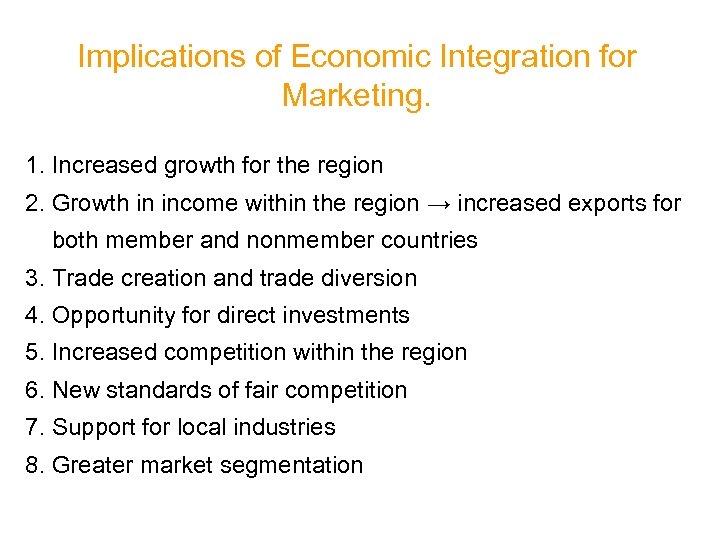
Implications of Economic Integration for Marketing. 1. Increased growth for the region 2. Growth in income within the region → increased exports for both member and nonmember countries 3. Trade creation and trade diversion 4. Opportunity for direct investments 5. Increased competition within the region 6. New standards of fair competition 7. Support for local industries 8. Greater market segmentation
Strategies for Regional Markets Europe: Fill gaps in product/market portfolios; Create alliances with strong European firms; Rationalize European organization, production, distribution; Hire senior-level European talent; Establish region-wide government relations … Emerging markets: Adjust entry strategy; Manage affordability; Invest in distribution; Build strong brands … Developing Markets: Research customers; Create buying power; Tailor local solutions; Improve access; Shape aspirations …
Chapter 5 The Political and Legal Environment BY RAJA. MAZHAR HAMEED
International Political Issues. • Nationalism, sovereignty, imperialism, power, ideologies, national interests, political risk. . . IK
Political/Legal Concerns of International Marketers § Home country political and legal circumstances § Host country political and legal circumstances host country. § Bilateral and multilateral agreements, treaties, and laws governing the relations between host and home countries. • Home country government policies and the legal systems have a major impact on a firm’s opportunities abroad. Examples: • Minimum wage legislation affects the international competitiveness of a firm using highly labor intensive production processes. • The cost of domestic environment safety regulations may also significantly affect the pricing policies of firms in their international marketing efforts
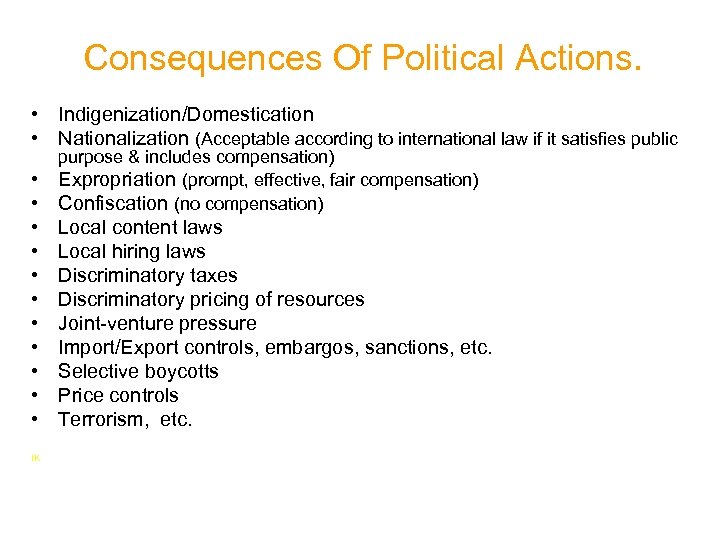
Consequences Of Political Actions. • Indigenization/Domestication • Nationalization (Acceptable according to international law if it satisfies public • • • IK purpose & includes compensation) Expropriation (prompt, effective, fair compensation) Confiscation (no compensation) Local content laws Local hiring laws Discriminatory taxes Discriminatory pricing of resources Joint-venture pressure Import/Export controls, embargos, sanctions, etc. Selective boycotts Price controls Terrorism, etc.
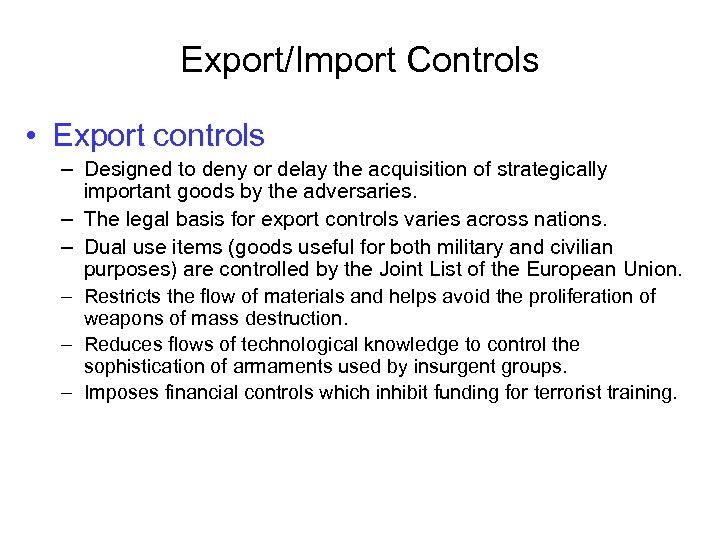
Export/Import Controls • Export controls – Designed to deny or delay the acquisition of strategically important goods by the adversaries. – The legal basis for export controls varies across nations. – Dual use items (goods useful for both military and civilian purposes) are controlled by the Joint List of the European Union. – Restricts the flow of materials and helps avoid the proliferation of weapons of mass destruction. – Reduces flows of technological knowledge to control the sophistication of armaments used by insurgent groups. – Imposes financial controls which inhibit funding for terrorist training.
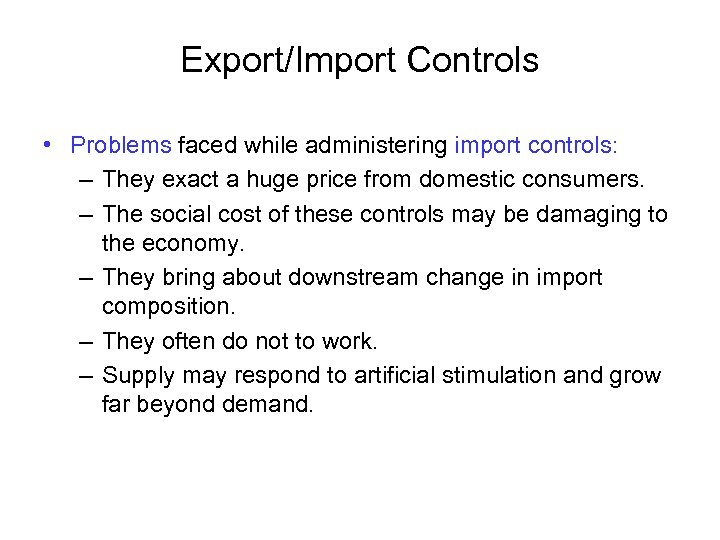
Export/Import Controls • Problems faced while administering import controls: – They exact a huge price from domestic consumers. – The social cost of these controls may be damaging to the economy. – They bring about downstream change in import composition. – They often do not to work. – Supply may respond to artificial stimulation and grow far beyond demand.
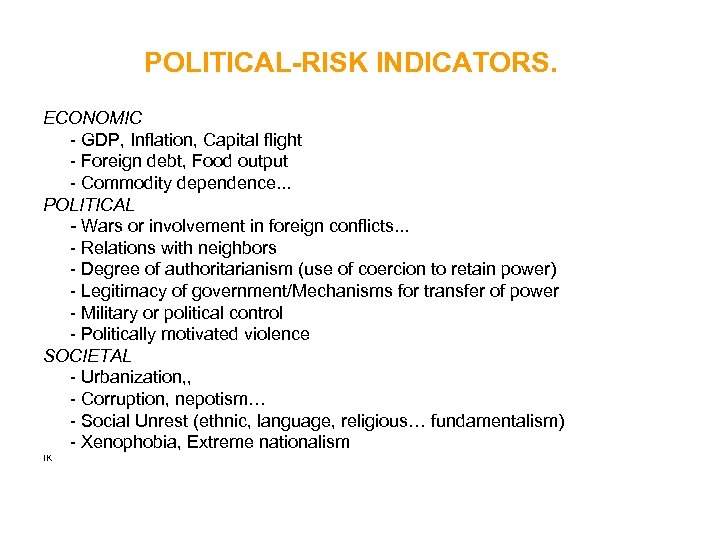
POLITICAL-RISK INDICATORS. ECONOMIC - GDP, Inflation, Capital flight - Foreign debt, Food output - Commodity dependence. . . POLITICAL - Wars or involvement in foreign conflicts. . . - Relations with neighbors - Degree of authoritarianism (use of coercion to retain power) - Legitimacy of government/Mechanisms for transfer of power - Military or political control - Politically motivated violence SOCIETAL - Urbanization, , - Corruption, nepotism… - Social Unrest (ethnic, language, religious… fundamentalism) - Xenophobia, Extreme nationalism IK
Legal Environment • Home country laws • Host country laws • International law • Two major legal systems popular worldwide are: – Common law - Based on tradition and depends less on written statutes and codes than on precedent and custom. – Code law - Based on a comprehensive set of written statutes that spell out legal rules explicitly; based on Roman law.
International Law – No enforceable body of international law exists; – Treaties and agreements respected by a number of countries influence international business operations. – Firms are restricted by both home and host country laws. In case of a conflict in deciding which country’s law to follow, firms can choose either arbitration or litigation. • Litigation often involves extensive delays and is very costly. • Arbitration procedures should always be included in the original contract.
International Terrorism ―Terrorism is the systematic use (or threat) of violence aimed at attaining a political goal and conveying a political message. – Terrorists direct their strikes at business more than any other target. – Terrorism creates new opportunities for firms in a few industries like construction, security, and information technology.
International Terrorism – Direct effect of terrorism: the immediate cost levied on individual firms. – Indirect effect on business activities: the real or perceived decline in per capita income, purchasing power, and stock market values. – Chill effect - Uncertainty about the state of a nation’s economy leads to a sharp reduction in demand for both consumer and industrial goods.
International Terrorism – Physical damage disrupts power supply, communication, transport and other forms of infrastructure, thereby disturbing the supply of inputs, resources and services. – Terrorism deteriorates transnational relationships. – Regulations imposed by the government to reduce a country’s vulnerability to terrorism may delay the supply of inputs, increase administrative burden and require firms to invest in new procedures.
International Travel Hazards. Azerbaijan: Air Azerbaijan flights are often overcrowded. Passengers may have to stand in isles. Seatbelts often missing Angola: Airport personnel/health officials may threaten arriving passengers with ‘vaccinations’ with unsterilized needles if gratuities are not paid. Guatemala: Rumors that foreigners steal children for their organs. Mob violence resulted in the beating of American tourists. Finland: Moose often wander on to major highways at night during mating season Colombia: A ‘policeman’ approaches a tourist to ‘check’ their currency for fake bills. Takes the money, gives a fake receipt, and disappears. Spain: Thieves distract victims by squirting mustard/ketchup/mayonnaise, pick their pockets Thailand: Reckless passing in mountainous regions and consumption of stimulants by commercial drivers is common Jordan: Minefields that my not be properly marked and fenced off Mali, India: Unmarked speed bumps on main roads, trucks driving without headlights at night, great variety of slow moving traffic without any lights
Ethical Issues • The ethical obligations faced by multinational enterprises include: – Corporate governance and responsibility – Intellectual property rights – Bribery and corruption
Corporate governance and responsibility Corporate governance - Relationships among stakeholders that determine and control the strategic direction and performance of an organization. – Its key elements include: • Transparency of a firm’s operation. • Financial results. • Principles by which it measures sales, expenses, assets, and liabilities.

Bribery and corruption – The Foreign Corrupt Practices Act (FCPA): passed in 1977 to prohibit U. S. firms to bribe foreign officials for business purposes. – Functional lubrication/Enabling payments: the amount is small, it is standardized, and is passed on to others involved in the processing of the documents. – Bribery: the process driven by “individual greed, ” the amount depends on the individual official and is for the official’s own personal use.
Bribery and corruption – In 1995, the Organization of American States (OAS) officially condemned bribery. – The Organization for Economic Cooperation and Development (OECD) in 1999 agreed to change the bribery regulations among its member countries to prohibit the tax deductibility of improper payments. – The Sarbanes-Oxley Act of 2002 was intended to protect investors by improving the accuracy and reliability of corporate disclosures.
Скачать презентацию International Marketing BY RAJA MAZHAR HAMEED Chapter
96e20165eb8cb3d45ffcb8af926c8c53.ppt