


 Скачать презентацию International Marketing 21 April 2008 The Plan
848aa54e7eb8486c2ebe8c62611c6b92.ppt
- Количество слайдов: 54
 International Marketing 21 April 2008
 The Plan for Today: • Merck Case study: Final Discussion & Action Plan Marketing Program elements • Product Decisions • International Distribution Decisions • Pricing Decisions in International Context
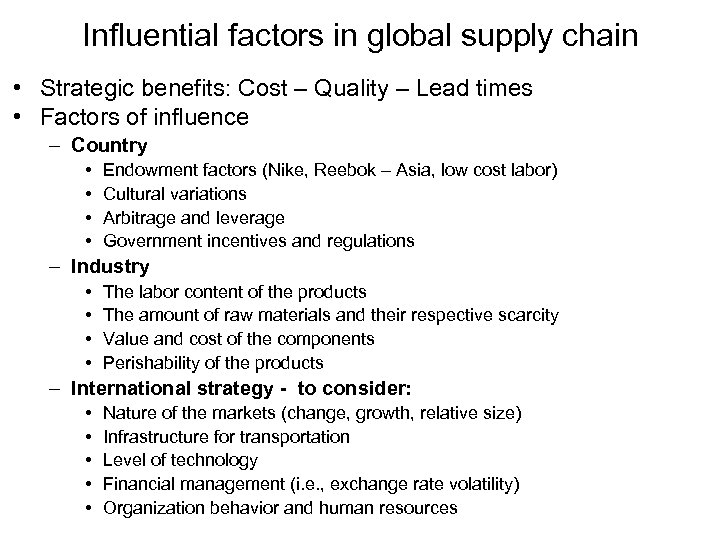 Influential factors in global supply chain • Strategic benefits: Cost – Quality – Lead times • Factors of influence – Country • • Endowment factors (Nike, Reebok – Asia, low cost labor) Cultural variations Arbitrage and leverage Government incentives and regulations – Industry • • The labor content of the products The amount of raw materials and their respective scarcity Value and cost of the components Perishability of the products – International strategy - to consider: • • • Nature of the markets (change, growth, relative size) Infrastructure for transportation Level of technology Financial management (i. e. , exchange rate volatility) Organization behavior and human resources
 International Marketing Programme
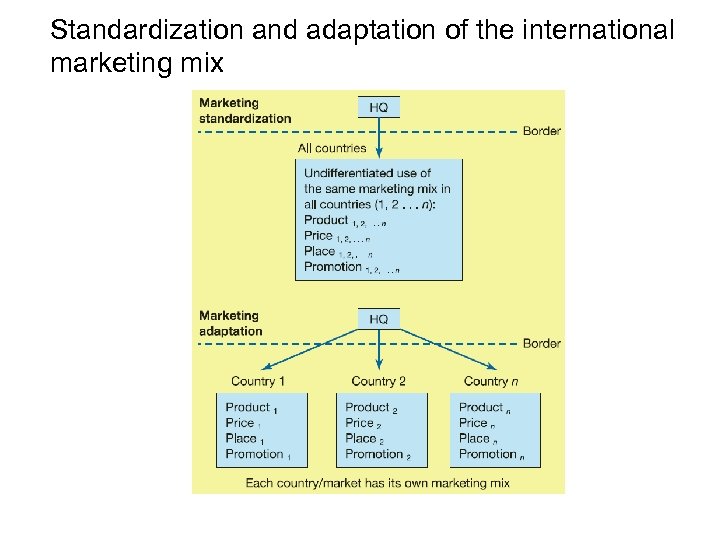 Standardization and adaptation of the international marketing mix
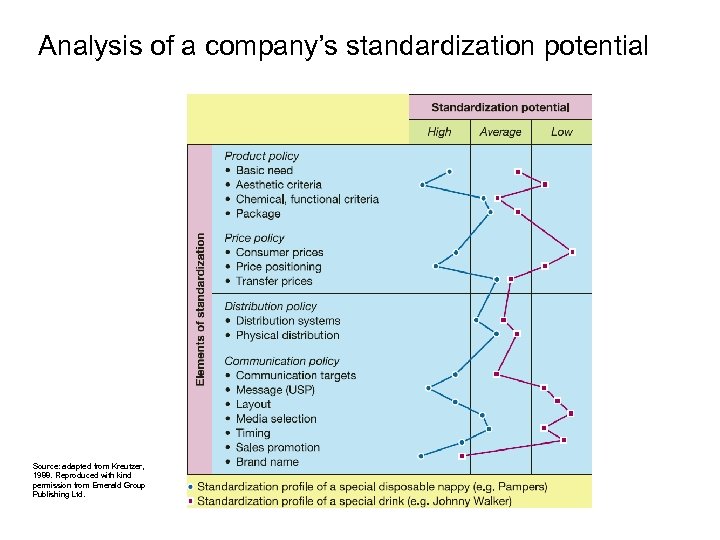 Analysis of a company’s standardization potential Source: adapted from Kreutzer, 1988. Reproduced with kind permission from Emerald Group Publishing Ltd.
 Product decisions • Dimensions of Product Offer • The Product Life Cycle • Product Positioning – Targeting Right Customers in the Right Markets – Baltika example • Branding decisions
 Before deciding on international marketing research strategy… • Some main decision factors: – Consumer products – Industrial products – Services
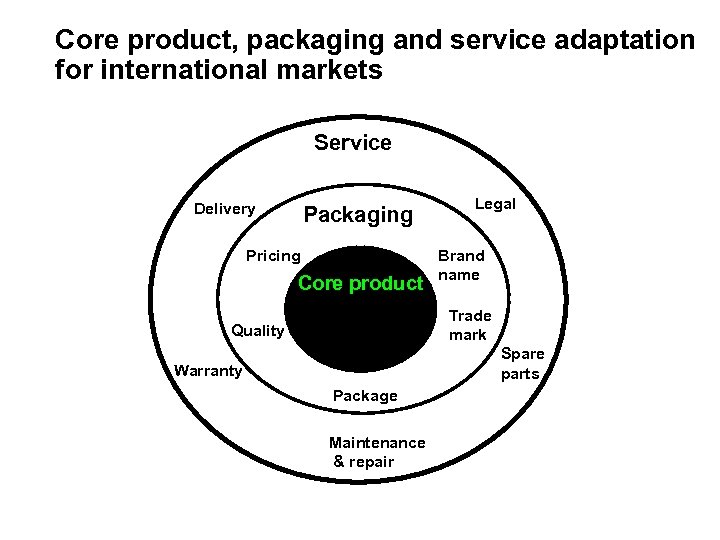 Core product, packaging and service adaptation for international markets Service Delivery Packaging Pricing Core product Quality platform design function Warranty Package Maintenance & repair Legal Brand name Trade mark Spare parts
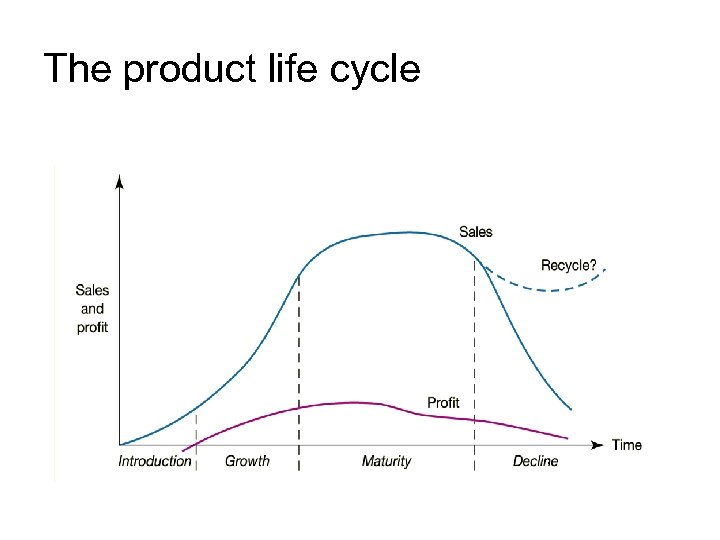 The product life cycle
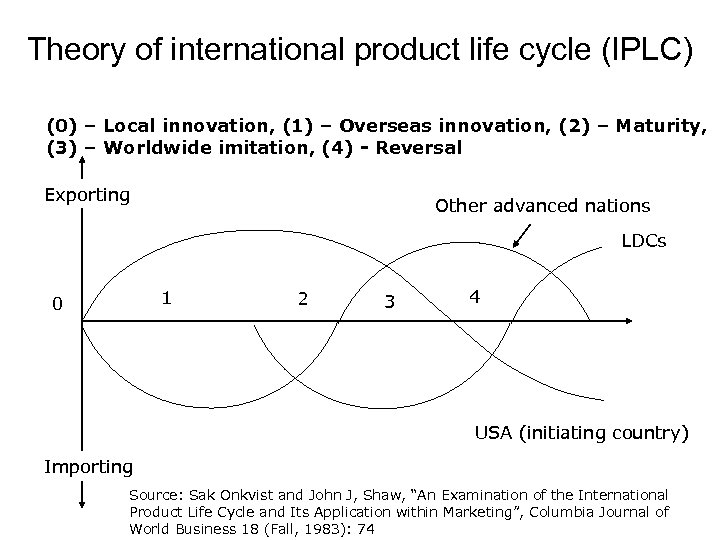 Theory of international product life cycle (IPLC) (0) – Local innovation, (1) – Overseas innovation, (2) – Maturity, (3) – Worldwide imitation, (4) - Reversal Exporting Other advanced nations LDCs 1 0 2 3 4 USA (initiating country) Importing Source: Sak Onkvist and John J, Shaw, “An Examination of the International Product Life Cycle and Its Application within Marketing”, Columbia Journal of World Business 18 (Fall, 1983): 74
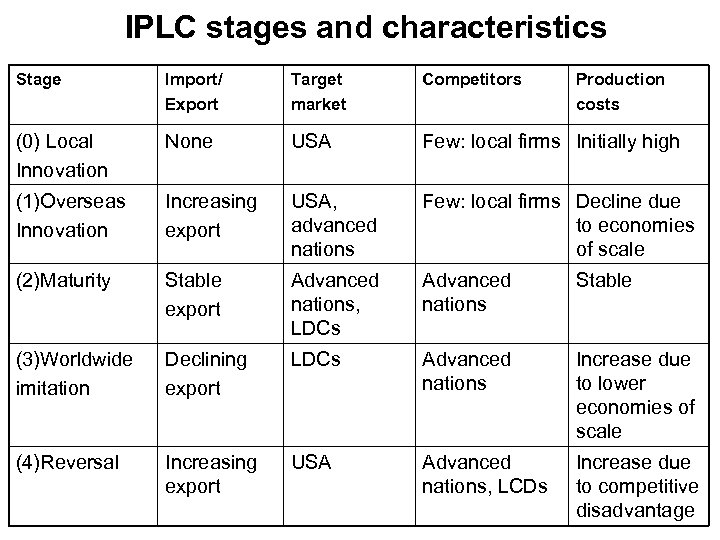 IPLC stages and characteristics Stage Import/ Export Target market Competitors Production costs (0) Local Innovation None USA Few: local firms Initially high (1)Overseas Innovation Increasing export USA, advanced nations Few: local firms Decline due to economies of scale (2)Maturity Stable export Advanced nations, LDCs Advanced nations Stable (3)Worldwide imitation Declining export LDCs Advanced nations Increase due to lower economies of scale (4)Reversal Increasing export USA Advanced nations, LCDs Increase due to competitive disadvantage
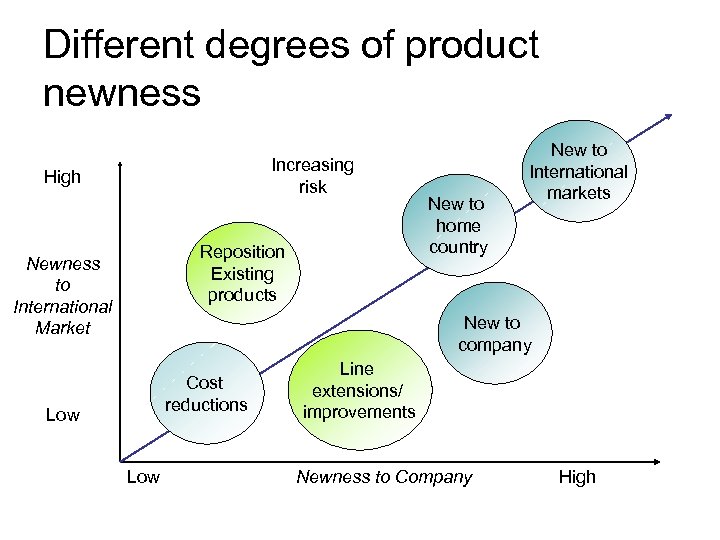 Different degrees of product newness Increasing risk High Reposition Existing products Newness to International Market New to home country New to International markets New to company Cost reductions Low Line extensions/ improvements Newness to Company High
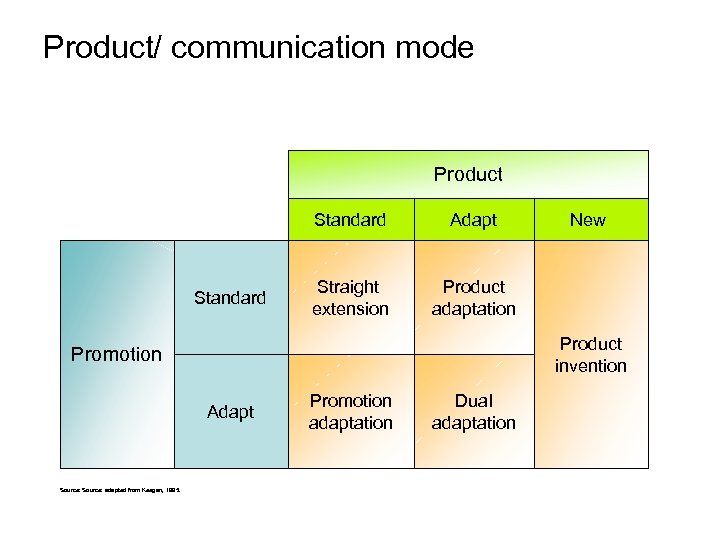 Product/ communication mode Product Standard Adapt Straight extension Product adaptation Product invention Promotion Adapt Source: adapted from Keegan, 1995. New Promotion adaptation Dual adaptation
 Product innovation and differentiation • Nokia vs. Samsung • P&G – unlike Coca-Cola, P&G has changed its Tide detergent 30 times in the past 50 years “We live or die by product innovation, we know that if we don’t have it, we can’t grow the business in North America. Nor can we succeed in China or Russia the way we need to (John Pepper)”
 Consumer products as competitive platforms • A product platform refers to the development of a set of subsystems and interfaces that form a common product structure • Markets consolidation vs. fragmentation – Renault: from 34 to 10 platforms by 2010, emphasis on brand, design, styling
 The industrial products firm • Industrial firm involves a network of influences • The level of economic development in a country is a major determinant of the demand for industrial products • Culture has less impact (usage patterns, product features, specifications, negotiations) • Customer-bound nature of industrial products (collaborative internationalization decisions) • Derived nature of demand – Chrysler/Daimler-Benz - $80 bln on parts – Renault-Nissan merger – new jointly developed vehicles are likely to be designed to share some components, increasing leverage
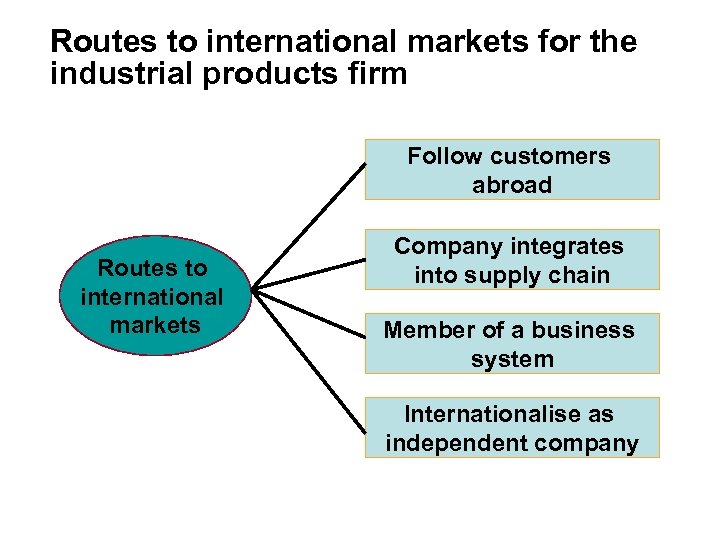 Routes to international markets for the industrial products firm Follow customers abroad Routes to international markets Company integrates into supply chain Member of a business system Internationalise as independent company
 The service firm: internationalization • A service can be described as any activity or benefit that a supplier offers a customer that is usually intangible and does not results in the ownership of anything • According to the International Standard Industrial Classification (ISIC): – Wholesale, retail trade, restaurants, hotels, transport, storage and communications, financial, insurance and real estate and business services, personal, community and social services, government services • Intangibility, Inseparability, Perishibility, Heterogeneity
 The service firm: internationalization (2) • Only those services that are embedded in goods can be directly exported – Software, videos, CDs… • The involvement of people is crucial • Critical role of customer contact as the physical presence of the customer in the system – High contact – customized nature of each delivery, customer can affect the time of demand, the exact nature of service and the quality of service • The closer the contact – the richer the customer relationship • Delivered by technology - do not require high contact • Scale and culture effects
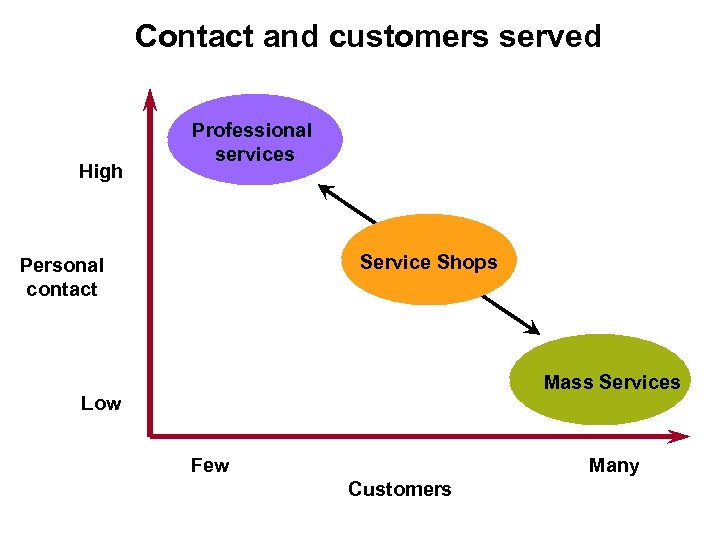 Contact and customers served High Professional services Service Shops Personal contact Mass Services Low Few Many Customers
 Standardization vs customization in services • Customer contact dictates the extent to which services may be standardized or should be customized • Core services that are sold globally are more likely to be standardized • The criteria: is a service people-based or equipmentbased? – Automatic car-wash • Investments in people and training as a mean of standardization, • Standardization and customization simultaneously possible by using local nationals as providers the ‘foreignness’ of a standard service may be overcome (local cabin crews by international airlines).
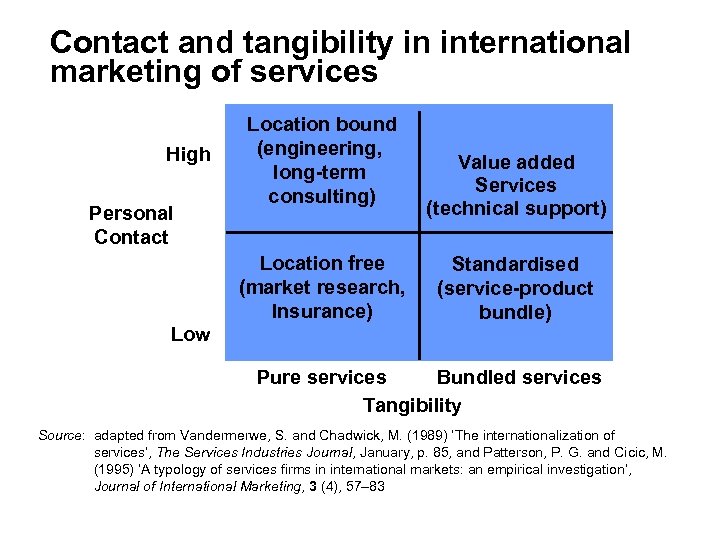 Contact and tangibility in international marketing of services High Personal Contact Location bound (engineering, long-term consulting) Location free (market research, Insurance) Low Value added Services (technical support) Standardised (service-product bundle) Pure services Bundled services Tangibility Source: adapted from Vandermerwe, S. and Chadwick, M. (1989) ‘The internationalization of services’, The Services Industries Journal, January, p. 85, and Patterson, P. G. and Cicic, M. (1995) ‘A typology of services firms in international markets: an empirical investigation’, Journal of International Marketing, 3 (4), 57– 83
 Brand equity refers to the premium a customer would pay for the branded product compared to an identical unbranded version of the same product? The role of branding • To distinguish a company’s offering and differentiate one particular product from its competitors • To create identification and brand awareness • To guarantee a certain level of quality and satisfaction • To help with promotion of the product
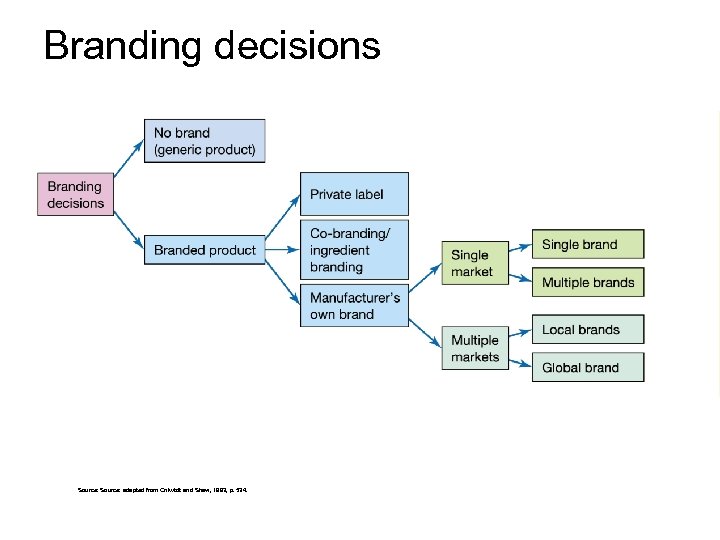 Branding decisions Source: adapted from Onkvisit and Shaw, 1993, p. 534.
 Pricing decisions in International Context • Comparison with domestic pricing strategies • Factors influencing pricing • International pricing strategies • Terms of sale/delivery terms • Export financing
 Pricing • A product can not exist without price • Price should never be isolated from the other parts of the marketing mix! • Consumers do not object to price; they object to is a lack of relationship between the perceived value of the product and price • Only area of global marketing mix where policy can be changed rapidly without large direct cost implications • Decisions in global markets are affected by complexity of influential factors
 Should price be uniform worldwide? 1. There is no reason for an export price to differ from the home price Ø EU example: Ø due to free movement of goods, elimination of customs barriers, and harmonization of VAT rates Ø internationally recognized consumer goods with wide European distribution are likely to have more uniform pricing system 2. Prices across multiple markets should be coordinated Ø without violating national law Ø Nintendo case: price cartel 1991 -1998 with 7 European distributors and allowed the companies to keep prices for its games artificially high in certain countries, resulting in extraordinarily wide differences in prices among countries
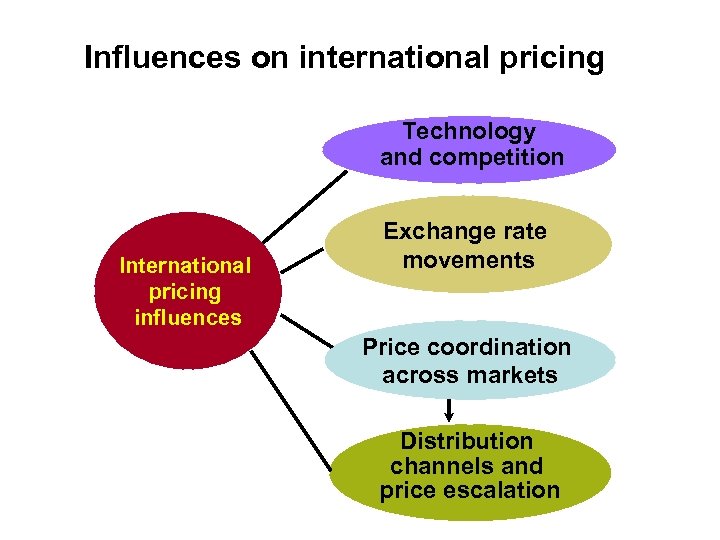 Influences on international pricing Technology and competition International pricing influences Exchange rate movements Price coordination across markets Distribution channels and price escalation
 options to consider the cost factor 1. Export price should be lower than home price v overhead expenses are spread over an expanded production volume v low price may be necessary to penetrate the foreign market 2. Cost-plus method (i. e. , full cost) v all costs (including domestic marketing costs and fixed costs must be paid for by all other countries) v domestic price plus various overseas costs (freight, packing, insurance, customs duties, etc) v ethnocentric practice – the same price prevails everywhere v it is easy for the price to end up being to high Example Mercedez-Benz - cost-plus method lead to engineers insensitivity to costs! The company found that its costs were 30% higher above Lexus! Now engineers and plant managers are required to
 options to consider the cost factor (2) • Marginal-cost pricing – represents a more polycentric approach – is based upon an assumption that some of the product costs, such as administration costs and advertising at home are irrelevant overseas • research and development costs, engineering costs have already been accounted for in the home market and thus should not be factored in again by extending them to other countries – the actual production costs plus foreign marketing costs are used as the floor price below which the prices cannot be set C the method is sensitive to local conditions D full costs may not be adequately taken into account by overseas subsidiaries Japanese firms use this method to penetrate foreign markets; and to maintain the market share. Break even is regarded as a success. The profits, thus, are sacrificed to keep factories going.
 the factor of elasticity • To be competitive does not mean that a company’s price must be at or below the market – Desirable image • SONY strategy: price above the market on the base of the image; though when the price gap between it and competitors has widened too far, SONY had to decrease prices • Cartier takes full advantage from its reputation. A watch made by its subcontractor for $125 is sold by almost 5 times above it. • More then 2/3 of BMW owners are repeat buyers – because of brand loyalty, BMW was able to price its cars 10 -30% above competitors comparable models • Country’s per capita income can be a good indicator of market’s ability to pay (and indirectly determine a product’s elasticity of demand) • Exceptions: Levi’s 501’s example shows that a high price can succeed in countries with low per capita income
 factor exchange rate has no impact in domestic marketing, but is crucial in international marketing – since 1985 a sharp drop in the dollar value against major currencies caused earnings of US MNCs to jump; factor market share • high market share provides pricing flexibility – ability to be above market – economies of scale advantage – important for late entrants (as an entry barrier) • can be bought with a very low price – Compaq shocked the Japanese market in 1992 by selling desktop PCs for less than a half the price of Japanese manufacturers
 culture • all buyers – the same price? • flexible (negotiated) price? – tradition of haggling around price – superior negotiating skills are required to get a better price
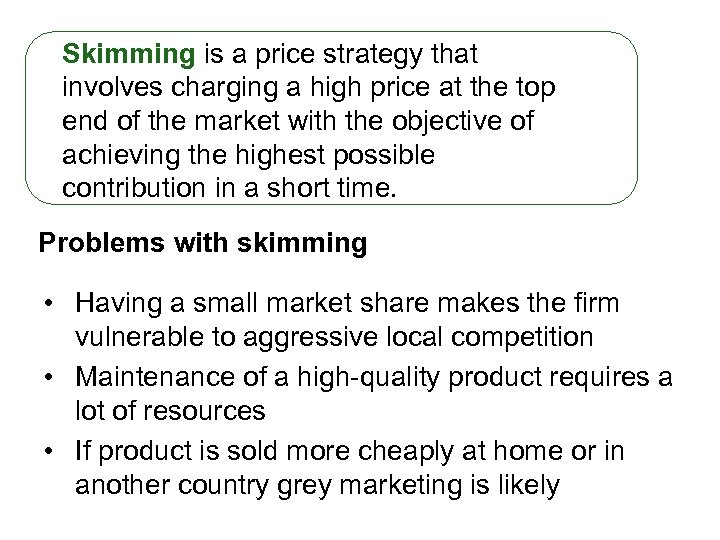 Skimming is a price strategy that involves charging a high price at the top end of the market with the objective of achieving the highest possible contribution in a short time. Problems with skimming • Having a small market share makes the firm vulnerable to aggressive local competition • Maintenance of a high-quality product requires a lot of resources • If product is sold more cheaply at home or in another country grey marketing is likely
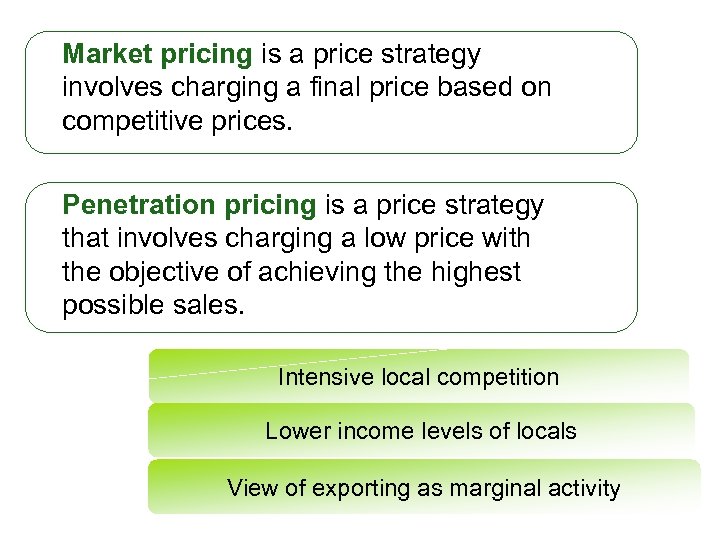 Market pricing is a price strategy involves charging a final price based on competitive prices. Penetration pricing is a price strategy that involves charging a low price with the objective of achieving the highest possible sales. Intensive local competition Lower income levels of locals View of exporting as marginal activity
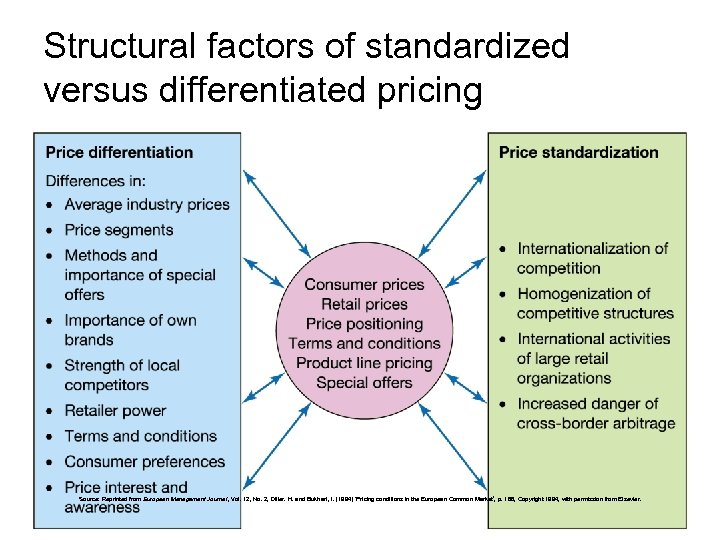 Structural factors of standardized versus differentiated pricing Source: Reprinted from European Management Journal , Vol. 12, No. 2, Diller. H. and Bukhari, I. (1994) ‘Pricing conditions in the European Common Market’, p. 168, Copyright 1994, with permission from Elsevier.
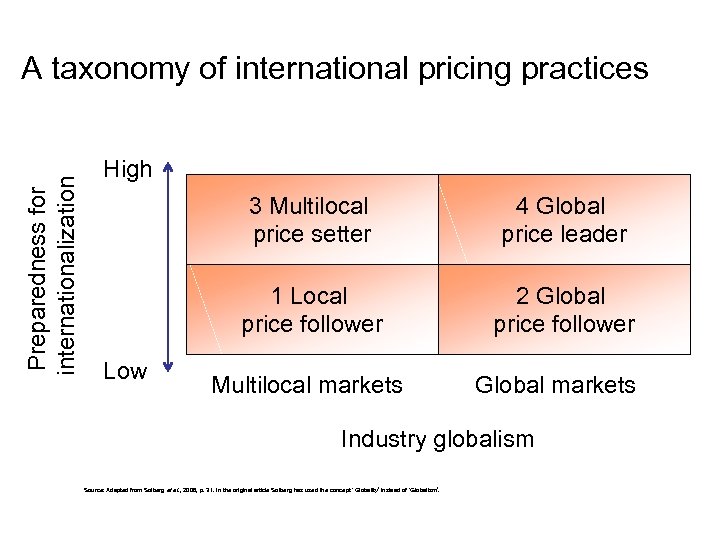 Preparedness for internationalization A taxonomy of international pricing practices High 3 Multilocal price setter 1 Local price follower Low 4 Global price leader 2 Global price follower Multilocal markets Global markets Industry globalism Source: Adapted from Solberg et al. , 2006, p. 31. In the original article Solberg has used the concept ‘ Globality’ instead of ‘Globalism’.
 alternative pricing strategies • Pricing involves more than simply marking up or down • Alternative strategies include: – – – Timing of the price change Number of price changes Time interval to which price change applies Number of items to change Use of discount and credit Bundling and unbundling Ex: US car makers – price changes by small amounts a number of times over the year
 alternative pricing strategies (2) • The effect of price can be masked and greatly moderated by financing or credit terms • Discounts may be used to adjust prices indirectly – Large vs smaller middlemen • To bundle or unbundle the product – Bundling adds value and increases prices a little or not at all for added value • Japanese car makers in USA – US car makers – a base price plus extra cost for each option – Ford – experiment with bundling approach (3 levels of bundling) + simplified production and assembly system, cut costs, speeded up delivery time, clearer market image for the brand, simplified marketing activities - the price can be made more affordable when unblundling the product
 dumping strategies • Dumping – a form of price discrimination, the practice of charging different prices for the same product in similar markets – Boeing accused Airbus of receiving $9 bln in subsidies enabling the company to price each airplane at some $15 to 20 million less than the true cost • Types of dumping – Sporadic dumping (manufacturer with unsold inventories wants to get rid of distressed or excess merchandise) – Predatory dumping involves selling at a loss to gain access to a market and perhaps to drive out competition and achieve monopolistic position – Persistent dumping is the most permanent mode of dumping, requiring consistent selling at lower prices in one market than in others (maybe due to recognition that the market are different in terms of overhead costs and demand characteristics) • Japan – home prices for consumer electronics are higher (no foreign competition)
 dumping strategies (2) • Whether or not dumping is illegal depends on whether the practice is tolerated in a particular country – Switzerland has no specific antidumping laws • Most countries have laws specifying a minimum price or a floor on prices that can be charged in the market Ex. Melex golf carts in US Ex. Mitsui – the largest dumping case (falsifying documents, hiding the origin of products, backdated invoices, rebates, claims about damaged goods, etc) • Dumping thus is a controversial practice; economists argue that the widely used antidumping measures have been abused for protectionist purposes
 how to dump? • Dumping is a risky strategy • Preferable strategy is to use other means to legally overcome dumping laws – To differentiate the exported item from the item being sold in the home market • Japanese car makers market their automobiles under new or different names in the USA – Provide financing terms that can have the same effect as price reduction – Produce the product in a host country • Japanese producers facing higher prices at home and lower prices in foreign markets; solution – to manufacture the sets in the USA and importing the components and parts from Japan
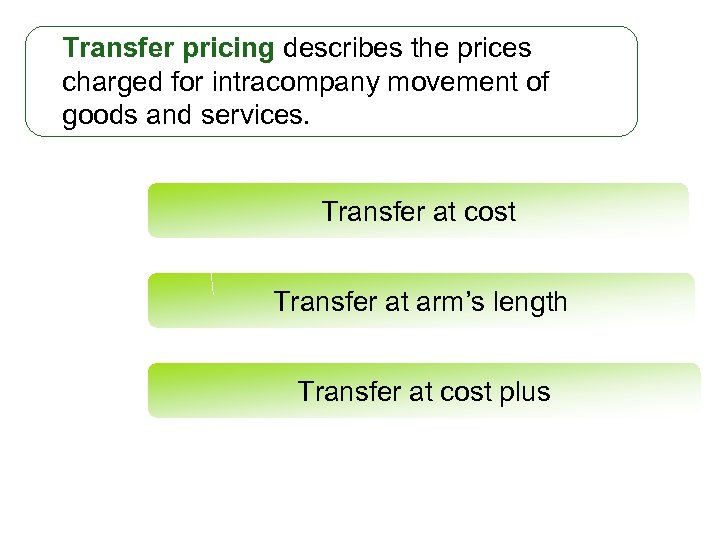 Transfer pricing describes the prices charged for intracompany movement of goods and services. Transfer at cost Transfer at arm’s length Transfer at cost plus
 terms of sale • Incoterms (International Chamber of Commerce) – Defining responsibility of buyers and sellers for delivery of goods under sales contracts • Incoterms 2000 (i. e. FOB London Incoterms 2000) • 4 categories: – E terms - the seller will make goods available to the buyer on the seller’s own premises – F terms - the seller is required to deliver goods to a carrier appointed by the buyer – C terms – the seller will be required to contract for carriage but will not take risk of loss or damage to goods – D terms – the seller is required to bear all costs and risks needed to bring goods to the place of destination
 Delivery terms • EXW Ex-works • FAS Free alongside ship • FOB Free on board • CFR Cost and freight • CIF Cost, insurance, and freight • DAF Delivered at frontier • DES Delivered ex-ship • DEQ Delivered exquay • DDP Delivered duty paid
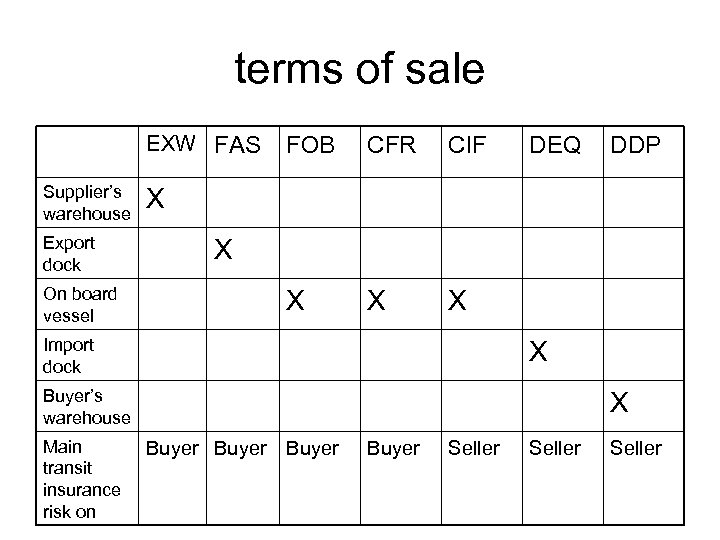 terms of sale EXW FAS Supplier’s warehouse Export dock On board vessel FOB CFR CIF X X DEQ X X X Import dock X Buyer’s warehouse Main transit insurance risk on DDP X Buyer Seller
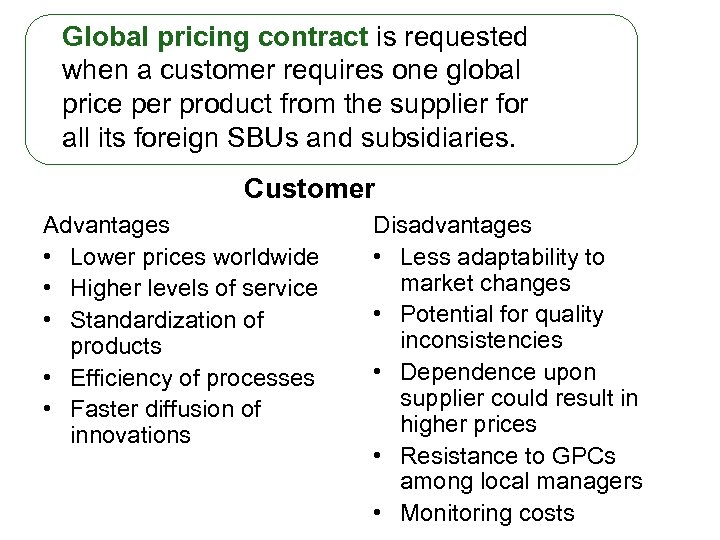 Global pricing contract is requested when a customer requires one global price per product from the supplier for all its foreign SBUs and subsidiaries. Customer Advantages • Lower prices worldwide • Higher levels of service • Standardization of products • Efficiency of processes • Faster diffusion of innovations Disadvantages • Less adaptability to market changes • Potential for quality inconsistencies • Dependence upon supplier could result in higher prices • Resistance to GPCs among local managers • Monitoring costs
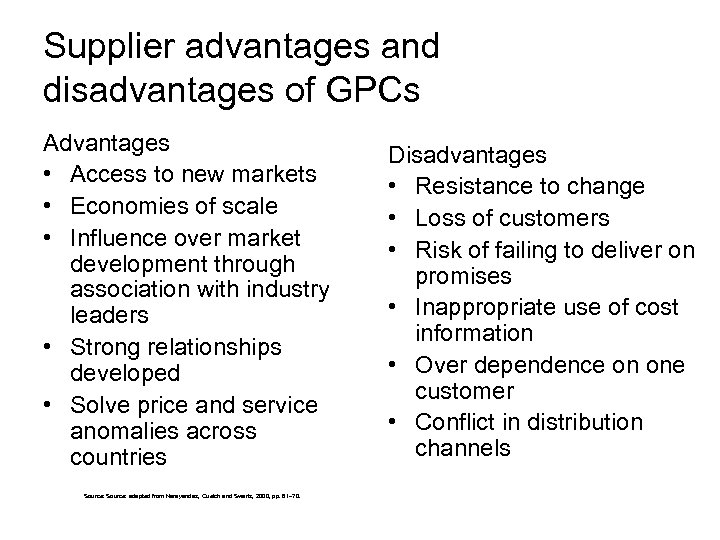 Supplier advantages and disadvantages of GPCs Advantages • Access to new markets • Economies of scale • Influence over market development through association with industry leaders • Strong relationships developed • Solve price and service anomalies across countries Source: adapted from Narayandas, Quelch and Swartz, 2000, pp. 61– 70. Disadvantages • Resistance to change • Loss of customers • Risk of failing to deliver on promises • Inappropriate use of cost information • Over dependence on one customer • Conflict in distribution channels
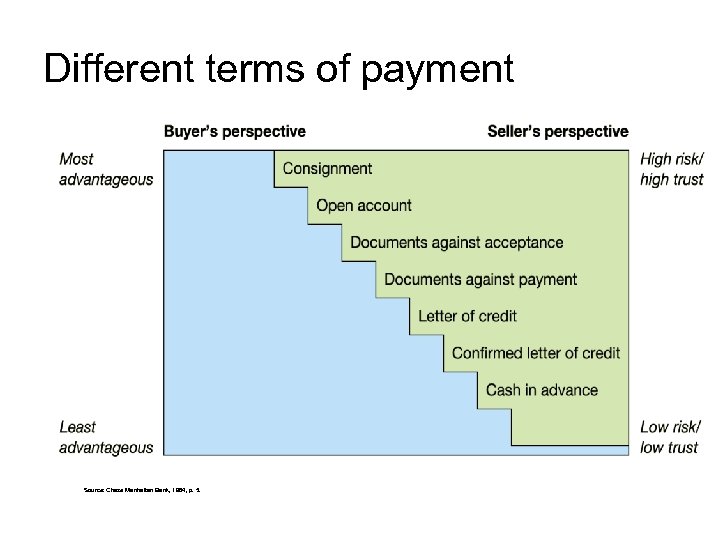 Different terms of payment Source: Chase Manhattan Bank, 1984, p. 5.
 Characteristics of letters of credit • An arrangement by banks for settling international commercial transactions • Provide a form of security for parties involved • Ensure payment, provided that terms and conditions of credit have been fulfilled • Payment based on documents only and not on merchandise or services involved
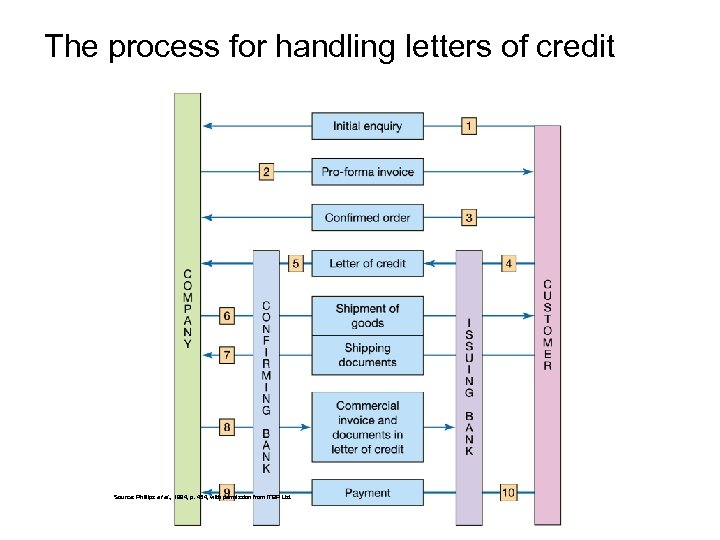 The process for handling letters of credit Source: Phillips et al. , 1994, p. 454, with permission from ITBP Ltd.
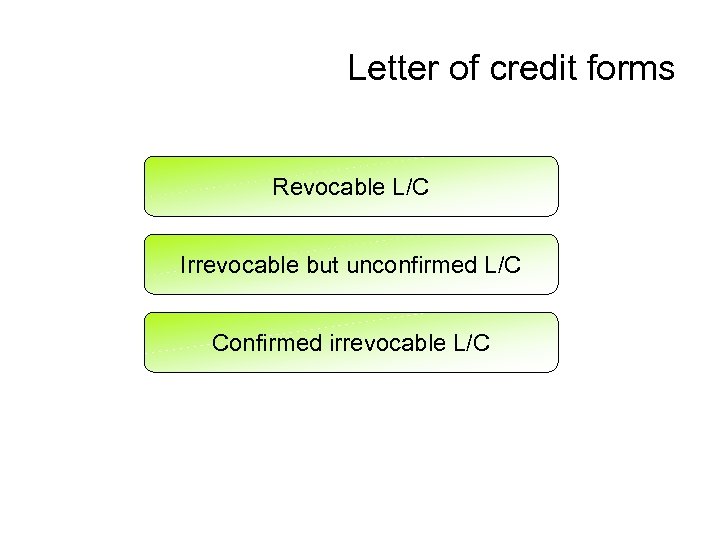 Letter of credit forms Revocable L/C Irrevocable but unconfirmed L/C Confirmed irrevocable L/C
 Export financing • Commercial banks • Export credit insurance • Factoring • Counter-trade – Barter – Buy-back agreement