


 Скачать презентацию International Management PLAN FOR THE DAY Part
International Management session 1.pptx
- Количество слайдов: 46
 International Management
 PLAN FOR THE DAY Part 1: What is ‘International Business’ (IB) and what types of management issues arise? Part 2: The state of globalization Part 3: Explaining risks and opportunities: CAGE and the institutional view Part 4: Intro to national variations in business-government relations (how “institutions” are built) Part 5: Practical aspects related to the course: assignments, exam etc. Part 6: Introduction to next class
 PART 1: WHAT IS ‘INTERNATIONAL BUSINESS’ AND WHAT DOES IT MEAN FOR MANAGEMENT?
 WHAT IS INTERNATIONAL MANAGEMENT? § Managing an international business: a company that engages in international (cross-border) economic activities, sometimes an “MNE” § A Multinational Enterprise (MNE) is a firm that uses foreign direct investment (FDI) to establish or purchase income-generating assets abroad § IM is about managing complexity and uncertainty: § cross-border activity brings new challenges. . . §. . . requiring awareness and strategic thinking
 THE EVERYDAY REALITY OF IM
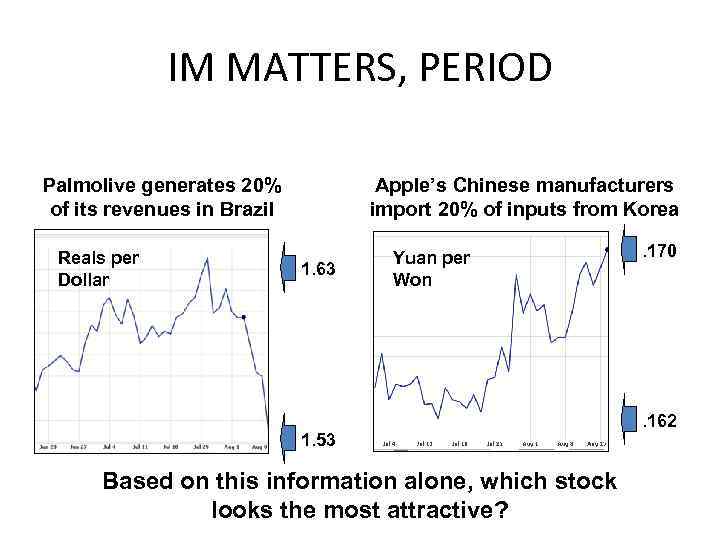 IM MATTERS, PERIOD Palmolive generates 20% of its revenues in Brazil Reals per Dollar Apple’s Chinese manufacturers import 20% of inputs from Korea 1. 63 Yuan per Won 1. 53 Based on this information alone, which stock looks the most attractive? . 170 . 162
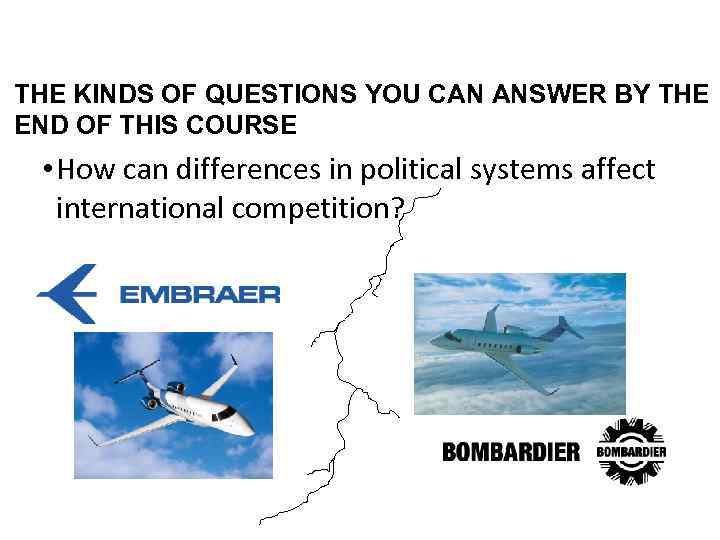 THE KINDS OF QUESTIONS YOU CAN ANSWER BY THE END OF THIS COURSE • How can differences in political systems affect international competition?
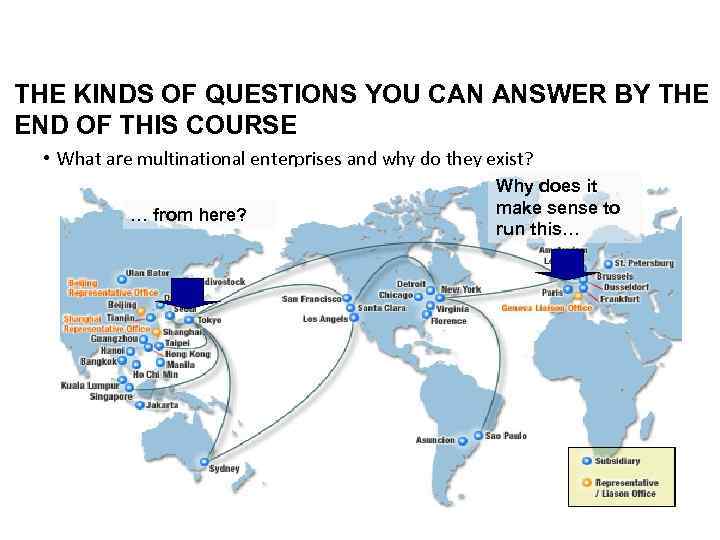 THE KINDS OF QUESTIONS YOU CAN ANSWER BY THE END OF THIS COURSE • What are multinational enterprises and why do they exist? … from here? Why does it make sense to run this…
 THE KINDS OF QUESTIONS YOU CAN ANSWER BY THE END OF THIS COURSE • Why does Starbucks conduct its international roll-out primarily through joint ventures, when it is famous for maintaining strict control over its intellectual property at home? ABROAD? AT HOME?
 THEORETICAL UNDERPINNINGS OF IM § Institutional theory § Resource Based view (RBV) § Organizational learning § Classical & modern trade theories § Transaction cost / internalization theory § …What is “theory” anyway?
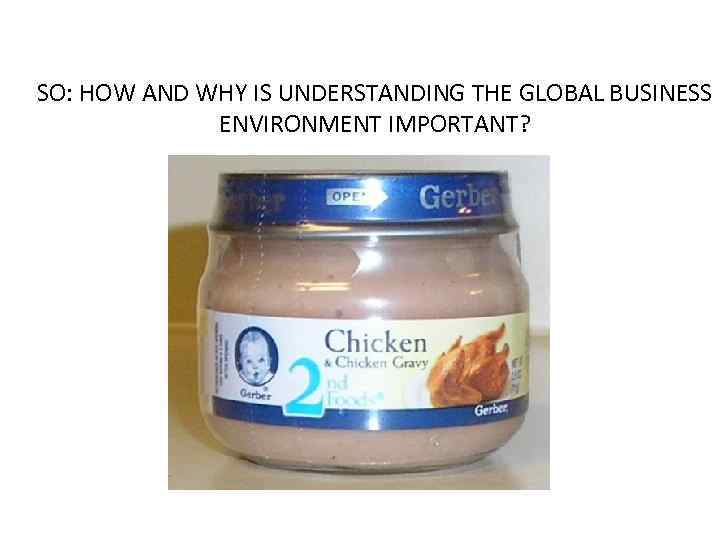 SO: HOW AND WHY IS UNDERSTANDING THE GLOBAL BUSINESS ENVIRONMENT IMPORTANT?
 IM: ABOUT AWARENESS AND UNDERSTANDING Ray Vernon, director of the MNE project at Harvard Business School, once wrote: “[more and more of us] …have come to recognize that the world of business offers infinite variety. [Yet] most of us continue to see these phenomena as aberrations, traps on the fairway that have no right to be there. Why can't the others, we plaintively ask, play like us? We must stop addressing that as a rhetorical question and begin looking earnestly for the answer. ” Vernon, R. 1994. Contributing to an International Business Curriculum: An Approach from the Flank. Journal of International Business Studies, 25(2): 215 -227.
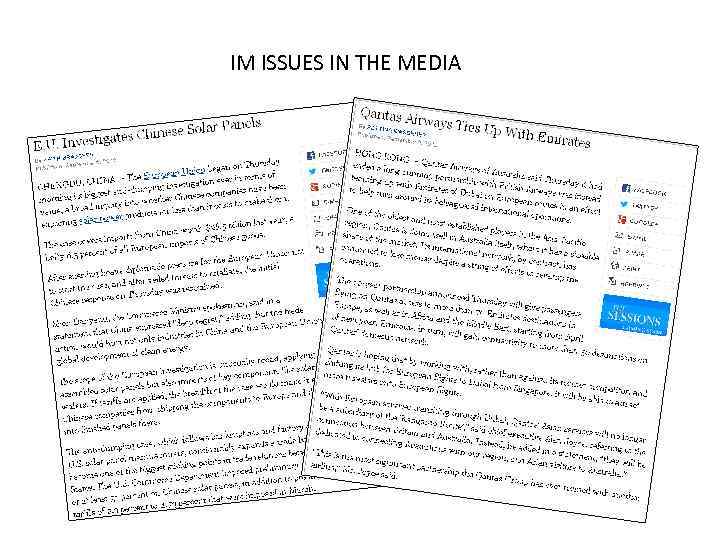 IM ISSUES IN THE MEDIA
 PART 2: THE STATE OF “GLOBALIZATION”
 WHAT IS GLOBALIZATION? Globalization is…
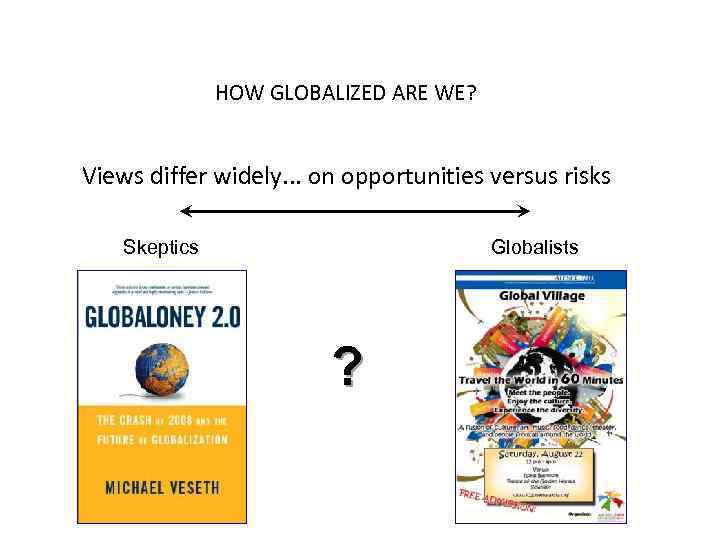 HOW GLOBALIZED ARE WE? Views differ widely. . . on opportunities versus risks Skeptics Globalists ?
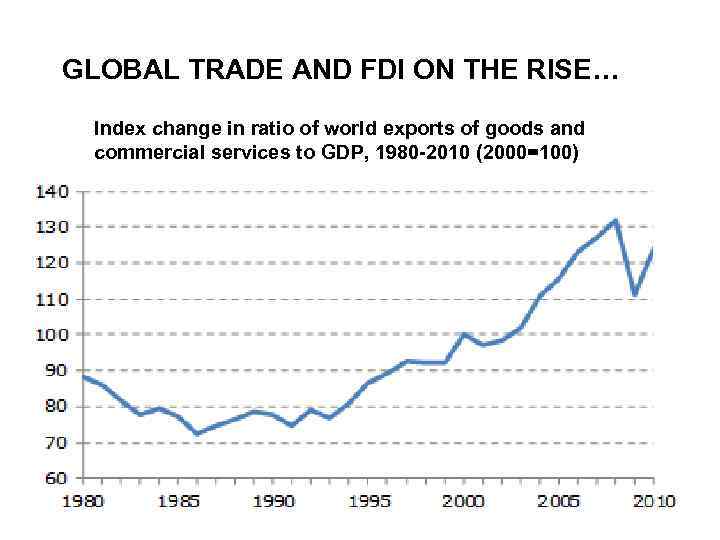 GLOBAL TRADE AND FDI ON THE RISE… Index change in ratio of world exports of goods and commercial services to GDP, 1980 -2010 (2000=100) 17
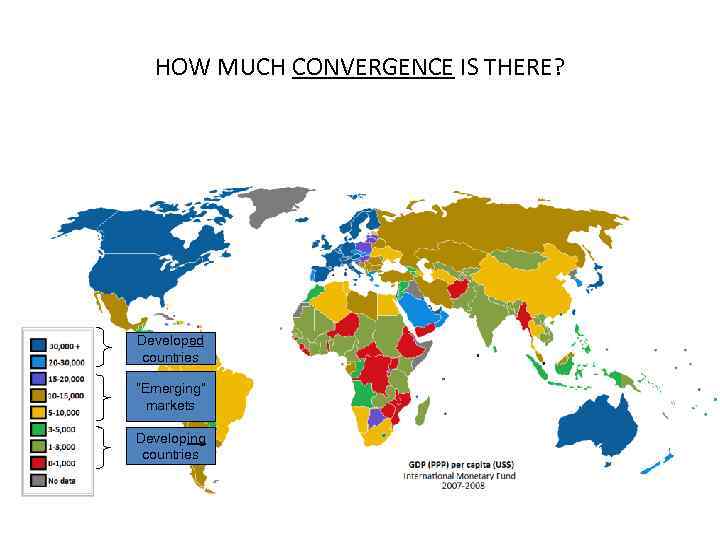 HOW MUCH CONVERGENCE IS THERE? Developed countries “Emerging” markets Developing countries
 … AND HOW MUCH INTEGRATION? • gross domestic product (GDP) - total market value of all final goods and services produced within a country in a given period of time, usually a calendar year • gross national income (GNI) - the term used by the World Bank and other international organizations to supersede the GNP term. Like GNP, it means GDP plus (net) income from nonresident, domestically-owned assets
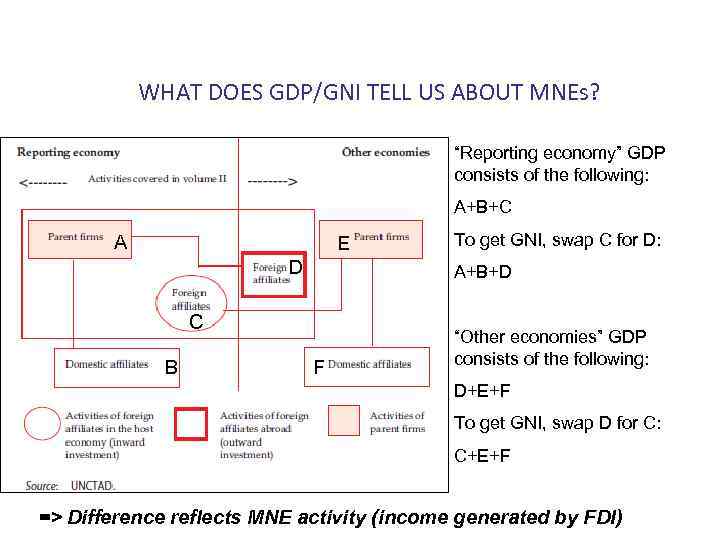 WHAT DOES GDP/GNI TELL US ABOUT MNEs? “Reporting economy” GDP consists of the following: A+B+C A E D A+B+D C B To get GNI, swap C for D: F “Other economies” GDP consists of the following: D+E+F To get GNI, swap D for C: 20 C+E+F => Difference reflects MNE activity (income generated by FDI)
 GDP vs GNI Q: “Can you see the difference when looking at ‘tax havens’? ” For example: NL: GDP = $52, 699; GNI = $52, 254 BUT: Cayman Islands: GDP = $50, 716; GNI = $45, 941 Bermuda: GDP = $99, 383; GNI = $83, 659
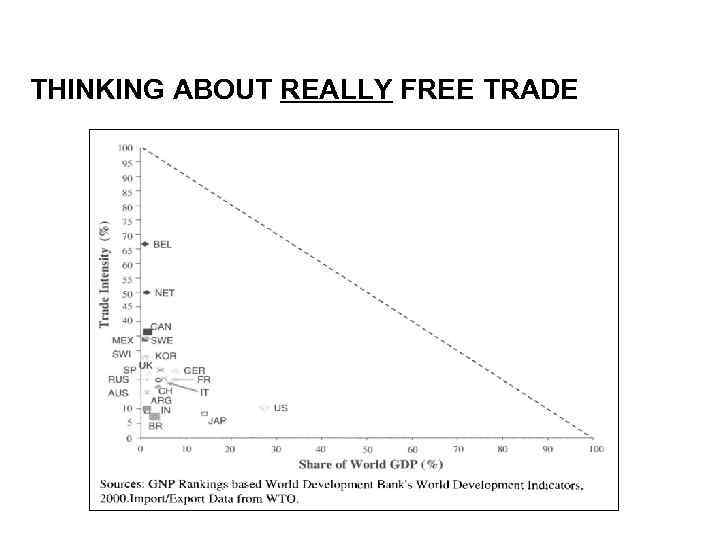 THINKING ABOUT REALLY FREE TRADE
 PART 3: EXPLAINING RISKS AND OPPORTUNITIES IN THE BUSINESS ENVIRONMENT
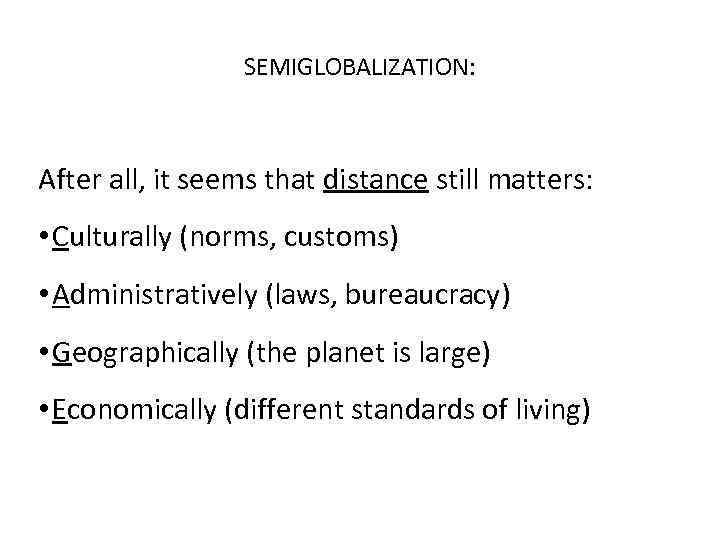 SEMIGLOBALIZATION: After all, it seems that distance still matters: • Culturally (norms, customs) • Administratively (laws, bureaucracy) • Geographically (the planet is large) • Economically (different standards of living)
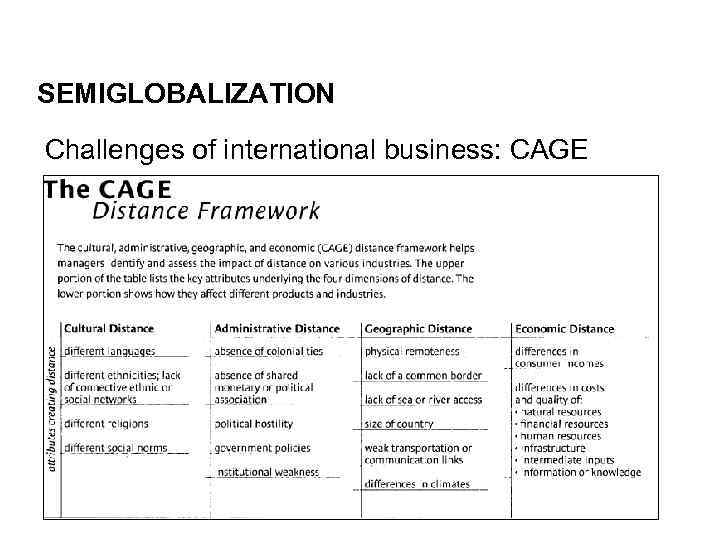 SEMIGLOBALIZATION Challenges of international business: CAGE 25
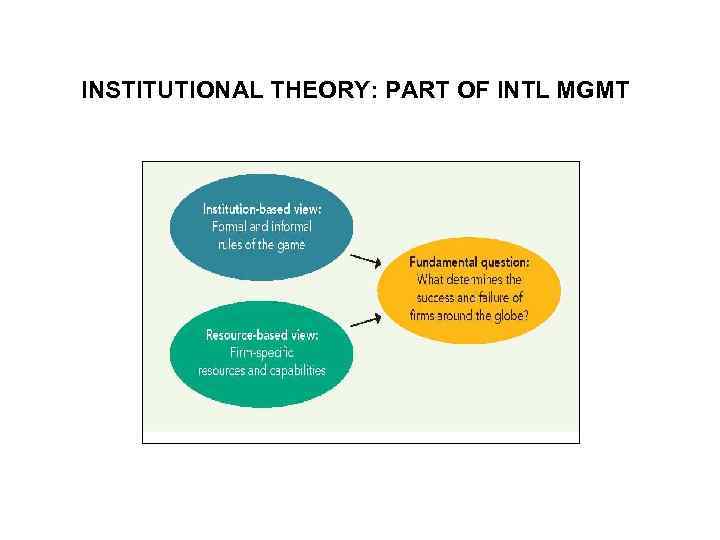 INSTITUTIONAL THEORY: PART OF INTL MGMT 26
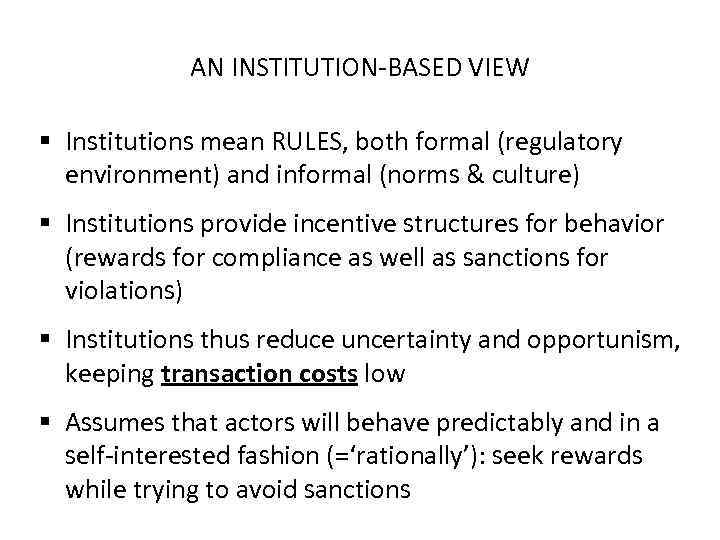 AN INSTITUTION-BASED VIEW § Institutions mean RULES, both formal (regulatory environment) and informal (norms & culture) § Institutions provide incentive structures for behavior (rewards for compliance as well as sanctions for violations) § Institutions thus reduce uncertainty and opportunism, keeping transaction costs low § Assumes that actors will behave predictably and in a self-interested fashion (=‘rationally’): seek rewards while trying to avoid sanctions
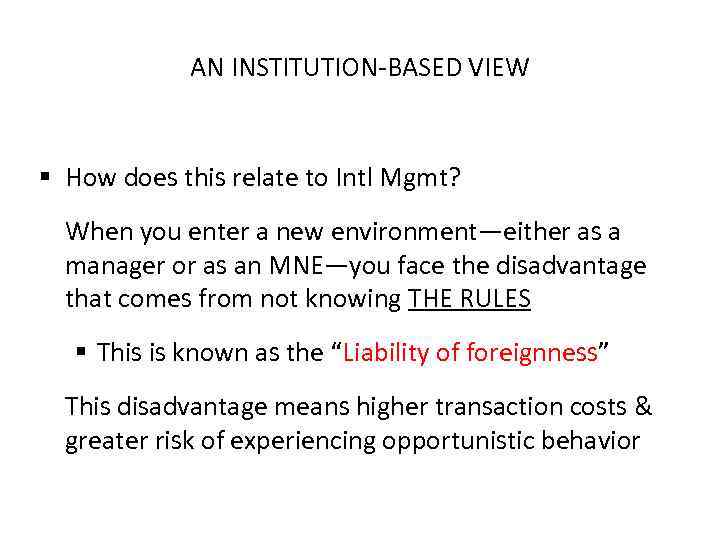 AN INSTITUTION-BASED VIEW § How does this relate to Intl Mgmt? When you enter a new environment—either as a manager or as an MNE—you face the disadvantage that comes from not knowing THE RULES § This is known as the “Liability of foreignness” This disadvantage means higher transaction costs & greater risk of experiencing opportunistic behavior
 WHICH OF THESE ARE “INSTITUTIONS”? a) The World Bank? b) An auction? c) Respect for your parents? d) Posted speed limits?
 IF THESE ARE “INSTITUTIONS”… • The World Bank • An auction • Respect for your parents • Posted speed limits 1) What are the rules? 2) What are sanctions & rewards with respect to compliance?
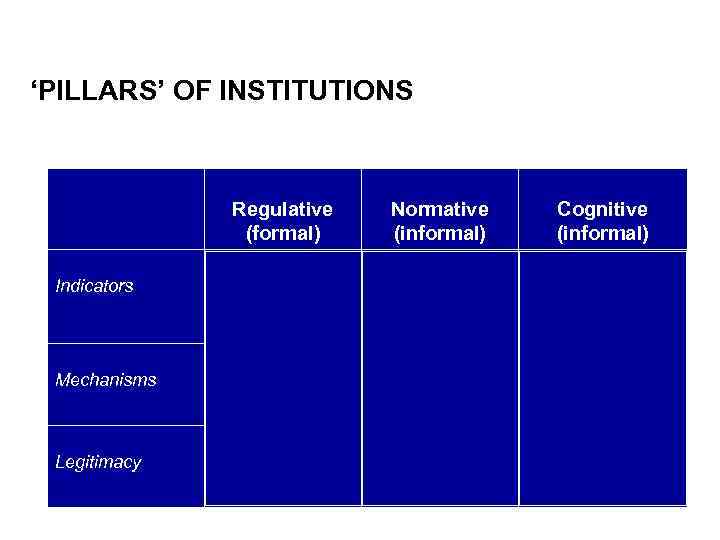 ‘PILLARS’ OF INSTITUTIONS Regulative (formal) Indicators Mechanisms Legitimacy Normative (informal) Cognitive (informal) Rules / Sanctions (If you do, you’ll get wet) Certifications (You belong with us – or, you’re out of the herd) Imitation (I guess that’s how they do things around here) Obligation (must do) Norms (right thing to do) Mimetic (you just do) Law Morality Culture 31
 DISTINGUISHING BETWEEN NORMATIVE AND COGNITIVE § Normative is related to peer pressure / social expectations § “You should wash your hands after using the restroom” § “You should take off your shoes when entering a home” § “You should pass the ball when playing team sports” § Cognitive is related to deep-seated assumptions and often hard to explain § “Winning is the most important thing” § “Government intervention is bad” § “Polygamy is wrong”
 INSTITUTIONS EFFECTIVE WHEN SUPPORTED BOTH FORMALLY & INFORMALLY § Norms can lead to regulation § the Kyoto Protocol => environmental regulation § Codes of Conduct => Sarbanes-Oxley § Cultural values lead to laws § Women banned from driving in Saudi Arabia § Store closures on Sunday in many countries § When a rule rests on only one pillar, it is ineffective. § Jaywalking: law says not ok, norms say ok § Gun possession: law says ok, norms say not ok
 PART 4: INTRO TO FORMAL INSTITUTIONS: NATIONAL BUSINESS SYSTEMS AND POLITICAL ADVANTAGE
 BUSINESS-GOVERNMENT RELATIONS §Policy outcomes (formal institutions) reflect political/ economic interests – those of firms, industries, sectors §National differences in how (economic) interests are represented: associational (pluralist) vs corporatist (Spencer et al. , 2005) Q: How much latitude do (different) governments have to grant long-term political favors?
 PART 5: LEARNING GOALS AND COURSE DESIGN
 LEARNING GOALS 1. To be able to think systematically about ways in which countries and regions differ 2. To be able to discuss some of the key ways in which those differences affect businesses operating internationally 3. To establish a link between understanding of practical international management issues and theoretical foundations
 IN THE CLASSROOM 1. Lecture to elucidate and expand on concepts from the readings 2. Open, two-way discussion between you and me on some of the ‘big picture’ topics of IM 3. Short cases and other in-class exercises requiring your thought & input (pair work) 4. Attendance is required
 INDIVIDUAL ASSIGNMENTS § You have 2 assignments that are spread out over the semester § Their purpose is to help you link IM concepts to practice § These assignments are INDIVIDUAL
 READING ARTICLES § Articles are selected based on topic and broad theoretical relevance § Most articles review important theoretical perspectives that have been used to understand a particular phenomenon § Make notes in which you capture the essence of these arguments: what does theory say about X and why?
 GRADING § 2 assignments, 20% each § Exam, 60% To pass: § Average for assignments >= 3 § Grade for exam >= 3
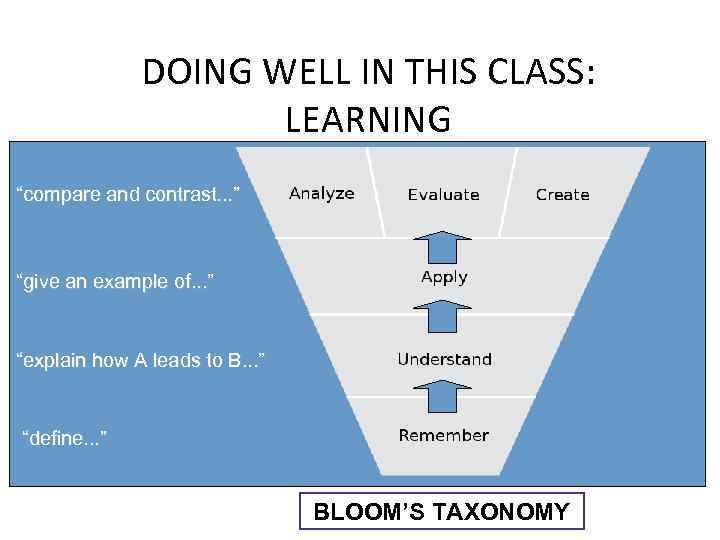 DOING WELL IN THIS CLASS: LEARNING “compare and contrast. . . ” “give an example of. . . ” “explain how A leads to B. . . ” “define. . . ” BLOOM’S TAXONOMY
 PART 6: NEXT CLASS
 • Formal institutions: Politics, laws, economics • Informal institutions: Cultures, ethics, norms
 CONTACT INFO Alexandra Dorina Mesteru (alexandra. mesteru@gmail. com) +7 916 170 85 70 Office: Room 310
 QUESTIONS?