 Скачать презентацию International Logistics Learning Objectives You should be
86c6393aa13dd6c6e7c2524bd1162874.ppt
- Количество слайдов: 37



International Logistics
Learning Objectives You should be able to: • Understand the strategic importance of logistics • Identify the various modes of transportation • Discuss the international aspects of logistics • Describe how logistics impacts supply chain management • Examine the interrelatedness of transportation, warehousing, & material handling
Learning Objectives (Cont. ) • Identify a number of third-party logistics service providers • Summarize the important aspects of transportation regulation and deregulation • Describe the various reverse logistics activities • Discuss some of the e-commerce issues in logistics management
Introduction Logistics is necessary to: – Move goods from suppliers to buyers – Move finished goods to the customer Products have little value to the customer until they are moved to the customer’s point of consumption – Time utility- products are delivered at the right time. – Place utility- products are delivered to the desired location.
Introduction (Cont. ) Logistics is: “…the process of planning, implementing, and controlling the efficient, effective flow and storage of goods, services, and related information from point of origin to point of consumption for the purpose of conforming to customer requirements. “ Council of Supply Chain Management Professionals
The Fundamentals of Transportation The Objective of Transportation • Maximize value to firm through negotiation to provide profit contribution • Make sure service is provided effectively • Satisfy customer needs
The Fundamentals of Transportation (Cont. ) Legal Forms of Transportation service companies are classified legally as either common, contract, exempt, or private carriers. – Common carriers- offer transportation services to all shippers at published rates between designated locations without discrimination. – Contract carriers- not bound to serve the general public. Contract carriers serve specific customers under contractual agreements.
The Fundamentals of Transportation (Cont. ) Legal Forms of Transportation (Cont. )– Exempt carriers- exempt from regulation of services & rates & if they transport certain exempt products like produce, livestock, coal, or newspapers. – Private carrier- not subject to economic regulation & typically transports goods for the company owning the carrier.
The Fundamentals of Transportation (Cont. ) The Modes of Transportation Motor Carriers (trucks)- most flexible mode of transportation & carries > 80% of U. S. freight. Competes w/rail & air for short-to-medium hauls. – Less-than-truckload (LTL) & truck-load (TL) carriers. LTL carriers move small shipments & fees are higher. – General freight carriers carry the majority of goods shipped & include common carriers. – Specialized carriers transport liquid petroleum, household goods, building materials, & other specialized items.
The Fundamentals of Transportation (Cont. ) The Modes of Transportation (Cont. ) Rail Carriers- compete when the distance is long & the shipments are heavy or bulky. – Rail slow & inflexible, but have begun purchasing motor carriers & can thus offer point-to-point pickup & delivery service known as trailer-on-flatcar (TOFC) service. – Rail companies use each other’s rail cars. Keeping track of rail cars & getting them where needed can be problematic. – Railroad infrastructure & aging equipment are also problems for the railroads.
The Fundamentals of Transportation (Cont. ) The Modes of Transportation (Cont. ) Air Carriers- Expensive relative to other modes but fast. Air carriers transport about 5 % of U. S. freight. – Airlines cannot carry extremely heavy or bulky cargo. – For light, high value goods over long distances quickly. Most small cities & towns do not have airports. – Half of the goods transported by air are carried by freight–only airlines, Fed. Ex.
The Fundamentals of Transportation (Cont. ) The Modes of Transportation (Cont. ) Water Carriers- Inexpensive, slow & inflexible. Includes inland waterway, coastal & intercoastal, & deep-sea. – Inland waterway transportation is used for heavy, bulky, low-value materials (e. g. , coal, grain). – Competes w/rail & pipeline. – Water carriers are paired w/trucks for door-to-door delivery. – Supertankers are +1, 500 ft long & 200 ft wide.
The Fundamentals of Transportation (Cont. ) The Modes of Transportation (Cont. ) Pipeline Carriers- Limited in variety they can carry. – Little maintenance once pipeline is running. – Materials hauled in a liquid or gaseous state.
The Fundamentals of Transportation (Cont. ) Intermodal Transportation Combinations of the various transportation modes, is becoming a popular method. – Trailer-on-flatcar (TOFC), container-on-flatcar (COFC), piggy-back service. The same containers can be placed on board containerships & airliners. – RO-ROs or roll-on-roll-off containerships truck trailers & containers to be directly driven on & off the ship, without the use of cranes.
The Fundamentals of Transportation (Cont. ) Transportation Pricing – Cost-of-service pricing- varies based on fixed & variable costs. – Value-of-Service Pricing- services priced at market bearing competitive levels. – Terms of Sale- includes transportation FOB (free on board) destination. – Pricing Negotiation- Since deregulation, negotiating prices has become more common. – Rate Categories- Classified as line haul rates, class rates, exception rates, commodity rates, & miscellaneous rates.
The Fundamentals of Transportation (Cont. ) Transportation Security – Particularly important regarding airline security since Sept. 11 2001 – Aviation & Transportation Security Act (2001)Transportation Security Administration (TSA) to oversee transportation security which oversees 429 US airports – Department of Homeland Security (DHS) (2003) created to provide overall U. S. security leadership. – Not all measures have improved security as envisioned
The Fundamentals of Transportation (Cont. ) Transportation Regulation & Deregulation – Pro- Regulation tends to assure adequate transportation service throughout the country while protecting consumers from monopoly pricing, safety, & liability. – Con- Deregulation encourages competition & allows prices to adjust as demand & negotiations dictate. – Today, U. S. transportation industry remains essentially deregulated
The Fundamentals of Transportation (Cont. ) Transportation Regulation – Granger laws (1870 s)- regulate the RRs. – Interstate Commerce Act of 1887 - Created the Interstate Commerce Commission (ICC). – Transportation Act of 1920 - Changes to IC Act. – Motor Carrier Act of 1935 - brought motor carriers under ICC control. – Transportation Act of 1940 - established ICC control over domestic water transportation. – Federal Aviation Act of 1958 created air traffic & safety regulations & national airport system. – Department of Transportation Act 1966 - Coordination of all transportation-related matters.
The Fundamentals of Transportation (Cont. ) Transportation Deregulation – Railroad Revitalization & Regulatory Reform Act (1976)- RRs could change rates w/o ICC approval. – Air freight deregulated in 1977. – Motor carriers deregulated in 1980 to promote competitive, safe & efficient motor transportation. – Shipping Act of 1984 allowed ocean carriers to pool shipments, assign ports, publish rates, & enter into contracts with shippers. – ICC Termination Act of 1995 & the Ocean Shipping Reform Act of 1998 - ICC was eliminated, requirement for ocean carriers to file rates also came to an end.
Warehousing & Distribution Warehousing – allows firms to store purchases, WIP, & finished goods and perform break bulk and assessment services – provides faster & more frequent deliveries & better customer service Crossdocking: – to receive, breakdown, repackage, & distribute components to a manufacturing location or finished products to customers warehouse. This description more accurately refers to a distribution center
Warehousing & Distribution (Cont. ) Importance & Types of Warehouses – Support purchasing, production, & distribution. – Consolidation warehouses collect LTL shipments for transport in TL or CL quantities. Private Warehouses – owned by the firm storing goods. – Pro- Reduces the cost, offers greater control, provides better workforce utilization, & can generate income & tax advantages through leasing of excess capacity &/or asset depreciation. – Con- Owning a private warehouse represents a financial risk & loss of flexibility.
Warehousing & Distribution (Cont. ) Public Warehouses– Owned by for profit orgs & contracted out – Breakbulk: shipments are broken down & items are combined into specific customer orders. – Repackaging – Assembly – Incoming & outgoing quality inspections. – Material handling, equipment maintenance, & documentation services – Storage – Pro- Provides flexibility & investment cost savings – Con- Lack of control.
Warehousing & Distribution (Cont. ) Risk Pooling & Warehouse Location – As the # of warehouses increases, the system becomes more decentralized. Responsiveness & delivery service increase. – However, warehousing operating & inventory costs also increase. Trade-off between costs & customer service must be considered. Risk Pooling – Describes the relationship between the # of warehouses, inventory, & customer service. – Risk pooling is estimated by square-root rule
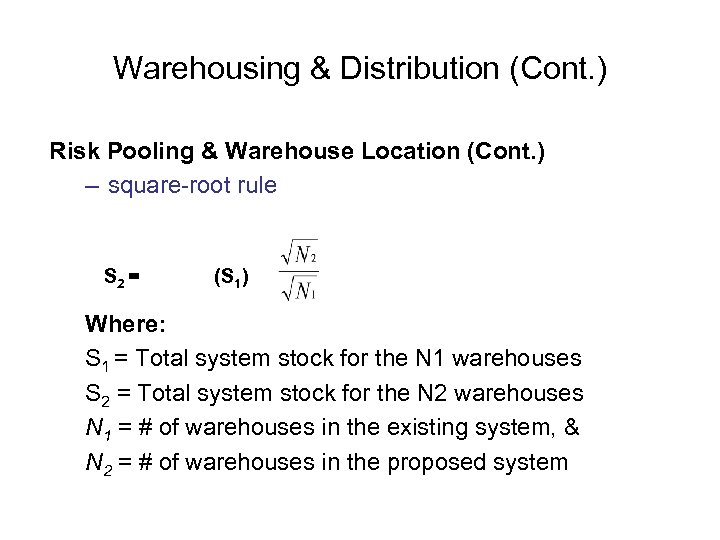
Warehousing & Distribution (Cont. ) Risk Pooling & Warehouse Location (Cont. ) – square-root rule S 2 = (S 1) Where: S 1 = Total system stock for the N 1 warehouses S 2 = Total system stock for the N 2 warehouses N 1 = # of warehouses in the existing system, & N 2 = # of warehouses in the proposed system
Warehousing & Distribution (Cont. ) Warehouse Location Edgar Hoover – Market-positioned strategy- warehouses close to customers to maximize distribution svcs & improve transp. economies of scale. – Product positioned strategy- close to supply source for firm to collect goods & consolidate. – Intermediately positioned strategy- midway between supply source & customers when distribution requirements are high & product comes from various locations.
Warehousing & Distribution (Cont. ) Warehouse Location – Von Thunen - transportation costs should be minimized when considering facility location. Market prices & production costs would be identical regardless of warehouse location – Greenhut- based on profit instead of transportation costs. The optimum location is one that maximizes profits, which may not be min. cost location.
Warehousing & Distribution (Cont. ) Just-in-Time Warehousing Emphasis on warehousing to support JIT operations: – Commitment to customers & service quality – Reduced lot sizes & shipping quantities – Emphasis on cross docking – Increased automation – Increased assembly operations
Impacts of Logistics on Supply Chain Management Third Party Logistics (3 PL) – Provide reliable & timely delivery required by SCM – Used to significant degree by international logistics – Favored by small businesses – Some firms outsource all of their logistics needs to a lead logistics provider or fourth party logistics provider (4 PL)
Logistics Management Issues Environmental Sustainability in Logistics – Green logistics is a response to the need for reducing carbon emissions and by doing so can also save money for the firm 3 PL Supply Base Reduction – by reducing the 3 PL supply base a firm can achieve lower prices and better service as it becomes a larger customer
Logistics Management Issues (Cont. ) Mode & 3 PL Selection – firms identify the optimum transportation services to minimize costs & improve customer service Firms often use weighted factor analysis & transportation intermediaries, such as: – Freight forwarders – Transportation brokers – Shipper Associations – Intermodal marketing companies (IMCs)
Logistics Management Issues (Cont. ) Logistics Management Software Applications Transportation management systems- used to select the best mix of transportation services & pricing. Warehouse management- track & control the flow of goods from receiving dock to outbound shipment. New technologies, such as RFID tags, facilitate tracking. Returns management systems (RMS) provide global visibility, standardization, & documentation of product returns, while minimizing reverse logistics costs.
Logistics Management Issues (Cont. ) Measuring Logistics Performance – Allows the firm to identify problems & make improvements – Measures- derived from benchmarks or previous performance & are similar to those used to select 3 PLs. Creating Strategic 3 PL Alliances – Effective SC networks often include strategic alliances with providers of logistics services Performing Logistics Audits – To monitor change firms often conduct an audit by a multifunctional team
Logistics Management Issues (Cont. ) Use of e-Commerce Technologies in Logistics • Electronic Invoice Presentment & Payment (EIPP)sending & receiving invoices online. • Supply Chain Visibility- time-related benefits that lead to SC success. Visibility allows better communication across org boundaries • Third Party Electronic Transaction Platforms- Internet based transaction systems providing freight-matching services, auctions, & on-line marketplaces
International Logistics International Freight Security– Transportation across national boundaries introduces added complexity, particularly security. – Since 9/11 there is more conflict between U. S. govt. & industry toward more security & restrictions for inbound shipments.
International Logistics (Cont. ) International Logistics Intermediaries – Customs Brokers- move through customs & handle documentation. – International Freight Forwarders- move goods to foreign destination – Trading Companies- Put buyers & sellers together & handle export/import arrangements. – Non-Vessel-Operating Common Carriers- operate like freight forwarders but use scheduled ocean liners.
International Logistics (Cont. ) Foreign Trade Zones– Secure sites in U. S. under supervision of U. S. Customs. – FTZs offer storage, exporting, manufacturing, assembly, repacking, testing, & repairing services. North American Free Trade Agreement (NAFTA) – Created in 1994 & removes most barriers to trade & investment among U. S. , Canada & Mexico.
Reverse Logistics – Backwards flow of goods from customers in SC when goods are returned by a customer in the supply chain – Retail returns range 6% to 40% of sales – Often is an unwanted SC activity – Poor reverse logistics can hurt firm – Green reverse logistics programs- designed to return unneeded products for recycling. These programs reduce environmental impact on landfills & deal with dangerous contaminants.
Скачать презентацию International Logistics Learning Objectives You should be
86c6393aa13dd6c6e7c2524bd1162874.ppt