


 Скачать презентацию International Linear Collider Machine Detector Interface Materials for
a7a7e1b95426cb52a83b33c6c89c39b4.ppt
- Количество слайдов: 27
 International Linear Collider Machine Detector Interface Materials for discussion at Engineering Forum: experiences from LHC detectors conception and construction CERN, October 13 Andrei Seryi, Hitoshi Yamamoto October 13, 2006 Global Design Effort 1
 Thanks • To many colleagues from CERN and other labs who were involved in discussion and work on the issues described in this talk • To everyone who organized this meeting, who were guiding the tour, and who are participating in this meeting Oct 13, 06 Global Design Effort 2
 Contents • Introduction, ILC and BDS layouts • Detector assembly, hall sizes, arrangements, etc – Adopted on-surface assembly concept for ILC – Consider pure CMS or modified CMS assembly • Questions associated with study of push-pull – Detector design and radiation shielding – Moving detector parts – Location of services and electronics, etc • Goal of this meeting: learn CERN experience and consider how to best apply it to ILC Oct 13, 06 Global Design Effort 3
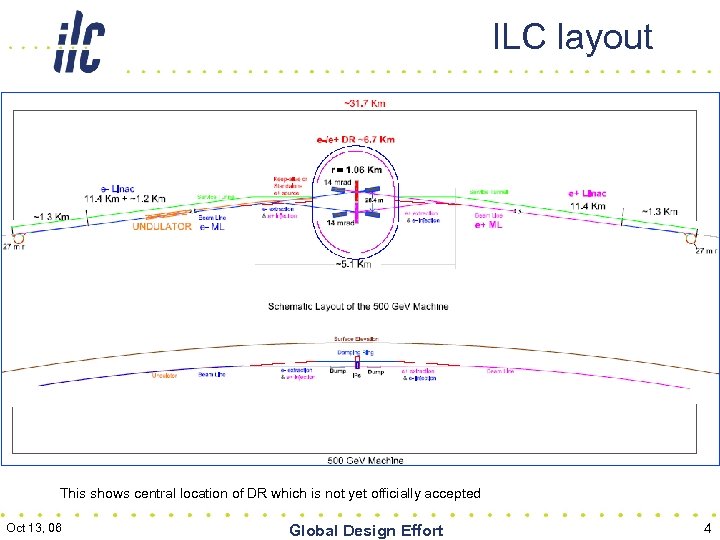 ILC layout This shows central location of DR which is not yet officially accepted Oct 13, 06 Global Design Effort 4
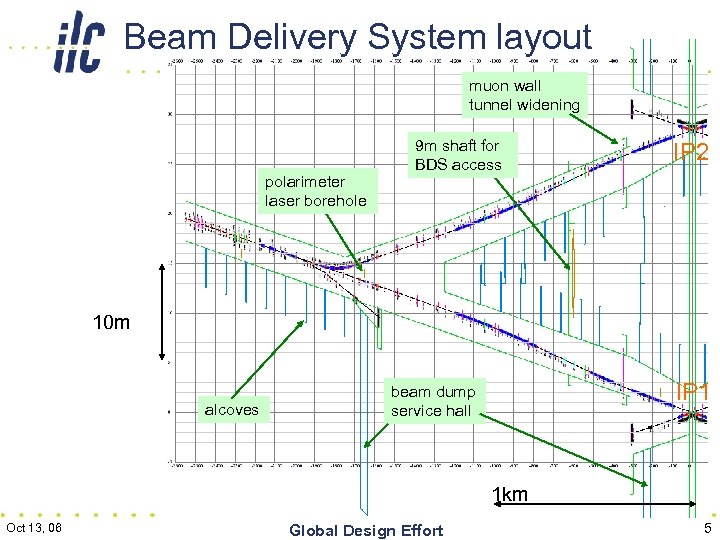 Beam Delivery System layout muon wall tunnel widening polarimeter laser borehole 9 m shaft for BDS access IP 2 10 m alcoves IP 1 beam dump service hall 1 km Oct 13, 06 Global Design Effort 5
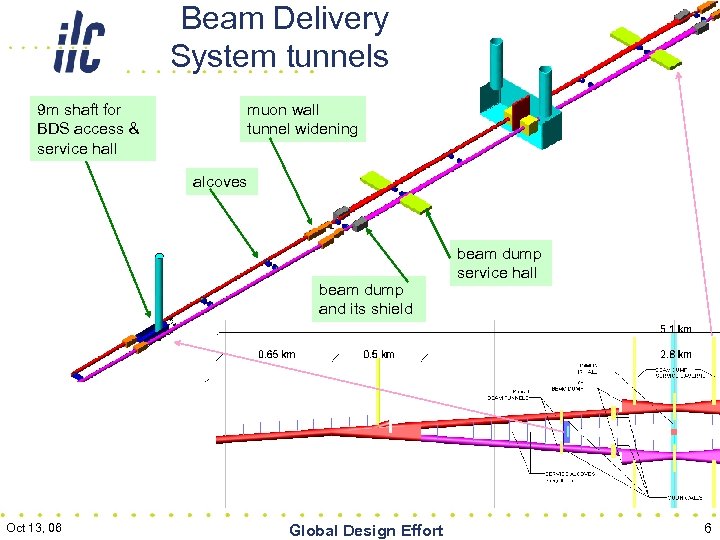 Beam Delivery System tunnels 9 m shaft for BDS access & service hall muon wall tunnel widening alcoves beam dump and its shield Oct 13, 06 Global Design Effort beam dump service hall 6
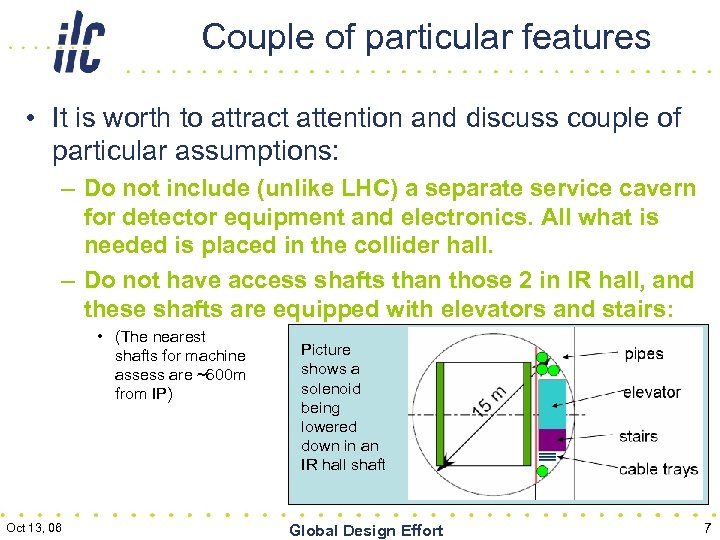 Couple of particular features • It is worth to attract attention and discuss couple of particular assumptions: – Do not include (unlike LHC) a separate service cavern for detector equipment and electronics. All what is needed is placed in the collider hall. – Do not have access shafts than those 2 in IR hall, and these shafts are equipped with elevators and stairs: • (The nearest shafts for machine assess are ~600 m from IP) Oct 13, 06 Picture shows a solenoid being lowered down in an IR hall shaft Global Design Effort 7
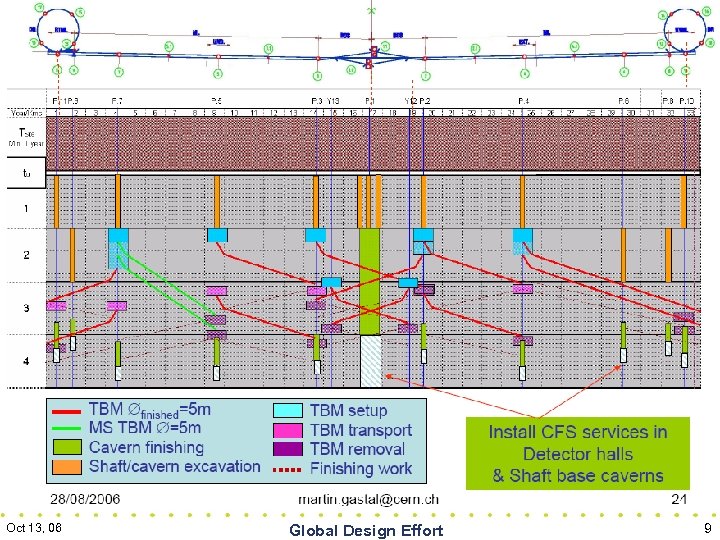
 On-surface (a la CMS) assembly • Schedules of ILC CFS work developed by Martin Gastal and his colleagues – According to tentative CF&S schedule, the detector hall is ready for detector assembly after 4 y 11 m after project start – If so, cannot fit into the goal of “ 7 years until first beam” and “ 8 years until physics run” • Surface assembly allows to save 2 -2. 5 years and allows to fit into this goal – The collider hall size may be smaller in this case – A building on surface is needed, but savings may be still substantial • Adopted on-surface assembly for ILC Oct 13, 06 Global Design Effort 8
 Oct 13, 06 Global Design Effort 9
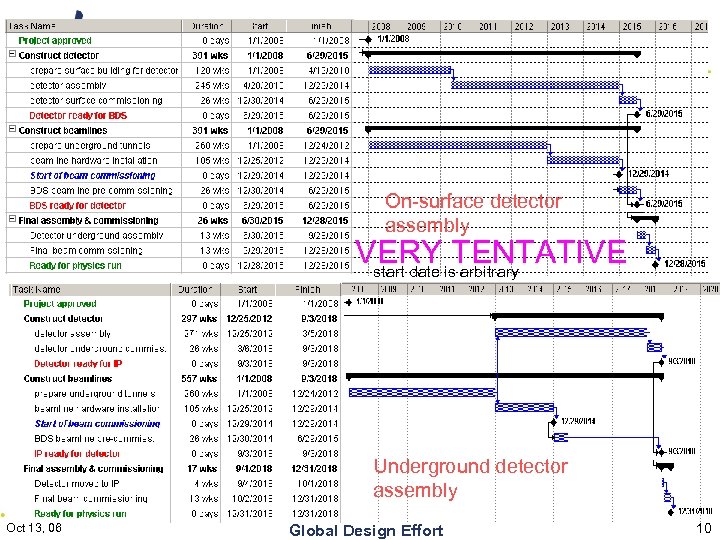 On-surface detector assembly VERY is. TENTATIVE start date arbitrary Underground detector assembly Oct 13, 06 Global Design Effort 10
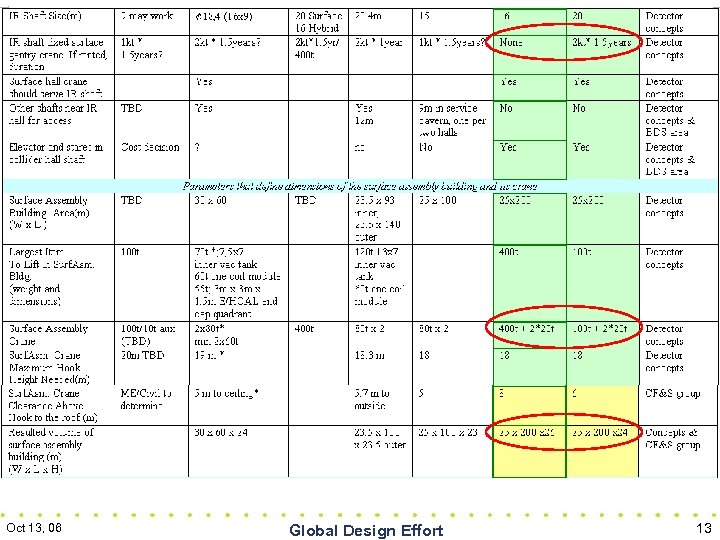
 Versions of on-surface assembly • Accepted on-surface assembly • Still, discuss variations – pure CMS assembly (config B) – modified CMS assembly (config A) • Assemble smaller (than CMS) pieces on surface, lower down and perform final assembly underground • May affect schedule (? ), but preliminary looks by a small bit less expensive than “B” • Details of assumptions shown on next pages – would like to clarify our understanding and perhaps refine the ILC assumptions during this visit to CERN Oct 13, 06 Global Design Effort 11
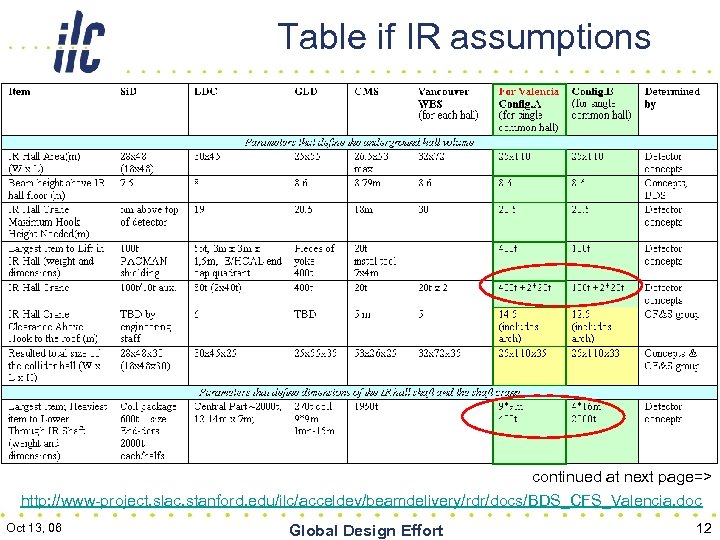 Table if IR assumptions continued at next page=> http: //www-project. slac. stanford. edu/ilc/acceldev/beamdelivery/rdr/docs/BDS_CFS_Valencia. doc Oct 13, 06 Global Design Effort 12
 Oct 13, 06 Global Design Effort 13
 Single IR questions • GDE is studying a design with single IR and two detector (“push-pull” case) • Questions associated with study of push-pull – – Detector design and assembly Radiation shielding Moving detector parts and shielding Location of services and electronics, etc • Detailed list of questions here: http: //www-project. slac. stanford. edu/ilc/acceldev/beamdelivery/rdr/docs/push-pull/ • Some tentative conclusions are below Oct 13, 06 Global Design Effort 14
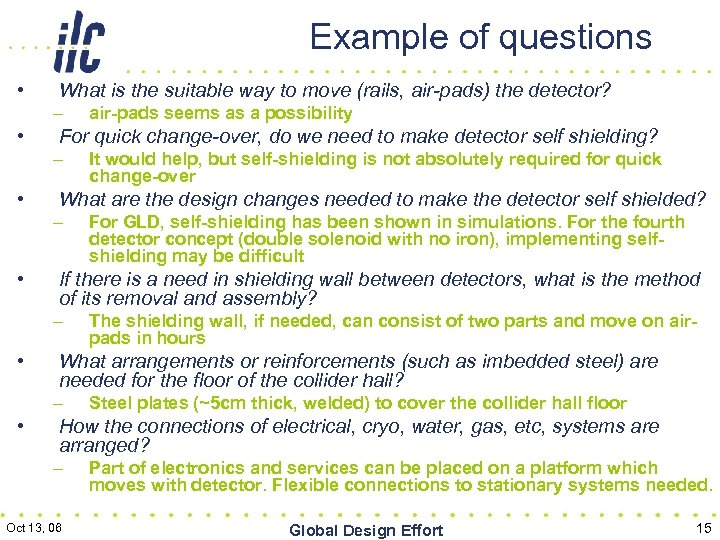 Example of questions • What is the suitable way to move (rails, air-pads) the detector? – • For quick change-over, do we need to make detector self shielding? – • The shielding wall, if needed, can consist of two parts and move on airpads in hours What arrangements or reinforcements (such as imbedded steel) are needed for the floor of the collider hall? – • For GLD, self-shielding has been shown in simulations. For the fourth detector concept (double solenoid with no iron), implementing selfshielding may be difficult If there is a need in shielding wall between detectors, what is the method of its removal and assembly? – • It would help, but self-shielding is not absolutely required for quick change-over What are the design changes needed to make the detector self shielded? – • air-pads seems as a possibility Steel plates (~5 cm thick, welded) to cover the collider hall floor How the connections of electrical, cryo, water, gas, etc, systems are arranged? – Oct 13, 06 Part of electronics and services can be placed on a platform which moves with detector. Flexible connections to stationary systems needed. Global Design Effort 15
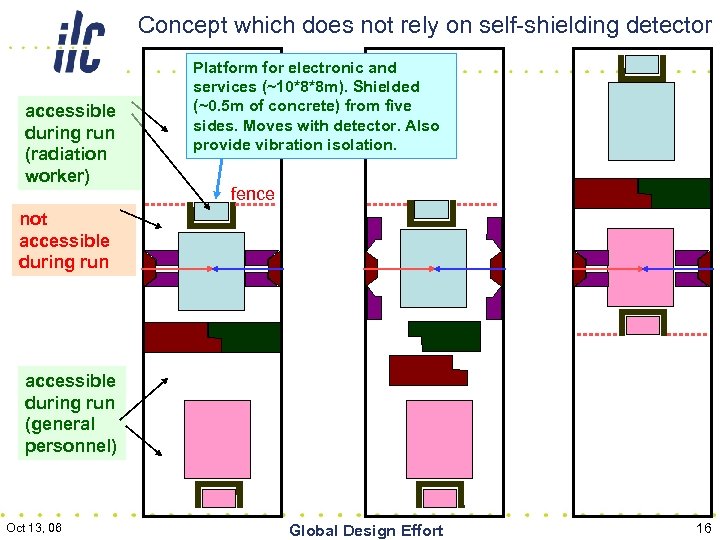 Concept which does not rely on self-shielding detector accessible during run (radiation worker) Platform for electronic and services (~10*8*8 m). Shielded (~0. 5 m of concrete) from five sides. Moves with detector. Also provide vibration isolation. fence not accessible during run (general personnel) Oct 13, 06 Global Design Effort 16
 Detector assembly and its radiation safety properties • Although not required, eliminating the shielding wall would facilitate the push-pull case – In this case, If the off-beamline detector is to be accessible, the detectors should be self-shielded • Preliminary study indicate that most of ILC detectors can be made self-shielded even for pessimistic assumption of full beam loss (18 MW) • Question is: are there any particular constraints, due to on-surface assembly, which complicates design of self-shielded detector? Oct 13, 06 Global Design Effort 17
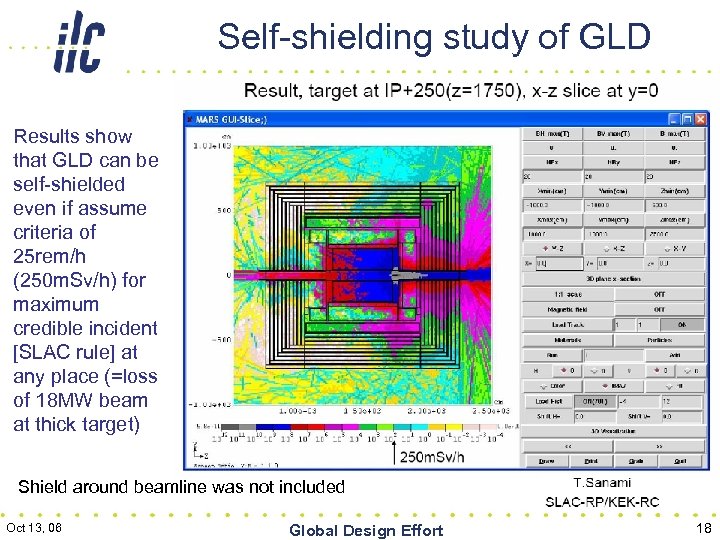 Self-shielding study of GLD Results show that GLD can be self-shielded even if assume criteria of 25 rem/h (250 m. Sv/h) for maximum credible incident [SLAC rule] at any place (=loss of 18 MW beam at thick target) Shield around beamline was not included Oct 13, 06 Global Design Effort 18
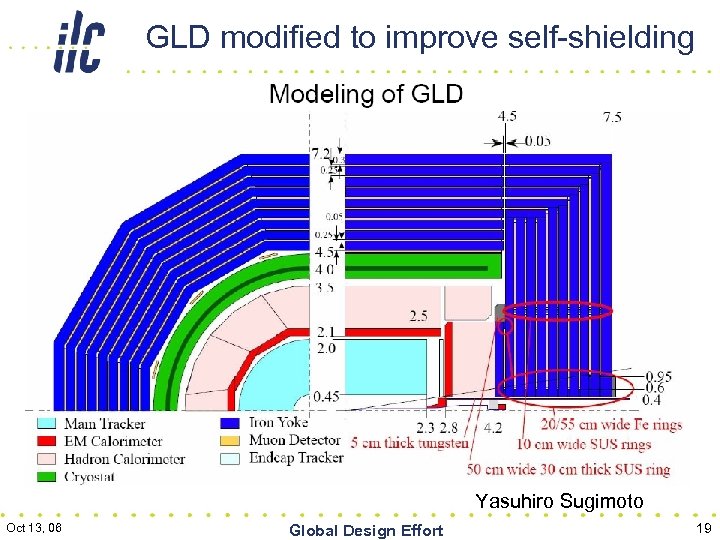 GLD modified to improve self-shielding Yasuhiro Sugimoto Oct 13, 06 Global Design Effort 19
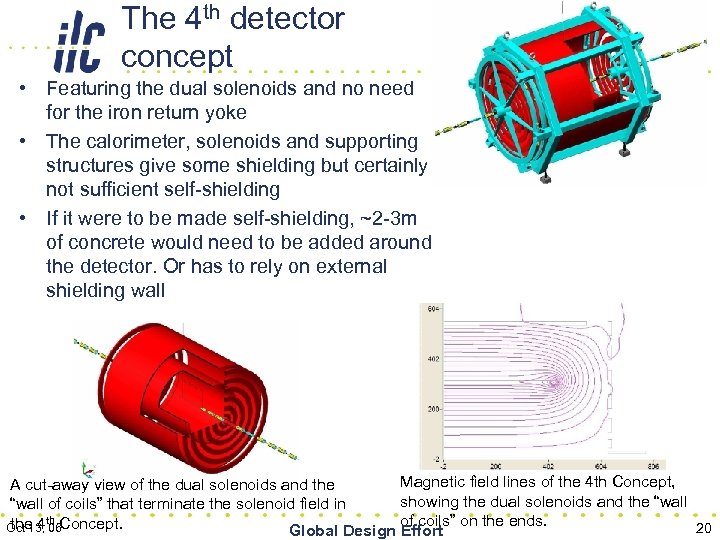 The 4 th detector concept • Featuring the dual solenoids and no need for the iron return yoke • The calorimeter, solenoids and supporting structures give some shielding but certainly not sufficient self-shielding • If it were to be made self-shielding, ~2 -3 m of concrete would need to be added around the detector. Or has to rely on external shielding wall Magnetic field lines of the 4 th Concept, A cut-away view of the dual solenoids and the showing the dual solenoids and the “wall of coils” that terminate the solenoid field in of coils” on the ends. the 4 th Concept. Oct 13, 06 20 Global Design Effort
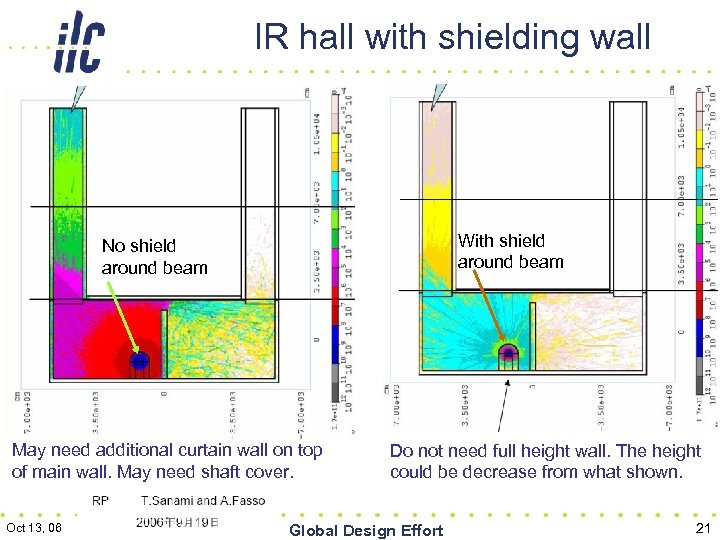 IR hall with shielding wall With shield around beam No shield around beam May need additional curtain wall on top of main wall. May need shaft cover. Oct 13, 06 Do not need full height wall. The height could be decrease from what shown. Global Design Effort 21
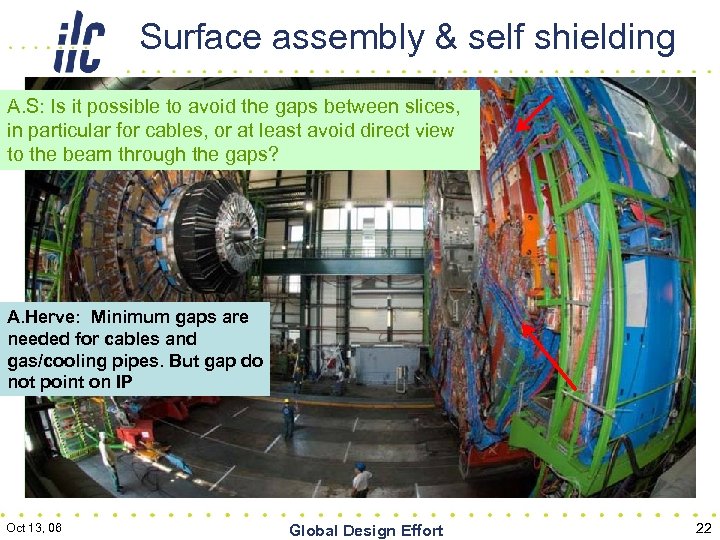 Surface assembly & self shielding A. S: Is it possible to avoid the gaps between slices, in particular for cables, or at least avoid direct view to the beam through the gaps? A. Herve: Minimum gaps are needed for cables and gas/cooling pipes. But gap do not point on IP Oct 13, 06 Global Design Effort 22
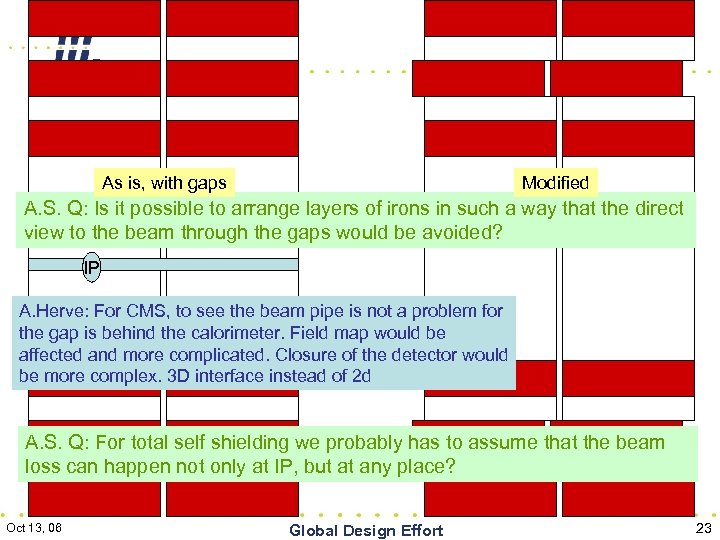 As is, with gaps Modified A. S. Q: Is it possible to arrange layers of irons in such a way that the direct view to the beam through the gaps would be avoided? IP A. Herve: For CMS, to see the beam pipe is not a problem for the gap is behind the calorimeter. Field map would be affected and more complicated. Closure of the detector would be more complex. 3 D interface instead of 2 d A. S. Q: For total self shielding we probably has to assume that the beam loss can happen not only at IP, but at any place? Oct 13, 06 Global Design Effort 23
 Summary • Looking forward to discuss the issues of detector assembly, radiation safety design, IR hall arrangements, etc. Oct 13, 06 Global Design Effort 24
 Backup slides Oct 13, 06 Global Design Effort 25
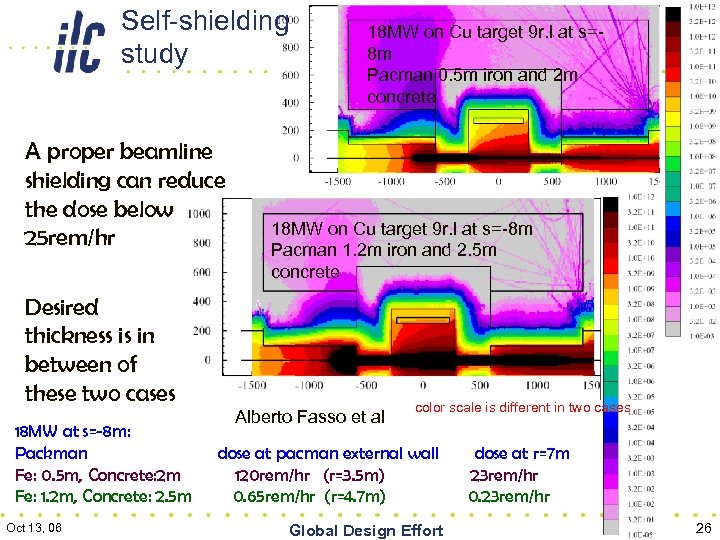 Self-shielding study A proper beamline shielding can reduce the dose below 25 rem/hr 18 MW on Cu target 9 r. l at s=8 m Pacman 0. 5 m iron and 2 m concrete 18 MW on Cu target 9 r. l at s=-8 m Pacman 1. 2 m iron and 2. 5 m concrete Desired thickness is in between of these two cases 18 MW at s=-8 m: Packman Fe: 0. 5 m, Concrete: 2 m Fe: 1. 2 m, Concrete: 2. 5 m Oct 13, 06 Alberto Fasso et al color scale is different in two cases dose at pacman external wall 120 rem/hr (r=3. 5 m) 0. 65 rem/hr (r=4. 7 m) Global Design Effort dose at r=7 m 23 rem/hr 0. 23 rem/hr 26
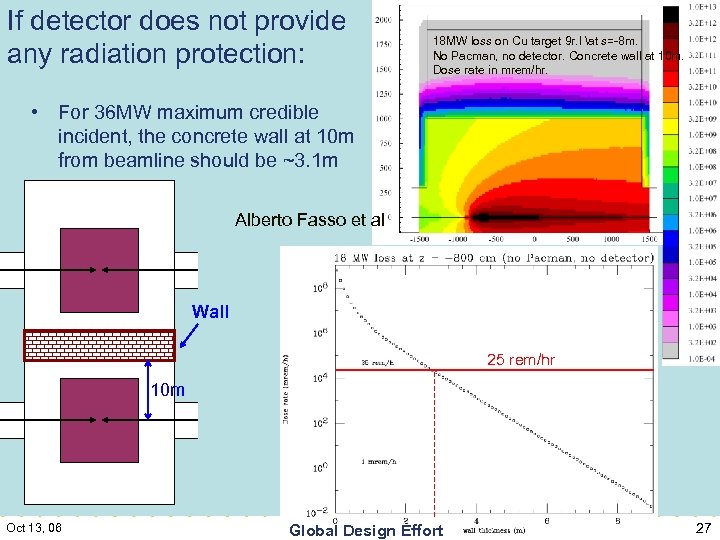 If detector does not provide any radiation protection: 18 MW loss on Cu target 9 r. l at s=-8 m. No Pacman, no detector. Concrete wall at 10 m. Dose rate in mrem/hr. • For 36 MW maximum credible incident, the concrete wall at 10 m from beamline should be ~3. 1 m Alberto Fasso et al Wall 25 rem/hr 10 m Oct 13, 06 Global Design Effort 27