


 Скачать презентацию International LEADER Conference Oct 12 -13 Przemyśl Polska
4a12fedac72352bf50497fee3548f5f8.ppt
- Количество слайдов: 21
 International LEADER Conference Oct. 12 -13 Przemyśl, Polska One LAG, one life Robert Lukesch
 Guiding questions 1. How shall the LAG be structured? 2. Which criteria shall be used for acknowledging a LAG? 3. Which rules and criteria shall be used for selecting projects?
 1. How shall the LAG be structured?
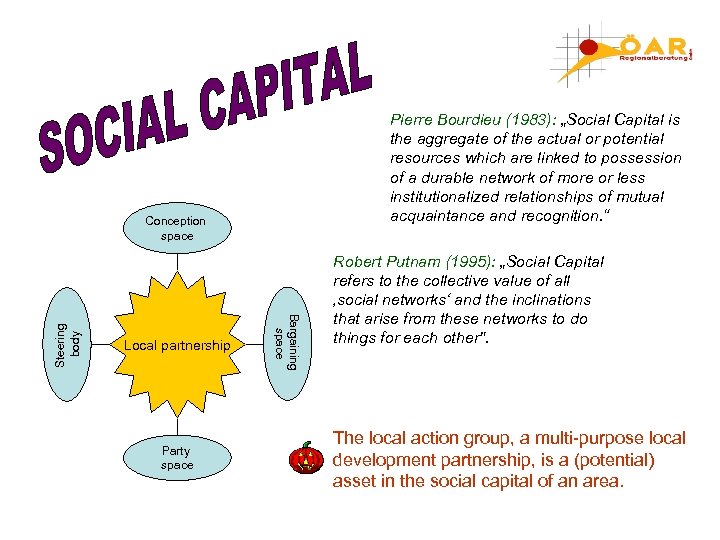 Pierre Bourdieu (1983): „Social Capital is the aggregate of the actual or potential resources which are linked to possession of a durable network of more or less institutionalized relationships of mutual acquaintance and recognition. “ Local partnership Party space Bargaining space Steering body Conception space Robert Putnam (1995): „Social Capital refers to the collective value of all ‚social networks‘ and the inclinations that arise from these networks to do things for each other". The local action group, a multi-purpose local development partnership, is a (potential) asset in the social capital of an area.
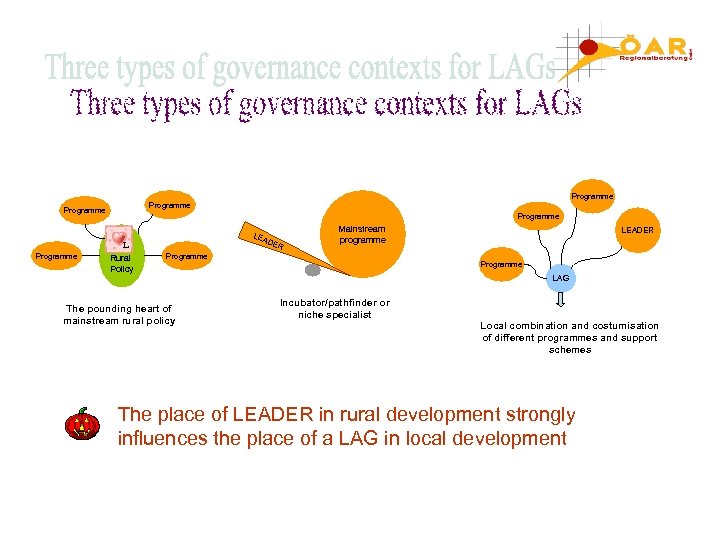 Programme Programme L Rural Policy LEA DE R Mainstream programme Programme The pounding heart of mainstream rural policy LEADER Programme LAG Incubator/pathfinder or niche specialist Local combination and costumisation of different programmes and support schemes The place of LEADER in rural development strongly influences the place of a LAG in local development
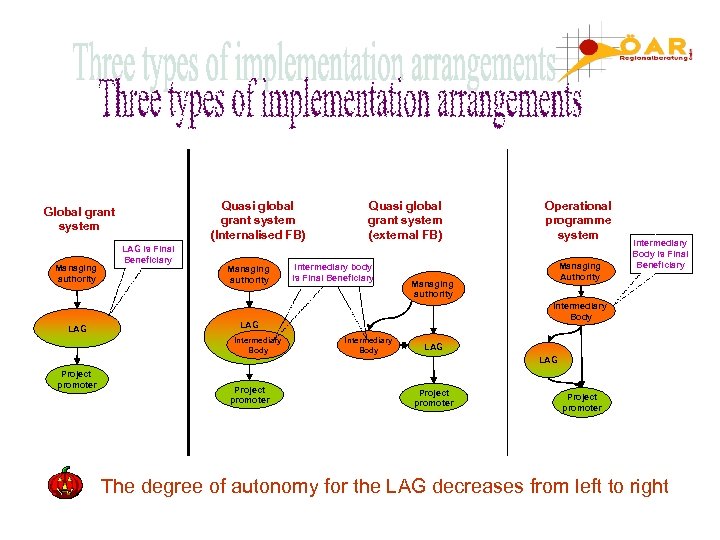 Quasi global grant system (Internalised FB) Global grant system Managing authority LAG is Final Beneficiary Managing authority Quasi global grant system (external FB) Intermediary body is Final Beneficiary Managing Authority Managing authority Intermediary Body is Final Beneficiary Intermediary Body LAG Intermediary Body Operational programme system Intermediary Body LAG Project promoter The degree of autonomy for the LAG decreases from left to right
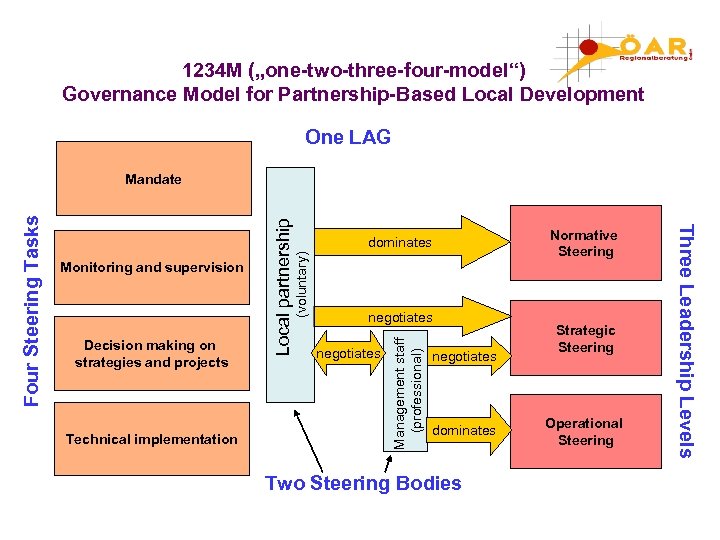 1234 M („one-two-three-four-model“) Governance Model for Partnership-Based Local Development One LAG Technical implementation (voluntary) negotiates Management staff (professional) Decision making on strategies and projects Local partnership Monitoring and supervision dominates negotiates dominates Two Steering Bodies Normative Steering Strategic Steering Operational Steering Three Leadership Levels Four Steering Tasks Mandate
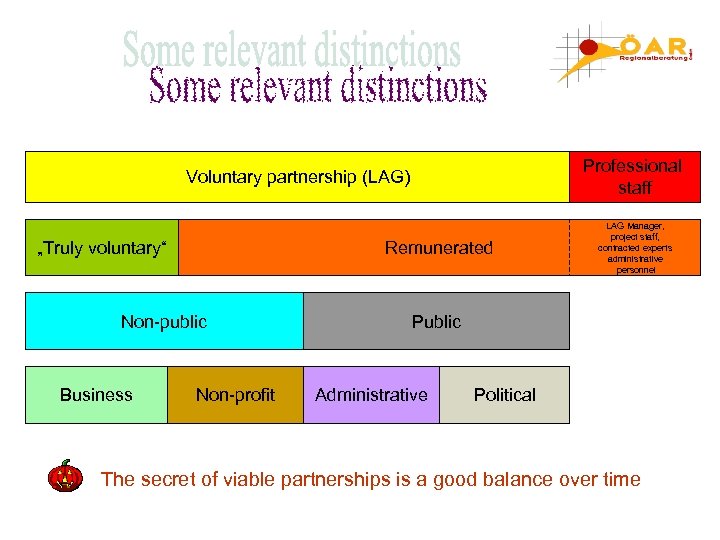 Professional staff Voluntary partnership (LAG) „Truly voluntary“ Remunerated Non-public Business Non-profit LAG Manager, project staff, contracted experts administrative personnel Public Administrative Political The secret of viable partnerships is a good balance over time
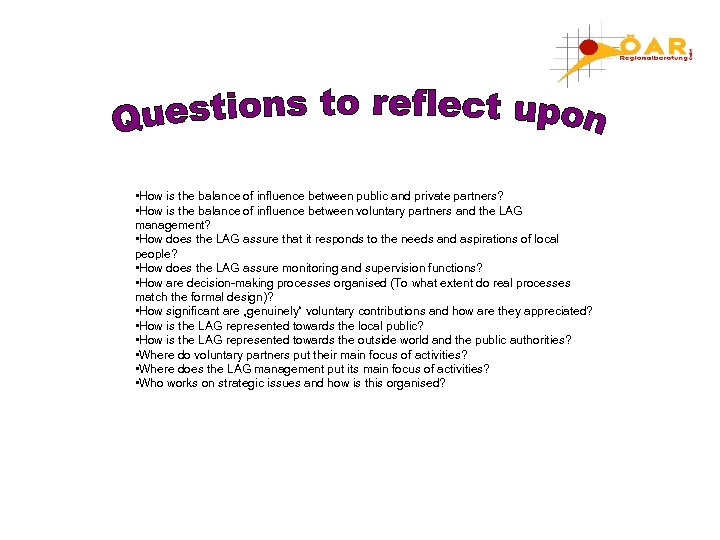 • How is the balance of influence between public and private partners? • How is the balance of influence between voluntary partners and the LAG management? • How does the LAG assure that it responds to the needs and aspirations of local people? • How does the LAG assure monitoring and supervision functions? • How are decision-making processes organised (To what extent do real processes match the formal design)? • How significant are „genuinely“ voluntary contributions and how are they appreciated? • How is the LAG represented towards the local public? • How is the LAG represented towards the outside world and the public authorities? • Where do voluntary partners put their main focus of activities? • Where does the LAG management put its main focus of activities? • Who works on strategic issues and how is this organised?
 2. Which criteria shall be used for acknowledging a LAG?
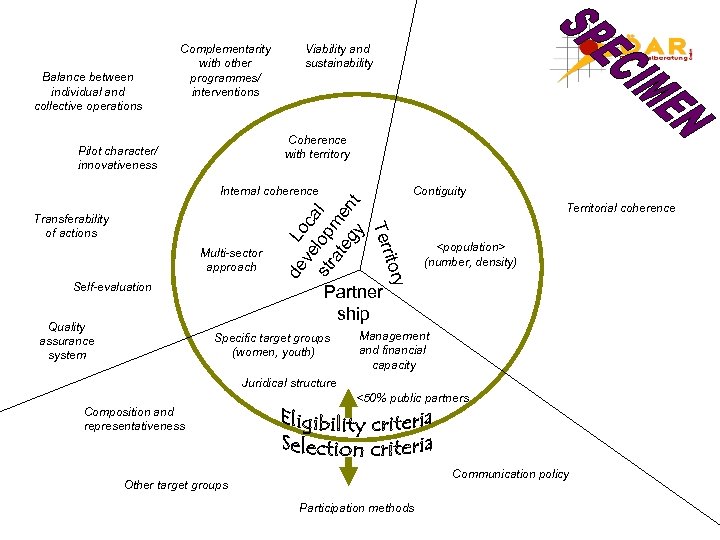 Balance between individual and collective operations Complementarity with other programmes/ interventions Viability and sustainability Coherence with territory Pilot character/ innovativeness Self-evaluation Quality assurance system de itory Multi-sector approach Territorial coherence Terr Transferability of actions Contiguity L ve oca str lop l at me eg n y t Internal coherence
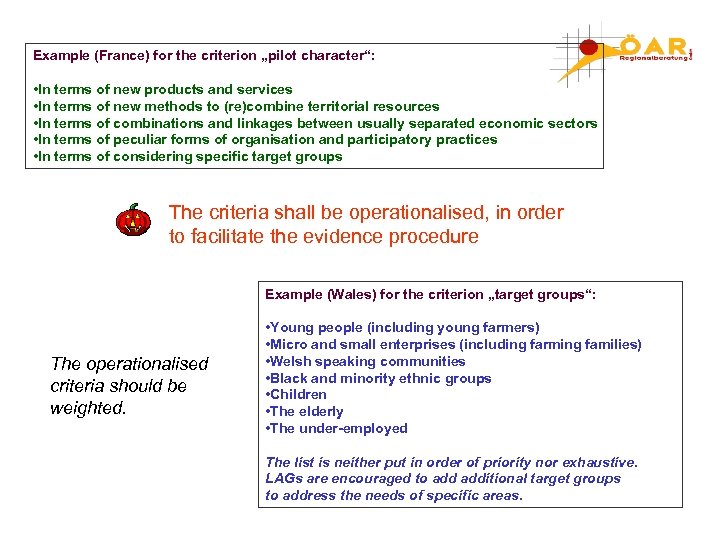 Example (France) for the criterion „pilot character“: • In terms of new products and services • In terms of new methods to (re)combine territorial resources • In terms of combinations and linkages between usually separated economic sectors • In terms of peculiar forms of organisation and participatory practices • In terms of considering specific target groups The criteria shall be operationalised, in order to facilitate the evidence procedure Example (Wales) for the criterion „target groups“: The operationalised criteria should be weighted. • Young people (including young farmers) • Micro and small enterprises (including farming families) • Welsh speaking communities • Black and minority ethnic groups • Children • The elderly • The under-employed The list is neither put in order of priority nor exhaustive. LAGs are encouraged to additional target groups to address the needs of specific areas.
 3. Which rules and criteria shall be used for selecting projects?
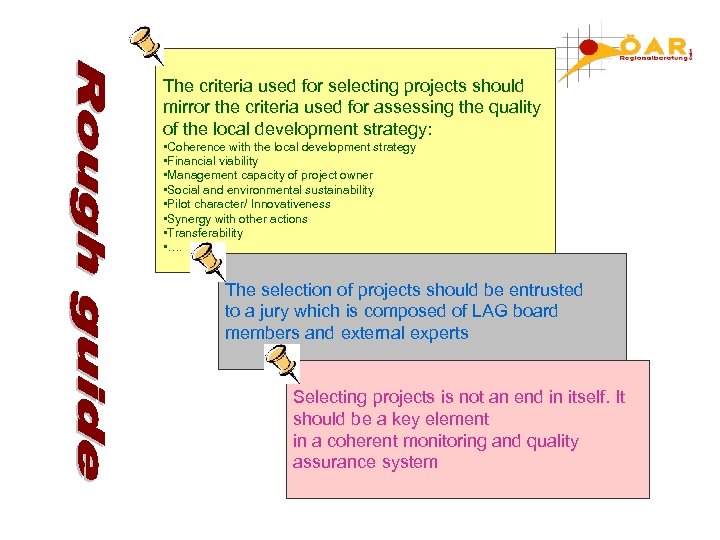 The criteria used for selecting projects should mirror the criteria used for assessing the quality of the local development strategy: • Coherence with the local development strategy • Financial viability • Management capacity of project owner • Social and environmental sustainability • Pilot character/ Innovativeness • Synergy with other actions • Transferability • …. The selection of projects should be entrusted to a jury which is composed of LAG board members and external experts Selecting projects is not an end in itself. It should be a key element in a coherent monitoring and quality assurance system
 …it is therefore the monitoring and quality assurance system on which the main focus should be put
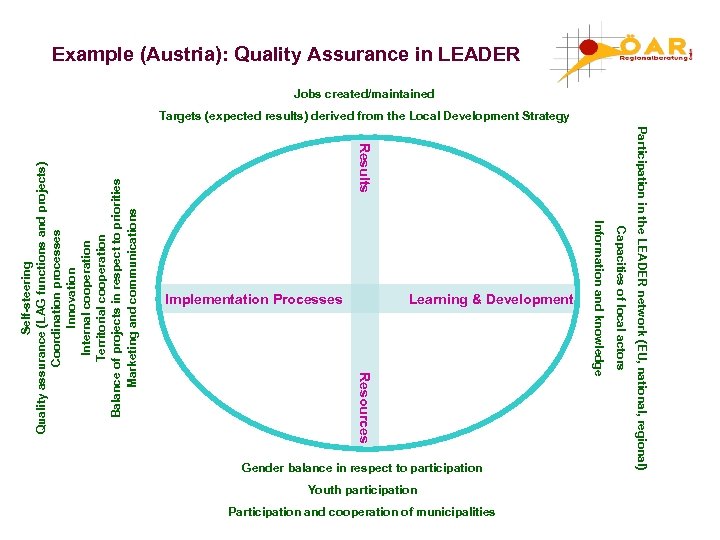 Example (Austria): Quality Assurance in LEADER Jobs created/maintained Resources Gender balance in respect to participation Youth participation Participation and cooperation of municipalities Capacities of local actors Learning & Development Information and knowledge Implementation Processes Participation in the LEADER network (EU, national, regional) Results Self-steering Quality assurance (LAG functions and projects) Coordination processes Innovation Internal cooperation Territorial cooperation Balance of projects in respect to priorities Marketing and communications Targets (expected results) derived from the Local Development Strategy
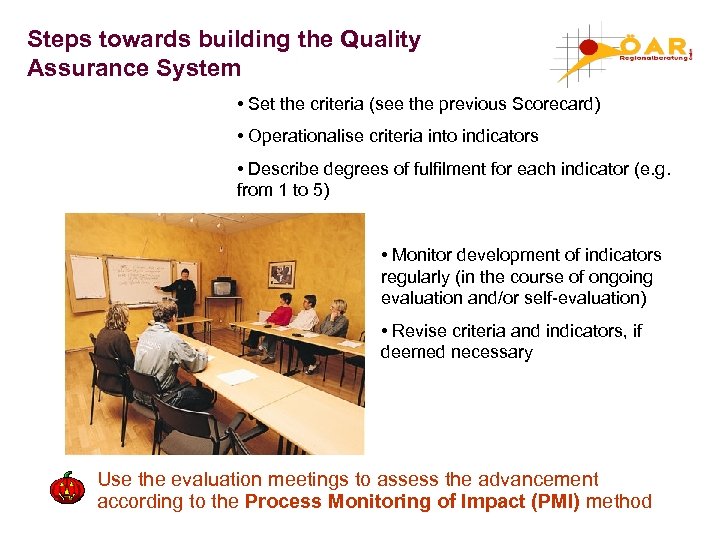 Steps towards building the Quality Assurance System • Set the criteria (see the previous Scorecard) • Operationalise criteria into indicators • Describe degrees of fulfilment for each indicator (e. g. from 1 to 5) • Monitor development of indicators regularly (in the course of ongoing evaluation and/or self-evaluation) • Revise criteria and indicators, if deemed necessary Use the evaluation meetings to assess the advancement according to the Process Monitoring of Impact (PMI) method
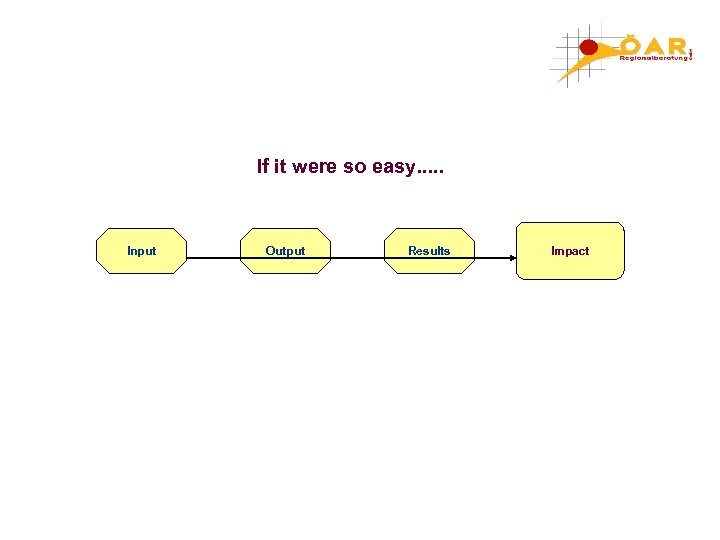 If it were so easy. . . Input Output Results Impact
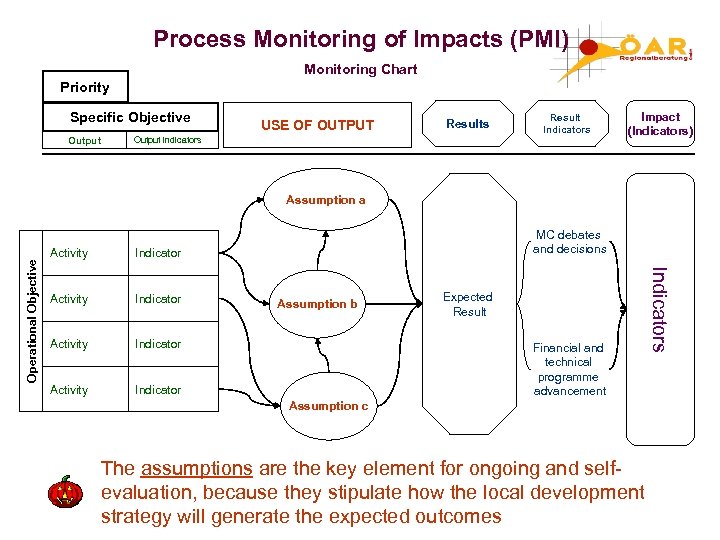 Process Monitoring of Impacts (PMI) Monitoring Chart Priority Specific Objective Output USE OF OUTPUT Results Output indicators Result Indicators Impact (Indicators) Activity Indicator Activity MC debates and decisions Indicator Assumption b Expected Result Financial and technical programme advancement Assumption c The assumptions are the key element for ongoing and selfevaluation, because they stipulate how the local development strategy will generate the expected outcomes Indicators Operational Objective Assumption a
 • How is the advancement of activities monitored? • Are there practices of periodic self-reflection or self-evaluation? • On the basis of which parametres is the functioning of the local partnership appraised? Is it appraised at all? • How does the local partnership get feedback from target beneficiaries (local actors and project promoters)? • How is feedback from target beneficiaries appreciated and processed? • How are deficiencies and wrong decisions dealt with? • Is there a systematic exchange with programme administration upon the quality of programme delivery? • Is there a systematic exchange with other LAGs in order to learn from good practices?
 Thanks. Robert Lukesch www. oear. at Download (on the European Contact Point Website): http: //ec. europa. eu/agriculture/rur/leaderplus/pdf/library/methodology/lukesch_handbook. pdf