


 Скачать презентацию INTERNATIONAL LAW ON THE REFUGEE IN AFRICA Presented
8835f2f46c05275623eefcf206f63726.ppt
- Количество слайдов: 17
 INTERNATIONAL LAW ON THE REFUGEE IN AFRICA Presented by : Christina Ete Ewanga Global Law and Society Forum. Date: 17 th. November 2011.
 Historical Background In the aftermath of the Second World War, refugees and displaced persons were high on the international agenda. At its first session in 1946, the United Nations General Assembly recognized not only the urgency of the problem, but also the cardinal principle that “no refugees or displaced persons who have finally and definitely. . . expressed valid objections to returning to their countries of origin. . . shall be compelled to return. . . ” (resolution 8 (I) of 12 February 1946). The United Nations’ first post-war response was a specialized agency, the International Refugee Organization (IRO, 1946 -1952), but notwithstanding its success in providing protection and assistance and facilitating solutions, it was expensive and also caught up in the politics of the Cold War. It was therefore decided to replace it with a temporary, initially non-operational agency, and to complement the new institution with revised treaty provisions on the status of refugees.
 Definition of Key Terms Who is a refugee? A refugee is someone who has been forced to flee his or her country because of persecution, war, or violence. A refugee has a well-founded fear of persecution for reasons of race, religion, nationality, political opinion or membership in a particular social group. Most likely, they cannot return home or is afraid to do so. War and ethnic, tribal and religious violence are leading causes of refugees fleeing their countries. A refugee is a civilian. Soldiers taking part of military actions can not be refugees. Usually escaping military service is not a reason to receive refugee status. In cases where conscientious objection is not possible or where a conflict violates international norms, draft evaders who fear persecution may be eligible for refugee status. Persons who have participated in war crimes, violations of humanitarian and human rights law or terrorism are excluded from the possibility of receiving refugee status. A criminal who has received a fair trial for a common law offence and who flees his country to escape jail is not necessarily a refugee. Economic migrants are not refugees. Economic migrants leave a country voluntarily to seek a better life and it is safe for them to return to their country of origin.
 Who is an asylum seeker? When people flee their own country and seek . sanctuary in another country, they apply for asylum – the right to be recognized as a refugee and receive legal protection and material assistance. An asylum seeker must demonstrate that his or her fear of persecution in his or her home country is wellfounded. What is the difference between a refugee and an economic migrant? An economic migrant normally leaves a country voluntarily to seek a better life. Should he or she decide to return home, they would continue to receive the protection of his or her government. Refugees flee because of the threat of persecution and cannot return safely to their homes. What is the 1951 Refugee Convention? The 1951 Geneva Convention is the main international instrument of refugee law. The Convention clearly spells out who a refugee is and the kind of legal protection, other assistance and social rights he or she should receive from the countries who have signed the document. The Convention also defines a refugee’s obligations to host governments and certain categories or people, such as war criminals, who do not qualify for refugee status. The Convention was limited to protecting mainly European refugees in the aftermath of World War II, but another document, the 1967 Protocol, expanded the scope of the Convention as the problem of displacement spread around the world
 .
.
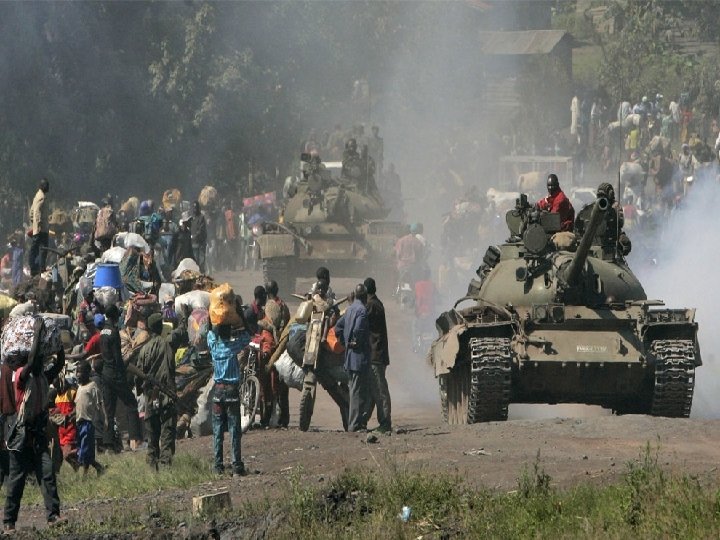
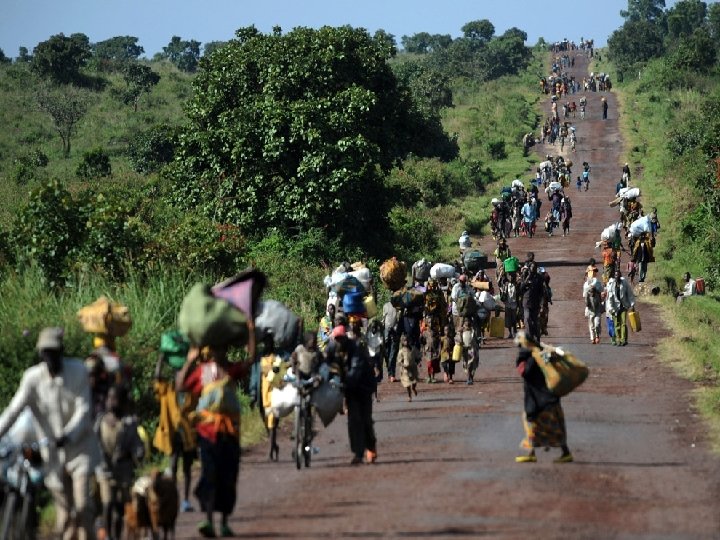
 Independence and Civil wars in Africa. (The wind of Change in Africa) History of Sudan(1956 -1969) and First Civil war. -UK and Egypt signed agreements that gave Sudanese self-government and selfdetermination. United State was the First foreign power to recognize the new State. -The Arab-led Khartoum government reneged on promises to Southerners to create a Federal System which led to mutiny by Southern army officers that sparked 17 years of Civil War(1955 -1972). The war is often characterized as a fight between the central government expanding and dominating peoples of the periphery, raising allegations of marginalization. Some paint the conflict as racial (Arabs vs. Africans) Others also paint the conflict as religious (Muslims vs. Christians and Animists). In reality, the conflict is far more complicated. Scholars such as Douglas Johnson have pointed at exploitative governance as the root cause. Roughly two million people have died as a result of war, famine and disease caused by the conflict. By the end of 1980’s , four million people in southern Sudan have been displaced at least once (and often repeatedly) during the war. The civilian death toll is one of the highest of any war since World War II.
 .
.
 .
.
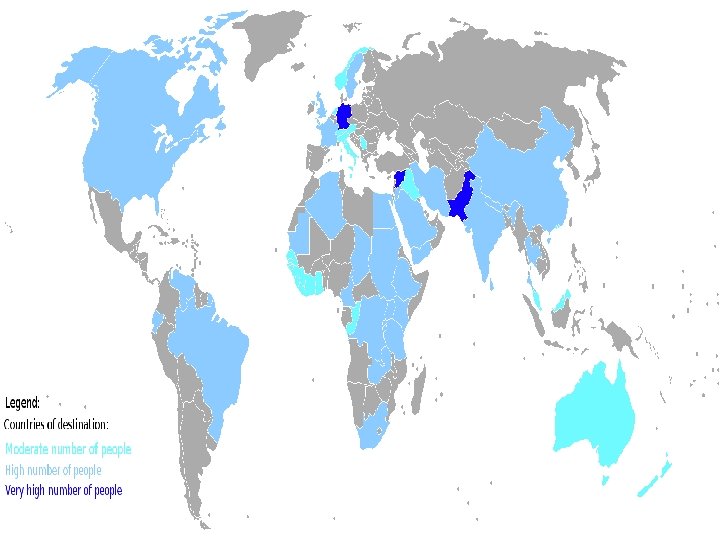
 Between 1966 -1969, Sudan had a series of governments that proved unable either to . agree on permanent constitution or to cope with problems of factionalism, economic stagnation and ethnic dissidence. The succession of early post-independence government were dominated by Arab Muslims who viewed Sudan as a Muslim Arab State. In March 1991, a new penal code, the Criminal Act of 1991, instituted harsh punishments nationwide, including amputations and stoning-Islamic Shari's law in the south which was against their wishes. Many Sudanese felt from several forms of persecutions to neighboring countries. Many countries have received asylum applications from Sudanese such as Cameroon, Tanzania, Eritrea, Kenya, amongst others. Out of the 67, 000 Sudanese who claimed refugee status from the UNHCR office between 1997 -March 2004, only about 20, 700 were recognized. Of those recognized, UNHCR resettled over 14, 300 people. Private sponsorships in addition to family reunification programs administered by the Australian and Canadian embassies have resettled an additional few thousand more. UNHCR’s office in Cairo has a past of using a very limited interpretation of the refugee definition outlined in the 1951 Refugee Convention. Although most of the Sudanese in Egypt fled due to war and violence, many were rejected refugee status because they were unable to prove a “well founded fear of persecution”.
 In past decade other destination countries become more prominent. -There are tens of thousands of Sudanese refugees in Egypt, most of them seeking refuge from ongoing military conflicts in their home country of Sudan. - Their official status as refugees is highly disputed, and they have been subject to racial discrimination and police violence. -The U. S. Committee for Refugees and Immigrants believes many more of these migrants are in fact refugees, but see little benefit in seeking recognition. -Egypt employs a "shoot to stop” policy against refugees attempting to continue to Israel refugees, but see little benefit in seeking recognition. According to Human Rights Watch, over 50 refugees, including women and children, have been shot by Egyptian border guards since 2007. -The violent destabilization and economic collapse caused by the immense amount of death and destruction has forced million of civilians to flee their homes and cities. -The majority of these IDPs are attempting to resettle outside of the country, but efforts have produced minimal results. .
 LEGAL STATUS AND CONFLICTS The 1967 Protocol Relating to the Status of Refugees in Africa The origins of the 1967 Protocol relating to the Status of Refugees, which reflected recognition by UNHCR and the States members of its Executive Committee that there was a disjuncture between the universal, unlimited UNHCR Statute and the scope of the 1951 Convention, were quite different from those of the latter. Instead of an international conference under the auspices of the United Nations, the issues were addressed at a colloquium of some thirteen legal experts which met in Bellagio, Italy, from 21 to 28 April 1965. The Colloquium did not favor a complete revision of the 1951 Convention, but opted instead for a Protocol by way of which States parties would agree to apply the relevant provisions of the Convention, but without necessarily becoming party to that treaty. The approach was approved by the UNHCR Executive Committee and the draft Protocol was referred to the Economic and Social Council for transmission to the General Assembly. The General Assembly took note of the Protocol (the General Assembly commonly “takes note” of, rather than adopts or approves, instruments drafted outside the United Nations system), and requested the Secretary-General to transmit the text to States with a view to enabling them to accede (resolution 2198 (XXI) of 16 December 1966). The Protocol required just six ratifications and it duly entered into force on 4 October 1967. The Protocol is often referred to as “amending” the 1951 Convention.
 As of August 2008, Cape Verde, Swaziland, the United States of America and Venezuela have acceded only to the Protocol, while Madagascar, Monaco, Namibia and St. Vincent & the Grenadines are party only to the Convention (and the Congo, Madagascar, Monaco, and Turkey have retained the geographical limitation). Article II on the cooperation of national authorities with the United Nations is equivalent to article 35 of the Convention, while the few remaining articles (just eleven in all) add no substantive obligations to the Convention regime. Before 1995, the Wadi El Nil agreement between Sudan and Egypt was signed. US restrain of Sudanese refugees and Asylum seekers. UNHCR’s office in Cairo has a past of using a very limited interpretation of the refugee definition outlined in the 1951 Refugee Convention. Although most of the Sudanese in Egypt fled due to war and violence, many were rejected refugee status because they were unable to prove a “well founded fear of persecution”. Refugees in Egypt experience discrimination by both the government and civilian services. A series of laws passed by parliament has effectively stalled legal and financial gains for refugees of all nationalities, and the response by the international community has been limited. Legal employment in Egypt is "virtually" impossible for Sudanese refugees. The 2003 Labor Law and its implementing Ministerial Decree and the 2004 Decree of the Ministry of Manpower and Emigration force all foreigners including refugees to have a permit to work in "gainful" employment. The large influx of Sudanese refugees in Egypt beginning in the late 1990 s led to an increase in rent prices and a higher cost of living for refugees as well as social tensions between the natives and Sudanese not experienced during the past influxes in the 1980 s. .
 Conflict with Authorities "Black Days" On January 27, 28 and 29, 2003, Egyptian police conducted raids of Sudanese, Liberian and sub-Saharan African residences in the Maadi area. Detainees, including those with refugee cards, reported ill treatment, beatings and abuse. One detainee reported “I was taken into a police wagon on the street. They drove around to collect other black people. They would ask Egyptians on the street, "Where are the buildings where blacks live? " It was about one hour driving around like this. By the end there were ten or twelve Africans in the car” HRW Other detainees alleged that police referred to the raids as "Black Day" and that police intake sheets were labeled, "Operation Track Down Blacks. “ “Mohandessin protests’’ An August 2004, Sudanese refugees, backed by the Egyptian non-governmental organization SOUTH, mounted a protest against the issuing of yellow cards outside the UNHCR office. Police and security officers arrested and dispersed refugees with tear gas. They dragged the refugees across the street, raped girls and women, pulled women from their hair and pushed the elderly carrying newborn babies. Refugees were put in public transit busses to be transferred to central security force camps in different locations in Egypt in addition to taking some of them to State security intelligence offices. Many of those taken to the camps suffered fractures and injuries and lack any medical help. At least 28, and as many as 100, Sudanese migrants seeking refugee status were killed. The opposition Muslim Brotherhood condemned the raid.
 .
.
 Persecution and the Reasons for Persecution Although the risk of persecution is central to the refugee definition, “persecution” itself is not defined in the 1951 Convention. Articles 31 and 33 refer to those whose life or freedom “was” or “would be” threatened, so clearly it includes the threat of death, or the threat of torture, or cruel, inhuman or degrading treatment or punishment. A comprehensive analysis today will require the general notion to be related to developments within the broad field of human rights (cf. 1984 Convention against Torture, article 7; 1966 International Covenant on Civil and Political Rights, article 3; 1950 European Convention on Human Rights, article 6; 1969 American Convention on Human Rights, article 5; 1981 African Charter of Human and Peoples’ Rights). At the same time, fear of persecution and lack of protection are themselves interrelated elements. The persecuted clearly do not enjoy the protection of their country of origin, while evidence of the lack of protection on either the internal or external level may create a presumption as to the likelihood of persecution and to the well-founded fear. However, there is no necessary linkage between persecution and Government authority. A Convention refugee, by definition, must be unable or unwilling to avail him- or herself of the protection of the State or Government, and the notion of inability to secure the protection of the State is broad enough to include a situation where the authorities cannot or will not provide protection, for example, against the persecution of non-State actors. .
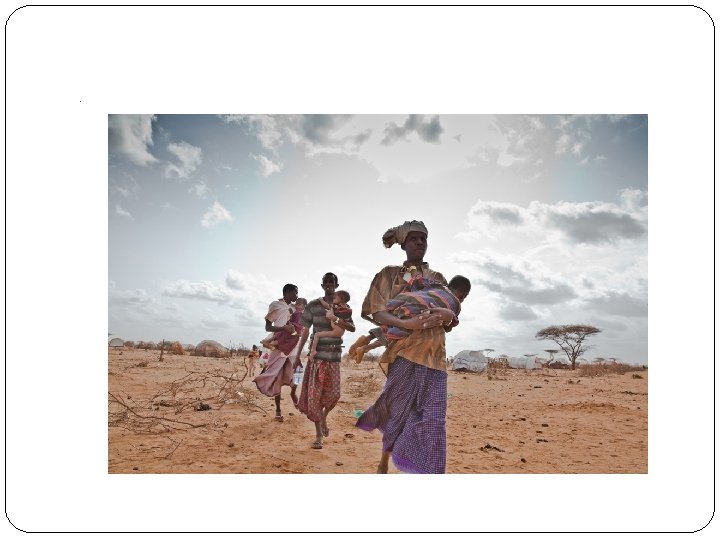
 . THE HARSH REALITIES Kenya and Somalia vow to defeat al-Shabaab. Somalia suffering famine, declares UN The United Nations declares famine in parts of southern Somalia, signaling to donors the need for more aid and to insurgents that the population's suffering is taken seriously: Suffering: A Harsh Daily Reality in Refugee Camps. What measures are needed? Who is responsible?
 ‘DEATH IN THE DESERT 'Death in the Desert' The CNN documentary "Death in the Desert" showed the remarkable risks Africans were prepared to make to try to get to Israel. A hazardous trip across Africa to Egypt where Bedouins would take them across the Sinai Desert but also hold them as bonded labor. And if they couldn't pay, bodies have been found with organs missing and fresh scars - signs, experts say, of organ trafficking. Now watch the documentary in full online in three parts.