 Скачать презентацию International Humanitarian Law SS 2011 Alexander Breitegger Session
7be1af0508baa6d5792767dbc0f627d1.ppt
- Количество слайдов: 15



International Humanitarian Law, SS 2011, Alexander Breitegger Session 3: Methods and means of combat with particular focus on cluster munitions
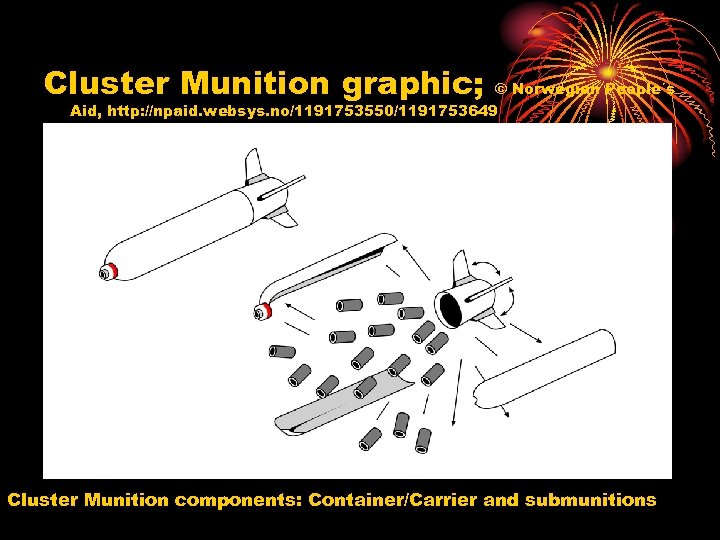
Cluster Munition graphic; © Norwegian People´s Aid, http: //npaid. websys. no/1191753550/1191753649 Cluster Munition components: Container/Carrier and submunitions
Cluster Munitions: Military Purpose • For large targets, massed concentrations of tanks or dispersed personnel • Many submunitions combine antiarmour (pierce armour) anti-personnel effect (fragmentation) and additional incendiary effect • Compared to unitary bombs/munitions: capability to destroy large numbers of persons/tanks within shorter period of time
However: 2 fundamental humanitarian problems 1) Wide dispersal pattern of explosive submunitions: if used in or near populated areas, civilian casualties virtually guaranteed 2) Many submunitions do not explode as designed: may maim and kill civilians post-conflict, obstruct livelihoods of civilians and return of refugees and IDPs and then…
Cluster Munition Facts • Used by Eritrea, Ethiopia, France, Georgia, Iraq, Israel, Libya, Morocco, Netherlands, Nigeria, Russia, Saudi Arabia, Sudan, UK, US, allegedly Thailand • Used by NSAG in Afghanistan (N-Alliance), Bosnia (Bosnian Serbs), Croatia (Krajina Serbs), Tajikistan, Israel (Hezbollah) • Stockpiled by almost 90 states • 34 states have produced over 210 different types • Affected: 32 states
General IHL rules relevant to weapons • Fundamental balance: military necessity v. humanity • Art. 35 (1), API: right of parties to choose methods or means of warfare not unlimited • Art. 35 (2), API: prohibition of employing weapons and methods of warfare that cause superfluous injury or unnecessary suffering • Art. 48, API: obligation of distinction between civilian and military targets
Superfluous Injury or Unnecessary Suffering (Art. 35 (2), API) • Primarily concerned with effects of weapons on combatants • Still controversial how “superfluous injury”, “unnecessary suffering” measured • Criteria: • balance between military necessity v. expected injury/suffering of person; • Alternative weapons available inflicting less suffering but having same military advantage? • Would serious permanent disability be inevitable?
Distinction • Fundamental rationale: protection of civilians that do not fight against dangers from military operations (Art. 51(1), (3) API) • Prohibition of deliberate attacks exclusively on civilians (Art. 51(2), API) • Prohibition of indiscriminate attacks (Art. 51(4), (5), API) • Prohibition of disproportionate attacks as manifestation of indiscriminate attacks
![Distinction: Military v. civilian targets • Military Objectives: „ […] military objectives are limited](https://present5.com/presentation/7be1af0508baa6d5792767dbc0f627d1/image-9.jpg "Distinction: Military v. civilian targets • Military Objectives: „ […] military objectives are limited")
Distinction: Military v. civilian targets • Military Objectives: „ […] military objectives are limited to those objects which by their nature, location, purpose or use make an effective contribution to military action and whose total or partial destruction, capture or neutralization, in the circumstances ruling at the time, offers a definite military advantage. “ (Art. 52(2), API) • Element 1: effective contribution to military action of the enemy by nature, location, purpose or use; • Element 2: capture, destruction or neutralisation provides the attacker with definite military advantage
Implementing distinction • Obligation on staff officers and field commanders to take the following precautionary measures (Art. 57, API): • Feasible verification that targets are military; • Proportionality assessment; • Feasible precautions in choice of methods/means of warfare to minimise civilian harm • Cancel or suspend attack if it becomes apparent that object targeted not military or proportionality rule breached • Effective advance warning to civilians • Also precautionary obligations of defenders Arts. 51 (7), 58 API
Specific prohibitions/regulations of weapons: Convention on Conventional Weapons (CCW) • Specific prohibitions and restrictions as corollary to general rules on means of combat • 1980 Convention on Prohibitions or Restrictions on the Use of Certain Conventional Weapons Which May be Deemed to be Excessively Injurious or to Have Indiscriminate Effects (CCW): separate from general rules in 1977 API • Framework convention with five specific Protocols designed to implement specifically prohibitions of unnecessary suffering and indiscriminate attacks: scope of application not limited, new Protocols can be added • “Pick and choose menu”: state becomes party on ratification of framework convention and any 2 of Protocols
Protocol V on ERW to the CCW • Prot. V on ERW: explosive remnants of war = any conventional munitions that have already been fired, dropped, launched or projected and have failed to explode as intended; paradigmatic case: cluster munitions • Content: important recognition that user of explosives special responsibility for marking, clearance of, and making available information on those explosives becoming ERW even if no territorial control • not sufficient for cluster munitions: • only deals with post-conflict dimension of the problem and also not retroactive • measures preventing occurrence of ERW merely voluntary; • very weak obligation on assistance in dealing with existing ERWs; • generally many qualifiers („as far as practicable“, „subject to legitimate security interests“ )
Cluster Munitions • 2 fundamental problems with general rules of IHL: • During armed conflict: If explode as intended: indiscriminate attack in or near civilian targets no distinction between military/civilian possible (opposite of precise weapons) but NO INDISCRIMINATÈ WEAPON BY NATURE • After armed conflict: many do not explode as intended: duds may remain on ground for a long time, effects: de facto landmines; indiscriminate effects of weapon, proportionality • Specific rules: 2003 Protocol V to the CCW on Explosive Remnants of War
„Oslo process“ • failure of 2006 CCW Rev Con to agree on negotiating mandate • 21 -23 February 2007: Oslo conference on Cluster Munitions • 49 states attended, 46 states endorsed final declaration calling for treaty by 2008 prohibiting the use, production, transfer and stockpiling of cluster munitions that cause unacceptable harm to civilians; providing for assistance to cluster munition survivors; clearance; risk education; destruction of stockpiles • follow-up conferences: Lima 23 -25 May 2007; Vienna 4 -7 Dec. 2007; Wellington 18 -22 Feb. 2008 • negotiations on Cluster Munition Convention in Dublin 19 -30 May 2008
Convention on Cluster Munitions • Prohibits use, stockpiling, production and transfer of cluster munitions • Definition: exclusion under Art. 2 (2) (c) for certain SFW • Obligations of stockpile destruction within 8 years; clearance within 10 years • Obligation to provide assistance to victims: highest standard under IL • Framework of international cooperation • Reporting obligations for implementation • Weakness: interoperability under Art. 21! • entry into force: 01/08/2010
Скачать презентацию International Humanitarian Law SS 2011 Alexander Breitegger Session
7be1af0508baa6d5792767dbc0f627d1.ppt