


 Скачать презентацию International Health Care Systems Kao-Ping Chua Jack Rutledge
7d5b1681fe71fc0dd42da473b1d442df.ppt
- Количество слайдов: 37
 International Health Care Systems Kao-Ping Chua Jack Rutledge Fellow, 2005 -2006 American Medical Student Association
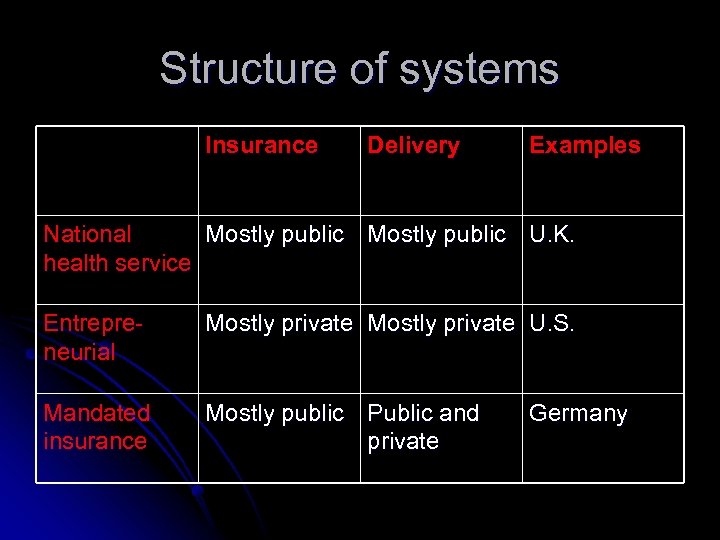 Structure of systems Insurance Delivery Examples National Mostly public U. K. health service Entrepreneurial Mostly private U. S. Mandated insurance Mostly public Public and private Germany
 The influence of values on systems l European social ethic: public good, social solidarity l American individualistic ethic: individual good, social fragmentation
 Three categories of analysis l Organization: insurance pools, public/private mix l Quality, choice, and access l Problems
 Outline I. III. IV. V. VI. U. S. Japan Germany France U. K. Canada THINK BIG PICTURE!!!
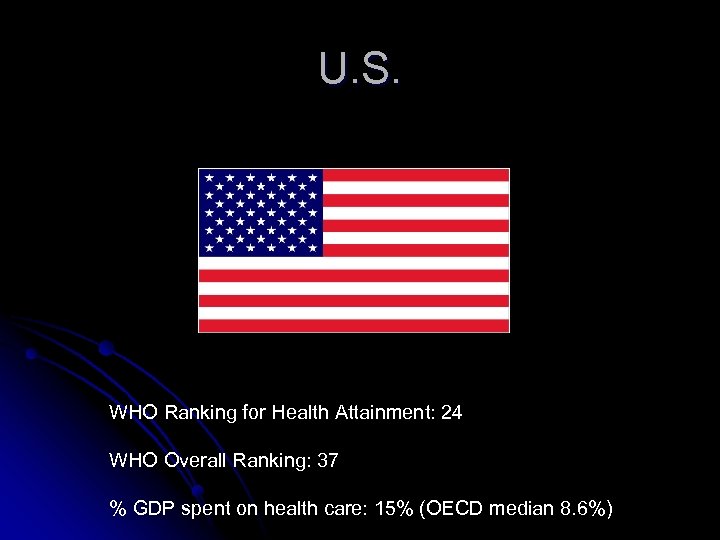 U. S. WHO Ranking for Health Attainment: 24 WHO Overall Ranking: 37 % GDP spent on health care: 15% (OECD median 8. 6%)
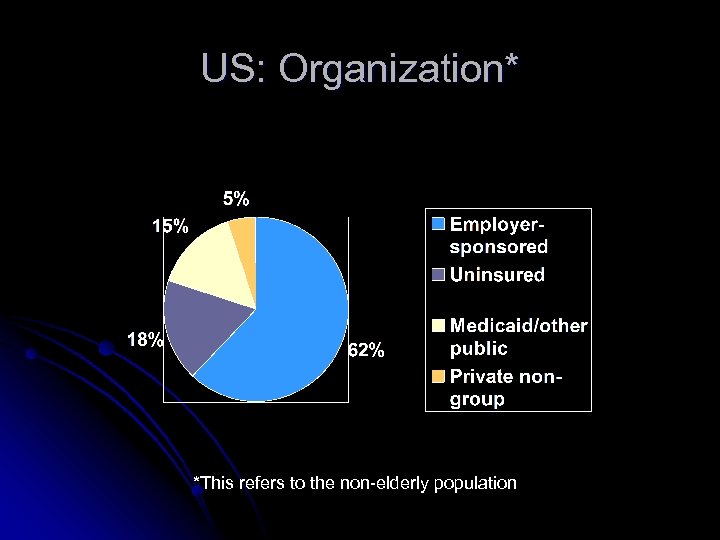 US: Organization* *This refers to the non-elderly population
 US: Quality, choice, access l Quality: depends on plan – often gaps for prescription drugs, dental, vision l Choice: Restricted choice of providers l Access: Waiting lines relatively rare, huge amount of uninsurance
 US: Problems l 45 million uninsured l Skyrocketing health care costs l Significant health disparities by race and income
 Japan WHO Ranking for Health Attainment: 1 WHO Overall Ranking: 10 % GDP spent on health care: 7. 9% (OECD median 8. 6%)
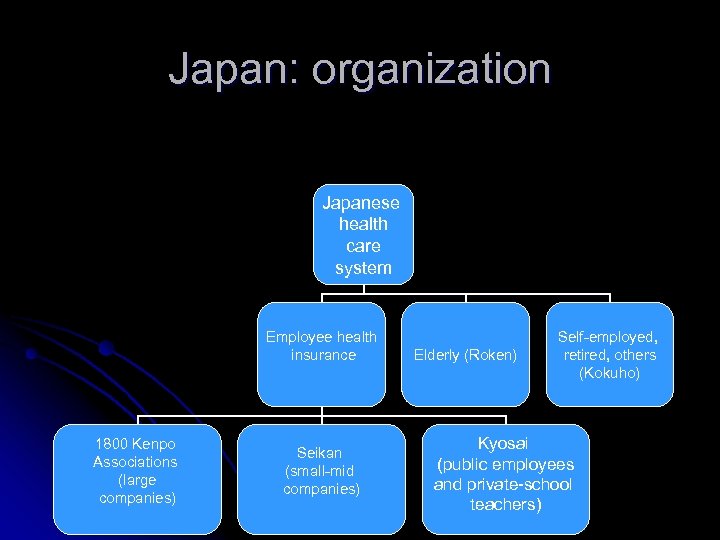 Japan: organization Japanese health care system Employee health insurance 1800 Kenpo Associations (large companies) Seikan (small-mid companies) Elderly (Roken) Self-employed, retired, others (Kokuho) Kyosai (public employees and private-school teachers)
 Japan: organization l Most providers and hospitals are in the private sector l Hospitals are the center of care
 Japan: quality, choice, access l Quality: huge amount of technology, comprehensive benefits l Choice: free choice of doctors and hospitals l Access: few waiting lists except at the very best hospitals
 Japan: problems/reforms l Kenpo associations in debt (crosssubsidizations); rapidly aging population l Over-prescription of drugs l High cost-sharing
 France WHO Ranking for Health Attainment: 3 WHO Overall Ranking: 1 % GDP spent on health care: 10. 1% (OECD median 8. 6%)
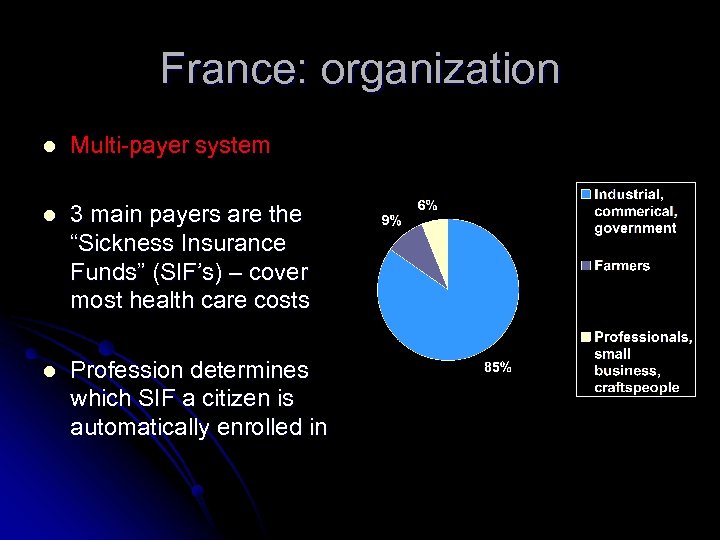 France: organization l Multi-payer system l 3 main payers are the “Sickness Insurance Funds” (SIF’s) – cover most health care costs l Profession determines which SIF a citizen is automatically enrolled in
 France: organization l Most ambulatory care physicians are in private practice l l Sector I: charge at national fee schedule but get government benefits Sector II: charge above fee schedule but don’t get government benefits l Hospitals both private and public l Complementary health insurance for costsharing (90% of the population)
 France: quality, choice, access l Quality: very comprehensive, good safety net for the poor l Choice: Free choice of doctors l Access: Can usually see GP on same-day
 France: problems l Nursing and physician shortages l Increasing health expenditures, mainly from drugs (19% of all expenditures) l 90% of physician visits end up with prescriptions!
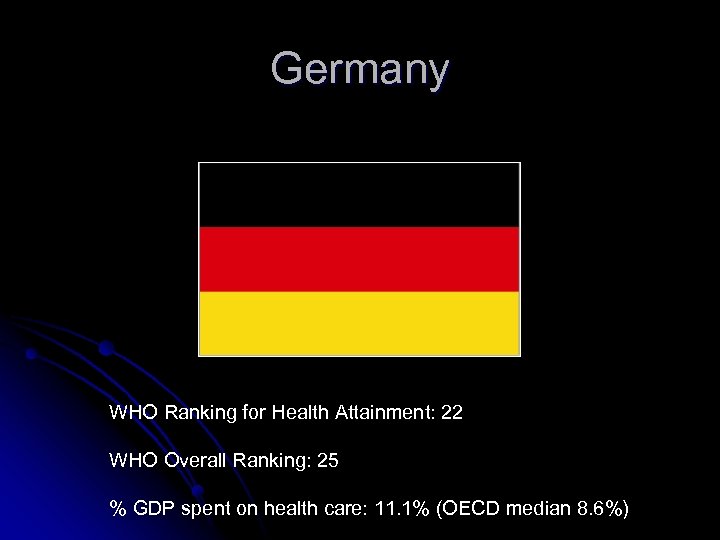 Germany WHO Ranking for Health Attainment: 22 WHO Overall Ranking: 25 % GDP spent on health care: 11. 1% (OECD median 8. 6%)
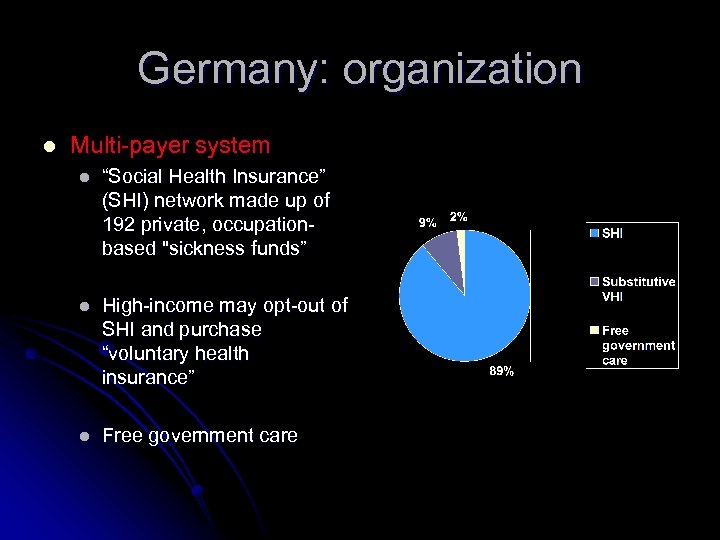 Germany: organization l Multi-payer system l “Social Health Insurance” (SHI) network made up of 192 private, occupationbased "sickness funds” l High-income may opt-out of SHI and purchase “voluntary health insurance” l Free government care
 Germany: organization l Ambulatory physicians are mostly private l Hospitals are both public and private
 Germany: quality, choice, access l Quality: Extremely comprehensive benefits l Generous sick pay policies l Choice: Free choice of GP and specialists, must use closest hospital l Access: Waiting times not usually a problem
 Germany: problems/reforms l Expensive health care system l High cost-sharing l Excessive numbers of physicians (60% of areas are closed off to more doctors)
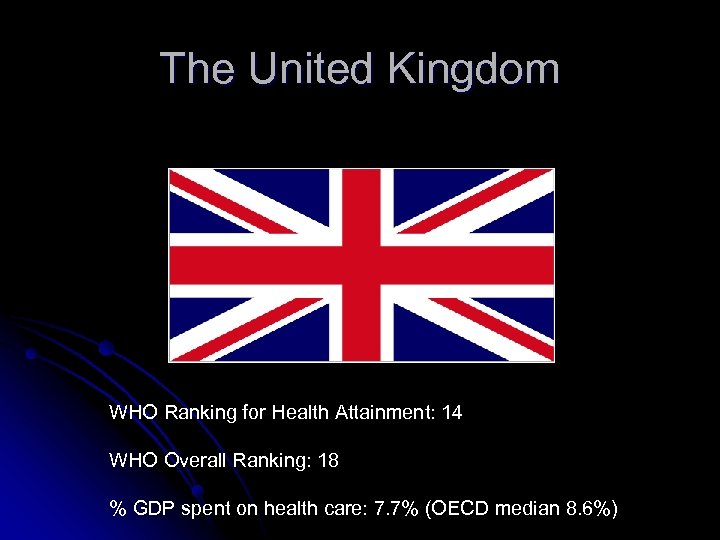 The United Kingdom WHO Ranking for Health Attainment: 14 WHO Overall Ranking: 18 % GDP spent on health care: 7. 7% (OECD median 8. 6%)
 UK: organization l National health service (NHS): publicly financed and delivered l Supplemental private insurance for dental and eye care l Growing sector of substitutive private insurance
 UK: Quality, choice, access l Quality: Comprehensive except dental and eye l Choice: Free choice of doctor l Access: major problems with waiting lists l Specialist (2. 5 months) l Elective procedures (3 months)
 UK: problems l Underfunding: l Waiting lists l Health care delivery capacity is insufficient for many services l Facilities need updating
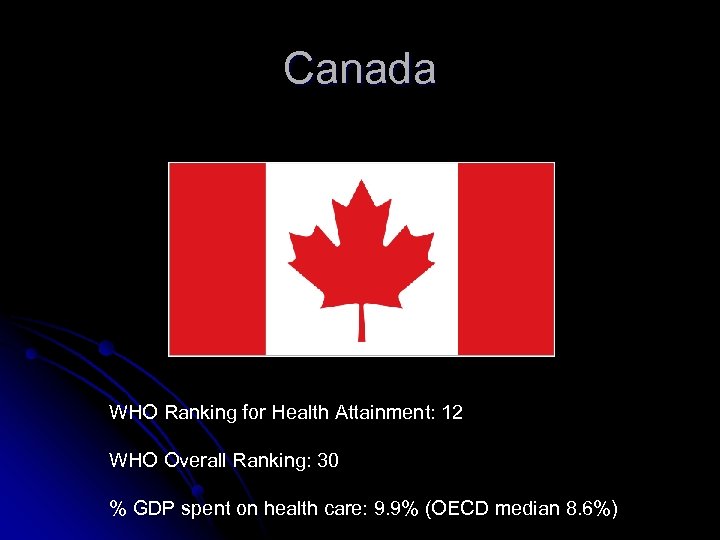 Canada WHO Ranking for Health Attainment: 12 WHO Overall Ranking: 30 % GDP spent on health care: 9. 9% (OECD median 8. 6%)
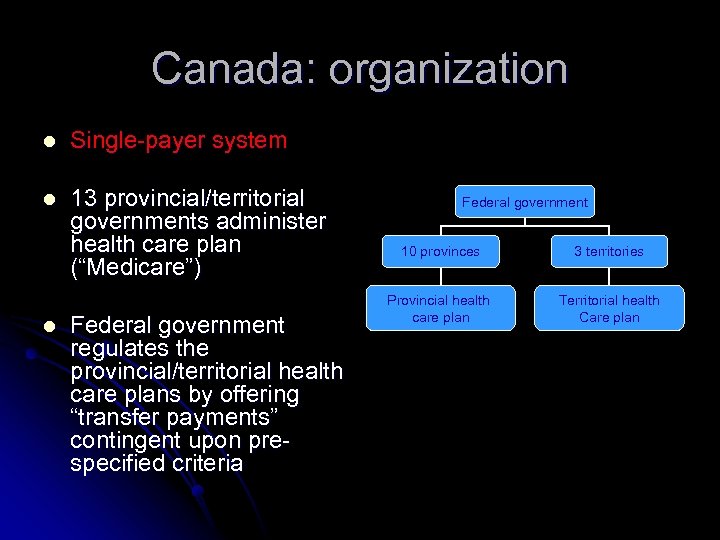 Canada: organization l Single-payer system l 13 provincial/territorial governments administer health care plan (“Medicare”) l Federal government regulates the provincial/territorial health care plans by offering “transfer payments” contingent upon prespecified criteria Federal government 10 provinces 3 territories Provincial health care plan Territorial health Care plan
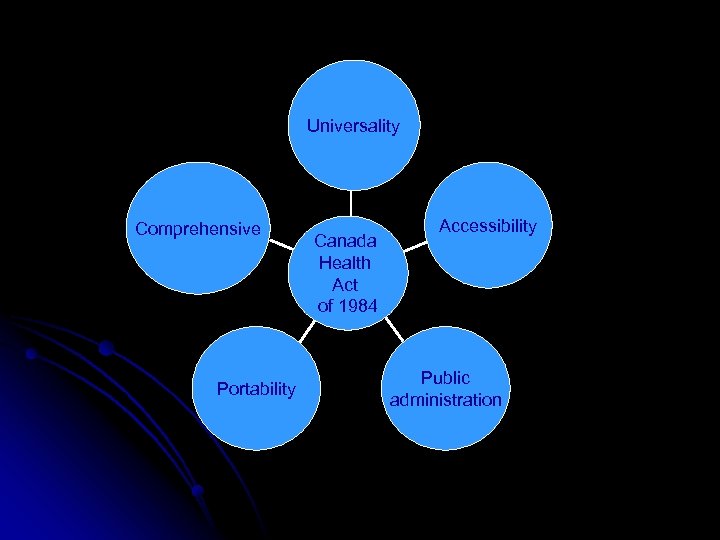 Universality Comprehensive Portability Canada Health Act of 1984 Accessibility Public administration
 Canada: organization l Providers are mostly private; hospitals mostly public l Most Canadians have complementary private health insurance for non-covered services
 Canada: Quality, choice, access l Quality: Coverage for “medically necessary” services l Gaps for dental care, long-term care, outpatient drugs complementary private insurance l Choice: Free to choose GP and hospital l Access: l l No waiting lists for GP visits or emergencies Waiting times can be problematic for certain ELECTIVE procedures
 Canada: Problems/reforms l Underfunding l Gaps in coverage l Tension between provincial and central governments
 Points to remember, part 1 l Every country is dealing with increasing health care costs l ANY system can have problems if it is underfunded, no matter how good it is theoretically l Privatization exists to various degrees in each system…but no country allows private elements to price people out of health care
 Points to remember, part 2 l UHC can be achieved while maintaining: l Comprehensive benefits for everyone (every country but U. S. ) l Free choice of providers (every country but U. S. ) l High levels of technology (Japan, Germany) l Few waiting lists (France, Germany, Japan)
 Parting thought The U. S. is the only industrialized country in the world without UHC… …but we can achieve high-quality, affordable health care for EVERYONE if we used the vast amounts of money in our system more efficiently