 Скачать презентацию International Giving Opportunities April 2016 Jane Peebles Karlin
a48dc3242e89e15e7e4604452e6cb894.ppt
- Количество слайдов: 96



International Giving Opportunities April 2016 Jane Peebles Karlin & Peebles 5900 Wilshire Blvd, Ste. 500 Los Angeles, CA 90036 (310) 274 -5245 www. karlinpeebles. com © Karlin & Peebles, LLP
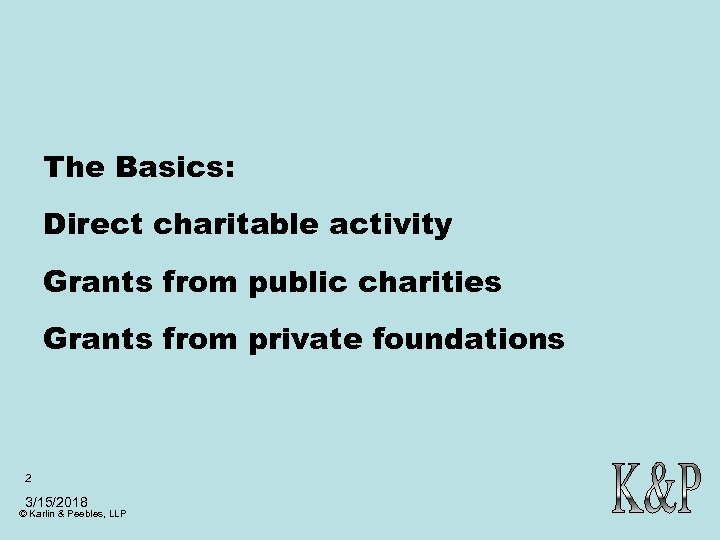
The Basics: Direct charitable activity Grants from public charities Grants from private foundations 2 3/15/2018 © Karlin & Peebles, LLP
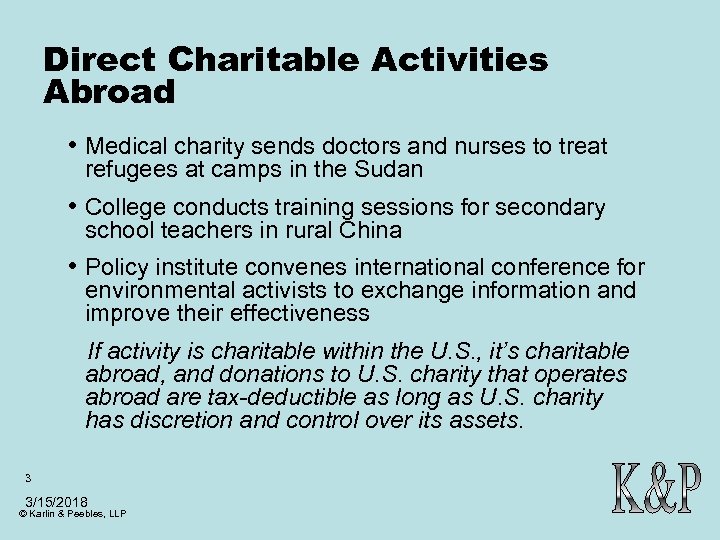
Direct Charitable Activities Abroad • Medical charity sends doctors and nurses to treat refugees at camps in the Sudan • College conducts training sessions for secondary school teachers in rural China • Policy institute convenes international conference for environmental activists to exchange information and improve their effectiveness If activity is charitable within the U. S. , it’s charitable abroad, and donations to U. S. charity that operates abroad are tax-deductible as long as U. S. charity has discretion and control over its assets. 3 3/15/2018 © Karlin & Peebles, LLP
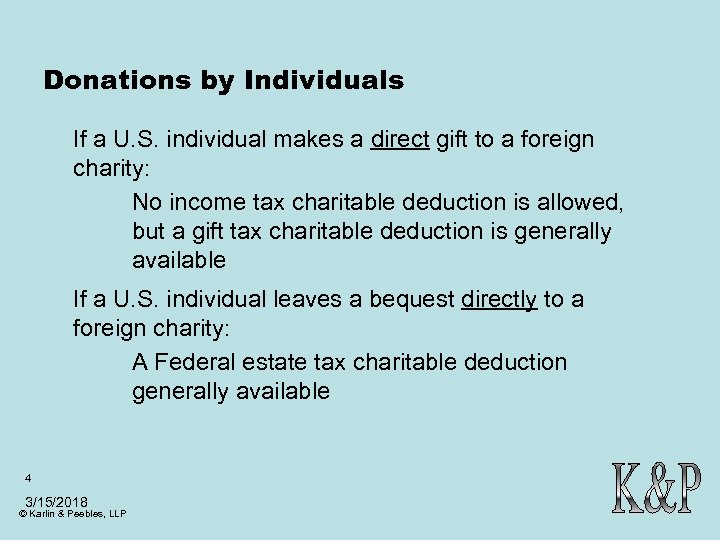
Donations by Individuals If a U. S. individual makes a direct gift to a foreign charity: No income tax charitable deduction is allowed, but a gift tax charitable deduction is generally available If a U. S. individual leaves a bequest directly to a foreign charity: A Federal estate tax charitable deduction generally available 4 3/15/2018 © Karlin & Peebles, LLP
Donations by Individuals Note: Even if the foreign charity has an IRS determination letter stating that it is equivalent to a U. S. public charity, a U. S. individual cannot claim an income tax deduction for a direct donation to that foreign charity unless there is a treaty exception. Treaty exceptions are very rare. 5 3/15/2018 © Karlin & Peebles, LLP
U. S. -Canada Treaty The U. S. -Canada treaty provides that contributions by a U. S. citizen or resident to a Canadian tax-exempt organization are deductible against the donor's Canadian -source income, subject to U. S. percentage limitations. 6 3/15/2018 © Karlin & Peebles, LLP
U. S. -Canada Treaty The U. S. -Canada treaty provides for reciprocal credits for gifts by Canadian residents to U. S. taxexempt organizations. Credits may generally be claimed only against U. S. -source income, subject to Canadian percentage limitations. 7 3/15/2018 © Karlin & Peebles, LLP
U. S. -Canada: Special Exception An exception permits a deduction against the U. S. donor's U. S. -source income (again, subject to U. S. percentage limitations) for contributions to a Canadian college or university at which the donor or a member of the donor's family is or was enrolled. 8 3/15/2018 © Karlin & Peebles, LLP
U. S. -Canada: Special Exception Gifts to U. S. colleges or universities attended by a Canadian donor or a member of the donor's family are creditable against Canadian-source income (again, subject to Canadian percentage limitations). 9 3/15/2018 © Karlin & Peebles, LLP
U. S. -Mexico Treaty The U. S. -Mexico income tax treaty allows income tax deductions to U. S. citizens and residents for contributions to Mexican charities (other than churches). Deductions are allowed only with respect to Mexican-source income and are subject to U. S. percentage limitations. 10 3/15/2018 © Karlin & Peebles, LLP
U. S. -Mexico Treaty • Mexicans are allowed reciprocal deductions against U. S. source income (subject to Mexican percentage limitations) for contributions to U. S. charities. 11 3/15/2018 © Karlin & Peebles, LLP
U. S. -Israel Treaty The U. S. -Israel income tax treaty permits U. S. citizens and residents to deduct contributions to Israeli charities against their Israeli-source income if the Israeli charity would have qualified for tax exemption under U. S. law had it been established here. The deduction is capped at 25% of Israelisource adjusted gross income for individual donors. 12 3/15/2018 © Karlin & Peebles, LLP
Income Tax Deduction for Gift to Foreign Charity • If a U. S. person wants an income tax charitable deduction and there is no treaty exception, the donation should be made to a charity organized in the U. S. : U. S. charity with direct operations abroad - U. S. charity with foreign branch or subsidiary - U. S. "friends of" organization - Community foundation - Other U. S. public charity or U. S. private foundation 13 3/15/2018 © Karlin & Peebles, LLP
Corporate Contributions Corporate contributions intended for use outside of the United States are not deductible unless donee is a U. S. nonprofit in corporate form. 14 3/15/2018 © Karlin & Peebles, LLP
Key Concepts DISCRETION AND CONTROL 15 3/15/2018 © Karlin & Peebles, LLP
U. S. Charity With Foreign Branch or Subsidiary The foreign branch or subsidiary is under control of U. S. charity, so the IRS says: • The U. S. charity is the true beneficiary • The donor is entitled to a U. S. income tax deduction the same as if the gift were made to a U. S. charity for use in the U. S. , even if earmarked for a particular program abroad. This is the only situation where earmarking is okay. 16 3/15/2018 © Karlin & Peebles, LLP
"Friends of" Organization • A U. S. public charity formed exclusively to support one or more foreign charities • May not merely funnel earmarked donations • Must control and monitor use of funds 17 3/15/2018 © Karlin & Peebles, LLP
"Friends of" Organization “Friends of" organizations should: • Review the purposes of the foreign charity and determine they are analogous to those of U. S. nonprofits. 18 3/15/2018 © Karlin & Peebles, LLP
"Friends of" Organization • Review and approve specific projects and related solicitation programs. • Enter into a grant agreement with the foreign donee organization. • Require accountings. 19 3/15/2018 © Karlin & Peebles, LLP
"Friends of" Organization • Retain exclusive power to refuse any conditional or earmarked donations. • A “friends of” organization may solicit funds for specific projects abroad, but it must retain discretion to use the donated funds for other exempt purposes determined to be more appropriate. 20 3/15/2018 © Karlin & Peebles, LLP
In Support of This Discretion: • The U. S. charity and the supported non-U. S. charity should not have identical or substantially overlapping boards. If they do, no real oversight is possible. • The U. S. charity should serve some independent purpose other than merely remitting funds to the non-U. S. charity. See Rev. Rul. 63 -252 in your materials. 21 3/15/2018 © Karlin & Peebles, LLP
• The U. S. charity should use some portion of its funds in the U. S. or for purposes of mutual benefit to the U. S. charity and the foreign charity. • The U. S. charity's fundraising materials should advise contributors that all donated funds are subject to independent control of the U. S. organization. 22 3/15/2018 © Karlin & Peebles, LLP
"Friends of" Organization • If the “friends of” organization does not follow these rules, and particularly if it acts as a mere conduit, the donor will not be entitled to an income tax deduction. 23 3/15/2018 © Karlin & Peebles, LLP
Public Charity Grants • There are no I. R. S. requirements specifically applicable to grants by U. S. public charities for use abroad. • However, the Board of a U. S. public charity has a fiduciary obligation to see that such grants are used for charitable purposes as defined in 170(c). 24 3/15/2018 © Karlin & Peebles, LLP
Public Charity Grants A U. S. public charity can make distributions to any organization, without geographical limit, for legitimate charitable purposes. To fulfill the Board’s fiduciary duties, it should: • Obtain necessary documentation from the foreign grantee; • Enter into a written agreement which documents the grantee's commitments; and • Obtain accountings from the foreign grantees if it would do so for a similar grant made to a U. S. grantee. 25 3/15/2018 © Karlin & Peebles, LLP
Community Foundations • Geographic restrictions? The governing documents may need to be amended to permit grants abroad. • Grants from "unrestricted funds" are generally okay. • If the donor specifies a particular charitable focus, but the foundation has discretion to determine the ultimate grantee, may make foreign grants from “field of interest” funds. 26 3/15/2018 © Karlin & Peebles, LLP
Community Foundations • If a community foundation permits grants abroad from donor advised funds but not unrestricted funds, the IRS may argue that the "advised fund" is in fact subject to donor control. • Grants abroad from donor advised funds always require the DAF sponsor either to exercise expenditure responsibility or make a foreign public charity equivalence determination, terms we’ll explain later 27 3/15/2018 © Karlin & Peebles, LLP
Private Foundation Grants • • • A private foundation can make distributions to any organization, without geographical limit, for legitimate charitable purposes if— It grants funds to a U. S. public charity that conducts its own programs outside the U. S. , or It grants funds directly to a non-U. S. entity after determining that it is the foreign equivalent of a U. S. public charity, or It grants funds directly to a non-U. S. entity, or to a U. S. entity that is not a public charity, and exercises expenditure responsibility over the grant 28 3/15/2018 © Karlin & Peebles, LLP
No Earmarking! • A private foundation may grant funds to a U. S. public charity for a specific project that the public charity will conduct or fund outside the U. S. • The U. S. public charity must retain discretion and control over the funds • If the public charity does not have discretion and control, the IRS will contend that the private foundation has essentially made a grant directly to the foreign recipient without following proper procedures – that’s a taxable expenditure. 29 3/15/2018 © Karlin & Peebles, LLP
Do the Right Thing • Private foundations that want to fund non-U. S. organizations directly have two techniques in the toolbox: Expenditure responsibility Public charity equivalency determination • Let’s look into that toolbox… 30 3/15/2018 © Karlin & Peebles, LLP
The Institutional Grantmaker’s Tool Box: Direct Grants to Foreign Organizations 31 3/15/2018 © Karlin & Peebles, LLP
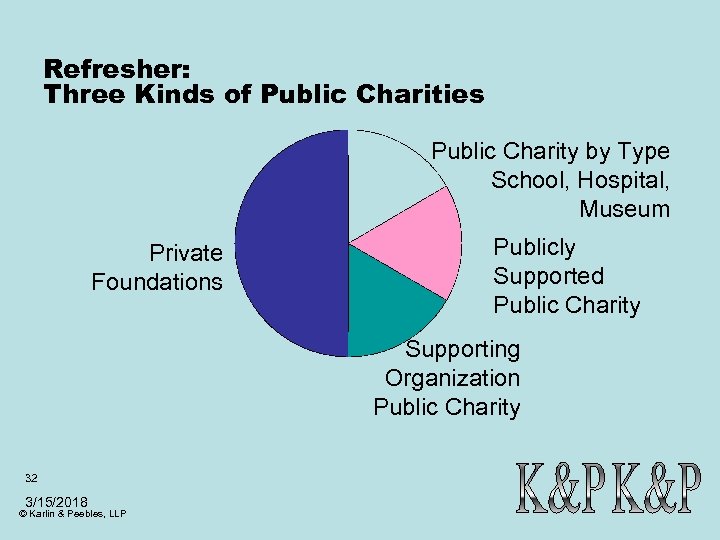
Refresher: Three Kinds of Public Charities Public Charity by Type School, Hospital, Museum Private Foundations Publicly Supported Public Charity Supporting Organization Public Charity 32 3/15/2018 © Karlin & Peebles, LLP
Why PFs Prefer to Make Grants to Public Charities • The private foundation may usually count these grants as qualifying distributions • These grants are usually not taxable expenditures by the private foundation 33 3/15/2018 © Karlin & Peebles, LLP
How Do I Know if Grantee Is a Public Charity? • Domestic organization will have a letter from the IRS saying it is exempt under Section 501(c)(3) and “not a private foundation” • Foreign organization might, but usually won’t, so what can you do? 34 3/15/2018 © Karlin & Peebles, LLP
A Solution for PF/DAF Grants to Foreign Organizations • Regulations governing “qualifying distributions” and “taxable expenditures” specifically permit PF grantors to make “good faith determinations” and “reasonable judgments” that foreign organizations without IRS rulings are foreign public charity equivalents • Sponsoring charities, like PFs, must either use expenditure responsibility or (if possible) make an equivalency determination for grants from DAFs to organizations that are not domestic public charities 35 3/15/2018 © Karlin & Peebles, LLP
What Is a Good Faith Determination and a Reasonable Judgment? • Regulations don’t say much other than it can be based on an affidavit of the grantee organization or an opinion of counsel • Revenue Procedure 92 -94 provided some clarification 36 3/15/2018 © Karlin & Peebles, LLP
Revenue Procedure 92 -94 • Provides a safe harbor for PF grantmakers making good faith determinations and reasonable judgments • If a PF grantmaker follows procedures in Rev. Proc. 92 -94, its grant will be treated as though the grantee is a public charity 37 3/15/2018 © Karlin & Peebles, LLP
Affidavit • Sample in your materials – let’s look at it • Paragraphs 2 -9 are general Section 501(c)(3) requirements • Paragraph 11 is about whether the entity is a public charity equivalent • Financial schedules are only for grantees that hope to qualify for PC status by virtue of public support 38 3/15/2018 © Karlin & Peebles, LLP
New Development: Cash, Accrual, or Something Else? • In the past, PFs computed public support for potential foreign-equivalent grantees on cash basis only, regardless of their accounting system • Now, you should evaluate them using the same accounting method as they keep their books 39 3/15/2018 © Karlin & Peebles, LLP
New Development: 5 Years, Not 4 • In the past, for publicly supported charities, you got 4 years of financial data. If they passed the test, you could assume they were publicly supported for 2 years. • Now, you should get 5 years of data. If they pass the test, you can probably treat them as publicly supported for only one year. • No clarification from IRS yet 40 3/15/2018 © Karlin & Peebles, LLP
Governing Documents • Get them in English to fall in safe harbor • Read to make sure nothing contradicts affidavit • Sometimes grantees have trouble understanding what their governing documents are, as their country’s equivalent may not match ours precisely 41 3/15/2018 © Karlin & Peebles, LLP
Possible Problems - Legal • Grantor happens to know that grantee’s representations in affidavit are not entirely true • Governing documents call for shareholders who own the grantee, and who can benefit financially from its profits • Grantee’s dissolution clause suggests that noncharitable entities (or people) can receive its assets on dissolution 42 3/15/2018 © Karlin & Peebles, LLP
Common Problems - Practical • Language barriers (grantee difficulty understanding affidavit, need to translate governing documents) • Accounting differences • Problems filling out public support schedule, as public support test can be difficult even for U. S. folks! 43 3/15/2018 © Karlin & Peebles, LLP
Renewals: How Often? • Public support test: for now, renew each year to be safe • For others, no set period, but probably a good idea to do a renewal from time to time, perhaps every four years (no formal guidance from IRS, though) 44 3/15/2018 © Karlin & Peebles, LLP
Renewals: Another Affidavit? • Consider a shortened version of affidavit, confirming that there have been no material changes to anything covered by original affidavit or disclosing any changes that have occurred • If public charity equivalence is based on public support test, grantee must provide updated financial information 45 3/15/2018 © Karlin & Peebles, LLP
Expenditure Responsibility • Exercising expenditure responsibility is required if U. S. private foundation cannot make a "good faith determination" that the foreign organization is equivalent of U. S. public charity. 46 3/15/2018 © Karlin & Peebles, LLP
Expenditure Responsibility Expenditure responsibility is required if the foreign charity: • Can qualify as equivalent of U. S. IRC Section 501(c)(3) organization but cannot qualify as public charity and is therefore deemed to be private foundation. 47 3/15/2018 © Karlin & Peebles, LLP
Expenditure Responsibility • Cannot provide sufficient data on public support or is largely dependent on a single private source of funds; • Cannot provide sufficient documentation to support a reasonable judgment of public charity equivalency even though it appears to be a legitimate charity; 48 3/15/2018 © Karlin & Peebles, LLP
Expenditure Responsibility • Is not organized and operated exclusively for charitable purposes (i. e. , because it is a chamber of commerce, trade or professional association or labor union); • Operates in part to affect political campaigns or in substantial amount to lobby; or • Is a for-profit organization. 49 3/15/2018 © Karlin & Peebles, LLP
IRS Guideline If the U. S. private foundation determines early on that it clearly will not be able to make a good faith equivalency determination, it may skip this step and go directly to “expenditure responsibility” grant procedures (4/18/01 IRS General Information Letter). 50 3/15/2018 © Karlin & Peebles, LLP
Exercising Expenditure Responsibility Expenditure responsibility requires: • Pre-grant inquiry - Is proposed grantee able to fulfill the charitable purpose of the grant? 51 3/15/2018 © Karlin & Peebles, LLP
ER Grant Agreement • Written grant agreement - Specifies the charitable purposes of the grant and commits the grantee to: Repay any funds not used for the grant's purpose Submit annual reports Maintain books and records reasonably available to the grantor 52 3/15/2018 © Karlin & Peebles, LLP
ER Grant Agreement • Refrain from using any of the funds for lobbying, direct or indirect influence on any public election or voter registration drive, or any activity for a noncharitable purpose, to the extent such use of the funds would be taxable to a private foundation. 53 3/15/2018 © Karlin & Peebles, LLP
ER Grant Agreement • The agreement will typically also prohibit the grantee from re-granting the funds to other organizations or individuals since that triggers additional complicated rules. • It is harder to ensure that funds are not diverted if they have been re-granted by one foreign organization to another. 54 3/15/2018 © Karlin & Peebles, LLP
ER Grantee Reports • Grantee reports on the status of the grant, including description of how funds have been used, compliance with terms of the grant agreement, and grantee's progress in achieving the purposes for which the grant was made. These should be submitted annually, starting at the end of the grantee's accounting period in which the grant was made and for each accounting period until the grant has been fully expended. 55 3/15/2018 © Karlin & Peebles, LLP
IRS Notification • The U. S. privation foundation must notify the IRS that an expenditure responsibility grant has been made. This data is provided as an answer to a standard Form 990 -PF tax return inquiry as to whether any such grants have been made. 56 3/15/2018 © Karlin & Peebles, LLP
Grants to Entities Not Equivalent to U. S. Charities • If the foreign grantee is not the equivalent of a private foundation (i. e. , it is for profit, a trade union, etc. ), it must maintain all grant monies in a separate fund dedicated to one or more charitable purposes. 57 3/15/2018 © Karlin & Peebles, LLP
Government Exception • Grants to foreign governments or units thereof are considered to be grants to public charity equivalents as long as the grant must be used for charitable, not public, purposes. • No effort at a good faith equivalency determination is required. 58 3/15/2018 © Karlin & Peebles, LLP
When to use which? • If grantee can’t pass equivalency analysis, ER is your only option • ER is also useful for rapid or one-time grant • Equivalency is useful for multiple grants, long-term relationships, grants paid in installments over time • Equivalency is a better choice for core support or general operating support • See article in your materials for details 59 3/15/2018 © Karlin & Peebles, LLP
The "Out of Corpus Rule" • Any grant from one private foundation to another must be spent by the grantee within 12 months after the close of the taxable year in which it received the funds. • One private foundation cannot make grants to endow another. Therefore, the grantee must take the grant funds "out of corpus" and spend them within the required amount of time. 60 3/15/2018 © Karlin & Peebles, LLP
The grantee foundation must also provide records to the grantor foundation showing that: • The grantee met its minimum payout requirement before it • received the grant, and The grantee satisfied its minimum payout requirement for the year in which the grant was received in addition to spending grant. 61 3/15/2018 © Karlin & Peebles, LLP
Out of Corpus • Many smaller charities spend all of their funds every year, so the rules does not come into play. • Most foreign charities are unfamiliar with the minimum payout rules and do not maintain records necessary to compute it. Thus, satisfying the "out of corpus" requirement will be impossible. In such a case, the grantor may adopt one of the following approaches: 62 3/15/2018 © Karlin & Peebles, LLP
Not a Qualifying Distribution • If the U. S. private foundation's actual charitable distributions for other grants far exceed its minimum payout requirement, it can exercise expenditure responsibility over the grant to the foreign private foundation equivalent and simply not count the grant in meeting the minimum payout requirement. This allows it to avoid the "out of corpus" rule entirely with respect to that grant. 63 3/15/2018 © Karlin & Peebles, LLP
• If the grant to the foreign charity is earmarked for the purchase of capital equipment, and if the purchases are completed within 12 months after close of the taxable year in which the foreign charity receives funds, the "out of corpus" rule will be satisfied. 64 3/15/2018 © Karlin & Peebles, LLP
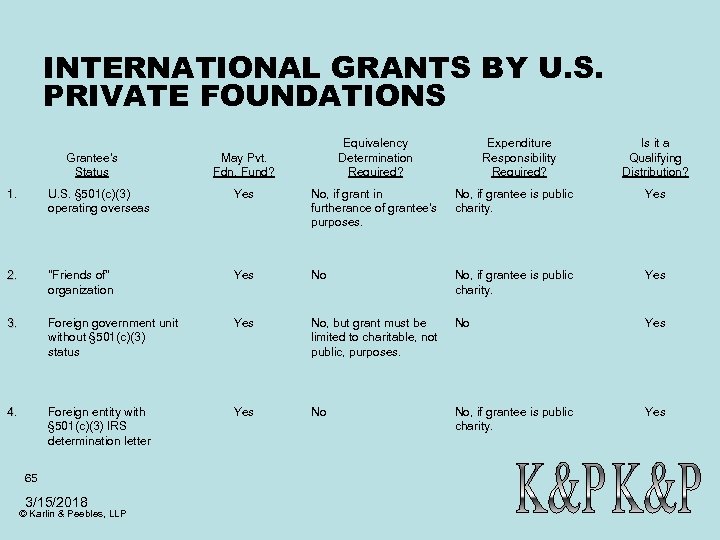
INTERNATIONAL GRANTS BY U. S. PRIVATE FOUNDATIONS Grantee's Status Equivalency Determination Required? May Pvt. Fdn. Fund? Expenditure Responsibility Required? Is it a Qualifying Distribution? 1. U. S. § 501(c)(3) operating overseas Yes No, if grant in furtherance of grantee's purposes. No, if grantee is public charity. Yes 2. "Friends of" organization Yes No No, if grantee is public charity. Yes 3. Foreign government unit without § 501(c)(3) status Yes No, but grant must be limited to charitable, not public, purposes. No Yes 4. Foreign entity with § 501(c)(3) IRS determination letter Yes No No, if grantee is public charity. Yes 65 3/15/2018 © Karlin & Peebles, LLP
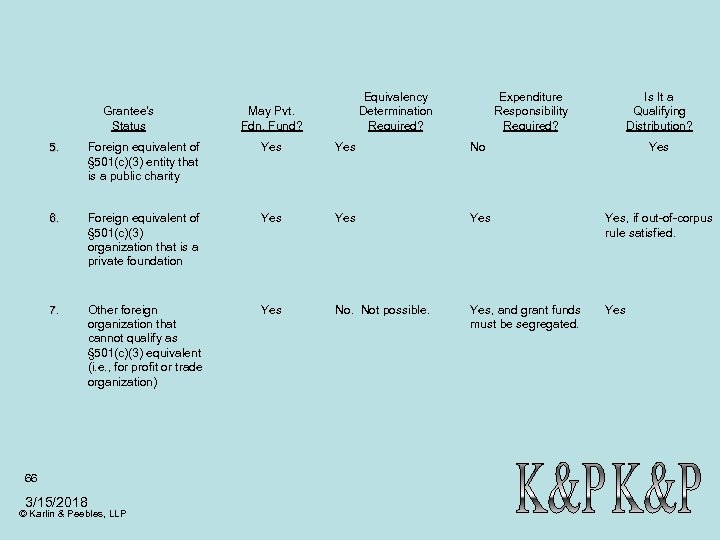
Grantee's Status Equivalency Determination Required? May Pvt. Fdn. Fund? Expenditure Responsibility Required? Is It a Qualifying Distribution? 5. Foreign equivalent of § 501(c)(3) entity that is a public charity Yes No Yes 6. Foreign equivalent of § 501(c)(3) organization that is a private foundation Yes Yes, if out-of-corpus rule satisfied. 7. Other foreign organization that cannot qualify as § 501(c)(3) equivalent (i. e. , for profit or trade organization) Yes No. Not possible. Yes, and grant funds must be segregated. Yes 66 3/15/2018 © Karlin & Peebles, LLP
The Institutional Grantmaker’s Tool Box: Specialized Tools for Foreign Grants 67 3/15/2018 © Karlin & Peebles, LLP
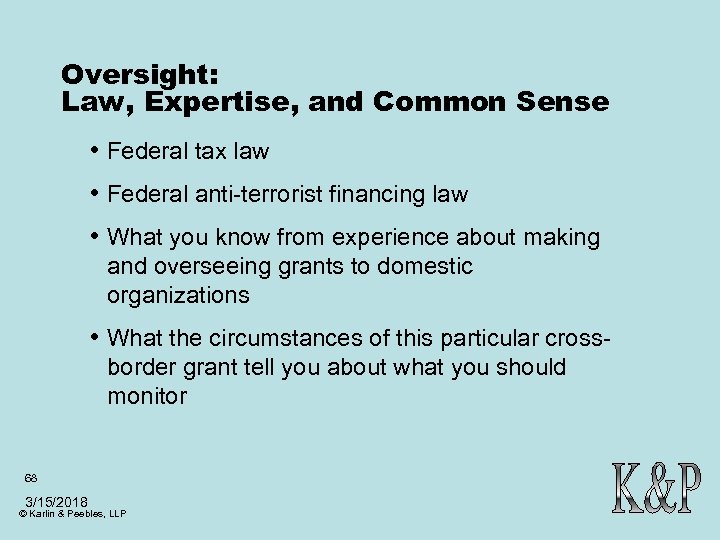
Oversight: Law, Expertise, and Common Sense • Federal tax law • Federal anti-terrorist financing law • What you know from experience about making and overseeing grants to domestic organizations • What the circumstances of this particular crossborder grant tell you about what you should monitor 68 3/15/2018 © Karlin & Peebles, LLP
Federal Tax Law • Expenditure responsibility grant: law requires PF to obtain written reports from grantee (annual and final summary report) • Public charity equivalency grant: no express legal requirement; if you would ordinarily require a report from a domestic public charity grantee for a grant of this size, in similar circumstances, you should require it from the foreign equivalent • If you don’t get a report, how will you know what the grantee did (or claims to have done) with your grant funds? 69 3/15/2018 © Karlin & Peebles, LLP
Following Up: ER Grants • Review grantee reports and follow up with questions if you see anything indicating possible misuse or diversion • If grantee does not submit reports on time, that’s a breach of the grant agreement; PF should pursue reports and remind grantee that no further funds will be disbursed until the report is provided • Consider using local representatives to pursue missing reports 70 3/15/2018 © Karlin & Peebles, LLP
Following Up: Generally • Problems in getting reports: language differences, technology access, time zone differences, insufficient staff to provide all the information that the grantmaker requires • Site visits? • Engage local help? • How much money and time must grantmakers invest in finding out whethere’s a problem, assessing the extent of the problem, and – if necessary – retrieving misspent funds? 71 3/15/2018 © Karlin & Peebles, LLP
Anti-terrorism Legal Rules • It is against federal law to provide material financial support to Listed Persons or those associated with Listed Persons • A Listed Person is any individual or entity whose name appears on the Specially Designated Nationals list maintained by Treasury’s Office of Foreign Asset Control (“SDN” and “OFAC”) • What does “associated with” mean in this context? • These rules apply generally, not only to charities 72 3/15/2018 © Karlin & Peebles, LLP
Making a list, checking it twice… • The SDN list is long, searchable online in various formats, and of limited practical utility for charities • Spelling and transliteration errors are inescapable where Listed Persons’ names originate in many different languages and alphabets • How do you handle false positives? • Who do you check – grantee organizations, grantee leadership, subgrantees, subcontractors, recipients of direct aid? 73 3/15/2018 © Karlin & Peebles, LLP
Treasury Tries to Help • In 2002, Treasury released “Voluntary Best Practice Guidelines” in an effort to help charities avoid inadvertently providing support to terrorists • Initial version of Guidelines was not perceived as helpful • Representatives of charitable sector submitted written comments and met with Treasury • Treasury has rewritten Guidelines several times; consensus among internationally active charities is they are still of limited use; group continues to work with Treasury to improve them or get them withdrawn 74 3/15/2018 © Karlin & Peebles, LLP
Treasury tries to help Treasury may update the Guidelines yet again, so instead of giving you a hard copy of the current version, here is a link that should always get you to the latest version, with additional educational materials and links to the OFAC SDN List: www. treasury. gov/offices/enforcement/keyissues/protecting/index. shtml 75 3/15/2018 © Karlin & Peebles, LLP
Charitable Sector’s “Principles” In your materials: “Principles of International Philanthropy” developed by the Treasury Guidelines Working Group coordinated by the Council on Foundations 76 3/15/2018 © Karlin & Peebles, LLP
Practical Suggestions • Treasury has endorsed a risk assessment approach • Assess the risk that charitable assets will be diverted away from their intended purpose • Manage the risk by developing and implementing procedures to reduce the possibility of diversion of assets • Don’t let risk scare you – everything contains risk (just try crossing a busy street) – the key is to assess and manage the risk 77 3/15/2018 © Karlin & Peebles, LLP
More Practical Suggestions • Always use a written grant agreement; balance grantee-friendly plain language with technical provisions that protect grantmaker under U. S. law • Get reports from your grantees • Follow up if you see signs of trouble • Know your grantee • Consider checking the SDN Lists when considering a grant in a region where corruption and violence are present • Consider partnering with other funders with experience in the region 78 3/15/2018 © Karlin & Peebles, LLP
Donations of Inventory • A US corporation may claim a deduction for • • charitable gifts of inventory to be used abroad The donation must be made to a US charity in corporate form Contributions of inventory generally may be deducted only at cost basis, not market value 79 3/15/2018 © Karlin & Peebles, LLP
Donations of Inventory • Example: Gift of medicine to US disaster relief • • organization for aid to the ill in Ethiopia If donor US corporation is satisfied with deduction at basis, there are fewer restrictions. However, certain gifts of inventory may be deducted at more than cost 80 3/15/2018 © Karlin & Peebles, LLP
Inventory: Deductions Above Cost • The additional deduction (above cost) equals the lesser of (i) ½ the difference between cost and market value and (ii) twice the cost 81 3/15/2018 © Karlin & Peebles, LLP
Inventory: Deductions Above Cost • Example: US corporation makes pants at $25 cost • with market value of $85. The difference between cost ($25) and market value ($85) is $60, which when added to the cost ($25) suggests a deduction of $85. Since $85 is more than twice the cost, the corporation may deduct only twice the cost, or $50 ($25 x 2) 82 3/15/2018 © Karlin & Peebles, LLP
Donations of Inventory • To deduct more than cost for gifts of inventory to be used abroad: Grantee must be 501(c)(3) organized in the US in corporate form Grantee must be a public charity or private operating foundation Donated inventory must be used by grantee solely for care of the ill, needy or infants 83 3/15/2018 © Karlin & Peebles, LLP
Inventory Donor corporation must not receive money, other property or services in exchange for donated inventory Donor must receive written statement from grantee that use and disposition of inventory will comply with these rules 84 3/15/2018 © Karlin & Peebles, LLP
What Qualifies? • Clothing, medicine and blankets used directly in the • care of the ill, needy or infants qualify Computer or typewriter used in the administrative office of an orphanage or nursing home do not qualify for the higher deduction 85 3/15/2018 © Karlin & Peebles, LLP
Inventory Donations: Obstacles • Export controls may prohibit or restrict export of • • certain technological or other products Duties and customs fees may apply to in-kind crossborder donations If charitable deduction not available, corporation may deduct donation as business expense, such as public relations or marketing 86 3/15/2018 © Karlin & Peebles, LLP
Gifts of Inventory Through Non-US Subsidiaries • Multinational US corporations with foreign country • subsidiaries may make grants of cash or inventory to non-US charities The non-US subsidiary can make the donation and take advantage of whatever tax benefits are available in the country in which it operates 87 3/15/2018 © Karlin & Peebles, LLP
Foreign Bank Account Reports • US citizen or resident directors with signature • authority over foreign financial accounts of a US or foreign nonprofit must file IRS Form TD F 90 -22. 1 (Foreign Bank Account Report or “FBAR”) US nonprofits had to file, by 10/15/09, FBARs to report interests in any foreign financial account for 2003 -2008 88 3/15/2018 © Karlin & Peebles, LLP
FBAR Reporting • The FBARs are required only if aggregate value of foreign accounts exceeds $10, 000 at any time in the year at issue • Serious penalties apply to failure to file FBAR, whether willful or inadvertent 89 3/15/2018 © Karlin & Peebles, LLP
FBAR Penalties • If failure to file is inadvertent, maximum penalty is • $10, 000 per account per year If failure is willful, the nonprofit may be liable for as much as the greater of (i) 50% of maximum balance per unreported account for the year and (ii) $100, 000 AND additional penalties of up to $250, 000 and/or 5 years in prison 90 3/15/2018 © Karlin & Peebles, LLP
FBAR Reporting • FBARs due by 6/30 of the next year • US persons who are directors of US or foreign nonprofits and have signature authority over the nonprofit’s foreign bank/brokerage accounts must file FBAR with Treasury Dept and also disclose the account on the nonprofit’s 990 or 990 -PF and also on their personal US returns (Form 1040, Schedule B) 91 3/15/2018 © Karlin & Peebles, LLP
FBAR Reporting • US nonprofits which wholly own foreign subsidiaries with foreign financial or investment accounts must also file FBARs. 92 3/15/2018 © Karlin & Peebles, LLP
Section 1441 withholding Charitable grants from Section 501(c)(3) funders to foreign recipients are not generally subject to U. S. withholding tax obligations… UNLESS GRANTEE USES THE FUNDS FOR ACTIVITIES CONDUCTED IN THE U. S. , INCLUDING TRAVEL TO THE U. S. If the grant will be used for travel to the U. S. , or otherwise within the U. S. , the grantmaker has to withhold and pay over 30% of the amount! 93 3/15/2018 © Karlin & Peebles, LLP

You didn’t expect this roadblock! 94 3/15/2018 © Karlin & Peebles, LLP
What to do about Section 1441? • Add a clause to your grant agreement requiring the grantee to use the funds only for activities conducted entirely outside the U. S. and not to apply any of the funds for travel to the U. S. • If grantee must travel here to accomplish your charitable purposes, consider bifurcating your grant so that you are only required to withhold on that portion of the overall budget that pays for travel to, or work within, the U. S. 95 3/15/2018 © Karlin & Peebles, LLP

For more information… Jane Peebles jpeebles@karlinpeebles. com Karlin & Peebles, LLP 5900 Wilshire Blvd. , Suite 500 Los Angeles, CA 90036 (310) 274 -5245 www. karlinpeebles. com 96 3/15/2018 © Karlin & Peebles, LLP
Скачать презентацию International Giving Opportunities April 2016 Jane Peebles Karlin
a48dc3242e89e15e7e4604452e6cb894.ppt