 Скачать презентацию International Fund for Cultural Diversity Abidjan Côte d Ivoire
406d11369c0b96d93780f51b247cbe4b.ppt
- Количество слайдов: 15



International Fund for Cultural Diversity Abidjan, Côte d'Ivoire 9 June 2012 2005 Convention on the Protection and Promotion of the Diversity of Cultural Expressions UNESCO
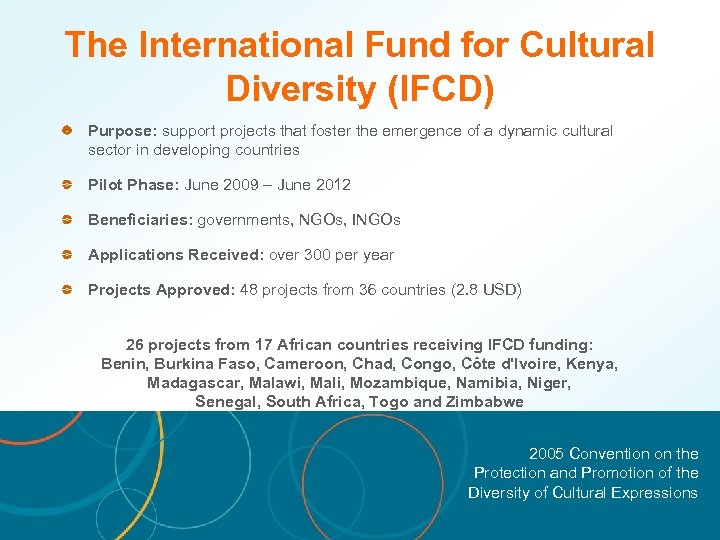
The International Fund for Cultural Diversity (IFCD) Purpose: support projects that foster the emergence of a dynamic cultural sector in developing countries Pilot Phase: June 2009 – June 2012 Beneficiaries: governments, NGOs, INGOs Applications Received: over 300 per year Projects Approved: 48 projects from 36 countries (2. 8 USD) 26 projects from 17 African countries receiving IFCD funding: Benin, Burkina Faso, Cameroon, Chad, Congo, Côte d'Ivoire, Kenya, Madagascar, Malawi, Mali, Mozambique, Namibia, Niger, Senegal, South Africa, Togo and Zimbabwe 2005 Convention on the Protection and Promotion of the Diversity of Cultural Expressions
Programme/Project Proposals Cultural policies Cultural industries Max. USD 100, 000 2005 Convention on the Protection and Promotion of the Diversity of Cultural Expressions
Preparatory Assistance Requests Public authorities only Enables programme/project elaboration Max. USD 10, 000 2005 Convention on the Protection and Promotion of the Diversity of Cultural Expressions
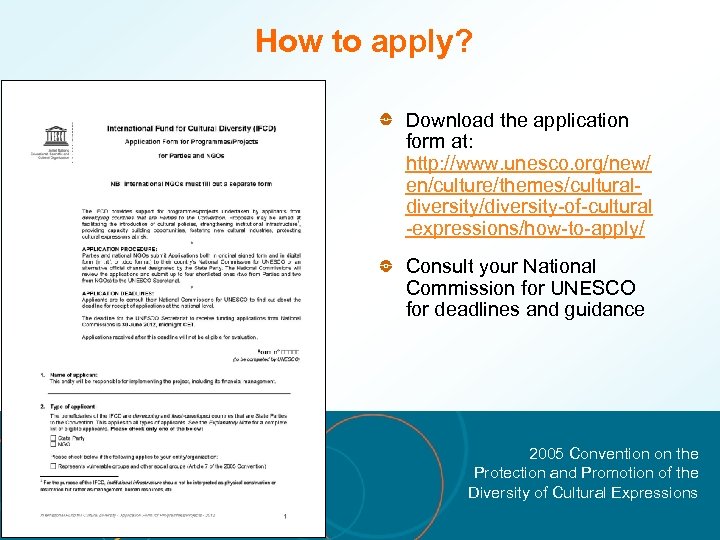
How to apply? Download the application form at: http: //www. unesco. org/new/ en/culture/themes/culturaldiversity/diversity-of-cultural -expressions/how-to-apply/ Consult your National Commission for UNESCO for deadlines and guidance 2005 Convention on the Protection and Promotion of the Diversity of Cultural Expressions
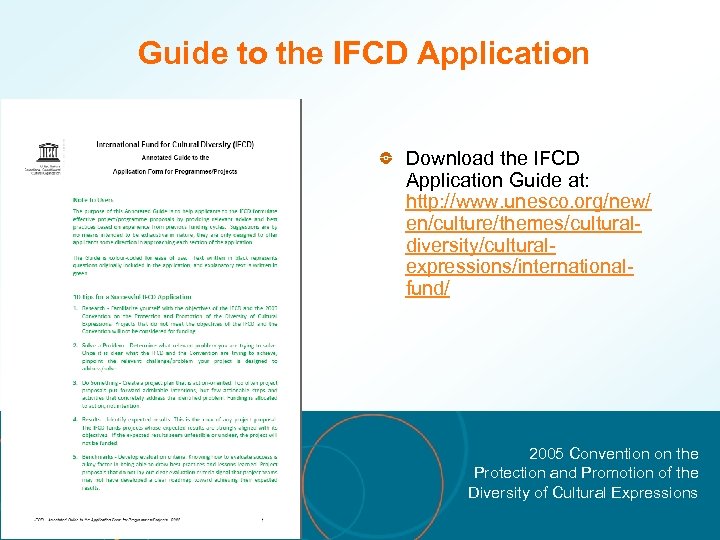
Guide to the IFCD Application Download the IFCD Application Guide at: http: //www. unesco. org/new/ en/culture/themes/culturaldiversity/culturalexpressions/internationalfund/ 2005 Convention on the Protection and Promotion of the Diversity of Cultural Expressions
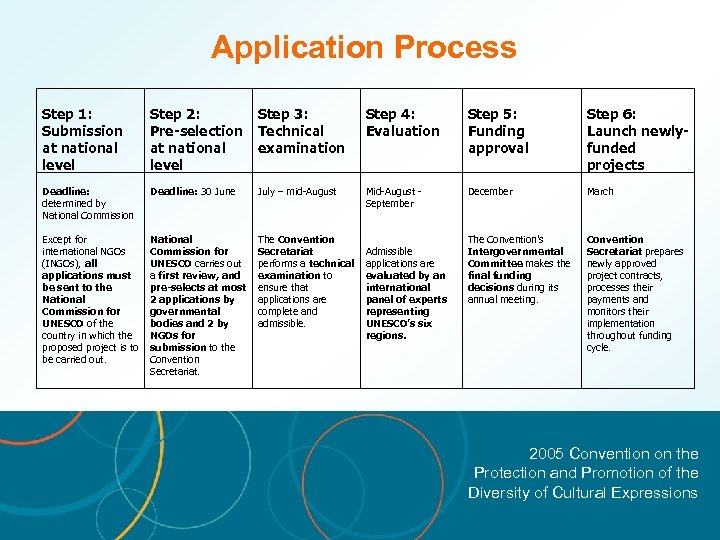
Application Process Step 1: Submission at national level Step 2: Pre-selection at national level Step 3: Technical examination Step 4: Evaluation Step 5: Funding approval Step 6: Launch newlyfunded projects Deadline: determined by National Commission Deadline: 30 June July – mid-August Mid-August September December March Except for international NGOs (INGOs), all applications must be sent to the National Commission for UNESCO of the country in which the proposed project is to be carried out. National Commission for UNESCO carries out a first review, and pre-selects at most 2 applications by governmental bodies and 2 by NGOs for submission to the Convention Secretariat. The Convention Secretariat performs a technical examination to ensure that applications are complete and admissible. The Convention’s Intergovernmental Committee makes the final funding decisions during its annual meeting. Convention Secretariat prepares newly approved project contracts, processes their payments and monitors their implementation throughout funding cycle. Admissible applications are evaluated by an international panel of experts representing UNESCO’s six regions. 2005 Convention on the Protection and Promotion of the Diversity of Cultural Expressions
National Commissions play a crucial role… …by ensuring that projects: meet the country’s needs and priorities are relevant and feasible have been subject to consultation among stakeholders 2005 Convention on the Protection and Promotion of the Diversity of Cultural Expressions
IFCD-funded Programmes / Projects 2005 Convention on the Protection and Promotion of the Diversity of Cultural Expressions
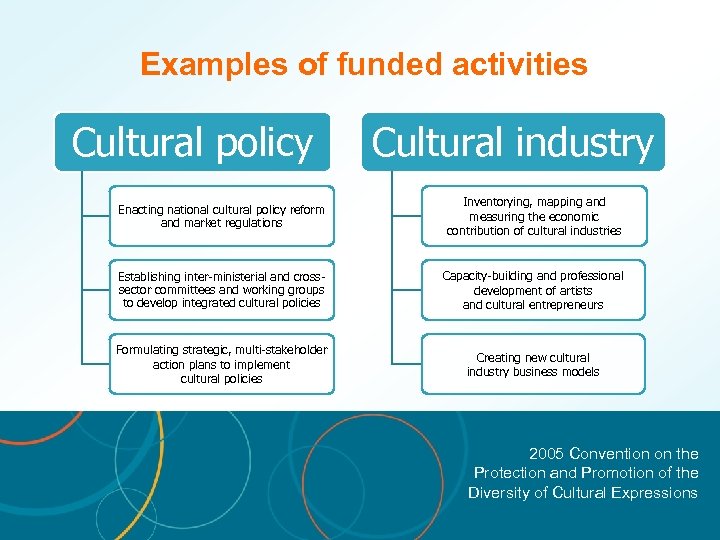
Examples of funded activities Cultural policy Cultural industry Enacting national cultural policy reform and market regulations Inventorying, mapping and measuring the economic contribution of cultural industries Establishing inter-ministerial and crosssector committees and working groups to develop integrated cultural policies Capacity-building and professional development of artists and cultural entrepreneurs Formulating strategic, multi-stakeholder action plans to implement cultural policies Creating new cultural industry business models 2005 Convention on the Protection and Promotion of the Diversity of Cultural Expressions
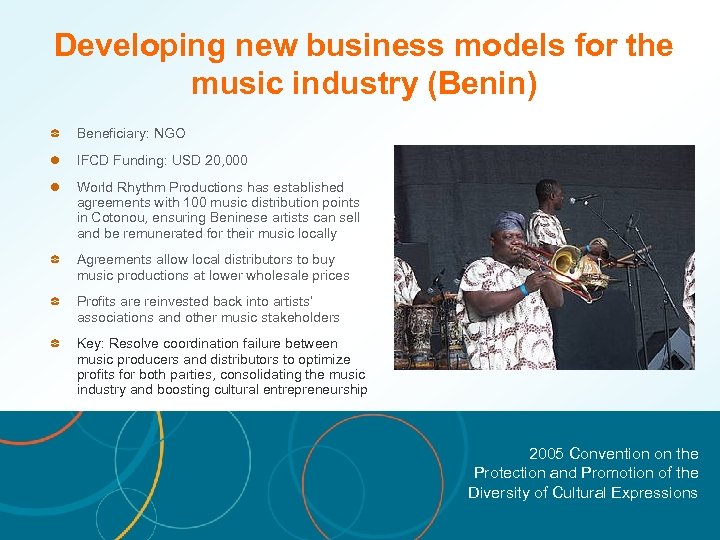
Developing new business models for the music industry (Benin) Beneficiary: NGO IFCD Funding: USD 20, 000 World Rhythm Productions has established agreements with 100 music distribution points in Cotonou, ensuring Beninese artists can sell and be remunerated for their music locally Agreements allow local distributors to buy music productions at lower wholesale prices Profits are reinvested back into artists’ associations and other music stakeholders Key: Resolve coordination failure between music producers and distributors to optimize profits for both parties, consolidating the music industry and boosting cultural entrepreneurship 2005 Convention on the Protection and Promotion of the Diversity of Cultural Expressions
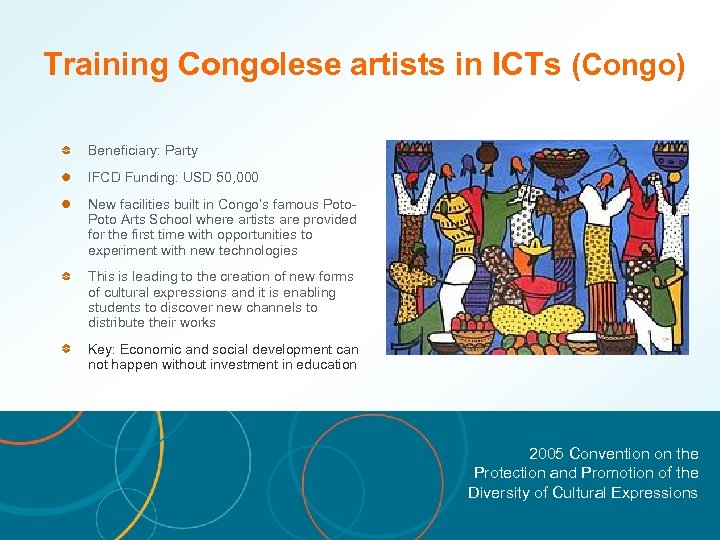
Training Congolese artists in ICTs (Congo) Beneficiary: Party IFCD Funding: USD 50, 000 New facilities built in Congo’s famous Poto Arts School where artists are provided for the first time with opportunities to experiment with new technologies This is leading to the creation of new forms of cultural expressions and it is enabling students to discover new channels to distribute their works Key: Economic and social development can not happen without investment in education 2005 Convention on the Protection and Promotion of the Diversity of Cultural Expressions
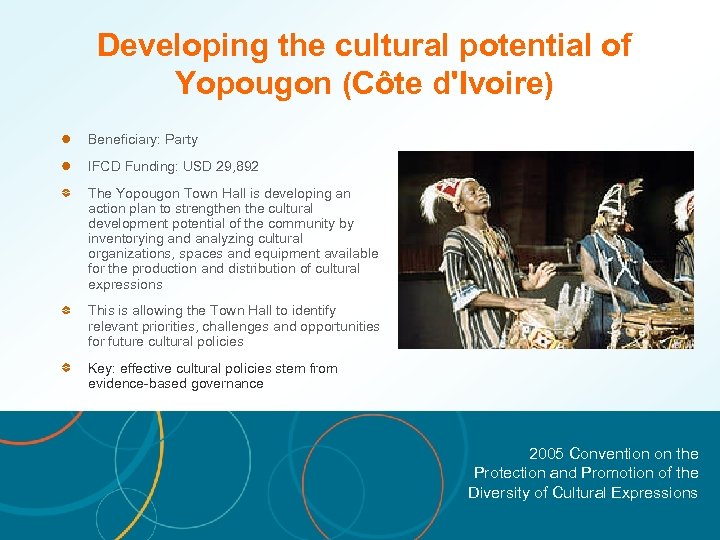
Developing the cultural potential of Yopougon (Côte d'Ivoire) Beneficiary: Party IFCD Funding: USD 29, 892 The Yopougon Town Hall is developing an action plan to strengthen the cultural development potential of the community by inventorying and analyzing cultural organizations, spaces and equipment available for the production and distribution of cultural expressions This is allowing the Town Hall to identify relevant priorities, challenges and opportunities for future cultural policies Key: effective cultural policies stem from evidence-based governance 2005 Convention on the Protection and Promotion of the Diversity of Cultural Expressions
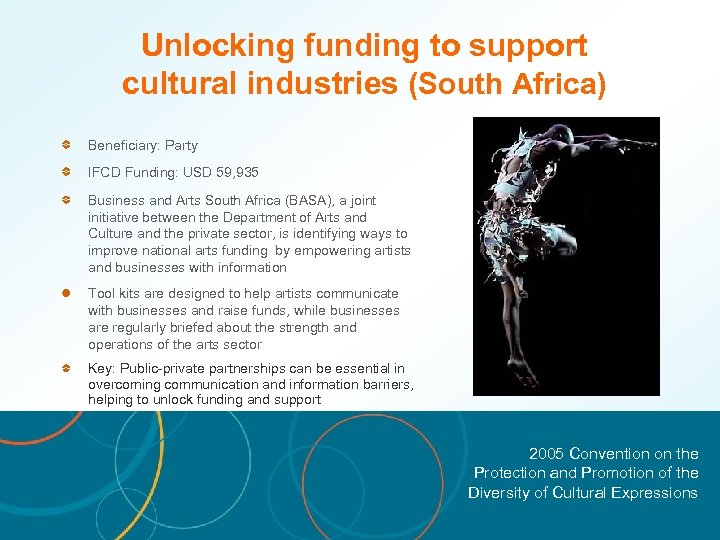
Unlocking funding to support cultural industries (South Africa) Beneficiary: Party IFCD Funding: USD 59, 935 Business and Arts South Africa (BASA), a joint initiative between the Department of Arts and Culture and the private sector, is identifying ways to improve national arts funding by empowering artists and businesses with information Tool kits are designed to help artists communicate with businesses and raise funds, while businesses are regularly briefed about the strength and operations of the arts sector Key: Public-private partnerships can be essential in overcoming communication and information barriers, helping to unlock funding and support 2005 Convention on the Protection and Promotion of the Diversity of Cultural Expressions
For further information, please consult: www. unesco. org/culture/en/diversity/convention ifcd. convention 2005@unesco. org 2005 Convention on the Protection and Promotion of the Diversity of Cultural Expressions
Скачать презентацию International Fund for Cultural Diversity Abidjan Côte d Ivoire
406d11369c0b96d93780f51b247cbe4b.ppt