


 Скачать презентацию International Fixed Income Topic IIA Introduction Readings
583ad4e52231c87ad97226335d92c677.ppt
- Количество слайдов: 26
 International Fixed Income Topic IIA: Introduction
 Readings • Europe can’t handle the Euro, Martin Feldstein, WSJ, 2/8/00. • One for the money, Paul Krugman, NYT, 1/30/00. • Quest, European Commission, 8/31/99. (This is a layperson’s view of the Euro from the EC’s perspective. )
 International Monetary System • What is an exchange rate? • The Euro • Fixed vs. floating regimes
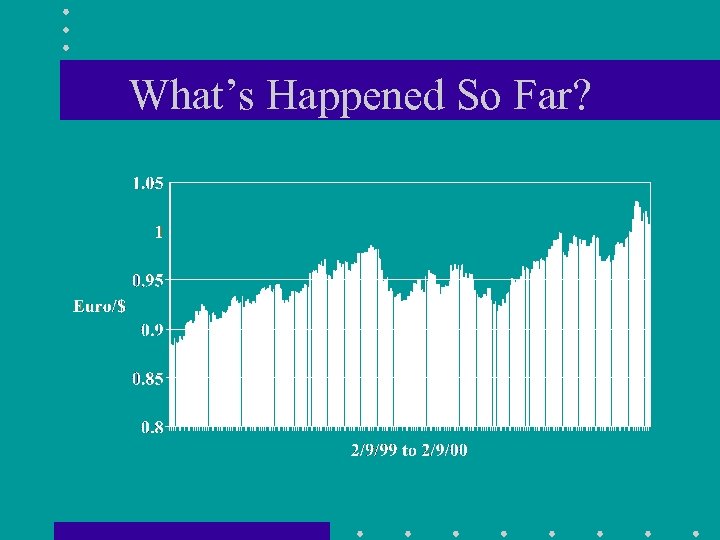
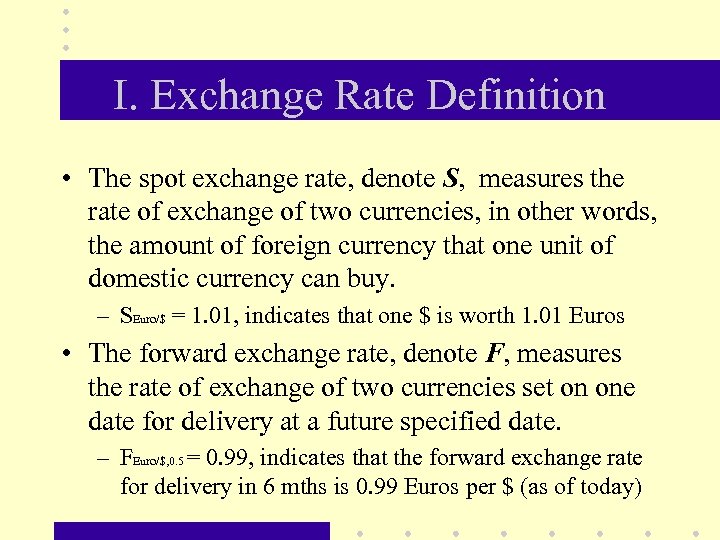 I. Exchange Rate Definition • The spot exchange rate, denote S, measures the rate of exchange of two currencies, in other words, the amount of foreign currency that one unit of domestic currency can buy. – SEuro/$ = 1. 01, indicates that one $ is worth 1. 01 Euros • The forward exchange rate, denote F, measures the rate of exchange of two currencies set on one date for delivery at a future specified date. – FEuro/$, 0. 5 = 0. 99, indicates that the forward exchange rate for delivery in 6 mths is 0. 99 Euros per $ (as of today)
 What Determines Exchange Rates? • Purchasing power of the currency. • The balance of payments. • News about future economic prospects, i. e. , expectations about real rates. (Sometimes called the Asset Approach).
 II. The Euro • The Past – Early history – Maastricht – The 92 -93 turmoil – The run-up to unification • The future – The impact on European financial markets: the bright future – The impact on European financial markets: the stumbling blocks – The Euro vs. The USD: the numbers – Can the Euro challenge the USD? – The Euro: Strong or weak?
 The Early History • • The Bretton Woods agreement The European system: the snake The EMS emerges The beginning: 1987 -88 – France (Balladur -- the french finance minister): “the attempt to tie XRs together is producing abnormal results” by virtue of German dominance (of the ECU and the European economy) – Germany (Genscher -- the German foreign minister): “a European currency area and a ECB could represent a viable advance” – Preceded it probably was a “bargain” between Kohl and Mitterrand
 Maastricht • The Delors Committee (President of the European Commission) drafts a three-stage plan – Effort to coordinate monetary policy – A move to a no-realignment phase – A single currency • Stage 1 took affect in conjunction with the abolishment of capital controls on 7/1/90 • Followed was the Maastricht treaty – The UK (Major) opted out, concerned with the “political unification” add-ins, with an “opt in” option – Similar concession was given to Denmark (after the 6/92 rejection of Maastricht in a referendum)
 The Test • The 92 -93 turmoil presented the first test: – The GBP and ITL crashed out of the EMS – The Punt, Escudo and Peseta devalued as well – The run on the FF in 7/93, and the expansion of the band (15%) • 2 nd stage union began 1/1/94. • In Madrid (12/95) the date for a single currency was set (to 1/1/99)
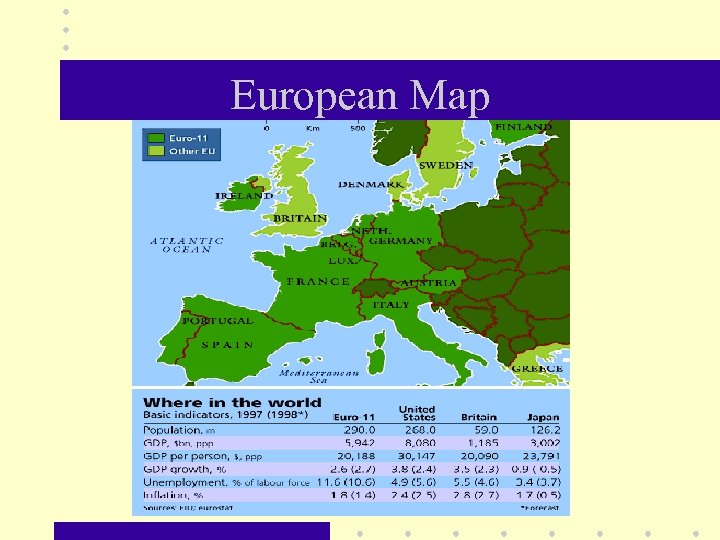
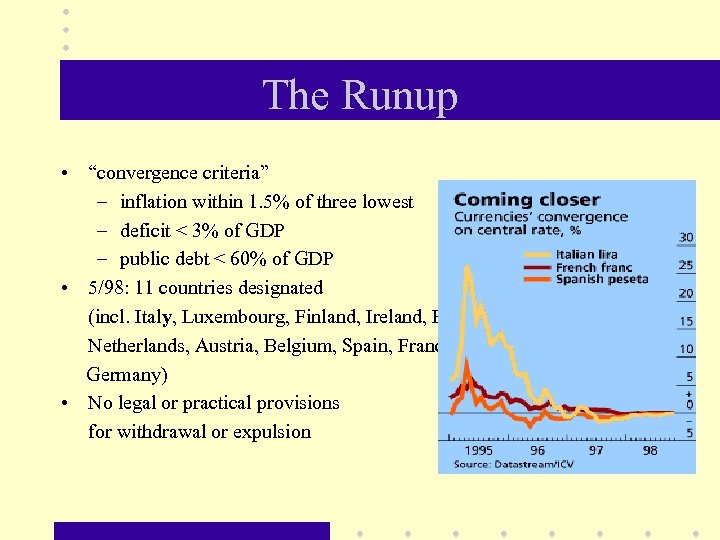 The Runup • “convergence criteria” – inflation within 1. 5% of three lowest – deficit < 3% of GDP – public debt < 60% of GDP • 5/98: 11 countries designated (incl. Italy, Luxembourg, Finland, Ireland, Portugal, Netherlands, Austria, Belgium, Spain, France, Germany) • No legal or practical provisions for withdrawal or expulsion
 European Map
![Europe vs. US Euro US • • GDP 97[$Tril] Int’l trade [%] Cross border](https://present5.com/presentation/583ad4e52231c87ad97226335d92c677/image-12.jpg "Europe vs. US Euro US • • GDP 97[$Tril] Int’l trade [%] Cross border") Europe vs. US Euro US • • GDP 97[$Tril] Int’l trade [%] Cross border bank lending [%] Current account surplus/deficit 98 [$Bil] • Inflation 98 [%] • Reserve currency [%] 6. 5 l 19 18 8. 1 17 45 110 0. 9 20 -250 1. 7 57
Europe vs. US Euro US • • GDP 97[$Tril] Int’l trade [%] Cross border bank lending [%] Current account surplus/deficit 98 [$Bil] • Inflation 98 [%] • Reserve currency [%] 6. 5 l 19 18 8. 1 17 45 110 0. 9 20 -250 1. 7 57
 What’s Happened So Far?
 The Euro: Advantages • More liquidity in markets will generate lower transaction costs, in line with US$. • ECB will conduct a Bundesbank-light tight policy, coupled with a fiscal policy determined by membership rules (e. g. , deficit < 3%). • Central banks will shift into Euro reserves, in proportion to the block’s economic size, providing a strong and stable currency.
 The Euro: Disadvantages • What happens when growth rates across countries diverge? – Uniform monetary policy across 11 countries, but no “convergence” of fiscal policy (e. g. , net wealth transfers? ). – Inflexible wage and labor mobility due to cultural, language and institutional (i. e. , regulatory) differences.
 III. Fixed Vs. Floating • Under a fixed (i. e. , pegged) exchange rate system, an exchange rate between two countries is allowed to vary within narrow bands. – If “economies” diverge, maintained via central bank intervention, exchange controls, or, in the extreme, by revoking convertibility. • Under a floating exchange rate system, the exchange rate is free to adjust to changing market conditions. • Under hybrid systems (e. g. , target zones, managed floating, …), exchange rates move within bands, which periodically move to reflect market conditions (e. g. , EMS).
 Exchange Rate Regimes Source: IMF publications, 1997
 Government Intervention • Indirect intervention – Short term: interest rates, money supply, . . . – Longer term: Gov’t spending, real rates, inflation, . . . • Direct intervention – Exchange control, trading and stated goals • Reasons given for intervention – To stabilize a temporary “disequilibrium” which may cause short run panics (e. g. , recent USD/JPY experience) – Note that stabilizing intervention should result in central bank profits – Nevertheless, this is NOT the record
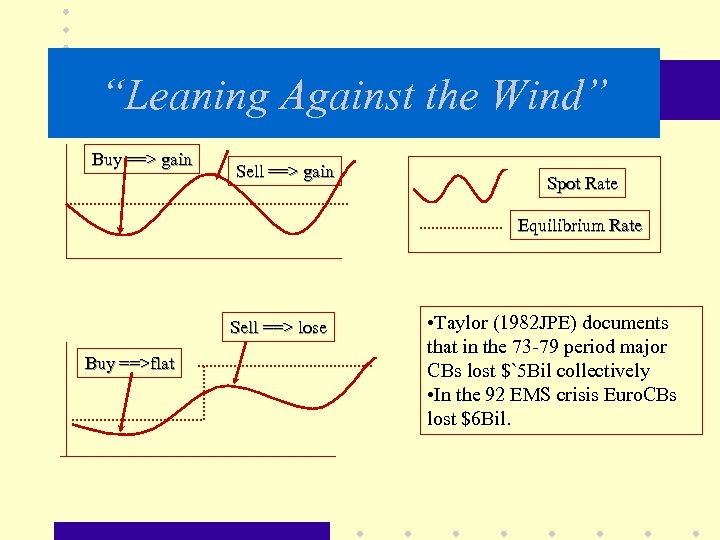 “Leaning Against the Wind” Buy ==> gain Sell ==> gain Spot Rate Equilibrium Rate Sell ==> lose Buy ==>flat • Taylor (1982 JPE) documents that in the 73 -79 period major CBs lost $`5 Bil collectively • In the 92 EMS crisis Euro. CBs lost $6 Bil.
 Intervention and the IMF: Then and Now • Formed as part of the Bretton Woods agreement – Gold peg ==> intervention – “…to promote exchange stability … and to avoid competitive exchange depreciation…” – The conditionality principle: that “financing and adjustment must go together”, generated much controversy through the years (due to forced monetary and fiscal contractionary measures) • Nowadays IMF is functioning in much the same way. . .
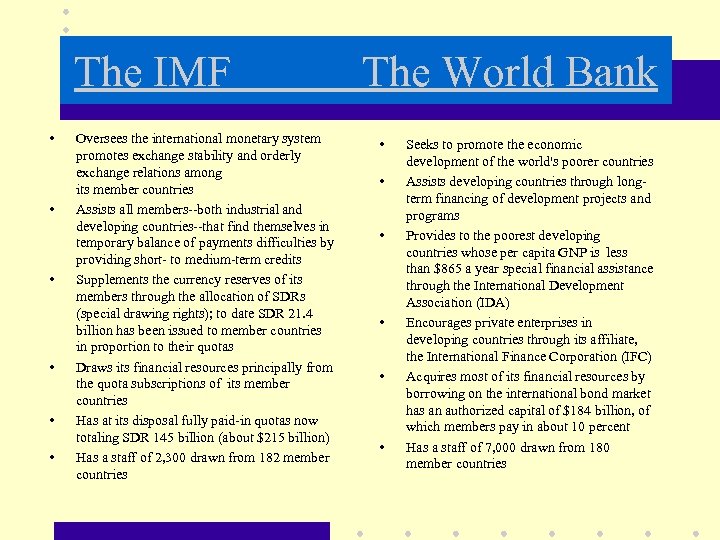 The IMF • • • Oversees the international monetary system promotes exchange stability and orderly exchange relations among its member countries Assists all members--both industrial and developing countries--that find themselves in temporary balance of payments difficulties by providing short- to medium-term credits Supplements the currency reserves of its members through the allocation of SDRs (special drawing rights); to date SDR 21. 4 billion has been issued to member countries in proportion to their quotas Draws its financial resources principally from the quota subscriptions of its member countries Has at its disposal fully paid-in quotas now totaling SDR 145 billion (about $215 billion) Has a staff of 2, 300 drawn from 182 member countries The World Bank • • • Seeks to promote the economic development of the world's poorer countries Assists developing countries through longterm financing of development projects and programs Provides to the poorest developing countries whose per capita GNP is less than $865 a year special financial assistance through the International Development Association (IDA) Encourages private enterprises in developing countries through its affiliate, the International Finance Corporation (IFC) Acquires most of its financial resources by borrowing on the international bond market has an authorized capital of $184 billion, of which members pay in about 10 percent Has a staff of 7, 000 drawn from 180 member countries
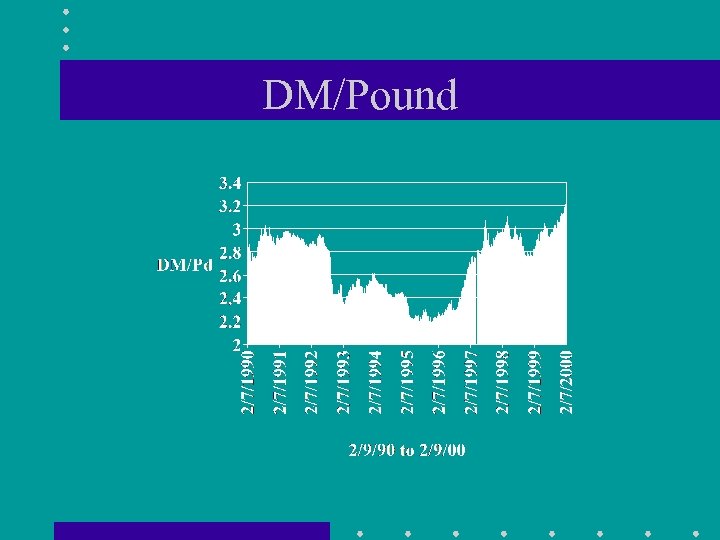 DM/Pound
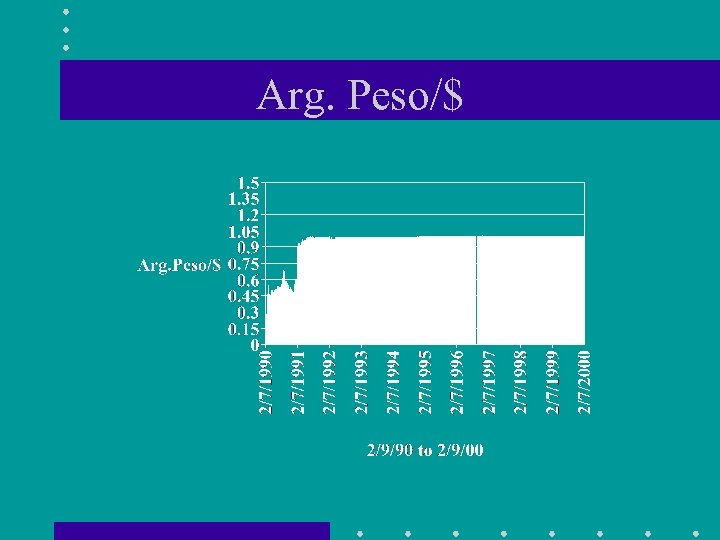 Arg. Peso/$
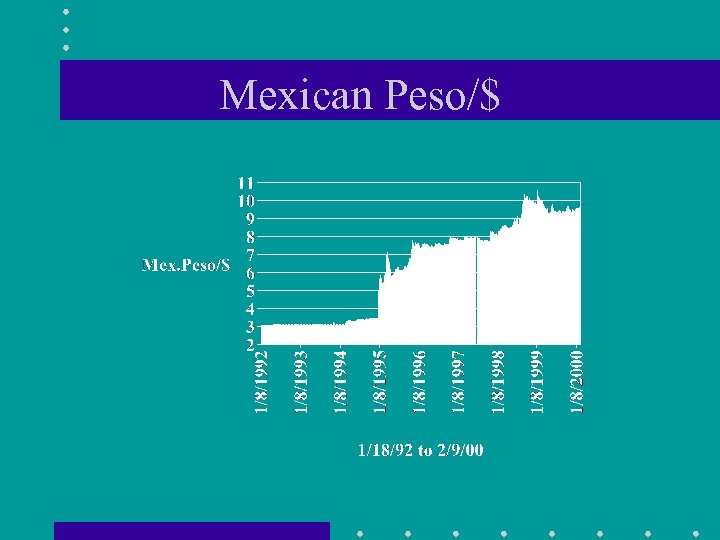 Mexican Peso/$
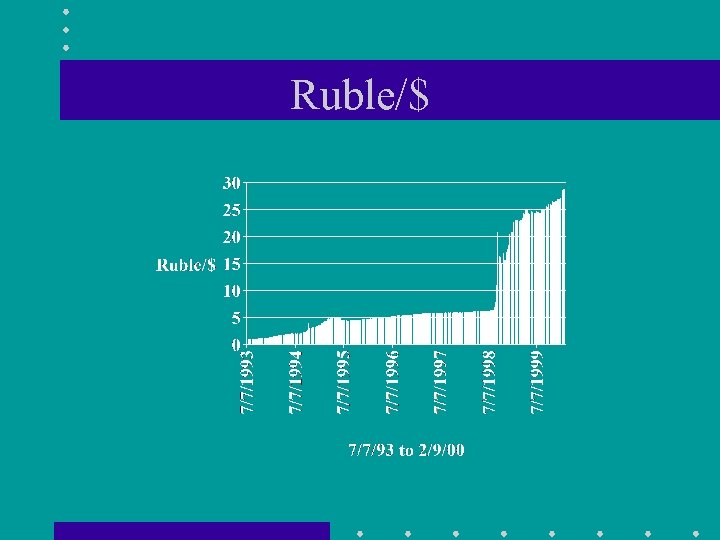 Ruble/$
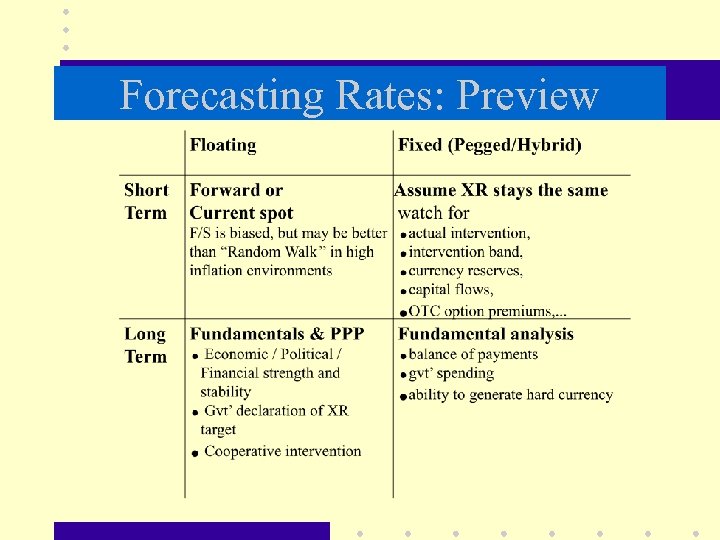 Forecasting Rates: Preview