


 Скачать презентацию International Financial Reporting Standards http www iasplus com en sta
IFRS and Taxation day 2.pptx
- Количество слайдов: 10
 International Financial Reporting Standards http: //www. iasplus. com/en/sta ndards
 The structure of IFRS. n n n n n Supplemental part. Introduction. Scope. Terms. Approaches to the recognition and measurement. Disclosure in the notes. Transitional provisions. Date of first use. Applications (examples). Basis for Conclusions.
 IAS 1. Presentation of Financial Statements Objective of IAS 1 The objective of IAS 1 (2007) is to prescribe the basis for presentation of general purpose financial statements, to ensure comparability both with the entity's financial statements of previous periods and with the financial statements of other entities. IAS 1 sets out the overall requirements for the presentation of financial statements, guidelines for their structure and minimum requirements for their content. [IAS 1. 1]
 IAS 1. Presentation of Financial Statements Components of financial statements A complete set of financial statements includes: [IAS 1. 10] n a statement of financial position (balance sheet) at the end of the period n a statement of profit or loss and other comprehensive income for the period (presented as a single statement, or by presenting the profit or loss section in a separate statement of profit or loss, immediately followed by a statement presenting comprehensive income beginning with profit or loss) n a statement of changes in equity for the period n a statement of cash flows for the period n notes, comprising a summary of significant accounting policies and other explanatory notes n comparative information prescribed by the standard.
 Accounting principles to prepare financial statements under IFRS Accrual n Continuity of operations n Consistency in presentation n Materiality and aggregation n Offsetting n Comparability of information n
 The structure and content of reports Elements of Financial Statements: n Assets n Liabilities n Capital n Income n Expenses n Cash flows
 The structure and content of reports Recognition elements: parallel accounting or transformation. Conditions for recognition : n Priority of economic substance of the transaction over form; n Transfer of ownership; n Receiving / loss of economic benefits.
 The structure and content of reports Assessment of the elements in value : 1. Historical value 2. Replacement value 3. Disposal value 4. Fair value 5. Discounted/Present value 6. Recoverable value 7. Actuarial value 8. Amortized value 9. Net book value 10. Carrying value
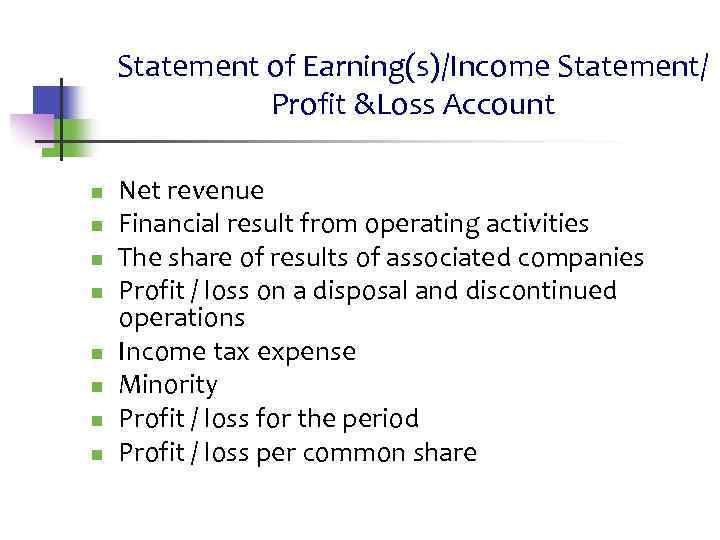 Statement of Earning(s)/Income Statement/ Profit &Loss Account n n n n Net revenue Financial result from operating activities The share of results of associated companies Profit / loss on a disposal and discontinued operations Income tax expense Minority Profit / loss for the period Profit / loss per common share
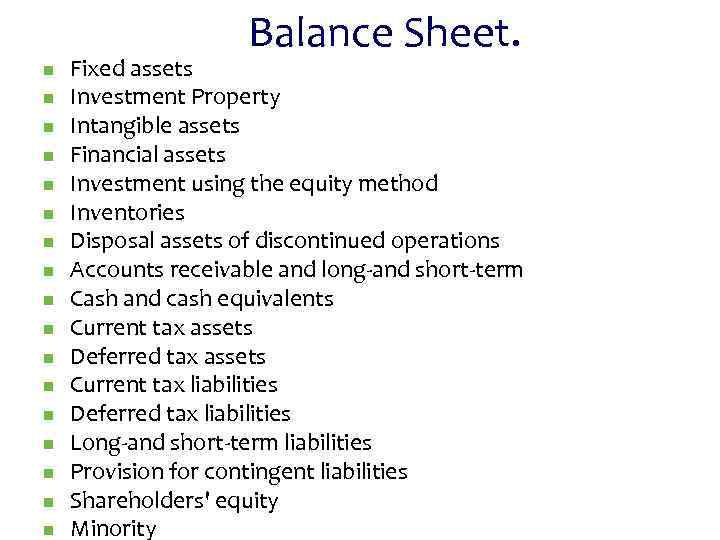 Balance Sheet. n n n n n Fixed assets Investment Property Intangible assets Financial assets Investment using the equity method Inventories Disposal assets of discontinued operations Accounts receivable and long-and short-term Cash and cash equivalents Current tax assets Deferred tax assets Current tax liabilities Deferred tax liabilities Long-and short-term liabilities Provision for contingent liabilities Shareholders' equity Minority