 Скачать презентацию International Financial Management INBU 4200 Fall Semester 2004
56a79822607d952c6d4bffc553c59880.ppt
- Количество слайдов: 35



International Financial Management: INBU 4200 Fall Semester 2004 Lecture 8 The (International) Equity Markets (Chapter 8)
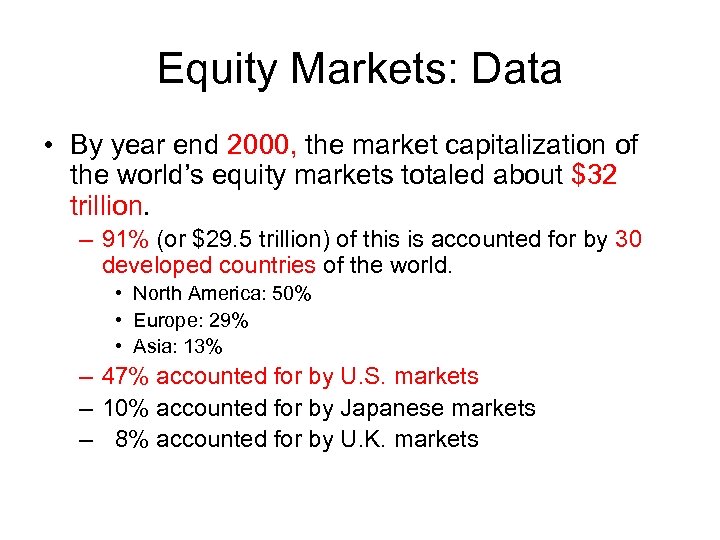
Equity Markets: Data • By year end 2000, the market capitalization of the world’s equity markets totaled about $32 trillion. – 91% (or $29. 5 trillion) of this is accounted for by 30 developed countries of the world. • North America: 50% • Europe: 29% • Asia: 13% – 47% accounted for by U. S. markets – 10% accounted for by Japanese markets – 8% accounted for by U. K. markets
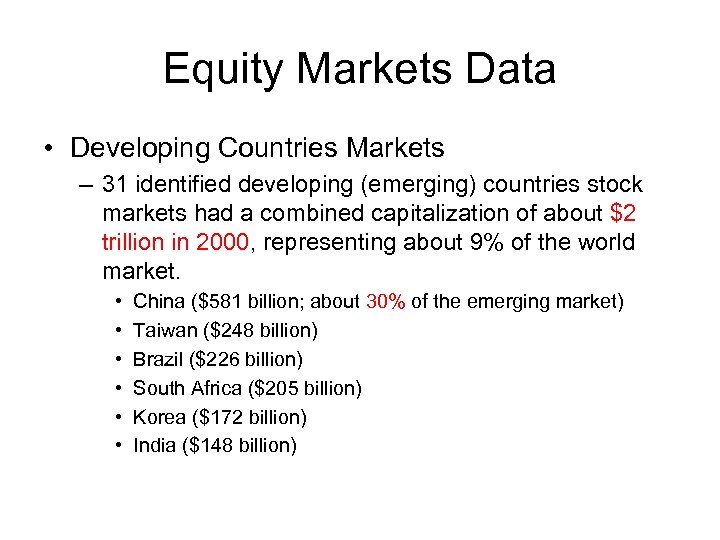
Equity Markets Data • Developing Countries Markets – 31 identified developing (emerging) countries stock markets had a combined capitalization of about $2 trillion in 2000, representing about 9% of the world market. • • • China ($581 billion; about 30% of the emerging market) Taiwan ($248 billion) Brazil ($226 billion) South Africa ($205 billion) Korea ($172 billion) India ($148 billion)
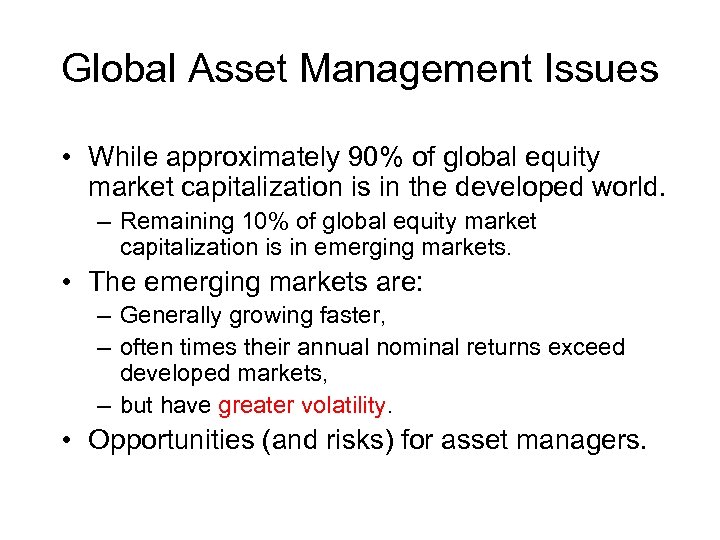
Global Asset Management Issues • While approximately 90% of global equity market capitalization is in the developed world. – Remaining 10% of global equity market capitalization is in emerging markets. • The emerging markets are: – Generally growing faster, – often times their annual nominal returns exceed developed markets, – but have greater volatility. • Opportunities (and risks) for asset managers.
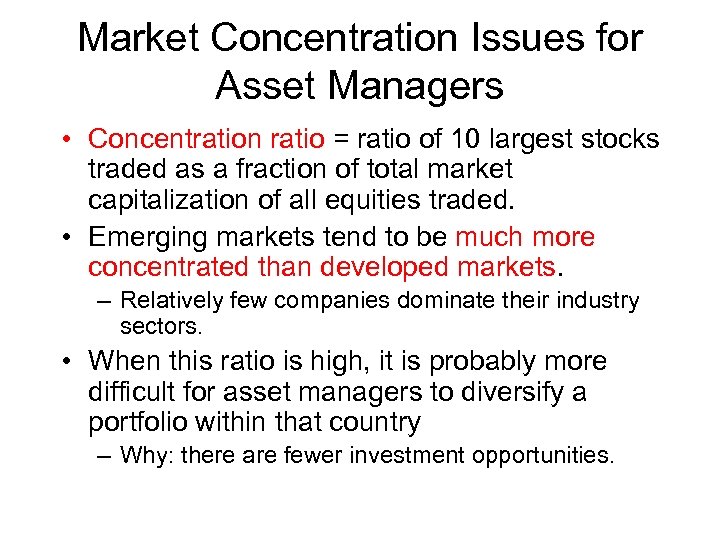
Market Concentration Issues for Asset Managers • Concentration ratio = ratio of 10 largest stocks traded as a fraction of total market capitalization of all equities traded. • Emerging markets tend to be much more concentrated than developed markets. – Relatively few companies dominate their industry sectors. • When this ratio is high, it is probably more difficult for asset managers to diversify a portfolio within that country – Why: there are fewer investment opportunities.
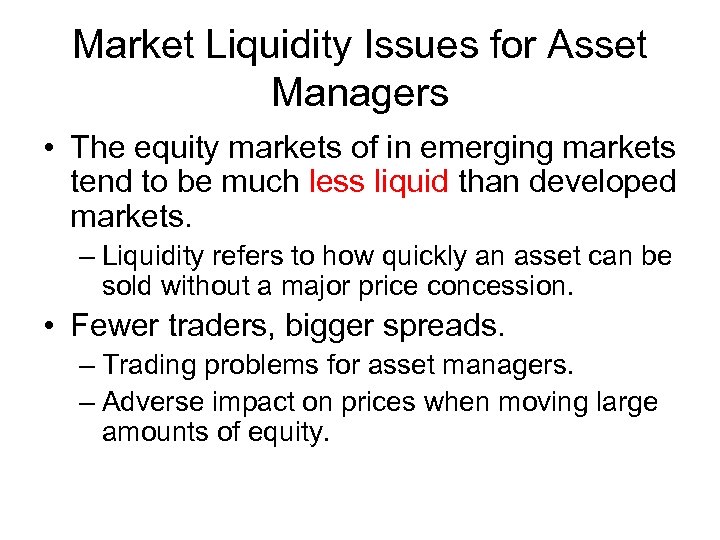
Market Liquidity Issues for Asset Managers • The equity markets of in emerging markets tend to be much less liquid than developed markets. – Liquidity refers to how quickly an asset can be sold without a major price concession. • Fewer traders, bigger spreads. – Trading problems for asset managers. – Adverse impact on prices when moving large amounts of equity.
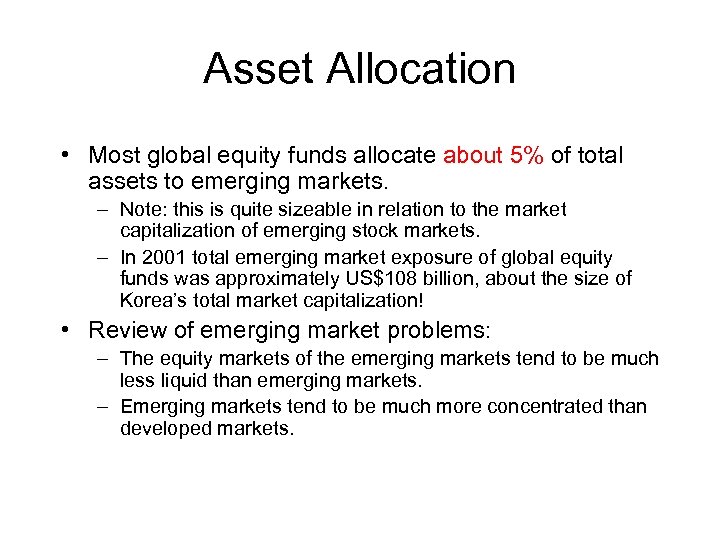
Asset Allocation • Most global equity funds allocate about 5% of total assets to emerging markets. – Note: this is quite sizeable in relation to the market capitalization of emerging stock markets. – In 2001 total emerging market exposure of global equity funds was approximately US$108 billion, about the size of Korea’s total market capitalization! • Review of emerging market problems: – The equity markets of the emerging markets tend to be much less liquid than emerging markets. – Emerging markets tend to be much more concentrated than developed markets.
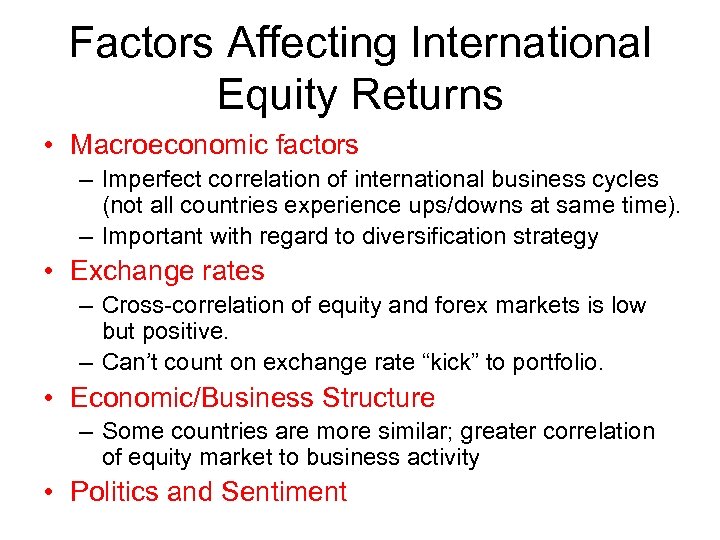
Factors Affecting International Equity Returns • Macroeconomic factors – Imperfect correlation of international business cycles (not all countries experience ups/downs at same time). – Important with regard to diversification strategy • Exchange rates – Cross-correlation of equity and forex markets is low but positive. – Can’t count on exchange rate “kick” to portfolio. • Economic/Business Structure – Some countries are more similar; greater correlation of equity market to business activity • Politics and Sentiment
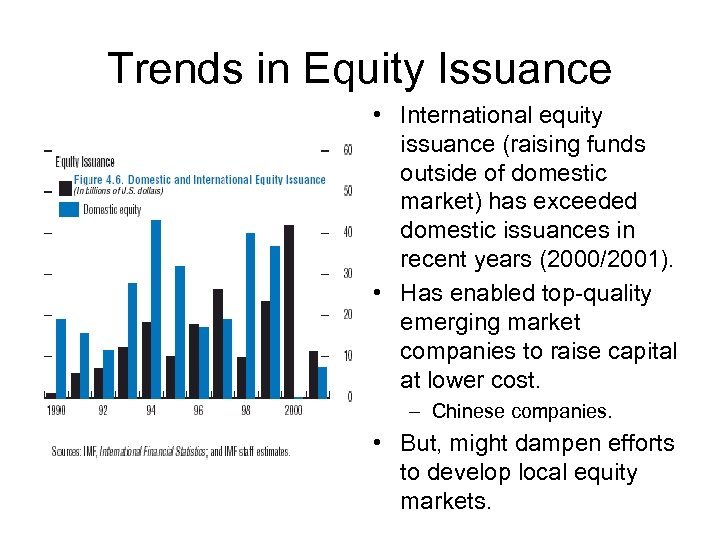
Trends in Equity Issuance • International equity issuance (raising funds outside of domestic market) has exceeded domestic issuances in recent years (2000/2001). • Has enabled top-quality emerging market companies to raise capital at lower cost. – Chinese companies. • But, might dampen efforts to develop local equity markets.
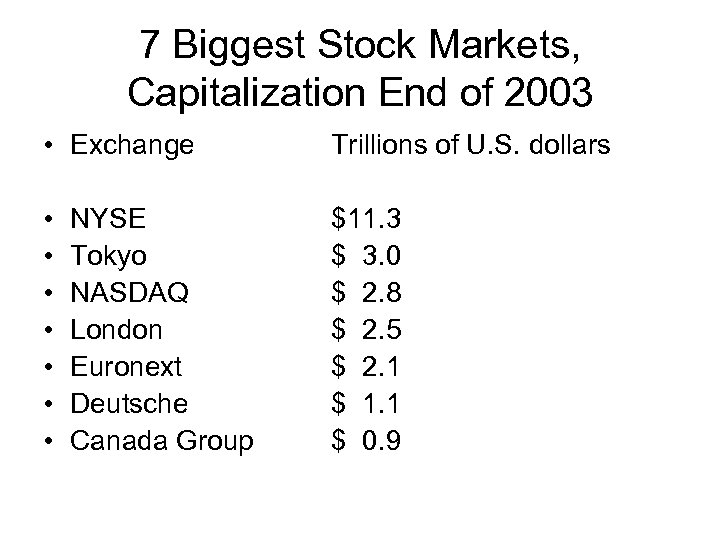
7 Biggest Stock Markets, Capitalization End of 2003 • Exchange Trillions of U. S. dollars • • $11. 3 $ 3. 0 $ 2. 8 $ 2. 5 $ 2. 1 $ 1. 1 $ 0. 9 NYSE Tokyo NASDAQ London Euronext Deutsche Canada Group
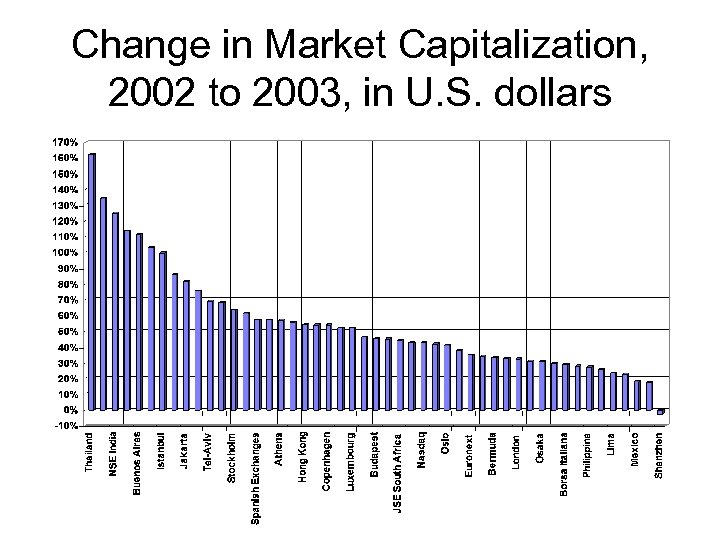
Change in Market Capitalization, 2002 to 2003, in U. S. dollars
Observations on Equity Markets • Stock markets are opening up all over the world. – In countries which a few years ago did not have a domestic equity market. – Opportunities for global investors and global companies. • • Asia Latin America Eastern Europe Africa/Middle East
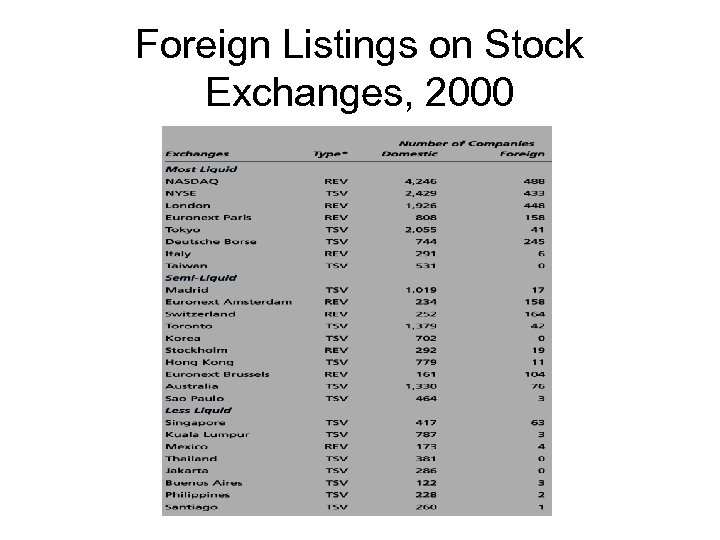
Foreign Listings on Stock Exchanges, 2000
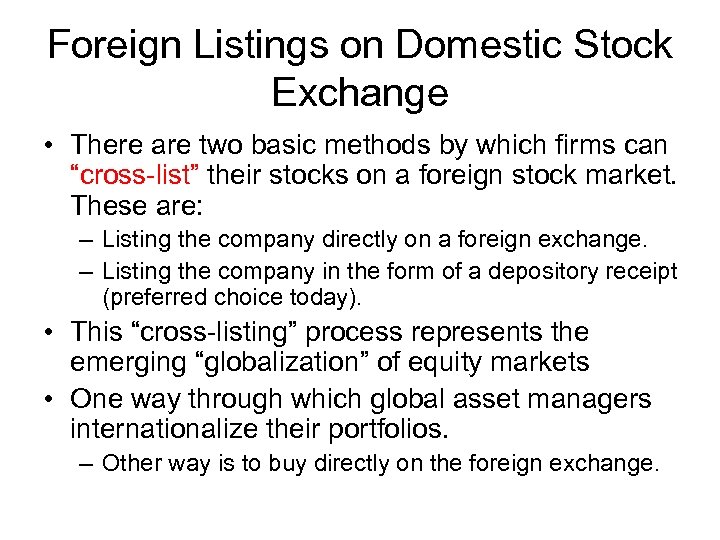
Foreign Listings on Domestic Stock Exchange • There are two basic methods by which firms can “cross-list” their stocks on a foreign stock market. These are: – Listing the company directly on a foreign exchange. – Listing the company in the form of a depository receipt (preferred choice today). • This “cross-listing” process represents the emerging “globalization” of equity markets • One way through which global asset managers internationalize their portfolios. – Other way is to buy directly on the foreign exchange.
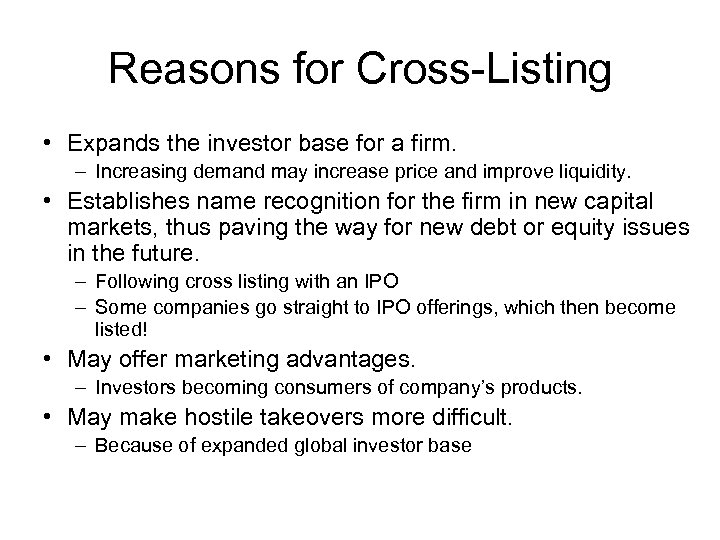
Reasons for Cross-Listing • Expands the investor base for a firm. – Increasing demand may increase price and improve liquidity. • Establishes name recognition for the firm in new capital markets, thus paving the way for new debt or equity issues in the future. – Following cross listing with an IPO – Some companies go straight to IPO offerings, which then become listed! • May offer marketing advantages. – Investors becoming consumers of company’s products. • May make hostile takeovers more difficult. – Because of expanded global investor base
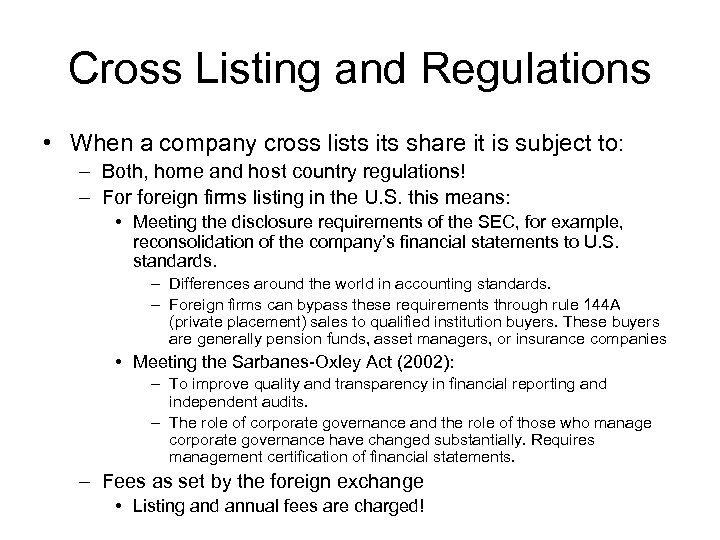
Cross Listing and Regulations • When a company cross lists its share it is subject to: – Both, home and host country regulations! – For foreign firms listing in the U. S. this means: • Meeting the disclosure requirements of the SEC, for example, reconsolidation of the company’s financial statements to U. S. standards. – Differences around the world in accounting standards. – Foreign firms can bypass these requirements through rule 144 A (private placement) sales to qualified institution buyers. These buyers are generally pension funds, asset managers, or insurance companies • Meeting the Sarbanes-Oxley Act (2002): – To improve quality and transparency in financial reporting and independent audits. – The role of corporate governance and the role of those who manage corporate governance have changed substantially. Requires management certification of financial statements. – Fees as set by the foreign exchange • Listing and annual fees are charged!
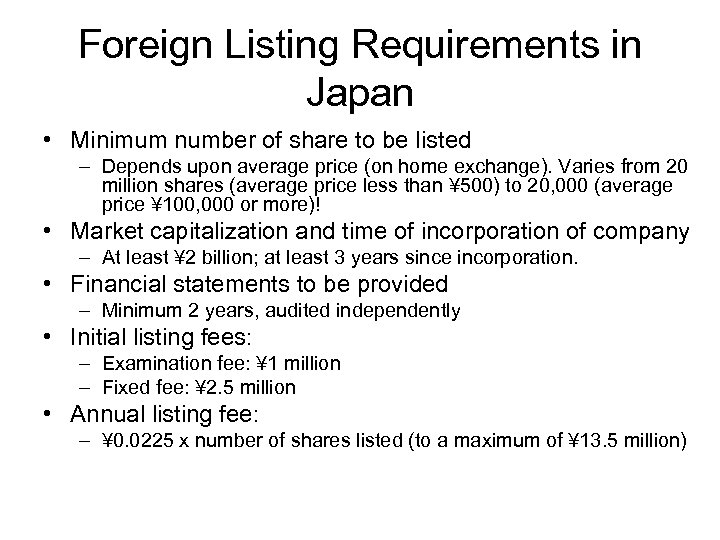
Foreign Listing Requirements in Japan • Minimum number of share to be listed – Depends upon average price (on home exchange). Varies from 20 million shares (average price less than ¥ 500) to 20, 000 (average price ¥ 100, 000 or more)! • Market capitalization and time of incorporation of company – At least ¥ 2 billion; at least 3 years since incorporation. • Financial statements to be provided – Minimum 2 years, audited independently • Initial listing fees: – Examination fee: ¥ 1 million – Fixed fee: ¥ 2. 5 million • Annual listing fee: – ¥ 0. 0225 x number of shares listed (to a maximum of ¥ 13. 5 million)
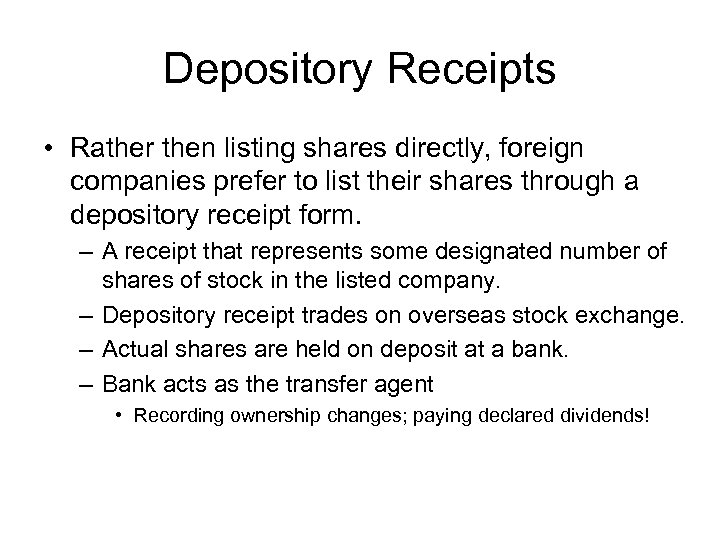
Depository Receipts • Rather then listing shares directly, foreign companies prefer to list their shares through a depository receipt form. – A receipt that represents some designated number of shares of stock in the listed company. – Depository receipt trades on overseas stock exchange. – Actual shares are held on deposit at a bank. – Bank acts as the transfer agent • Recording ownership changes; paying declared dividends!
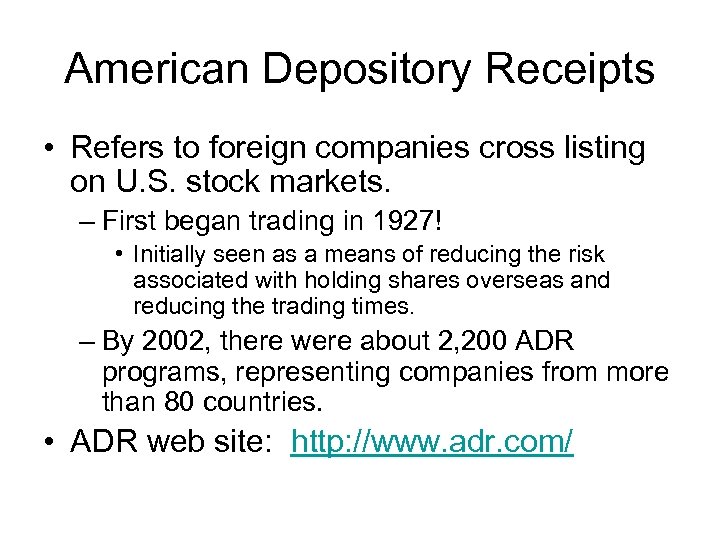
American Depository Receipts • Refers to foreign companies cross listing on U. S. stock markets. – First began trading in 1927! • Initially seen as a means of reducing the risk associated with holding shares overseas and reducing the trading times. – By 2002, there were about 2, 200 ADR programs, representing companies from more than 80 countries. • ADR web site: http: //www. adr. com/
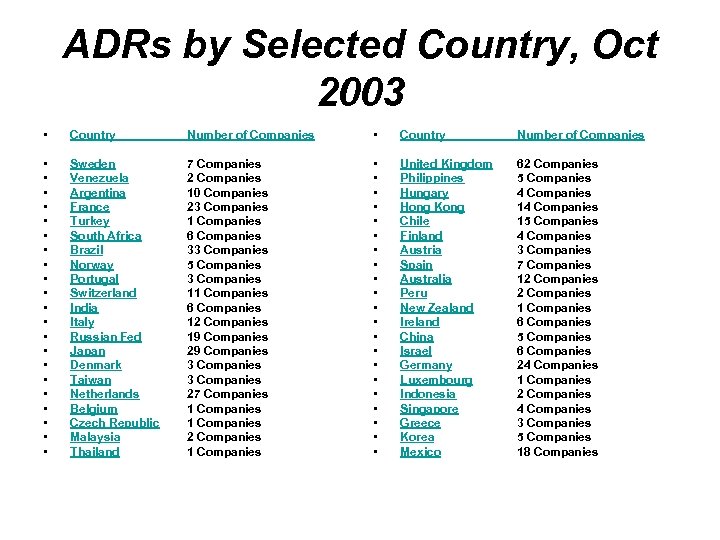
ADRs by Selected Country, Oct 2003 • Country Number of Companies • • • • • • Sweden Venezuela Argentina France Turkey South Africa Brazil Norway Portugal Switzerland India Italy Russian Fed Japan Denmark Taiwan Netherlands Belgium Czech Republic Malaysia Thailand 7 Companies 2 Companies 10 Companies 23 Companies 1 Companies 6 Companies 33 Companies 5 Companies 3 Companies 11 Companies 6 Companies 12 Companies 19 Companies 29 Companies 3 Companies 27 Companies 1 Companies 2 Companies 1 Companies • • • • • • United Kingdom Philippines Hungary Hong Kong Chile Finland Austria Spain Australia Peru New Zealand Ireland China Israel Germany Luxembourg Indonesia Singapore Greece Korea Mexico 62 Companies 5 Companies 4 Companies 15 Companies 4 Companies 3 Companies 7 Companies 12 Companies 1 Companies 6 Companies 5 Companies 6 Companies 24 Companies 1 Companies 2 Companies 4 Companies 3 Companies 5 Companies 18 Companies
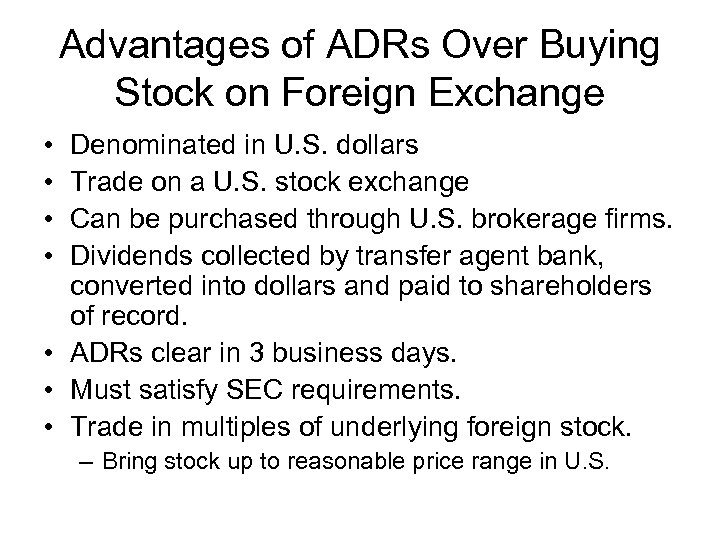
Advantages of ADRs Over Buying Stock on Foreign Exchange • • Denominated in U. S. dollars Trade on a U. S. stock exchange Can be purchased through U. S. brokerage firms. Dividends collected by transfer agent bank, converted into dollars and paid to shareholders of record. • ADRs clear in 3 business days. • Must satisfy SEC requirements. • Trade in multiples of underlying foreign stock. – Bring stock up to reasonable price range in U. S.
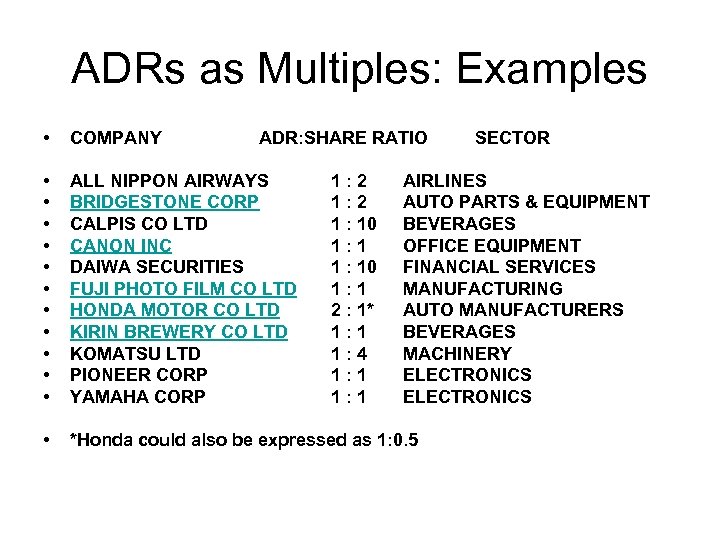
ADRs as Multiples: Examples • COMPANY • • • ALL NIPPON AIRWAYS BRIDGESTONE CORP CALPIS CO LTD CANON INC DAIWA SECURITIES FUJI PHOTO FILM CO LTD HONDA MOTOR CO LTD KIRIN BREWERY CO LTD KOMATSU LTD PIONEER CORP YAMAHA CORP • *Honda could also be expressed as 1: 0. 5 ADR: SHARE RATIO 1: 2 1 : 10 1: 1 2 : 1* 1: 1 1: 4 1: 1 SECTOR AIRLINES AUTO PARTS & EQUIPMENT BEVERAGES OFFICE EQUIPMENT FINANCIAL SERVICES MANUFACTURING AUTO MANUFACTURERS BEVERAGES MACHINERY ELECTRONICS
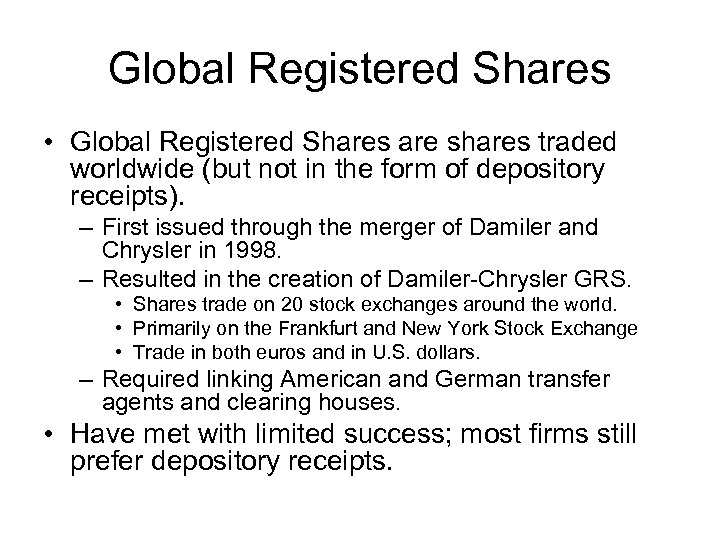
Global Registered Shares • Global Registered Shares are shares traded worldwide (but not in the form of depository receipts). – First issued through the merger of Damiler and Chrysler in 1998. – Resulted in the creation of Damiler-Chrysler GRS. • Shares trade on 20 stock exchanges around the world. • Primarily on the Frankfurt and New York Stock Exchange • Trade in both euros and in U. S. dollars. – Required linking American and German transfer agents and clearing houses. • Have met with limited success; most firms still prefer depository receipts.
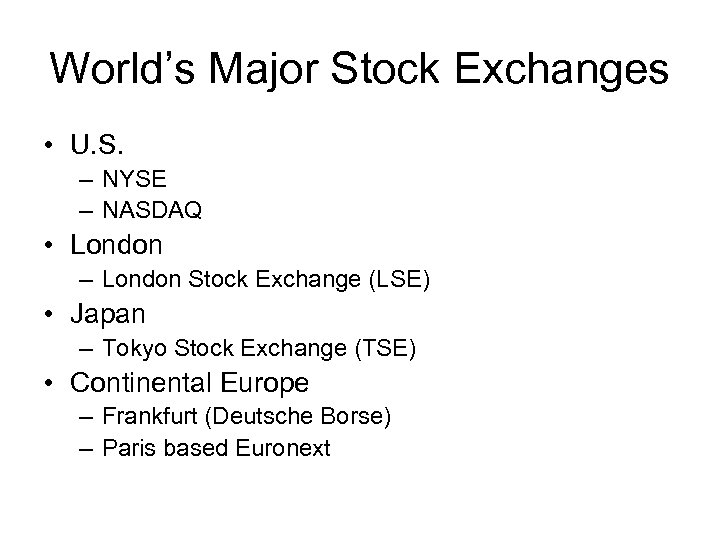
World’s Major Stock Exchanges • U. S. – NYSE – NASDAQ • London – London Stock Exchange (LSE) • Japan – Tokyo Stock Exchange (TSE) • Continental Europe – Frankfurt (Deutsche Borse) – Paris based Euronext
London Stock Exchange • Founded in 1792. • Initially used by British Government to raise funds (war with France). • Big Bang in 1986: series of reforms liberalizing commissions and introducing a screen based trading system. Paved the way foreign ownership. • Currently lists around 2, 900 stocks, depository receipts, and bonds. Largest market in Europe! • As of Sept 30, 2003, 445 foreign companies from over 60 countries are trading on the LSE (60 are U. S. companies). • Major stock index is the FTS 100 (largest 100 U. K. firms). • Official web site: http: //www. londonstockexchange. com
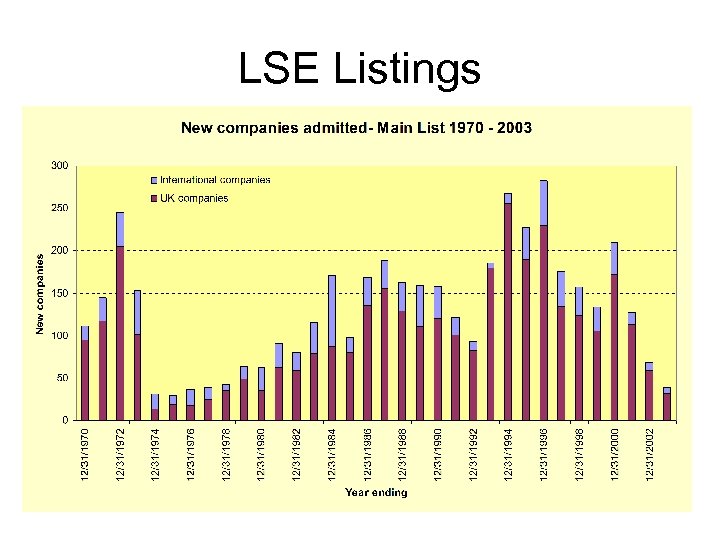
LSE Listings
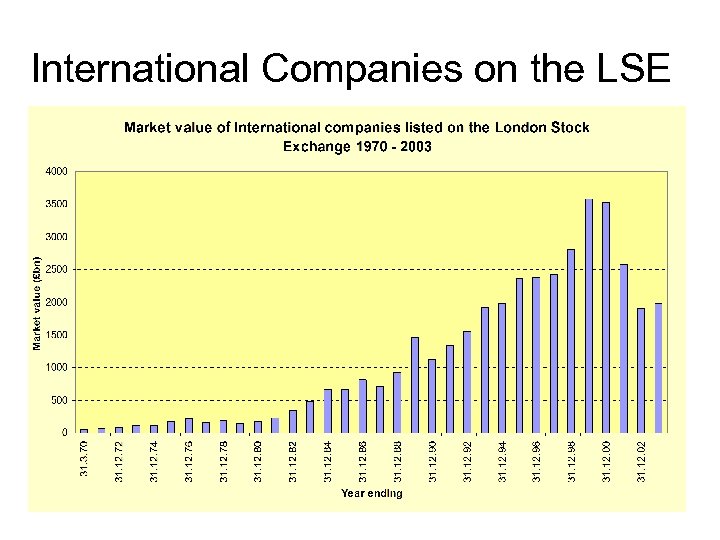
International Companies on the LSE
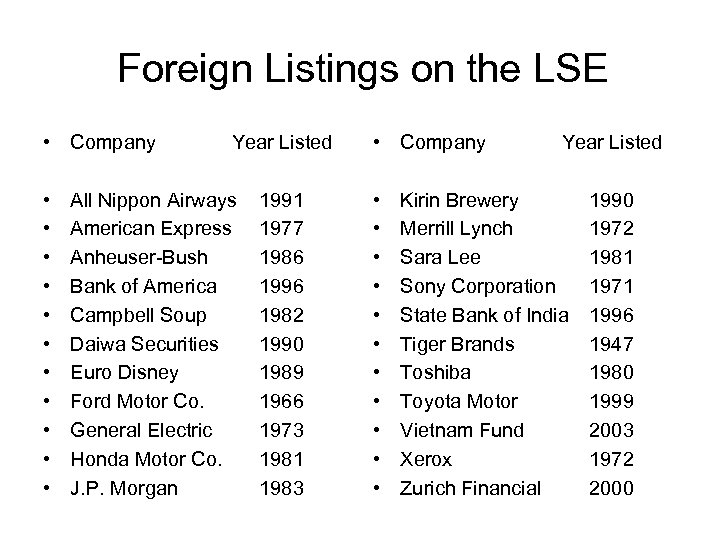
Foreign Listings on the LSE • Company • • • Year Listed All Nippon Airways American Express Anheuser-Bush Bank of America Campbell Soup Daiwa Securities Euro Disney Ford Motor Co. General Electric Honda Motor Co. J. P. Morgan 1991 1977 1986 1996 1982 1990 1989 1966 1973 1981 1983 • Company • • • Year Listed Kirin Brewery Merrill Lynch Sara Lee Sony Corporation State Bank of India Tiger Brands Toshiba Toyota Motor Vietnam Fund Xerox Zurich Financial 1990 1972 1981 1971 1996 1947 1980 1999 2003 1972 2000
Frankfurt Stock Exchange • Traces its history to a long tradition of trading (bills of exchange and government bonds) back to the 1600 s. • Lost its status as an international market during most of the 20 th century as a result of World Wars; regained its international position in the mid-1950 s. • The Frankfurt Deutsche Borse’s major stock index is the DAX (representing the 30 largest German firms). • Official web site: http: //deutsche-boerse. com/
Euronext • Euronext (Paris based holding company) formed in September 2000 by the merger of: – the Amsterdam and Brussels Exchanges and Paris Bourse. Added the Lisbon Exchange and London International Financial Futures Exchange (LIFFE) in 2002. • Has created a cross-border, electronic market for European and international equities and bonds. • Approximately 1, 500 companies trade on Euronext. • Is currently Europe’s second largest exchange. • Euronext’s major stock index is the Euronext 100 (representing the 100 largest European companies). • Official web site: http: //www. euronext. com/
Tokyo Stock Exchange • One of the oldest stock exchanges in Asia founded in 1878 (the oldest is the Bombay Stock Exchange founded in 1875). • There are four separate sections within the TSE market. – The first section is for the largest, most successful companies often referred to as 'blue chips'. – The second section is for smaller companies with lower trading volume levels. – Mothers (market for growth and emerging stocks), established in November 1999, is for newer, innovative venture enterprises. – The foreign section is for companies from countries other than Japan. • Official web site: http: //www. tse. or. jp/ • Major index is the TOPIX (TOkyo stock Price Inde. X. Includes all First Section listed shares.
Tokyo Stock Exchange • Currently 2, 147 companies are listed on the TSE – – First Section: 1, 525 Second Section: 560 Mothers: 62 Foreign: 32 • The section foreign stocks was opened in 1973 (when the TSE pushed to become an international exchange). • By 1991, 127 foreign companies were listed on the TSE. • However, as a result of delisting 32 foreign companies remain today (March 2004). Of these 12 are from the US, and 6 are from Germany. – View for a history of foreign listings and delistings: http: //www. tse. or. jp/english/listing/companies/frhistory e. pdf
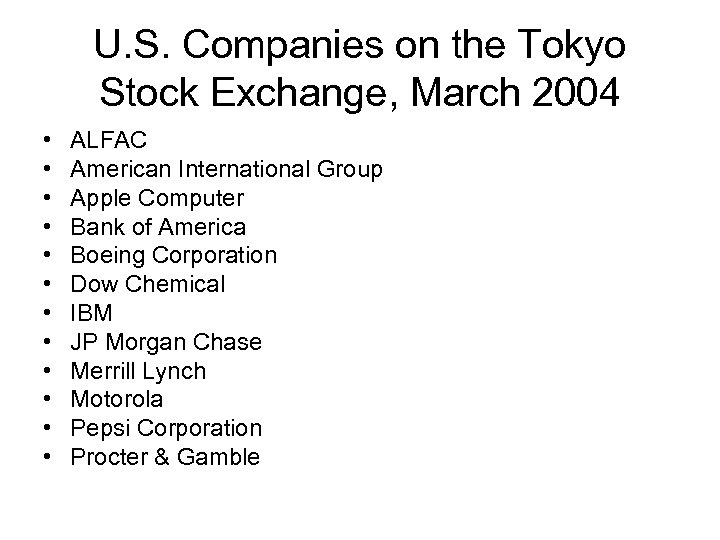
U. S. Companies on the Tokyo Stock Exchange, March 2004 • • • ALFAC American International Group Apple Computer Bank of America Boeing Corporation Dow Chemical IBM JP Morgan Chase Merrill Lynch Motorola Pepsi Corporation Procter & Gamble
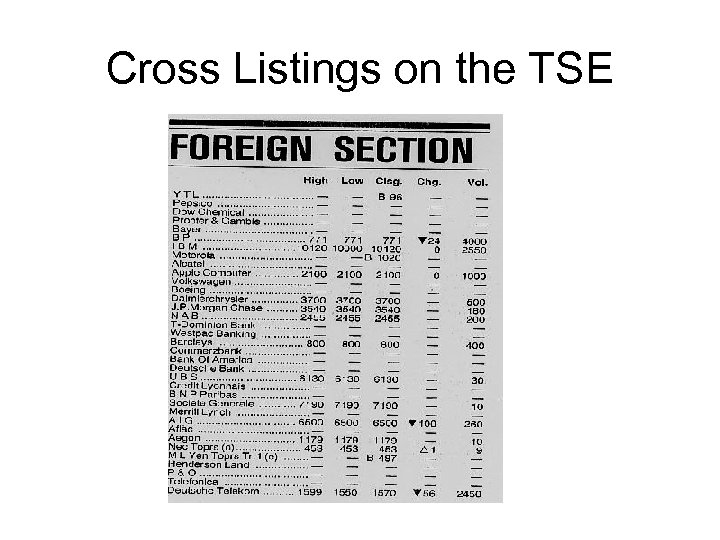
Cross Listings on the TSE
Stock Market Web Site • Stock markets around the world – Current data – Historical charts • http: //quote. yahoo. com/m 2? u
Скачать презентацию International Financial Management INBU 4200 Fall Semester 2004
56a79822607d952c6d4bffc553c59880.ppt