 Скачать презентацию International Financial Management INBU 4200 Fall Semester 2004
92274bf5cb438cbc60b44dae8de85f72.ppt
- Количество слайдов: 26



International Financial Management: INBU 4200 Fall Semester 2004 Lecture 4: Part 1 International Parity Relationships: The Interest Rate Parity Model (Explaining the Forward Rate) (Chapter 5)
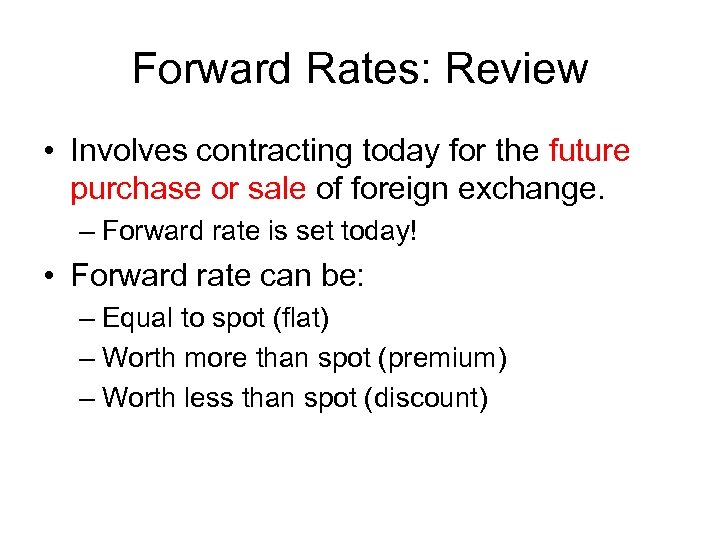
Forward Rates: Review • Involves contracting today for the future purchase or sale of foreign exchange. – Forward rate is set today! • Forward rate can be: – Equal to spot (flat) – Worth more than spot (premium) – Worth less than spot (discount)
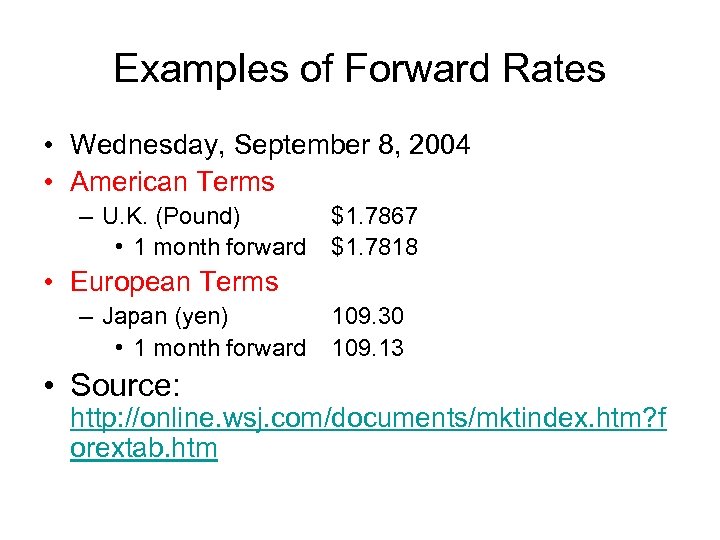
Examples of Forward Rates • Wednesday, September 8, 2004 • American Terms – U. K. (Pound) • 1 month forward $1. 7867 $1. 7818 • European Terms – Japan (yen) • 1 month forward • Source: 109. 30 109. 13 http: //online. wsj. com/documents/mktindex. htm? f orextab. htm
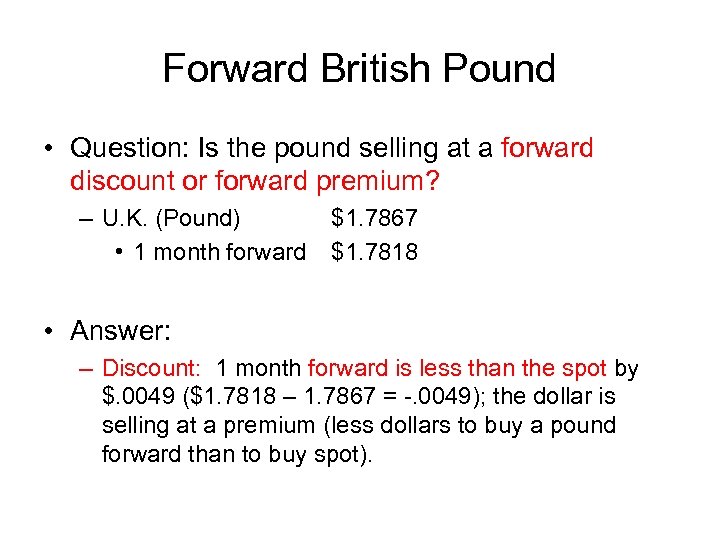
Forward British Pound • Question: Is the pound selling at a forward discount or forward premium? – U. K. (Pound) • 1 month forward $1. 7867 $1. 7818 • Answer: – Discount: 1 month forward is less than the spot by $. 0049 ($1. 7818 – 1. 7867 = -. 0049); the dollar is selling at a premium (less dollars to buy a pound forward than to buy spot).
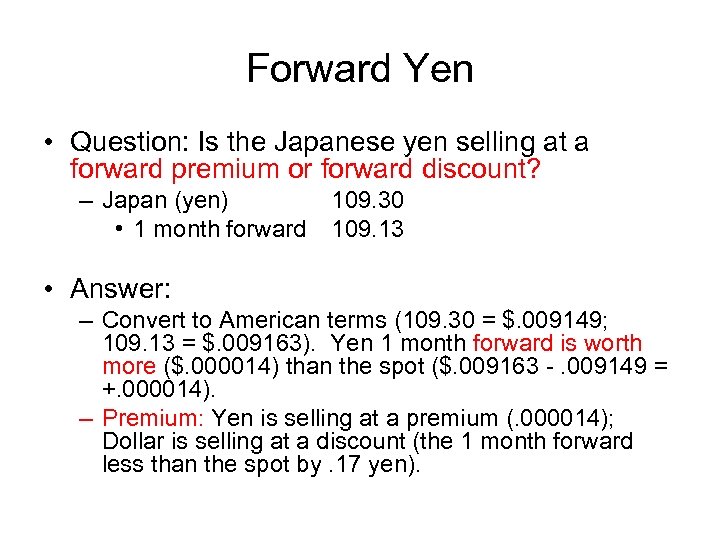
Forward Yen • Question: Is the Japanese yen selling at a forward premium or forward discount? – Japan (yen) • 1 month forward 109. 30 109. 13 • Answer: – Convert to American terms (109. 30 = $. 009149; 109. 13 = $. 009163). Yen 1 month forward is worth more ($. 000014) than the spot ($. 009163 -. 009149 = +. 000014). – Premium: Yen is selling at a premium (. 000014); Dollar is selling at a discount (the 1 month forward less than the spot by. 17 yen).
What Determines the Forward Rate? • What does NOT determine forward rate: – Market’s expectation about where spot rate will be in the future. • What does determine forward rate: – Assuming no capital controls, in equilibrium the rate represents the difference in interest rates between the two currencies in question.
Interest Rate Parity Model • What do we mean by parity? – Markets (prices) in equilibrium according to the assumptions of a given model. • Interest rate parity theory provides a linkage (and explanation) between international money markets and (forward) foreign exchange markets. • The theory states that the forward rate discount or premium on a foreign currency should be equal to, but opposite in sign to, the difference in the national interest rates for securities of similar risk and maturity.
Cross Border Investing: Risk • Assume a US dollar-based investor has $1 million to invest for 90 days and can select from two investments: – Invest in the U. S. and earn 4. 0% p. a. – Invest in Switzerland earn 8. 0% p. a. • What is the risk with Swiss franc investment? – U. S. investor will receive Swiss francs in 90 days. – Risk is the uncertainty about the future Swiss franc spot rate. – If the franc depreciates by 4% or more, this will wipe out the higher interest rate on the Swiss investment
A Solution to Currency Risk • Solution for U. S. investor: – How can you manage this risk, or foreign exchange exposure (in the Swiss franc)? – Cover the Swiss franc investment by selling the anticipated Swiss francs forward 90 days. • Anticipated amount would be equal to the principal repayment plus earned interest. • Issue – What will the forward rate on francs to be delivered in 90 days be? – This will determine the “covered” investment return.
Forward Rate and Interest Rate Parity • In equilibrium, the forward rate must settle at a rate to offset the interest rate differential between the two countries (i. e. , currencies) in question. – This is the interest rate parity model. • This forward rate offset is to insure that the two investments (U. S. and Switzerland) will yield similar returns when covered. – If the forward rate did not offset the interest rate differential, investors could cover and earn higher returns than at home. – Thus, the offset prevents covered interest arbitrage opportunities.
Covered Interest Arbitrage • Assume: – 90 day Interest rate in U. S. is 4% – 90 day Interest rate in Switzerland is 8% • Assume the spot rate and the 90 day forward rate are the same. – The Swiss franc is selling flat of its spot. • A U. S. investor could invest in Switzerland, and cover (sell francs forward) and obtain a (foreign exchange) riskless return of 8% which is 400 basis points greater than investing in the U. S. • This is covered interest arbitrage!
In Equilibrium • In equilibrium the forward rate will price the currency’s forward rate to offset the interest rate differential. • In the previous example, the “correct, ” or equilibrium, 90 day forward Swiss franc rate will be at a discount of 4% of its spot. • Thus, when the U. S. investor covers (sells the francs forward), the 8% Swiss return is reduced by the 4% discount, resulting in a covered return of 4%. – This is equal to the return the U. S. investors would get at home.
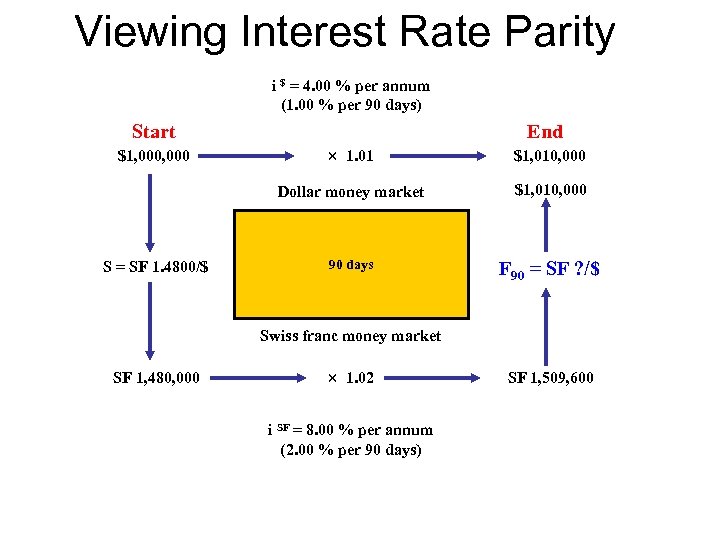
Viewing Interest Rate Parity i $ = 4. 00 % per annum (1. 00 % per 90 days) Start End S = SF 1. 4800/$ 1. 01 $1, 010, 000 Dollar money market $1, 000 $1, 010, 000 90 days F 90 = SF ? /$ Swiss franc money market SF 1, 480, 000 1. 02 i SF = 8. 00 % per annum (2. 00 % per 90 days) SF 1, 509, 600
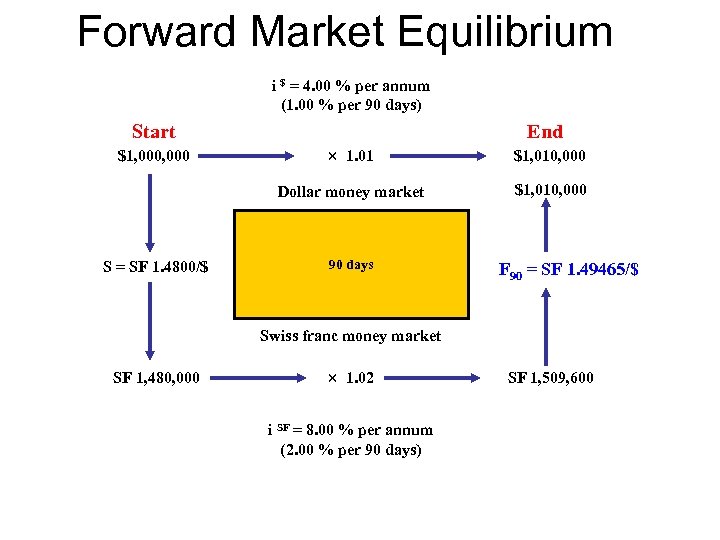
Forward Market Equilibrium i $ = 4. 00 % per annum (1. 00 % per 90 days) Start End S = SF 1. 4800/$ 1. 01 $1, 010, 000 Dollar money market $1, 000 $1, 010, 000 90 days F 90 = SF 1. 49465/$ Swiss franc money market SF 1, 480, 000 1. 02 i SF = 8. 00 % per annum (2. 00 % per 90 days) SF 1, 509, 600
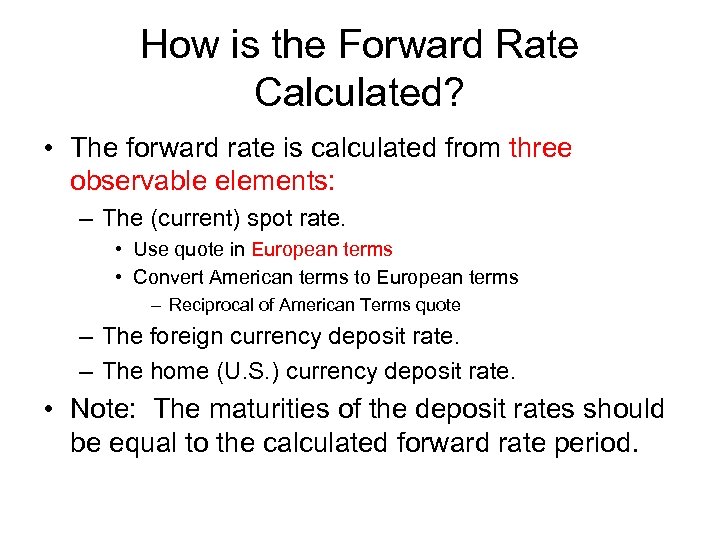
How is the Forward Rate Calculated? • The forward rate is calculated from three observable elements: – The (current) spot rate. • Use quote in European terms • Convert American terms to European terms – Reciprocal of American Terms quote – The foreign currency deposit rate. – The home (U. S. ) currency deposit rate. • Note: The maturities of the deposit rates should be equal to the calculated forward rate period.
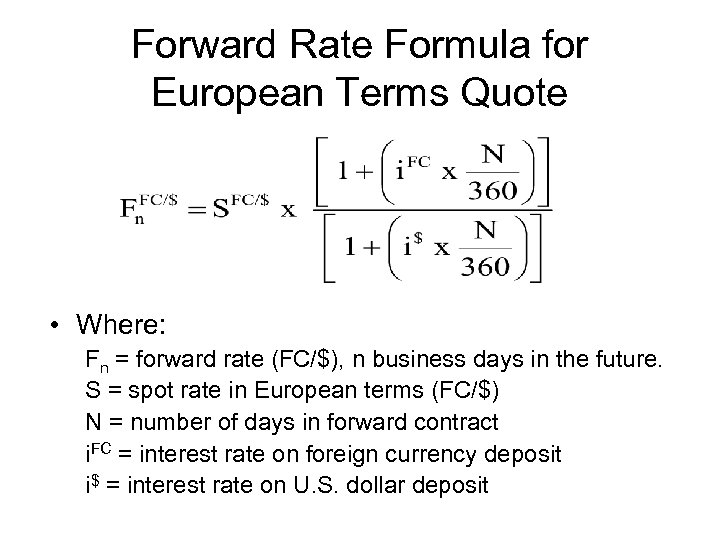
Forward Rate Formula for European Terms Quote • Where: Fn = forward rate (FC/$), n business days in the future. S = spot rate in European terms (FC/$) N = number of days in forward contract i. FC = interest rate on foreign currency deposit i$ = interest rate on U. S. dollar deposit
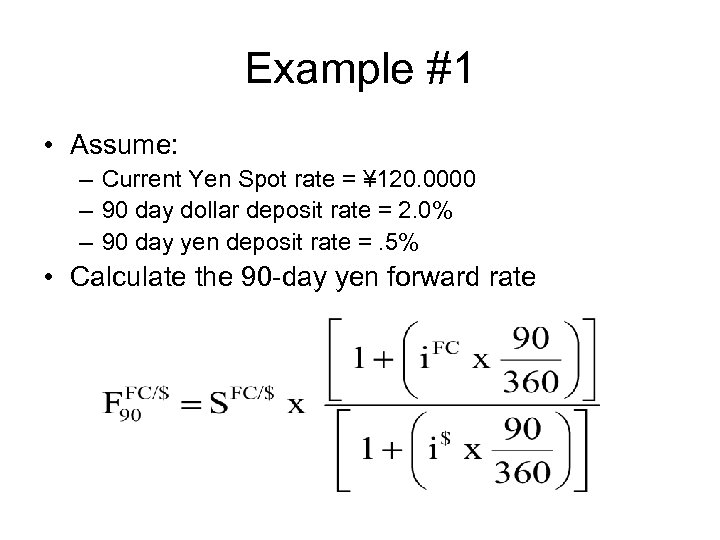
Example #1 • Assume: – Current Yen Spot rate = ¥ 120. 0000 – 90 day dollar deposit rate = 2. 0% – 90 day yen deposit rate =. 5% • Calculate the 90 -day yen forward rate
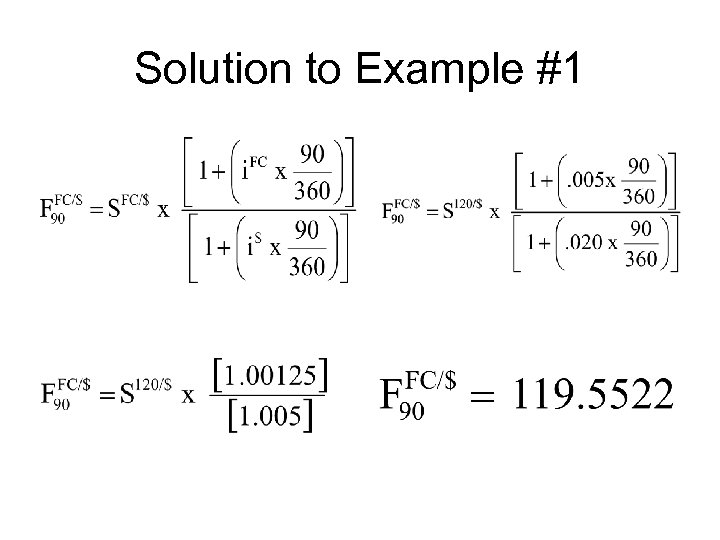
Solution to Example #1
Calculated Yen Forward • At ¥ 119. 5522 is the 90 day forward yen selling at a discount or premium of its spot (120)? • Answer: – At a premium • Why? – Premium on the forward yen is offsetting the lower interest rate on yen deposits (relative to U. S. deposits).
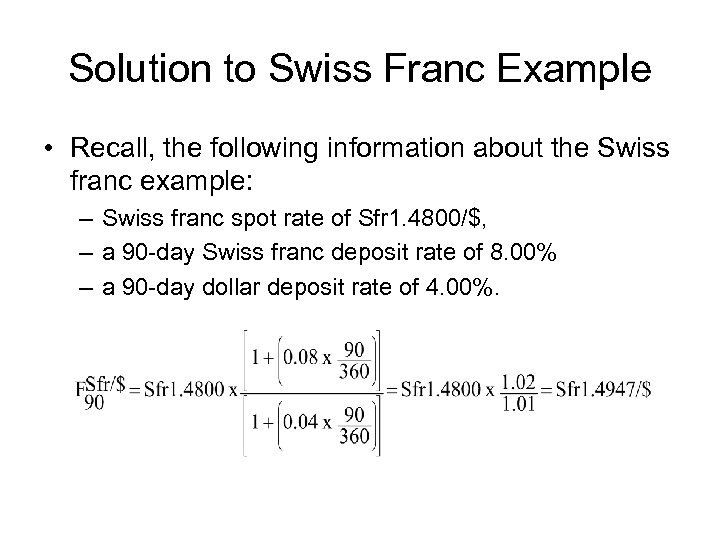
Solution to Swiss Franc Example • Recall, the following information about the Swiss franc example: – Swiss franc spot rate of Sfr 1. 4800/$, – a 90 -day Swiss franc deposit rate of 8. 00% – a 90 -day dollar deposit rate of 4. 00%.
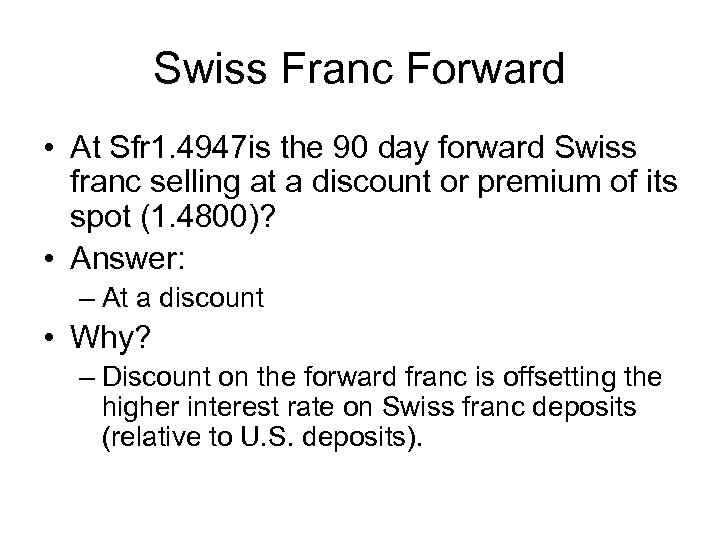
Swiss Franc Forward • At Sfr 1. 4947 is the 90 day forward Swiss franc selling at a discount or premium of its spot (1. 4800)? • Answer: – At a discount • Why? – Discount on the forward franc is offsetting the higher interest rate on Swiss franc deposits (relative to U. S. deposits).
Covered Interest Arbitrage • If the forward rate is not correct, the chance of covered interest arbitrage exists. • Generally, these situations will not last long. • As the market participants take advantage of them, equilibrium will be restored. – Through adjustments in the forward rates.
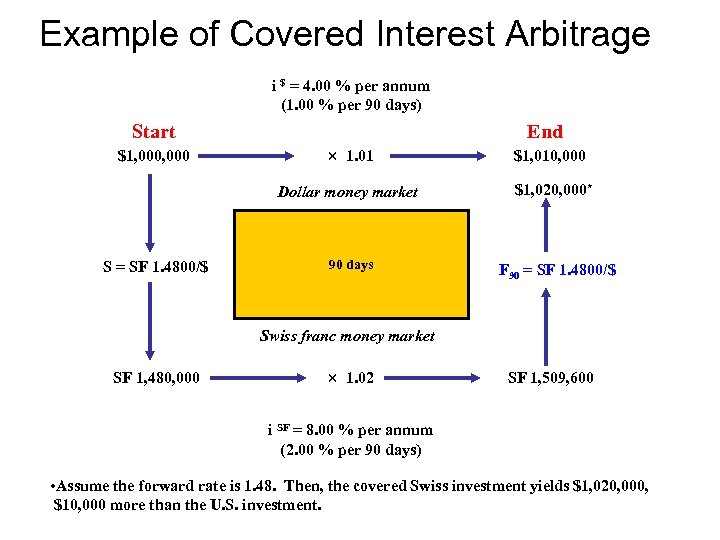
Example of Covered Interest Arbitrage i $ = 4. 00 % per annum (1. 00 % per 90 days) Start End S = SF 1. 4800/$ 1. 01 $1, 010, 000 Dollar money market $1, 000 $1, 020, 000* 90 days F 90 = SF 1. 4800/$ Swiss franc money market SF 1, 480, 000 1. 02 SF 1, 509, 600 i SF = 8. 00 % per annum (2. 00 % per 90 days) • Assume the forward rate is 1. 48. Then, the covered Swiss investment yields $1, 020, 000, $10, 000 more than the U. S. investment.
Using the Interest Rate Parity Model to Forecast Future Spot Rates • While the forward rate under the assumption of the Interest Rate Parity model assumes: – The forward rate simply represents interest rate differentials – And NOT the market’s view of the future spot rate. • Some forecasters do use this model to forecast future spot rates.
Forward Rates as an Unbiased Predictor • Some forecasters believe that the forward rate is an “unbiased” predictor of the future spot rate. • This is roughly equivalent to saying that the forward rate can act as a prediction of the future spot exchange rate, but – it will generally “miss” the actual future spot rate – and it will miss with equal probabilities (directions) and magnitudes (distances) which offset the errors of the individual forecasts!
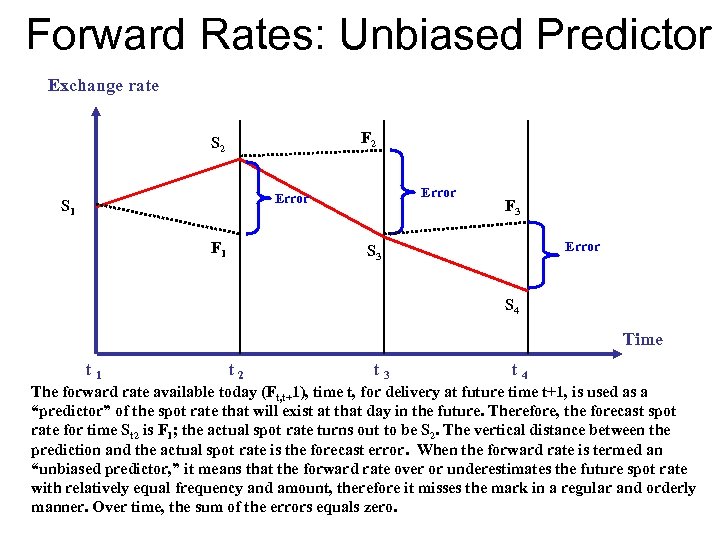
Forward Rates: Unbiased Predictor Exchange rate F 2 S 2 Error S 1 F 3 Error S 3 S 4 Time t 1 t 2 t 3 t 4 The forward rate available today (Ft, t+1), time t, for delivery at future time t+1, is used as a “predictor” of the spot rate that will exist at that day in the future. Therefore, the forecast spot rate for time St 2 is F 1; the actual spot rate turns out to be S 2. The vertical distance between the prediction and the actual spot rate is the forecast error. When the forward rate is termed an “unbiased predictor, ” it means that the forward rate over or underestimates the future spot rate with relatively equal frequency and amount, therefore it misses the mark in a regular and orderly manner. Over time, the sum of the errors equals zero.
Скачать презентацию International Financial Management INBU 4200 Fall Semester 2004
92274bf5cb438cbc60b44dae8de85f72.ppt