


 Скачать презентацию INTERNATIONAL FINANCIAL MANAGEMENT Fifth Edition EUN RESNICK
b492386531ef0556da93f731f2ebb723.ppt
- Количество слайдов: 85
 INTERNATIONAL FINANCIAL MANAGEMENT Fifth Edition EUN / RESNICK Mc. Graw-Hill/Irwin Copyright © 2009 by The Mc. Graw-Hill Companies, Inc. All rights reserved.
 Futures and Options on Foreign Exchange 7 Chapter Seven Chapter Objective: This chapter discusses exchange-traded currency futures contracts, options contracts, and options on currency futures. 7 -1
 Chapter Outline l l l l Futures Contracts: Preliminaries Currency Futures Markets Basic Currency Futures Relationships Eurodollar Interest Rate Futures Contracts Options Contracts: Preliminaries Currency Options Markets Currency Futures Options 7 -2
 Chapter Outline (continued) l l l Basic Option Pricing Relationships at Expiry American Option Pricing Relationships European Option Pricing Relationships Binomial Option Pricing Model European Option Pricing Model Empirical Tests of Currency Option Models 7 -3
 Futures Contracts: Preliminaries l A futures contract is like a forward contract: l l A futures contract is different from a forward contract: l 7 -4 It specifies that a certain currency will be exchanged for another at a specified time in the future at prices specified today. Futures are standardized contracts trading on organized exchanges with daily resettlement through a clearinghouse.
 Futures Contracts: Preliminaries l Standardizing Features: l l Contract Size Delivery Month Daily resettlement Initial performance bond (about 2 percent of contract value, cash or T-bills held in a street name at your brokerage). 7 -5
 Daily Resettlement: An Example l l l Consider a long position in the CME Euro/U. S. Dollar contract. It is written on € 125, 000 and quoted in $ per €. The strike price is $1. 30 the maturity is 3 months. At initiation of the contract, the long posts an initial performance bond of $6, 500. The maintenance performance bond is $4, 000. 7 -6
 Daily Resettlement: An Example l l Recall that an investor with a long position gains from increases in the price of the underlying asset. Our investor has agreed to BUY € 125, 000 at $1. 30 per euro in three months time. With a forward contract, at the end of three months, if the euro was worth $1. 24, he would lose $7, 500 = ($1. 24 – $1. 30) × 125, 000. If instead at maturity the euro was worth $1. 35, the counterparty to his forward contract would pay him $6, 250 = ($1. 35 – $1. 30) × 125, 000. 7 -7
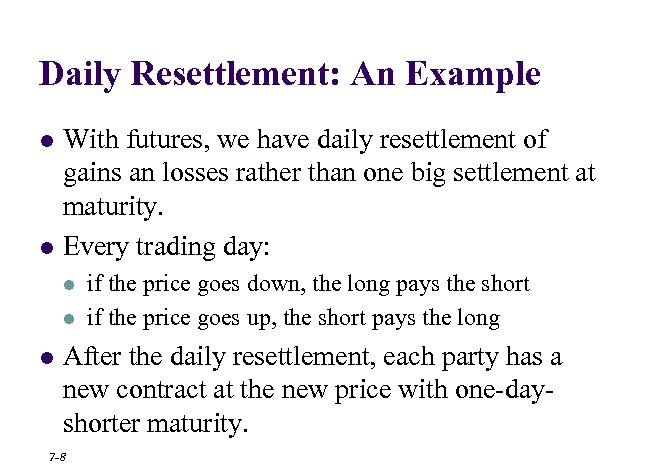 Daily Resettlement: An Example l l With futures, we have daily resettlement of gains an losses rather than one big settlement at maturity. Every trading day: l l l if the price goes down, the long pays the short if the price goes up, the short pays the long After the daily resettlement, each party has a new contract at the new price with one-dayshorter maturity. 7 -8
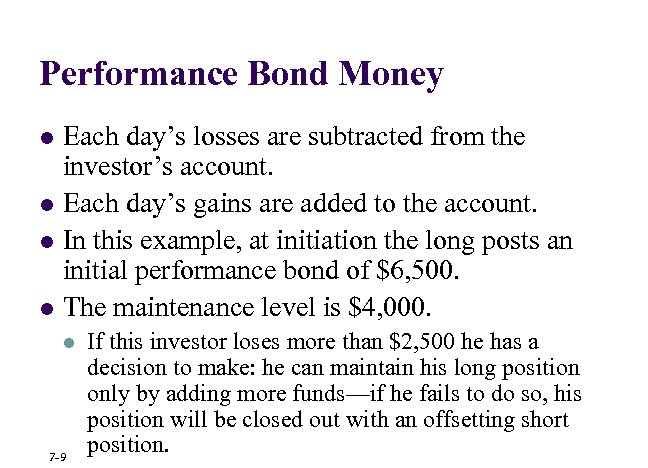 Performance Bond Money l l Each day’s losses are subtracted from the investor’s account. Each day’s gains are added to the account. In this example, at initiation the long posts an initial performance bond of $6, 500. The maintenance level is $4, 000. l 7 -9 If this investor loses more than $2, 500 he has a decision to make: he can maintain his long position only by adding more funds—if he fails to do so, his position will be closed out with an offsetting short position.
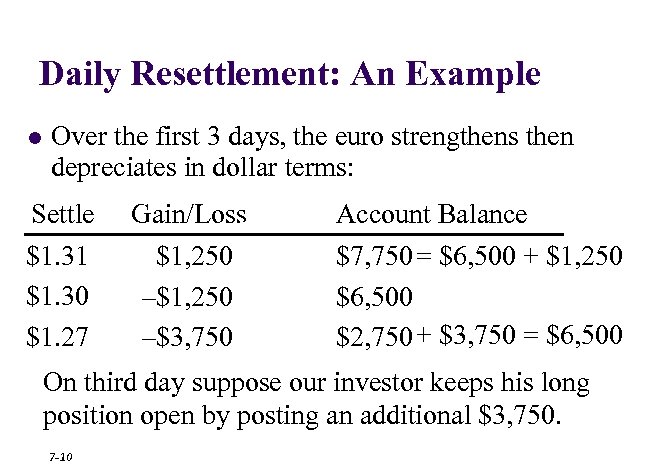 Daily Resettlement: An Example l Over the first 3 days, the euro strengthens then depreciates in dollar terms: Settle $1. 31 $1. 30 $1. 27 Gain/Loss Account Balance $1, 250 = ($1. 31 – $1. 30)× 125, 000 $7, 750 = $6, 500 + $1, 250 –$1, 250 $6, 500 –$3, 750 $2, 750 + $3, 750 = $6, 500 On third day suppose our investor keeps his long position open by posting an additional $3, 750. 7 -10
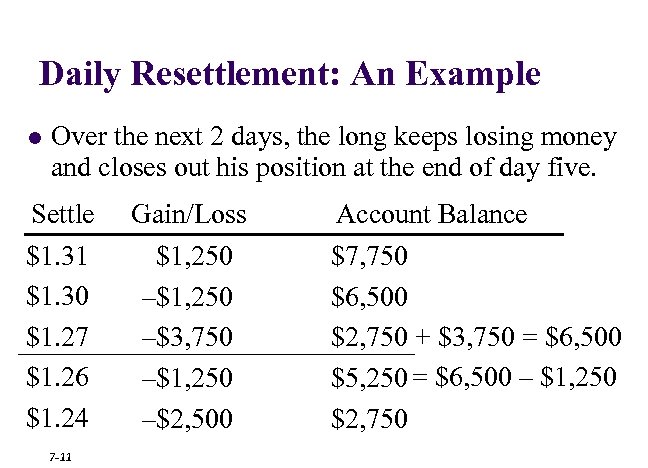 Daily Resettlement: An Example l Over the next 2 days, the long keeps losing money and closes out his position at the end of day five. Settle $1. 31 $1. 30 $1. 27 $1. 26 $1. 24 7 -11 Gain/Loss $1, 250 –$3, 750 –$1, 250 –$2, 500 Account Balance $7, 750 $6, 500 $2, 750 + $3, 750 = $6, 500 $5, 250 = $6, 500 – $1, 250 $2, 750
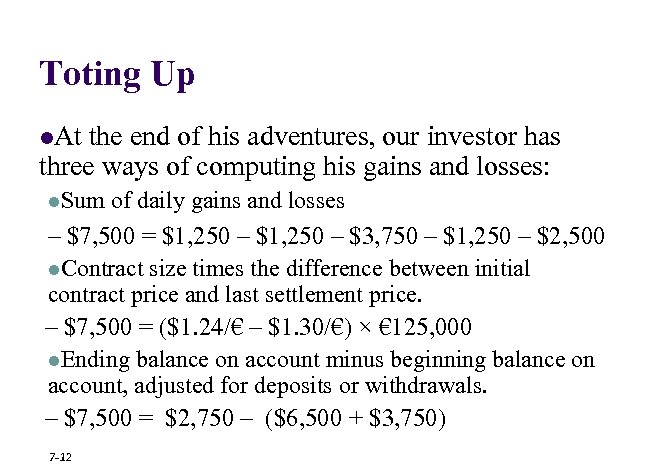 Toting Up l. At the end of his adventures, our investor has three ways of computing his gains and losses: l. Sum of daily gains and losses – $7, 500 = $1, 250 – $3, 750 – $1, 250 – $2, 500 l. Contract size times the difference between initial contract price and last settlement price. – $7, 500 = ($1. 24/€ – $1. 30/€) × € 125, 000 l. Ending balance on account minus beginning balance on account, adjusted for deposits or withdrawals. – $7, 500 = $2, 750 – ($6, 500 + $3, 750) 7 -12
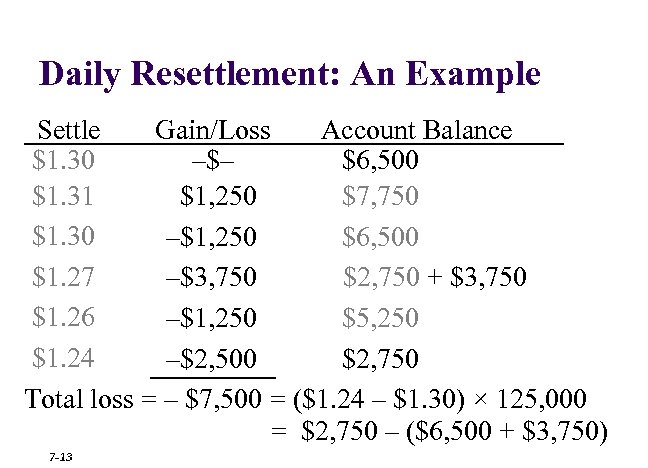 Daily Resettlement: An Example Settle Gain/Loss Account Balance $1. 30 –$– $6, 500 $1. 31 $1, 250 $7, 750 $1. 30 –$1, 250 $6, 500 $1. 27 –$3, 750 $2, 750 + $3, 750 $1. 26 –$1, 250 $5, 250 $1. 24 –$2, 500 $2, 750 Total loss = – $7, 500 = ($1. 24 – $1. 30) × 125, 000 = $2, 750 – ($6, 500 + $3, 750) 7 -13
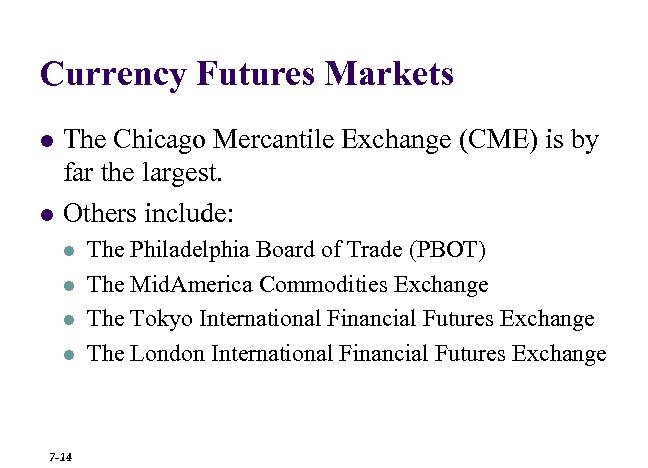 Currency Futures Markets l l The Chicago Mercantile Exchange (CME) is by far the largest. Others include: l l 7 -14 The Philadelphia Board of Trade (PBOT) The Mid. America Commodities Exchange The Tokyo International Financial Futures Exchange The London International Financial Futures Exchange
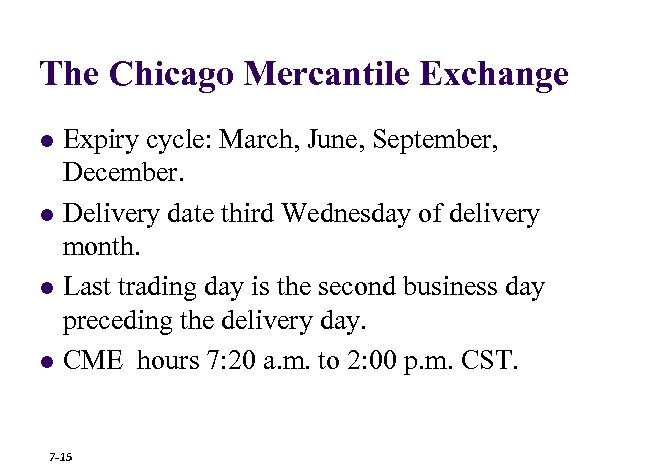 The Chicago Mercantile Exchange l l Expiry cycle: March, June, September, December. Delivery date third Wednesday of delivery month. Last trading day is the second business day preceding the delivery day. CME hours 7: 20 a. m. to 2: 00 p. m. CST. 7 -15
 CME After Hours l l l Extended-hours trading on GLOBEX runs from 2: 30 p. m. to 4: 00 p. m dinner break and then back at it from 6: 00 p. m. to 6: 00 a. m. CST. The Singapore Exchange offers interchangeable contracts. There are other markets, but none are close to CME and SIMEX trading volume. 7 -16
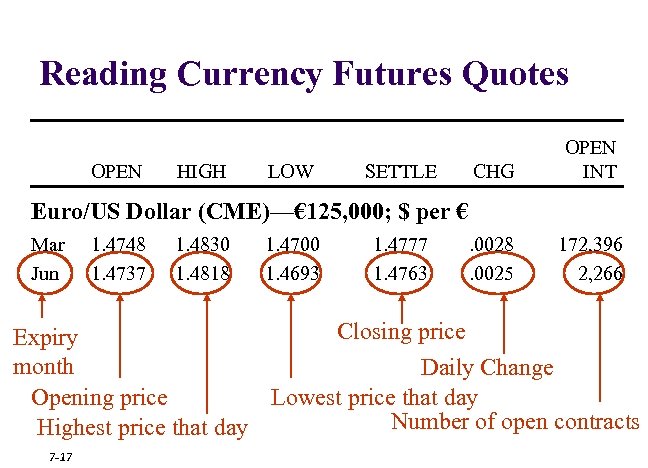 Reading Currency Futures Quotes OPEN HIGH LOW SETTLE CHG OPEN INT . 0028. 0025 172, 396 2, 266 Euro/US Dollar (CME)—€ 125, 000; $ per € Mar Jun 1. 4748 1. 4737 1. 4830 1. 4818 1. 4700 1. 4693 1. 4777 1. 4763 Closing price Expiry month Daily Change Opening price Lowest price that day Number of open contracts Highest price that day 7 -17
 Basic Currency Futures Relationships l l l Open Interest refers to the number of contracts outstanding for a particular delivery month. Open interest is a good proxy for demand for a contract. Some refer to open interest as the depth of the market. The breadth of the market would be how many different contracts (expiry month, currency) are outstanding. 7 -18
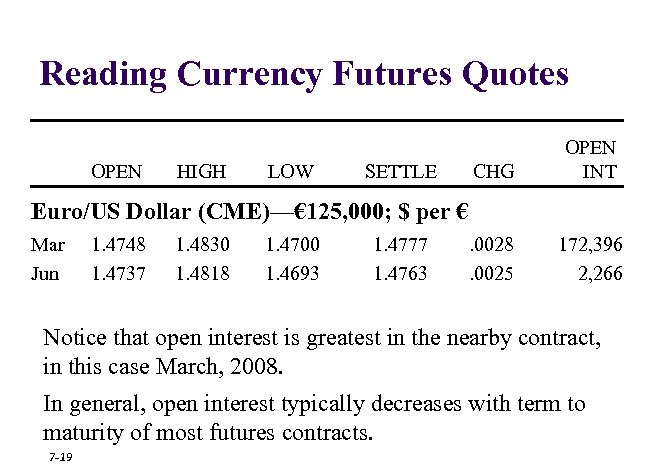 Reading Currency Futures Quotes OPEN HIGH LOW SETTLE CHG OPEN INT . 0028. 0025 172, 396 2, 266 Euro/US Dollar (CME)—€ 125, 000; $ per € Mar Jun 1. 4748 1. 4737 1. 4830 1. 4818 1. 4700 1. 4693 1. 4777 1. 4763 Notice that open interest is greatest in the nearby contract, in this case March, 2008. In general, open interest typically decreases with term to maturity of most futures contracts. 7 -19
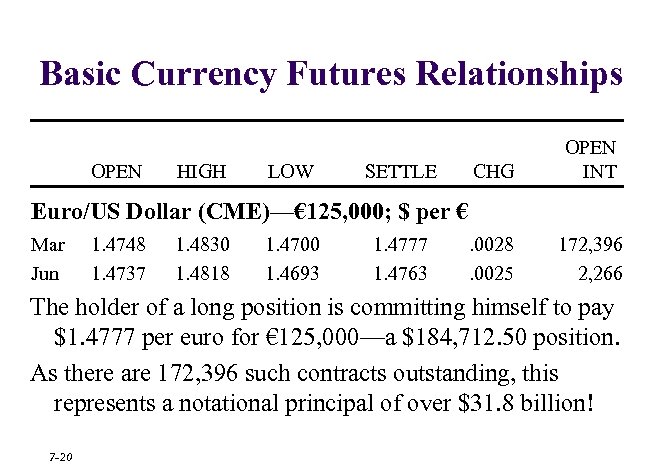 Basic Currency Futures Relationships OPEN HIGH LOW SETTLE CHG OPEN INT . 0028. 0025 172, 396 2, 266 Euro/US Dollar (CME)—€ 125, 000; $ per € Mar Jun 1. 4748 1. 4737 1. 4830 1. 4818 1. 4700 1. 4693 1. 4777 1. 4763 The holder of a long position is committing himself to pay $1. 4777 per euro for € 125, 000—a $184, 712. 50 position. As there are 172, 396 such contracts outstanding, this represents a notational principal of over $31. 8 billion! 7 -20
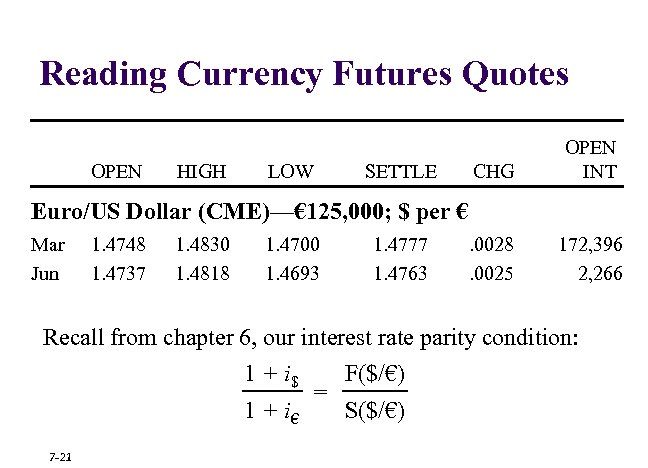 Reading Currency Futures Quotes OPEN HIGH LOW SETTLE CHG OPEN INT . 0028. 0025 172, 396 2, 266 Euro/US Dollar (CME)—€ 125, 000; $ per € Mar Jun 1. 4748 1. 4737 1. 4830 1. 4818 1. 4700 1. 4693 1. 4777 1. 4763 Recall from chapter 6, our interest rate parity condition: 1 + i$ F($/€) = 1 + i€ S($/€) 7 -21
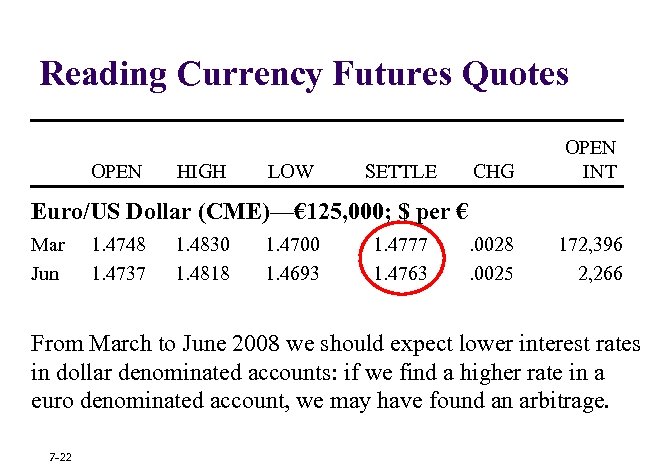 Reading Currency Futures Quotes OPEN HIGH LOW SETTLE CHG OPEN INT . 0028. 0025 172, 396 2, 266 Euro/US Dollar (CME)—€ 125, 000; $ per € Mar Jun 1. 4748 1. 4737 1. 4830 1. 4818 1. 4700 1. 4693 1. 4777 1. 4763 From March to June 2008 we should expect lower interest rates in dollar denominated accounts: if we find a higher rate in a euro denominated account, we may have found an arbitrage. 7 -22
 Eurodollar Interest Rate Futures Contracts l l Widely used futures contract for hedging shortterm U. S. dollar interest rate risk. The underlying asset is a hypothetical $1, 000 90 -day Eurodollar deposit—the contract is cash settled. Traded on the CME and the Singapore International Monetary Exchange. The contract trades in the March, June, September and December cycle. 7 -23
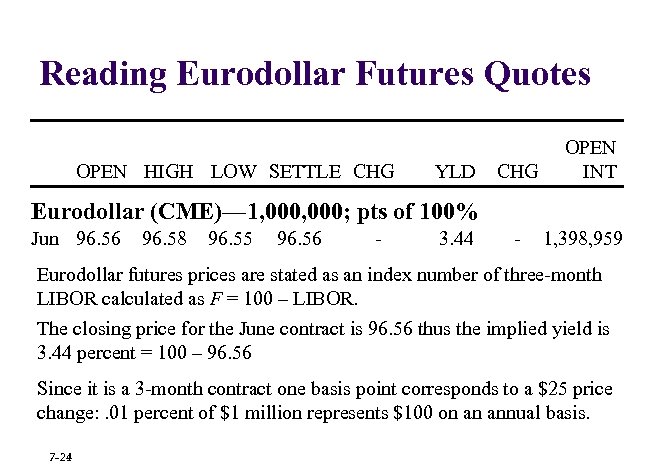 Reading Eurodollar Futures Quotes OPEN HIGH LOW SETTLE CHG YLD CHG OPEN INT Eurodollar (CME)— 1, 000; pts of 100% Jun 96. 56 96. 58 96. 55 96. 56 - 3. 44 - 1, 398, 959 Eurodollar futures prices are stated as an index number of three-month LIBOR calculated as F = 100 – LIBOR. The closing price for the June contract is 96. 56 thus the implied yield is 3. 44 percent = 100 – 96. 56 Since it is a 3 -month contract one basis point corresponds to a $25 price change: . 01 percent of $1 million represents $100 on an annual basis. 7 -24
 Trading irregularities l Futures Markets are also a great place to launder money l 7 -25 The zero sum nature of futures is the key to laundering the money.
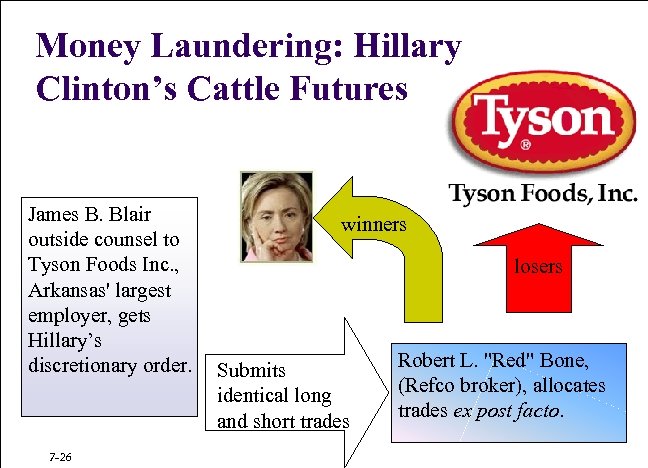 Money Laundering: Hillary Clinton’s Cattle Futures James B. Blair outside counsel to Tyson Foods Inc. , Arkansas' largest employer, gets Hillary’s discretionary order. 7 -26 winners Submits identical long and short trades losers Robert L. "Red" Bone, (Refco broker), allocates trades ex post facto.
 Options Contracts: Preliminaries l l An option gives the holder the right, but not the obligation, to buy or sell a given quantity of an asset in the future, at prices agreed upon today. Calls vs. Puts l l 7 -27 Call options gives the holder the right, but not the obligation, to buy a given quantity of some asset at some time in the future, at prices agreed upon today. Put options gives the holder the right, but not the obligation, to sell a given quantity of some asset at some time in the future, at prices agreed upon today.
 Options Contracts: Preliminaries l European vs. American options l l l 7 -28 European options can only be exercised on the expiration date. American options can be exercised at any time up to and including the expiration date. Since this option to exercise early generally has value, American options are usually worth more than European options, other things equal.
 Options Contracts: Preliminaries l In-the-money l l At-the-money l l The exercise price is less than the spot price of the underlying asset. The exercise price is equal to the spot price of the underlying asset. Out-of-the-money l 7 -29 The exercise price is more than the spot price of the underlying asset.
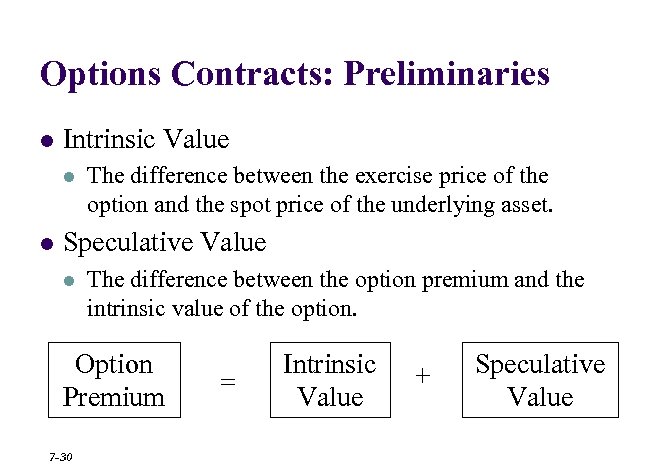 Options Contracts: Preliminaries l Intrinsic Value l l The difference between the exercise price of the option and the spot price of the underlying asset. Speculative Value l The difference between the option premium and the intrinsic value of the option. Option Premium 7 -30 = Intrinsic Value + Speculative Value
 Currency Options Markets l l l PHLX HKFE 20 -hour trading day. OTC volume is much bigger than exchange volume. Trading is in six major currencies against the U. S. dollar. 7 -31
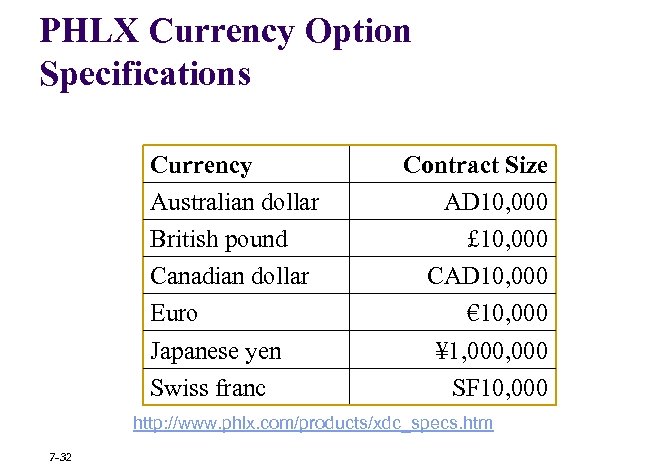 PHLX Currency Option Specifications Currency Australian dollar British pound Canadian dollar Euro Japanese yen Swiss franc Contract Size AD 10, 000 £ 10, 000 CAD 10, 000 € 10, 000 ¥ 1, 000 SF 10, 000 http: //www. phlx. com/products/xdc_specs. htm 7 -32
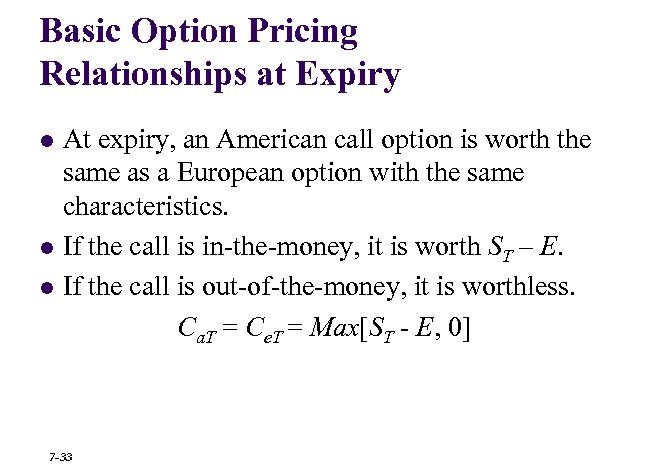 Basic Option Pricing Relationships at Expiry l l l At expiry, an American call option is worth the same as a European option with the same characteristics. If the call is in-the-money, it is worth ST – E. If the call is out-of-the-money, it is worthless. Ca. T = Ce. T = Max[ST - E, 0] 7 -33
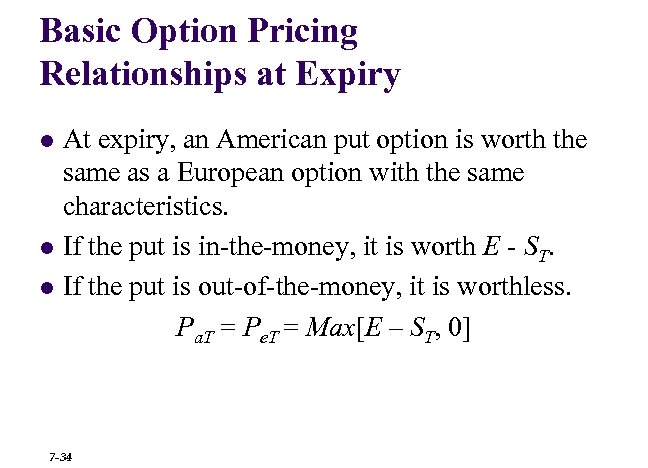 Basic Option Pricing Relationships at Expiry l l l At expiry, an American put option is worth the same as a European option with the same characteristics. If the put is in-the-money, it is worth E - ST. If the put is out-of-the-money, it is worthless. Pa. T = Pe. T = Max[E – ST, 0] 7 -34
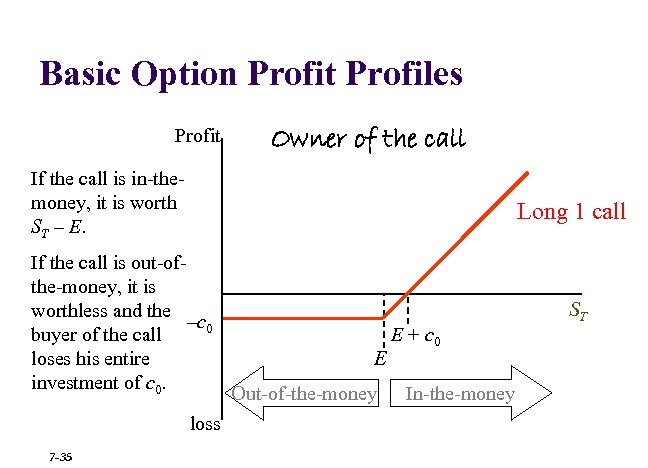 Basic Option Profit Profiles Profit Owner of the call If the call is in-themoney, it is worth ST – E. Long 1 call If the call is out-ofthe-money, it is worthless and the –c 0 buyer of the call loses his entire investment of c 0. loss 7 -35 E Out-of-the-money E + c 0 In-the-money ST
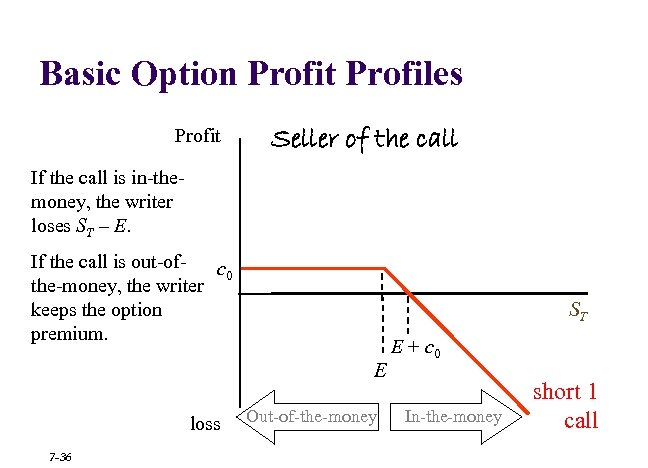 Basic Option Profit Profiles Profit Seller of the call If the call is in-themoney, the writer loses ST – E. If the call is out-ofc 0 the-money, the writer keeps the option premium. ST E loss 7 -36 Out-of-the-money E + c 0 In-the-money short 1 call
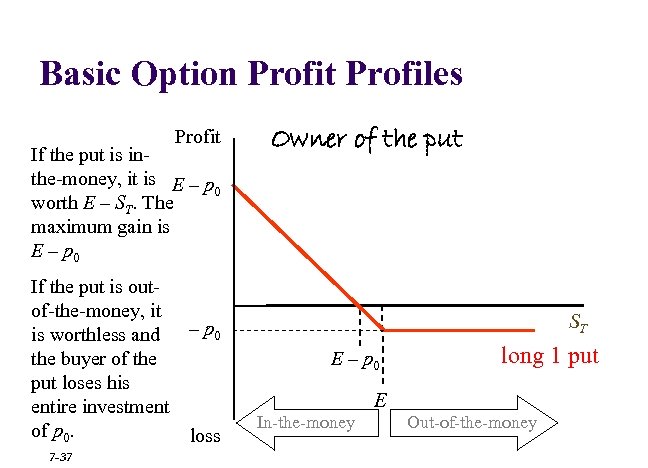 Basic Option Profit Profiles Profit If the put is inthe-money, it is E – p 0 worth E – ST. The maximum gain is E – p 0 If the put is outof-the-money, it is worthless and – p 0 the buyer of the put loses his entire investment of p 0. loss 7 -37 Owner of the put ST E – p 0 long 1 put E In-the-money Out-of-the-money
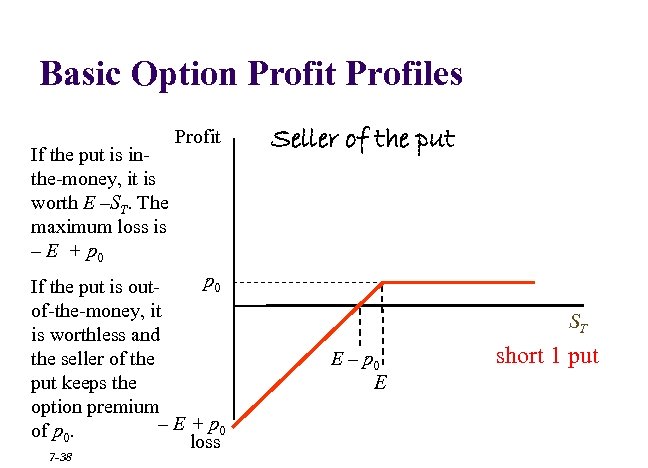 Basic Option Profit Profiles If the put is inthe-money, it is worth E –ST. The maximum loss is – E + p 0 Profit p 0 If the put is outof-the-money, it is worthless and the seller of the put keeps the option premium – E + p 0 of p 0. loss 7 -38 Seller of the put ST E – p 0 E short 1 put
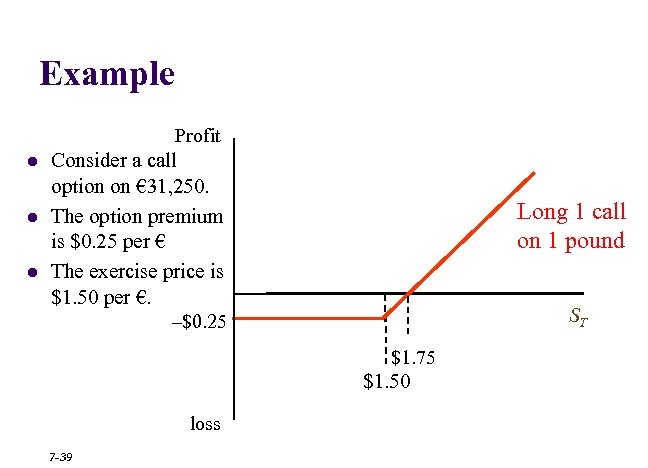 Example Profit l l l Consider a call option on € 31, 250. The option premium is $0. 25 per € The exercise price is $1. 50 per €. –$0. 25 Long 1 call on 1 pound ST $1. 75 $1. 50 loss 7 -39
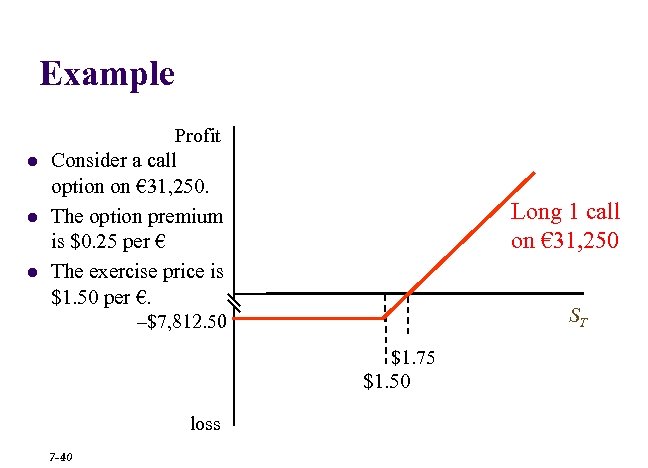 Example Profit l l l Consider a call option on € 31, 250. The option premium is $0. 25 per € The exercise price is $1. 50 per €. –$7, 812. 50 Long 1 call on € 31, 250 ST $1. 75 $1. 50 loss 7 -40
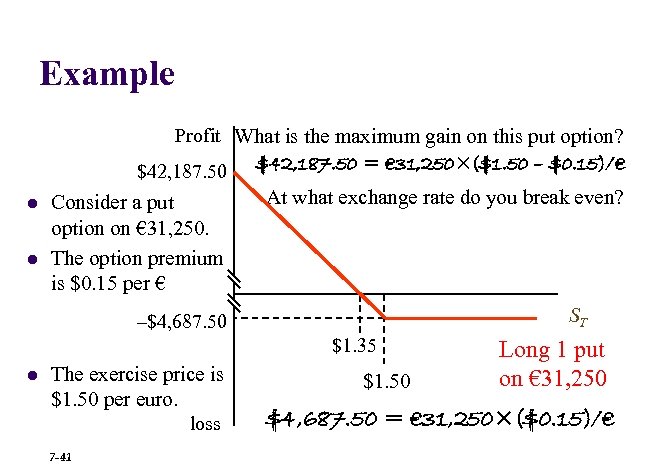 Example Profit What is the maximum gain on this put option? $42, 187. 50 = € 31, 250×($1. 50 – $0. 15)/€ l l Consider a put option on € 31, 250. The option premium is $0. 15 per € At what exchange rate do you break even? ST –$4, 687. 50 $1. 35 l The exercise price is $1. 50 per euro. loss 7 -41 $1. 50 Long 1 put on € 31, 250 $4, 687. 50 = € 31, 250×($0. 15)/€
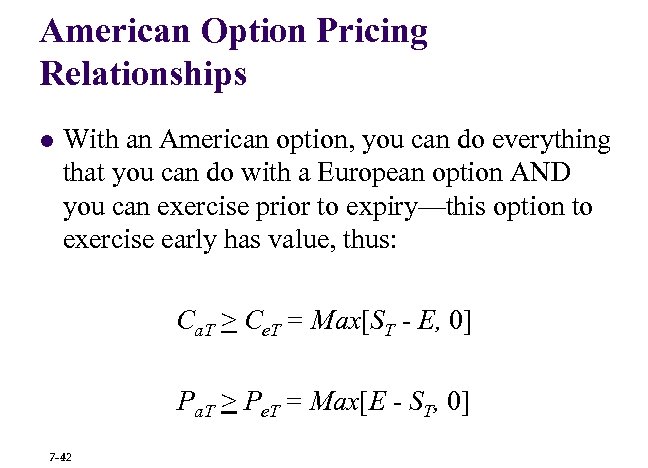 American Option Pricing Relationships l With an American option, you can do everything that you can do with a European option AND you can exercise prior to expiry—this option to exercise early has value, thus: Ca. T > Ce. T = Max[ST - E, 0] Pa. T > Pe. T = Max[E - ST, 0] 7 -42
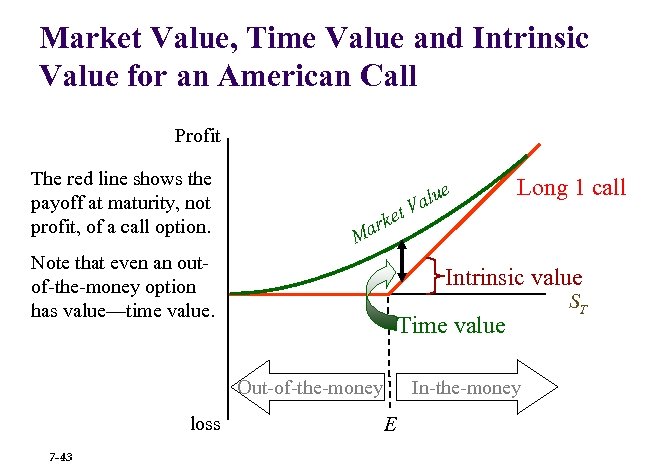 Market Value, Time Value and Intrinsic Value for an American Call Profit The red line shows the payoff at maturity, not profit, of a call option. t e ark Intrinsic value Time value Out-of-the-money 7 -43 Long 1 call M Note that even an outof-the-money option has value—time value. loss e alu V In-the-money E ST
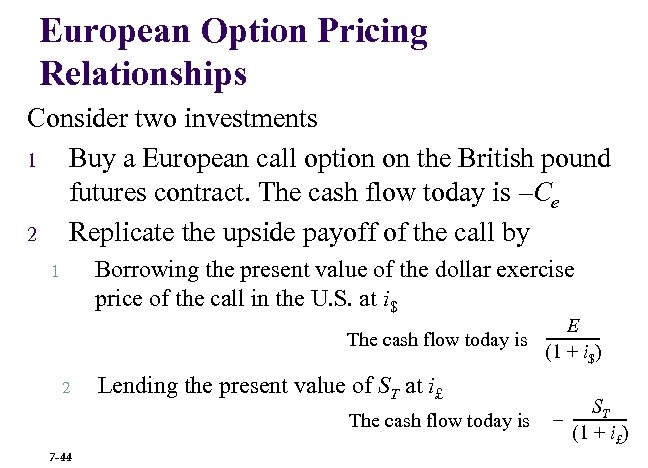 European Option Pricing Relationships Consider two investments 1 Buy a European call option on the British pound futures contract. The cash flow today is –Ce 2 Replicate the upside payoff of the call by Borrowing the present value of the dollar exercise price of the call in the U. S. at i$ 1 E The cash flow today is (1 + i$) 2 Lending the present value of ST at i£ The cash flow today is – 7 -44 ST (1 + i£)
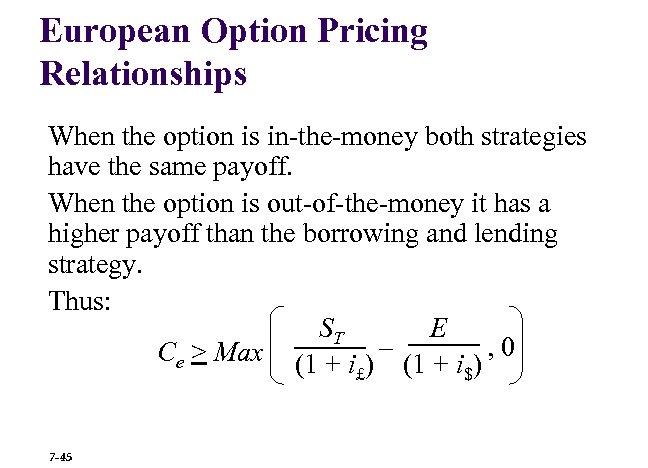 European Option Pricing Relationships When the option is in-the-money both strategies have the same payoff. When the option is out-of-the-money it has a higher payoff than the borrowing and lending strategy. Thus: ST E Ce > Max (1 + i ) – (1 + i ) , 0 £ $ 7 -45
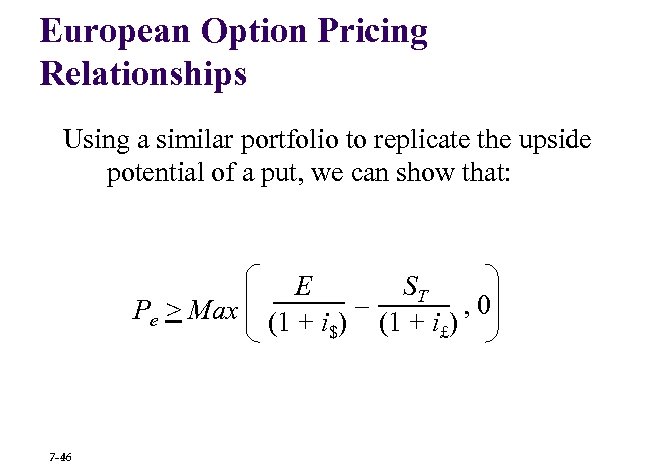 European Option Pricing Relationships Using a similar portfolio to replicate the upside potential of a put, we can show that: Pe > Max 7 -46 E ST – , 0 (1 + i$) (1 + i£)
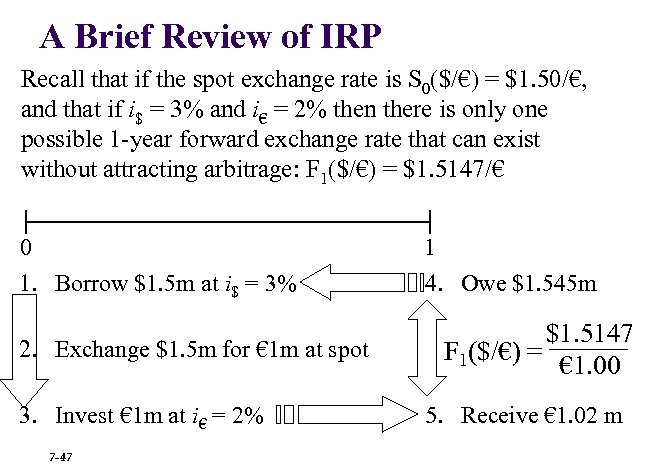 A Brief Review of IRP Recall that if the spot exchange rate is S 0($/€) = $1. 50/€, and that if i$ = 3% and i€ = 2% then there is only one possible 1 -year forward exchange rate that can exist without attracting arbitrage: F 1($/€) = $1. 5147/€ 0 1 1. Borrow $1. 5 m at i$ = 3% 4. Owe $1. 545 m 2. Exchange $1. 5 m for € 1 m at spot 3. Invest € 1 m at i€ = 2% 7 -47 $1. 5147 F 1($/€) = € 1. 00 5. Receive € 1. 02 m
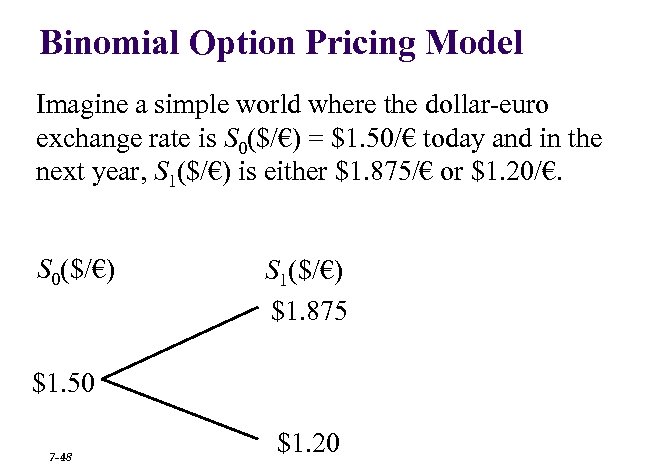 Binomial Option Pricing Model Imagine a simple world where the dollar-euro exchange rate is S 0($/€) = $1. 50/€ today and in the next year, S 1($/€) is either $1. 875/€ or $1. 20/€. S 0($/€) S 1($/€) $1. 875 $1. 50 7 -48 $1. 20
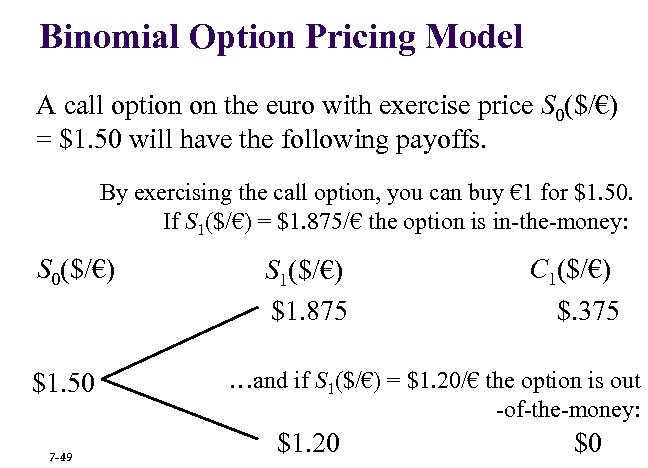 Binomial Option Pricing Model A call option on the euro with exercise price S 0($/€) = $1. 50 will have the following payoffs. By exercising the call option, you can buy € 1 for $1. 50. If S 1($/€) = $1. 875/€ the option is in-the-money: S 0($/€) $1. 50 7 -49 S 1($/€) $1. 875 C 1($/€) $. 375 …and if S 1($/€) = $1. 20/€ the option is out -of-the-money: $1. 20 $0
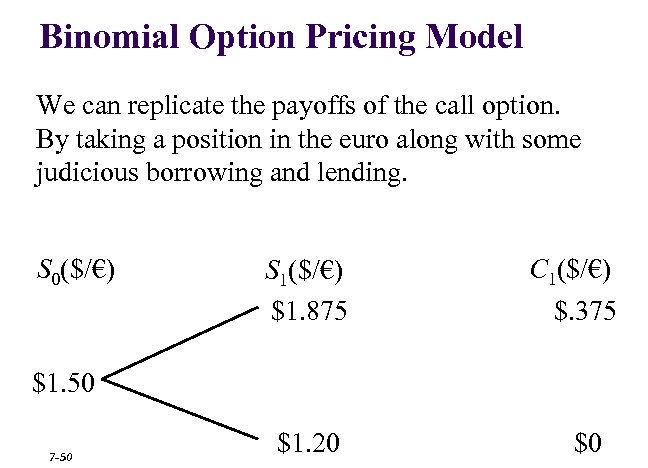 Binomial Option Pricing Model We can replicate the payoffs of the call option. By taking a position in the euro along with some judicious borrowing and lending. S 0($/€) S 1($/€) $1. 875 C 1($/€) $. 375 $1. 50 7 -50 $1. 20 $0
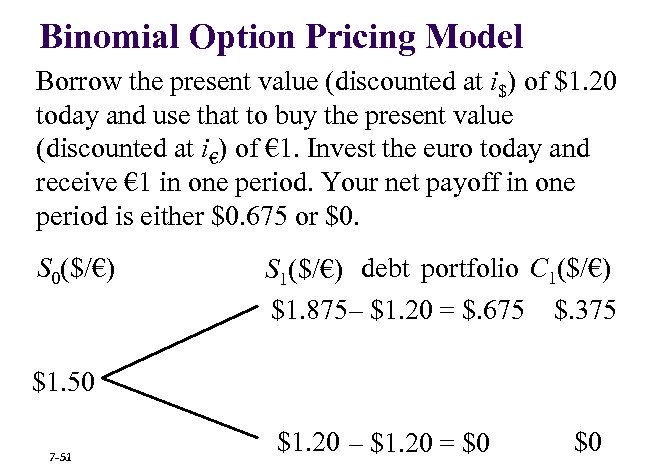 Binomial Option Pricing Model Borrow the present value (discounted at i$) of $1. 20 today and use that to buy the present value (discounted at i€) of € 1. Invest the euro today and receive € 1 in one period. Your net payoff in one period is either $0. 675 or $0. S 0($/€) S 1($/€) debt portfolio C 1($/€) $1. 875 – $1. 20 = $. 675 $. 375 $1. 50 7 -51 $1. 20 – $1. 20 = $0 $0
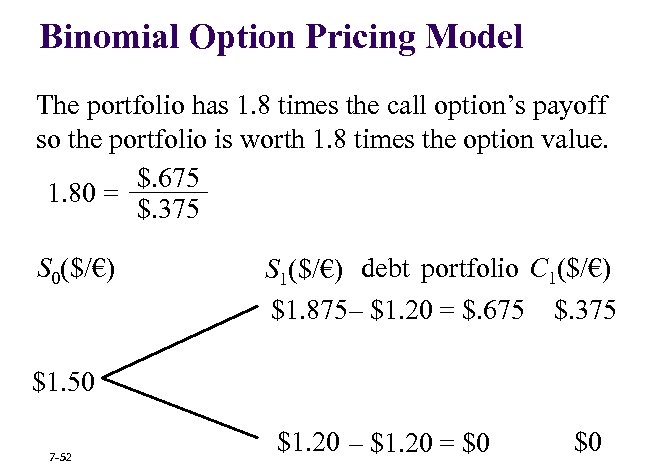 Binomial Option Pricing Model The portfolio has 1. 8 times the call option’s payoff so the portfolio is worth 1. 8 times the option value. $. 675 1. 80 = $. 375 S 0($/€) S 1($/€) debt portfolio C 1($/€) $1. 875 – $1. 20 = $. 675 $. 375 $1. 50 7 -52 $1. 20 – $1. 20 = $0 $0
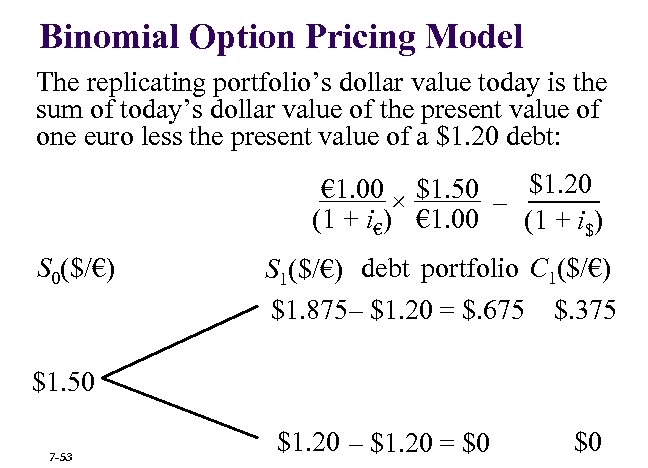 Binomial Option Pricing Model The replicating portfolio’s dollar value today is the sum of today’s dollar value of the present value of one euro less the present value of a $1. 20 debt: € 1. 00 × $1. 50 – $1. 20 (1 + i€) € 1. 00 (1 + i$) S 0($/€) S 1($/€) debt portfolio C 1($/€) $1. 875 – $1. 20 = $. 675 $. 375 $1. 50 7 -53 $1. 20 – $1. 20 = $0 $0
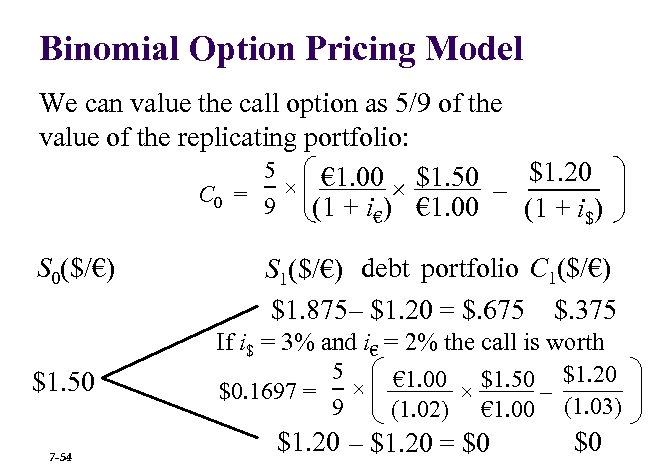 Binomial Option Pricing Model We can value the call option as 5/9 of the value of the replicating portfolio: 5 $1. 20 × € 1. 00 × $1. 50 – C 0 = 9 (1 + i€) € 1. 00 (1 + i$) S 0($/€) $1. 50 7 -54 S 1($/€) debt portfolio C 1($/€) $1. 875– $1. 20 = $. 675 $. 375 If i$ = 3% and i€ = 2% the call is worth 5 € 1. 00 $1. 50 – $1. 20 $0. 1697 = × × 9 (1. 02) € 1. 00 (1. 03) $1. 20 – $1. 20 = $0 $0
 Binomial Option Pricing Model l The most important lesson from the binomial option pricing model is: the replicating portfolio intuition. l Many derivative securities can be valued by valuing portfolios of primitive securities when those portfolios have the same payoffs as the derivative securities. 7 -55
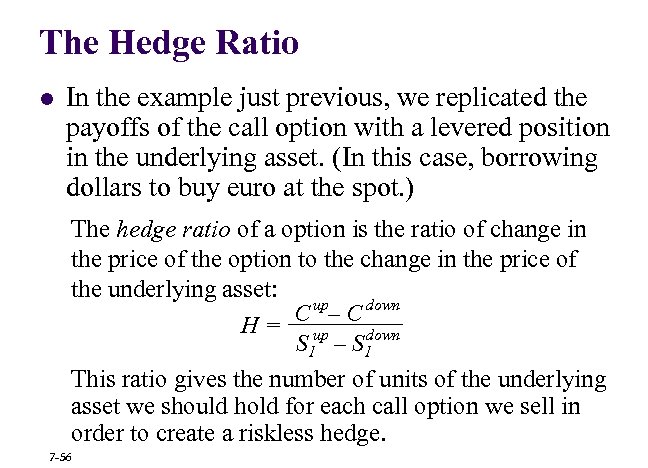 The Hedge Ratio l In the example just previous, we replicated the payoffs of the call option with a levered position in the underlying asset. (In this case, borrowing dollars to buy euro at the spot. ) The hedge ratio of a option is the ratio of change in the price of the option to the change in the price of the underlying asset: C up– C down H = up down S 1 – S 1 This ratio gives the number of units of the underlying asset we should hold for each call option we sell in order to create a riskless hedge. 7 -56
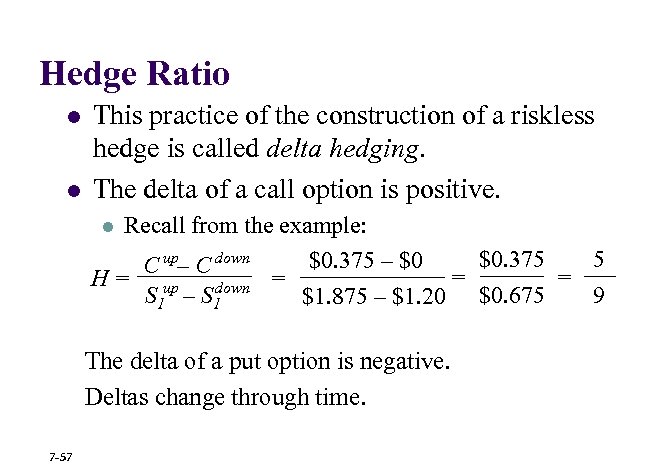 Hedge Ratio l l This practice of the construction of a riskless hedge is called delta hedging. The delta of a call option is positive. Recall from the example: $0. 375 5 $0. 375 – $0 C up– C down = = H = up down = 9 S 1 – S 1 $1. 875 – $1. 20 $0. 675 l The delta of a put option is negative. Deltas change through time. 7 -57
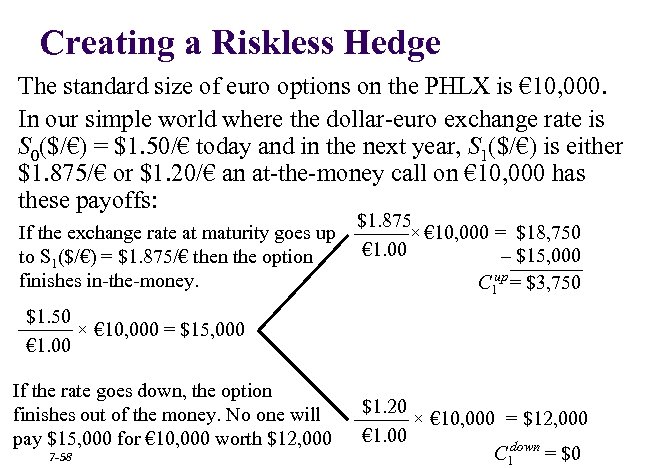 Creating a Riskless Hedge The standard size of euro options on the PHLX is € 10, 000. In our simple world where the dollar-euro exchange rate is S 0($/€) = $1. 50/€ today and in the next year, S 1($/€) is either $1. 875/€ or $1. 20/€ an at-the-money call on € 10, 000 has these payoffs: If the exchange rate at maturity goes up to S 1($/€) = $1. 875/€ then the option finishes in-the-money. $1. 875 × € 10, 000 = $18, 750 € 1. 00 – $15, 000 up C 1 = $3, 750 $1. 50 × € 10, 000 = $15, 000 € 1. 00 If the rate goes down, the option finishes out of the money. No one will pay $15, 000 for € 10, 000 worth $12, 000 7 -58 $1. 20 × € 10, 000 = $12, 000 € 1. 00 down C 1 = $0
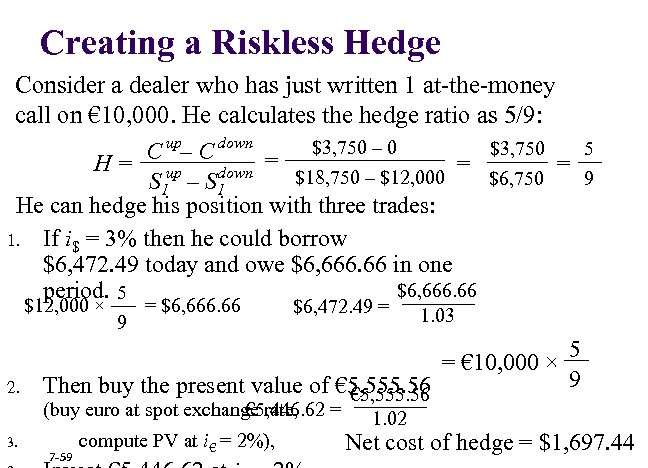 Creating a Riskless Hedge Consider a dealer who has just written 1 at-the-money call on € 10, 000. He calculates the hedge ratio as 5/9: $3, 750 C up– C down = $3, 750 – 0 = = H = up down $18, 750 – $12, 000 $6, 750 S 1 – S 1 He can hedge his position with three trades: 1. If i$ = 3% then he could borrow $6, 472. 49 today and owe $6, 666. 66 in one $6, 666. 66 period. 5 $12, 000 × = $6, 666. 66 9 2. $6, 472. 49 = 1. 03 Then buy the present value of € 5, 555. 56 (buy euro at spot exchange rate, € 5, 446. 62 = 3. 7 -59 compute PV at i€ = 2%), 1. 02 5 9 = € 10, 000 × 5 9 Net cost of hedge = $1, 697. 44
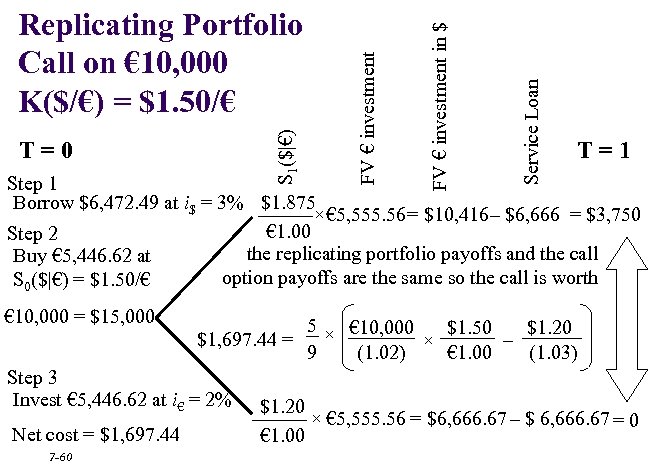 Service Loan FV € investment in $ T=0 FV € investment S 1($|€) Replicating Portfolio Call on € 10, 000 K($/€) = $1. 50/€ T=1 Step 1 Borrow $6, 472. 49 at i$ = 3% $1. 875 × € 5, 555. 56 = $10, 416 – $6, 666 = $3, 750 € 1. 00 Step 2 the replicating portfolio payoffs and the call Buy € 5, 446. 62 at option payoffs are the same so the call is worth S 0($|€) = $1. 50/€ € 10, 000 = $15, 000 5 × € 10, 000 $1. 20 $1. 50 $1, 697. 44 = – × 9 (1. 02) € 1. 00 (1. 03) Step 3 Invest € 5, 446. 62 at i€ = 2% Net cost = $1, 697. 44 7 -60 $1. 20 × € 5, 555. 56 = $6, 666. 67 – $ 6, 666. 67 = 0 € 1. 00
 Risk Neutral Valuation of Options l Calculating the hedge ratio is vitally important if you are going to use options. l l 7 -61 The seller needs to know it if he wants to protect his profits or eliminate his downside risk. The buyer needs to use the hedge ratio to inform his decision on how many options to buy. Knowing what the hedge ratio is isn’t especially important if you are trying to value options. Risk Neutral Valuation is a very hand shortcut to valuation.
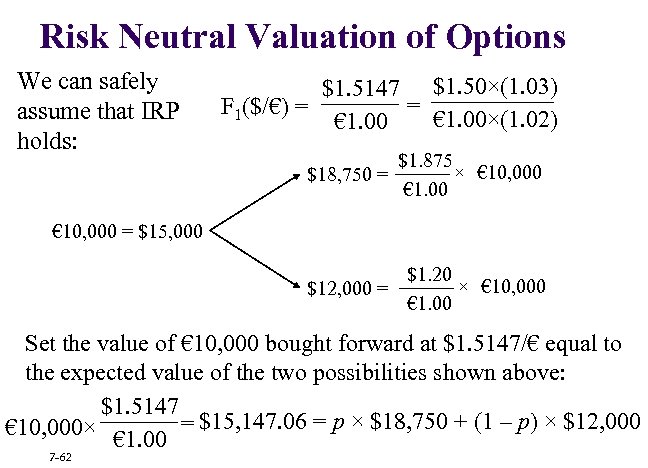 Risk Neutral Valuation of Options We can safely assume that IRP holds: $1. 5147 $1. 50×(1. 03) = F 1($/€) = € 1. 00×(1. 02) € 1. 00 $1. 875 × € 10, 000 $18, 750 = € 1. 00 € 10, 000 = $15, 000 $12, 000 = $1. 20 × € 10, 000 € 1. 00 Set the value of € 10, 000 bought forward at $1. 5147/€ equal to the expected value of the two possibilities shown above: $1. 5147 € 10, 000× € 1. 00 = $15, 147. 06 = p × $18, 750 + (1 – p) × $12, 000 7 -62
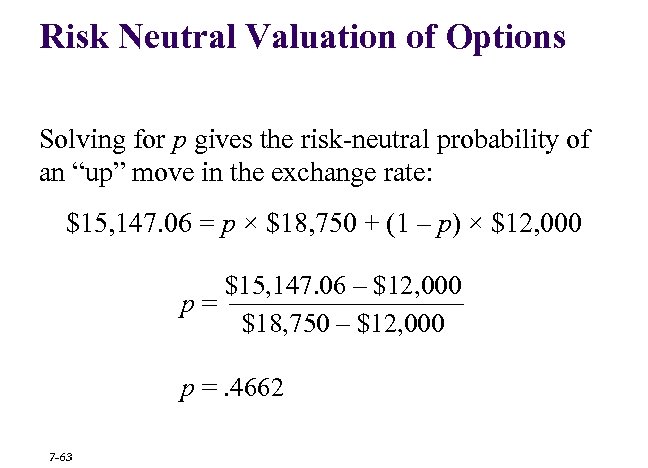 Risk Neutral Valuation of Options Solving for p gives the risk-neutral probability of an “up” move in the exchange rate: $15, 147. 06 = p × $18, 750 + (1 – p) × $12, 000 $15, 147. 06 – $12, 000 p = $18, 750 – $12, 000 p =. 4662 7 -63
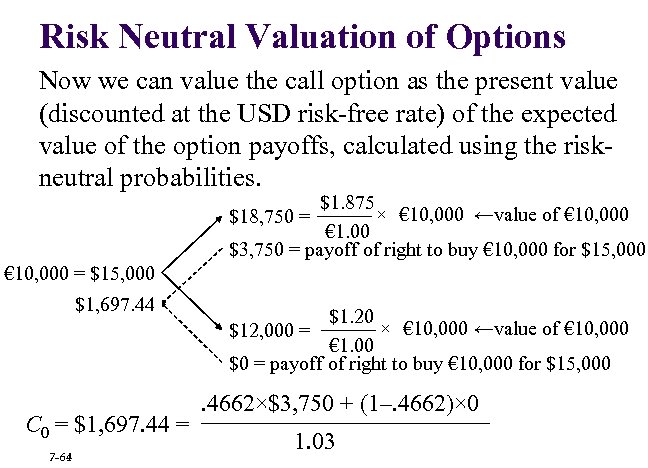 Risk Neutral Valuation of Options Now we can value the call option as the present value (discounted at the USD risk-free rate) of the expected value of the option payoffs, calculated using the riskneutral probabilities. $1. 875 × € 10, 000 ←value of € 10, 000 € 1. 00 $3, 750 = payoff of right to buy € 10, 000 for $15, 000 $18, 750 = € 10, 000 = $15, 000 $1, 697. 44 C 0 = $1, 697. 44 = 7 -64 $1. 20 × € 10, 000 ←value of € 10, 000 $12, 000 = € 1. 00 $0 = payoff of right to buy € 10, 000 for $15, 000 . 4662×$3, 750 + (1–. 4662)× 0 1. 03
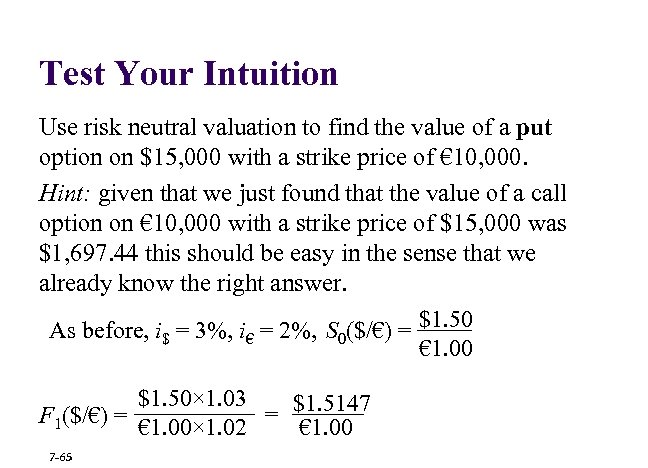 Test Your Intuition Use risk neutral valuation to find the value of a put option on $15, 000 with a strike price of € 10, 000. Hint: given that we just found that the value of a call option on € 10, 000 with a strike price of $15, 000 was $1, 697. 44 this should be easy in the sense that we already know the right answer. As before, i$ = 3%, i€ = 2%, S 0($/€) = $1. 50 € 1. 00 $1. 50× 1. 03 $1. 5147 F 1($/€) = € 1. 00× 1. 02 = € 1. 00 7 -65
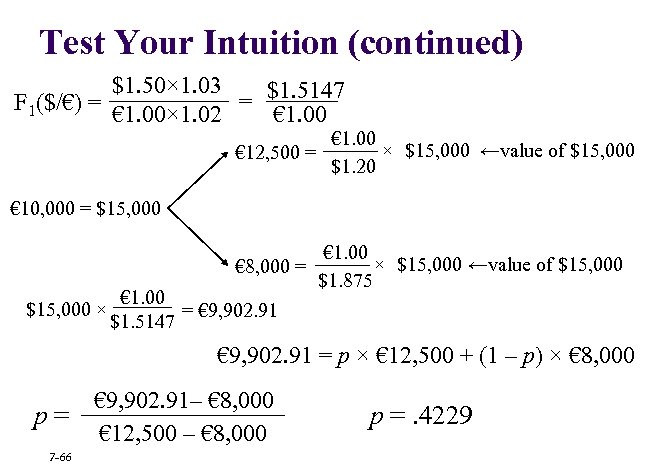 Test Your Intuition (continued) $1. 50× 1. 03 $1. 5147 F 1($/€) = € 1. 00× 1. 02 = € 1. 00 € 12, 500 = € 1. 00 × $15, 000 ←value of $15, 000 $1. 20 € 10, 000 = $15, 000 € 1. 00 × $15, 000 ←value of $15, 000 € 8, 000 = $1. 875 $15, 000 × € 1. 00 = € 9, 902. 91 $1. 5147 € 9, 902. 91 = p × € 12, 500 + (1 – p) × € 8, 000 p = 7 -66 € 9, 902. 91– € 8, 000 € 12, 500 – € 8, 000 p =. 4229
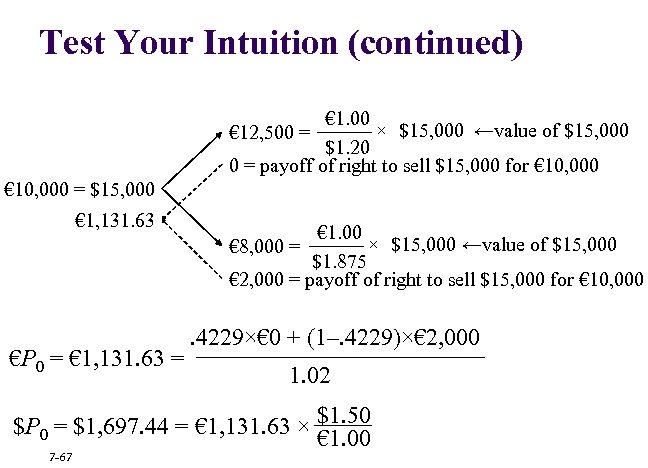 Test Your Intuition (continued) € 1. 00 × $15, 000 ←value of $15, 000 $1. 20 0 = payoff of right to sell $15, 000 for € 10, 000 € 12, 500 = € 10, 000 = $15, 000 € 1, 131. 63 € 1. 00 × $15, 000 ←value of $15, 000 € 8, 000 = $1. 875 € 2, 000 = payoff of right to sell $15, 000 for € 10, 000 . 4229×€ 0 + (1–. 4229)×€ 2, 000 €P 0 = € 1, 131. 63 = 1. 02 $P 0 = $1, 697. 44 = € 1, 131. 63 × $1. 50 € 1. 00 7 -67
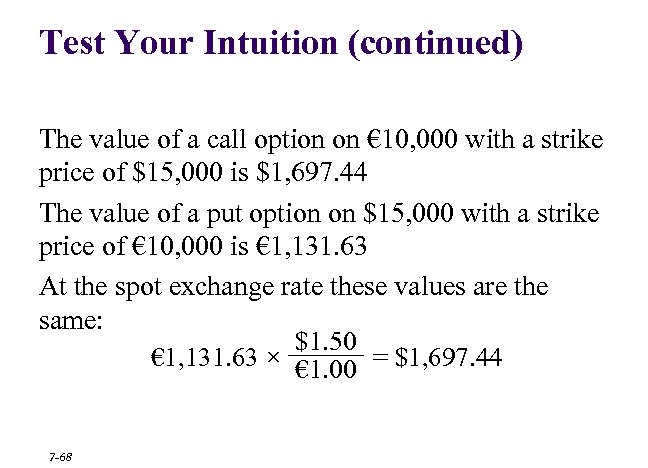 Test Your Intuition (continued) The value of a call option on € 10, 000 with a strike price of $15, 000 is $1, 697. 44 The value of a put option on $15, 000 with a strike price of € 10, 000 is € 1, 131. 63 At the spot exchange rate these values are the same: $1. 50 € 1, 131. 63 × € 1. 00 = $1, 697. 44 7 -68
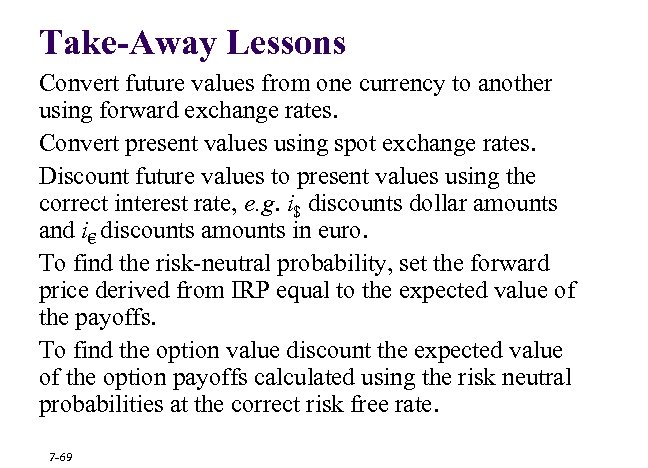 Take-Away Lessons Convert future values from one currency to another using forward exchange rates. Convert present values using spot exchange rates. Discount future values to present values using the correct interest rate, e. g. i$ discounts dollar amounts and i€ discounts amounts in euro. To find the risk-neutral probability, set the forward price derived from IRP equal to the expected value of the payoffs. To find the option value discount the expected value of the option payoffs calculated using the risk neutral probabilities at the correct risk free rate. 7 -69
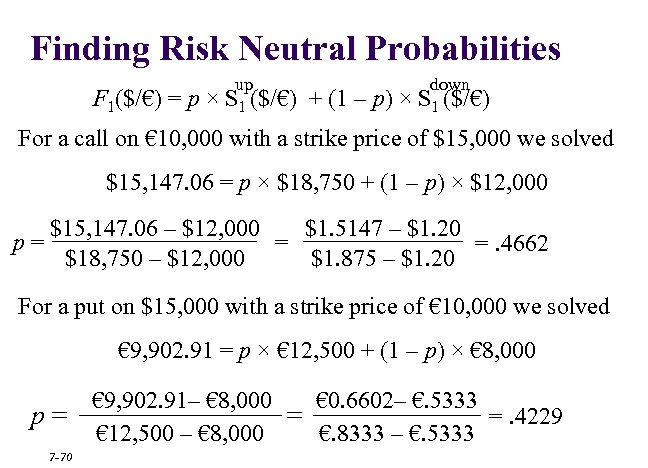 Finding Risk Neutral Probabilities up down F 1($/€) = p × S 1 ($/€) + (1 – p) × S 1 ($/€) For a call on € 10, 000 with a strike price of $15, 000 we solved $15, 147. 06 = p × $18, 750 + (1 – p) × $12, 000 $15, 147. 06 – $12, 000 $1. 5147 – $1. 20 p = = =. 4662 $18, 750 – $12, 000 $1. 875 – $1. 20 For a put on $15, 000 with a strike price of € 10, 000 we solved € 9, 902. 91 = p × € 12, 500 + (1 – p) × € 8, 000 p = 7 -70 € 9, 902. 91– € 8, 000 € 0. 6602– €. 5333 = =. 4229 € 12, 500 – € 8, 000 €. 8333 – €. 5333
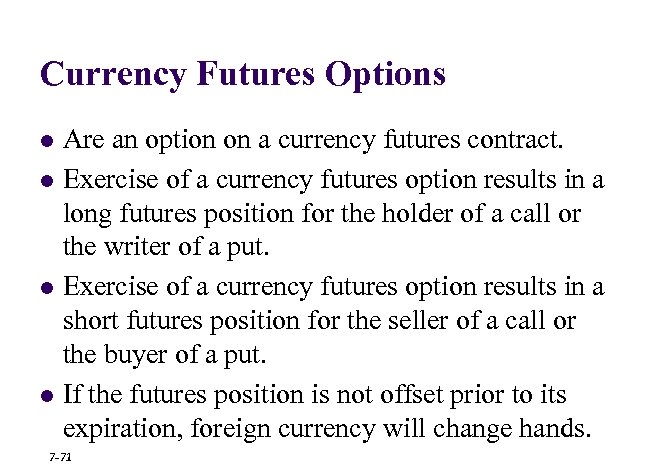 Currency Futures Options l l Are an option on a currency futures contract. Exercise of a currency futures option results in a long futures position for the holder of a call or the writer of a put. Exercise of a currency futures option results in a short futures position for the seller of a call or the buyer of a put. If the futures position is not offset prior to its expiration, foreign currency will change hands. 7 -71
 Currency Futures Options l l l Why a derivative on a derivative? Transactions costs and liquidity. For some assets, the futures contract can have lower transactions costs and greater liquidity than the underlying asset. Tax consequences matter as well, and for some users an option contract on a future is more tax efficient. The proof is in the fact that they exist. 7 -72
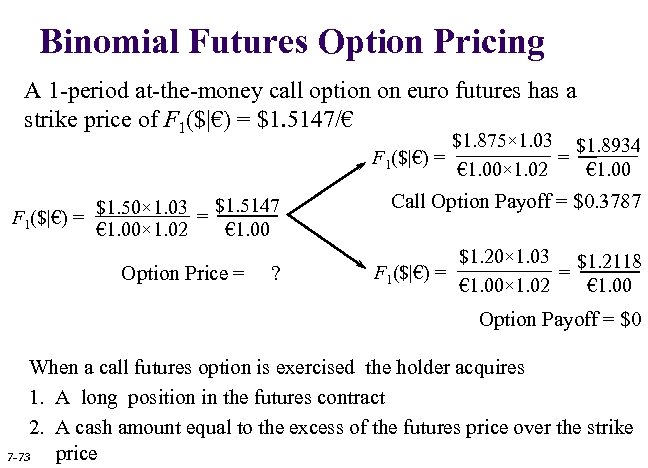 Binomial Futures Option Pricing A 1 -period at-the-money call option on euro futures has a strike price of F 1($|€) = $1. 5147/€ $1. 875× 1. 03 $1. 8934 = F 1($|€) = € 1. 00× 1. 02 € 1. 00 $1. 5147 F 1($|€) = $1. 50× 1. 03 = € 1. 00× 1. 02 € 1. 00 Option Price = ? Call Option Payoff = $0. 3787 $1. 20× 1. 03 $1. 2118 = F 1($|€) = € 1. 00× 1. 02 € 1. 00 Option Payoff = $0 When a call futures option is exercised the holder acquires 1. A long position in the futures contract 2. A cash amount equal to the excess of the futures price over the strike price 7 -73
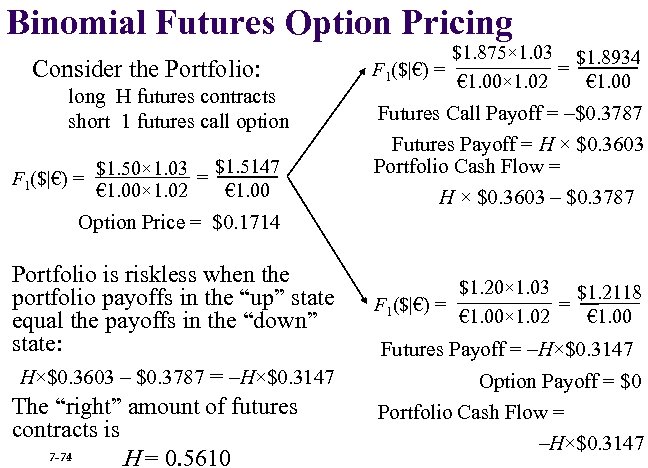 Binomial Futures Option Pricing Consider the Portfolio: long H futures contracts short 1 futures call option $1. 5147 F 1($|€) = $1. 50× 1. 03 = € 1. 00× 1. 02 € 1. 00 $1. 875× 1. 03 $1. 8934 = F 1($|€) = € 1. 00× 1. 02 € 1. 00 Futures Call Payoff = –$0. 3787 Futures Payoff = H × $0. 3603 Portfolio Cash Flow = H × $0. 3603 – $0. 3787 Option Price = $0. 1714 Portfolio is riskless when the portfolio payoffs in the “up” state equal the payoffs in the “down” state: H×$0. 3603 – $0. 3787 = –H×$0. 3147 The “right” amount of futures contracts is 7 -74 H = 0. 5610 $1. 20× 1. 03 $1. 2118 = F 1($|€) = € 1. 00× 1. 02 € 1. 00 Futures Payoff = –H×$0. 3147 Option Payoff = $0 Portfolio Cash Flow = –H×$0. 3147
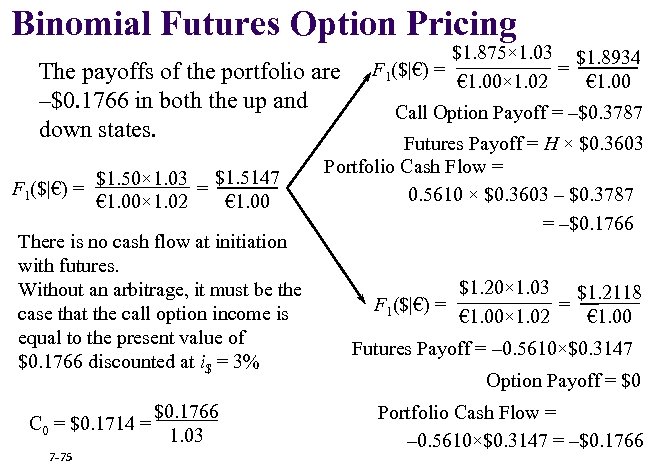 Binomial Futures Option Pricing The payoffs of the portfolio are –$0. 1766 in both the up and down states. $1. 5147 F 1($|€) = $1. 50× 1. 03 = € 1. 00× 1. 02 € 1. 00 There is no cash flow at initiation with futures. Without an arbitrage, it must be the case that the call option income is equal to the present value of $0. 1766 discounted at i$ = 3% C 0 = $0. 1714 = 7 -75 $0. 1766 1. 03 $1. 875× 1. 03 $1. 8934 = F 1($|€) = € 1. 00× 1. 02 € 1. 00 Call Option Payoff = –$0. 3787 Futures Payoff = H × $0. 3603 Portfolio Cash Flow = 0. 5610 × $0. 3603 – $0. 3787 = –$0. 1766 $1. 20× 1. 03 $1. 2118 = F 1($|€) = € 1. 00× 1. 02 € 1. 00 Futures Payoff = – 0. 5610×$0. 3147 Option Payoff = $0 Portfolio Cash Flow = – 0. 5610×$0. 3147 = –$0. 1766
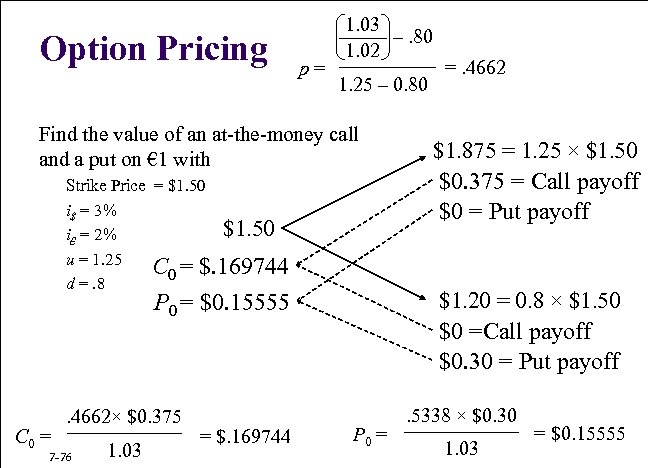 Option Pricing p = 1. 03 –. 80 1. 02 1. 25 – 0. 80 Find the value of an at-the-money call and a put on € 1 with Strike Price = $1. 50 i$ = 3% $1. 50 i€ = 2% u = 1. 25 C 0 = $. 169744 d =. 8 C 0 = 7 -76 1. 03 = $. 169744 $1. 875 = 1. 25 × $1. 50 $0. 375 = Call payoff $0 = Put payoff $1. 20 = 0. 8 × $1. 50 $0 =Call payoff $0. 30 = Put payoff P 0 = $0. 15555 . 4662× $0. 375 =. 4662 P 0 = . 5338 × $0. 30 1. 03 = $0. 15555
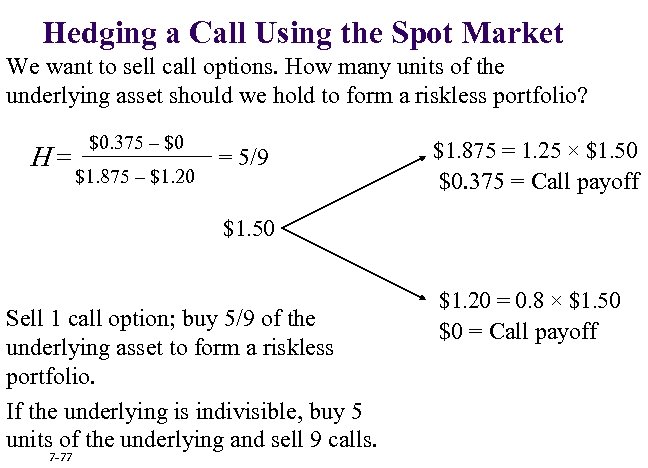 Hedging a Call Using the Spot Market We want to sell call options. How many units of the underlying asset should we hold to form a riskless portfolio? H = $0. 375 – $0 $1. 875 – $1. 20 = 5/9 $1. 875 = 1. 25 × $1. 50 $0. 375 = Call payoff $1. 50 Sell 1 call option; buy 5/9 of the underlying asset to form a riskless portfolio. If the underlying is indivisible, buy 5 units of the underlying and sell 9 calls. 7 -77 $1. 20 = 0. 8 × $1. 50 $0 = Call payoff
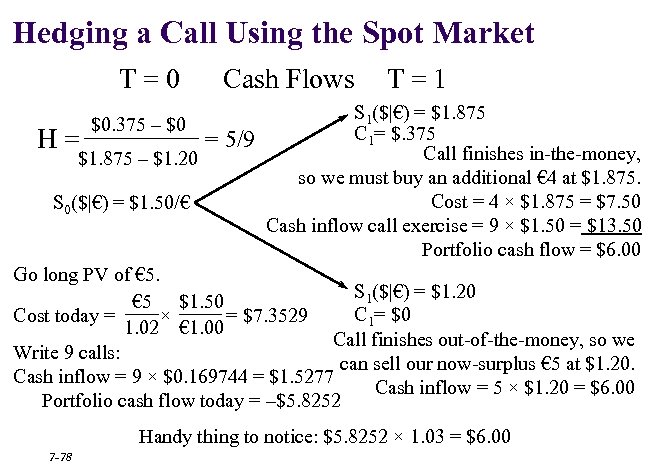 Hedging a Call Using the Spot Market T = 0 H = $0. 375 – $0 $1. 875 – $1. 20 S 0($|€) = $1. 50/€ Cash Flows = 5/9 T = 1 S 1($|€) = $1. 875 C 1= $. 375 Call finishes in-the-money, so we must buy an additional € 4 at $1. 875. Cost = 4 × $1. 875 = $7. 50 Cash inflow call exercise = 9 × $1. 50 = $13. 50 Portfolio cash flow = $6. 00 Go long PV of € 5. S 1($|€) = $1. 20 € 5 $1. 50 C 1= $0 × = $7. 3529 Cost today = 1. 02 € 1. 00 Call finishes out-of-the-money, so we Write 9 calls: can sell our now-surplus € 5 at $1. 20. Cash inflow = 9 × $0. 169744 = $1. 5277 Cash inflow = 5 × $1. 20 = $6. 00 Portfolio cash flow today = –$5. 8252 Handy thing to notice: $5. 8252 × 1. 03 = $6. 00 7 -78
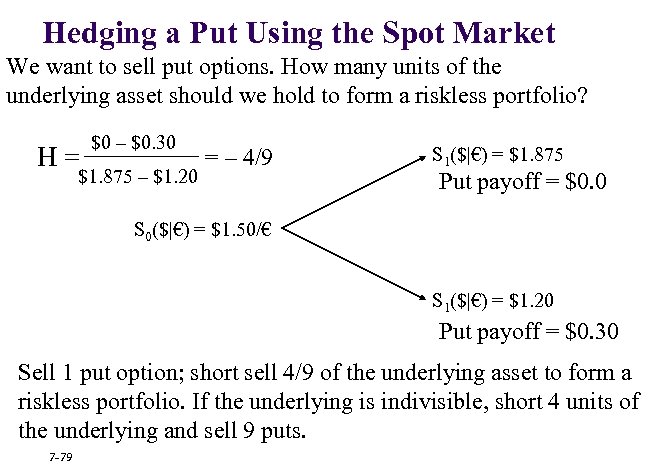 Hedging a Put Using the Spot Market We want to sell put options. How many units of the underlying asset should we hold to form a riskless portfolio? H = $0 – $0. 30 $1. 875 – $1. 20 = – 4/9 S 1($|€) = $1. 875 Put payoff = $0. 0 S 0($|€) = $1. 50/€ S 1($|€) = $1. 20 Put payoff = $0. 30 Sell 1 put option; short sell 4/9 of the underlying asset to form a riskless portfolio. If the underlying is indivisible, short 4 units of the underlying and sell 9 puts. 7 -79
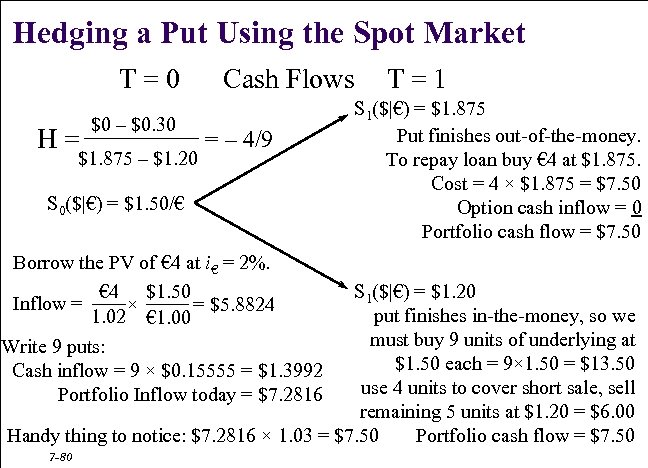 Hedging a Put Using the Spot Market T = 0 H = $0 – $0. 30 $1. 875 – $1. 20 Cash Flows = – 4/9 S 0($|€) = $1. 50/€ Borrow the PV of € 4 at i€ = 2%. € 4 $1. 50 Inflow = × = $5. 8824 1. 02 € 1. 00 Write 9 puts: Cash inflow = 9 × $0. 15555 = $1. 3992 Portfolio Inflow today = $7. 2816 T = 1 S 1($|€) = $1. 875 Put finishes out-of-the-money. To repay loan buy € 4 at $1. 875. Cost = 4 × $1. 875 = $7. 50 Option cash inflow = 0 Portfolio cash flow = $7. 50 S 1($|€) = $1. 20 put finishes in-the-money, so we must buy 9 units of underlying at $1. 50 each = 9× 1. 50 = $13. 50 use 4 units to cover short sale, sell remaining 5 units at $1. 20 = $6. 00 Handy thing to notice: $7. 2816 × 1. 03 = $7. 50 Portfolio cash flow = $7. 50 7 -80
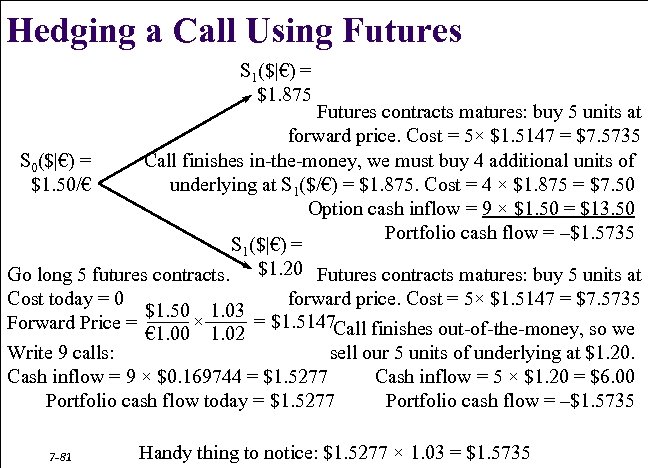 Hedging a Call Using Futures S 1($|€) = $1. 875 Futures contracts matures: buy 5 units at forward price. Cost = 5× $1. 5147 = $7. 5735 S 0($|€) = Call finishes in-the-money, we must buy 4 additional units of $1. 50/€ underlying at S 1($/€) = $1. 875. Cost = 4 × $1. 875 = $7. 50 Option cash inflow = 9 × $1. 50 = $13. 50 Portfolio cash flow = –$1. 5735 S 1($|€) = Go long 5 futures contracts. $1. 20 Futures contracts matures: buy 5 units at forward price. Cost = 5× $1. 5147 = $7. 5735 Cost today = 0 $1. 50 1. 03 × = $1. 5147 Forward Price = Call finishes out-of-the-money, so we € 1. 00 1. 02 Write 9 calls: sell our 5 units of underlying at $1. 20. Cash inflow = 9 × $0. 169744 = $1. 5277 Cash inflow = 5 × $1. 20 = $6. 00 Portfolio cash flow today = $1. 5277 Portfolio cash flow = –$1. 5735 7 -81 Handy thing to notice: $1. 5277 × 1. 03 = $1. 5735
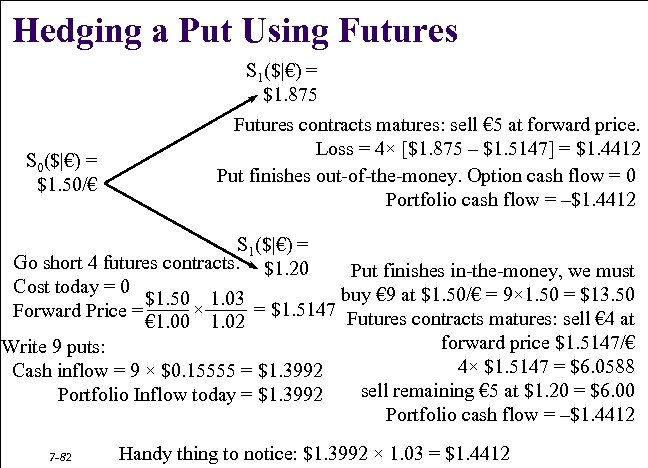 Hedging a Put Using Futures S 1($|€) = $1. 875 S 0($|€) = $1. 50/€ Futures contracts matures: sell € 5 at forward price. Loss = 4× [$1. 875 – $1. 5147] = $1. 4412 Put finishes out-of-the-money. Option cash flow = 0 Portfolio cash flow = –$1. 4412 S 1($|€) = Go short 4 futures contracts. $1. 20 Put finishes in-the-money, we must Cost today = 0 buy € 9 at $1. 50/€ = 9× 1. 50 = $13. 50 $1. 50 1. 03 × = $1. 5147 Futures contracts matures: sell € 4 at Forward Price = € 1. 00 1. 02 forward price $1. 5147/€ Write 9 puts: 4× $1. 5147 = $6. 0588 Cash inflow = 9 × $0. 15555 = $1. 3992 sell remaining € 5 at $1. 20 = $6. 00 Portfolio Inflow today = $1. 3992 Portfolio cash flow = –$1. 4412 7 -82 Handy thing to notice: $1. 3992 × 1. 03 = $1. 4412
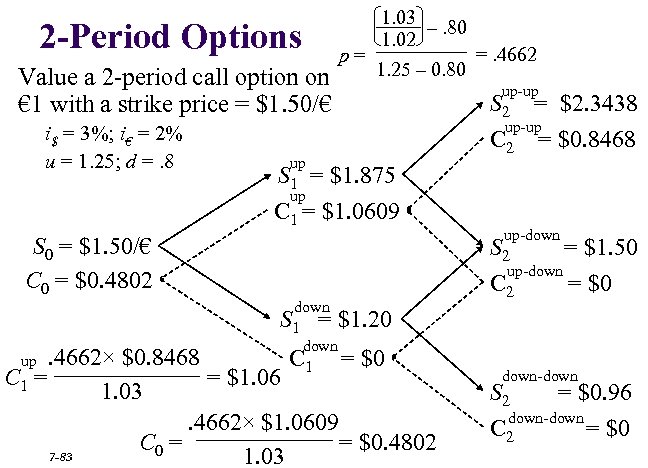 1. 03 –. 80 1. 02 =. 4662 p = 1. 25 – 0. 80 Value a 2 -period call option on 2 -Period Options € 1 with a strike price = $1. 50/€ i$ = 3%; i€ = 2% u = 1. 25; d =. 8 up S 1 = $1. 875 up C 1 = $1. 0609 S 0 = $1. 50/€ C 0 = $0. 4802 down S 1 = $1. 20 down C 1 = $0 . 4662× $0. 8468 C 1 = = $1. 06 1. 03. 4662× $1. 0609 C 0 = = $0. 4802 7 -83 1. 03 up up-up S 2 = $2. 3438 up-up C 2 = $0. 8468 up-down S 2 = $1. 50 up-down C 2 = $0 down-down S 2 = $0. 96 down-down C 2 = $0
 End Chapter Seven 7 -84