


 Скачать презентацию INTERNATIONAL FINANCIAL MANAGEMENT Fifth Edition EUN RESNICK
d58eba65df1c8cd957e2da707fbba55e.ppt
- Количество слайдов: 16
 INTERNATIONAL FINANCIAL MANAGEMENT Fifth Edition EUN / RESNICK Mc. Graw-Hill/Irwin Copyright © 2009 by The Mc. Graw-Hill Companies, Inc. All rights reserved.
 Balance of Payments 3 Chapter Three Chapter Objective: This chapter serves to introduce the student to the balance of payments. How it is constructed and how balance of payments data may be interpreted. 3 -1
 Balance of Payments Accounting l The Balance of Payments is the statistical record of a country’s international transactions over a certain period of time presented in the form of double-entry bookkeeping. N. B. when we say “a country’s balance of payments” we are referring to the transactions of its citizens and government. 3 -2
 Balance of Payments Accounts l l The balance of payments accounts are those that record all transactions between the residents of a country and residents of all foreign nations. They are composed of the following: l l 3 -3 The Current Account The Capital Account The Official Reserves Account Statistical Discrepancy
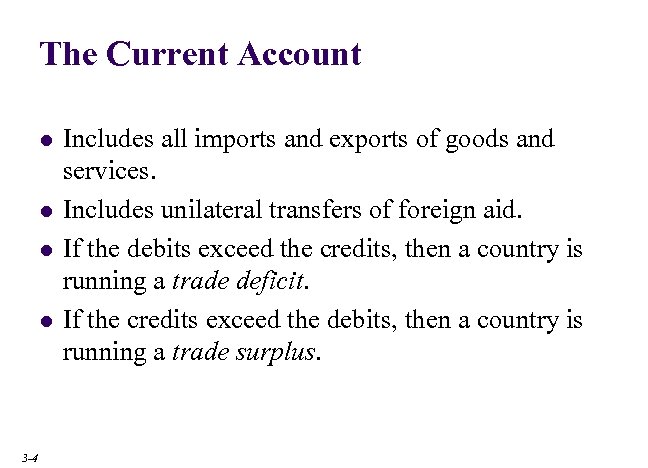 The Current Account l l 3 -4 Includes all imports and exports of goods and services. Includes unilateral transfers of foreign aid. If the debits exceed the credits, then a country is running a trade deficit. If the credits exceed the debits, then a country is running a trade surplus.
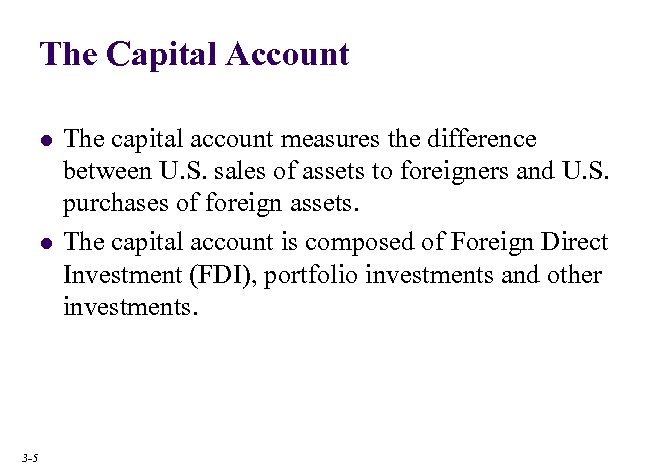 The Capital Account l l 3 -5 The capital account measures the difference between U. S. sales of assets to foreigners and U. S. purchases of foreign assets. The capital account is composed of Foreign Direct Investment (FDI), portfolio investments and other investments.
 Statistical Discrepancy l 3 -6 There’s going to be some omissions and misrecorded transactions—so we use a “plug” figure to get things to balance.
 The Official Reserves Account l 3 -7 Official reserves assets include gold, foreign currencies, SDRs, reserve positions in the IMF.
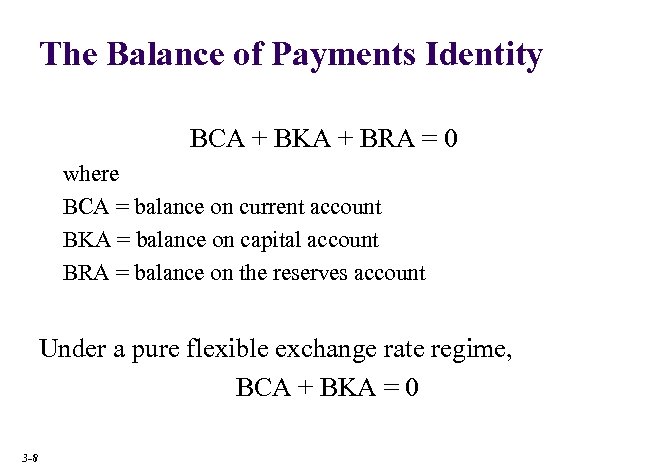 The Balance of Payments Identity BCA + BKA + BRA = 0 where BCA = balance on current account BKA = balance on capital account BRA = balance on the reserves account Under a pure flexible exchange rate regime, BCA + BKA = 0 3 -8
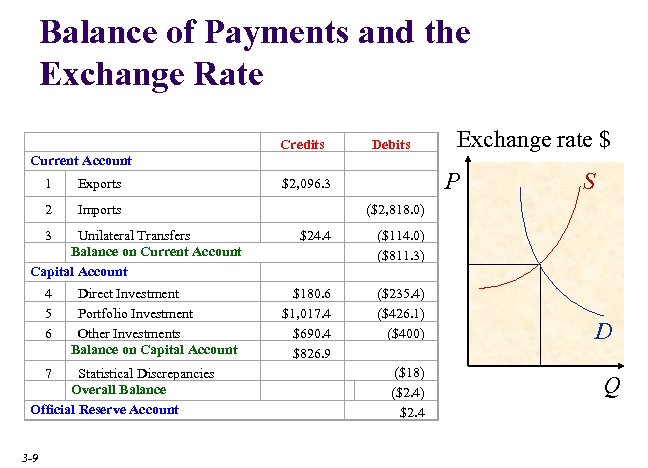 Balance of Payments and the Exchange Rate Current Account Credits Exchange rate $ Debits 1 Exports $2, 096. 3 2 Imports $24. 4 4 5 6 7 $180. 6 $1, 017. 4 $690. 4 $826. 9 ($114. 0) ($811. 3) ($235. 4) ($426. 1) ($400) ($18) ($2. 4) $2. 4 Unilateral Transfers Balance on Current Account Capital Account Direct Investment Portfolio Investment Other Investments Balance on Capital Account Statistical Discrepancies Overall Balance Official Reserve Account 3 -9 S ($2, 818. 0) 3 P D Q
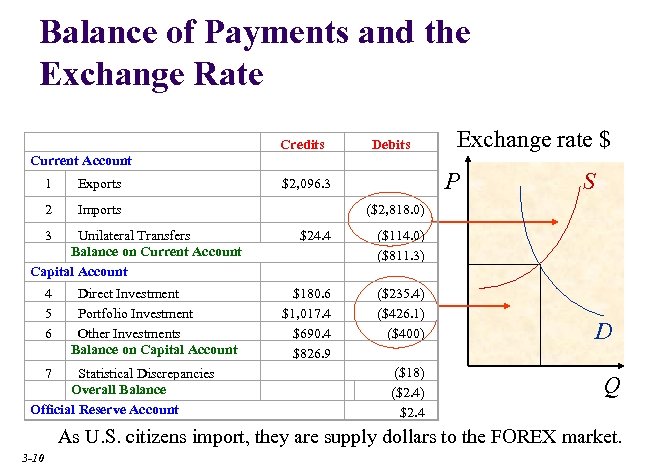 Balance of Payments and the Exchange Rate Current Account Credits Exchange rate $ Debits 1 Exports $2, 096. 3 2 Imports $24. 4 4 5 6 7 $180. 6 $1, 017. 4 $690. 4 $826. 9 ($114. 0) ($811. 3) ($235. 4) ($426. 1) ($400) ($18) ($2. 4) $2. 4 S ($2, 818. 0) 3 P Unilateral Transfers Balance on Current Account Capital Account Direct Investment Portfolio Investment Other Investments Balance on Capital Account Statistical Discrepancies Overall Balance Official Reserve Account D Q As U. S. citizens import, they are supply dollars to the FOREX market. 3 -10
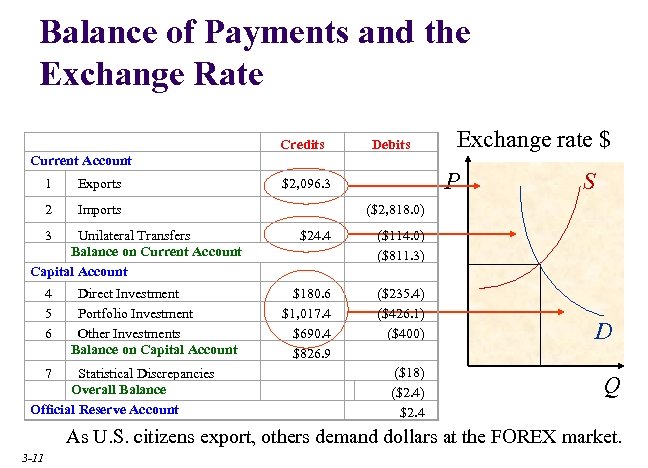 Balance of Payments and the Exchange Rate Current Account Credits Exchange rate $ Debits 1 Exports $2, 096. 3 2 Imports $24. 4 4 5 6 7 $180. 6 $1, 017. 4 $690. 4 $826. 9 ($114. 0) ($811. 3) ($235. 4) ($426. 1) ($400) ($18) ($2. 4) $2. 4 S ($2, 818. 0) 3 P Unilateral Transfers Balance on Current Account Capital Account Direct Investment Portfolio Investment Other Investments Balance on Capital Account Statistical Discrepancies Overall Balance Official Reserve Account D Q As U. S. citizens export, others demand dollars at the FOREX market. 3 -11
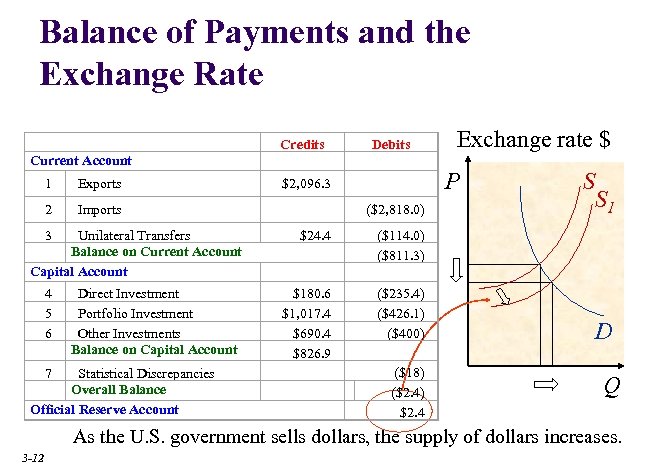 Balance of Payments and the Exchange Rate Current Account Credits Exchange rate $ Debits 1 Exports $2, 096. 3 2 Imports ($2, 818. 0) 3 $24. 4 4 5 6 7 $180. 6 $1, 017. 4 $690. 4 $826. 9 ($114. 0) ($811. 3) ($235. 4) ($426. 1) ($400) ($18) ($2. 4) $2. 4 Unilateral Transfers Balance on Current Account Capital Account Direct Investment Portfolio Investment Other Investments Balance on Capital Account Statistical Discrepancies Overall Balance Official Reserve Account P S S 1 D Q As the U. S. government sells dollars, the supply of dollars increases. 3 -12
 Sovereign Wealth Funds l l 3 -13 Government-controlled investment funds are playing an increasingly visible role in international investments. SWFs are mostly domiciled in Asian and Mid. East countries usually are responsible for recycling foreign exchange reserves of these countries swelled by trade surpluses and oil revenues.
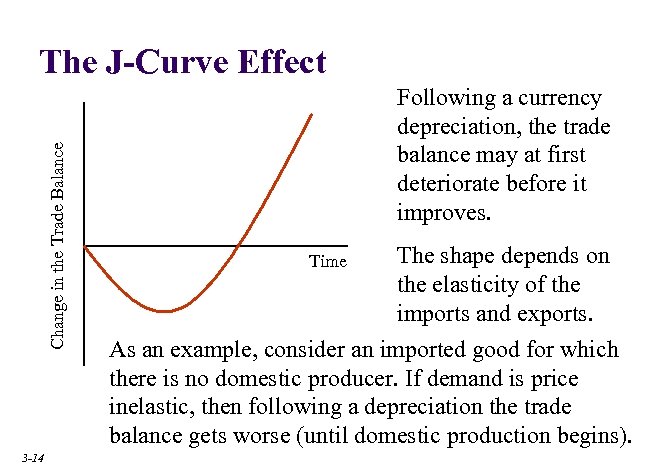 Change in the Trade Balance The J-Curve Effect 3 -14 Following a currency depreciation, the trade balance may at first deteriorate before it improves. Time The shape depends on the elasticity of the imports and exports. As an example, consider an imported good for which there is no domestic producer. If demand is price inelastic, then following a depreciation the trade balance gets worse (until domestic production begins).
 Mercantilism and the Balance of Payments l l l 3 -15 Mercantilism holds that a country should avoid trade deficits at all costs, even to imposing various restrictions on imports. Mercantilist ideas were criticized in the 18 th century by such British thinkers as Adam Smith, David Ricardo, and David Hume. They argued that the main source of wealth in a country is its productive capacity not its trade surpluses.