


 Скачать презентацию INTERNATIONAL FINANCIAL MANAGEMENT Fifth Edition EUN RESNICK
158704bcbb85c5733495d8c57e13436e.ppt
- Количество слайдов: 30
 INTERNATIONAL FINANCIAL MANAGEMENT Fifth Edition EUN / RESNICK Mc. Graw-Hill/Irwin Copyright © 2009 by The Mc. Graw-Hill Companies, Inc. All rights reserved.
 International Capital Structure and the Cost of Capital 17 Chapter Seventeen Chapter Objective: This chapter discusses the cost of capital for the multinational firm. Fifth Edition 17 -1
 Chapter Outline l l l l 17 -2 Cost of Capital in Segmented vs. Integrated Markets Does the Cost of Capital Differ Among Countries? Cross-Border Listings of Stocks Capital Asset Pricing Under Cross-Listings The Effect of Foreign Equity Ownership Restrictions The Financial Structure of Subsidiaries.
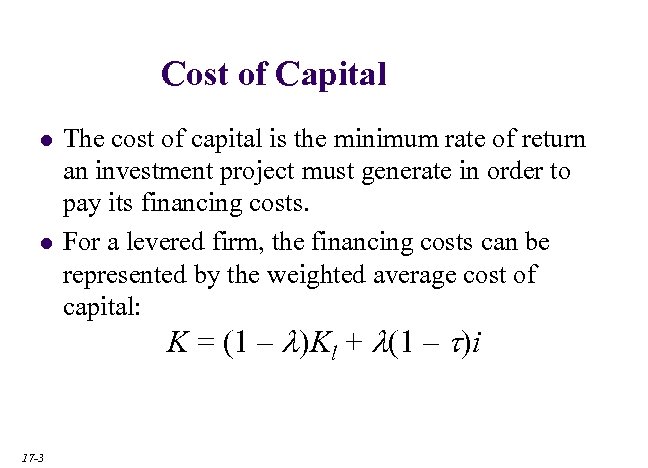 Cost of Capital l l The cost of capital is the minimum rate of return an investment project must generate in order to pay its financing costs. For a levered firm, the financing costs can be represented by the weighted average cost of capital: K = (1 – )Kl + (1 – t)i 17 -3
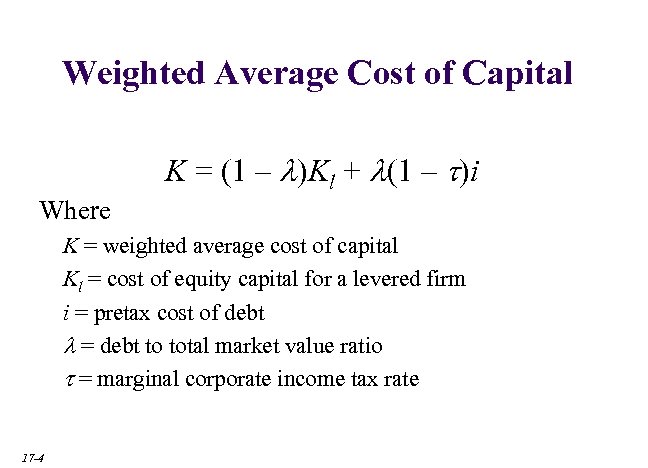 Weighted Average Cost of Capital K = (1 – )Kl + (1 – t)i Where K = weighted average cost of capital Kl = cost of equity capital for a levered firm i = pretax cost of debt = debt to total market value ratio t = marginal corporate income tax rate 17 -4
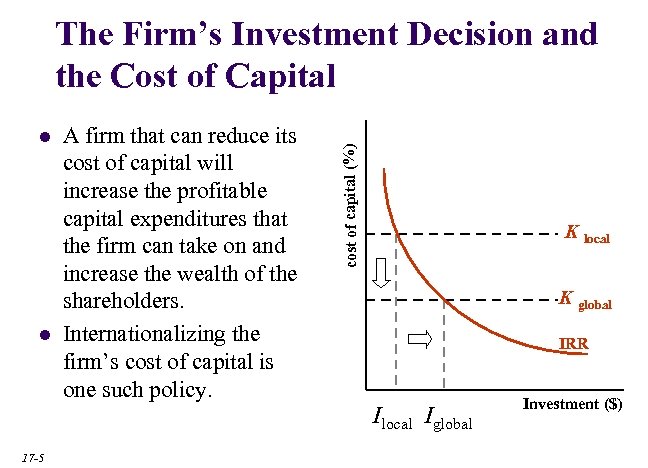 l l 17 -5 A firm that can reduce its cost of capital will increase the profitable capital expenditures that the firm can take on and increase the wealth of the shareholders. Internationalizing the firm’s cost of capital is one such policy. cost of capital (%) The Firm’s Investment Decision and the Cost of Capital K local K global IRR Ilocal Iglobal Investment ($)
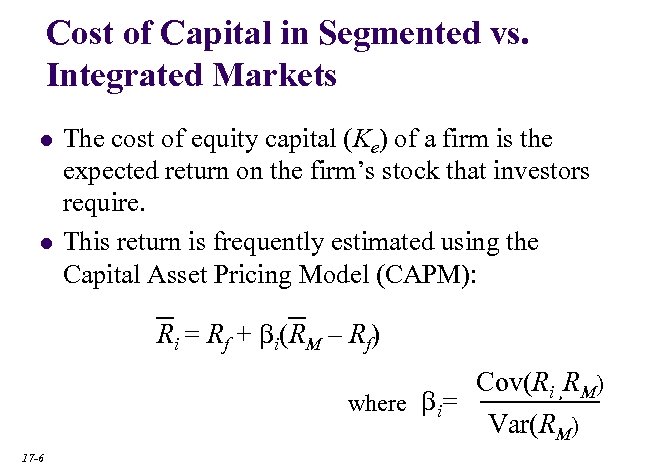 Cost of Capital in Segmented vs. Integrated Markets l l The cost of equity capital (Ke) of a firm is the expected return on the firm’s stock that investors require. This return is frequently estimated using the Capital Asset Pricing Model (CAPM): Ri = Rf + bi(RM – Rf) Cov(Ri , RM) where bi= Var(RM) 17 -6
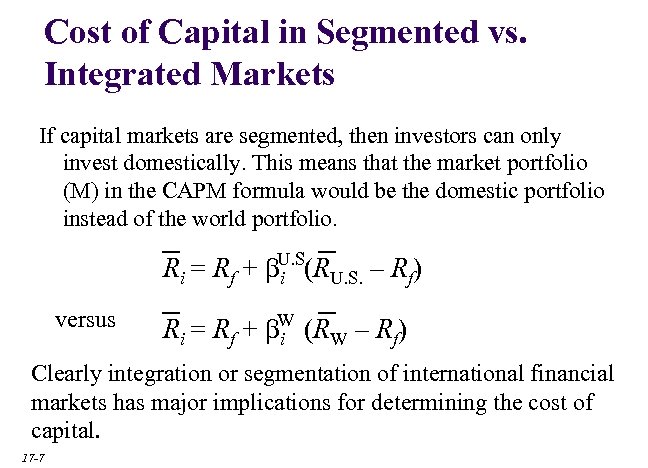 Cost of Capital in Segmented vs. Integrated Markets If capital markets are segmented, then investors can only invest domestically. This means that the market portfolio (M) in the CAPM formula would be the domestic portfolio instead of the world portfolio. Ri = Rf + b. U. S. – Rf) i (R versus Ri = Rf + b. W (RW – Rf) i Clearly integration or segmentation of international financial markets has major implications for determining the cost of capital. 17 -7
 Does the Cost of Capital Differ among Countries? l l l 17 -8 There do appear to be differences in the cost of capital in different countries. When markets are imperfect, international financing can lower the firm’s cost of capital. One way to achieve this is to internationalize the firm’s ownership structure.
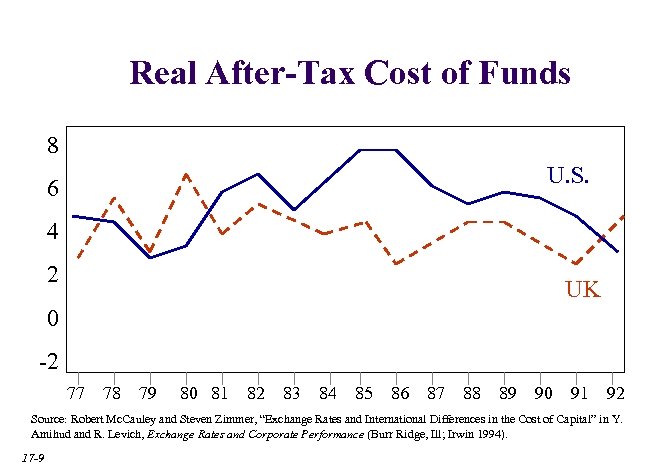 Real After-Tax Cost of Funds 8 U. S. 6 4 2 UK 0 -2 77 78 79 80 81 82 83 84 85 86 87 88 89 90 91 92 Source: Robert Mc. Cauley and Steven Zimmer, “Exchange Rates and International Differences in the Cost of Capital” in Y. Amihud and R. Levich, Exchange Rates and Corporate Performance (Burr Ridge, Ill; Irwin 1994). 17 -9
 Cross-Border Listings of Stocks l l l 17 -10 Cross-border listings of stocks have become quite popular among major corporations. The largest contingent of foreign stocks are listed on the London Stock Exchange. U. S. exchanges attracted the next largest contingent of foreign stocks.
 Cross-Border Listings of Stocks Cross-border listings of stocks benefit a company in the following ways. 1. 2. 3. 4. 17 -11 The company can expand its potential investor base, which will lead to a higher stock price and lower cost of capital. Cross-listing creates a secondary market for the company’s shares, which facilitates raising new capital in foreign markets. Cross-listing can enhance the liquidity of the company’s stock. Cross-listing enhances the visibility of the company’s name and its products in foreign marketplaces.
 Cross-Border Listings of Stocks Cross-border listings of stocks do carry costs. 1. 2. 3. 17 -12 It can be costly to meet the disclosure and listing requirements imposed by the foreign exchange and regulatory authorities. Once a company’s stock is traded in overseas markets, there can be volatility spillover from these markets. Once a company’s stock is make available to foreigners, they might acquire a controlling interest and challenge the domestic control of the company.
 Cross-Border Listings of Stocks On average, cross-border listings of stocks appears to be a profitable decision. The benefits outweigh the costs. 17 -13
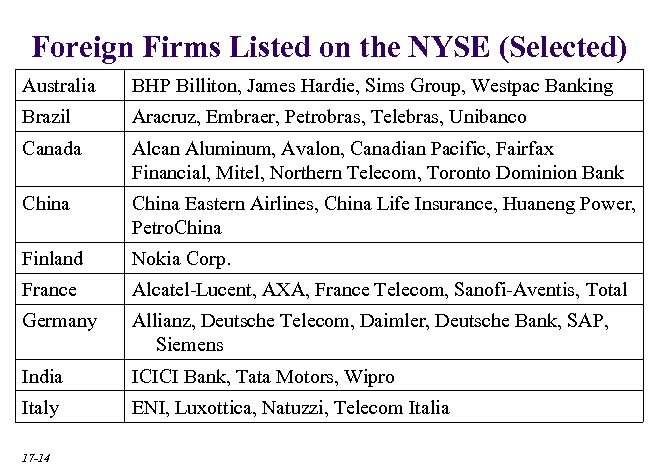 Foreign Firms Listed on the NYSE (Selected) Australia BHP Billiton, James Hardie, Sims Group, Westpac Banking Brazil Aracruz, Embraer, Petrobras, Telebras, Unibanco Canada Alcan Aluminum, Avalon, Canadian Pacific, Fairfax Financial, Mitel, Northern Telecom, Toronto Dominion Bank China Eastern Airlines, China Life Insurance, Huaneng Power, Petro. China Finland Nokia Corp. France Alcatel-Lucent, AXA, France Telecom, Sanofi-Aventis, Total Germany Allianz, Deutsche Telecom, Daimler, Deutsche Bank, SAP, Siemens India ICICI Bank, Tata Motors, Wipro Italy ENI, Luxottica, Natuzzi, Telecom Italia 17 -14
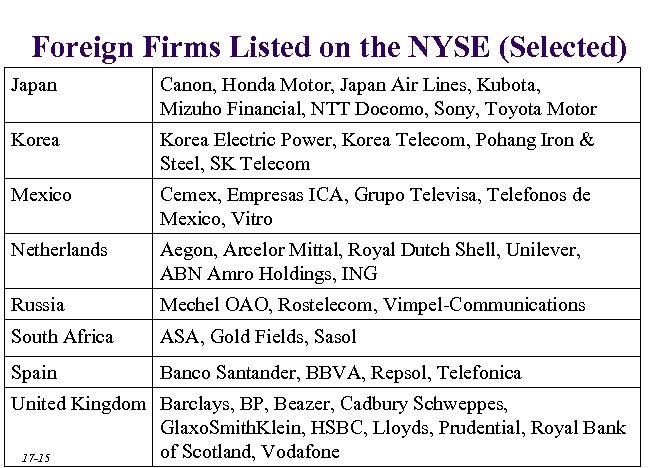 Foreign Firms Listed on the NYSE (Selected) Japan Canon, Honda Motor, Japan Air Lines, Kubota, Mizuho Financial, NTT Docomo, Sony, Toyota Motor Korea Electric Power, Korea Telecom, Pohang Iron & Steel, SK Telecom Mexico Cemex, Empresas ICA, Grupo Televisa, Telefonos de Mexico, Vitro Netherlands Aegon, Arcelor Mittal, Royal Dutch Shell, Unilever, ABN Amro Holdings, ING Russia Mechel OAO, Rostelecom, Vimpel-Communications South Africa ASA, Gold Fields, Sasol Spain Banco Santander, BBVA, Repsol, Telefonica United Kingdom Barclays, BP, Beazer, Cadbury Schweppes, Glaxo. Smith. Klein, HSBC, Lloyds, Prudential, Royal Bank of Scotland, Vodafone 17 -15
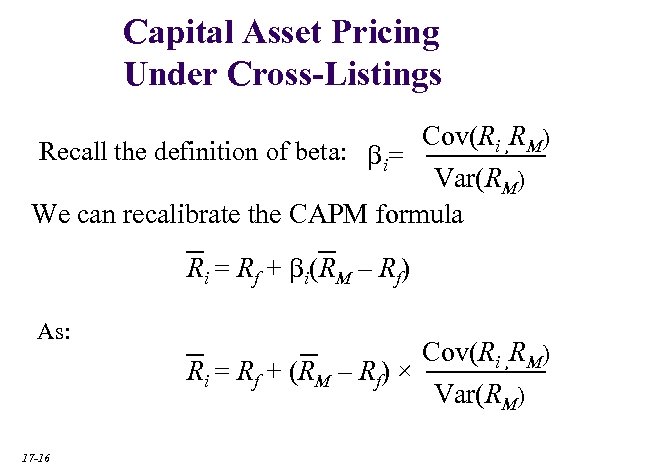 Capital Asset Pricing Under Cross-Listings Cov(Ri , RM) Var(RM) We can recalibrate the CAPM formula Recall the definition of beta: bi= Ri = Rf + bi(RM – Rf) As: Ri = Rf + (RM – Rf) × 17 -16 Cov(Ri , RM) Var(RM)
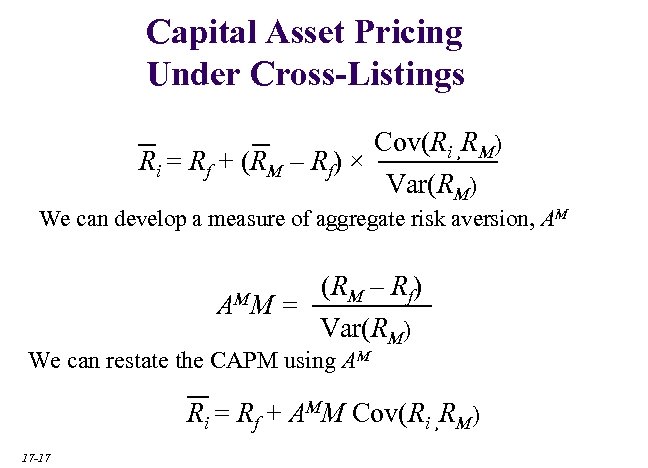 Capital Asset Pricing Under Cross-Listings Ri = Rf + (RM – Rf) × Cov(Ri , RM) Var(RM) We can develop a measure of aggregate risk aversion, AM A MM (RM – Rf) = Var(RM) We can restate the CAPM using AM Ri = Rf + AMM Cov(Ri , RM) 17 -17
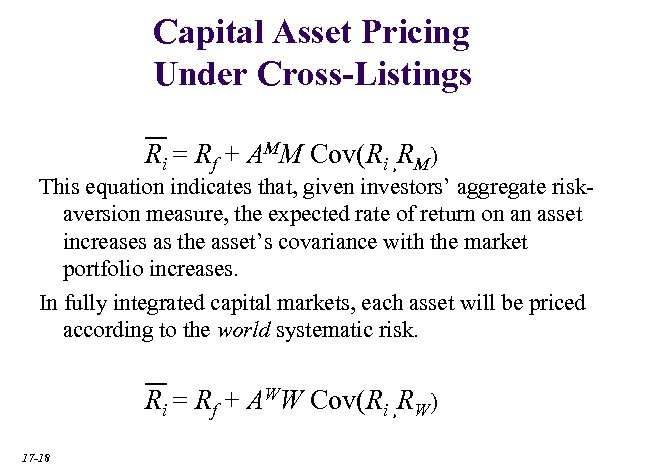 Capital Asset Pricing Under Cross-Listings Ri = Rf + AMM Cov(Ri , RM) This equation indicates that, given investors’ aggregate riskaversion measure, the expected rate of return on an asset increases as the asset’s covariance with the market portfolio increases. In fully integrated capital markets, each asset will be priced according to the world systematic risk. Ri = Rf + AWW Cov(Ri , RW) 17 -18
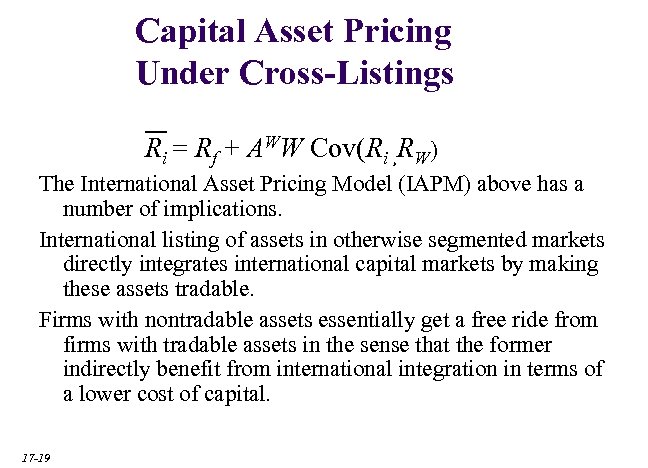 Capital Asset Pricing Under Cross-Listings Ri = Rf + AWW Cov(Ri , RW) The International Asset Pricing Model (IAPM) above has a number of implications. International listing of assets in otherwise segmented markets directly integrates international capital markets by making these assets tradable. Firms with nontradable assets essentially get a free ride from firms with tradable assets in the sense that the former indirectly benefit from international integration in terms of a lower cost of capital. 17 -19
 The Effect of Foreign Equity Ownership Restrictions l l l 17 -20 While companies have incentives to internationalize their ownership structure to lower the cost of capital and increase market share, they may be concerned with the possible loss of corporate control to foreigners. In some countries, there are legal restrictions on the percentage of a firm that foreigners can own. These restrictions are imposed as a means of ensuring domestic control of local firms.
 Pricing-to-Market Phenomenon l l 17 -21 Suppose foreigners, if allowed, would like to buy 30 percent of a Korean firm. But they are constrained by ownership constraints imposed on foreigners to purchase at most 20 percent. Because this constraint is effective in limiting desired foreign ownership, foreign and domestic investors many face different market share prices. This dual pricing is the pricing-to-market phenomenon.
 Asset Pricing under Foreign Ownership Restrictions l l 17 -22 An interesting outcome is that the firm’s cost of capital depends on which investors, domestic or foreign, supply capital. The implication is that a firm can reduce its cost of capital by internationalizing its ownership structure.
 An Example of Foreign Ownership Restrictions: Nestlé l Nestlé used to issue two different classes of common stock: bearer shares and registered shares. l l 17 -23 Foreigners were only allowed to buy bearer shares. Swiss citizens could buy registered shares. The bearer stock was more expensive. On November 18, 1988, Nestlé lifted restrictions imposed on foreigners, allowing them to hold registered shares as well as bearer shares.
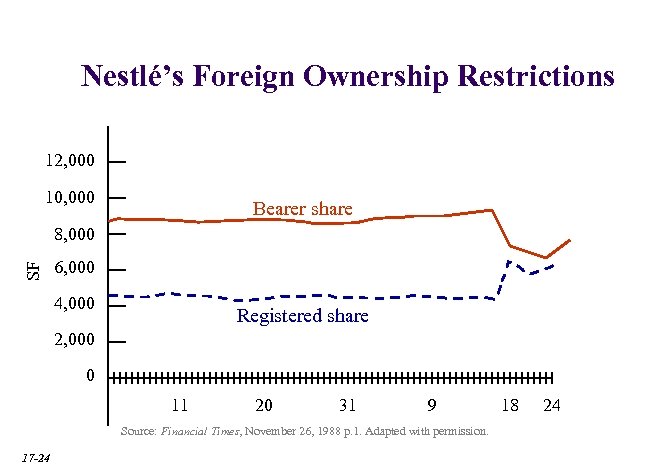 Nestlé’s Foreign Ownership Restrictions 12, 000 10, 000 Bearer share SF 8, 000 6, 000 4, 000 Registered share 2, 000 0 11 20 31 9 Source: Financial Times, November 26, 1988 p. 1. Adapted with permission. 17 -24 18 24
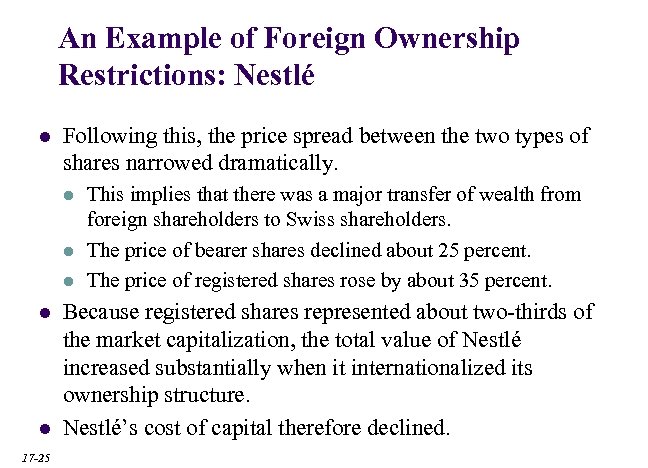 An Example of Foreign Ownership Restrictions: Nestlé l Following this, the price spread between the two types of shares narrowed dramatically. l l l 17 -25 This implies that there was a major transfer of wealth from foreign shareholders to Swiss shareholders. The price of bearer shares declined about 25 percent. The price of registered shares rose by about 35 percent. Because registered shares represented about two-thirds of the market capitalization, the total value of Nestlé increased substantially when it internationalized its ownership structure. Nestlé’s cost of capital therefore declined.
 An Example of Foreign Ownership Restrictions: Nestlé l l Foreigners holding Nestlé bearer shares were exposed to political risk in a country that is widely viewed as a haven from such risk. The Nestlé episode illustrates l l l 17 -26 The importance of considering market imperfections. The peril of political risk. The benefits to the firm of internationalizing its ownership structure.
 The Financial Structure of Subsidiaries. l 1. 2. 3. 17 -27 There are three different approaches to determining the subsidiary’s financial structure. Conform to the parent company's norm. Conform to the local norm of the country where the subsidiary operates. Vary judiciously to capitalize on opportunities to lower taxes, reduce financing costs and risk, and take advantage of various market imperfections.
 The Financial Structure of Subsidiaries. l 17 -28 In addition to taxes, political risk should be given due consideration in the choice of a subsidiary’s financial structure.
 End Chapter Seventeen 17 -29