


 Скачать презентацию International Finance Lecture 5 Page 1 World
a67dc43453c0b4ad2c60b34ca5a6c08f.ppt
- Количество слайдов: 53
 International Finance Lecture 5 Page 1
 World Financial Markets and Institutions • International Banking and Money Market • International Bond Market • International Equity Markets • Futures and Options on Foreign Exchange • Currency and Interest Rate Swaps • International Portfolio Investment 2
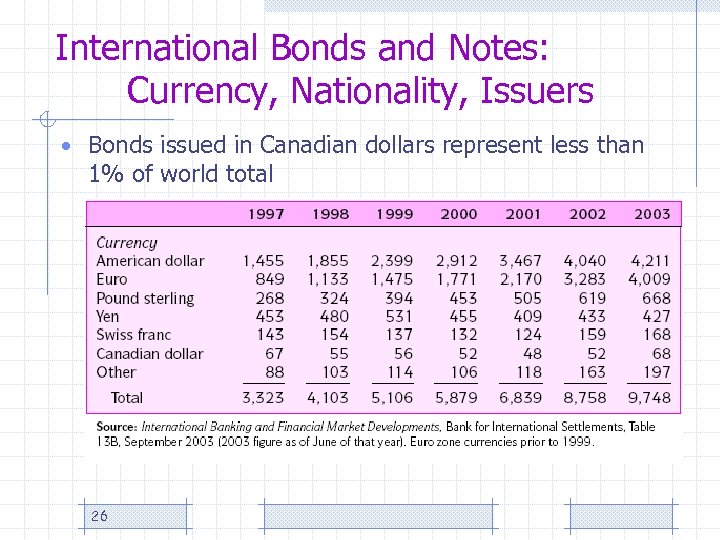
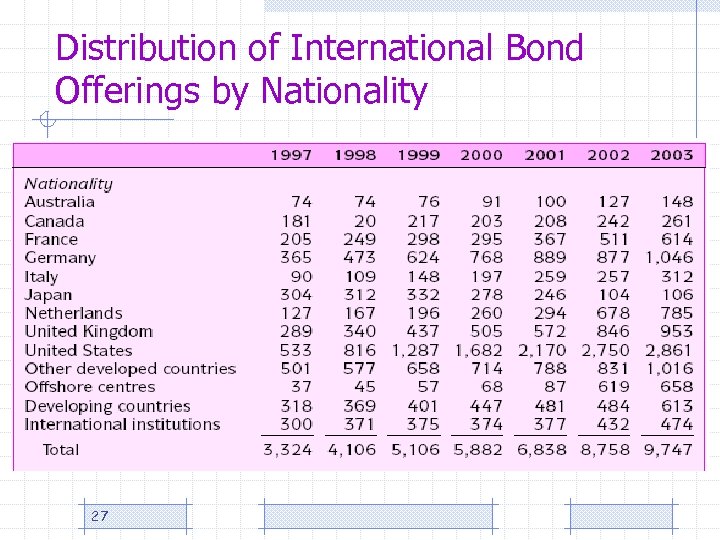
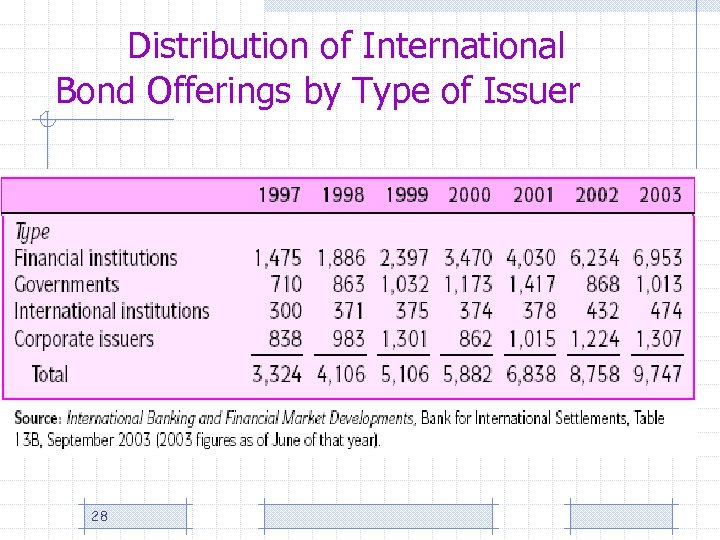
 International Bond Market • Facts and figures • Foreign bonds and Eurobonds • Types of ____ securities • International debt securities: Currency, Nationality, and Type of Issuer • ____ ratings • Market structure • International Bond Market Indices 3
 The World’s Bond Markets • A statistical perspective: – Go to the Bank of International Settlements and view data on outstanding ____ of debt and equity securities. – In 2005, outstanding amounts of international debt securities was $14, 615. 9 billion, domestic debt securities B$44, 991. 7 billion. Data from Morgan Stanley Capital International show that world market capitalization (World Index) was $1, 257. 78 billion in the end of 2005. – The total market ____ of the world’s bond markets is much larger than that of the world equity markets 4
 Foreign bonds and Eurobonds • Foreign bond – issued on a local market by a foreign borrower and usually denominated in local currency. Issue and trading supervised by local authorities. – Toyota issues $-denominated bonds in _____ market • Eurobond – underwritten by a multinational syndicate of banks and placed mainly in countries other than the one in whose currency it is denominated. – KLM Royal Dutch issues a ____ denominated bond in ____ • Types: – Bearer bonds – Registered bonds 5
 Bearer Bonds and Registered Bonds • Bearer Bonds are bonds with no registered owner. As such they offer anonymity but they also offer the same risk of loss as currency. • Registered Bonds: the owners ____ is registered with the issuer. • Foreign bonds often have colourful names: – Yankee bonds are US $ denominated foreign bonds sold in the US; – Samurai bonds are Yen denominated foreign bonds ____ in ____; – Bulldogs are pound sterling denominated foreign bonds sold in the UK. 6
 National Security Regulations • Yankee bonds must meet the requirements of the ____, just like U. S. domestic bonds. • Many borrowers find this level of regulation burdensome and prefer to raise U. S. dollars in the ____ market. • Eurobonds sold in the primary market in the United States may not be sold to U. S. citizens. • Of course, a U. S. citizen could ____ a Eurobond on the secondary market. 7
 Global Bonds • A global bond is a very large international bond offering by a single borrower that is simultaneously ____ in North America, Europe and Asia. • Mostly institutional investors are the purchasers so far. 8
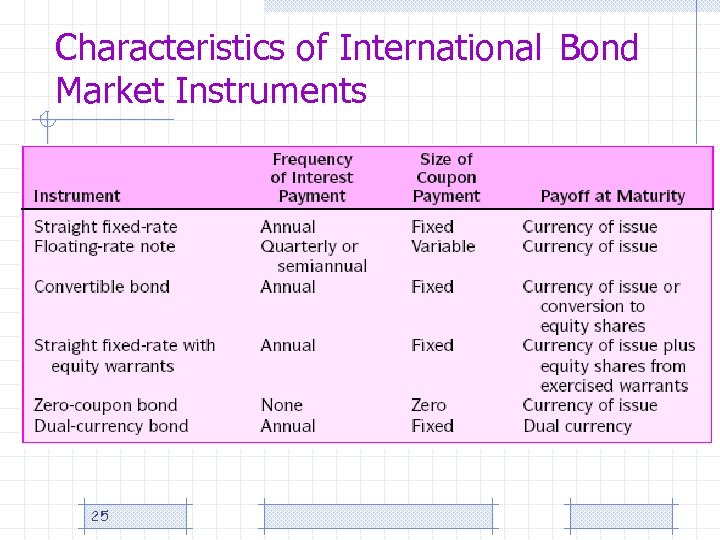
 Types of Instruments • Straight Fixed Rate Debt • Euro-medium term notes • Floating-Rate Notes • Equity-Related Bonds • Zero Coupon Bonds • Dual-Currency Bonds 9
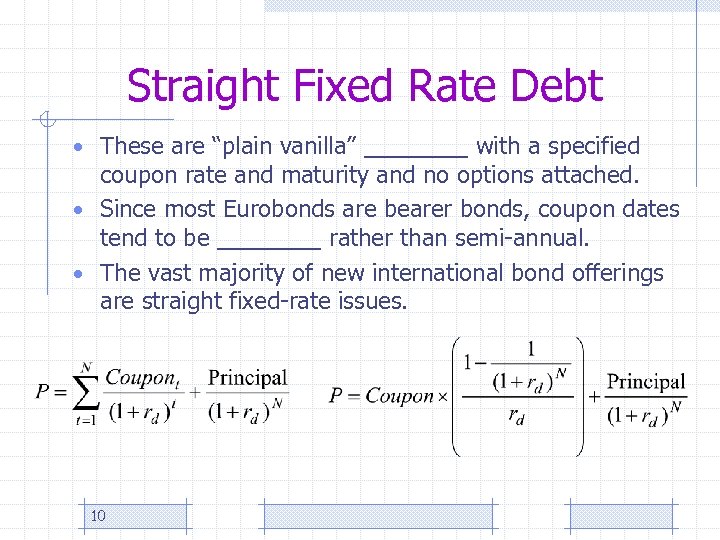 Straight Fixed Rate Debt • These are “plain vanilla” ____ with a specified coupon rate and maturity and no options attached. • Since most Eurobonds are bearer bonds, coupon dates tend to be ____ rather than semi-annual. • The vast majority of new international bond offerings are straight fixed-rate issues. 10
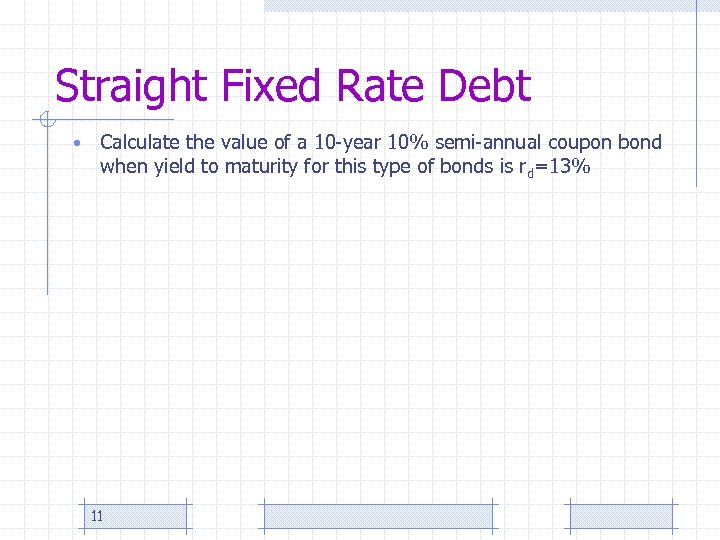 Straight Fixed Rate Debt • Calculate the value of a 10 -year 10% semi-annual coupon bond when yield to maturity for this type of bonds is rd=13% 11
 Accrued interest • The full price of the bond equals the quoted price Q (clean price) plus accrued interest AI. • The clean price of a Eurobond is Q=95, the annual coupon is 6%, and we are exactly three months from the past coupon payment. What is the full price of the bond? 12
 Floating-Rate Notes • Just like an ____ rate mortgage. • Common reference rates are 3 -month and 6 month U. S. dollar LIBOR • Since FRN’s reset every 6 or 12 months, the premium or discount is usually quite small…as long as there is no change in the default risk. 13
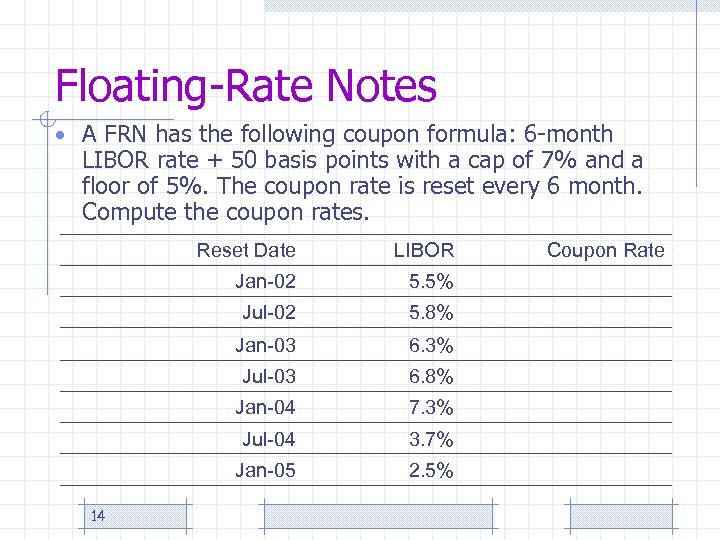 Floating-Rate Notes • A FRN has the following coupon formula: 6 -month LIBOR rate + 50 basis points with a cap of 7% and a floor of 5%. The coupon rate is reset every 6 month. Compute the coupon rates. Reset Date Jan-02 5. 5% Jul-02 5. 8% Jan-03 6. 3% Jul-03 6. 8% Jan-04 7. 3% Jul-04 3. 7% Jan-05 14 LIBOR 2. 5% Coupon Rate
 Floating-Rate Notes • An A-rated company issues a perpetual Eurodollar FRN. The FRN has a semi-annual coupon rate set at 6 -month LIBOR plus a spread of 0. 5%. Six months later, LIBOR is 6% and the default spread for A-rated bonds moved to 1%. What is the estimated value of the FRN on the reset date if we assume no further changes in LIBOR? (socalled “freeze method”). 15
 Equity-Related Bonds • Convertibles • • – Convertible bonds allow the holder to ____ his bond in exchange for a specified number of shares in the firm of the issuer. Bonds with equity warrants – These bonds allow the holder to ____ his bond but still buy a specified number of shares in the firm of the issuer at a specified price. Value = Price of straight bond + Value of call option to convert into stock or to buy shares Trade usually at ____ compared to straight bonds Note: Vcallable bond = Price of straight bond - Vcall option 16
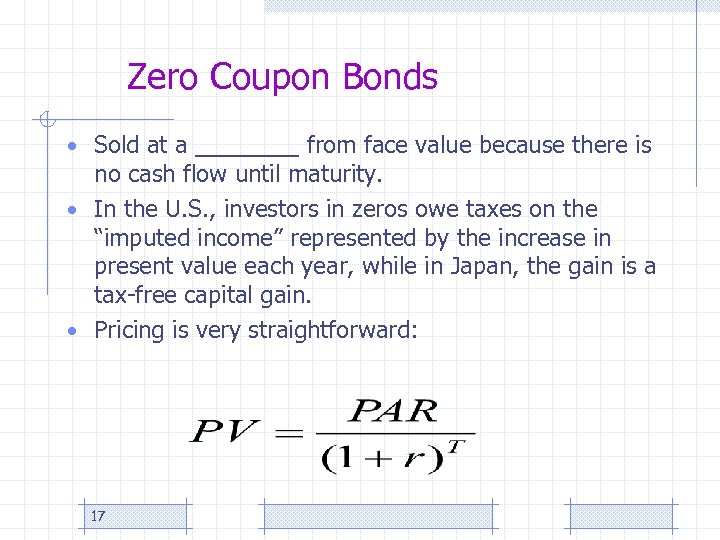 Zero Coupon Bonds • Sold at a ____ from face value because there is no cash flow until maturity. • In the U. S. , investors in zeros owe taxes on the “imputed income” represented by the increase in present value each year, while in Japan, the gain is a tax-free capital gain. • Pricing is very straightforward: 17
 Implied Forward Exchange Rate • Term structure of interest rates ____ for every major currency – View term structures for USA, Japan, Germany, other countries from Bloomberg. – Using yields on zero-coupon bonds with different maturities, we can calculate implied ____ exchange rates – Useful information in checking exchange rate forecasts (break-even analysis in international bond investing) – n-year implied forward rate is Fn=S(1+r. FC)n/(1+r. DC)n 18
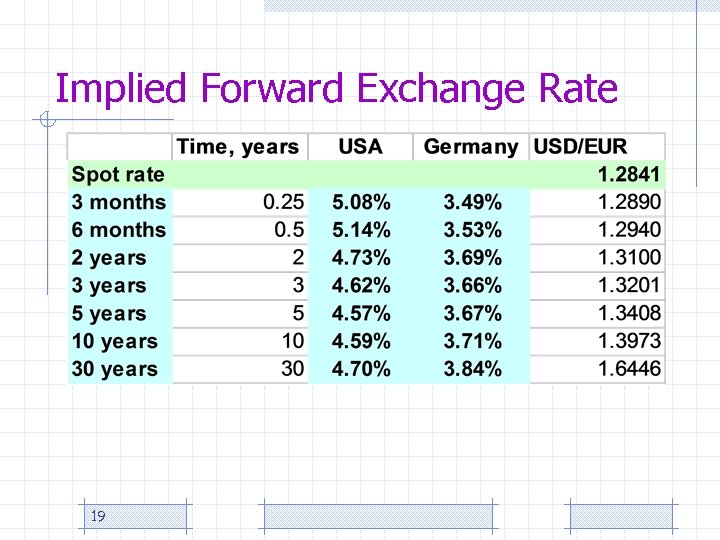 Implied Forward Exchange Rate 19
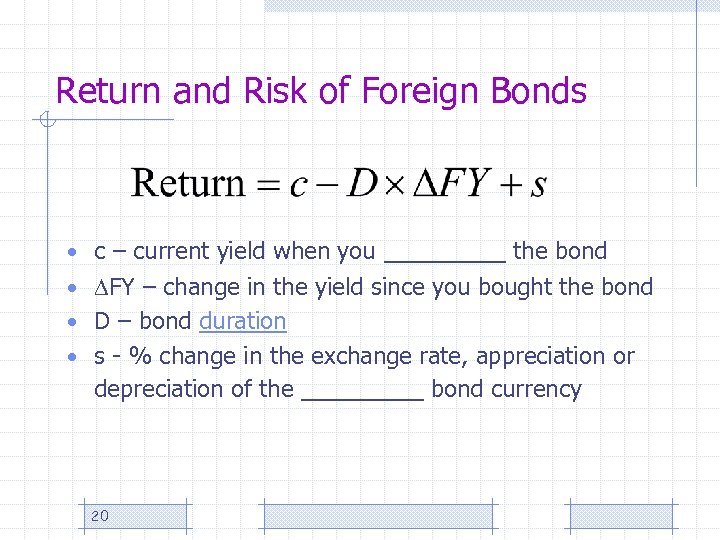 Return and Risk of Foreign Bonds • c – current yield when you ____ the bond • FY – change in the yield since you bought the bond • D – bond duration • s - % change in the exchange rate, appreciation or depreciation of the ____ bond currency 20
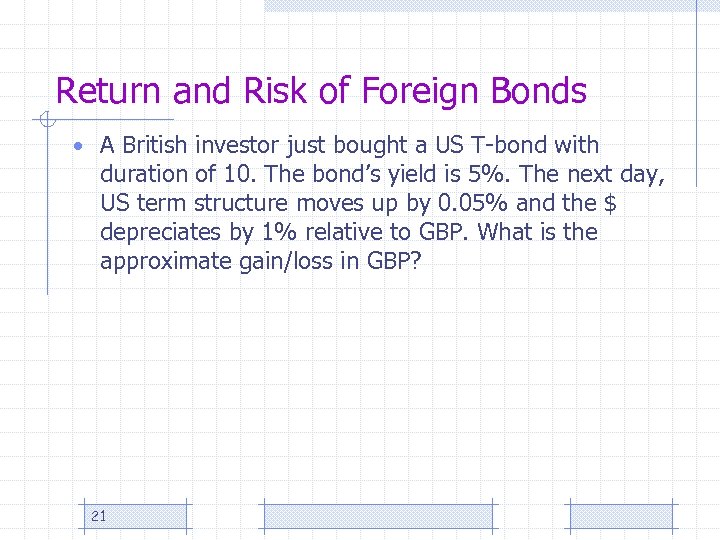 Return and Risk of Foreign Bonds • A British investor just bought a US T-bond with duration of 10. The bond’s yield is 5%. The next day, US term structure moves up by 0. 05% and the $ depreciates by 1% relative to GBP. What is the approximate gain/loss in GBP? 21
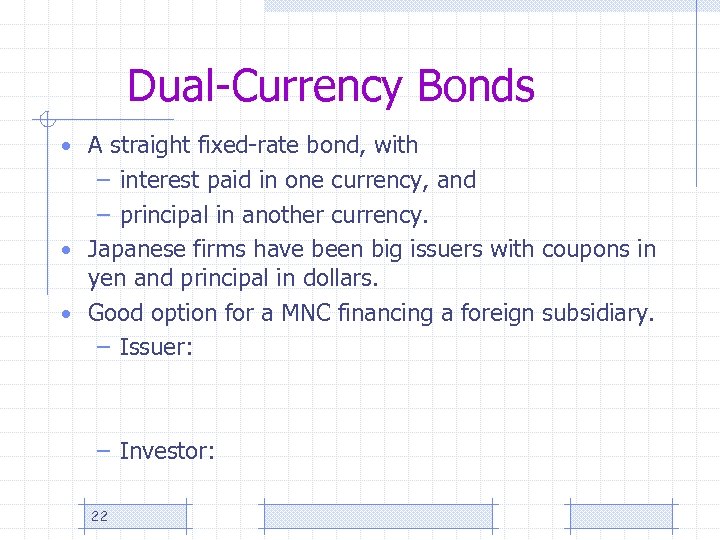 Dual-Currency Bonds • A straight fixed-rate bond, with – interest paid in one currency, and – principal in another currency. • Japanese firms have been big issuers with coupons in yen and principal in dollars. • Good option for a MNC financing a foreign subsidiary. – Issuer: – Investor: 22
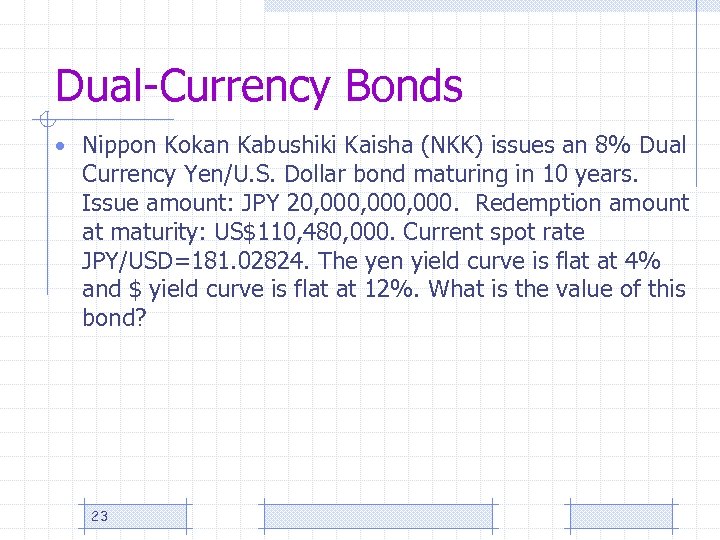 Dual-Currency Bonds • Nippon Kokan Kabushiki Kaisha (NKK) issues an 8% Dual Currency Yen/U. S. Dollar bond maturing in 10 years. Issue amount: JPY 20, 000, 000. Redemption amount at maturity: US$110, 480, 000. Current spot rate JPY/USD=181. 02824. The yen yield curve is flat at 4% and $ yield curve is flat at 12%. What is the value of this bond? 23
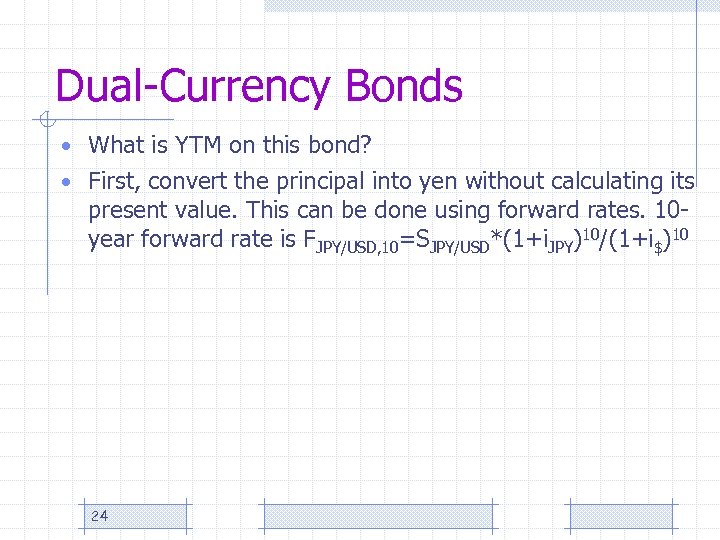 Dual-Currency Bonds • What is YTM on this bond? • First, convert the principal into yen without calculating its present value. This can be done using forward rates. 10 year forward rate is FJPY/USD, 10=SJPY/USD*(1+i. JPY)10/(1+i$)10 24
 Characteristics of International Bond Market Instruments 25
 International Bonds and Notes: Currency, Nationality, Issuers • Bonds issued in Canadian dollars represent less than 1% of world total 26
 Distribution of International Bond Offerings by Nationality 27
 Distribution of International Bond Offerings by Type of Issuer 28
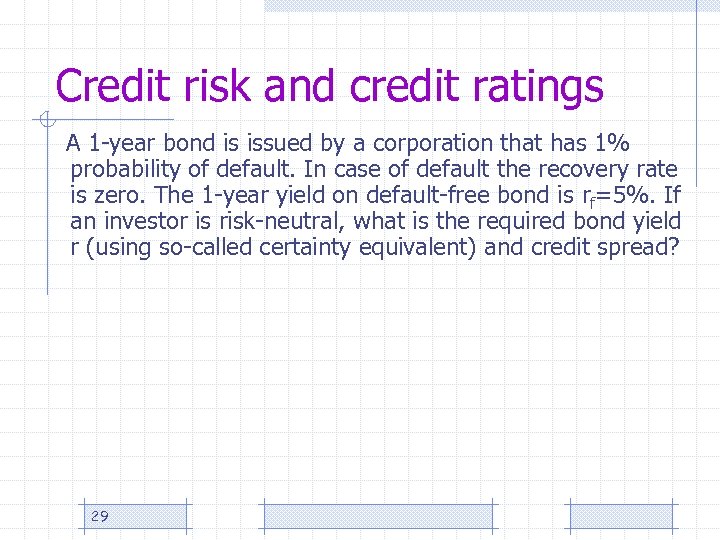 Credit risk and credit ratings A 1 -year bond is issued by a corporation that has 1% probability of default. In case of default the recovery rate is zero. The 1 -year yield on default-free bond is rf=5%. If an investor is risk-neutral, what is the required bond yield r (using so-called certainty equivalent) and credit spread? 29
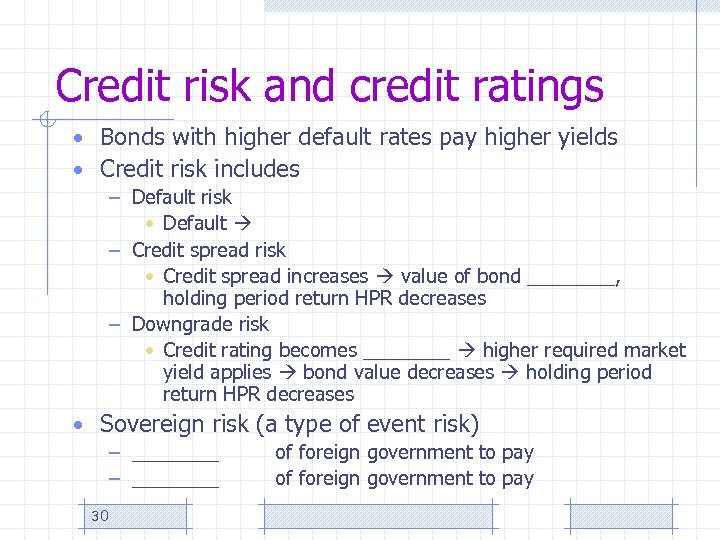 Credit risk and credit ratings • Bonds with higher default rates pay higher yields • Credit risk includes – Default risk • Default – Credit spread risk • Credit spread increases value of bond ____, holding period return HPR decreases – Downgrade risk • Credit rating becomes ____ higher required market yield applies bond value decreases holding period return HPR decreases • Sovereign risk (a type of event risk) – ________ 30 of foreign government to pay
 31
31
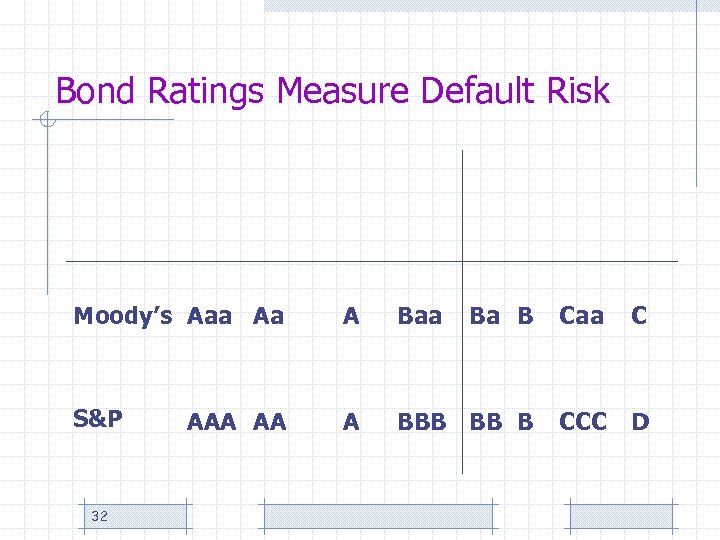 Bond Ratings Measure Default Risk Moody’s Aaa Aa A Baa S&P A BBB BB B 32 AAA AA Ba B Caa C CCC D
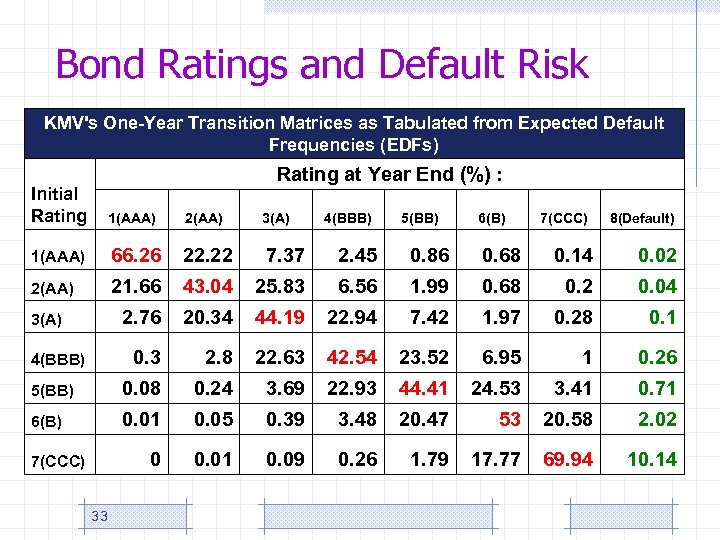 Bond Ratings and Default Risk KMV's One-Year Transition Matrices as Tabulated from Expected Default Frequencies (EDFs) Rating at Year End (%) : Initial Rating 1(AAA) 2(AA) 3(A) 1(AAA) 66. 26 22. 22 7. 37 2. 45 0. 86 0. 68 0. 14 0. 02 2(AA) 21. 66 43. 04 25. 83 6. 56 1. 99 0. 68 0. 2 0. 04 2. 76 20. 34 44. 19 22. 94 7. 42 1. 97 0. 28 0. 1 0. 3 2. 8 22. 63 42. 54 23. 52 6. 95 1 0. 26 5(BB) 0. 08 0. 24 3. 69 22. 93 44. 41 24. 53 3. 41 0. 71 6(B) 0. 01 0. 05 0. 39 3. 48 20. 47 53 20. 58 2. 02 0 0. 01 0. 09 0. 26 1. 79 17. 77 69. 94 10. 14 3(A) 4(BBB) 7(CCC) 33 4(BBB) 5(BB) 6(B) 7(CCC) 8(Default)
 Bond Ratings and Default Risk • What is the probability that a bond rated AA in the beginning of the year will be in default by the end of the year? • What is the probability that a bond rated BB in the beginning of the year will maintain BB-rating by the end of the year? • What is the probability that a bond rated BB in the beginning of the year will be downgraded by the end of the year? 34
 Eurobond Market Structure • Primary Market – Very similar to U. S. ____. • Secondary Market – OTC market centered in London. • Comprised of market makers as well as brokers. • Market makers and brokers are members of the International Securities Market Association (____). • Clearing Procedures – Euroclear and Cedel handle most Eurobond trades. 35
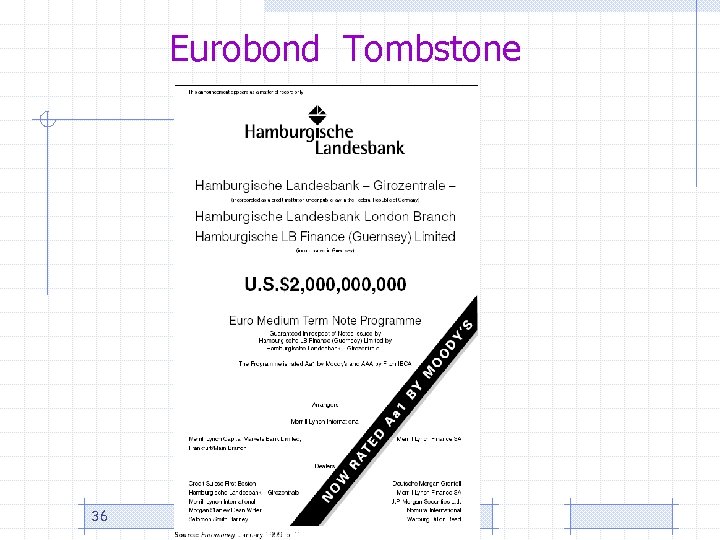 Eurobond Tombstone 36
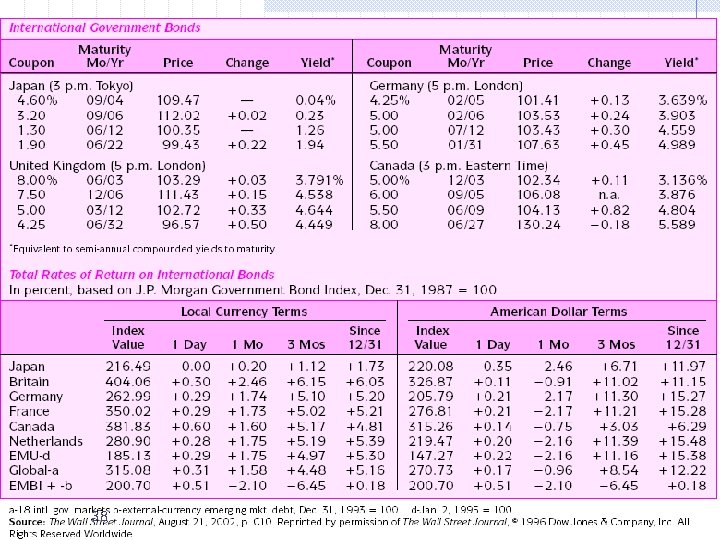
 International Bond Market Indices • There are several international bond market ____. • J. P. Morgan and Company – Domestic Bond Indices – International Government bond index for 18 countries. – Widely referenced and often used as a benchmark. – Appears daily in The Wall Street Journal • Bond index data from CIBC, from FTSE, and MSCI 37
 38
38
 World Financial Markets and Institutions • International Banking and Money Market • International Bond Market • International Equity Markets • Futures and Options on Foreign Exchange • Currency and Interest Rate Swaps • International Portfolio Investment 39
 International Equity Markets • Facts and figures • International Stock Market Indices • World Equity Benchmark Shares • Trading in International Stock Markets • International Equity Returns 40
 Market Capitalization of Countries • Over 90% of the total market capitalization of the world’s equity markets is accounted for by the market capitalization of the ____ world. The other 10% is accounted for by the market capitalization of developing countries in “emerging markets”. – Latin America – ____ – Eastern Europe – Mideast/Africa • Recently the growth rates in these emerging markets have been strong, but with more volatility than we have here at home. 41
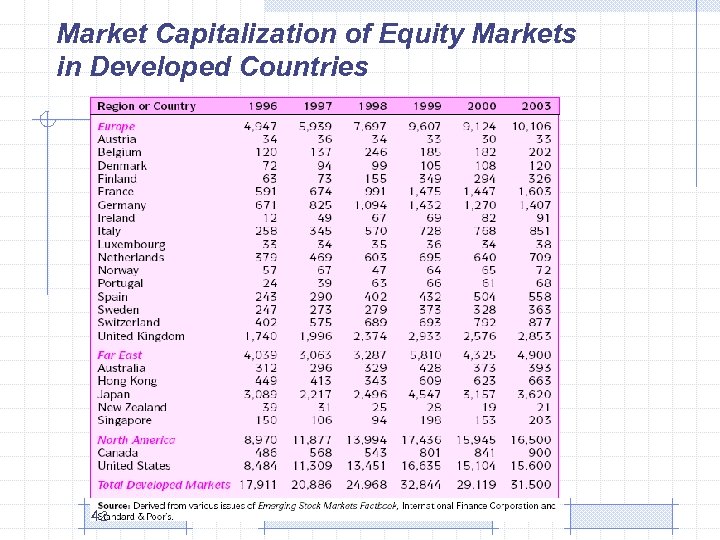 Market Capitalization of Equity Markets in Developed Countries 42
 Liquidity and Concentration • The equity markets of the developed world tend to be much more liquid than emerging markets. – Liquidity refers to how quickly an asset can be ____ without a major price concession. • Emerging Markets tend to be much more concentrated than ____ markets. – Concentrated in relatively few companies. 43
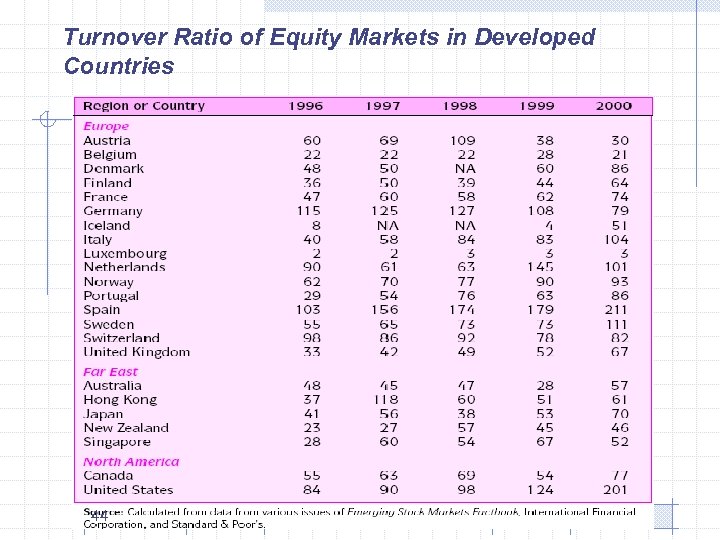 Turnover Ratio of Equity Markets in Developed Countries 44
 Market Structure, Trading Practices, and Costs • Primary Markets – Shares offered for ____ directly from the issuing company. • Secondary Markets – Provide market participants with marketability and share ____. 45
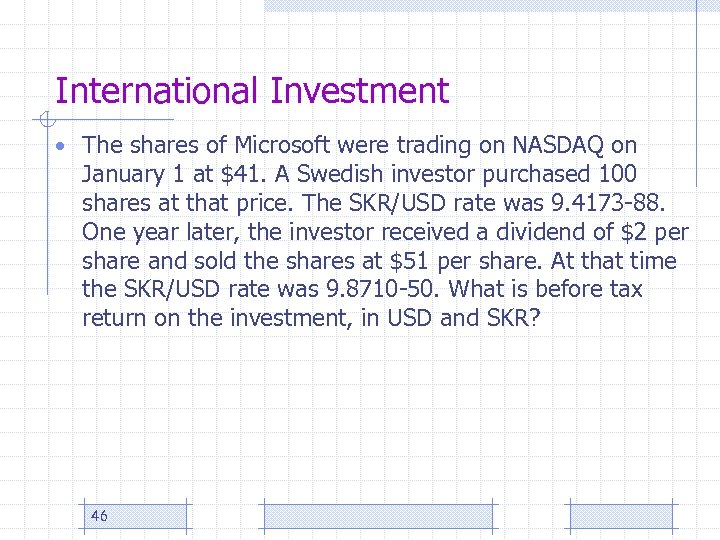 International Investment • The shares of Microsoft were trading on NASDAQ on January 1 at $41. A Swedish investor purchased 100 shares at that price. The SKR/USD rate was 9. 4173 -88. One year later, the investor received a dividend of $2 per share and sold the shares at $51 per share. At that time the SKR/USD rate was 9. 8710 -50. What is before tax return on the investment, in USD and SKR? 46
 International Investment • SKR return = Buy $ (ask SKR/$ rate), invest in MSFT, receive $ dividend and sale proceeds, convert $ back into SKR (bid SKR/$ rate) 47
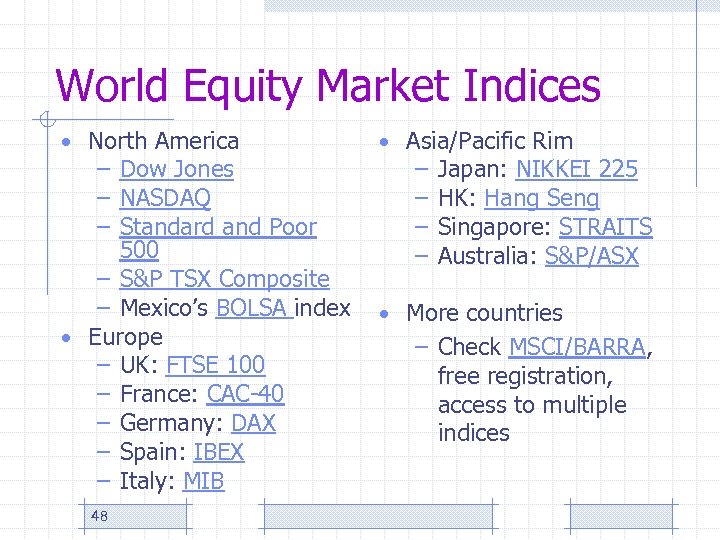 World Equity Market Indices • North America – Dow Jones – NASDAQ – Standard and Poor 500 – S&P TSX Composite – Mexico’s BOLSA index • Europe – UK: FTSE 100 – France: CAC-40 – Germany: DAX – Spain: IBEX – Italy: MIB 48 • Asia/Pacific Rim – – Japan: NIKKEI 225 HK: Hang Seng Singapore: STRAITS Australia: S&P/ASX • More countries – Check MSCI/BARRA, free registration, access to multiple indices
 World Equity Benchmark Shares • Exchange-traded fund (ETF) –mutual fund that issues shares that are ____ traded on stock exchange • World Equity Benchmark Shares (WEBS) – ETF replicating returns on MSCI international indices, trades on AMEX, look up i. Shares. – Country-specific baskets of stocks designed to replicate the country indexes of 14 countries. – ____ are subject to U. S. SEC and IRS diversification requirements. – Low cost, convenient way for investors to hold diversified investments in several different ____. 49
 World Equity Benchmark Shares • An ETF indexed on NIKKEI 225 is listed on NYSE. Its NAV is computed based on closing prices in Tokyo. When it is 9 am in NY, it is 11 pm in Tokyo, on the same day. The NAV based on Tokyo closing price is 10, 000, the 9 am exchange rate is JPY/USD=100. When NYSE is closing at 4 pm, Tokyo is still closed, and JPY/USD=99. • What is the $ value of the ETF at 9 am in NY? • What is the $ value of the ETF at 4 pm in NY? 50
 International Equity Trading • Magnitude – During the 1980’s world ____ markets began a trend toward greater global ____. – Diversification, reduced ____, improvements in computer and communications technology, increased demand from MNCs for global issuance. • Cross-Listing – Firm having its equity shares listed on one or more foreign ____. – The number of firms doing this has exploded in recent years. 51
 International Equity Trading • American depositary receipts (ADRs) – US bank either has a branch or hires a custodian (local bank) in a foreign country – Foreign country shares are ____ and left in vault in foreign country – ADRs are receipts that represent shares in foreign vault, traded in the USA – Idea: ____ transaction costs related to buying/selling shares traded in a foreign country • Global Registered Shares (GRS) – Same shares trading on exchanges in different countries 52
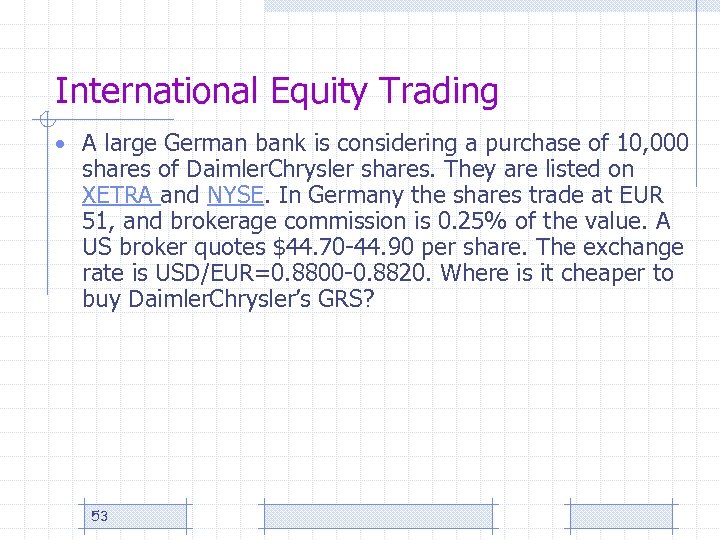 International Equity Trading • A large German bank is considering a purchase of 10, 000 shares of Daimler. Chrysler shares. They are listed on XETRA and NYSE. In Germany the shares trade at EUR 51, and brokerage commission is 0. 25% of the value. A US broker quotes $44. 70 -44. 90 per share. The exchange rate is USD/EUR=0. 8800 -0. 8820. Where is it cheaper to buy Daimler. Chrysler’s GRS? 53