


 Скачать презентацию International Finance Lecture 3 Page 1 Foundations
a370adff140c6051f38dbdb2d08e3443.ppt
- Количество слайдов: 51
 International Finance Lecture 3 Page 1
 Foundations of International Financial Management • Globalization and the Multinational Firm • International Monetary System • Balance of Payments • The Market for Foreign Exchange • International Parity Relationships 2
 International Parity Relations • Interest rate _____ • Purchasing _____ parity • _____ effect • Using the parity relations in forecasting exchange rates 3
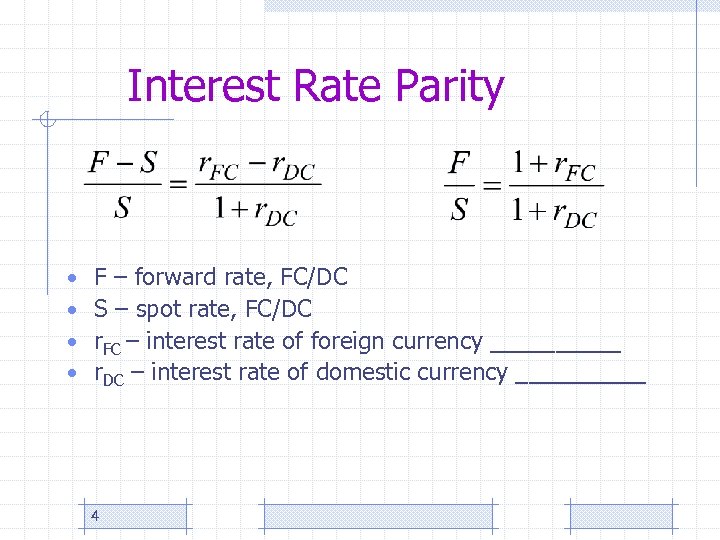 Interest Rate Parity • • F – forward rate, FC/DC S – spot rate, FC/DC r. FC – interest rate of foreign currency _____ r. DC – interest rate of domestic currency _____ 4
 Interest Rate Parity • You observe that spot EUR/USD=1. 05, one-year interest rates are: r. USD=1. 76%, r. EUR=3. 39%, what is the 1 -year forward EUR/USD rate? 5
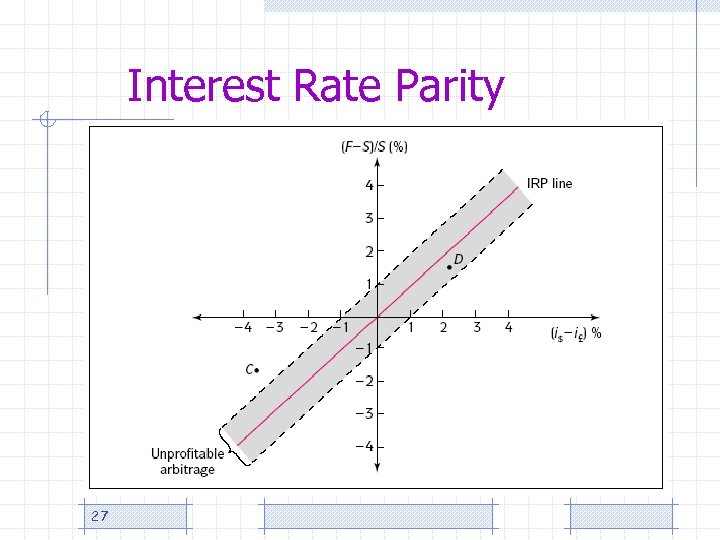
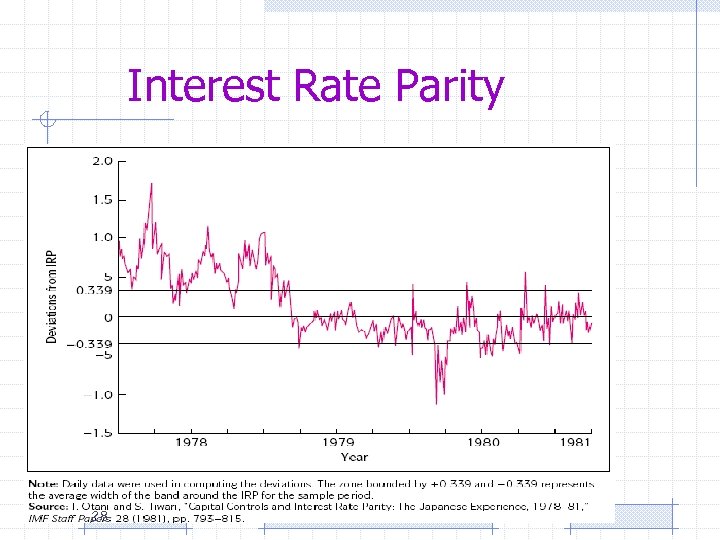
 Interest Rate Parity • IRP is an _____ condition. • If IRP did not hold, then it would be possible for a trader to make _____ amounts of money without risk exploiting the arbitrage opportunity. • Since we don’t typically observe persistent arbitrage conditions, we can safely assume that IRP holds. • If it does not hold for long time, it is due to _____ costs and government-imposed capital ____ that make arbitrage impossible 6
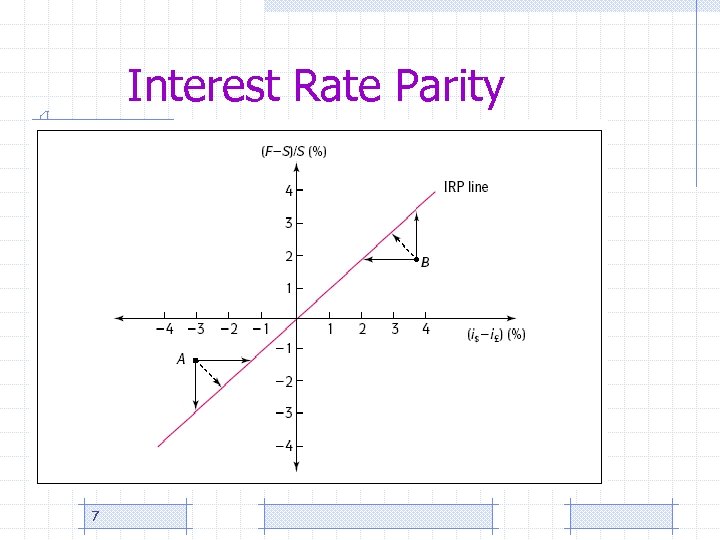 Interest Rate Parity 7
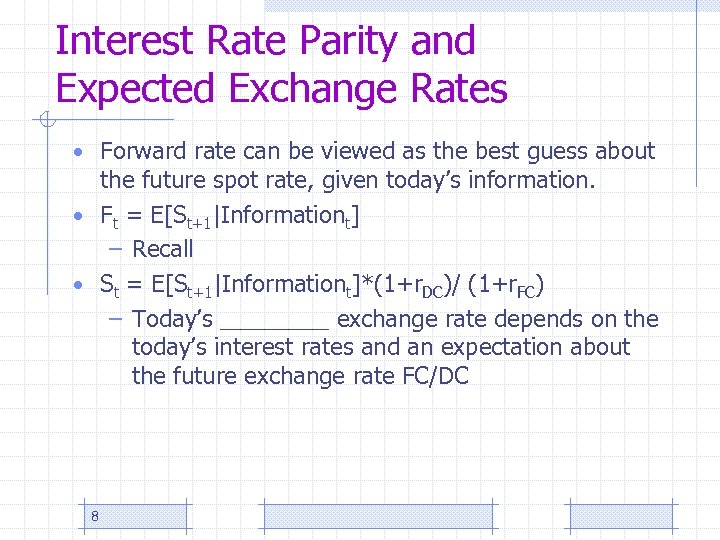 Interest Rate Parity and Expected Exchange Rates • Forward rate can be viewed as the best guess about the future spot rate, given today’s information. • Ft = E[St+1|Informationt] – Recall • St = E[St+1|Informationt]*(1+r. DC)/ (1+r. FC) – Today’s _____ exchange rate depends on the today’s interest rates and an expectation about the future exchange rate FC/DC 8
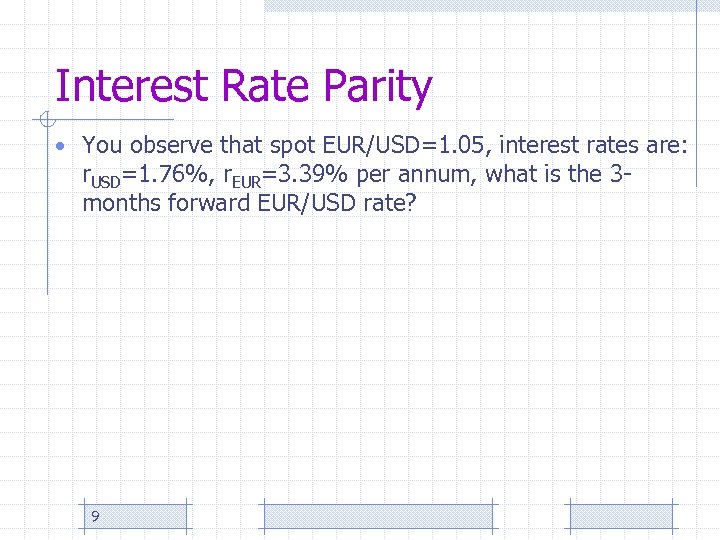 Interest Rate Parity • You observe that spot EUR/USD=1. 05, interest rates are: r. USD=1. 76%, r. EUR=3. 39% per annum, what is the 3 months forward EUR/USD rate? 9
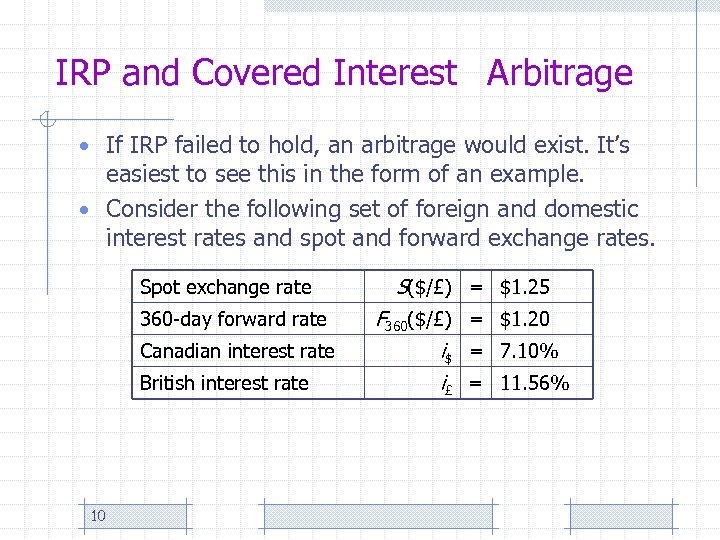 IRP and Covered Interest Arbitrage • If IRP failed to hold, an arbitrage would exist. It’s easiest to see this in the form of an example. • Consider the following set of foreign and domestic interest rates and spot and forward exchange rates. Spot exchange rate 360 -day forward rate S($/£) = $1. 25 F 360($/£) = $1. 20 Canadian interest rate British interest rate 10 i$ = 7. 10% i£ = 11. 56%
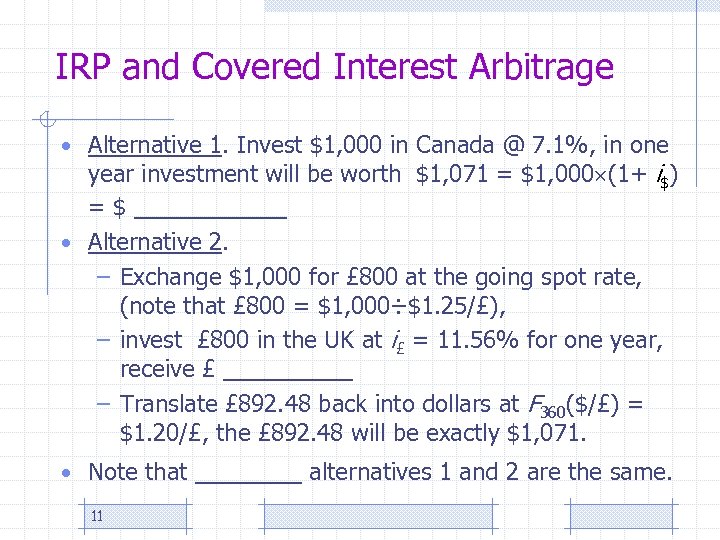 IRP and Covered Interest Arbitrage • Alternative 1. Invest $1, 000 in Canada @ 7. 1%, in one year investment will be worth $1, 071 = $1, 000 (1+ i$) = $ _____ • Alternative 2. – Exchange $1, 000 for £ 800 at the going spot rate, (note that £ 800 = $1, 000÷$1. 25/£), – invest £ 800 in the UK at i£ = 11. 56% for one year, receive £ _____ – Translate £ 892. 48 back into dollars at F 360($/£) = $1. 20/£, the £ 892. 48 will be exactly $1, 071. • Note that 11 _______ alternatives 1 and 2 are the same.
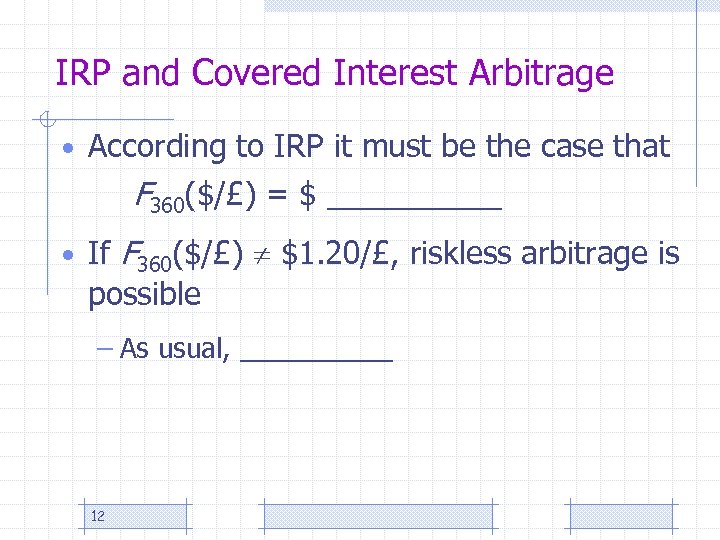 IRP and Covered Interest Arbitrage • According to IRP it must be the case that F 360($/£) = $ _____ • If F 360($/£) $1. 20/£, riskless arbitrage is possible – As usual, _____ 12
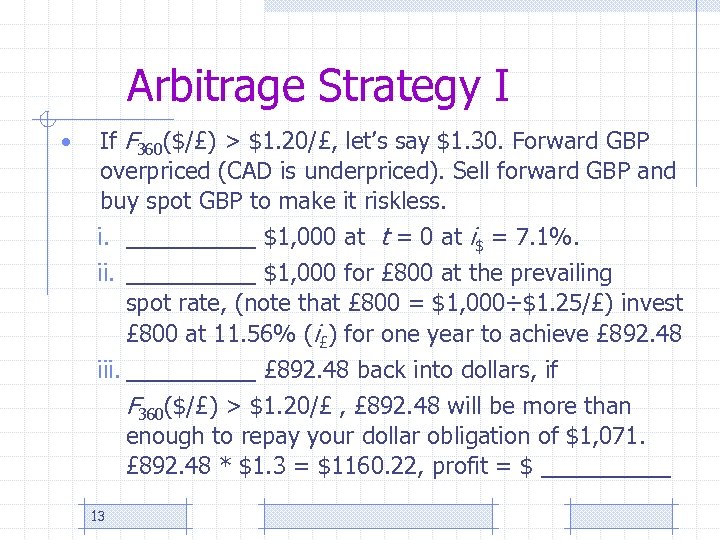 Arbitrage Strategy I • If F 360($/£) > $1. 20/£, let’s say $1. 30. Forward GBP overpriced (CAD is underpriced). Sell forward GBP and buy spot GBP to make it riskless. i. _____ $1, 000 at t = 0 at i$ = 7. 1%. ii. _____ $1, 000 for £ 800 at the prevailing spot rate, (note that £ 800 = $1, 000÷$1. 25/£) invest £ 800 at 11. 56% (i£) for one year to achieve £ 892. 48 iii. _____ £ 892. 48 back into dollars, if F 360($/£) > $1. 20/£ , £ 892. 48 will be more than enough to repay your dollar obligation of $1, 071. £ 892. 48 * $1. 3 = $1160. 22, profit = $ _____ 13
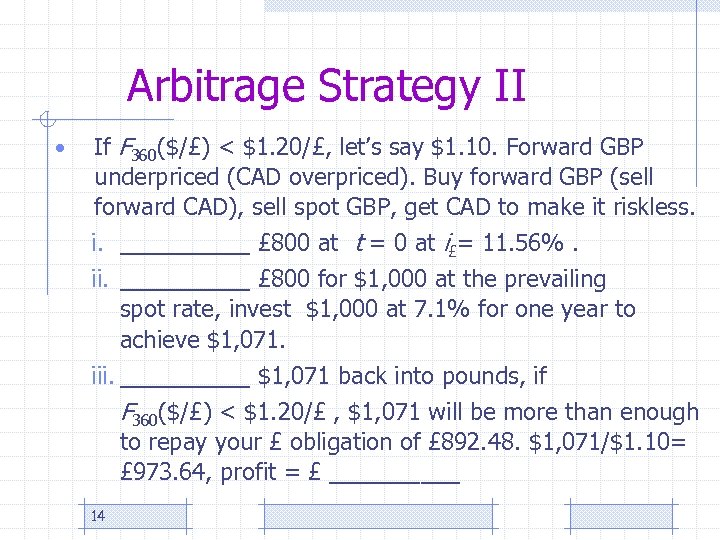 Arbitrage Strategy II • If F 360($/£) < $1. 20/£, let’s say $1. 10. Forward GBP underpriced (CAD overpriced). Buy forward GBP (sell forward CAD), sell spot GBP, get CAD to make it riskless. i. _____ £ 800 at t = 0 at i£= 11. 56%. ii. _____ £ 800 for $1, 000 at the prevailing spot rate, invest $1, 000 at 7. 1% for one year to achieve $1, 071. iii. _____ $1, 071 back into pounds, if F 360($/£) < $1. 20/£ , $1, 071 will be more than enough to repay your £ obligation of £ 892. 48. $1, 071/$1. 10= £ 973. 64, profit = £ _____ 14
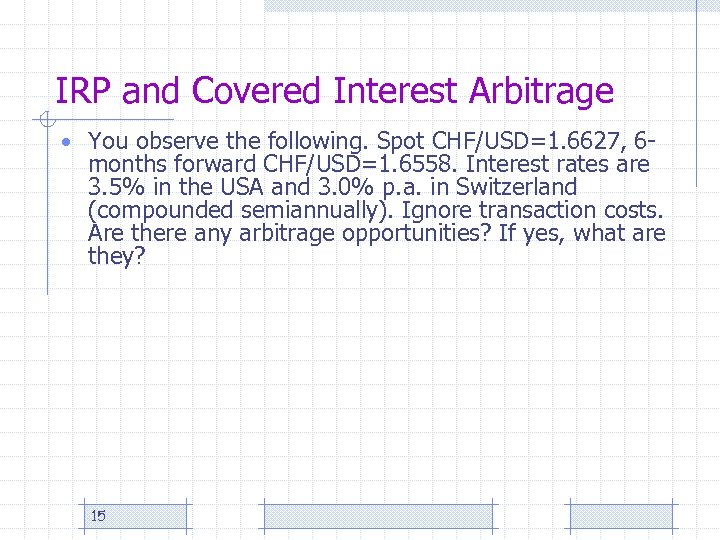 IRP and Covered Interest Arbitrage • You observe the following. Spot CHF/USD=1. 6627, 6 - months forward CHF/USD=1. 6558. Interest rates are 3. 5% in the USA and 3. 0% p. a. in Switzerland (compounded semiannually). Ignore transaction costs. Are there any arbitrage opportunities? If yes, what are they? 15
 IRP and Covered Interest Arbitrage 16
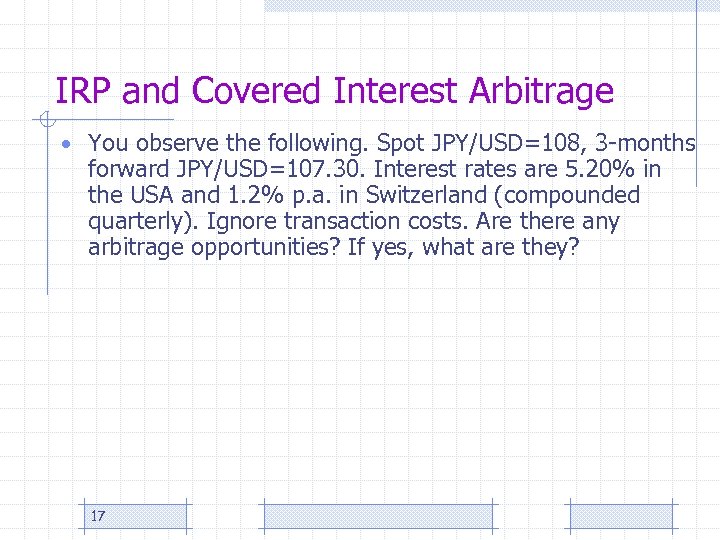 IRP and Covered Interest Arbitrage • You observe the following. Spot JPY/USD=108, 3 -months forward JPY/USD=107. 30. Interest rates are 5. 20% in the USA and 1. 2% p. a. in Switzerland (compounded quarterly). Ignore transaction costs. Are there any arbitrage opportunities? If yes, what are they? 17
 IRP and Covered Interest Arbitrage 18
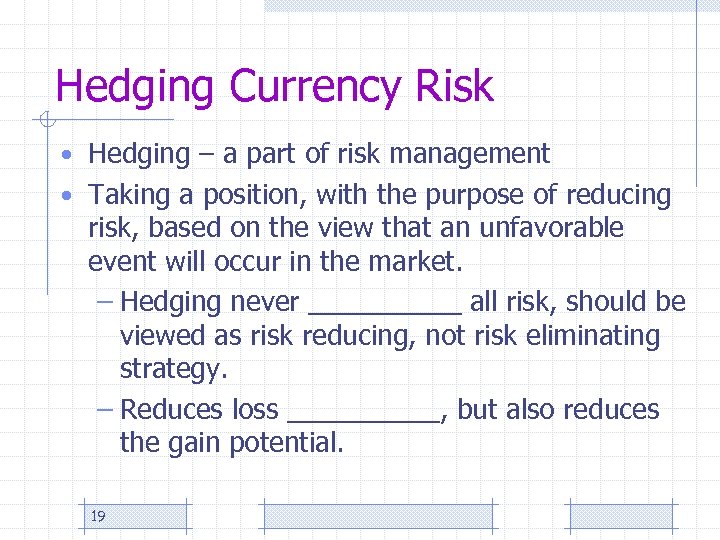 Hedging Currency Risk • Hedging – a part of risk management • Taking a position, with the purpose of reducing risk, based on the view that an unfavorable event will occur in the market. – Hedging never _____ all risk, should be viewed as risk reducing, not risk eliminating strategy. – Reduces loss _____, but also reduces the gain potential. 19
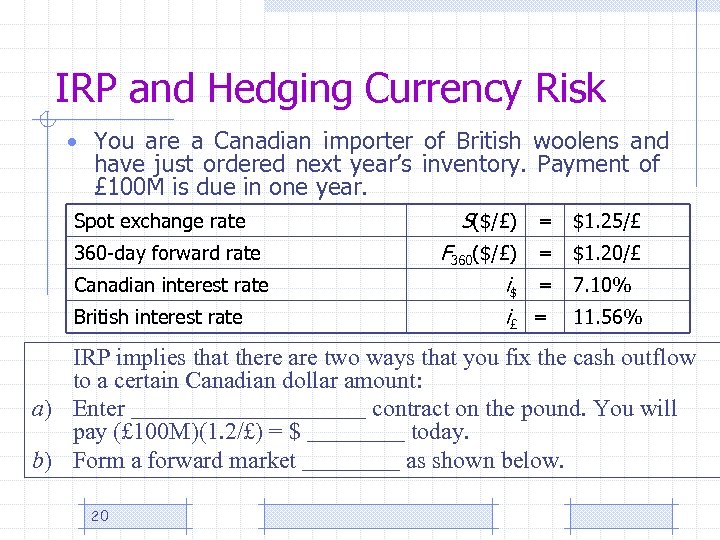 IRP and Hedging Currency Risk • You are a Canadian importer of British woolens and have just ordered next year’s inventory. Payment of £ 100 M is due in one year. Spot exchange rate 360 -day forward rate S($/£) = $1. 25/£ F 360($/£) = $1. 20/£ Canadian interest rate i$ = 7. 10% British interest rate i£ = 11. 56% IRP implies that there are two ways that you fix the cash outflow to a certain Canadian dollar amount: a) Enter ____________ contract on the pound. You will pay (£ 100 M)(1. 2/£) = $ _____ today. b) Form a forward market _____ as shown below. 20
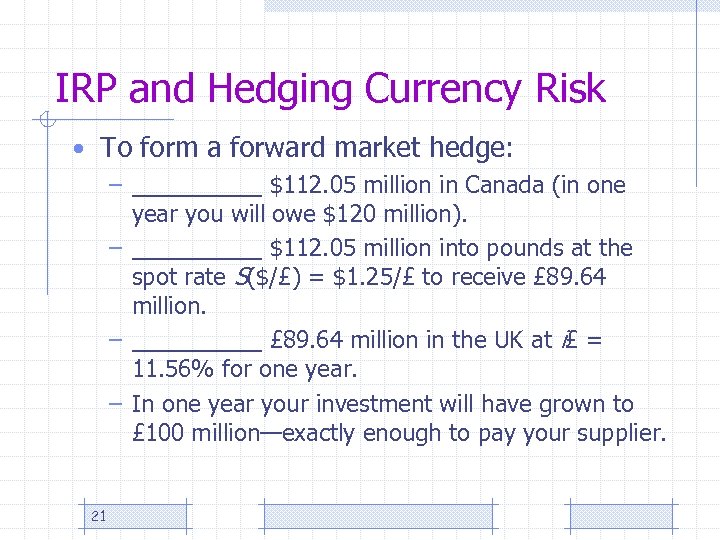 IRP and Hedging Currency Risk • To form a forward market hedge: – _____ $112. 05 million in Canada (in one year you will owe $120 million). – _____ $112. 05 million into pounds at the spot rate S($/£) = $1. 25/£ to receive £ 89. 64 million. – _____ £ 89. 64 million in the UK at i£ = 11. 56% for one year. – In one year your investment will have grown to £ 100 million—exactly enough to pay your supplier. 21
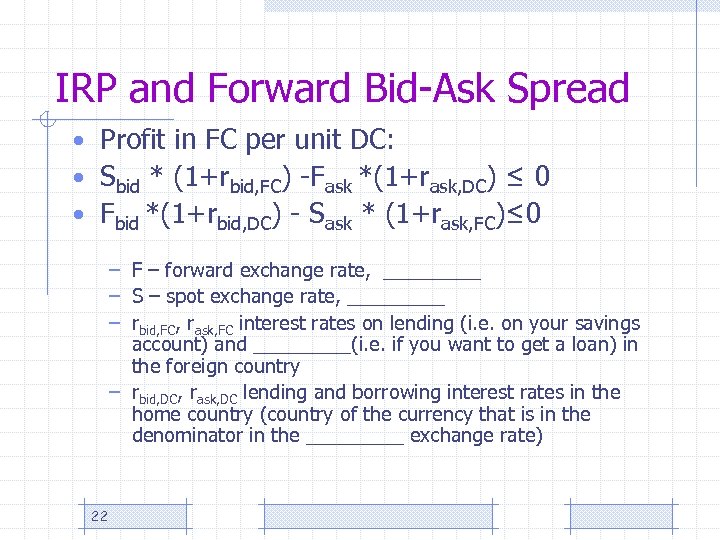 IRP and Forward Bid-Ask Spread • Profit in FC per unit DC: • Sbid * (1+rbid, FC) -Fask *(1+rask, DC) ≤ 0 • Fbid *(1+rbid, DC) - Sask * (1+rask, FC)≤ 0 – F – forward exchange rate, _____ – S – spot exchange rate, _____ – rbid, FC, rask, FC interest rates on lending (i. e. on your savings account) and _____(i. e. if you want to get a loan) in the foreign country – rbid, DC, rask, DC lending and borrowing interest rates in the home country (country of the currency that is in the denominator in the _____ exchange rate) 22
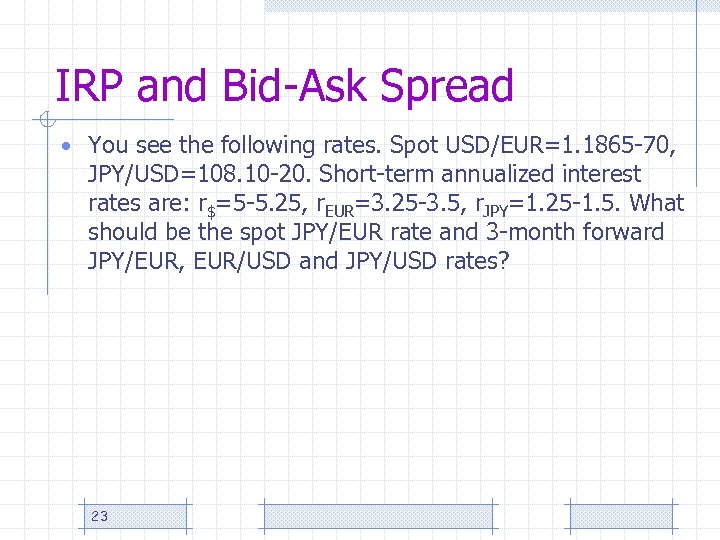 IRP and Bid-Ask Spread • You see the following rates. Spot USD/EUR=1. 1865 -70, JPY/USD=108. 10 -20. Short-term annualized interest rates are: r$=5 -5. 25, r. EUR=3. 25 -3. 5, r. JPY=1. 25 -1. 5. What should be the spot JPY/EUR rate and 3 -month forward JPY/EUR, EUR/USD and JPY/USD rates? 23
 IRP and Bid-Ask Spread • Solution (2) 3 -month forward JPY/EUR rate 24
 IRP and Bid-Ask Spread • Solution (3) 3 -month forward EUR/USD rate 25
 IRP and Bid-Ask Spread • Solution (4) 3 -month forward JPY/USD rate 26
 Interest Rate Parity 27
 Interest Rate Parity 28
 Purchasing Power Parity • The exchange rate between two currencies should equal the ratio of the countries’ price levels: • For example, if an ounce of gold costs $300 in the U. S. and £ 150 in the U. K. , then the price of one pound in terms of dollars should be: 29
 Purchasing Power Parity • If the law of one price were true for all goods and services, the purchasing power parity exchange rate can be found from any set of prices. • This is _____ purchasing power parity. • Hamburger standard compares Big Mac prices with the exchange rates to determine whether or not overvaluation or undervaluation exist. • Index introduced by The Economist, shortly after the Big Mac they introduced the Tall Latte index. Subscription required. They offer free online subscription, try and see the articles. 30
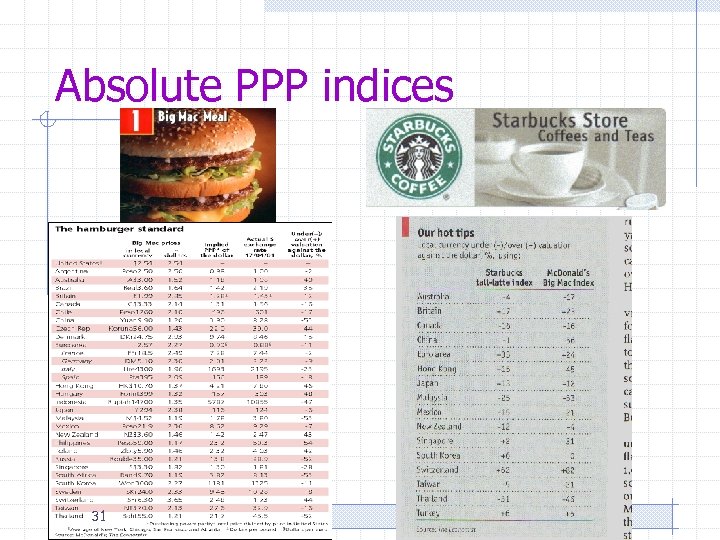 Absolute PPP indices 31
 Purchasing Power Parity • Absolute PPP never works for most goods/commodities – • Less Strict version uses a basket of goods instead of individual items. • Relative Purchasing Power Parity: – If the spot exchange rate between two countries starts in _____, • any change in differential rate of inflation between them tends to be offset over in the long run by an equal but opposite change in the spot exchange rate. 32
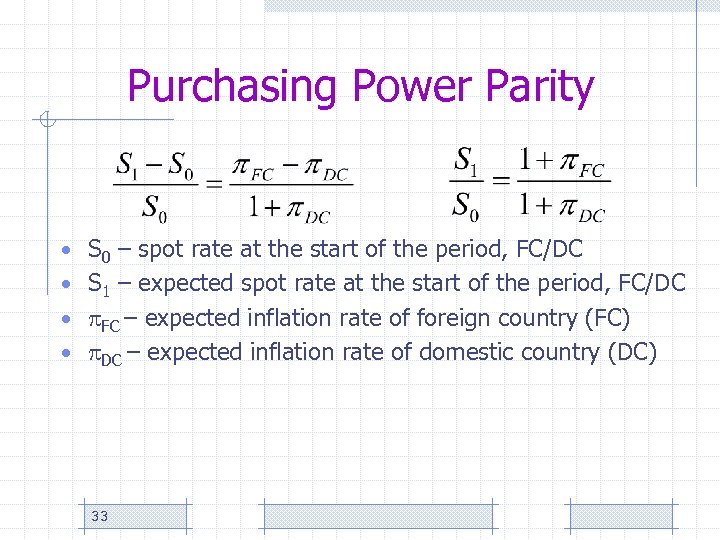 Purchasing Power Parity • S 0 – spot rate at the start of the period, FC/DC • S 1 – expected spot rate at the start of the period, FC/DC • FC – expected inflation rate of foreign country (FC) • DC – expected inflation rate of domestic country (DC) 33
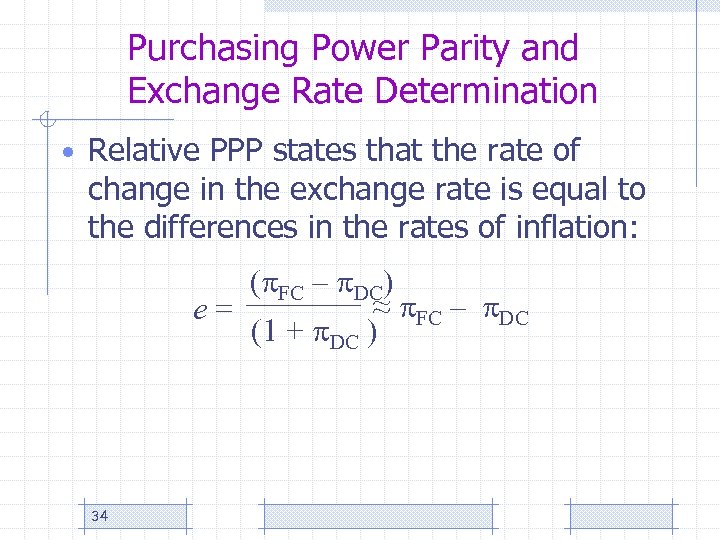 Purchasing Power Parity and Exchange Rate Determination • Relative PPP states that the rate of change in the exchange rate is equal to the differences in the rates of inflation: ( FC – DC) ≈ FC – DC e= (1 + DC ) 34
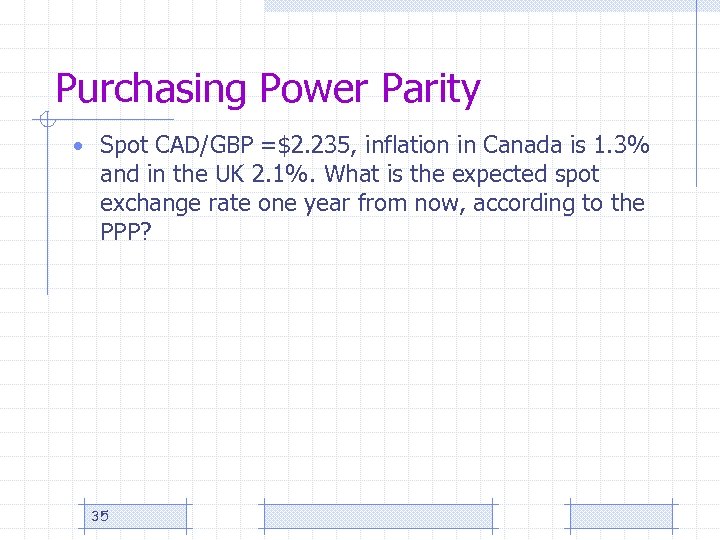 Purchasing Power Parity • Spot CAD/GBP =$2. 235, inflation in Canada is 1. 3% and in the UK 2. 1%. What is the expected spot exchange rate one year from now, according to the PPP? 35
 Evidence on PPP • PPP probably _____ precisely in the real world for a variety of reasons. – Haircuts cost 10 times as much in the developed world as in the developing world. – Film, on the other hand, is a highly _____ commodity that is actively traded across borders. – Shipping costs, as well as tariffs and quotas can lead to _____ from PPP. • PPP-determined exchange rates still provide a valuable benchmark. 36
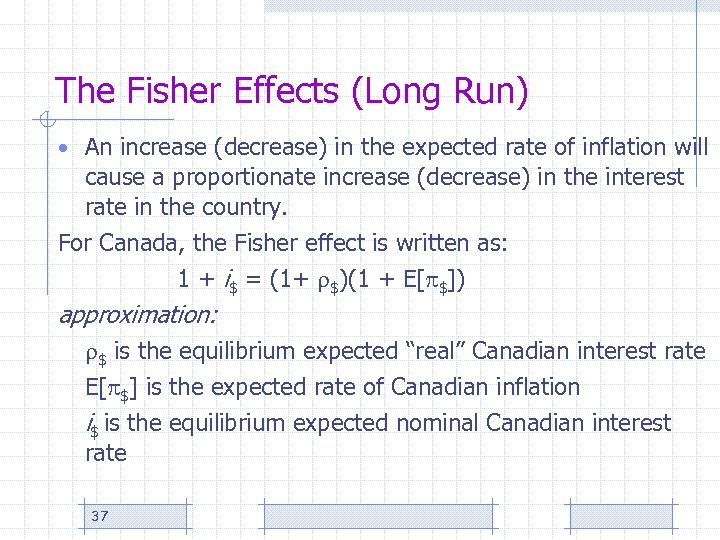 The Fisher Effects (Long Run) • An increase (decrease) in the expected rate of inflation will cause a proportionate increase (decrease) in the interest rate in the country. For Canada, the Fisher effect is written as: 1 + i$ = (1+ $)(1 + E[ $]) approximation: $ is the equilibrium expected “real” Canadian interest rate E[ $] is the expected rate of Canadian inflation i$ is the equilibrium expected nominal Canadian interest rate 37
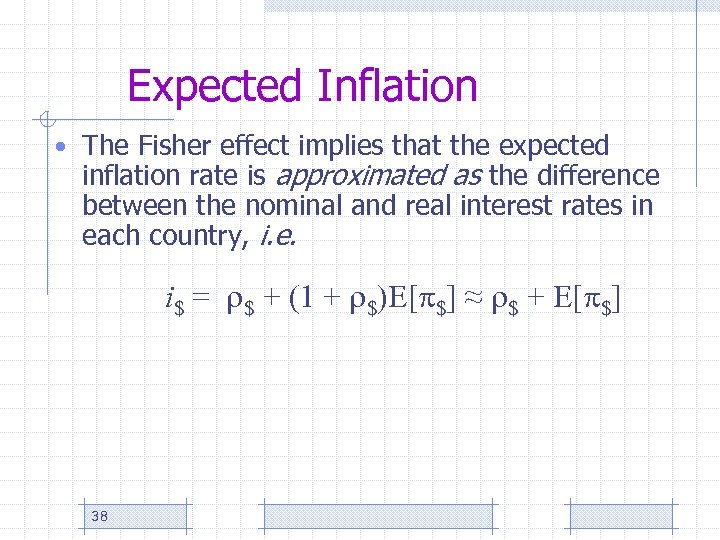 Expected Inflation • The Fisher effect implies that the expected inflation rate is approximated as the difference between the nominal and real interest rates in each country, i. e. i$ = $ + (1 + $)E[ $] ≈ $ + E[ $] 38
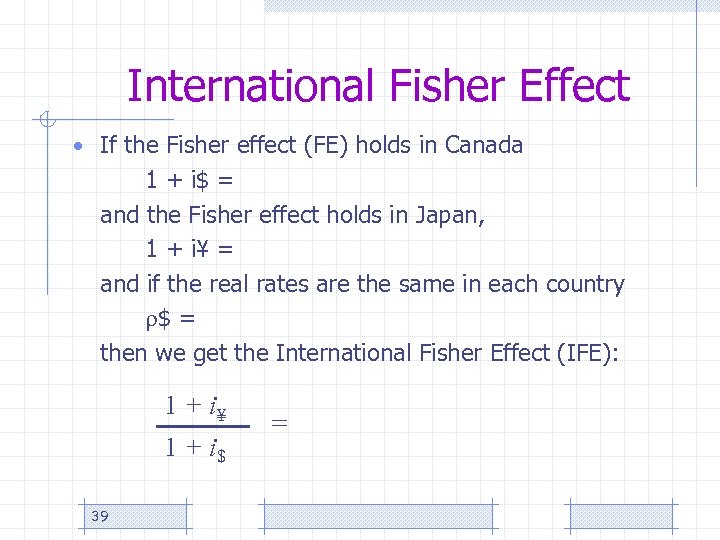 International Fisher Effect • If the Fisher effect (FE) holds in Canada 1 + i$ = and the Fisher effect holds in Japan, 1 + i¥ = and if the real rates are the same in each country $ = then we get the International Fisher Effect (IFE): 1 + i¥ 1 + i$ 39 =
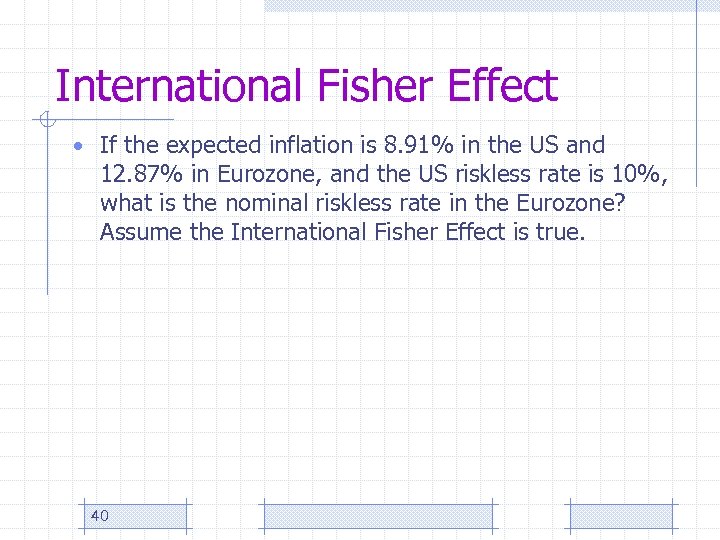 International Fisher Effect • If the expected inflation is 8. 91% in the US and 12. 87% in Eurozone, and the US riskless rate is 10%, what is the nominal riskless rate in the Eurozone? Assume the International Fisher Effect is true. 40
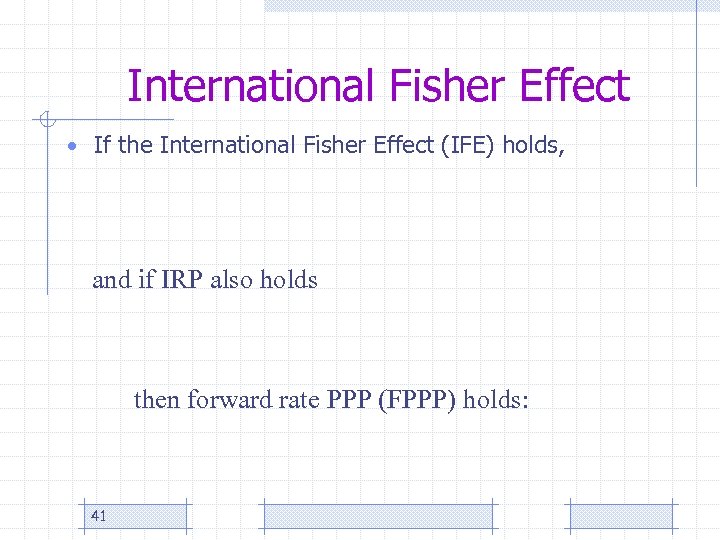 International Fisher Effect • If the International Fisher Effect (IFE) holds, and if IRP also holds then forward rate PPP (FPPP) holds: 41
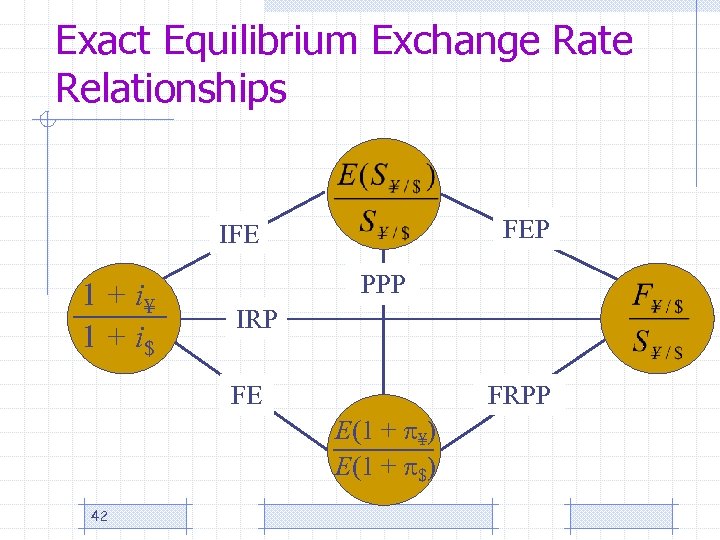 Exact Equilibrium Exchange Rate Relationships FEP IFE 1 + i¥ 1 + i$ PPP IRP FE FRPP E(1 + ¥) E(1 + $) 42
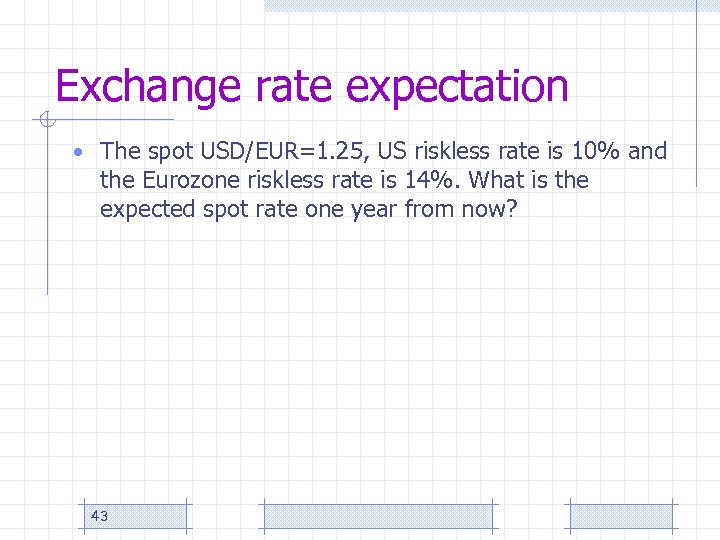 Exchange rate expectation • The spot USD/EUR=1. 25, US riskless rate is 10% and the Eurozone riskless rate is 14%. What is the expected spot rate one year from now? 43
 Forecasting Exchange Rates • Efficient __________ Approach • Technical Approach • Performance of the Forecasters 44
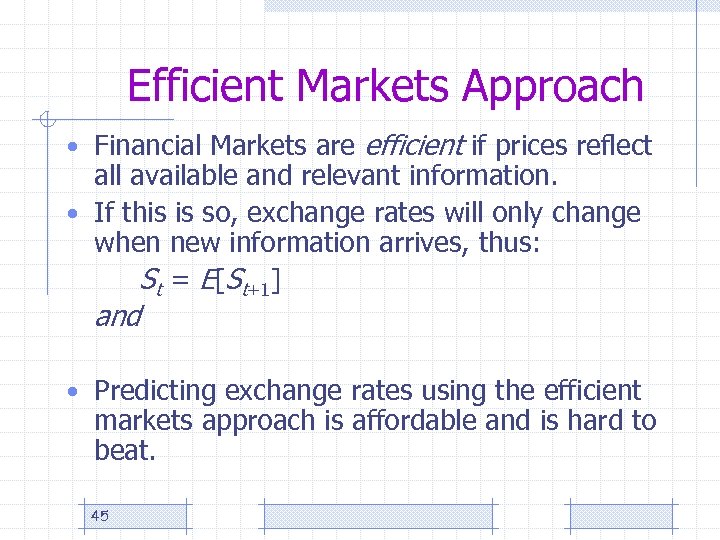 Efficient Markets Approach • Financial Markets are efficient if prices reflect all available and relevant information. • If this is so, exchange rates will only change when new information arrives, thus: St = E[St+1] and • Predicting exchange rates using the efficient markets approach is affordable and is hard to beat. 45
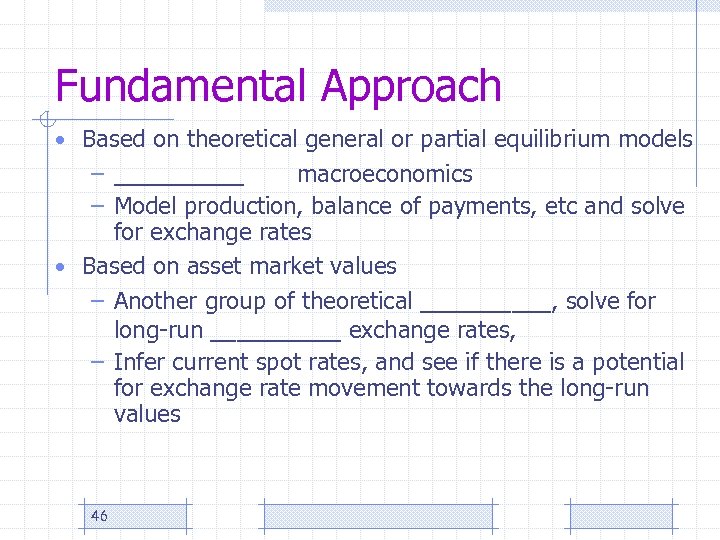 Fundamental Approach • Based on theoretical general or partial equilibrium models – _____ macroeconomics – Model production, balance of payments, etc and solve for exchange rates • Based on asset market values – Another group of theoretical _____, solve for long-run _____ exchange rates, – Infer current spot rates, and see if there is a potential for exchange rate movement towards the long-run values 46
 Technical Approach • Infer future movements of the exchange rates based on historical rates • “Technical analysis” – Assumes markets are _____ 47
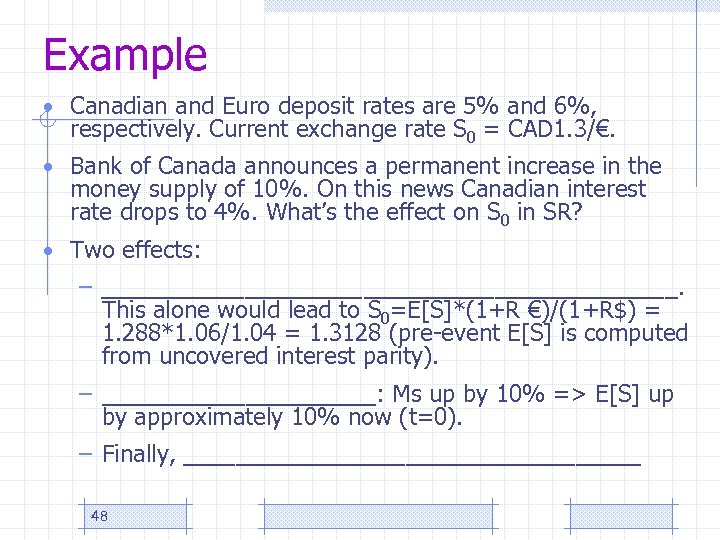 Example • Canadian and Euro deposit rates are 5% and 6%, respectively. Current exchange rate S 0 = CAD 1. 3/€. • Bank of Canada announces a permanent increase in the money supply of 10%. On this news Canadian interest rate drops to 4%. What’s the effect on S 0 in SR? • Two effects: – ______________________. This alone would lead to S 0=E[S]*(1+R €)/(1+R$) = 1. 288*1. 06/1. 04 = 1. 3128 (pre-event E[S] is computed from uncovered interest parity). – ___________: Ms up by 10% => E[S] up by approximately 10% now (t=0). – Finally, __________________ 48
 Example Cont’d • What is S 0 in the LR? – P _______ until R is _____ – S 0 = _____________ 49
 Exchange Rate Overshooting • The exchange rate is said to _____ when its immediate response to a change is greater than its long run response. – We assume that changes in the money supply have immediate effects on interest rates and exchange rates. – We assume that people change their expectations about inflation immediately after a change in the money supply. • Overshooting helps explain why exchange rates are so ______. • Overshooting occurs in the model because prices ________, but expectations about prices ______. 50
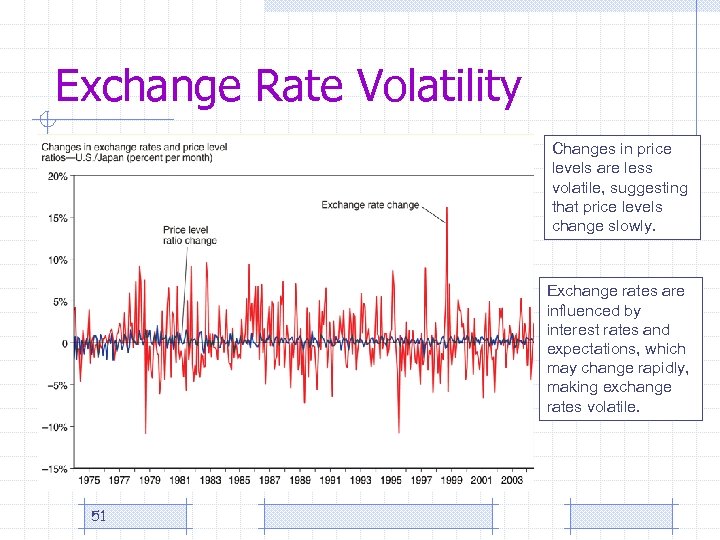 Exchange Rate Volatility Changes in price levels are less volatile, suggesting that price levels change slowly. Exchange rates are influenced by interest rates and expectations, which may change rapidly, making exchange rates volatile. 51