


 Скачать презентацию International Federal and State Perspectives on Greenhouse Gas
610424bec5f7b4d33278376833ba4af8.ppt
- Количество слайдов: 33
 International, Federal and State Perspectives on Greenhouse Gas Reduction Schemes Tom Werkema Arkema Inc August 9, 2007
 Climate Change International
 Kyoto Protocol Ü US fought for, and achieved, “market mechanisms” within KP Ü Carbon emissions trading allowed Joint Initiative – developed & former East Bloc countries only Clean Development Mechanism – between developing & developed countries Ü KP mandates emissions targets; does not establish “how”
 Kyoto Protocol Ü What is Emissions Trading? CAP on total emissions creates value Each entity reduces below CAP or buys credits from someone who reduce below CAP Market is formed when emissions are bought and sold Ü Markets can be w/i one country or between countries. KP controls between countries
 Kyoto Protocol Ü Created rules for CDM Executive Board paid by portion of emissions trading proceedings Trade must be approved by Board Ü Adaptation Fund created in 2006 Will contain a portion of emissions trading proceeds
 Kyoto Protocol Meeting 2006 Nairobi Ü KP establishes no 2 nd Commitment Period Ü Analytical work start in 2007 Mitigation potential analysis & emissions reduction range Analysis of possible means to achieve mitigation objectives Ü AWG will meet in Vienna, Austria – in two weeks Ü Will launch negotiations in 2008 Post 2012 commitments Developed countries only –China recently noted need to reduce
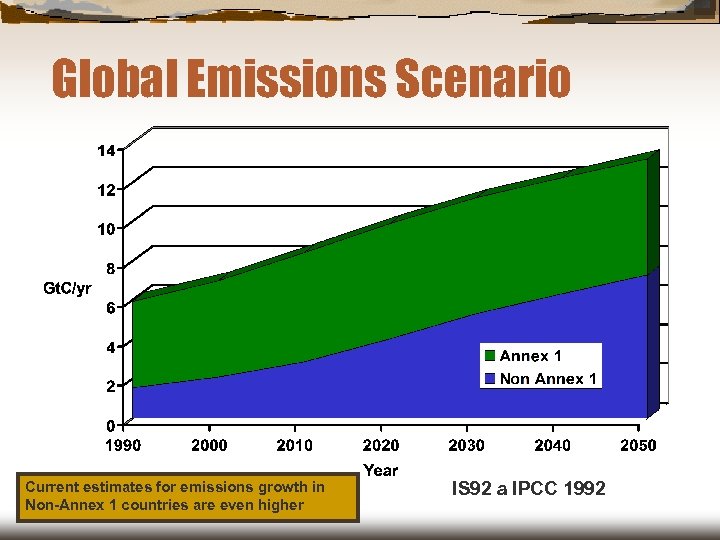 Global Emissions Scenario Current estimates for emissions growth in Non-Annex 1 countries are even higher IS 92 a IPCC 1992
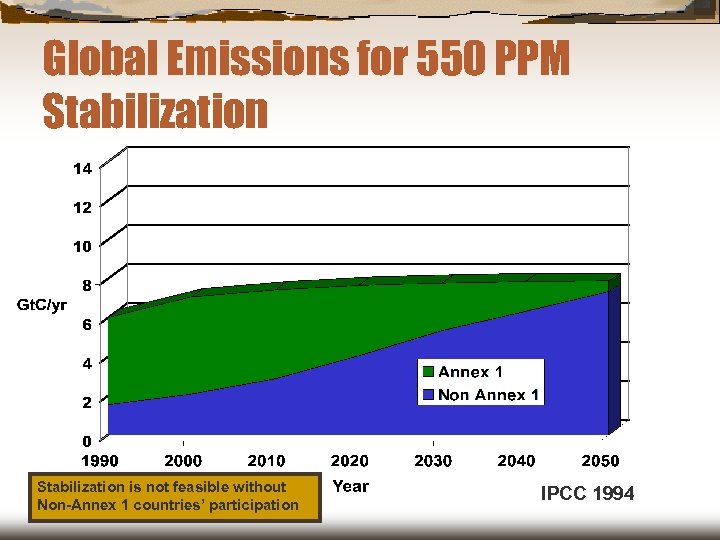 Global Emissions for 550 PPM Stabilization is not feasible without Non-Annex 1 countries’ participation IPCC 1994
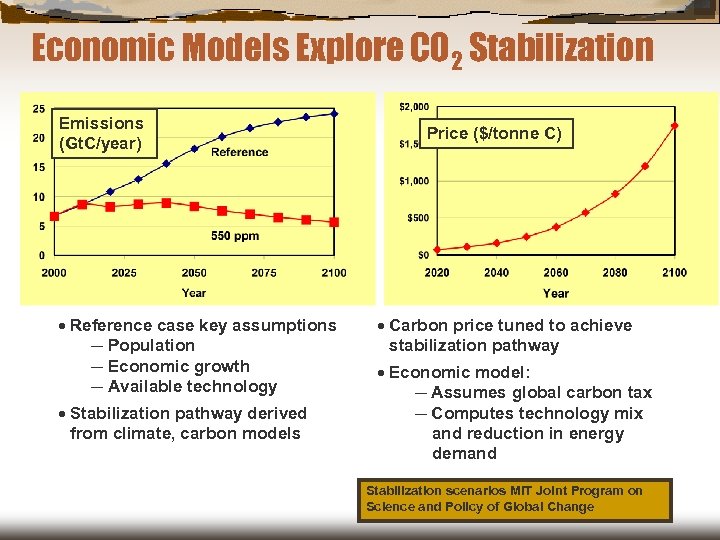 Economic Models Explore CO 2 Stabilization Emissions (Gt. C/year) · Reference case key assumptions ─ Population ─ Economic growth ─ Available technology · Stabilization pathway derived from climate, carbon models Price ($/tonne C) · Carbon price tuned to achieve stabilization pathway · Economic model: ─ Assumes global carbon tax ─ Computes technology mix and reduction in energy demand Stabilization scenarios MIT Joint Program on Science and Policy of Global Change
 Other Climate Change Ü Achim Steiner, UNFCCC Ex. Sec. requested emergency meeting Security Council on climate Mood agreed – targeted September Ü IPCC – released first 3 Working Group reports “…globally average net effect of human activities since 1750 has been one of warming…” 90% probability that climate change is manmade Massive populations at risk, plan/animal species elimination Ü Steiner noted MP contribution to KP goals – MP 8 GT, KP 2 GT, substitute HCFCs/HFCs
 Other Climate Change Ü G 8 Climate Focus Aim to cut ghgs 50% by 2050 Incorporate India/China emissions exceeded US in 2006 Ü 16 largest cities to reduce energy consumption in existing buildings –Clinton Climate Initiative Houston, Chicago, NY ASHRAE – Honeywell, Trane, Siemens, Johnson Controls conduct audits
 Other Climate Change Ü IEA reported total energy demand growth 57% by 2030. Coal fastest increasing energy source Renewables will be 8% of total Ü Asia/Pacific Partnership Energy focus
 Country Climate Programs
 Country Programs Countries can: Ü Legislate/Regulate Ü Create financial incentives Ü Create markets Ü Combine options above
 EU Climate Programs Ü EU Commission controls reporting/allocation Each Member State must submit plan for approval Commission can reduce allocations Ü Common EU Policies F Gas Regulation Emissions Trading – Trial in 2005 -2007, real in 2008 – Will propose to include aviation Automotive Directive – Tailpipe – MAC
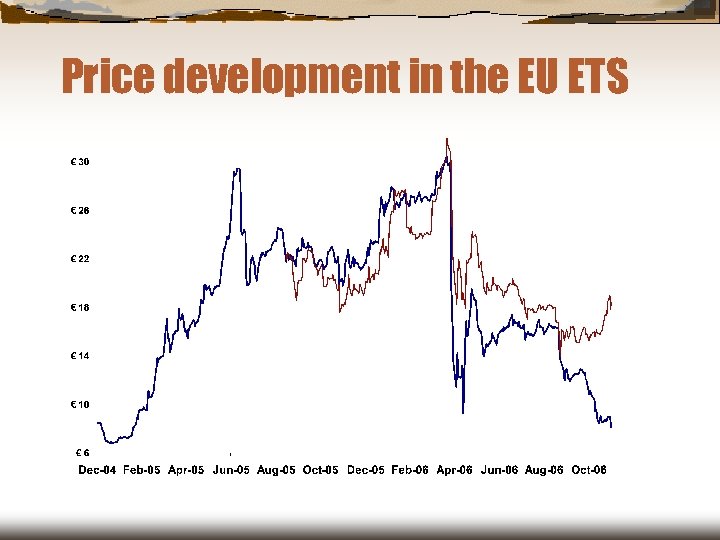 Price development in the EU ETS
 EU F Gas Regulation Ü Recovery/recycle at EOL Ü Trained staff for installation, service, maint. Ü Label stating type, quantity HFCs Ü Economically prevent/check leakage Ü Records for >3 kg/6 kg systems Ü Automatic leak systems >300 kg Ü Commenced July 4
 European Climate Change Ü Denmark’s national HFC plan approved thru ’ 12 Ü Commission proposed legally binding fleet avg. CO 2 emissions 130 gms/km from 2012 (43 mpg) Ü EU Ministers – cut ghg 20% below 1990 by 2020, 30% if “others” join
 Canadian Emission Reductions Ü Near term intensity reduction 18% by 2010 Baseline 2006 Further 2% reductions/year until 2020 Implemented by regulation (not legislation) Does not meet KP targets Ü Natural Resources Canada – working toward building energy labeling system
 Canada – Financial Incentives Ü $2 B over 5 years for implementation $1. 3 B for public transportation $0. 77 B for transit tax credits 5% ethanol fuel by 2010 CAPS and absolute reductions by 2025 – 40 -65% reductions from 2002 baseline by 2050 – Upstream & oil shale produce 1/3 rd Canada’s GHG emissions – 26. 6% growth since 1990
 US Climate Change Ü 3 Major Bills in Senate – same in House Ü Do “Ds” give Bush this legislation? Ü White House ready to discuss Ü Many hearings in Fall – dialog form basis for 2008
 US Congressional Discussions Ü Senate targets Bills include CAP & Trade, reduction Lieberman/Mc. Cain – Economy wide – 2004 levels in 2012, 1990 by 2020 – 20% below 1990 in 2030, 60% below in 2050 Sanders/Boxer – 1990 level in 2020 – 27% below 1990 in 2030, 53% below in 2040, 80% below in 2050 Bingamen/Specter – introduced July 13 – “upstream” cap & trade in 2012 – 76% “free” – 2006 by 2020, 1990 by 2030
 US White House Ü $5 b per year in financial incentives & funded programs Ü “Green” Federal buildings Executive Order Ü EPA/DOE/DOT transportation Executive Order – response to Supreme Court decision April 2 Ü Asia Pacific Partnership
 Climate Change - States
 Climate Change - States Ü RGGI announced by 7 NE States CAP and Trade system CO 2 Begins 2009 w/current level CAP – Frozen until 2015, then gradual reduction 10% reduction by 2019 Focus on utilities Ü Western states Links to RGGI Ü Midwest announced 2/07 states also considering
 Climate Change - States Ü Calif. , NM, Oregon, Wash. develop lowcarbon technologies and renewables Ü NJ introduced Climate Legislation – July 1990 levels by 2020 80% below 2006 in 2050 California emissions reductions
 California Climate Action–AB 32 Ü Reduce GHG emissions to 1990 levels by 12/31/20 Interim reductions 7/1/12, 7/1/16 Ü Multi-sector, market-based program CAP and Trade, or just CAP Ü Establishes multi-Agency Climate Action Board CAB establishes GHG Emissions Reduction Plan – Includes economics and benefits – Multi-sector, market-based compliance – CARB Implementation w Early Action list
 California Climate Action–AB 32 Ü Discrete Early Action Strategies – implement by 1/1/10, 7/1/07 approval Low carbon fuel standard Reduction of MAC refrigerant loss from non -professionals Increased landfill methane capture
 California Climate Action–AB 32 Ü Other discrete early actions (direct regulatory action – 23 measures total – eg. ) HFC Venting control Reduce venting leaks from oil/gas Heavy duty vehicle emissions reduction Cool automobile paints Transport refrigeration, standby electric Truck stop electrification
 California Climate Action–AB 32 Ü Other discrete early actions (direct regulatory action – 23 measures – cont’d) Tire inflation Low GWP MVACs Port electrification Reduction of HFCs in foam Green ships Energy savings from cement mfg
 US Climate Change - Other Ü Following Action in 26 Other States Executive orders Pending Legislation Ü 31 States announced common Registry Ü States implementing/working on reduction plans: Emissions reductions: Arizona, California, Illinois, Iowa, Maine, Minnesota, New Jersey, New York, Oklahoma, Pennsylvania, Rhode Island, Texas, Washington, Wisconsin Energy reductions only: Colorado, New Hampshire
 Business/Industry
 Companies Ü Pepsi. Co, Ikea, Carlsberg, TESCO, Mc. Donalds, Fosters, Coke joined GP in “Refrigerants Naturally” Ü Major corporations urge mandatory reductions in ghg emissions (Climate Action Partnership) Ü PEW Environmental Leadership Council Ü DOE 1605(b) rules Ü ASHRAE 189 P, 90. 1 + 30%, +50%, Performance Std